Page 253 of 348
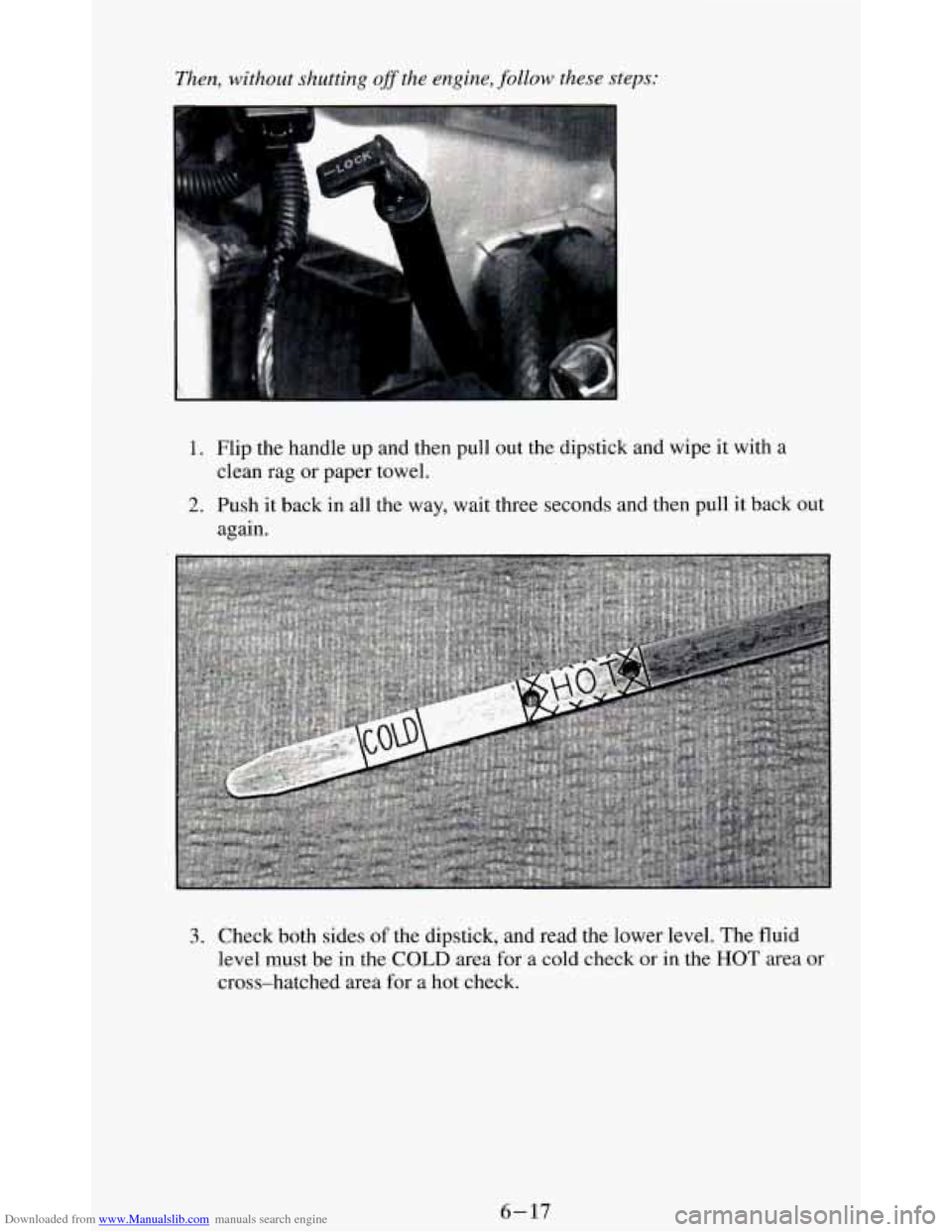
Downloaded from www.Manualslib.com manuals search engine Then, without shutting ofSthe engine, follow these steps:
1. Flip the handle up and then pull out the dipstick and wipe it with a
2. Push it back in all the way, wait three seconds and then pull it back out
clean rag
or paper towel.
again.
3. Check both sides of the dipstick, and read the lower level. The fluid
level must
be in the COLD area for a cold check or in the HOT area or
cross-hatched area for a hot check.
6-17
Page 254 of 348
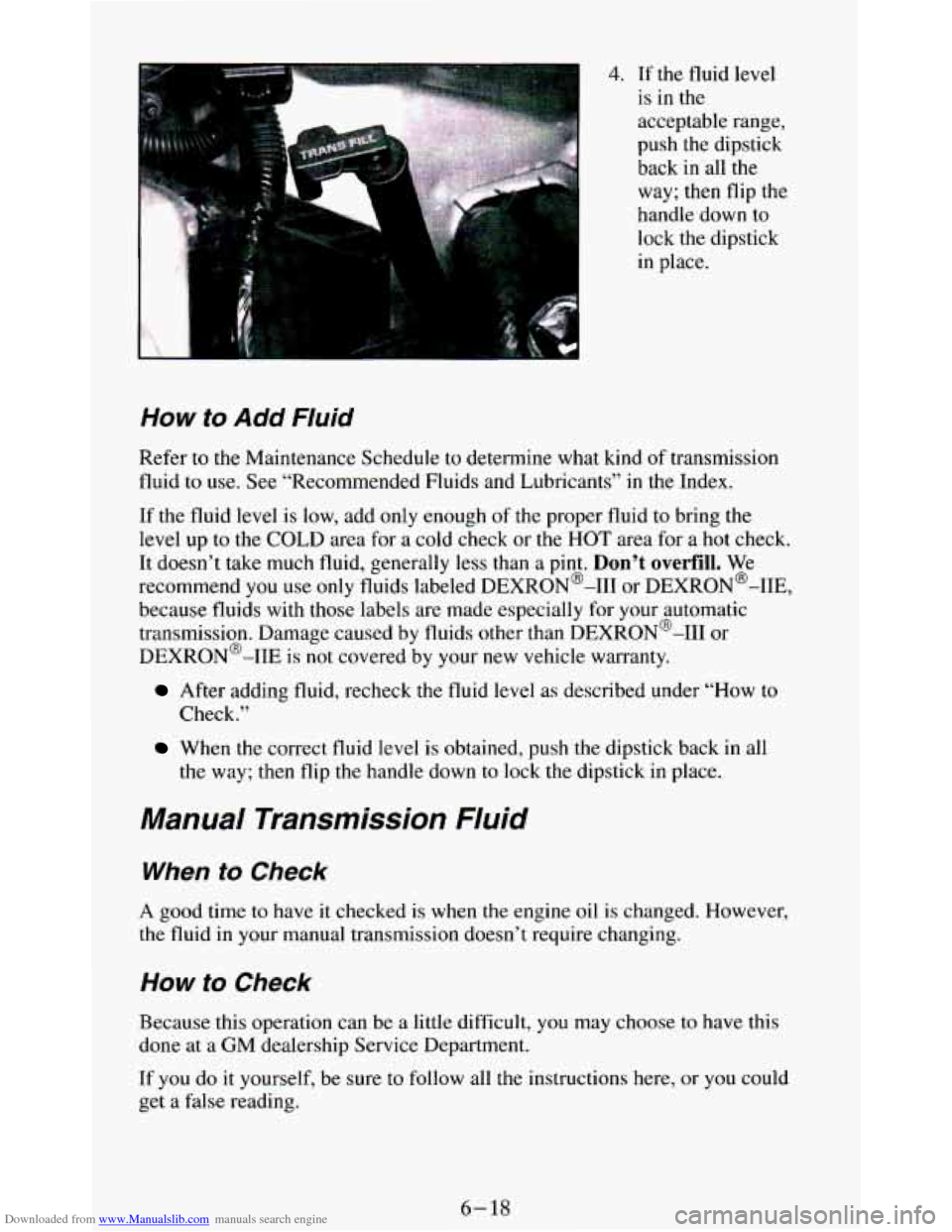
Downloaded from www.Manualslib.com manuals search engine 4. If the fluid level
is in the
acceptable range,
push the dipstick
back in all the
way; then flip
the
handle down to
lock the dipstick
in place.
How to Add Fluid
Refer to the Maintenance Schedule to determine what kind of transmission
fluid to use. See “Recommended Fluids and Lubricants’’
in the Index.
If the fluid level is low, add only enough
of the proper fluid to bring the
level up to the
COLD area for a cold check or the HOT area for a hot check.
It doesn’t take much fluid, generally
less than a pint. Don’t overfill. We
recommend you use only fluids labeled DEXR0N’-I11 or DEXR0N’-IIE,
because fluids with those labels are made especially for your automatic
transmission. Damage caused by fluids other than DEXRON@-I11 or
DEXRON@-IIE
is not covered by your new vehicle warranty.
After adding fluid, recheck the fluid level as described under “How to
Check.”
When the correct fluid level is obtained, push the dipstick back in all
the way; then flip
the handle down to lock the dipstick in place.
Manual Transmission Fluid
When to Check
A good time to have it checked is when the engine oil is changed. However,
the fluid in your manual transmission doesn’t require changing.
How fo Check
Because this operation can be a little difficult, you may choose to have this
done at a
GM dealership Service Department.
If
you do it yourself, be sure to follow all the instructions here, or you could
get a false reading.
6- 18
Page 255 of 348
Downloaded from www.Manualslib.com manuals search engine I NOTICE:
Too much or too little fluid can damage your transmission. Too
much can mean that some of the fluid could come out and fall on
hot engine parts or exhaust system, starting a fire. Be sure to get
an accurate reading
if you check your transmission fluid.
Check the fluid level only when your engine is off, the vehicle is parked on
a level place and the transmission is cool enough for you to rest your fingers
on the transmission case.
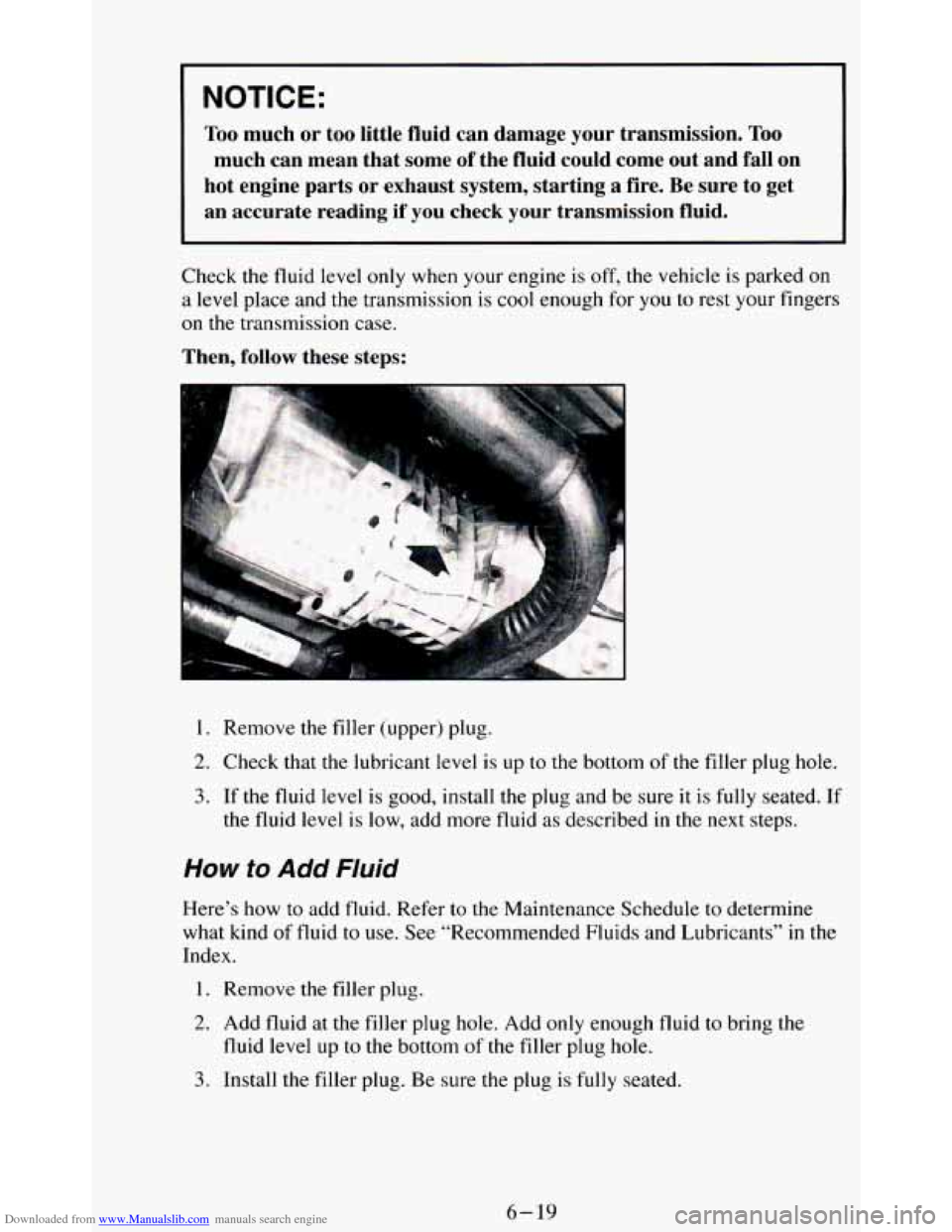
Then, follow these steps:
B
1. Remove the filler (upper) plug.
2. Check that the lubricant level is up to the bottom of the filler plug hole.
3. If the fluid level is good, install the plug and be sure it is fully seated. If
the fluid level
is low, add more fluid as described in the next steps.
How to Add Fluid
Here’s how to add fluid. Refer to the Maintenance Schedule to determine
what kind
of fluid to use. See “Recommended Fluids and Lubricants’’ in the
Index.
1. Remove the filler plug.
2. Add fluid at the filler plug hole. Add only enough fluid to bring the
fluid level
up to the bottom of the filler plug hole.
3. Install the filler plug. Be sure the plug is fully seated.
6-19
Page 256 of 348
Downloaded from www.Manualslib.com manuals search engine Hydraulic Clutch
The hydraulic clutch in your vehicle is self-adjusting. A slight amount of
play (114 inch to 1/2 inch) in the pedal is normal.
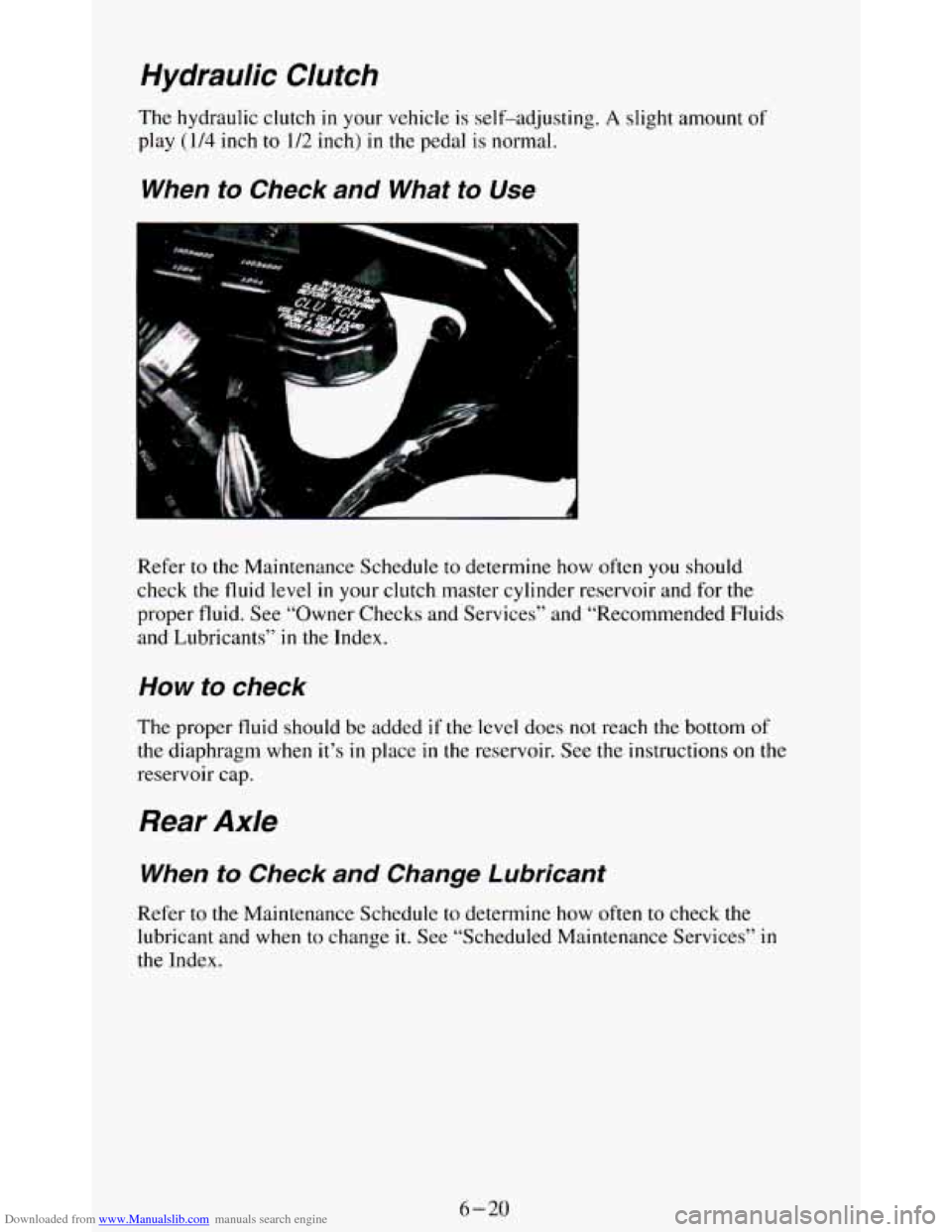
When to Check and What to Use
A
Refer to the Maintenance Schedule to determine how often you should
check
the fluid level in your clutch master cylinder reservoir and for the
proper fluid. See “Owner Checks and Services” and “Recommended Fluids
and Lubricants”
in the Index.
How to check
The proper fluid should be added if the level does not reach the bottom of
the diaphragm when it’s
in place in the reservoir. See the instructions on the
reservoir cap.
Rear Axle
When to Check and Change Lubricant
Refer to the Maintenance Schedule to determine how often to check the
lubricant and when to change
it. See “Scheduled Maintenance Services” in
the Index.
6-20
Page 257 of 348
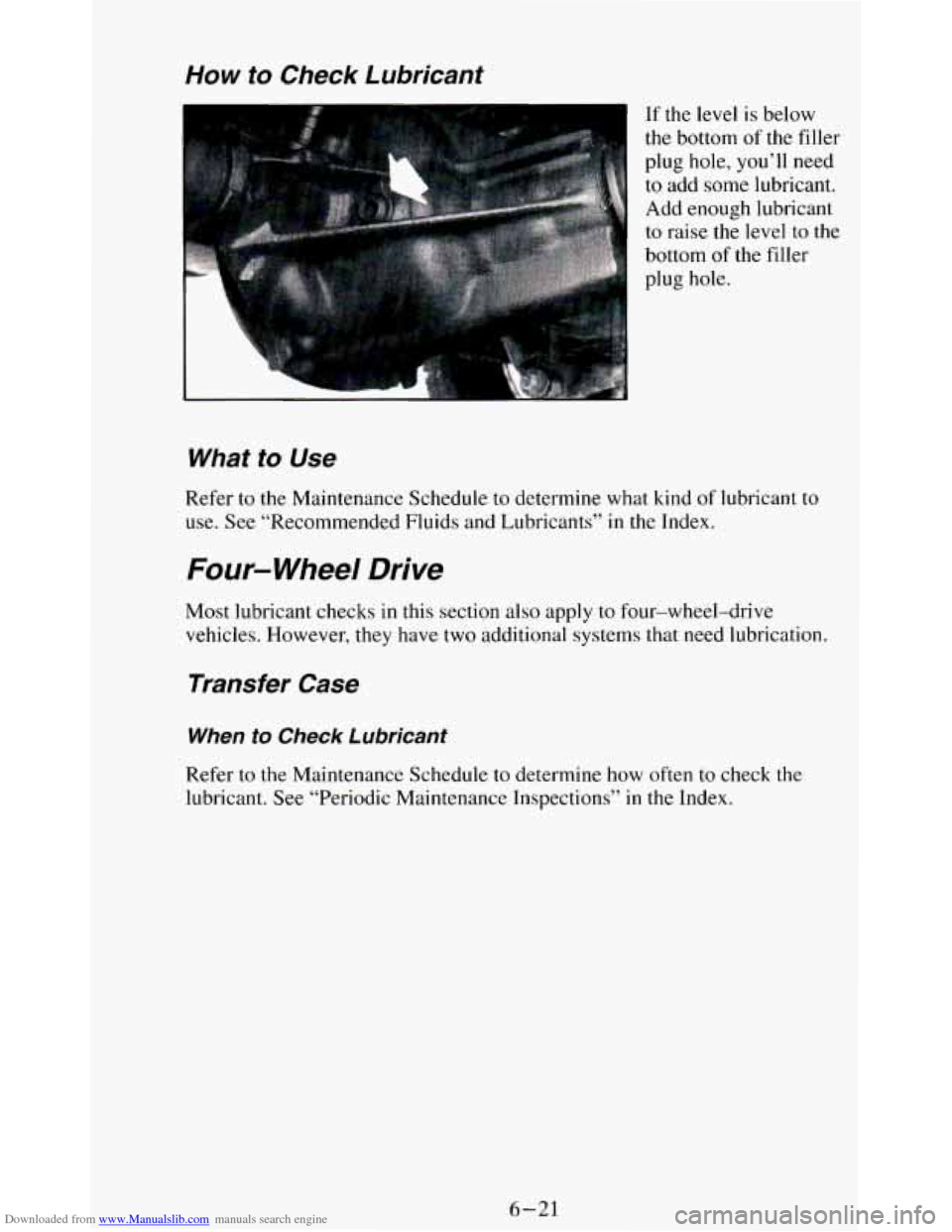
Downloaded from www.Manualslib.com manuals search engine How to Check Lubricant
If the level is below
the bottom of the filler
plug hole,
you’ll need
to add some lubricant.
Add enough lubricant
to raise the level to the
bottom
of the filler
plug hole.
What to Use
Refer to the Maintenance Schedule to determine what kind of lubricant to
use. See “Recommended Fluids and Lubricants”
in the Index.
Four-Wheel Drive
Most lubricant checks in this section also apply to four-wheel-drive
vehicles. However, they have two additional systems that need lubrication.
TrariSfer Case
When to Check Lubricant
Refer to the Maintenance Schedule to determine how often to check the
lubricant. See “Periodic Maintenance Inspections”
in the Index.
6-21
Page 258 of 348
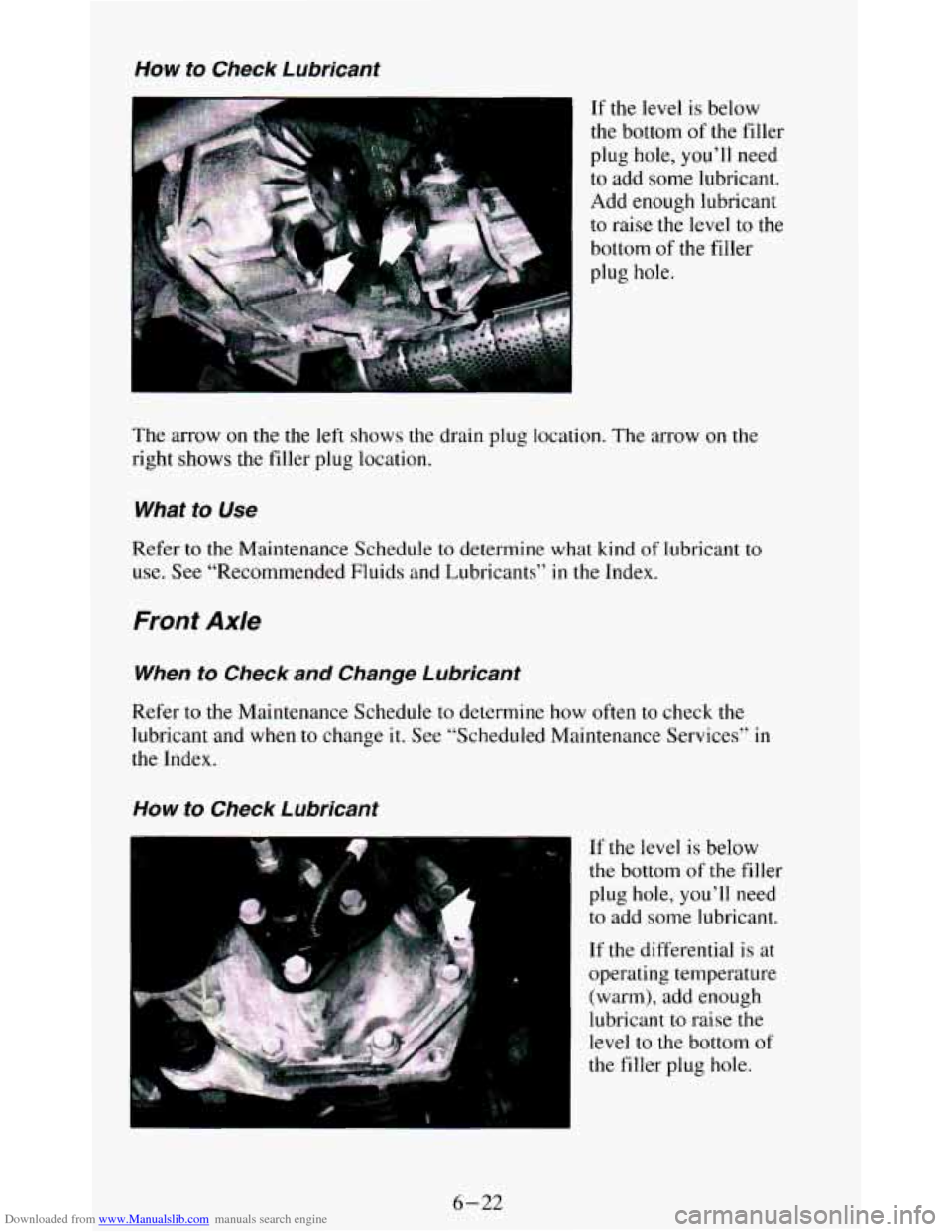
Downloaded from www.Manualslib.com manuals search engine Wow to Check Lubricant
If the level is below
the bottom
of the filler
plug hole, you’ll need
to add some lubricant.
Add enough lubricant
to raise the level to
the
bottom of the filler
plug hole.
The arrow on the the
left shows the drain plug location. The arrow on the
right shows the filler plug location.
What to Use
Refer to the Maintenance Schedule to determine what kind of lubricant to
use. See “Recommended Fluids and Lubricants” in the Index.
Front Axle
When to Check and Change Lubricant
Refer to the Maintenance Schedule to determine how often to check the
lubricant and
when to change it. See “Scheduled Maintenance Services” in
the Index.
How to Check Lubricant
f
, .’ @”,
If the level is below
the bottom
of the filler
plug
hole, you’ll need
to add some lubricant.
If the differential is at
operating temperature
(warm), add enough
lubricant to raise the
level to the bottom of
the filler plug hole.
6-22
Page 260 of 348
Downloaded from www.Manualslib.com manuals search engine I NOTICE:
If you use an improper coolant mix, your engine could overheat
and be badly damaged. The repair cost wouldn’t be covered by
your warranty.
Too much water in the mix can freeze and crack
the engine, radiator, heater core and other parts.
Some conditions, such as air trapped in the cooling system, can affect the
coolant level in the radiator. Check the coolant level when the engine
is cold
and follow the steps under “Adding Coolant” for
the proper way to add
coolant.
If you have to add coolant more than four times a year, have your dealer
check your cooling system.
NOTICE:
If you use the proper coolant, you don’t have to add extra
inhibitors or additives which claim to improve the system. These
can be harmful.
Adding Coolant
To Check Coolant
When your engine is cold, the coolant level should be at “ADD,” or a little
higher. When your engine
is warm, the level should be up to “FULL HOT,”
or a little higher.
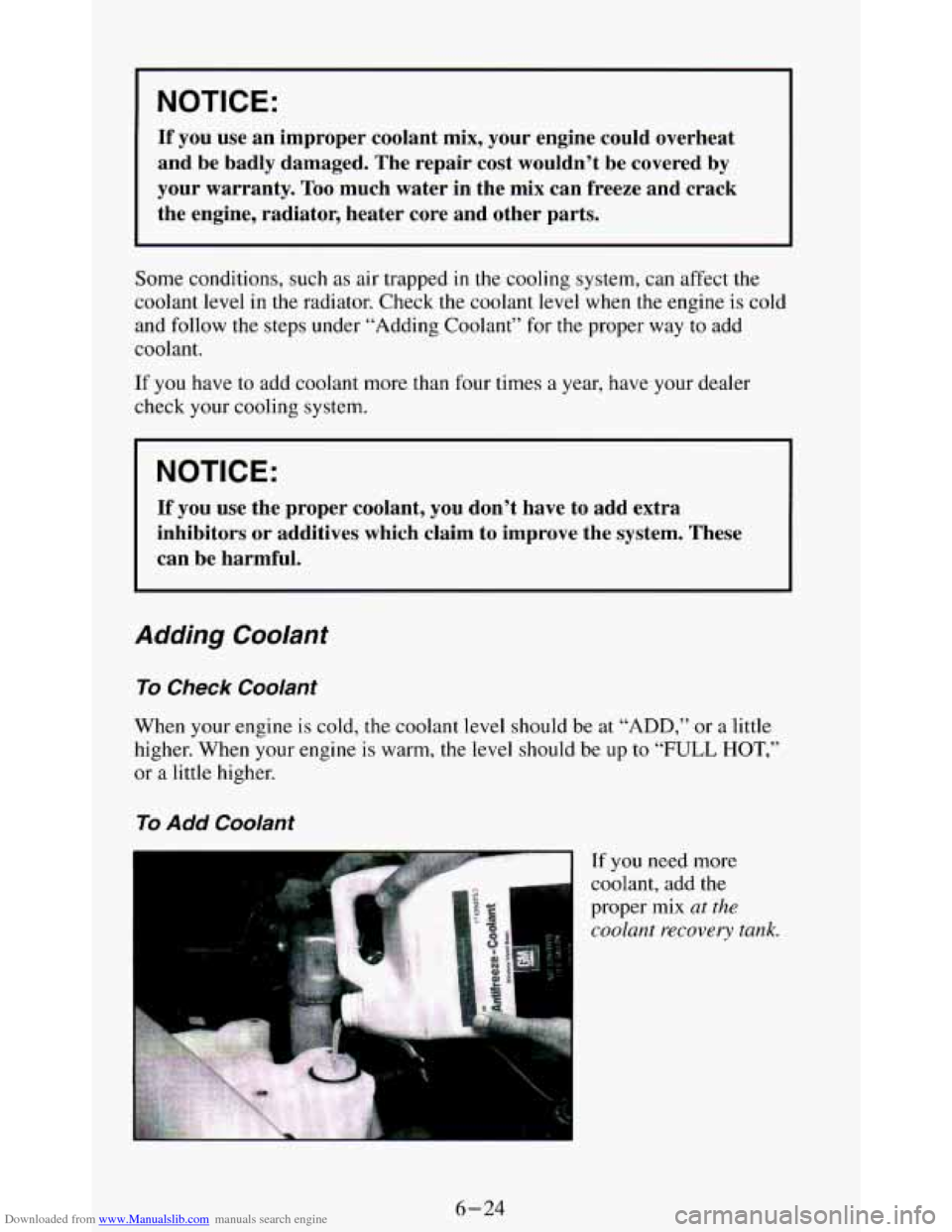
To Add Coolant
If you need more
coolant, add the
proper mix
at the
coolant recovery tank.
6-24
Page 262 of 348
Downloaded from www.Manualslib.com manuals search engine Thermostat
Engine coolant temperature is controlled by a thermostat in the engine
coolant system. The thermostat stops the flow
of coolant through the
radiator until the coolant reaches
a preset temperature.
When you replace your thermostat, an
AC@ thermostat is recommended.
Power Steering Fluid
NOTICE:
Always turn the engine off before checking or adding power
steering fluid. The power steering cap is close to the fan and
other moving parts.
P
i
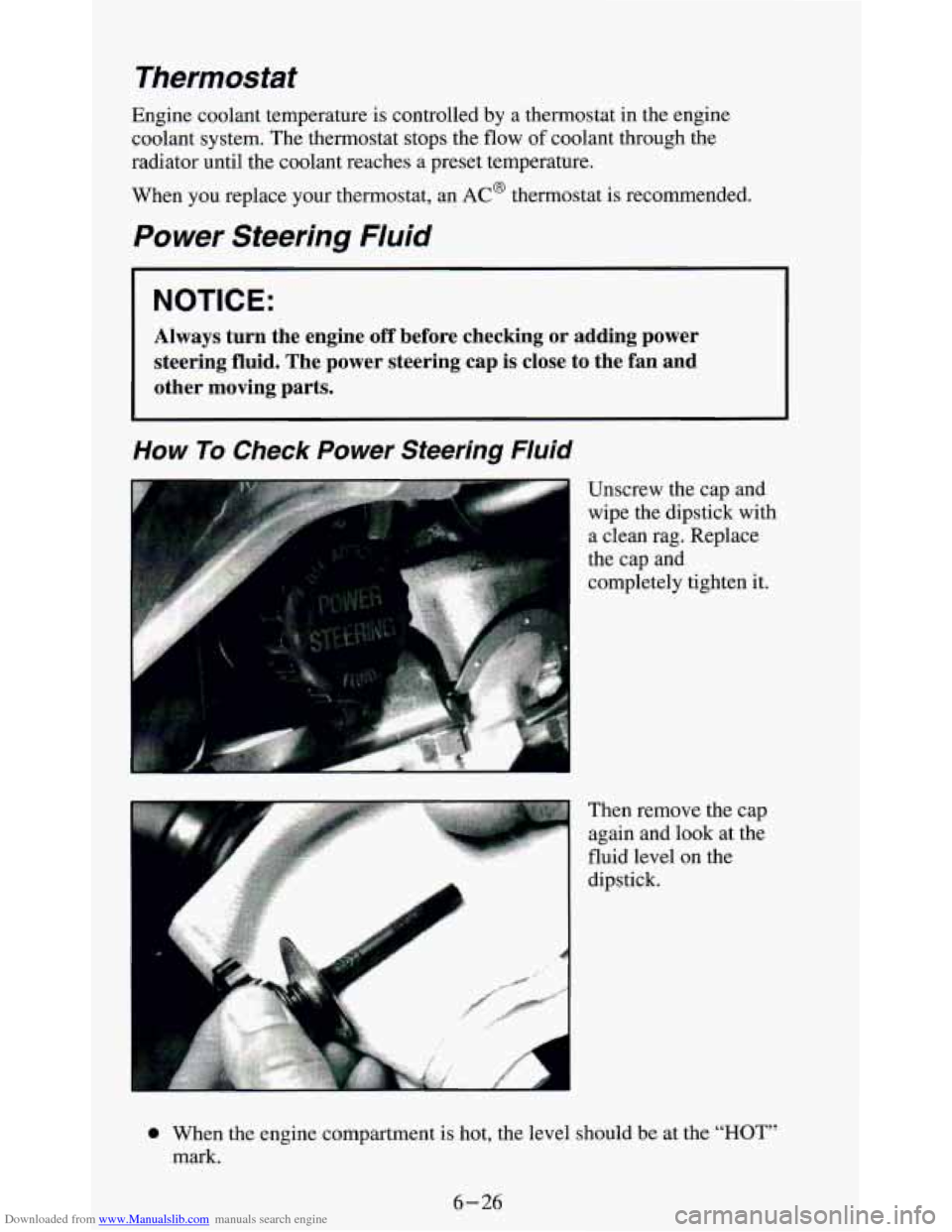
Unscrew the cap and
wipe the dipstick with
a clean rag. Replace
the cap and
completely tighten it.
Then remove the cap
again and look at the
fluid level on the
dipstick.
0 When the engine compartment is hot, the level should be at the “HOT”
mark.
6-26