1994 CHEVROLET BLAZER check engine
[x] Cancel search: check enginePage 314 of 348

Downloaded from www.Manualslib.com manuals search engine 6.
7.
8.
9.
10. 11.
12.
TRANSMISSION SERVICE:
Automatic Transmission
- Change the transmission fluid and filter
every 15,000 miles
(25 000 km) if the vehicle is mainly driven under
one or more of these conditions:
In heavy city traffic.
Where the outside temperature regularly reaches 90°F (32” C) or
In hilly or mountainous terrain.
Frequent trailer pulling.
0 Uses such as taxi, police, delivery or other commercial service.
If the vehicle is not used mainly under any of these conditions, change
the fluid and filter
every 30,000 miles (50 000 km). See “Automatic
Transmission Fluid”
in the Index for more information.
Manual Transmission - Transmission fluid does not require periodic
changing.
FUEL FILTER REPLACEMENT* $- Replace the fuel filter at the
specified interval or sooner
if clogged.
SPARK PLUG REPLACEMENT* - Replace spark plugs with the
type listed in Section 6. See “Specification Charts” in the Index.
SPARK PLUG WIRE INSPECTION* - Clean wires and inspect
for burns, cracks or other damage. Check the wire boot fit
at the
distributor and at the spark plugs. Replace wires as needed.
ENGINE TIMING CHECK AND DISTRIBUTOR CHECK*$ -
Adjust timing to underhood label specifications. Inspect the inside and
outside of the distributor cap and rotor for cracks, carbon tracking and
corrosion. Clean or replace as needed.
FUEL TANK, CAP AND LINES INSPECTION*$ - Inspect the
fuel tank, cap and lines for damage
or leaks. Remove fuel cap, inspect
gasket for an even filler neck imprint, and any damage. Replace parts
as needed.
ENGINE ACCESSORY DRIVE BELT INSPECTION* - Inspect
belt. Look for cracks, fraying, wear, and proper tension. Adjust or
replace as needed.
higher.
*An Emission Control Service
$=The California Air Resources Board has determined that the failure to
perform this maintenance item will not nullify the emission warranty or
limit recall liability prior to the completion of vehicle useful life. General
Motors, however, urges that all recommended maintenance services be
performed at the indicated intervals and the maintenance be recorded.
7-8
Page 315 of 348
Downloaded from www.Manualslib.com manuals search engine 13. TIRE AND WHEEL ROTATION AND INSPECTION - For
proper wear and maximum tire life, rotate tires at the first
6,000 miles
(10
000 kilometers) for Schedule I or 7,500 miles (12 500 kilometers)
for Schedule I1 and then every 15,000 miles
(25 000 kilometers)
thereafter. Follow the instructions and patterns shown in Section
6.
Check tires for uneven wear or damage. If irregular or premature wear
is apparent, check wheel alignment. Also, check for damaged wheels.
See “Tires” in the Index for more information.
14.
DRIVE AXLE SERVICE - Check readfront axle fluid level and add
as needed. Check constant velocity joints and axle seals for leaking.
Locking Differential - Drain fluid at first oil change and refill.
Check fluid
level and add as needed at subsequent oil changes. In
dusty areas or trailer towing applications, drain fluid at every
15,000 miles (24 135 kilometers) and refill.?
Standard Differential - Check fluid level and add as needed at
every oil change. In dusty areas or trailer towing applications,
drain fluid every
15,000 miles (24 135 kilometers) and refill.?
More frequent lubrication may be required for off-road use.
15. BRAKE SYSTEM INSPECTION - When the engine oil is changed,
inspect the lines and hoses for proper hookup, binding, leaks, cracks,
chafing, etc. Check the parking brake adjustment, and the fluid level in
the master cylinder. A low fluid level can indicate worn disc brake pads
which may need
to be serviced.?
When the wheels are removed for rotation, inspect disc brake pads for
wear and rotors for surface condition. Also inspect drum brake linings
for wear and cracks. Inspect other brake parts, including drums, wheel
cylinders, parking brake, etc. at the same time.
Inspect brakes more often if driving habits or conditions resul\
t in
frequent braking.
.L t A fluid loss in these systems may indicate a problem. Have them inspected
and repaired at once.
7-9
Page 316 of 348
Downloaded from www.Manualslib.com manuals search engine Owner Checks and Services
Listed below are owner checks and services which would be made at the
time period specified to help ensure proper safety, emission performance,
and dependability of your vehicle.
Be sure any necessary repairs are completed at once. Whenever any fluids
or lubricants are added
to your vehicle, make sure they are the proper ones,
as shown in this section.
At Least Once a Month
Tire Inflation Pressure Check - Check the tires for proper inflation. If
they are low, inflate them to the level specified on the Certification label.
See “Inflation-Tire Pressure” in the Index.
At Least Once a Year
Key Lock Cylinder Lubrication - Lubricate key lock cylinders with one
of the lubricants recommended
in this section.
Transmission Neutral or Clutch Start Switch Operation -
1. Before you start, be sure you have enough room around the vehicle.
2. Firmly apply both the manual parking brake, and the regular brake. See
“Brakes” and “Parking Brake” in the Index.
Do not use the accelerator
pedal.
3. Be ready to turn off the engine immediately if it starts.
4. On automatic transmission vehicles, try to start the engine in each gear.
The starter should work
only in “P” (Park) or “N” (Neutral).
On manual transmission vehicles, put the shift lever in “N’ (Neutral),
push the clutch down halfway, and try to start the engine. The starter
should work only when the clutch is pushed down
all the way to the
floor.
7-10
Page 317 of 348
Downloaded from www.Manualslib.com manuals search engine Steering Column Lock Operation - While parked, try to turn the key to
LOCK in each gear shift position.
0 With an automatic transmission, the key should turn to LOCK only
0 With manual shift, the key should turn to LOCK only when you’re in
On vehicles with a key release lever, try to turn the key to
LOCK without
pressing the lever.
The key should turn to LOCK only with the key lever
depressed.
On all vehicles, the key should come out
only in LOCK.
Parking Brake and Transmission
“P’ (Park) Mechanism Operation -
when the gear shift is in “P’ (Park).
“R” (Reverse).
Park on a fairly steep hill, with the vehicle facing downhill. :eping your
foot on the regular brake, set the manual parking brake.
0 To check the parking brake: With the engine running and the
transmission in
“N’ (Neutral), slowly remove foot pressure from the
regular brake pedal.
Do this until the vehicle is held by the parking
brake only.
To check the “P” (Park) mechanism’s holding ability: Apply the regular
brake and shift to
“P” (Park). Release the manual parking brake, then
slowly release the regular brake.
Lap and Shoulder Belts Condition and Operation - Inspect belt system,
including: webbing, buckles, latch plates, retractors, guide loops and
anchors. Have a belt assembly replaced if the webbing has been cut or
otherwise damaged.
Body Lubrication Service - Lubricate all body door hinges including the
endgate, endgate handle pivot points, and endgate mounted spare tire carrier
(if equipped), lubricate the body hood,
fuel door and rear compartment
hinges, latches and locks including interior glove box and console doors,
and any moving seat hardware. Lubricate the hood safety lever pivot and
prop rod pivot. More frequent lubrication may be required when exposed
to
a corrosive environment.
7-11
Page 318 of 348
Downloaded from www.Manualslib.com manuals search engine Periodic Maintenance Inspections
Listed below are inspections and services which should be performed at
least twice a year (for instance, each spring and fall). You should let your
GM dealer’s service department or other qualified service center do these
jobs. Make sure any necessary repairs are completed at once.
Steering and Suspension Inspection? - Inspect front and rear suspension
and steering system for damaged,
loose or missing parts, signs of wear or
lack of lubrication. Inspect power steering lines and hoses for proper
hook-up, binding, leaks, cracks, chafing, etc. (On vehicles equipped with
manual steering gear, check for seal leakage). Lubricate the steering linkage.
Accelerator Control System - Lubricate all pivot points with engine oil,
except the
TBI throttle shaft. Do not lubricate the cam pulley. Remove all
external deposits from pulley.
Do not oil any accelerator or cruise control
cables. Replace any cables that have high effort or excessive wear.
Exhaust System Inspection - Inspect the complete system. Inspect the
body near the exhaust system. Look for broken, damaged, missing or
out-of-position parts,
as well as open seams, holes, loose connections or
other conditions which could cause a heat buildup in the floor pan or could
let exhaust fumes seep into the passenger compartments. See “Engine
Exhaust” in the Index.
Drive Axle Service - Check readfront axle fluid level and add as needed.
Check constant velocity joints and axle seals for leaking.
Transfer Case (four-wheel drive) Inspection? - Every 12 months or at
oil change intervals, check front axle and transfer case and add lubricant
when necessary. Check vent hose at transfer case for kinks and proper
installation. More frequent lubrication may be required
on off-road use.
?A fluid loss in these systems may indicate a problem. Have them inspected
and repaired at once.
7- 12
Page 323 of 348
Downloaded from www.Manualslib.com manuals search engine Service Station Checks
It is important for you or a service station attendant to perform these
under-hood checks at each fuel fill.
Check the engine oil level and add if necessary.
Check the engine coolant level and add if necessary.
Check the windshield washer fluid level and add if necessary.
See the Index under these items
for information on how to check them.
7-17
Page 324 of 348
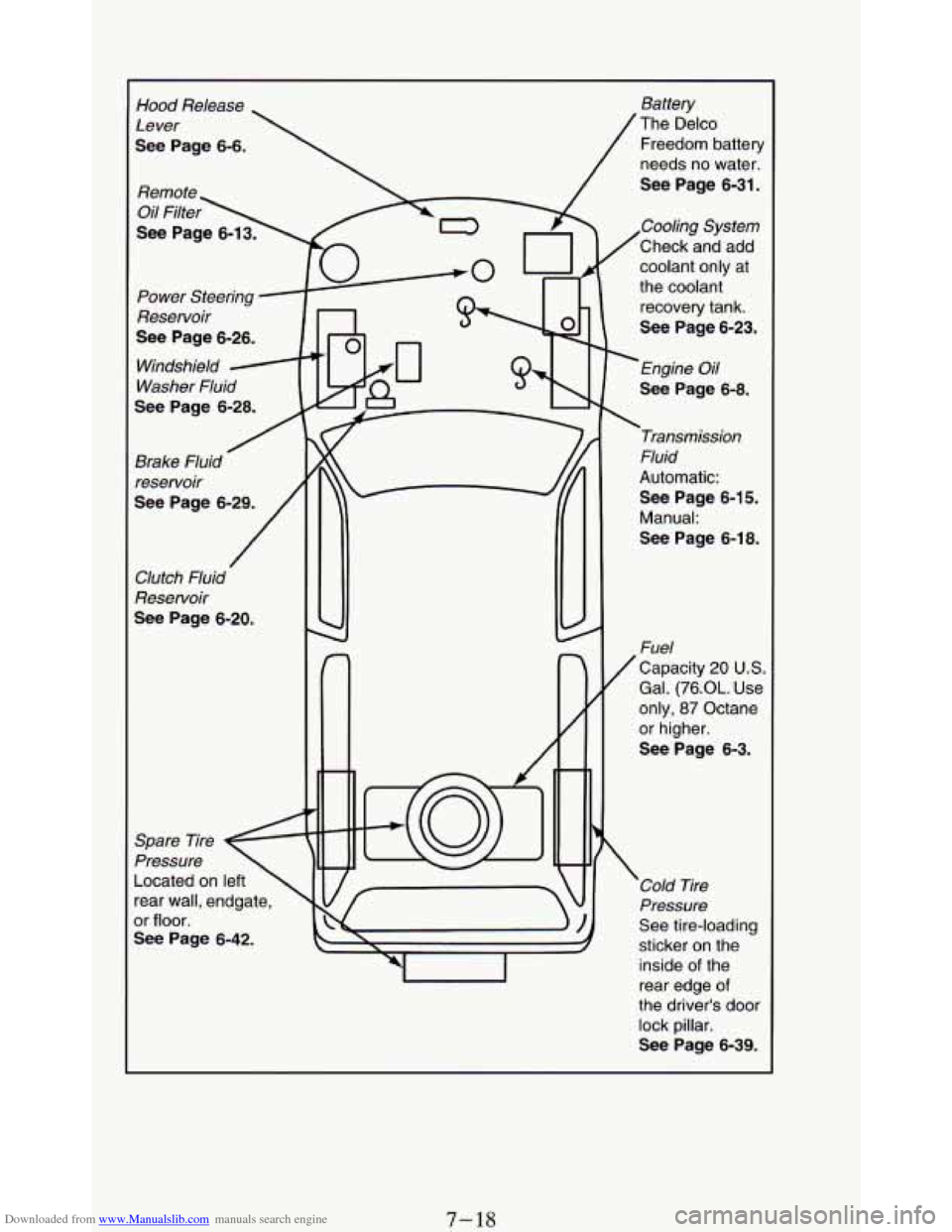
Downloaded from www.Manualslib.com manuals search engine Hood Release
Lever
See Page 6-6.
Remote
Oil Filter
See Page 6-13.
Power Steering
Reservoir
See Page 6-26.
Windshield -
Washer Fluid
See Page 6-28.
/ Brake Fluid
reservoir
See Page 6-29.
/
Clutch Fluid -
Reservoir
See Page 6-20.
Spare Tire
Pressure
Located on left
rear wall, endgat
3r floor.
See Page 6-42.
Battery
The Delco
Freedom battery
needs no water.
See Page 6-31.
,Cooling System
Check and add
coolant
only at
the coolant recovery tank.
See Page 6-23.
Engine Oil
See Page 6-8.
Transmission
Fluid
Automatic:
See Page 6-15.
Manual:
See Page 6-18.
/ Zacity 20 U.S.
Gal. (76.0L. Use
only, 87 Octane
or higher.
See Page 6-3.
Cold Tire
Pressure
See tire-loading
sticker
on the
inside
of the
rear edge
of
the driver's door
lock pillar.
See Page 6-39.
7-18
Page 332 of 348
Downloaded from www.Manualslib.com manuals search engine Bulletins cover various subjects. Some pertain to the proper use and care of
your vehicle. Some describe costly repairs. Others describe inexpensive
repairs which, if done on time with the latest parts, may avoid future costly
repairs. Some bulletins tell a technician how to repair a new or unexpected
condition. Others describe a quicker way
to fix your vehicle. They can help
a technician service your vehicle better.
Most bulletins apply to conditions affecting a small number of cars or
trucks. Your Chevrolet dealer or a qualified technician may have to
determine if a specific bulletin applies to your vehicle.
You can subscribe to all Chevrolet’s bulletins by calling Helm, Inc. at
1-800-782-4356. This way you’ll get them
as they become available.
Individual PSP’s
If you don’t want to buy all the PSP’s issued by Chevrolet for all car or
truck models
in the model year, you can buy individual PSP’s, such as those
which may pertain
to a particular model. To do this, you will first need to
see our index of PSP’s. It provides a variety of information. Here’s what
you’ll find in the index and how
you can get one:
What You’ll Find in the Index:
A list of PSP’s published by Chevrolet in a model year (1990 or later).
PSP’s covering all models of Chevrolet cars or light trucks (less than
10,000 pounds (4 536 kg) GVWR) are listed in the same index.
Ordering information so you can buy the specific PSP’s you may want.
0 Price information for the PSP’s you may want to buy.
How You Can Get an Index:
Indexes are published periodically. Most of the PSP’s which could
potentially apply to the most recent Chevrolet models will be listed in the
most recent publication for that model year. This means you may want
to
wait until the end of the model year before ordering an index, if you are
interested in buying PSP’s pertaining to a current model year car or truck.
Some PSP’s pertaining to a particular model year vehicle may be published
in later years, and these would be listed in the later year’s index. When
you
order an index for a model year that is not over yet, we’ll send you the most
recently published issue. Check the ordering form for indexes for earlier
model years.
Cut out the ordering form, fill it out, and mail it in. We will then
see to it
that an index is mailed
to you. There is no charge for indexes for the
1989- 1994 model years.
8-8