1993 VOLKSWAGEN GOLF key
[x] Cancel search: keyPage 39 of 156
Downloaded from www.Manualslib.com manuals search engine ___CONTROLS AND EQUIPMENT
Diesel engines
Glow plug system
Ith the 47 and 66 kW Diesel engines. ~fter sw itching to the driving position (ignion on ), the required glow plug warm-up
• m e is Indicated by a lamp which is con
:r oll ed by the coolant temperature -see
p ag e 47 .
On he
55 kW Diesel engine the glow pl ug sys tem is automaticall y activated after ~'osing the driver's door. If the engine is not subsequentl y sta rted, the glow plug syst em .111 not be activated by each further opening an closing of the driver's door.
Cold starting aid/idling speed
boost (47 and 55 kW engines only)
-0 facilitate starting from cold, there is a
c old starting device (cold sta rting aid) in the nJec tion pump.
he cold starting device is actuated when "'1e knob on h e left of the steerinq column
s pulle d out fully.
fl addition , the idling speed can be in~reased with the knob to reduce any vehicle
• br ation which may occur .
47 and 55 kW engines
Starting a cold engine
• At ambient temperatures down to -155C, pull the cold start knob out fully before operating the sta rter .
At lower t em pe rature s, the knob should not
be pulle d out until engine is firing regularly -the engine wi ll then start more
readily .
•
Turn the key in the igniti on lock to posi
tion 2 (see page 35) -the glow plug wa rning
lamp comes on. It goes out when the igni
t ion tempera ture is reached (see page 47) While the glow plugs are working do not switch on any other heavy current consumers because this would place an unnecessary load on the battery.
• When the w arning lam p goes out, start
the engine immediatel y
D o not depress the acce lerator while star
ting
If the
engine only fire s irregul arly, continue to ope rate the starter a few seconds longer (30 seconds at maximum) until the engine
runs under its own power. If
the eng ine does not start , switch the g
low plugs on again and try starting it again as de
scr ibed . If th e eng ine still doe s not start the
fuse for the glow plugs may have blown
page 120 .
• Push the cold start aid knob
in fully as soon as the engin e has rea ched its norma l
operating te mper ature.
If ve hicle vibrati on then
occurs whe n i dling,
the knob can be pul led out again until the en
gine runs free of vibration at the lowest
pos sible idling speed
Starting a warm engine
The glow plug lamp does not come on -the engin e can be started straight away. D o not pull the cold s tart aid knob and do not press
the accelerator pedal.
37
Page 40 of 156
Downloaded from www.Manualslib.com manuals search engine CONTROLS AND EQUIPMENT
Stopping engine
66 kW engine
Starting a cold engine
Ambient temperature above +5 0C:
The engine can be started without pre
glow Do not depress throttle during the
starting procedure.
Ambient temperature below +5 0C:
• Turn the key in the ignition lock to posi
tion 2 (see page 35) -the glow plug warning
lamp comes on It goes out when the igni
tion temperature is reached (see page 47). While the glow plugs are working do not switch on any other heavy current consumers because this would place an unnecessary load on the battery.
• When the warning lamp goes out, start
the engine immediately
If the engine does not start, repeat
preglow and try starting it again as described. If the
engine still does not start the fuse for the glow plugs may have blown -see page 120.
Starting a warm engine
The glow plug lamp does not come on -the
engine can be started straight away
When engine has been running fast for a long time, let it idle for about 2 minutes so that it can cool down slightly before being switched off.
Attention After the engine has been stopped the fan can continue running for a while (up to about 10 minutes) with the ignition switched off. It can also start to run again suddenly after a short time if -the coolant temperature increases due to heat build-up
-when engine is hot and the engine compartment is heated additionally by strong sunlight.
Special care must therefore be taken when working in the engine compartment.
On vehicles with a catalytic converter, the ignition must not be switched off as long as the vehicle is rolling with a gear engaged, otherwise, unburnt fuel can pass into the catalytic converter and cause damage.
38
Page 49 of 156
Downloaded from www.Manualslib.com manuals search engine CONTROLS AND EQUIPMENT
2 -Engine oil pressure ~
e wa rning lamp flashes when ignition is :ched on. the lamp must go out when ,=~g ne has started.
, 'Il e warning lamp does not go out or
ash es when driving -a buzzer also sounds
-' e!,gine spe,eds above 2000 rpm -stop, switch engine off, check oil level and if ecessary, add oil -see page 94.
- - he lamp comes
on although the oil level 5 n order, do not drive on. Do not even "'., t he engine at idling speed -call in expert ~slstance.
-du ring the Journe y the engine is operated
a : a speed less than idling speed, it ca n ~ appen that the oil warning lamp lights up. "crease engine speed by accelerating or :'langing down .
Note Th e oil pressure warning lamp is not an oil level indicator. The oil level shou.'d therefore be checked at reg, ular Intervals, preferably every time the fuel tank is filled.J
3 -Alternator
The warning lamp comes on w hen the igni
tion IS sWitched on and must go out when
the engine is started .
The alternator
is driven by a long-life ribbed
belt.
If the warning lamp lights during the
Journey ,
stop, switch off engine and
check ribbed belt.
If
t~e ribbed belt is loose or broken, do not
drive on -the coolant pump is no longer
being driven. The ribbed belt must be
checked/renewed by the next Volkswagen
dealer.
If the ribbed belt
is not loose or broken, one
can normally drive on to the next Vo lks
wag en dea ler. However as the battery is
then discharging co ntinuously , all electrical
consumers which are not absolutely essen
tial should be switched off.
4 -Glow plugs
(Diesel engines only)
When the engine
is cold the w arning lamp
come s on when key IS turned to Drive posi
tion (ignition on)
If the warning lamp does not come on, there IS a defectln the glow plug system -call in expert assistance.
When the lamp goes out, start the engine
Immediately -see page 37.
As the 55 kWDiesel engine glow period be
gins automatically after closing the drivers'
door,
It can happen that after switching to
the driving position (Ignition on) with a cold
engine, that the glow plug warning lamp
does not light up . The engine
can be started
straight away
When the engine
is warm the glow plug
lamp does not come on -the engine ca n be started straight away
Note
If while driving a fault occurs in the engine
management system of the 66 kW Diesel
engine, this
is indicated by a flashing warnIng lamp The engine must be checked by a
Volkswagen dealer as soon as possible.
47
Page 67 of 156
Downloaded from www.Manualslib.com manuals search engine CONTROLS AND EQUIPMENT
Sliding/tilting roof*
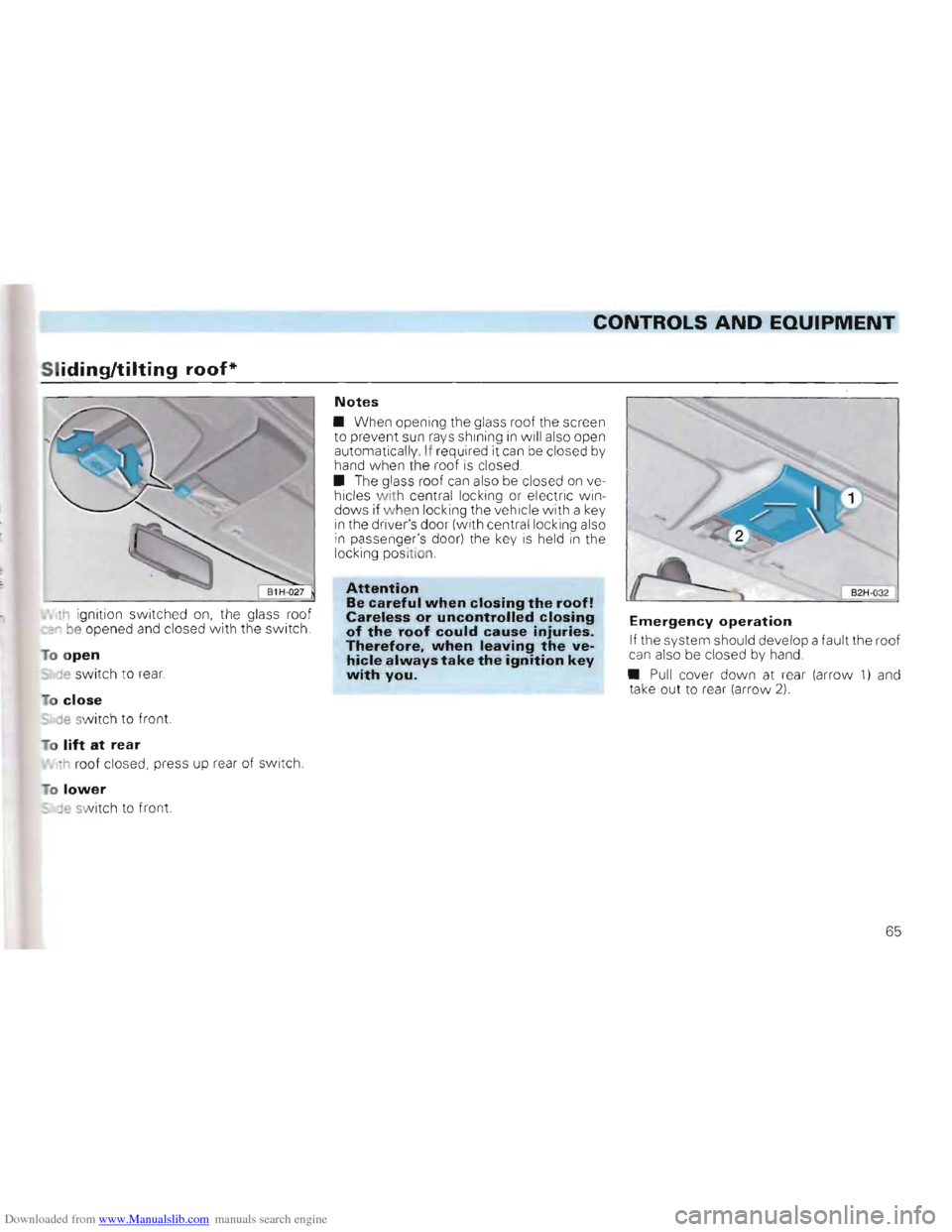
lh ignition sWit ched on, the glass roof
cl' be opened and closed with the switch.
T o
open
'de switch to rear.
o close
- de sw itc h to front.
To lift at rear
Ih ro of closed, press up rear of switch.
o
lower
lJe swi tc h to fro nt.
Notes
• When opening the glass roof the screen to prevent sun rays shining in w ill also open
automatical ly. I f req u ired it can be closed by hand whe n th e roof is closed .
• The glass roof can also be closedon ve
hicle s with central locking or electric win
dows if w he n loc king the vehicle with a key in the driv er' s door (with central locking al so in passeng er's door) the key is held in the
locking position.
Attention
Be careful when closing the roof!
Careless or uncontrolled closing
of the roof could cause injuries.
Therefore, when leaving the ve
hicle always take the ignition key
with you.
Emergency operation
If the system should develop a fault the roof
can also be c losed by hand .
• Pu
ll cover dow n at rear (arrow 1) and
take out to rear (arrow 2).
65
Page 70 of 156
Downloaded from www.Manualslib.com manuals search engine CONTROLS AND EQUIPMENT
Cigarette lighter
The cigarette lighter is switched on by
pushing in the element. When the heating
element glows, the lighter springs out auto
matically -pull it out immediately and use it.
The
cigarette lighter socket can be
used for other electrical accessories with a
capacity of up to 120 watts. However, when the engine is not running this will discharge
the battery. For further information see
chapter Accessories on page
111 .
•
Attention • Be careful when using the cigarette lighter! Careless or uncontrolled use of the cigarette lighter can cause burns. The cigarette lighter and the socket also work when the ignition is switched off and the key removed. For this reason children should never be left in the vehicle on their own.
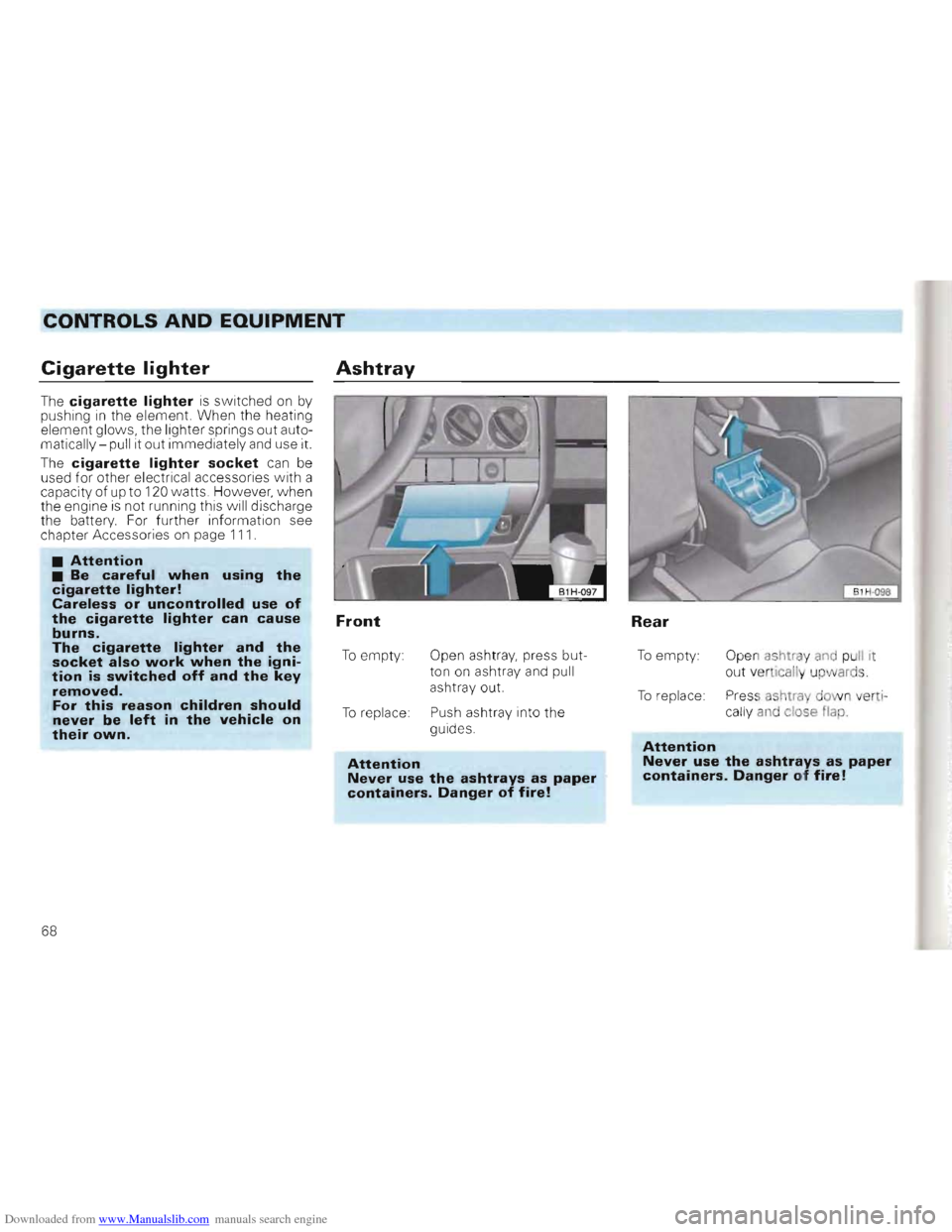
Ashtray
Front
To empty: Open ashtray, press but
ton
on ashtray and pull
ashtray out.
To replace Push ashtray into the
guides.
Attention Never use the ashtrays as paper containers. Danger of fire!
Rear
To empty
To replace: O
pen ashtra y and pull it
out ver ticall y u
pwards
P re ss ashtray
down ve rti cally and close flap.
Attention Never use the ashtrays as pape r containers. Danger of fire!
68
Page 90 of 156
Downloaded from www.Manualslib.com manuals search engine GENERAL MAINTENANCE
Cleaning seat belts
Keep belts clean because they ma y not
retract properly if very dirty .
Dirt y be
lts can be cleaned by was hing w ith
a mild soap solutio n without taking the belts
out of the vehicle.
Note
Inert ia reel belts should be completel y dry
before they are allowed to roll up.
Attention Do not have the belts cleaned chemically because the cleaning compounds damage the webbing material. Ensure that the belts do not come into contact with corrosive fluids.
Steel wheels
The wheels and the whee l tr ims should be
cle aned thoroughly at regular inter vals w hen the vehicle is being washed. This w ill
prevent brake dust , dirt and road salt from
accu mulating on the wheel. Persistent
ingr ained brake dust can be removed With an industrial grim e remov er. P aint damage
should be repaired before rust can form.
Alloy wheels
In order to maintain th e smart appearan ce
of all oy wheels for a long period, regular
car e is necessary . In particular, salt and brake pad dust must be washed off th or ough
ly
at leas t every tw o w eeks otherwise
the surface of the alloy Will be damaged
After being w ashed, the w heels shou ld be treated with an acid-free cleaner for al loy wheels. About every three months it is necessary to give wheels a good rubbing
w ith hard wax. Paint polish or other abrasiv e
solutions must not
be used. If the protecti ve
paint coat has been damaged , eg. by stone
impact, the damaged spots should be dealt with as soon as possible.
Cleaning and anti-corrosion
treatment of engine compart
ment
Attention Before doing any work in the engine compartment it is essential to read the notes on page 91!
The leaves, blossoms etc . w hich drop into
the water box (underneath the engine
bonnet
in f ront of the windscreen) should
be cleaned out occasional ly This w ill pre
v ent the water drain holes becoming
blocked
and -on veh ic les w ithout a fresh air
filter -foreign bodies entering the vehicle
interior v
ia the heating and ventilat ion sys
tem.
Attention For safety reasons pull out ignition key before reaching into the water box. Otherwise if the windscreen wipers are switched on unintentionally the movement of the wiper linkage could cause injury.
The engine compartment an d th e outsi de
surface of the power unit are given anti-cor
rosion treatment at the factor y.
In th e winter w hen the vehicle is being
driven frequ entl y on salted roads, good anti
corrosion treatment is very important. For
th is reason the entire engin e comp
artment and the plen um chamber should be thor
ough ly cleaned before and after the salting
period
and then preserved so that the salt cannot have a damag ing effect
The ignition must be switched off before washing the engine.
If the engine compartment is cle aned at any
time with greas e removing solution s 1) or if
one has the engine washed, the anti-cor
rosion compound is nearly alwa ys removed as wel l. It is the refore essential to ask for
durable preserv ation of all surfaces, seams,
joints and components in the engine compartment to be carried out. This applies also
1) Only the corre e clean ing solutions may be use d -on no aecoun petrol or Diesel.
88
Page 93 of 156
Downloaded from www.Manualslib.com manuals search engine GENERAL MAINTE NA NCE
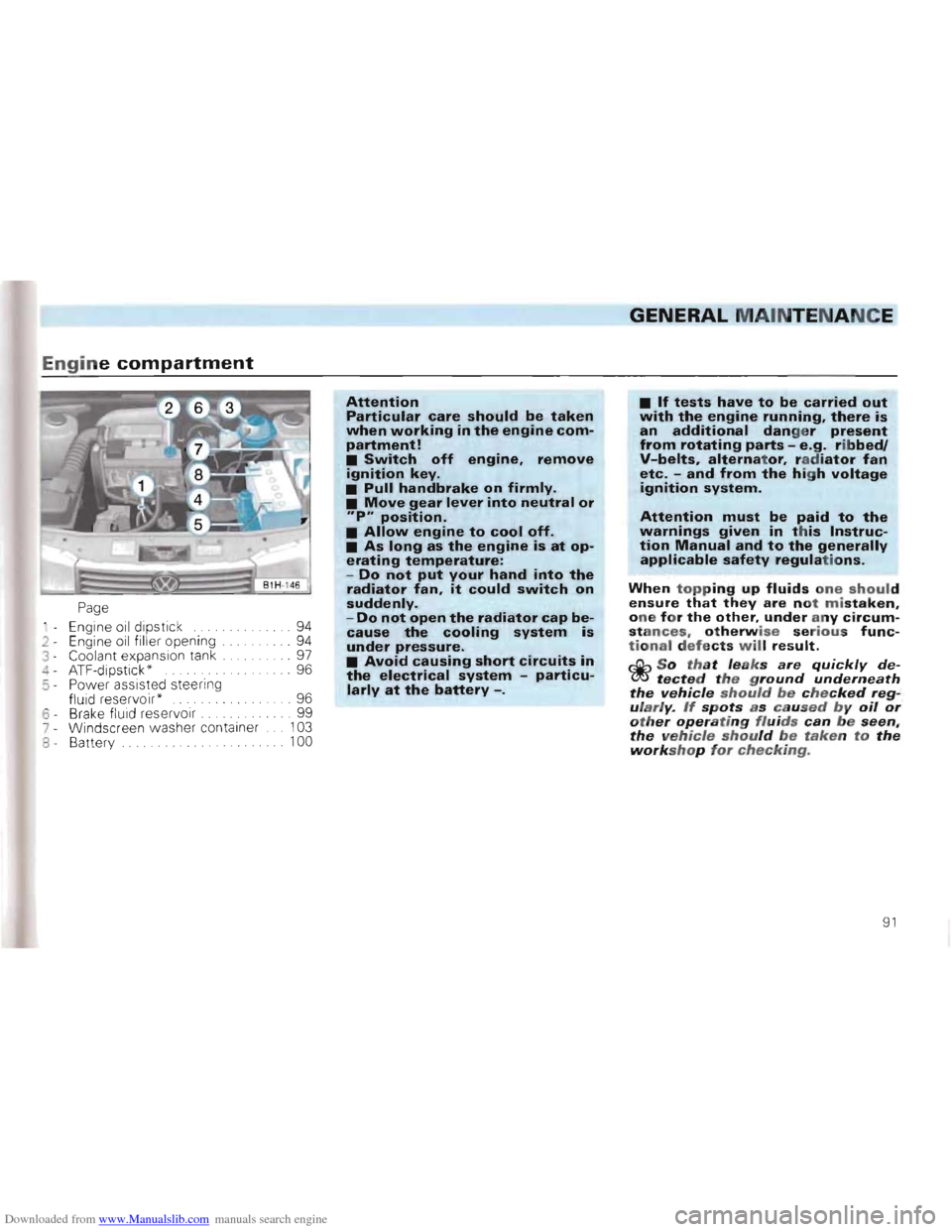
Engine c ompartmen t
Page
Engine oil dip sti ck . . 94
2 - Eng ine o
il filler openi ng ... ...... . 94
3 - Coolant exp ansion ta nk .. 97
4 -ATF-dip sti ck " . . . . . . . . . . . .. . 96
5 - Power assist ed steering flu id r eservoir '
6 Brak e fl uid re se rvo ir .
7 - Wi nd sc reen w ash er c on tainer
8 Battery .
Attention
Particular care should be taken
when working in the engine com
partment!
• Switch off engine. remove ignition key_
•
Pull handbrake on firmly.
• Move gear lever into neutral or
"P" position.
• Allow engine to cool off.
• As long as the engine is at op
erating temperature:
-Do not put your hand into the
radiator fan. it could switch on
suddenly.
-Do not open the radiator cap be
cause the cooling system is
under pressure.
• Avoid causing short circuits in
the electrical system -particu
larly at the battery -.
. .. 96
. .. 99
10 3
100
• If tests have to be ca rried o ut with the engine running. there is an additional dang e r present from rotating parts - e.g . ribbedl V-belts, alternator, ra d iator fan etc. -and fro m the high voltage ignition system.
Attention m ust be paid to the w arn ings given in this Instruction Manual and to the generally ap plicable safety regulations.
When topp ing up fluids one should ensure that they are not mistaken. one for the other, under any circum stances. otherwise serious fu nctional defects will result.
rJjh So that leaks are quickly de(!J!J tected the ground underneath the vehicle should be checked regularly. If spots as caused by oil or other operating fluids can be seen, the vehicle should be taken to the workshop for checking.
91
Page 132 of 156
Downloaded from www.Manualslib.com manuals search engine DO-lT-YOURSELF
• The emergency lights must be switched
on on both vehicles -unless local regula
tions differ.
•
Turn ignition key to "Drive" position so that the steering wheel is free and the turn
signals, horn, and, if necessary, the wind
screen wiper and washer can be used.
•
As the brake servo only works when the
engine is running, considerab ly more pres
sure is required on the brake pedal when
the engine is not running
•
On vehicles with power assisted steer
ing more force is required to turn steering
wheel when engine is not running.
• When there
is no lubricant in the manual
gearbox/automatic gearbox, the vehicle
may
on l y be towed with driving wheels
lifted.
Tow starting
The following points must be
noted when tow starting:
• Before moving off, engage 2nd or 3rd
gear .
• Switc h ignition
on. • As soon as engine starts, depress clutch and move gear lever into neutral to avoid
running into the towing vehicle.
• On vehicles with a catalytic converter the engine must not be started by towing the vehicle in ex
cess of 50 mll. Because then, fuel can pass into the converter and cause damage.
• For technical reasons tow starting a vehicle with an automatic gearbox is not possible.
Towing
When towing vehicles with an automatic gearbox, the following points
must be noted in addition to the details on the previous page :
• Selector lever
at " N". • Do not have the vehicle towed faste r
than 30 mph (50 km/h)
• Do not
tow further than 30 miles (50 km).
If the vehicle has to be towed long dis
tances it mu st be lifted at the front.
Reason: When the engine
is not running ,
the gearbox oi l pump is not working and the
gearbox is not adequately lubricated fo r
high speeds or long distances .
• With a breakdown vehicle the vehicle
may only be suspended at the front.
Reason: If given a rear suspended tow, the
drive shafts turn backwards . The plane tary
gears
in the automatic gearbox then turn at
such high speeds that the gearbox will be severely damaged in a short time .
1) Does not apply to Diese l e ng ines wi h cata
lytic conve rter
Note for the Golf syncro:
• The veh icle can be towed like any two
wheel drive Golf.
• With a recovery vehicle the car
can be
towed with front or rear wheels suspended.
If the vehicle has to be towed with the rear
wheels lifted and the rear wheels cannot
turn freely, one must ensure that the free
wheel
in the rear axle has not been bridged
beforehand by driving vehicle in reverse. To reintroduce the freewheel action the gear
lever must be moved briefly in to 1 st gear
wi th ignition on and then back in to neutral.
1 30