1993 VOLKSWAGEN GOLF lights
[x] Cancel search: lightsPage 5 of 156
Downloaded from www.Manualslib.com manuals search engine CONTROLS AND EQUIPMENT
Dashboard and Controls ..... 4
. ey s, Cen tral locking . . .... 6, 7
::"tl-thef t warning system .... 8
Joors .......................... .... 9
oot lid .... ........... . . . . . 10
::Iectric windows .. . .. 10
• ~Irrors . . ..... . ... 12
Seal belts 13
"" rbag System . . . . . 18
Safe ty for children .. ... 21
ead restraints . . . . . .. 24
= ro nt seats . . . . . . . . . . . .. 25
Rear seat . . . 27
L u ggage compartment ... . ... . ...... 28
M esh partition (Estate) ...... 29
L u ggage compartment cover /
F olding/sliding cover
... 30
Pedals, Hand brake .. 31
Manual gearbox .... ... .... 31
Automati c gearbox . . . .. .......... 32
H eig ht-adjustable steering wheel ..... 35
I gnition lock. . . . . .. 35
Starting/stopp ing engine 36, 38
\lIstrumellts .. .... 39
Warning lamps ....... 46
Switches . . . . . . . . . . . . . . 50
Turn signal and dip lever ............. 53
Cruise control system ........... 54
Wi ndscreen wipe r and washer system 55
Heating an d ventilation .. . ...... 56
Air cond itioner ......' 59
Sliding/ti ltin g roof. . . . . . . . . . . . ... 65
Sun visors / Interior lights 66,67
Cigarette lighter, Ash tray ..... 68
Shelves and boxes . . . . . . . . . . . ... 69
Roof rack / Roof ra ilings ... 70
DRIVING TIPS
The firs t 1500 km -and after wards .... 71
Driving economically and ecologically .. 72
Brakes. . . . . . . . . . . . . . . . 75
Tra iler tow ing . .. ..... . .... ... ...... 77
Driving a four- wheel drive vehicle .. 79
GENERAL MAINTENANCE
Filling the tan k, Fuel. 81, 82
Care of vehicle ........ .. . . 85
Bonnet . . ... 90
Engine compartment .. ...... .... .... 91
Engine oil ..... .......... ........... 92
Automatic transmission fluid (ATF)* ... 96
Power-assisted steering .. 96
Cooling system . . . . . . . . . . .. . 97
B rake fluid ...... 99
Battery . . . . .. 100
Spark plugs. V-belts . . . . . . . . . 102
Washer system
... . .. 103
Windscreen w iper blades . . . 104
Dust a
nd pollen filter * . 104
Wheel s . 105
D riving abroad ..... ............... 110
Accessories, modifications and
renewa l ot parts .............. III
Mobile telephones and tw o-way rad ios 111
DO -lT-YOURSELF
First -aid kit, Warn ing triangle ........ 112
Storage of vehicle tools, spare wheel
a n d ball coupling trailer bracket ...... 113
Vehicle tools, Spare wheel 114
CONTENTS
Changing w heels . 116
F uses . ........ .. .. . . . ... . .... 119
Changing bulbs. . .... .. . 121
Installing radio . . . . .. 127
E mergency starting .. .. 128
Tow starting / to wing . . .. 129
L ift ing vehicle ......... 131
SPECIAL INFORMATION
Body ..... .... . .......... 132
Environmental compatibility ... 133
TECHNICAL DATA
Engine data . .. , .... .... . 134
P er forman ce .. ... ... ... . .. 136
Fuel consump tion .. 137
Wh eels
. . 139
T yre pressures
.. .. ... .. . . .. ... 1 4 1
Weights ... 143
Trailer weights .. 144
Dimensions. ...... .. ... 145
Capacities " ..... 146
Vehicle identification data ... 147
ALPHABETICAL INDEX
Alph abetical index ... 148
3
Page 9 of 156
Downloaded from www.Manualslib.com manuals search engine Central locking system*
When one of the front doors is locked or un
lock ed w ith the key, all the other doors, the
tank flap and -depending on the position of
h e tailgate lock cylinder -the tailgate as w el l, are locked or unlocked by the central locking system
T he centra l locking system
is equipped with
a safe mechanism: Once the vehicle has been locked fr om the outside, the door lock Ing knobs on the inside are also blocked
a ft er approx. 12 seconds. This makes
b reaking in d ifficult.
W hen
unlocking, all the locking knobs
m ove upwards .
I f the key is held at the open position on
ve
h icles with electr ic win dows, all windows
wi ll open.
W hen
locking all door locking knobs must
m ove downwards. If this does not happen,
o p
en the door concer ned again and lock by pre ssing the locking knob down .
On ve hicles equipped w ith electric w inows/ele ctri c s liding roof, w indows/ele ctri c
s liding roof w hich hav e been left open can be automatically closed when the doors are
l o cked . T o do this one only need s to hold the
e y
in the lock ing position, until all windows and the sliding roof are completely closed.
The doors can also be locked by pushing down the locking knobs. However, the
s fe system IS not activated when th is is done. When the driver's door is locked all the other doors are locked as well. The
driv er
's door canno t be locked by pres
s ing the locking knob down as long as the
door is open. This is to prevent you from
locking yourself out.
Notes
• If you lock the car using the ignition key and with the driver' s door open, get into the
car and shut the door, all doors are locked.
They cannot be opened from the inside or
from the outs ide. As soon as the ignition is swit ched on, the door s are unlocked .
• If the ce ntral loc king shou ld fail , all locks
apart from the tank flap can be operated
manually.
Releasing tank flap manually, see Page 82.
Attention • When the vehicle is locked from outside, no-one should remain in the vehicle -especially not children -because the doors can no longer be opened from the inside. This applies particularly where the vehicle has electric windows, because then the windows cannot be opened either see page 10. • If the locking knob in the driver's door is pushed down, all the other doors are automatically locked as well. • Locking the doors can prevent them from bursting open in an extraordinary accident situation. Locked doors also prevent persons entering the vehicle forcibly e.g. at traffic lights. However, in an emergency, they make it more difficult for outside help to open the doors.
7
Page 11 of 156
Downloaded from www.Manualslib.com manuals search engine CONTROLS AND EQUIPMENT
Doors
From outside the front doors can be
ocked or unl ocked with the key.
h
en unlocking, the locking knobs move .Jp.
I the key is held in the opening position in .119 d riv er's door (with central locking front passenge r door also), on vehicles with elec
-'le wi ndows all windows will b e opened .
:Jh
en locking, the locking kn o bs move dow n.
-o n vehicles with central locking or electric
Nln dows the key is held in th e loc king posi
- o n in the driver's door (with cen tral lock ing 'ront passe nger door also), windows an d
:ne electric sliding roof which have been left
o pe n w ill be closed.
The fron t passenger's door and the rear
d oors can be locked from outside without Jsing the key J ust press locking knob down and close door.
-he dri ver's door cannot be locked when :Jpe n by pre ssing the locking knob down and closing door . This pre vents you from
eaving the key in the car and forgetting it.
From inside all the door s can be locked by
press ing down the locking knobs.
As long as the knobs are pr esse d down the
doors cannot be opened from inside or outside.
Attention Locking the doors can prevent them from bursting open in an extraordinary accident situation. Locked doors also prevent persons from entering the car forcibly e .g. at traffic lights. However, in an emergency they make it more d ifficult for outside help to open the doors. Child-proof catch
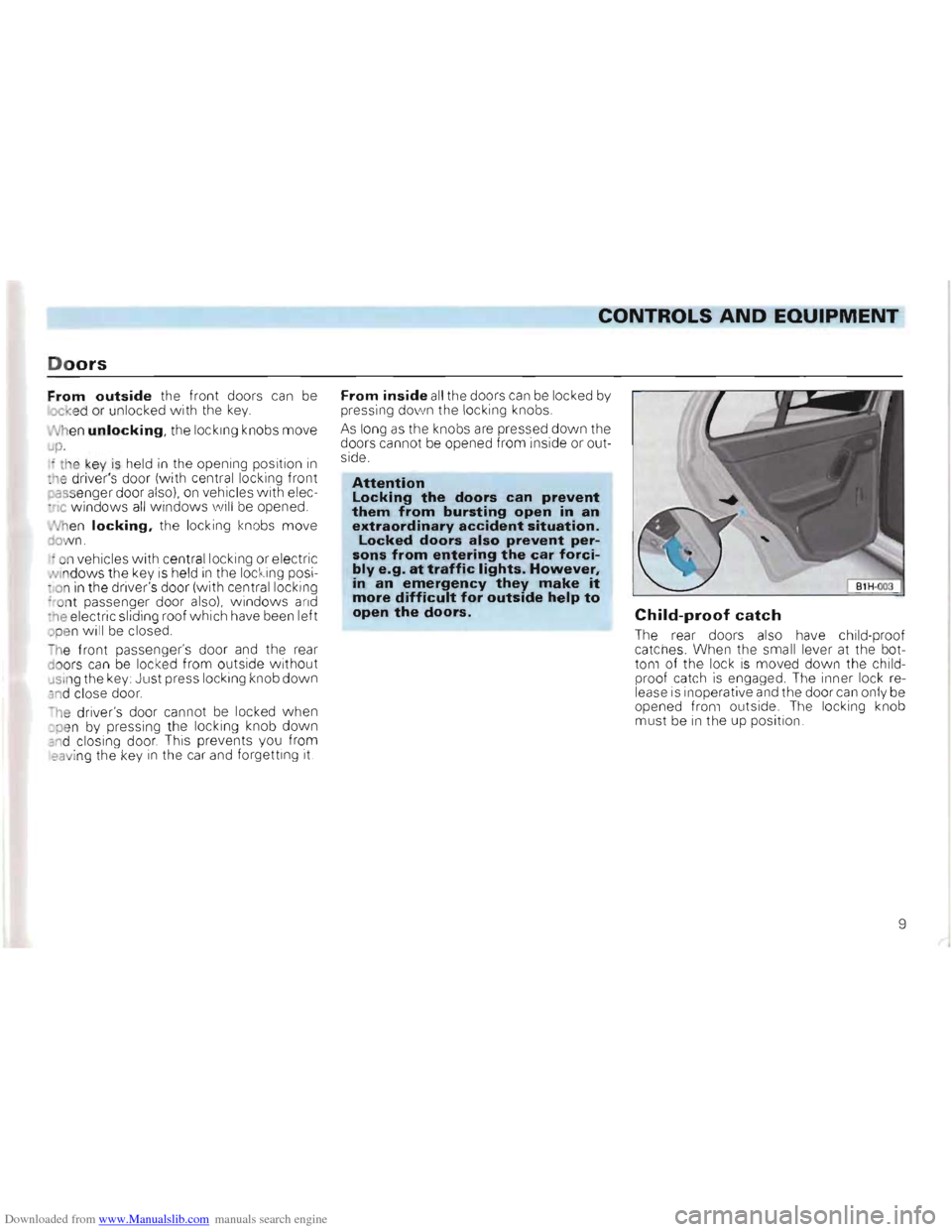
The rear doors also have child-pr oof catc hes . When the small lever at the bot
to m of the lock is moved down the chi ld
proof cat c h i s engaged. The inner lock release is inoperative and the door can only be opened from outside. The locking knob
m ust be in the up po sition .
9
Page 20 of 156
Downloaded from www.Manualslib.com manuals search engine CONTROLS AND EQUIPMENT
Airbag-System*
Vehicles with Airbag System for the driver and passenger can be recognized by an inscription "AI RBAG" on the steering wheel padded plate and on the right end of the dash panel.
Supplementary to the three point seat belts the Airbag System offers additional protection for the driver's and passenger's head and chest In a serious
frontal collision.
Apart
from its normal protective function the seat belt also has the task of keeping the
driver or passenger in such a position so
that the Airbag can offer maximum protec
tion in the case of a frontal collision.
The Airbag system will not be triggered for:
• Side collisions
• Rear collisions
•
Rol l i ng-over
• Minor frontal collisions
Therefore the seat belts should always be used not only for reasons of statutory regulations, but also for safety reasons!
Essentially the system consists of
• The electronic control and monitoring
unit
• Both airbags (air sack
with gas gener
ator) with gas generator for the:
- Driver (in steering wheel),
- Passenger (in right of dash panel)
• A
warning lamp in the dash panel -see
page 49.
The functional readiness of the Airbag
System is electronically monitored.
Each
time the ignition is switched on the
warning lamp lights for about 3 seconds
(self diagnosis).
The system has a fault, if
• When switching on the ignition the warn ing lam p does not light.
•
After swi tching on the ignition the warn
ing la m p does not extinguish after about 3
second s
• The warning lamp
comes on or flickers
du rin g the Journey.
Attention
When a fault is present the sys
tem should be checked by a
Volkswagen dealer immediately.
Otherwise there is the danger
that the Airbag will not be acti
vated in the case of an accident.
18
Page 33 of 156
Downloaded from www.Manualslib.com manuals search engine CONTROLS AND EaUIPMENT ------------------------------~---
Pedals
- _ movement of the peda ls must never be ~S ncted .
::-thIs reason, do not put articles in the '00 well which cou ld roll or slide under
- 3ath th e pedals.
-
he case of defects on the brake sys
'em, a greater pedal travel may be necessa , t should always be possib le to depress
- "'e clut ch and acce le rator pedals fully.
All peda ls must be able to return , unh in-Jere d, to their rest positions. .
= o r these reasons, the only foot mats which e 'Y'\ay be used are those which leave the
ed al area compl ete ly free and which are pre ve nted from slipping .
'11
Hand brake
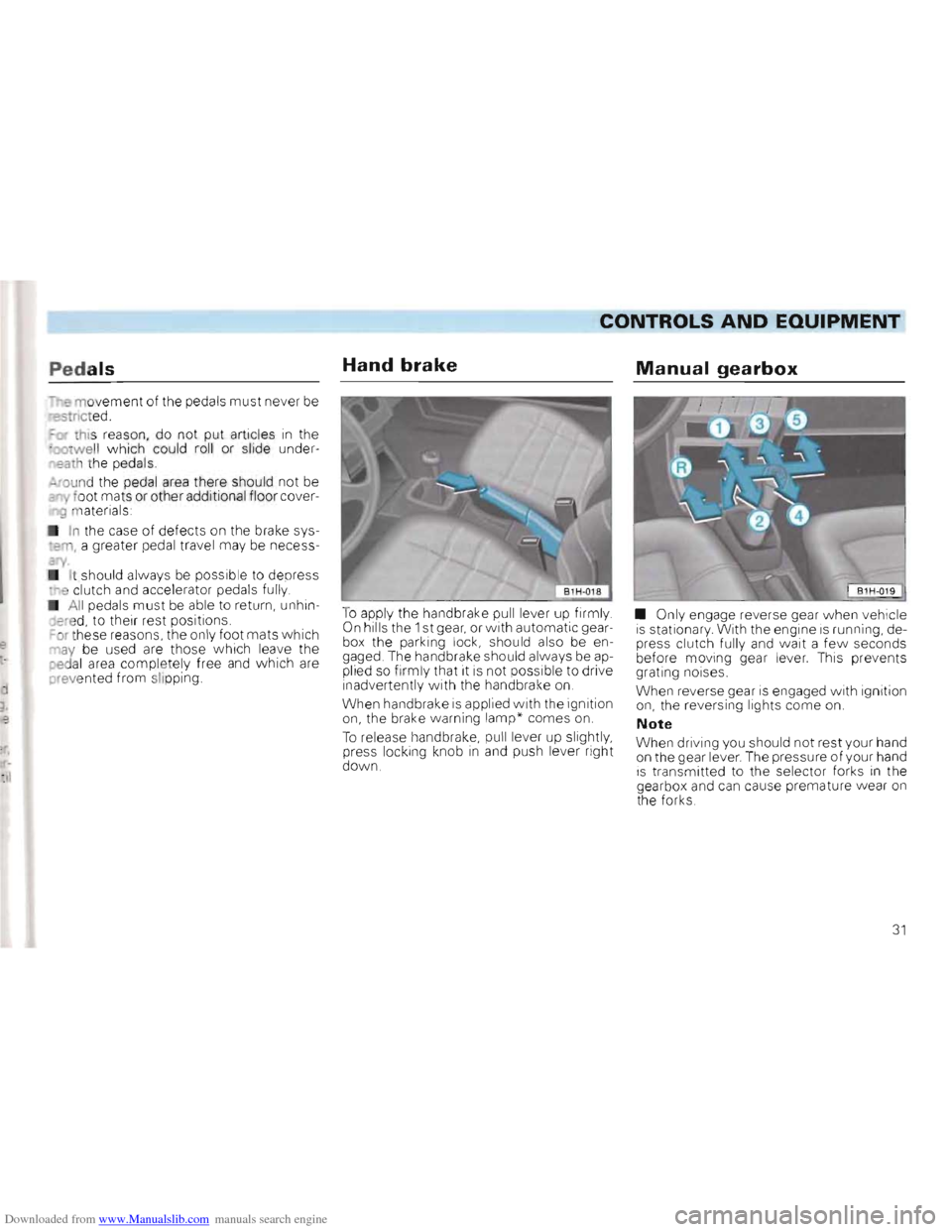
To apply the handbrake pull lever up firmly . On hills th e 1 st gear, or with automatic gear
box the parking lock, sho uld also be en
gaged. The handbrake should a lways be applied so firmly that it is not possible to drive inadve rtentl y with the handbrake on.
W h
en handbrake is applied with the ignition on, the brake warning lam p* comes on.
To release handbrake, pu ll lev er up slightly ,
press locking knob in and push lever right
do w n.
Manual gearbox
• Only engage reverse gear when vehicle is st ationary With the engin e is running, de
press clutch fully and wait a fe w seconds before mo ving gear lever. ThiS prevents
g rating noises .
When
rev erse gear is engaged with ignition on , the reversing lights come on.
Note
When driving you shou ld not rest your hand
on th e gear lever . The pressure of your hand is transmitted to the selector forks In the
gearb ox and can cause premature wear on the forks .
31
Page 34 of 156
Downloaded from www.Manualslib.com manuals search engine Automatic gearbox*
Driving programmes
The gearbox control unit is equipped with two driving programmes:
• Sport programme
• Economy programme
The programme is selected automatically depending on operation of the accel
erator pedal.
The sport programme is selected if the
accelerator pedal is operated rapidly. In this
case the accelerator pedal need not be de
pressed to the point of kick-down (see
Page 33). In the sport programme, full use is made of the engine's power reserves
through delayed change to higher gear
The
economy programme is selected
when the acce lerator, pedal is operated
s lowly or normally. Fuel consumption is reduced by changing early into higher gear and later into lower.
Selector lever lock
In positions "P" and " N" with the ignition
s wi tc h on the selector lever is locked . To move the selector lever out of these posi
t ions the brake pedal must be depressed and the selector lever button pushed in .
This prevents a gear being engaged inadver
tently
and the vehicle unintentional ly mov
ing off .
A de l
ay circuit prevents the selector lever
f rom locking when it is moved quickly past the" N" position (for Instan ce from" R" to "
D " ) This enables for examp
le the vehicle
to be " rocked" out of a "bogged down "
position The shift lock only locks the selec
tor
leve r if it is left in the " N" position for
more than about 1 second without the
brake pedal being depressed.
At speeds above 5 km/h the selector lever
is automatically switched-off in position "N".
Selector lever positions
P -Parking lock
The driving wheels are lock ed mechanically
The parking lock may only be engaged
when the vehicle is stationary. Before mov
ing the lever in or out of the" P" position the
lock button in the selector lever handle
must be pressed. Before moving the selec
tor lever out of
the" P" pOSition, the brake
pedal must also be depressed w hen the
ignition is switched on .
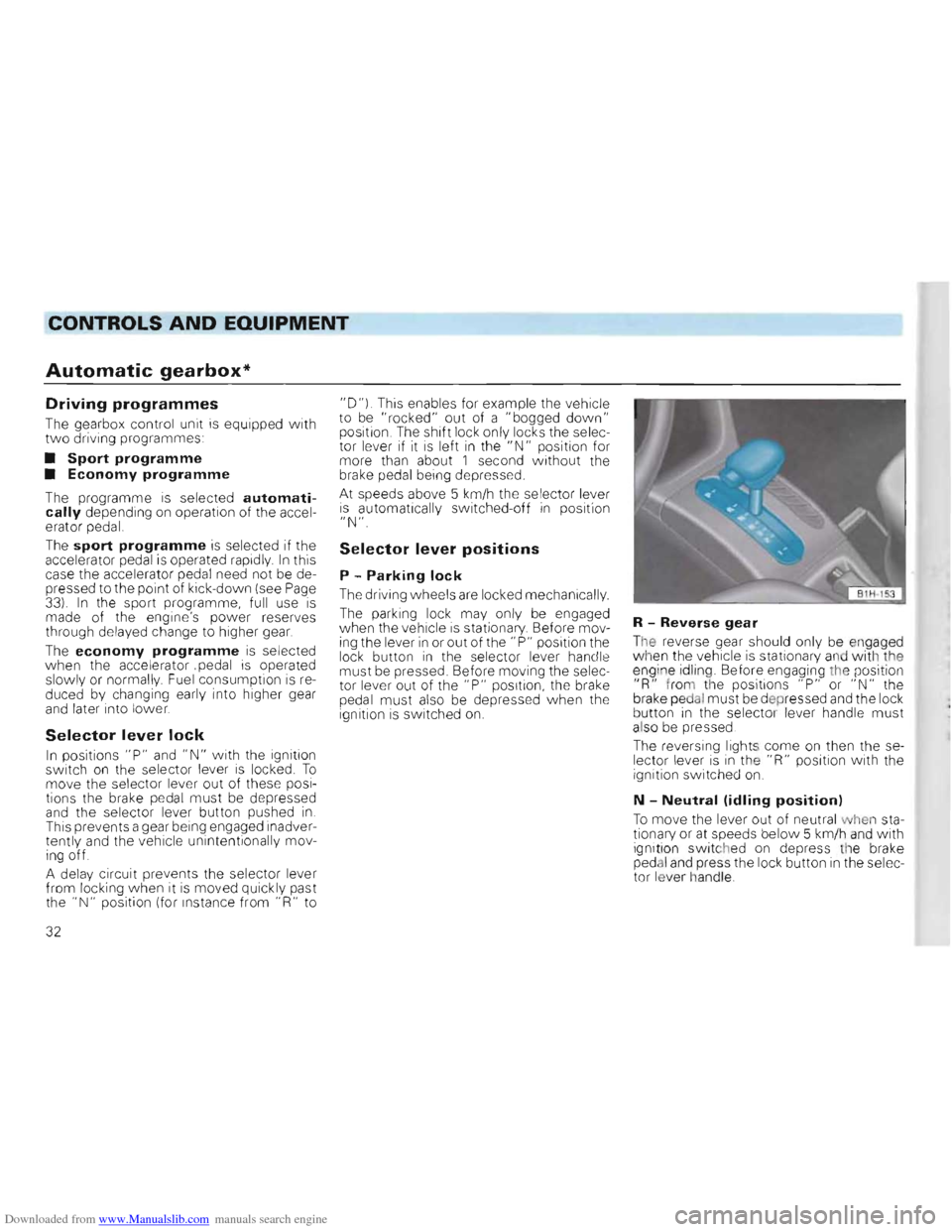
R -Reverse gear
The reverse gear should only be engaged
when the vehicle is station ary and with the
eng ine id ling. Before engaging the position
"R " from the positions "P" or "N " the
brake pedal must be d epr essed and the lock
b u tton in the selecto r lever handle must
also be p re ssed .
The
reversing lights come on then the se
l e cto r leve r is in the "R" position with the
ignition switched on.
N -Neutral (idling position)
To move the leve r out of neutral when sta
tionary or at speeds below 5 km/h and with
ignit ion switc hed on depress the brake
ped al and press the lock button in the selec
t or lever handle .
32
Page 36 of 156
Downloaded from www.Manualslib.com manuals search engine CONTROLS AND EQUIPMENT
• Attention • When the engine is running it is necessary to hold the vehicle with the foot brake in all gears. Because with an automatic gearbox the transfer of power is not fully interrupted even at idling speed -and the vehicle tends to "creep". If a driving range is selected while the vehicle is stationary, the throttle must on no account be opened (e.g. by hand from inside the engine compartment). The vehicle can then start moving, possibly even when the hand brake is applied.
Before working on a running engine, ensure that selector lever is
in position "p" and thatthe handbrake is applied.
Moving off
Select driving range (R, 0, 3, 2, 1) Wait until the gearbox has shifted and the power flow is made to the driving
wheels (light selection jerk perceptible). Then one can accelerate.
Stopping
To stop vehicle temporarily such as at traffic
lights, it is only necessary to apply the
brakes. It is not necessary to move selector
lever to "N". The engine should however on ly be running at idling speed.
Parking
On level ground all you need do is engage
the parking lock. On a gradient the hand
brake should be applied firmly first and then
the parking lock engaged. This will ensure
that the locking mechanism
is not too heav
ily loaded and makes the lock easier to dis
engage .
Tow starting
On vehicles w ith automatic gearbox the en
gine cannot be started by towing or pushing
the vehicle. See page130 .
When the battery
is flat. the engine can be started from the battery of another vehicle
by using jumper cables See" Emergency starting", page 128.
Towing
If the vehicle has to be towed at any time ,
you must read the instructions in the sec
tion "Towing/tow starting on page 129.
Emergency programme
If functional defects occur in the electronic system the gearbox can, amongst other
things, carry on operating in two emergency
programmes: •
The gearbox continues to change up
and
down automatically as before but hard shift
jerks are however noticeable. The vehicle
should
be taken to a Volkswagen dealer.
• The gearbox no longer changes up and
down automatically.
The gearbox can then be shifted manually
but in the selector leve r positions "0", "3"
and "2" only the 3rd gear is available.
I n se lector lever positions " 1 " and " R", the
1 st and reverse gears
are available as nor
mal .
However, the converter must. due to the
absence of 2nd gear work harder ,
and under
certain circumstances this causes the con
verte r to overheat.
In a case such as this the
vehicle should be taken, as soon as poss
ible, to a Volkswagen dealer.
34
Page 37 of 156
Downloaded from www.Manualslib.com manuals search engine CONTROLS AND EQUIPMENT
Height adjustable
steering wheel*
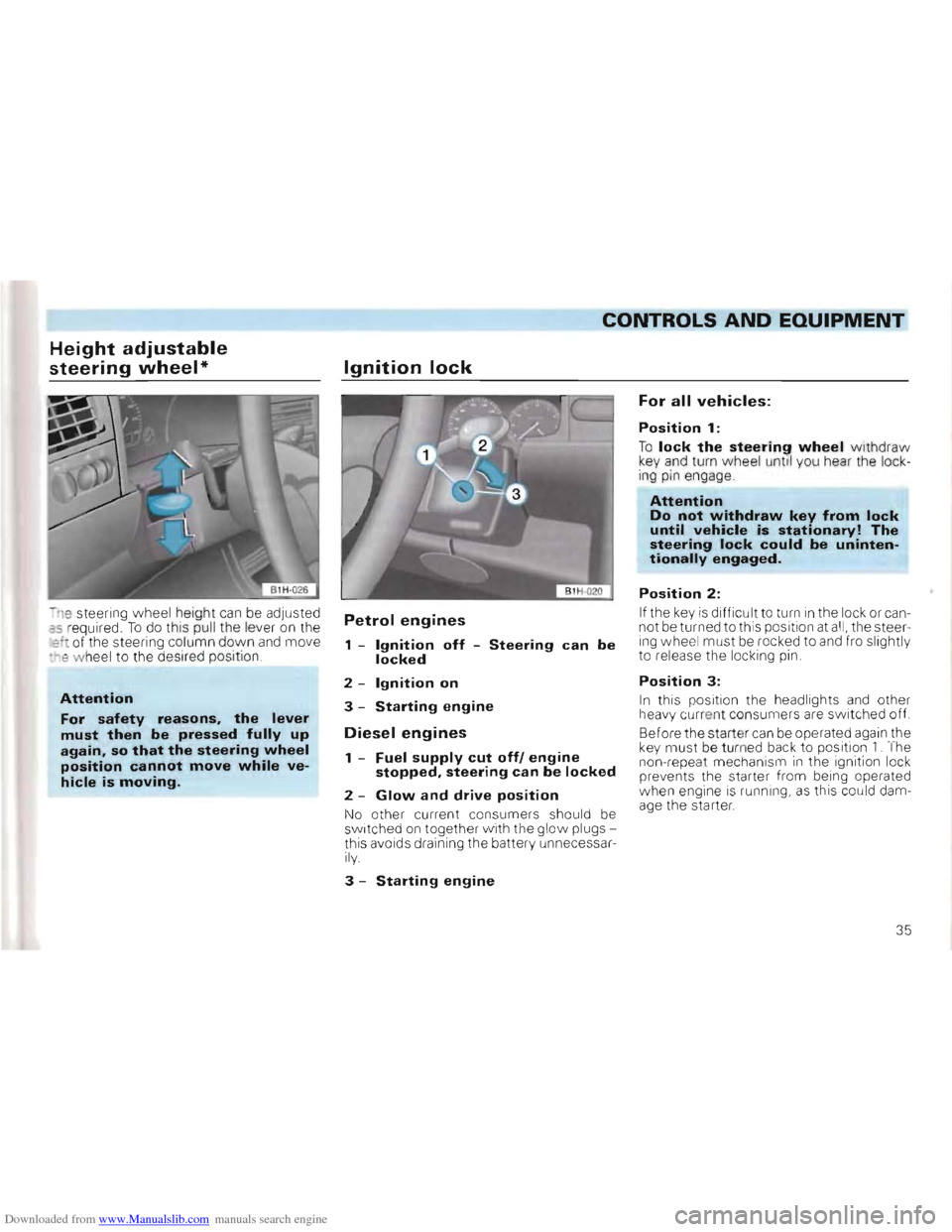
-n e steering wheel height can be adjusted as r equired . To do this pull the lever on the :::1 of th e stee ring co lumn down and move -~e w hee l to the desir ed position
Attention
For safety reasons, the lever
must then be pressed fully up again, so that the steering wheel position cannot move while ve
hicle is moving.
Ignition lock
Petrol engines
1 -Ignition off -Steering can be locked
2 -Ignition on
3 -Starting engine
Diesel engines
1 -Fuel supply cut off! engine stopped, steering can be locked
2 -Glow and drive position
No other current co nsumer s should be sw itc hed on together w ith the glow plugs
this aVOi d s dra ining the batte ry unn ecessa rily.
3 -Starting engine
For all vehicles:
Position 1:
To lock the steering wheel withdraw key and turn wheel unti l you hear the lock
ing pin engage
Attention Do not withdraw key from lock until vehicle is stationary! The steering lock could be unintentionally engaged.
Position 2:
If the key is difficult to turn in the lock or can
not be turned to this position at all, the steer
ing wheel must be rocked to and fro slightly
to release the locking pin .
Position 3:
In this pos ition the headlights and other
h eavy cu rre nt consume rs are switched off.
Before the start er
can be operated again the key must be turned back to position 1. The
non-repeat mechanism in the ignition lock
prevents th e starter from being operated
w hen engine
is ru nning, as this could dam
age the starter.
35