1993 VOLKSWAGEN GOLF check engine light
[x] Cancel search: check engine lightPage 10 of 156
Downloaded from www.Manualslib.com manuals search engine CONTROLS AND EQUIPMENT
Anti-theft warning
system*
Tailgate
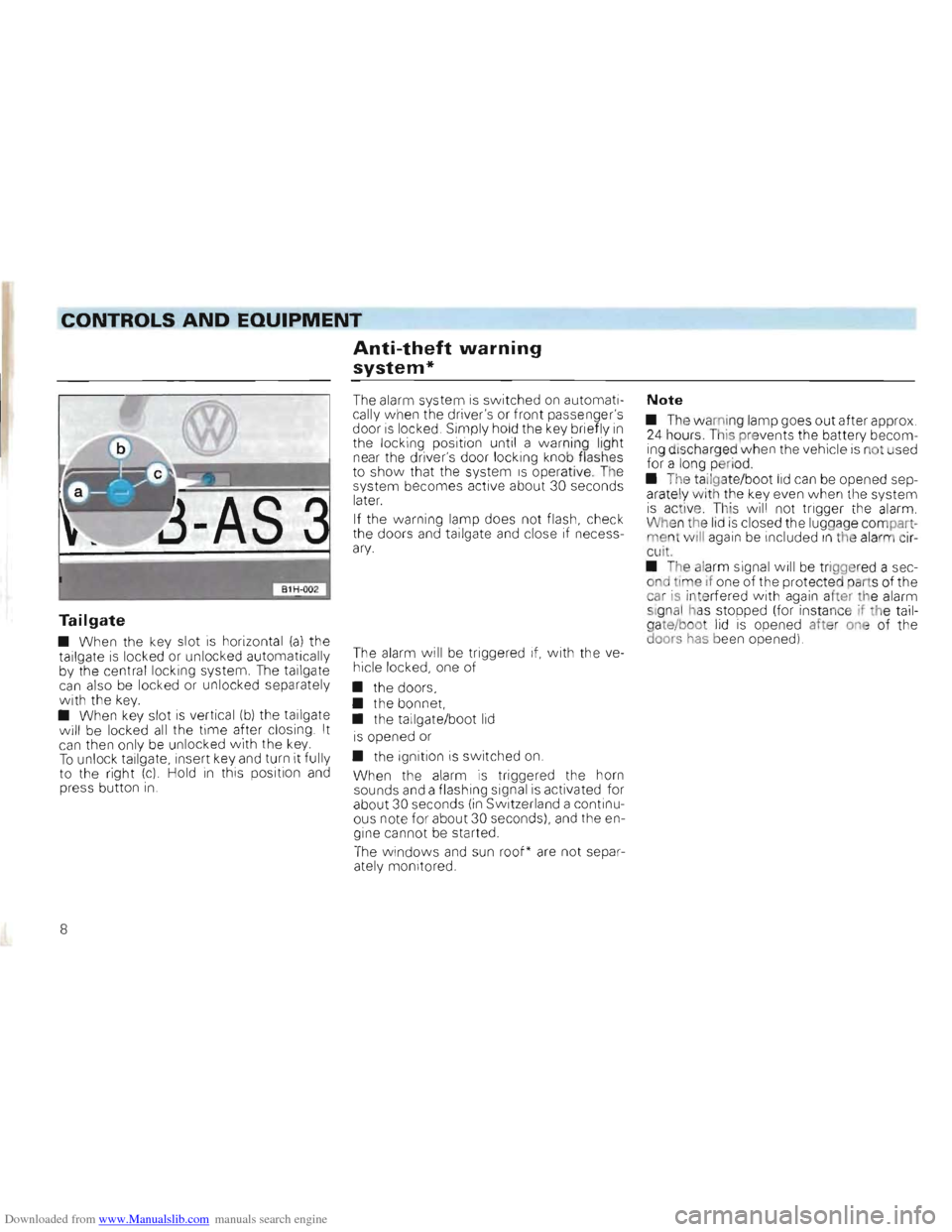
• When the key slot is horizont al (a) the
tailgate is locked or unloc ked automatically
by the central locking system. The tallgate can also be locked or unloc ked separately with the key. • When key slot is vertical (b) the tailgate
will be locke d all the time after closing . It can the n only be unlocked with the key. To unlock tailgate , insert key and turn It fully
to the right (c) Hold in this position and press button in .
The alarm system is switched on automatically when the driver's or front passenger's door is locked. Simply hold the key briefly in the locking position until a warni ng light
near the driver's door locking knob flashes
t o show that the system IS operative. The
system becomes active about 30 seconds
lat
er.
If the warning lamp does not flash, check
the doors and tailgate and close if necessary.
The alarm will be triggered if, with the ve
hicle locked, one of
• the doors,
• the bonnet,
• the tailgate/boot
lid
is opened or
• the ignition is switched
on.
When the alarm is triggered the horn
sounds and a flashi ng signal is activated for
about 30 seconds (in Switz erland a continu
ous note for about 30 seconds), and the en
gine cannot be started .
The windows and sun roof* are not separ
ately monitored .
Note
• The wa mi ng lamp goes out after approx . 24 hours. T hiS pre ven ts the battery becom
ing disc harged when the vehicle is not used for a long peri od
• The
tailgate/boo t lid can be opened sep
arate ly wi th the key even w hen the system is active . This wi ll not trigger the alarm .
Whe n the lid is closed the luggag e compartment wili again be included In the alarm circu it.
•
The alarm signal will be triggered a sec
ond time if one of the protecte d part s of the
car
is inte rfered w ith again aher th e alarm
si gnal has stopped (for insta nce if the tailgate/boo t lid is opened after one of the
doors has been opened)
8
Page 20 of 156
Downloaded from www.Manualslib.com manuals search engine CONTROLS AND EQUIPMENT
Airbag-System*
Vehicles with Airbag System for the driver and passenger can be recognized by an inscription "AI RBAG" on the steering wheel padded plate and on the right end of the dash panel.
Supplementary to the three point seat belts the Airbag System offers additional protection for the driver's and passenger's head and chest In a serious
frontal collision.
Apart
from its normal protective function the seat belt also has the task of keeping the
driver or passenger in such a position so
that the Airbag can offer maximum protec
tion in the case of a frontal collision.
The Airbag system will not be triggered for:
• Side collisions
• Rear collisions
•
Rol l i ng-over
• Minor frontal collisions
Therefore the seat belts should always be used not only for reasons of statutory regulations, but also for safety reasons!
Essentially the system consists of
• The electronic control and monitoring
unit
• Both airbags (air sack
with gas gener
ator) with gas generator for the:
- Driver (in steering wheel),
- Passenger (in right of dash panel)
• A
warning lamp in the dash panel -see
page 49.
The functional readiness of the Airbag
System is electronically monitored.
Each
time the ignition is switched on the
warning lamp lights for about 3 seconds
(self diagnosis).
The system has a fault, if
• When switching on the ignition the warn ing lam p does not light.
•
After swi tching on the ignition the warn
ing la m p does not extinguish after about 3
second s
• The warning lamp
comes on or flickers
du rin g the Journey.
Attention
When a fault is present the sys
tem should be checked by a
Volkswagen dealer immediately.
Otherwise there is the danger
that the Airbag will not be acti
vated in the case of an accident.
18
Page 47 of 156
Downloaded from www.Manualslib.com manuals search engine CONTROLS AND EQUIPMENT
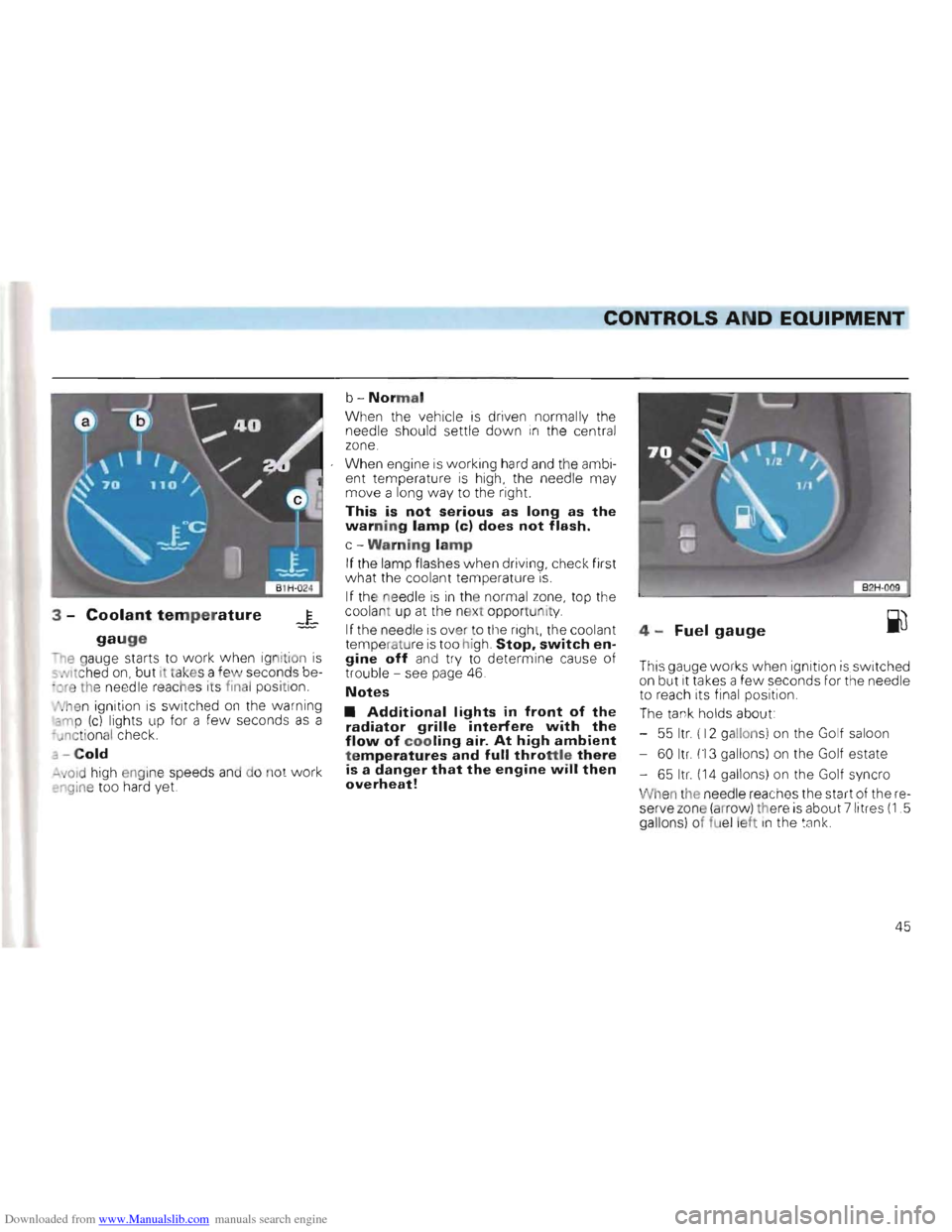
3 -Coolant temperature _~_
gauge
-I
' he n ignition
is switched on the warning amp (c) light s up for a few seconds as a
- u ncti onal check.
3 -Cold
~old high engin e speeds and do no t work engine too hard yet.
b-Normal
When the ~ehicle is dri~en normally the
needle should settle down in the central
zone.
When engine
is working hard and th e ambi
ent temperature is high, the needle may
move a long way to the right.
This is not serious as long as the warning lamp (c) does not flash.
c -Warning lamp
If the lamp flashes when driving , check first
what the coolant temperature is.
If th e needle
is in th e normal zone, top the
coolan t up at the next opportu nity.
If the needle is over to th e rig ht, the coolant
temperat ure is to o high. Stop. switch engine off an d try to determine cause of trouble -see page 46 .
Notes
• Additional lights in front of the radiator grille interfere with the flow of cooling air. At high ambient temperatures and full tt:arottl~ there is a danger that the engme Will then overheat!
4 -Fuel gauge
This gauge works when ign ition is. switched
on but it takes a few seconds for the need le
to reach its fina l posit ion.
The ta holds about
-55 ItL (1 2 gallons) on the Golf saloon
- 60
Itr. (1 3 gallons) on the Golf estat e
- 65 Itr.
(14 gallons) on the Golf syncro
W
hen the needle reaches the start of the re
serve zone (arrow) th ere is about 7 litres (1. 5
gallons) of fue l left in the tank .
45
Page 48 of 156
Downloaded from www.Manualslib.com manuals search engine CONTROLS AND EQUIPMENT
Warning lamps
Attention • Be careful when opening the coolant expansion tank! When the engine is hot the cooling system is under pressure -Danger of scalding! Let engine cool down therefore before unscrewing the cap_
• Do not touch the fan. The fan can switch on suddenly -even when ignition is switched off.
For furthe r details see pages 98 and 98.
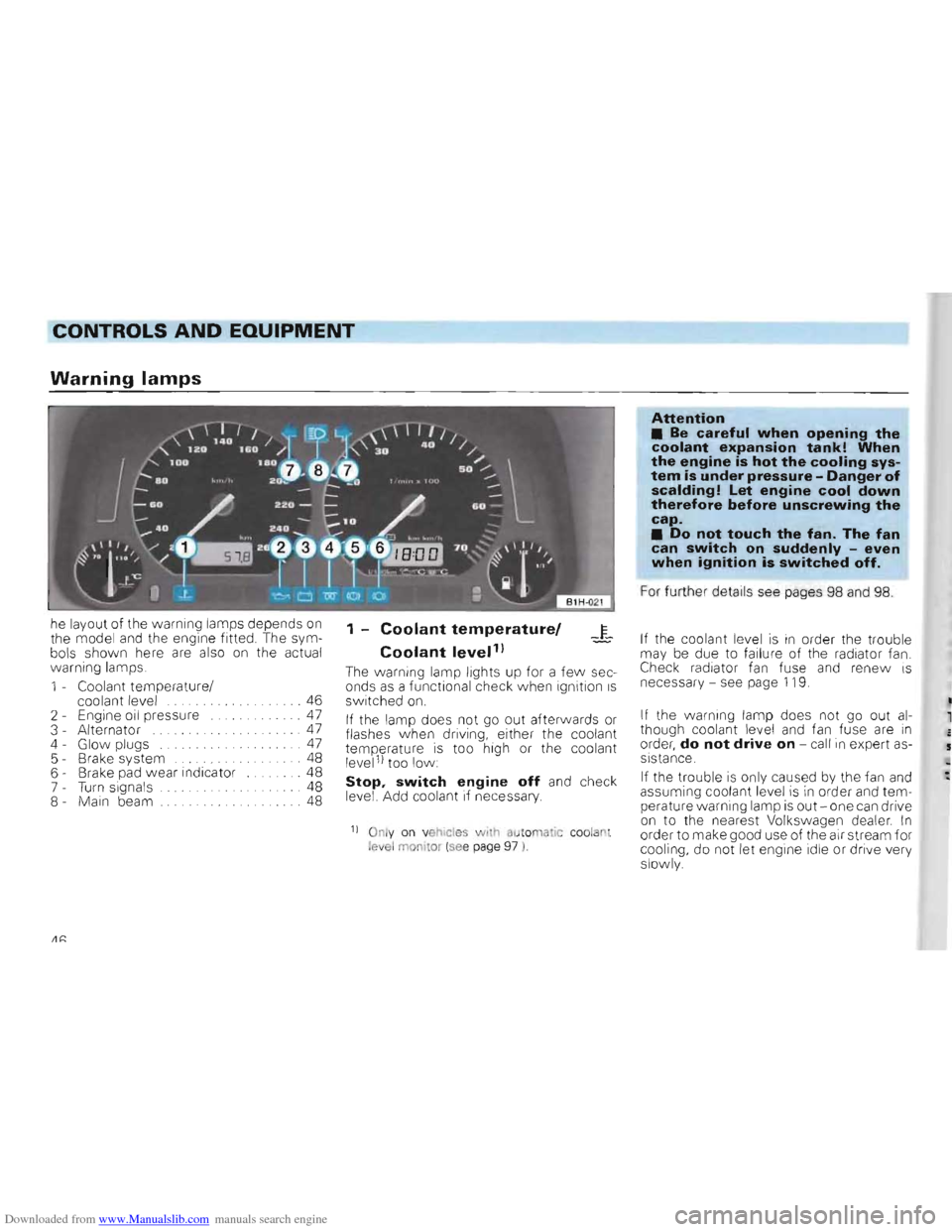
1 -Coolant temperaturel _~_ If the coolant le vel is in orde r the trouble Coolant level') may be due to failure of the radiato r fan.
Check radiator fan fuse and renew is
T he wa rni ng lamp lights up for a few sec
necessary -see page 119.onds as a functional check when ign ition IS coo lant level .
. 46 switched on.
2 - Engine oil pressure ... .. 47 If the warning lamp does not go out al
If the lamp does not go out afterwards or 3 -Alternator . 47 though coolant level and fan fuse are inflashes when driving, either the coolant 4 -Glow plugs ... 47 orde r, do not drive on -call in expe rt astempe ratur e is too high or the coolant 5 -Brake system .. 48 sistance
.
level1 l too low: 6 -Brake pad wear indicator .48 If the trouble is only caused by the fan andStop, switch engine off and check7 -Turn signals 48
assuming coolant level is in order and temlevel . Add coolant if necessary . 8 -Main beam .
48
perature warning lamp is out -one can drive on to the nearest Volkswagen dealer. In 11 Only 011 vehicl es wi h a t omatic coolant order to make good use of the air stream for level lllonit or (see page 97 l. cooling , do not let engine idle or drive very
slowly .
he
layout
of the warning lamps depends on the model and the engine fitted. The sym
bols shown here are also on the actual
warn ing lamps.
1 -Coolant temperature /
Page 49 of 156
Downloaded from www.Manualslib.com manuals search engine CONTROLS AND EQUIPMENT
2 -Engine oil pressure ~
e wa rning lamp flashes when ignition is :ched on. the lamp must go out when ,=~g ne has started.
, 'Il e warning lamp does not go out or
ash es when driving -a buzzer also sounds
-' e!,gine spe,eds above 2000 rpm -stop, switch engine off, check oil level and if ecessary, add oil -see page 94.
- - he lamp comes
on although the oil level 5 n order, do not drive on. Do not even "'., t he engine at idling speed -call in expert ~slstance.
-du ring the Journe y the engine is operated
a : a speed less than idling speed, it ca n ~ appen that the oil warning lamp lights up. "crease engine speed by accelerating or :'langing down .
Note Th e oil pressure warning lamp is not an oil level indicator. The oil level shou.'d therefore be checked at reg, ular Intervals, preferably every time the fuel tank is filled.J
3 -Alternator
The warning lamp comes on w hen the igni
tion IS sWitched on and must go out when
the engine is started .
The alternator
is driven by a long-life ribbed
belt.
If the warning lamp lights during the
Journey ,
stop, switch off engine and
check ribbed belt.
If
t~e ribbed belt is loose or broken, do not
drive on -the coolant pump is no longer
being driven. The ribbed belt must be
checked/renewed by the next Volkswagen
dealer.
If the ribbed belt
is not loose or broken, one
can normally drive on to the next Vo lks
wag en dea ler. However as the battery is
then discharging co ntinuously , all electrical
consumers which are not absolutely essen
tial should be switched off.
4 -Glow plugs
(Diesel engines only)
When the engine
is cold the w arning lamp
come s on when key IS turned to Drive posi
tion (ignition on)
If the warning lamp does not come on, there IS a defectln the glow plug system -call in expert assistance.
When the lamp goes out, start the engine
Immediately -see page 37.
As the 55 kWDiesel engine glow period be
gins automatically after closing the drivers'
door,
It can happen that after switching to
the driving position (Ignition on) with a cold
engine, that the glow plug warning lamp
does not light up . The engine
can be started
straight away
When the engine
is warm the glow plug
lamp does not come on -the engine ca n be started straight away
Note
If while driving a fault occurs in the engine
management system of the 66 kW Diesel
engine, this
is indicated by a flashing warnIng lamp The engine must be checked by a
Volkswagen dealer as soon as possible.
47
Page 50 of 156
Downloaded from www.Manualslib.com manuals search engine CONTROLS AND EQUIPMENT
5 -Brake system
(CD)
The warning lamp* co mes on when
• the handb rake is
on • the brake fluid level is too low The ignition must be switched on.
Attention
If the lamp does not go out when handbrake is released or comes on when driving, the fluid level in the reservoir is too low. Immedi
ately contact a Volkswagen dealer and have the brake system
examined.
You can drive on carefully to the
nearest Volkswagen dealer but allow for higher pedal pressures and longer braking distances on
the way.
I6 -Brake pad wear I,'0',
indicator*
The wa rning lamp lights up for one second when the ignition is switched on as a func
tiona l check.
If the lamp then does not go out or it lights
up dur ing the Journey , the front brake pads
are worn. You should visit a Volkswagen
dealer to have the brake pads checked.
As the brake pad wea r indicator only moni
t ors the front brake pads, we recommend
that you have the rear brake linings checked as well.
7 -Turn signals
The warn ing lamp flashe s when turn signals are sWitched on. If a turn signal fails, the
warning lamp flashes tw ice as fast. (Not
w hen towing a trailer )
Fur ther details are given
on pages 49 and 53.
8 -Main beam
The warning lamp come s on when th e main
beam is on or when the headligh t flas her is used.
48
Page 75 of 156
Downloaded from www.Manualslib.com manuals search engine DRIVING TIPS
The technical prerequisites
for a low fuel consumpt ion and efficienc y "" ere " built in" at the factory. Particular Im
p ortance was placed on the lowes t possible
d is turban ce to the enviro nme nt. To retain and make the best possible use of these characteristics attent ion should be paid to the fo llow ing points
~Even those vehicles which do W not have a catalytic converter should be driven on unleaded petrol for the sake of the environment.
~The prescribed maintenance W operations should be carried out exactly as specified in the Service Schedule.
Having your vehicle regularly serviced by a Volkswagen dealer not only ensures that it is always operationally fit, but it also ensures economy, lowest possible burden on the environment and a long service life.
~Check the tyre pressures every 4 W weeks.
Low tyre pressures increase the rolling resistance. This not only increases the fuel consumption and tyre wear, but the handling is also impaired.
~Do not carry unnecessary ballast W in the luggage boot
Particularly in town traffic when one has to accelerate often, weight has a great influence on the fuel consumption. As a
rule ofthumb: For every 100 kg ofweight the consumption increases by approximately litre per 100 km.
~Remove roof rack immediately Wafter use
Particularly at high speeds the increased air resistance makes itself felt considerably.
~Electrical consumers should W only be switched on when they are actually required
Heated rear windows, additional driving lights and heater blower consume a considerable amount of current. The higher alternator load also increases the fuel consumption. For instance, overa period of 10 hours, the heated rear window will increase the fuel consumption by approximately 1 litre.
~Check the fuel consumption regW ularly
The fuel consumption should be checked each time the tank is filled up. By doing this inconsistencies on the vehicle which lead to an increased fuel consumption can be discovered sooner.
• Check the engine oil level each time the tank is filled up The oil consumption depends to a g reat ex
tent on the engine load and speed. Depend
ing on the style of driving the consumption
can be as much as 1 .0 litr es/1 000 km .
It
IS no rmal fo r the oil consumption of a ne w
engine to reach its lowest level after a cer
tain mileage has be en covered . The con
sumption cannot be properly assessed until
the vehicle has run appro x. 5000 km.
This also applies to the fuel consumption
and the engine output.
73
Page 78 of 156
Downloaded from www.Manualslib.com manuals search engine DRIVING TIPS
Anti-locking brake system *
The AB S plays a major part in i ncreasing the active safety of the vehicle . The big adva ntage when compa red with a conve ntional brake system is t hat even when braking
hard on a s lippery road surfac e the bes t
poss ib le ste erabili ty is retained for the road
cond it io n because the wheels do not lock.
H
owever o ne mus t not expec t the ABS
sys tem t~ sho rt en the brak ing dis ta nce in all co nditions. When driv ing on grave l or o n
fr esh snow cove ring a slipp ery surf ace, I.e. when one shou ld be driving very care fully In
a ny case, the s topping distance may even be slightly longer
How the ABS system works
A n automatic check is made when a speed
of approx. 7 km/h is reached,. When this
hap pens a pumping no ise can be heard. W
he n the tu
rning speed of a w heel reac hes a leve l which is too low fo r the ve hicle speed
and it ten ds to lock , the brake pre ssu re to
t his whee l is r educ ed. On the fron t axle the
b rake press ure is regulated fo r eac h wheel
ind iv idually, whereas on the rear axle, the
press ure is regulated fo r bo th wheels at the
sam e tim e. As a result the braking effect IS the same f or both rear w heels and the driving stabi lity is reta ined as f a r as po~sible. This regulating process makes Itself known by movement .of the b~ake pedal and is accompanied by nOises. This is do ne deli berat ely as a warni ng to the
driver that a wheel or the wheels a re In th e
lock ing range So that the ABS can r egu la te
effec tively in th is range the brake peda l
must remai n depressed -on no account
should it be pumped l
Attention However the ABS system cannot overcome the physical limits. This must be borne in mind particularly on slippery or wet roads. When the ABS com es into the control range the speed must immediately be adapted to the road and traffic conditions. The increased amount of safety available must not tempt one into taking risks.
If a def ect occurs o n the ASS It is indicated by a warni ng lamp -see page 49.
76