Downloaded from www.Manualslib.com manuals search engine DO-lT-YOURSELF
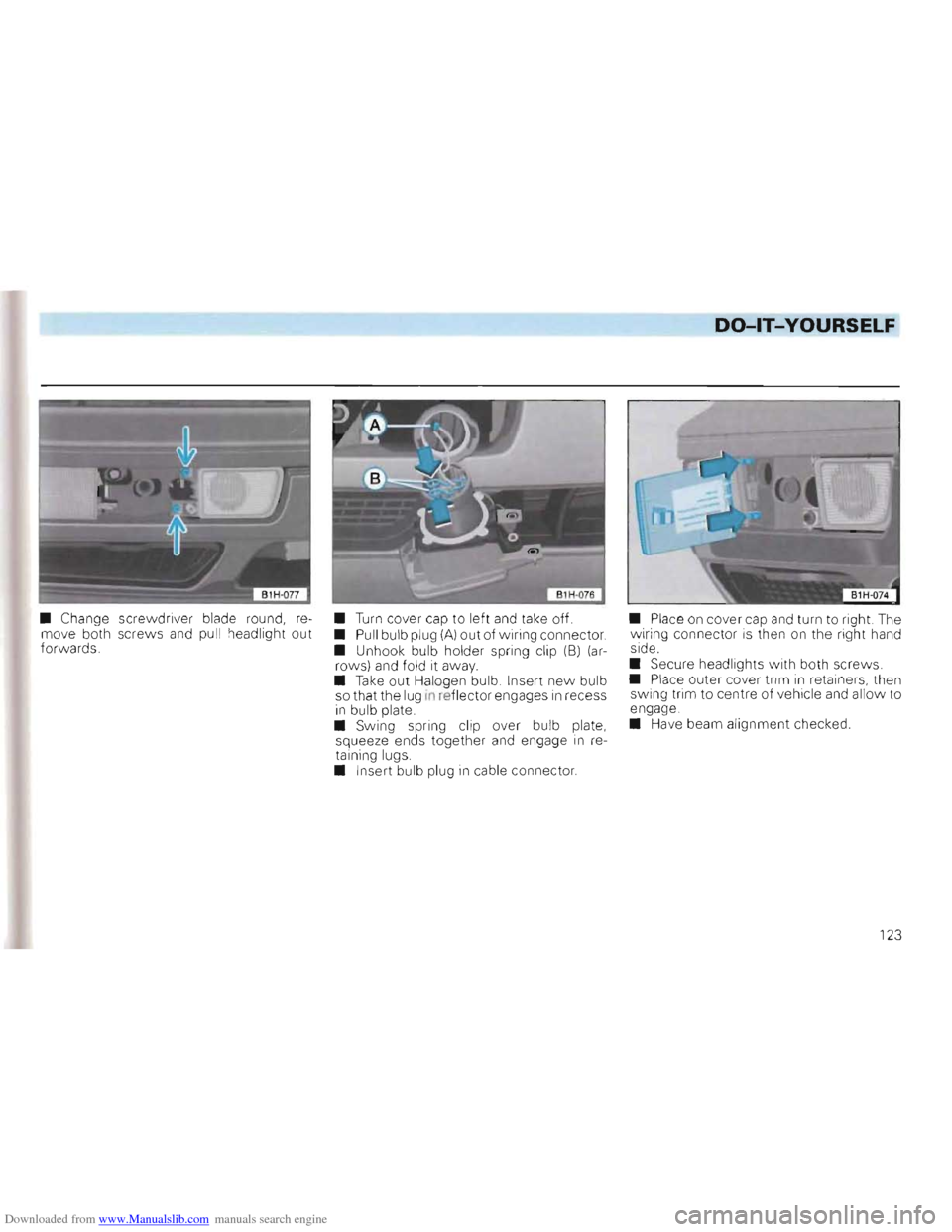
• Change screwdriver blade round, re
move both screws and pull headlight out forw ards. •
Turn cover
cap to left and take off.
• Pull bulb plug (A) out of wiring connector.
• Unhook bulb holder spring clip (8) (arrows) and fold it away.
•
Take out Halogen bulb. Insert new bulb
so that the lug in reflector engages in recess in bulb plate.
• Sw ing spring clip over bulb plate,
squeeze ends together and engage in
re
taining lugs.
• Inse rt bulb plug
in cable connector. •
Plac e
on cover cap and turn to right. The wiring connector is then on the right hand
side.
• Sec ure headlights
with both screws.
• Place outer cover trim in retainers, then
swing trim to centre of vehicle and allow to
engage.
• Have beam alignment checked .
123
Downloaded from www.Manualslib.com manuals search engine DO-lT-YOURSELF
Tow startingfTowing
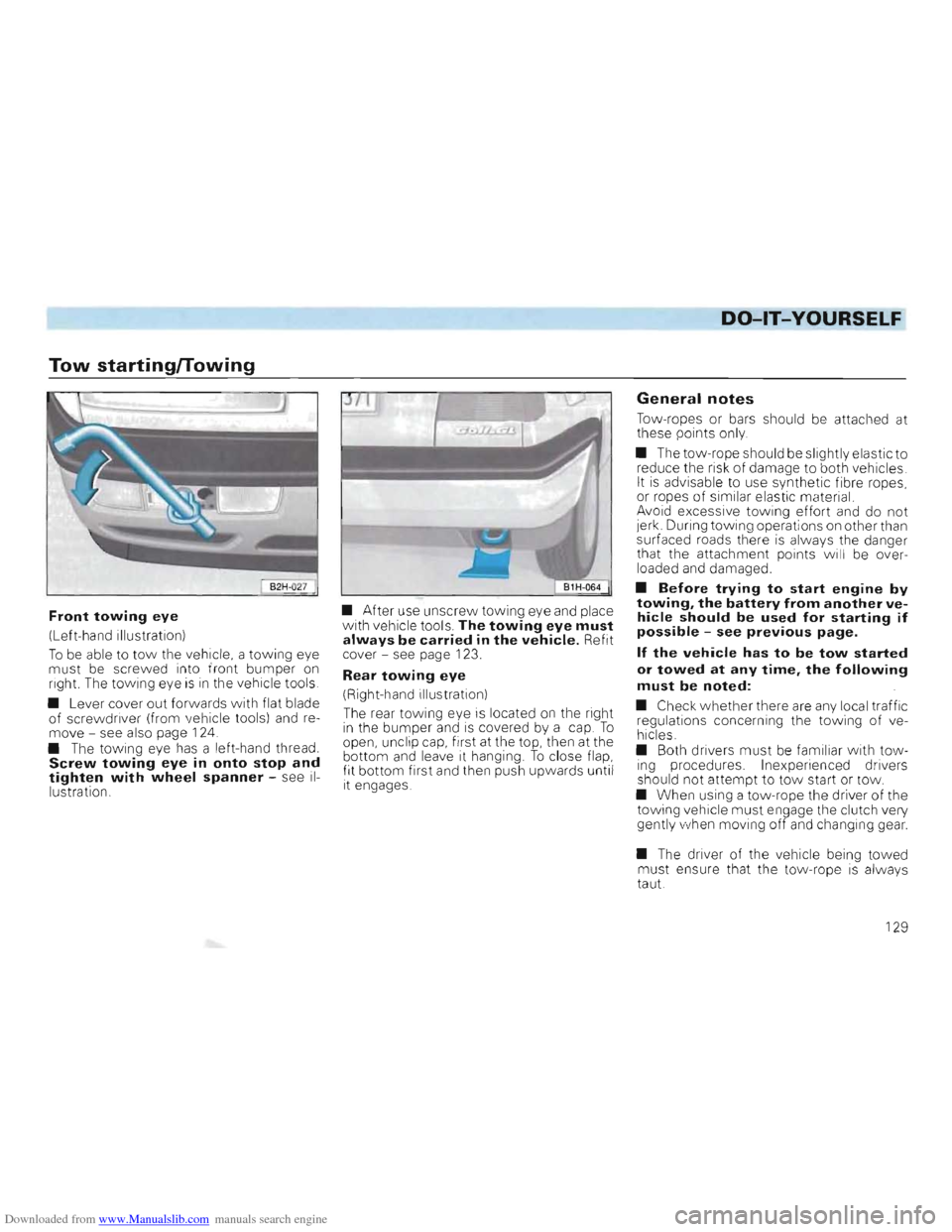
Front towing eye
(Left-hand illustration)
To be able to tow the vehicle, a towing eye
must be screwed into front bumper on
right. The towing eye is in the vehicle tools .
•
Lever cover out forwards with flat blade
of screwdri ver (fro m vehicle tools) and remove -see also page 124.
• The towing eye has a left- hand thread . ~crew to~ing eye in onto stop and tighten with wheel spanner -see illustration.
• . After use unscrew towing eye and place with vehicle tools. The towing eye must always be carried in the vehicle_ Refit
cove r -see page 123.
Rear towing eye
(Right-hand illustration)
The rear
towing eye is located on the right In the bumper and is covered by a cap. To
open, unclip ca p, first at the top, then at the
botto m and leave it hanging To close flap, lit bottom first and then push upwa rds unti l It engages .
General notes
Tow-ropes or bars should be atta ch ed at
these points only.
• The tow- rope
should be slight ly elastic to
reduce the risk of damage to both vehicles .
It IS advi sable to use synthe tic fibre ropes ,
or ropes of Similar elastic materia l.
Avoid excessive towing effort and do not
Jerk. DUring tow ing opera tions on other than
surfaced roads there is always the danger
that the attachment points will be over
loaded and damaged.
• Before trying to start engine by t?wing, the battery from another vehicle. should be used for starting if possible -see previous page.
If the vehicle has to be tow started
or towed at any time, the following
must be noted: .
• Check whethe r there are any local traffic regulat ions concerning the towing of ve
hicles .
• Both drivers
must be familiar with towIng procedures. Inexperienced drivers
should not attempt to tow start or tow.
• When using a to w-rope the driver of the
towing vehicle must engage the clutc h very
gent ly
v,/hen moving off and changing gear.
• The driver of the veh ic le being
towed must ensure that the tow -rope is always ta ut.
129
Downloaded from www.Manualslib.com manuals search engine TECHNICAL DATA
Capacities
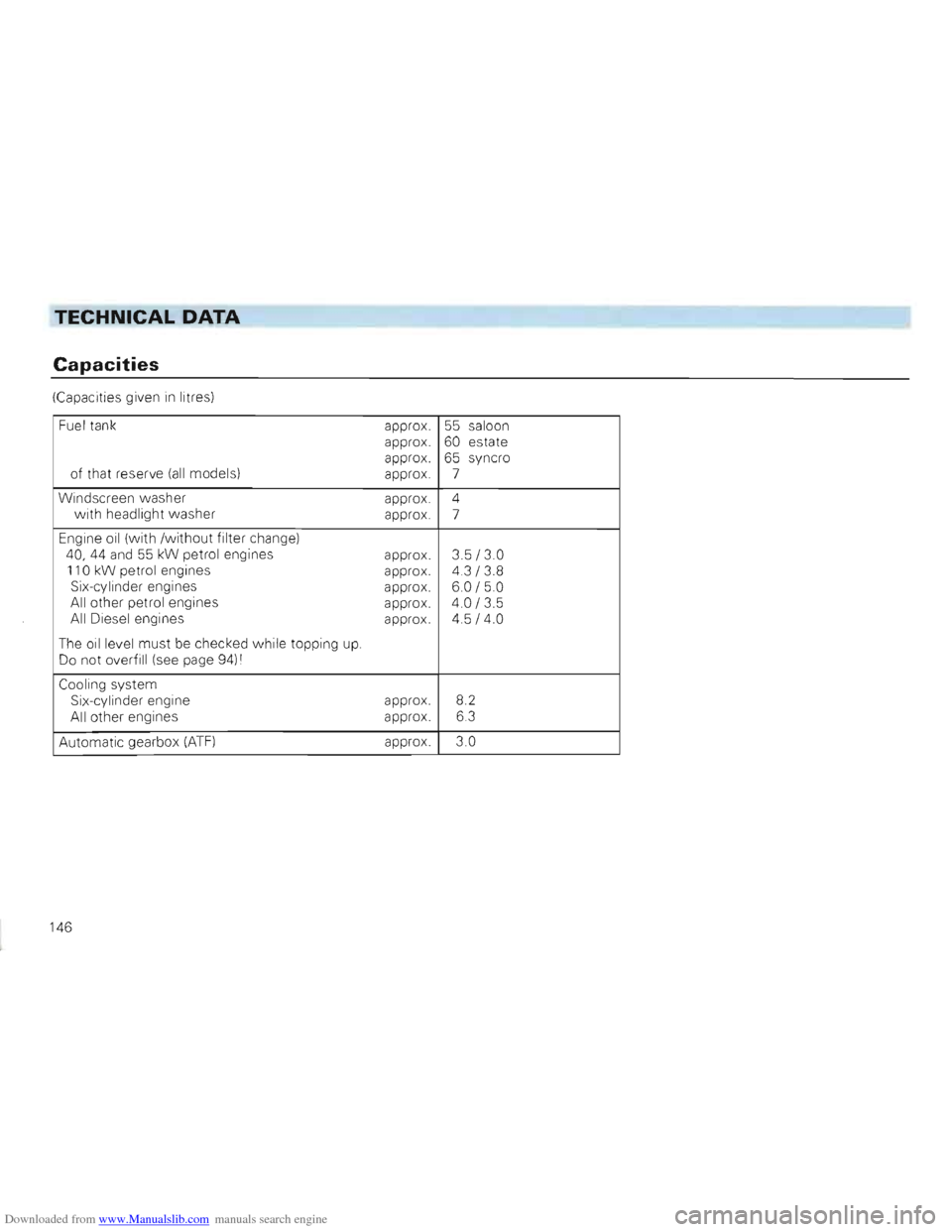
(Capacities given in litres)
Fuel tank
of that reser ve (all model s) approx.
a
p pro x.
a p prox.
ap pro x. 55
saloon
60 estate
65 syncro 7
Windscreen
w asher
with headlight w asher approx. approx.
4
7
Engine
oil (w ith Iwithout filter change)
40, 44 and 55
kW petrol engines
approx. 3 .5 I 3.0 110 kW petrol engine s
ap prox. 4 .3 I 3 .8 Six-cylinder engines
approx. 6.0 I 5.0 All other petrol engine s
approx. 4.0 I 3 .5 All Diesel engines
The oil level
must be checked while topping up.
Do not overfill (see page 94)
I
approx. 4.5 1 4 .0
Cooling system
Six-cylinder engine
All other engines approx.
approx. 8.2
6.3
Automatic gearbox
(ATF) approx. 3.0
146