1993 VOLKSWAGEN GOLF maintenance
[x] Cancel search: maintenancePage 4 of 156
Downloaded from www.Manualslib.com manuals search engine VEHICLE LITERATURE
In the vehicle wallet you will find, in addition
to this Instruction manual, a Service Schedule and a Service address list.
Also depending on vehicle model and equipment there can be various Supplements
(e.g. for car radio, Taxicabs and Hire cars)
If one of these publications appears to be
missing or you have the impression that the
information on some equipment or model
version
is not complete, please contact your
Volkswagen dealer. He will be pleased to
help you.
The Instruction Manual
should be read carefully as soon as possible
so that you get to know your vehicle quickly.
Besides regular care
and maintenance, cor
rect operation serves to maintain the value
of the vehicle and
is, in many cases, also
one of the stipulations for upholding war
ranty claims.
For safety reasons please note also the information on Accessories, modifications and the renewal of parts on page 111.
The Service Schedule
contains
identification data for your car
- the Service intervals
- the Service operations
- important details about Warranty
Service
work which has been carried out is also confirmed in the Service Schedule.
This can be important when a claim is made
under warranty.
Your should always present the Service
Schedule when taking the vehicle to a
Volkswagen dealer.
The Service address list
contains
- important addresses
and telephone
numbers
in Europe and overseas.
- important information on the Volks
wagen dealer emergency services
Notes on the layout of this Manual:
It describes the largest possible rang e of
equipm ent envisa ged at the time of go in g to
press Some 0 the equipment may be avall
able lat er on or n o t at all or will not be offere d in certain Expo rt markets.
Items of equip ment marked
with a * are
only standard on certain model versio ns or
are only availa b
le as optional extras on cer
tain models.
All blocks of text which have this colour backing and the title "Attention" refer to potential accident or injury risks.
& Texts following this symbol and ~printed in italics are i m p ortant notes on environmental protection.
One final request:
When you sell your car please give the co m
plete Vehic le Wallet to the new owner be
caus e the v ehicle literature belongs to the
vehicl e
2
Page 5 of 156
Downloaded from www.Manualslib.com manuals search engine CONTROLS AND EQUIPMENT
Dashboard and Controls ..... 4
. ey s, Cen tral locking . . .... 6, 7
::"tl-thef t warning system .... 8
Joors .......................... .... 9
oot lid .... ........... . . . . . 10
::Iectric windows .. . .. 10
• ~Irrors . . ..... . ... 12
Seal belts 13
"" rbag System . . . . . 18
Safe ty for children .. ... 21
ead restraints . . . . . .. 24
= ro nt seats . . . . . . . . . . . .. 25
Rear seat . . . 27
L u ggage compartment ... . ... . ...... 28
M esh partition (Estate) ...... 29
L u ggage compartment cover /
F olding/sliding cover
... 30
Pedals, Hand brake .. 31
Manual gearbox .... ... .... 31
Automati c gearbox . . . .. .......... 32
H eig ht-adjustable steering wheel ..... 35
I gnition lock. . . . . .. 35
Starting/stopp ing engine 36, 38
\lIstrumellts .. .... 39
Warning lamps ....... 46
Switches . . . . . . . . . . . . . . 50
Turn signal and dip lever ............. 53
Cruise control system ........... 54
Wi ndscreen wipe r and washer system 55
Heating an d ventilation .. . ...... 56
Air cond itioner ......' 59
Sliding/ti ltin g roof. . . . . . . . . . . . ... 65
Sun visors / Interior lights 66,67
Cigarette lighter, Ash tray ..... 68
Shelves and boxes . . . . . . . . . . . ... 69
Roof rack / Roof ra ilings ... 70
DRIVING TIPS
The firs t 1500 km -and after wards .... 71
Driving economically and ecologically .. 72
Brakes. . . . . . . . . . . . . . . . 75
Tra iler tow ing . .. ..... . .... ... ...... 77
Driving a four- wheel drive vehicle .. 79
GENERAL MAINTENANCE
Filling the tan k, Fuel. 81, 82
Care of vehicle ........ .. . . 85
Bonnet . . ... 90
Engine compartment .. ...... .... .... 91
Engine oil ..... .......... ........... 92
Automatic transmission fluid (ATF)* ... 96
Power-assisted steering .. 96
Cooling system . . . . . . . . . . .. . 97
B rake fluid ...... 99
Battery . . . . .. 100
Spark plugs. V-belts . . . . . . . . . 102
Washer system
... . .. 103
Windscreen w iper blades . . . 104
Dust a
nd pollen filter * . 104
Wheel s . 105
D riving abroad ..... ............... 110
Accessories, modifications and
renewa l ot parts .............. III
Mobile telephones and tw o-way rad ios 111
DO -lT-YOURSELF
First -aid kit, Warn ing triangle ........ 112
Storage of vehicle tools, spare wheel
a n d ball coupling trailer bracket ...... 113
Vehicle tools, Spare wheel 114
CONTENTS
Changing w heels . 116
F uses . ........ .. .. . . . ... . .... 119
Changing bulbs. . .... .. . 121
Installing radio . . . . .. 127
E mergency starting .. .. 128
Tow starting / to wing . . .. 129
L ift ing vehicle ......... 131
SPECIAL INFORMATION
Body ..... .... . .......... 132
Environmental compatibility ... 133
TECHNICAL DATA
Engine data . .. , .... .... . 134
P er forman ce .. ... ... ... . .. 136
Fuel consump tion .. 137
Wh eels
. . 139
T yre pressures
.. .. ... .. . . .. ... 1 4 1
Weights ... 143
Trailer weights .. 144
Dimensions. ...... .. ... 145
Capacities " ..... 146
Vehicle identification data ... 147
ALPHABETICAL INDEX
Alph abetical index ... 148
3
Page 75 of 156
Downloaded from www.Manualslib.com manuals search engine DRIVING TIPS
The technical prerequisites
for a low fuel consumpt ion and efficienc y "" ere " built in" at the factory. Particular Im
p ortance was placed on the lowes t possible
d is turban ce to the enviro nme nt. To retain and make the best possible use of these characteristics attent ion should be paid to the fo llow ing points
~Even those vehicles which do W not have a catalytic converter should be driven on unleaded petrol for the sake of the environment.
~The prescribed maintenance W operations should be carried out exactly as specified in the Service Schedule.
Having your vehicle regularly serviced by a Volkswagen dealer not only ensures that it is always operationally fit, but it also ensures economy, lowest possible burden on the environment and a long service life.
~Check the tyre pressures every 4 W weeks.
Low tyre pressures increase the rolling resistance. This not only increases the fuel consumption and tyre wear, but the handling is also impaired.
~Do not carry unnecessary ballast W in the luggage boot
Particularly in town traffic when one has to accelerate often, weight has a great influence on the fuel consumption. As a
rule ofthumb: For every 100 kg ofweight the consumption increases by approximately litre per 100 km.
~Remove roof rack immediately Wafter use
Particularly at high speeds the increased air resistance makes itself felt considerably.
~Electrical consumers should W only be switched on when they are actually required
Heated rear windows, additional driving lights and heater blower consume a considerable amount of current. The higher alternator load also increases the fuel consumption. For instance, overa period of 10 hours, the heated rear window will increase the fuel consumption by approximately 1 litre.
~Check the fuel consumption regW ularly
The fuel consumption should be checked each time the tank is filled up. By doing this inconsistencies on the vehicle which lead to an increased fuel consumption can be discovered sooner.
• Check the engine oil level each time the tank is filled up The oil consumption depends to a g reat ex
tent on the engine load and speed. Depend
ing on the style of driving the consumption
can be as much as 1 .0 litr es/1 000 km .
It
IS no rmal fo r the oil consumption of a ne w
engine to reach its lowest level after a cer
tain mileage has be en covered . The con
sumption cannot be properly assessed until
the vehicle has run appro x. 5000 km.
This also applies to the fuel consumption
and the engine output.
73
Page 84 of 156
Downloaded from www.Manualslib.com manuals search engine GENERAL MAINTENANCE
Fuel
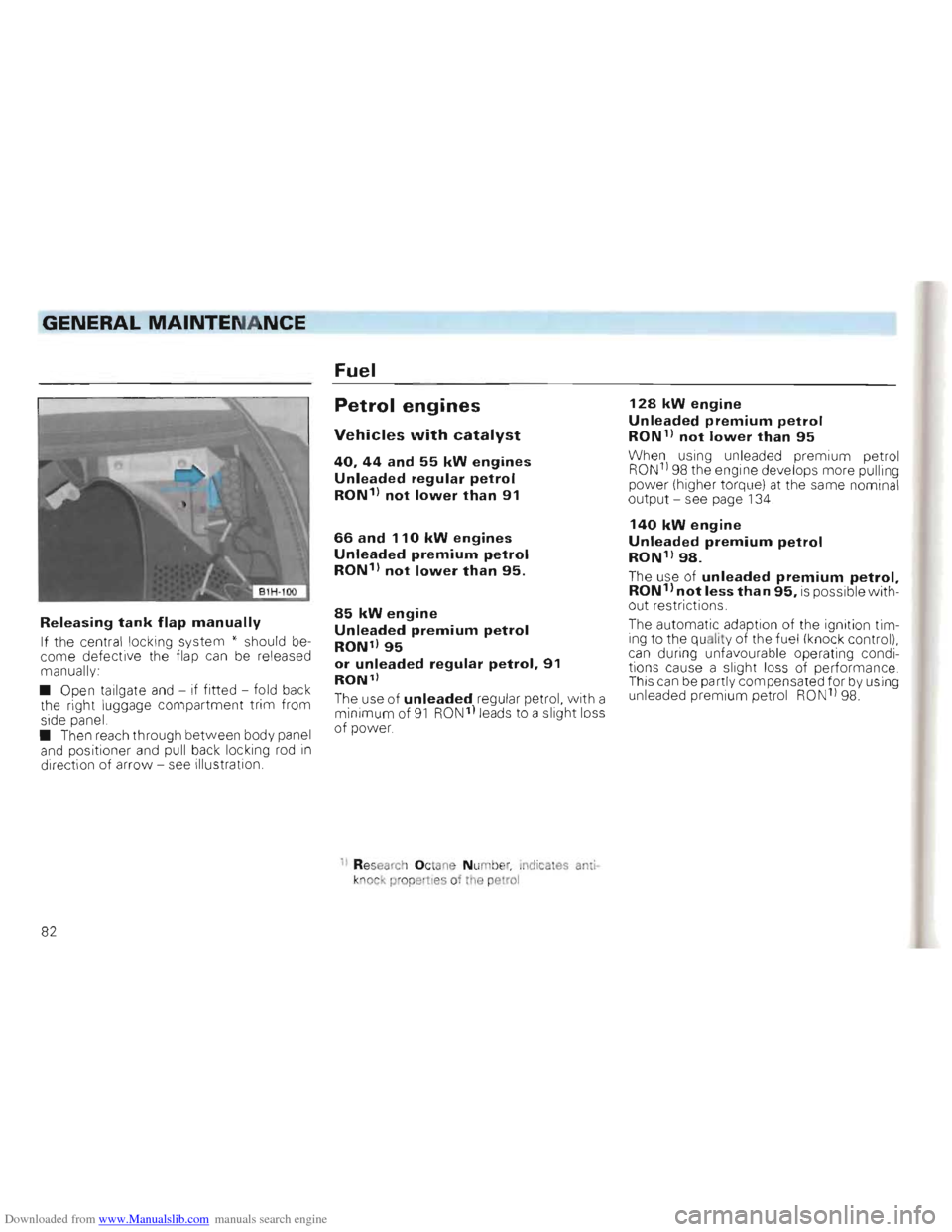
Releasing tank flap manually
If the central locking system * should become defective the flap can be released
manually :
• Open tailgate and -if
fitted -fold back
t he righ t luggage compartment trim from
side panel.
• Then reach through bet
ween body panel
and positioner and pull back loc king rod In directio n of arrow - see Illustration .
Petrol engines
Vehicles with catalyst
40. 44 and 55 kW engines
Unleaded regular petrol
RON1) not lower than 91
66 and 110 kW engines
Unleaded premium petrol
RON1) not lower than 95.
85 kW engine
Unleaded premium petrol
RON') 95
or unleaded regular petrol. 91
RON')
The use of unleaded regular petrol, with a
min imum of 91 RON ') leads to a slight loss
o f power
11 Re se arch O ctane Num b r, indicates anti
k nock properties of the pe rol
128 kW engine
Unleaded premium petrol
RON1) not lower than 95
When u sing un leaded premium petrol RON1) 98 the engine develops more pulling power (higher torque) at the same nominal output -see page 134.
140 kW engine
Unleaded premium petrol
RON') 98.
The use
of unleaded premium petrol. RON1) not less than 95. is possible without restrictions.
The automatic adaption
of the ignition tim
ing to the quality of the fuel (knock control),
can during unfavou rable operating condi
tions cause a s
light loss of performance
This can be partly compensated for by uS ing
un lead ed prem ium petro l RONlI 98 .
82
Page 85 of 156
Downloaded from www.Manualslib.com manuals search engine GENERAL MAINTENANCE
Vehicles without catalytic
converter
44 and 55 kW engines
un leaded or leaded regular petrol
RON') not lower t han 91
66 kW engine
Unleaded or leaded premium petrol
RON') not lower than 95
85 kW engine
Premium petrol unleaded or leaded
RON') 95
or regular petrol unleaded or l eaded . RON1) 91.
The use of u n leaded regular petrol, with a
m inimum of 91 RON1) leads to a slight loss of power .
Research Octane Num ber , indicate s anti
knock properties o f the petrol.
Notes
• Unleaded petrol must comp ly with DIN21 51 607 and leaded petrol with DIN 51 600.
• If i n an emergency the octane rating of
the available petrol is lower than that required by the engine only drive with me
dium engine speeds and low engine load
ing. High engine loading with full throttle or high revs can cause engine dam ag e. Fill tank with petrol of the
correct rating as soon as possible &.., On vehicles with catalytic con
~verter only unleaded petrol may
be used.
Even a single tank of leaded petrol
will reduce the effectiveness of the
catalytic converter.
In the interests of the environment,
unleaded petrol should always be
preferred to leaded fuel. even on ve
hicles without a catalytic converter.
21 Stan dards issued by th e G rman Standards inslltu\l on
Petrol additives
The quality of the fuel has a decisive influ
ence upon the running behaviour, perform
ance and ser v ice life of the engine. The addi
ti ves which are mixed into the petrol are of particular sign ificance. One is advised
theref ore only to use good quality petrol containing additives.
If such fu el is not available, or if eng ine troubles such as starting difficulties, stall ing during idling, vibratio n and loss of power
occur, the approp riate additives should be mixed with the petro l w hen filling the tank.
These additives have an anti-corrosion ef
f ect, clean the fuel system and prevent de
posits building up in the engine.
Petrol additives available
in accessory
outlets have not all shown themsel ves to be effective. Ther efore additives which have been tested for Volkswagen engines are
available from Volkswagen dealers in Germany and in many export countries . The Volks wagen dealers are also informed with
r e gard to the use of additives , and they
kno w what to do in cases where deposits have already built up.
83
Page 86 of 156
Downloaded from www.Manualslib.com manuals search engine GENERAL MAINTENANCE ~~~~~~=--------------------
Diesel engines
Diesel fuel
to DIN 51 601. eN1) not lower than 45.
Driving in winter
When using summer Diesel trouble may be experienced at temperatures below Ooe because the fuel thickens due to wax separ
ation.
For this reason, w inter Diesel which
is more
resistant to cold is sold during the winter in Germany, and this works satisfactorily
down to between -15 and -22°e, depend
ing on the type of fuel used.
In countries with different climatic condi
tions the Diesel fuels offered have a differ
ent temperature characteristic. Check with
Volkswagen dealers or filling stations
in the
country concerned regarding the character
istic s of Diesel fuels.
Filter preheating
The vehicle is fitted with a filter preheater.
This will ensure , that the fuel system remains operational down to about -25°e provided that winter Diesel which is cold resistant down to -15°e is used. Diluting with
petrol is then no longer necessary under
these conditions.
If, at temperatures below -25°e the fuel is waxed to such an extent that the engine w ill
not sta rt it is sufficient to place the vehicle in a warm room for a while .
Fuel additives (anti-waxing agents) and
similar fluids must not be mixed with the
Diesel fuel.
11 Cetane N u bee ind icates the ig nltabillty of
D iesel.
84
Page 87 of 156
Downloaded from www.Manualslib.com manuals search engine GENERAL MAINTENANCE
Care of vehi cle
Reg ular and careful care helps to m aintain the value of th e vehicle.
F
urthermore it can be one of the stipulations for the upholding of war
ranty claims should corros ion damage and paint defects occur.
Eve ry Volkswagen dealer carries stocks of su itabl e car care materials. The instr uctions for use on the containe r sh o uld be followed.
Attention • If misused, car care materials can be injurious to health. • Car care materials must always be store d in a safe place w here they are out ofthe reach of children.
~W hen buying car care materials W one should select products which do not damage the environment. Empty co n tainers which these materials wer e in do not belong with household waste.
Washing
The best protection against environmental influences is frequent washing and waxing .
How often this treatment is require d de
pends , amongst other things on how much
the vehicle is used, how it is parked (garage, in open under trees etc.), the seasons ,
w eather conditions and environmental in
fluences.
The longer bird dropp
ings, insects, tree resin , road and industr ia l grime, tar spots ,
soot, road s alt and other aggress ive ma
terials rema in o n the vehicle paint the more
l asting their destructive effect w ill be . High
temperatur es e .g . from strong sunli ght in
t ensi fies th e corrosi ve effe ct.
In certain circumstances weekly washing can be necessary, but monthly washing
with appropr iate waxi ng may be fully adequa te.
After the pe riod when salt is put on the
r oads the underside of the vehic le should al
w ay s be washed thoroughly.
Automatic wash plants
The vehic le paint is so durable that the ve
hicle can norma lly be washed without prob
lems in an aut omatic wash plant. However
the influe nce on the paint depends to a large
e xtent on the design of the plant, the filter
ing of the wash water, the type of wash and
care mater i
al, etc. If the paint has a matt appearance after gOing through the wash
p lant or is even scratched thi s shou ld be
brought to the notice of the plant operato r
immediately If necessary a different wash
p lant should
be used .
Notes
• Before going through the wash plant, apart from the usual precautions (closing windows and sliding roof, retrac ting the aerial) there is noth ing further to note . The VW
roof aerial does not have to be taken off.
• If there are specia l fittings on the vehicle
- such as spoilers, roof rack, two-way radio
aeria l etc . it is best to speak to the plant op
erator.
85
Page 88 of 156
Downloaded from www.Manualslib.com manuals search engine GENERAL MAINTENANCE
W ashing the vehicle by hand
~In the interests ofe n vironmental ~protection the vehicle s hould only be washed in specially provided wash bays. In some districts, washing cars elsewhere may even be forbidden .
First soften the dirt
with plenty of water and
rinse off as well as possible.
Th en clean the car with a soft sponge, glove
or brush starting on the roof and going from
t o p to bottom using only slight pressure.
Pain t sham poo should only be used for very
p ersis tent dirt.
Rinse the s ponge or glove out thoroughly at
s l
lort intervals.
Wheels and sill panels should be cleaned
last, using a different sponge if possible.
After clea nin g the vehicle, rinse thoroughly
with water and leather it off.
Notes
• The vehicle should not be washed In strong sunshine.
• If the vehicle
is rinsed with a hose, do not
direct the jet of water at the lock cylinders
- they can freeze up in the winter.
Washing vehicle with high pressure
cleaner
• The operating instructions for the high
pressure cleaner must be followed closely
- particularly with regard to pressu re and working distance.
•
Do not use a concentrated Jet. • The water temperature must not be
above 60°e.
Attention
Tyres must never be cleaned with
a concentrated jet! Even at a rela
tively large working distance and
a very short spraying time, dam
age can occur.
Waxing
A good coat of "vax pro tects the vehicle
paintwork to a large extent again st the envi
ronmental influences listed under "Washing" on the previous page an d even against
light mechanical damage
At the latest
when water on th e clean paint
does not form small drops an d roll off, the
vehicle should be protec te d b y applying a
coat of good hard wax. Even when a wax
solution
is used regular ly in the washing water it is advisable to prote ct th e paint vVlth a coat of hard wax at least twice a year.
Polishing
Should only be done if paint has lost its
shine and gloss cannot be brought back
with wax. If the polish used does not con
tain preservative compounds, th~ pain t must be waxed afterwards.
Note
Matt painted and plastic parts should
not be treated with pol is h or hard wax.
86