1993 VOLKSWAGEN GOLF check engine light
[x] Cancel search: check engine lightPage 79 of 156
Downloaded from www.Manualslib.com manuals search engine DRIVING TIPS
Trailer towing
The vehicle is intended main ly for the trans
portation of persons and luggage but it can, with the appropriate technical equipment,
also be used to tow a trailer.
Technical requirements
• If the vehicle is suppl ied with a factoryfi tted towing bracket, all that is technically
a nd legally necessary for trailer towing wil l
have been taken into account.
• If the trailer to be towed
has a 7 pin plug, an adapte r cable can be used whi ch IS ob
tained from a Volkswagen dealer.
• Volkswagen dealers have
all the necessary information on the In stallation of towing
brackets and the fitti ng of a heavy-duty cooling system. The installation should there
f ore be done by them .
Operations instructions
• On the Golf saloon with a factory
fitted towing bracket* the removable ball
coupling will
be fitted. Fitting/remo ving in
struc tions and instructions on correct stowage of the ball coupling in the spare wheel
well can be found in a linen bag in the ve
hicle luggage compartment.
•
On the Golf estate with a factory fitted
towing bracket* the remova ble ball coupl
ing is stored inside the vehicle next to the
spare wheel, together w ith instructions on
fitting.
• Pitching movements between towing
vehicle
and trailer can be reduced by hea vy
duty springs and shock absorbers on the
rear axle. If these springs and shock absorbers have not alread y been fitted at the
factory, they can, in many cases, be service
installed by a Volkswagen dealer.
• The permissible trailer weight -see
page 144 -m ust not
be exceeded on any account.
• If the the trailer weight
is below the
permissible maximum, a correspondingly
steeper gradient
can be climbed. •
The given trailer weights
are only appli
cable for altitudes up to 1000 m above sea level. As the engine output and thus the
climbing ability drops due to the decreasing
air density , the weight of vehic le and trailer
must also be reduced by 10 % for each
further 1000 m or part thereof.
• Where possible make full use of the
maximum permissible drawbar weight
on ball of the towing bracket -see page 144
but do not exceed it.
• While observing the permissible trailer
and drawbar weight, distribute the load in the trailer so that heavy objects are as nea r as possible to the axle. The objects must
also be secured so that they cannot slip
about.
• Check the ty
re pressures on the towing
v ehicle, and adjust for full load conditions,
and also check the pressures on the trailer
• T he headlight settings, should
be checked w ith trailer attached before mov
ing off and adjusted as necessary. On vehicles with headlight beam control it is on ly necessary to turn the knurled disc in dash in the appropriate directIOn .
77
Page 91 of 156
Downloaded from www.Manualslib.com manuals search engine GENERAL MAINTENANCE
w hen corrosion protected parts are reewed.
dih Because when washing the en~gine petrol, grease and oil deposits are washed off, the dirty water must be cleaned by an oil separator. For this reason engine washing should only be carried out in a workshop or filling station.
\folkswagen dealers have stocks of the
h igh-quality cleaning and prese rvation ma
te rials re commended by the factory and
have the equipment ne cessary to appl y them .
Underseal
The under side of the vehicle is coated with a special compound to protect It from cor
rosion and damage .
H ow ever,
as this protective layer becomes
a m aged when the ve hicle is in use , the
p rotecti ve coating under the body and on
t h e runn ing gear should be examined at de
fi ned inter vals -prefer ably befo re and after the winter season -and any damage made
g ood. Volksw
agen dealers have stocks of the cor
rect compound,
have the necessary equip
ment and are famil iar w ith th e application
proc edure . We advise you ther efore to have
the patching up or additional coating done by a Vol ksw agen dealer.
Note for vehicles with a catalytic
converter
Due to the high temperatures which occur in the afterburning process, additional heat
shi elds are fitted over the catalytic con
v e rter. Underbodysealant must not
be applied to the se shields, the catal ytic con
v erter or the exhaust pies. Remo val of the
heat shields is also not permissible .
Cavity preservation
All cavities on the vehicle which could be susceptible to corros ion are given perma
nent protect ion at the factory.
This coating does not need check i
ng or any
subsequent treatment. Should a small
amount
of wa x run out of the cavities at high
ambient te mperatures it can be re moved
with a plastic scraper and some white spirit.
Note
On no account allow the tail lights to com e
Into contact with dry cleaning solvent.
If the wax which has run out is removed with clean petrol, heed the safety and environmental protection regulations.
89
Page 92 of 156
Downloaded from www.Manualslib.com manuals search engine GENERAL MAINTENANCE
Bonnet
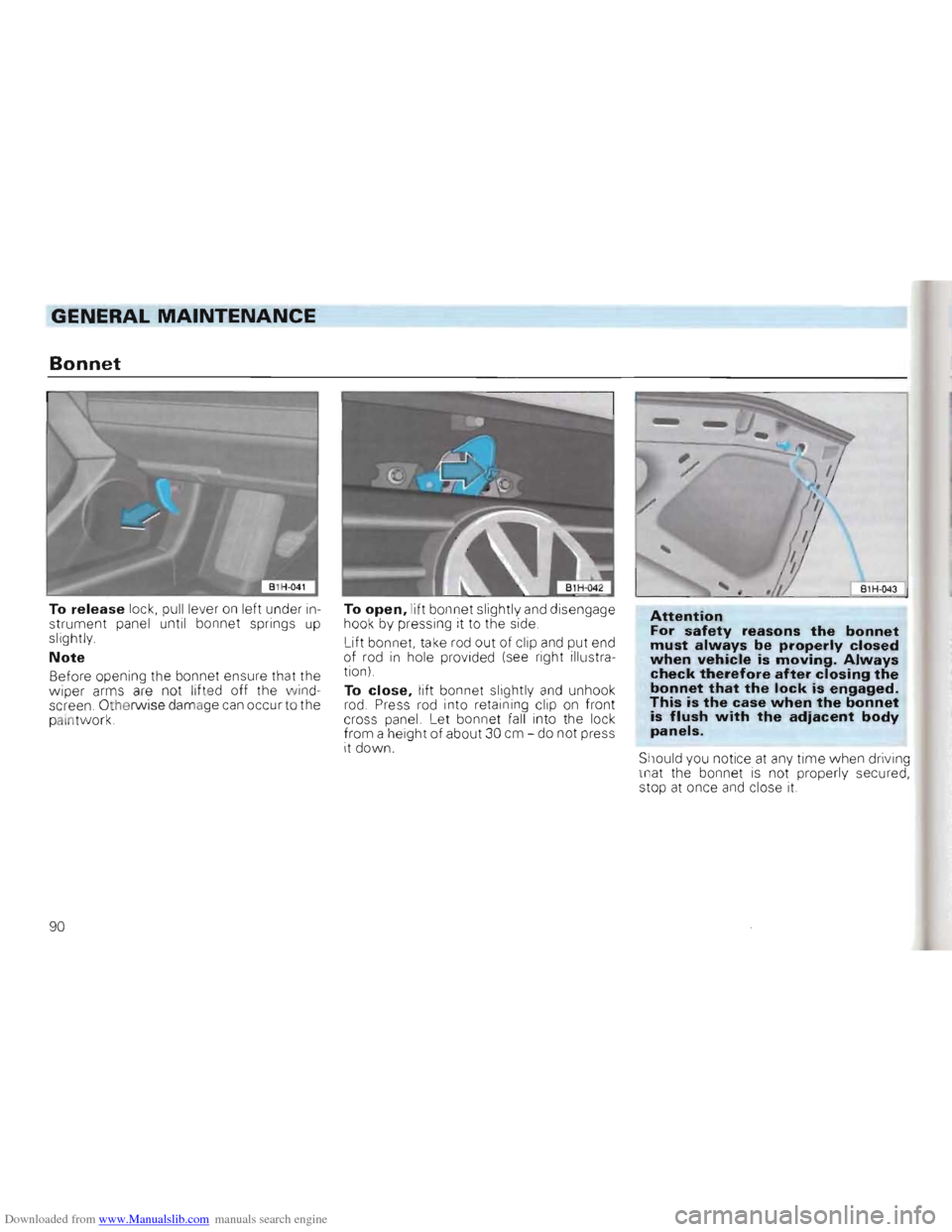
To release lock, pull lever on left under in
strument panel until bonnet springs up slightly.
Note
Before opening the bo nnet ensure that the
wiper arms are not lifted off the wind
screen. Othe rwise damage can occur to the
palntwork. To
open, lift
bonnet slightly and disengage
hook by pressing it to the side.
Lift bonnet, take rod out of
clip
and put end
of rod in hole provided (see right illustra
tion)
To
close, lift bonnet slightly and unhoo k
rod. Press rod into retaining cl ip on front
cross panel. Let bonnet fall into the lock
from a height of about 30 cm -do not press
it down.
B1H -043
Attention For safety reasons the bonnet must always be properly closed when vehicle is moving. Always check therefore after closing the bonnet that the lock is engaged. This is the case when the bonnet is flush with the adiacent body panels.
Should you notice at any time when driving
that the bonnet is not properly secured,
stop at once and close it.
90
Page 99 of 156
Downloaded from www.Manualslib.com manuals search engine GENERAL MAINTENANCE
Cooling system
The cooling system is filled at the factory with a perman ent coolant whic h is not
changed . The coo lant consists of w ater and a 40 % concent ration of our coolant additive
G 11 V8B (anti-f reeze on glycol basi s with
anti-corrosion additives). Thi s mi xture not
only gives the necessary frost prot ection
down to -25°C but also pro te cts the allo y
parts in the cooling system against cor
rosion. In add it ion it pr event s scal ing and raises the boiling point of the coo lant
The concentr atio n of the co olant therefore
must not be reduce d in the summer or in
wa rm countries, by tOPPing up with plain
w ater. The coolant additive proportion must be at least 40 %.
If greater protection against frost is re
qu ired, th e propor tion of G 11 V8B additive
c a n be increased, but onl y up to 60 % (Irost
prot ection to appr ox. -40 Cl. oth erwise the
a n ti-freeze prot ection is red uced and fur
t h ermore the cool ing effec t is im paired .
Vehicles for expor t to cold cou ntries usually
h ave frost protection down to -35°C.
Only our G 11 V8B or an addi tive with the specification TL-VW 774 B (ma rked on container ) should be added to the coolant.
The ad dit ive s can be obtained from Volks
w ag
en dealer s.
Other additives c a n b e very detrimental to the anti·corrosion effect in particular.
The subsequent corro sion damage can lead to coolant loss resulting in major engine damage.
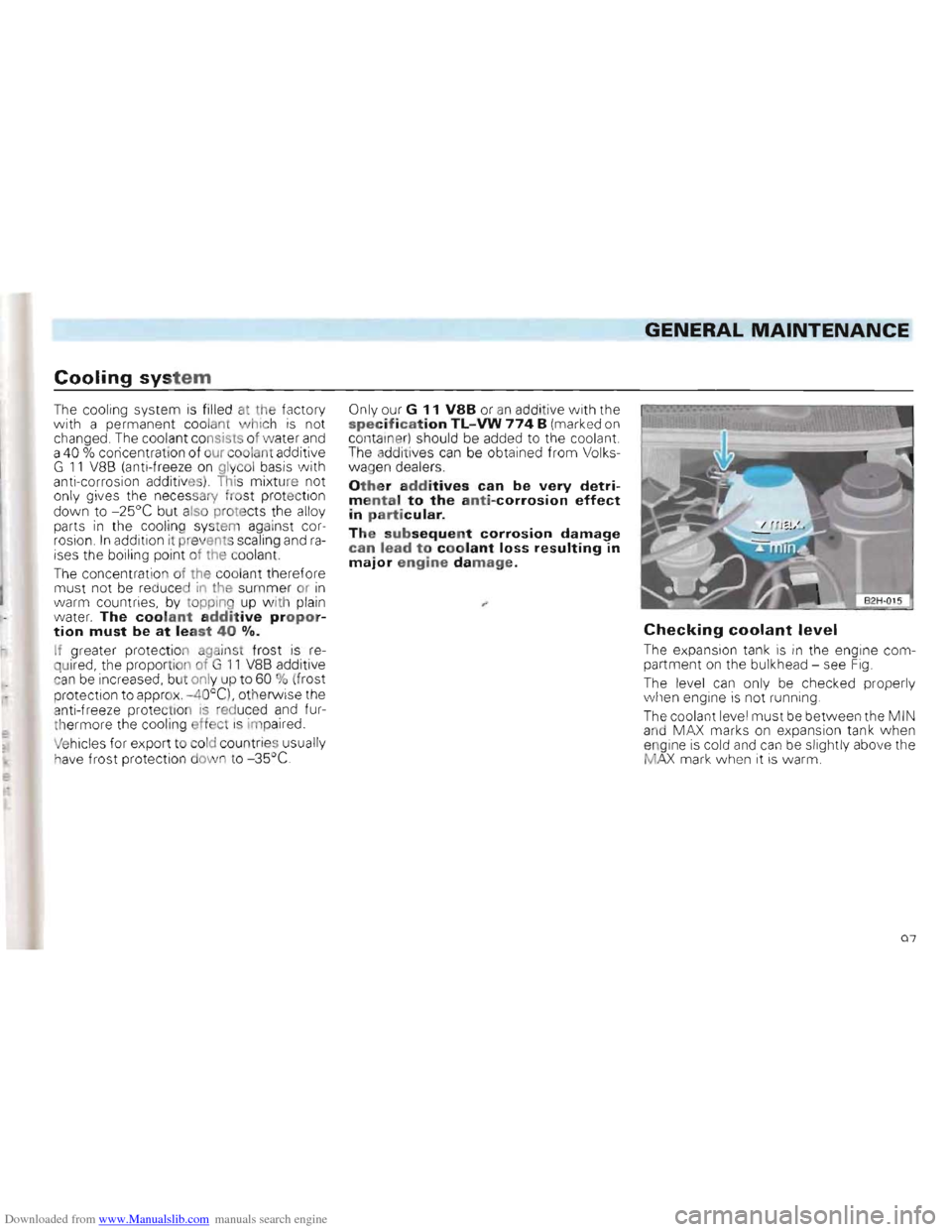
Checking coolant level
The expansion tank is in the engine com
p artm ent on the bulkhead -see Fig
The level can o nly be checked properly
w he n engin e is not running .
The coo lant level must be bet ween the MIN
and Mt>,X marks on e xpansion tank when
engine is cold and can be slightly above the
MAX mark when it is warm .
07
Page 100 of 156
Downloaded from www.Manualslib.com manuals search engine GENERAL MAINTENANCE
Coolant losses
Coolant loss normally indicates leaks in the
system . In this case the cooling system
should be checked by a Volkswagen dealer
w it h out delay . It is not sufficient merely to
add coolant.
Ii'! ~ ~MI~d ~v~t~m IMMS canonly occur if the boiling point of the coolant is exceeded as a result of overheating, and coolant is forced out of the system.
Topping up coolant
Switch engine off and let it cool down . Then
cover expansion tank cap with a cloth and
turn cap carefully
to the left
and remove.
Attention Do not remove expansion tank cap when engine is hot -Danger of scalding. System is under pressure.
If, in an emergency only water can be added the correct mixture concentration
must be restored with the specified coolant
additive (see previous page) as soon as possible. If
a lot of coolant has been lost.
on l y add cold
coolant after the engine has cooled down.
This will prevent engine damage.
Do not fill above the MAX. mark.
The excess coolant will be forced out
through the pressure rel ief valve in the cap
when engine becomes hot.
Screw cap on again tightly.
Attention The coolant additive and the coolant are a danger to health. The additive must therefore only be stored in the original container well out of reach of children. If the coolant has to be drained at any time it must be caught and also stored in a safe place.
dih Drained coolant should not nor~mally be reused, it must be disposed of, bearing in mind environmental protection regulations.
Fan
The radiator fan is driven electrically and controlled by a thermoswitch from the cool
ant temperature (also from the engine com
partment temperature
on some models).
Attention After the engine has been stopped the fan can continue running for a while -even with the engine switched off -(up to about 10 minutes). It can also start to run again suddenly after a short time if -the coolant temperature increases due to heat build-up
when engine is hot and the engine compartment is heated additionally by strong sunlight.
Special care must therefore be taken when working in the engine compartment.
98
Page 101 of 156
Downloaded from www.Manualslib.com manuals search engine GENERAL MAINTENANCE
Brake fluid
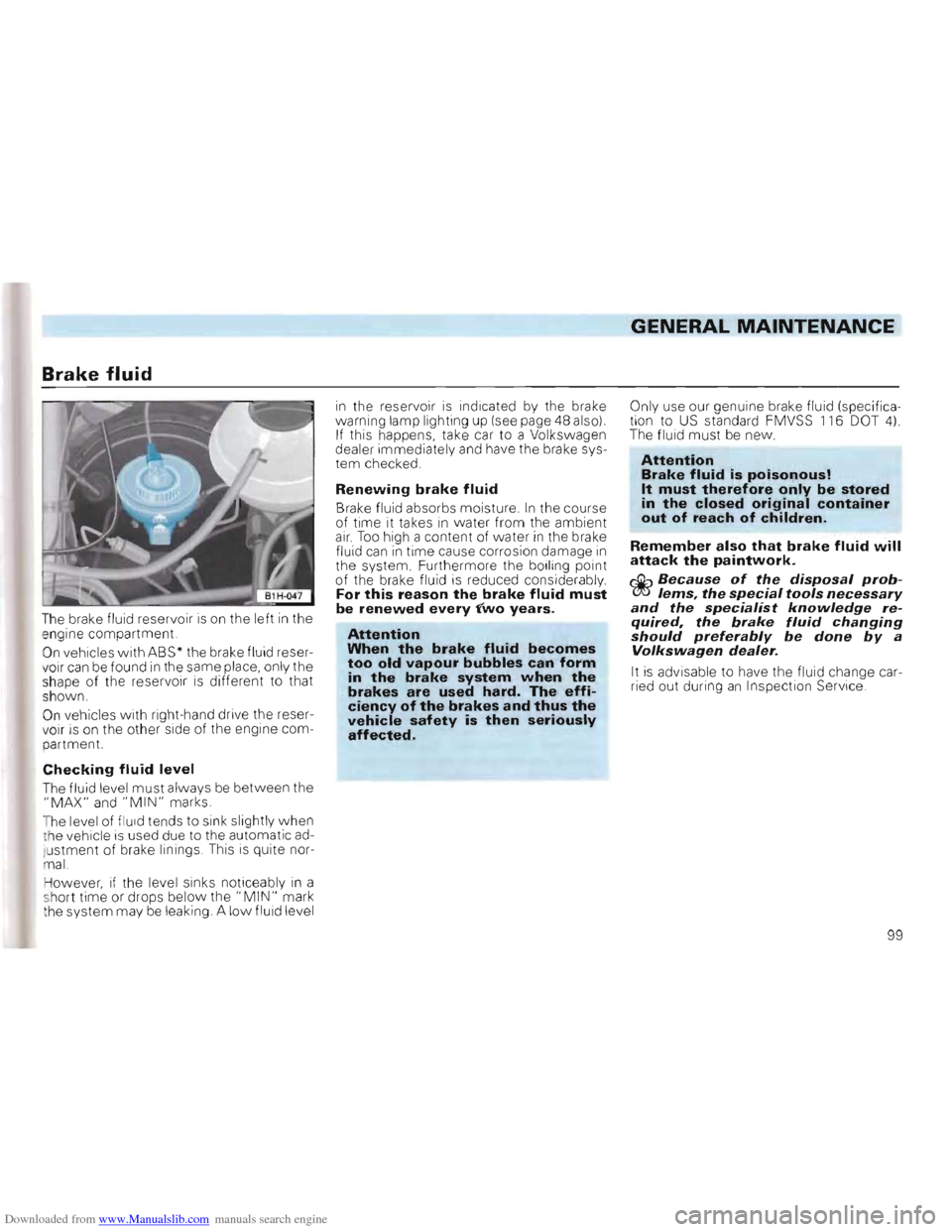
The brake fluid reservoir is on the left in the
e ngine compartment.
O n vehicles with ABS* the brake fluid reser
voir
can be found in the same place, only the
s hape of the reserv oir is different to that
s hown .
O n
vehicles with right-hand drive the reser
voir is on the other side of the engine com
p artment.
Checking fluid level
T he fluid level must always be between the
" MAX" and "MIN" marks.
T he
level of flu id tends to sin k slightly when the vehicle is used due to the automatic adJu stment of brake linings . This IS quite nor
mal.
H owever, if the level sinks noticeably in a
s h ort time or drops below the" MIN" mark
t h e system may be leaking. A low fluid level
in the reservoir is indicated by the brake
wa rning lamp lighting up (see page 48 also)
If this happens, take car to a Volkswagen
dealer immediately and have the brake sys
tem checked.
Renewing brake fluid
Brake fluid absorbs moisture. In the course
of time it takes in water from the ambient air. Too high a content of wa ter in the brake
fluid can In time cause corrosion damage in the system Furthermore the boiling point
of the brake fluid IS reduced considerably. For this reason the brake fluid must be renewed every f'wo years.
Attention When the brake fluid becomes too old vapour bubbles can form in the brake system when the brakes are used hard. The efficiency of the brakes and thus the vehicle safety is then seriously affected.
Only use our genuine brake fluid (spec ifica
tion to US standard FMVSS 116 DOT 4). The fluid must be new.
Attention Brake fluid is poisonous! It must therefore only be stored in the closed original container out of reach of children.
Remember also that brake fluid will attack the paintwork.
,.Q,., Because of the disposal prob
~lems, the special tools necessary
and the specialist knowledge re
quired, the brake fluid changing should preferably be done by a Vo/kswagen dealer.
It is advisable to have the fluid change car
ried out during an Inspection Service.
99
Page 103 of 156
Downloaded from www.Manualslib.com manuals search engine GENERAL MAINTENANCE
• When disconnecting the bat
tery from th e vehic le e lectrical
system first disconnect the nega
tive cable and then the positive
cable.
The battery must not b e discon
nected with th e engine ru nning,
as this will damage t he e lectrica l
system (e lectro n ic components).
• When reconnecting t h e bat
tery connect the positive cable
first and then the negative cable.
The connect ing cables must on
no account interchang ed -can
cause wiring to burn out.
In order to protect the c asing from UV radiation, do not expose battery to direct sunlight.
Checking acid level
In norma l operating conditions the ba ttery re quires hardly any maintenance . At 111(;)11 am bient tem peratu res Ilowever It I S advIs
a b le to check th e acid le ve l a t r egula r inter als. It shou ld always be between the M IN
a nd MAX marks on th e batter y I
f th e ac
id leve l drops below the MIN mark, the aff ecte d c ells must be topped -up to the
MAX mark W ith dis tille d wa ter.
It
is recommen ded that the acid level is checked and correcte d by a Volkswag en dea ler.
Winter driving
W inte r wea ther is part icu larly hard on the
battery. Furt h er more at low temperatures it has only a par t of th e capacity it has at nor
ma l temperatures . We reco mmend there
for e th at
the bat te ry sho uld be c h ecked pre
f erably by a Volkswage1l dea le r before the onset of cold weat her an d charge d if
necessary
I f the vehicle is not driven for seve ral weeks when te m peratures are very low, the battery should be taken out and stored in a frost-free room, s o tha t it cannot freeze up and become damaged.
To ake battery out, first d isconnect the two cables an d th en remov e retainer.
Charging battery
W hen charg ing with a lo w curren t (e.g. with a smal l char ger) the battery cables need not
no rmally b e taken off. The instructions from the charger manufactu re r must however be
noted.
Bef ore
Quick charging, that is charging
wi th a high current, both battery cables
must b e disconnec ted .
T
he f o llowin g inf ormation must be noted:
• Whe n charging the
battery do not re
move caps.
• A discha rged battery
can freeze at -10°e. It is essential to thaw out a frozen battery before it is given a quick charge otherwise it may explode!
• The mains cable of the charger should
n ot be connec ted unti l afte r the clips of the charger have been prop erly secured to th e
battery terminals Red =pos itive
Black = negative
•
Recon nect cables correct ly after ch arging battery.
101
Page 120 of 156
Downloaded from www.Manualslib.com manuals search engine DO-lT-YOURSELF
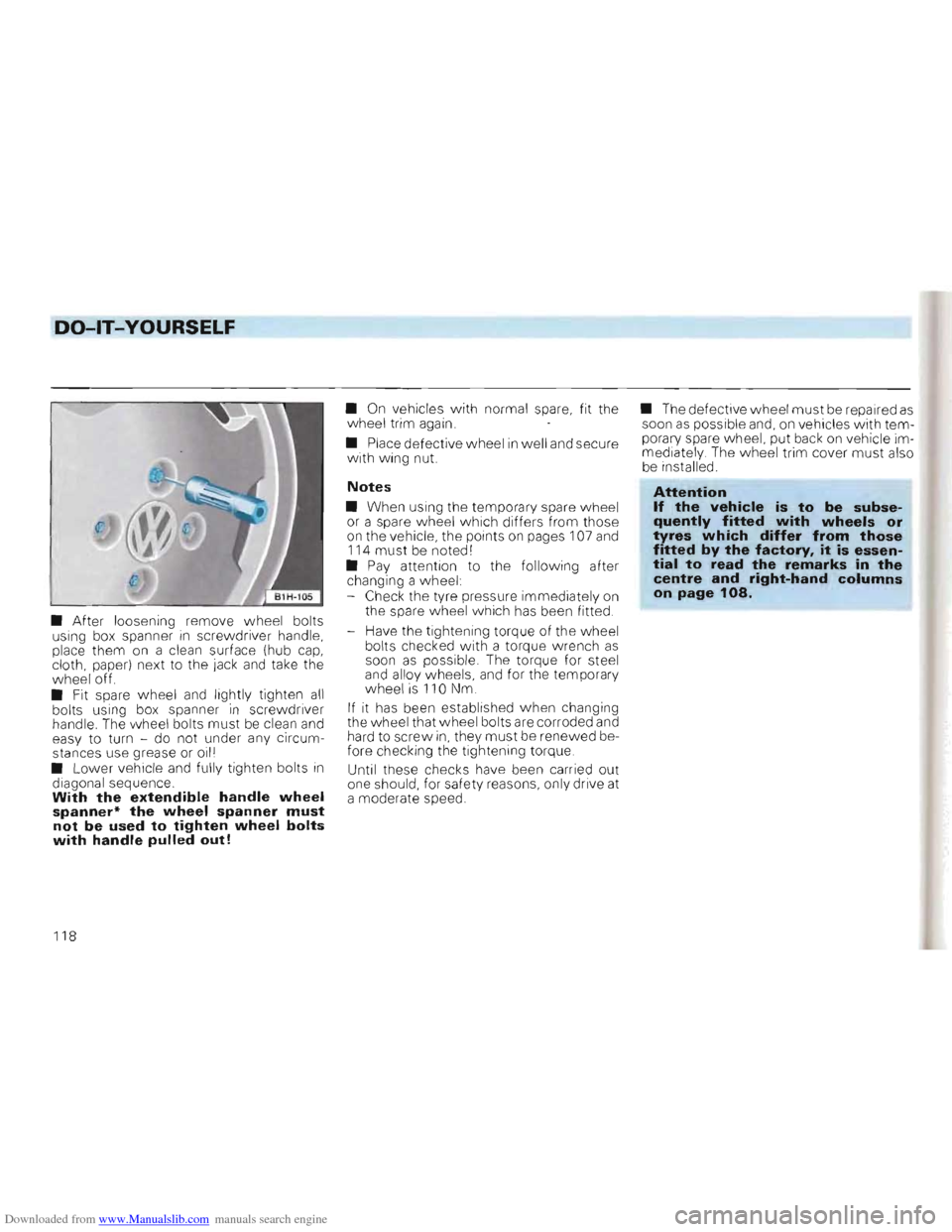
• After loosening remove wheel bolts
using box spanner in screwdriver handle,
place them on a clean surface (hub cap, cloth, paper) next to the jack and take the
wheel off.
• Fit spare w heel
and lightly tighten all bolts using box spanner in screwdriver
handle. The wheel bolts must be clean and
easy to turn -do not under any circum
stances use grease or oill
• L o
wer vehicle and fully tighten bolts in diagonal sequence. With the extendible handle wheel spanner* the wheel spanner must not be used to tighten wheel bolts with handle pulled out!
• On vehicles w ith normal spare, fit the
wheel trim again.
• Place defective wheel
in well and secure
with wing nut.
Notes
• When using the temporary spare wheel
or a spare wheel wh ich differs from those
on the vehicle, the points on pages 107 and
114 must be noted I
• Pay attention to the following after
changing a wheel:
- Check the tyre pressure immediatel y on
the spare wheel which has been fitted .
-
Have the tightening torque of the wheel
bolts checked with a torque wrench as soon as possible. The torque for steel and alloy wheels, and for the temporary
wheel is 110 Nm .
If it has been established when changing
the wheel that wheel bolts are corroded and
hard to screw
in, they must be renewed be
fore checking the tightening torque.
Until these checks have been carried out
one should, for safe ty reasons, only drive at
a moderate speed. •
The defective wheel
must be repaired as soon as possible and, on vehicles with tem
porary spare wheel, put back on vehicle im
mediately. The wheel trim cover must also be installed.
Attention If the vehicle is to be subsequently fitted with wheels or tyres which differ from those fitted by the factory. it is essential to read the remarks in the centre and right-hand columns on page 108.
118