1993 VOLKSWAGEN GOLF coolant temperature
[x] Cancel search: coolant temperaturePage 39 of 156
Downloaded from www.Manualslib.com manuals search engine ___CONTROLS AND EQUIPMENT
Diesel engines
Glow plug system
Ith the 47 and 66 kW Diesel engines. ~fter sw itching to the driving position (ignion on ), the required glow plug warm-up
• m e is Indicated by a lamp which is con
:r oll ed by the coolant temperature -see
p ag e 47 .
On he
55 kW Diesel engine the glow pl ug sys tem is automaticall y activated after ~'osing the driver's door. If the engine is not subsequentl y sta rted, the glow plug syst em .111 not be activated by each further opening an closing of the driver's door.
Cold starting aid/idling speed
boost (47 and 55 kW engines only)
-0 facilitate starting from cold, there is a
c old starting device (cold sta rting aid) in the nJec tion pump.
he cold starting device is actuated when "'1e knob on h e left of the steerinq column
s pulle d out fully.
fl addition , the idling speed can be in~reased with the knob to reduce any vehicle
• br ation which may occur .
47 and 55 kW engines
Starting a cold engine
• At ambient temperatures down to -155C, pull the cold start knob out fully before operating the sta rter .
At lower t em pe rature s, the knob should not
be pulle d out until engine is firing regularly -the engine wi ll then start more
readily .
•
Turn the key in the igniti on lock to posi
tion 2 (see page 35) -the glow plug wa rning
lamp comes on. It goes out when the igni
t ion tempera ture is reached (see page 47) While the glow plugs are working do not switch on any other heavy current consumers because this would place an unnecessary load on the battery.
• When the w arning lam p goes out, start
the engine immediatel y
D o not depress the acce lerator while star
ting
If the
engine only fire s irregul arly, continue to ope rate the starter a few seconds longer (30 seconds at maximum) until the engine
runs under its own power. If
the eng ine does not start , switch the g
low plugs on again and try starting it again as de
scr ibed . If th e eng ine still doe s not start the
fuse for the glow plugs may have blown
page 120 .
• Push the cold start aid knob
in fully as soon as the engin e has rea ched its norma l
operating te mper ature.
If ve hicle vibrati on then
occurs whe n i dling,
the knob can be pul led out again until the en
gine runs free of vibration at the lowest
pos sible idling speed
Starting a warm engine
The glow plug lamp does not come on -the engin e can be started straight away. D o not pull the cold s tart aid knob and do not press
the accelerator pedal.
37
Page 40 of 156
Downloaded from www.Manualslib.com manuals search engine CONTROLS AND EQUIPMENT
Stopping engine
66 kW engine
Starting a cold engine
Ambient temperature above +5 0C:
The engine can be started without pre
glow Do not depress throttle during the
starting procedure.
Ambient temperature below +5 0C:
• Turn the key in the ignition lock to posi
tion 2 (see page 35) -the glow plug warning
lamp comes on It goes out when the igni
tion temperature is reached (see page 47). While the glow plugs are working do not switch on any other heavy current consumers because this would place an unnecessary load on the battery.
• When the warning lamp goes out, start
the engine immediately
If the engine does not start, repeat
preglow and try starting it again as described. If the
engine still does not start the fuse for the glow plugs may have blown -see page 120.
Starting a warm engine
The glow plug lamp does not come on -the
engine can be started straight away
When engine has been running fast for a long time, let it idle for about 2 minutes so that it can cool down slightly before being switched off.
Attention After the engine has been stopped the fan can continue running for a while (up to about 10 minutes) with the ignition switched off. It can also start to run again suddenly after a short time if -the coolant temperature increases due to heat build-up
-when engine is hot and the engine compartment is heated additionally by strong sunlight.
Special care must therefore be taken when working in the engine compartment.
On vehicles with a catalytic converter, the ignition must not be switched off as long as the vehicle is rolling with a gear engaged, otherwise, unburnt fuel can pass into the catalytic converter and cause damage.
38
Page 41 of 156
Downloaded from www.Manualslib.com manuals search engine CONTROLS AND EQUIPMENT
Instruments
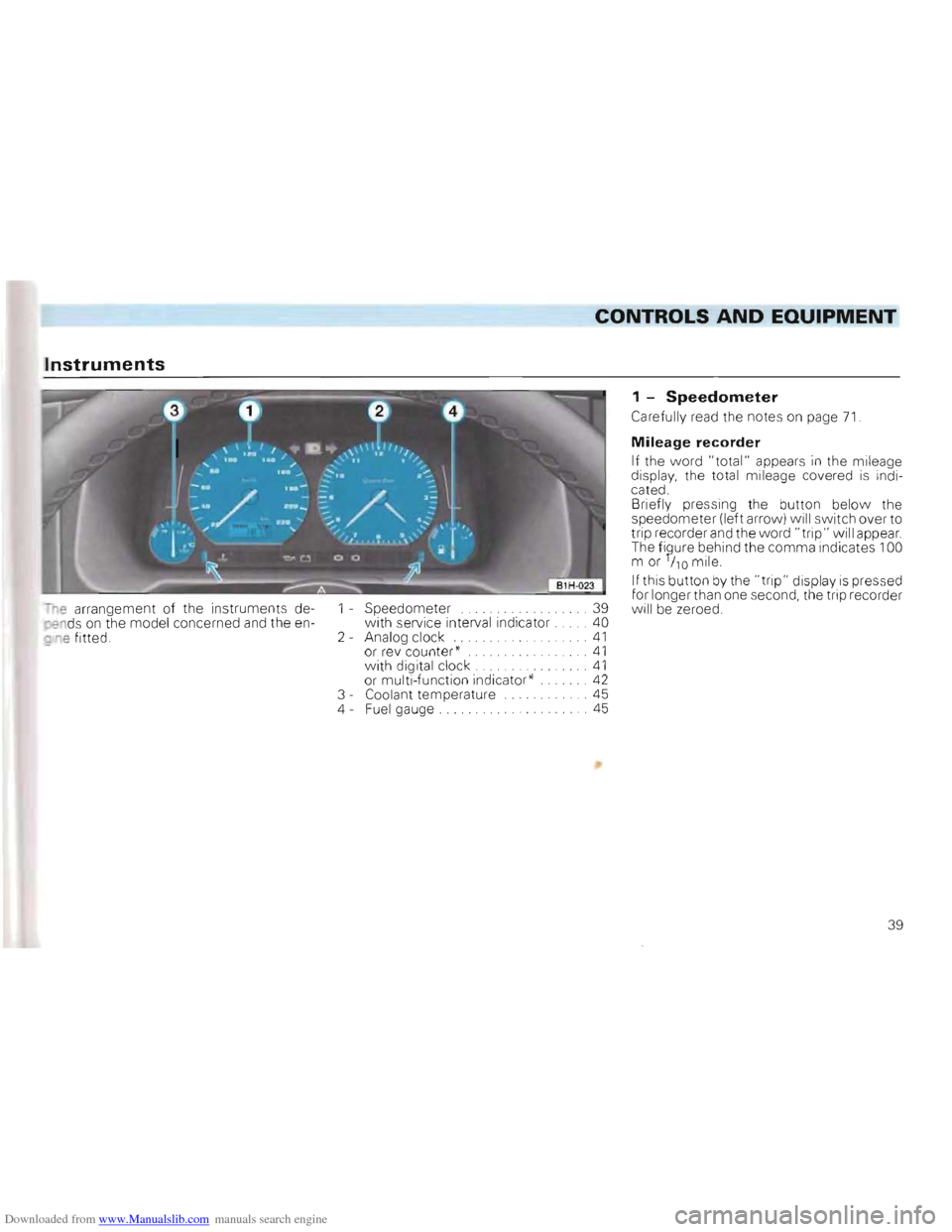
r;e arrangement of the instruments de-~nds on the model concerned and the en'le fitted . 1
Speedometer
................ 39 with service interval indicator. . 40
2 Analog clock ... 41 or rev counter* ... 41 with digital clock. . . . 41 or multi-function indicator* . . 42 3 Coolant temperature .. 45
4 Fuel gauge . . .... 45
1 -Speedometer
Carefully read the notes on page 71.
Mileage recorder
If the word "total" appears in the mileage
display, the total mileage covered is indi
cated.
Briefly pressing the button below the
speedomete r (left arrow) will switch over
to
trip recorder and the word "trip" will appear.
The fi?ure behind the comma indicates 100
m or
ha mile.
If this button by the
"trip" display is pressed
for longer than one second, the trip recorder
will be zeroed.
39
Page 47 of 156
Downloaded from www.Manualslib.com manuals search engine CONTROLS AND EQUIPMENT
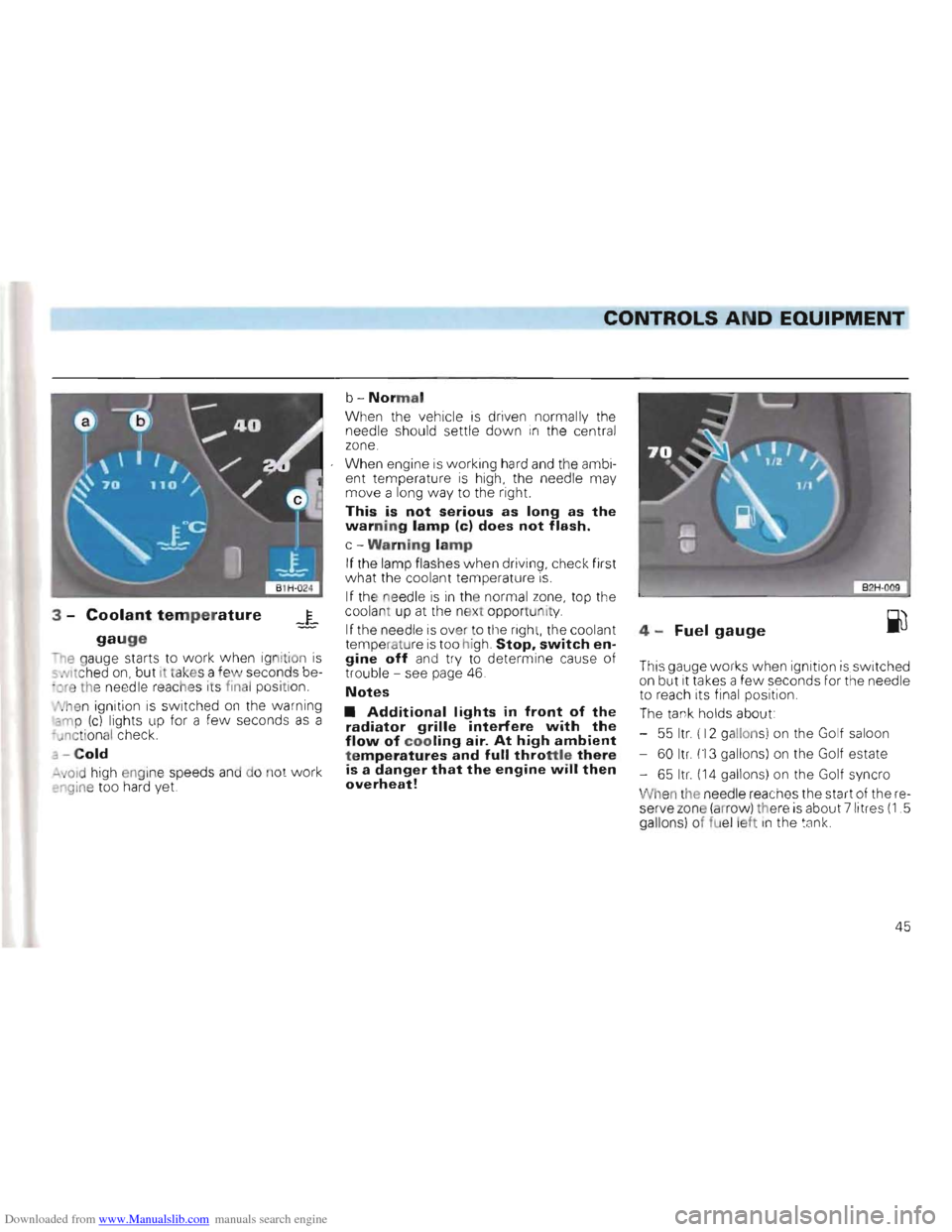
3 -Coolant temperature _~_
gauge
-I
' he n ignition
is switched on the warning amp (c) light s up for a few seconds as a
- u ncti onal check.
3 -Cold
~old high engin e speeds and do no t work engine too hard yet.
b-Normal
When the ~ehicle is dri~en normally the
needle should settle down in the central
zone.
When engine
is working hard and th e ambi
ent temperature is high, the needle may
move a long way to the right.
This is not serious as long as the warning lamp (c) does not flash.
c -Warning lamp
If the lamp flashes when driving , check first
what the coolant temperature is.
If th e needle
is in th e normal zone, top the
coolan t up at the next opportu nity.
If the needle is over to th e rig ht, the coolant
temperat ure is to o high. Stop. switch engine off an d try to determine cause of trouble -see page 46 .
Notes
• Additional lights in front of the radiator grille interfere with the flow of cooling air. At high ambient temperatures and full tt:arottl~ there is a danger that the engme Will then overheat!
4 -Fuel gauge
This gauge works when ign ition is. switched
on but it takes a few seconds for the need le
to reach its fina l posit ion.
The ta holds about
-55 ItL (1 2 gallons) on the Golf saloon
- 60
Itr. (1 3 gallons) on the Golf estat e
- 65 Itr.
(14 gallons) on the Golf syncro
W
hen the needle reaches the start of the re
serve zone (arrow) th ere is about 7 litres (1. 5
gallons) of fue l left in the tank .
45
Page 48 of 156
Downloaded from www.Manualslib.com manuals search engine CONTROLS AND EQUIPMENT
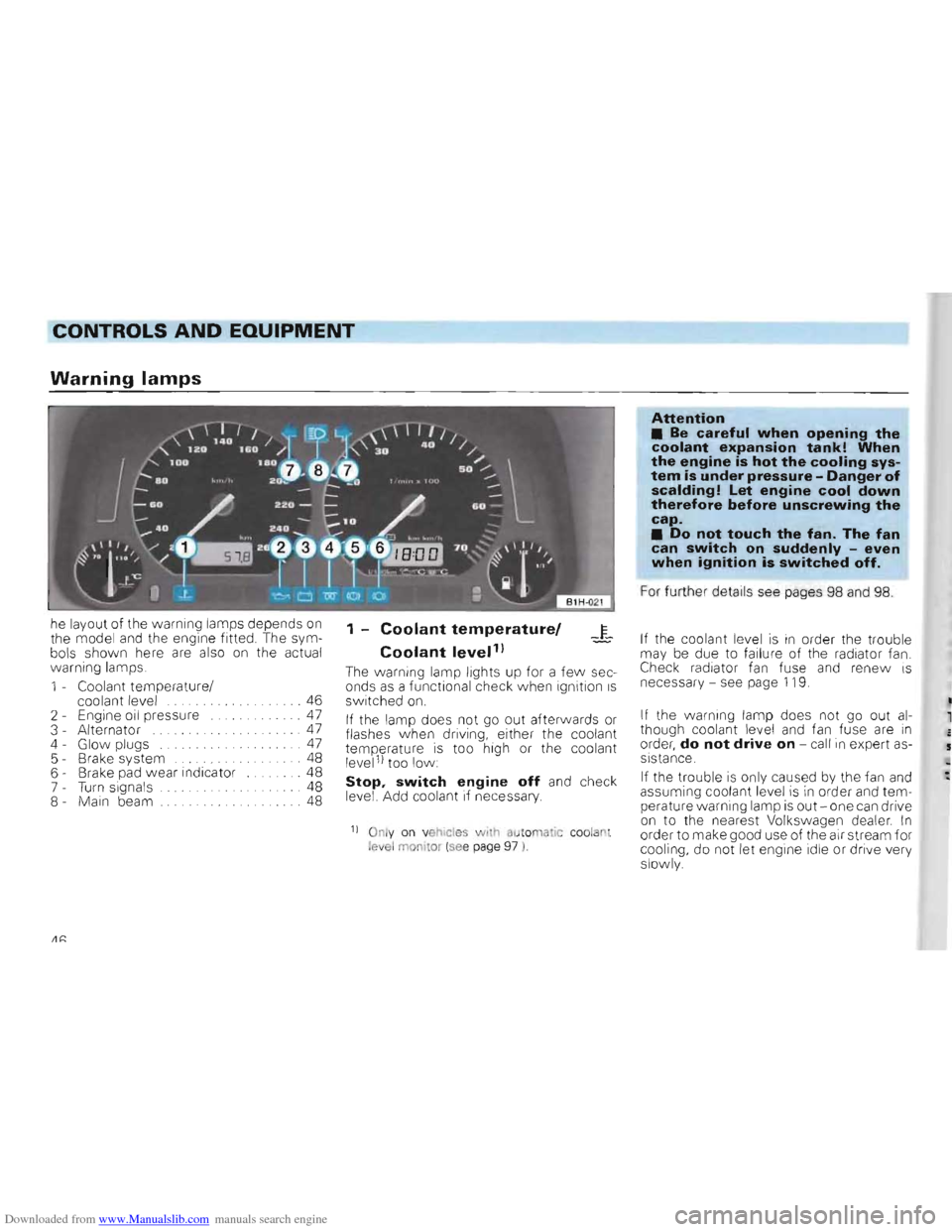
Warning lamps
Attention • Be careful when opening the coolant expansion tank! When the engine is hot the cooling system is under pressure -Danger of scalding! Let engine cool down therefore before unscrewing the cap_
• Do not touch the fan. The fan can switch on suddenly -even when ignition is switched off.
For furthe r details see pages 98 and 98.
1 -Coolant temperaturel _~_ If the coolant le vel is in orde r the trouble Coolant level') may be due to failure of the radiato r fan.
Check radiator fan fuse and renew is
T he wa rni ng lamp lights up for a few sec
necessary -see page 119.onds as a functional check when ign ition IS coo lant level .
. 46 switched on.
2 - Engine oil pressure ... .. 47 If the warning lamp does not go out al
If the lamp does not go out afterwards or 3 -Alternator . 47 though coolant level and fan fuse are inflashes when driving, either the coolant 4 -Glow plugs ... 47 orde r, do not drive on -call in expe rt astempe ratur e is too high or the coolant 5 -Brake system .. 48 sistance
.
level1 l too low: 6 -Brake pad wear indicator .48 If the trouble is only caused by the fan andStop, switch engine off and check7 -Turn signals 48
assuming coolant level is in order and temlevel . Add coolant if necessary . 8 -Main beam .
48
perature warning lamp is out -one can drive on to the nearest Volkswagen dealer. In 11 Only 011 vehicl es wi h a t omatic coolant order to make good use of the air stream for level lllonit or (see page 97 l. cooling , do not let engine idle or drive very
slowly .
he
layout
of the warning lamps depends on the model and the engine fitted. The sym
bols shown here are also on the actual
warn ing lamps.
1 -Coolant temperature /
Page 66 of 156
Downloaded from www.Manualslib.com manuals search engine CONTROLS AND EQUIPMENT
Operating instructions
• Ensure that the sensor betvveen the
windscreen defrost outlets in the centre of
the instrument panel and the air grille next
to the radio is not covered.
• If, after switching on the ignition,
all sym
bols in the display area flash for about 15
seconds, there is a fault in the system -con
tact a Volkswagen dealer.
Notes for both air conditioning
systems
• To ensure that the heating, ventilation
and air conditioner can work properly, the air
inlet in front of the windscreen should be
kept free of ice, snow and leaves.
• The heat output depends
on the coolant
temperature -the full heat output is there
fore available when the engine IS warm.
• The stale air escapes through openings
in the luggage compartment side panels.
Therefore when loading the luggage com
partment ensure that the openings are not
covered .
• When the ambient temperature
is high
and the air very humid, condensed water can drip off the evaporator and form a
puddle under the vehicle. This is quite nor
mal and does not indicate a leak.
Notes for the normal air condi
tioner
• All controls except the rotar y switch A and buttons 0 and E can be set to any inter
mediate position.
•
To prevent the windows from misting up
the blower should be running slowly when driving at low speeds.
Using air conditioners economi
cally
In cooling operation the air conditioner com
pressor places demands on the engine and
therefo re influences the fuel consumption.
To keep the period switched on as short as possible, the following points should be
noted:
• If the
in side temperature is very high
after the car has been parked in the sun, it is recommended to open doors or windows briefly to enable the hot air to escape
• The air conditioner should not be
switched on during a Journey if the
windows or sliding/tilting roof* are open.
• If the desired interior temperature
can be attained w ithout switching on the air
cond itioner the fresh air operation should
be selected (does not apply to Climatronicl.
Operating faults
• Should the air cond i:ioner not work at
any time, either .
- the ambient temperatu re IS below about +5 °C,
-or the fuse has blown.
Check fuse and if necessary r
enew it - see
page 119. If the troub le is n ot due to a defec
tive fuse, SWitch the system off and have It
checked.
- the air conditioner
has svvitched off due
to coolant temperature being too high -see
page 45.
• If the cooling output drops off, switch
the AlC
off and have the system checked.
64
Page 80 of 156
Downloaded from www.Manualslib.com manuals search engine DRIVING TIPS
Driving instructions
To obtain the best possible handling of ve
hicle and trailer, the following should be
noted :
•
Try to avoid driving w ith an unladen ve
hicle and a loaded trailer. If this cannot be
avoided, only drive
slowly to allow for the
unfavourable weight distribution .
• As driving stability
of vehicle and trailer
decreases when the speed increases do not drive at the maximum permissible top speed in unfavourable road, weather or wind conditions -particularly when going
downhill.
In any case the speed must be reduced im
mediately the trailer shows the slightest
sign of snaking . On no account try to stop
the snakin g by accelerating.
• For safety reasons one should not drive
faster than 80
km/h (50 mph). This also
applies in countries where higher speeds
are permitted. •
Al
ways brake in good time. If the trailer
has an overrun brake, apply the brakes gen
tl y at firs t then firmly. This will avoid the Je rk
ing caused by the trailer wheels loc king. Change down before going down a steep
hill so that the engine can act as a braka.
•
When a lon g climb in a low gear with ex
tremel y high engine revs must be nego
tiated at exceptionally high ambient temperatures the coolant temperature gauge must be observed. When the gauge needle
moves to the upper end of the scale, the
road speed must be reduced immediately
If nevertheles s the warning lamp flashes,
stop
immediatel y and allow the engine to
cool off at id l ing speed for several minutes.
• The coo ling
effect of the radiator fan can
not be increased by changing down, be
cause the speed of the fan is not dependent
on the engine speed. One should the refore
not change down even when towing a
trailer as 10ll g as the engine can cope without the vehicle speed dropping too much .
General notes
• It is advisable to hav e the vehicle serviced between the Insp ection in tervals it it
is used frequently for towing a trailer .
• The trailer and draw
bar load figures on
the data plate of the towing bracke t are for test ce rtific ation only. The correct figures
for the vehicle, which may be lower t han
th ese figures, are given in the eh icle documents and in this manual.
78
Page 93 of 156
Downloaded from www.Manualslib.com manuals search engine GENERAL MAINTE NA NCE
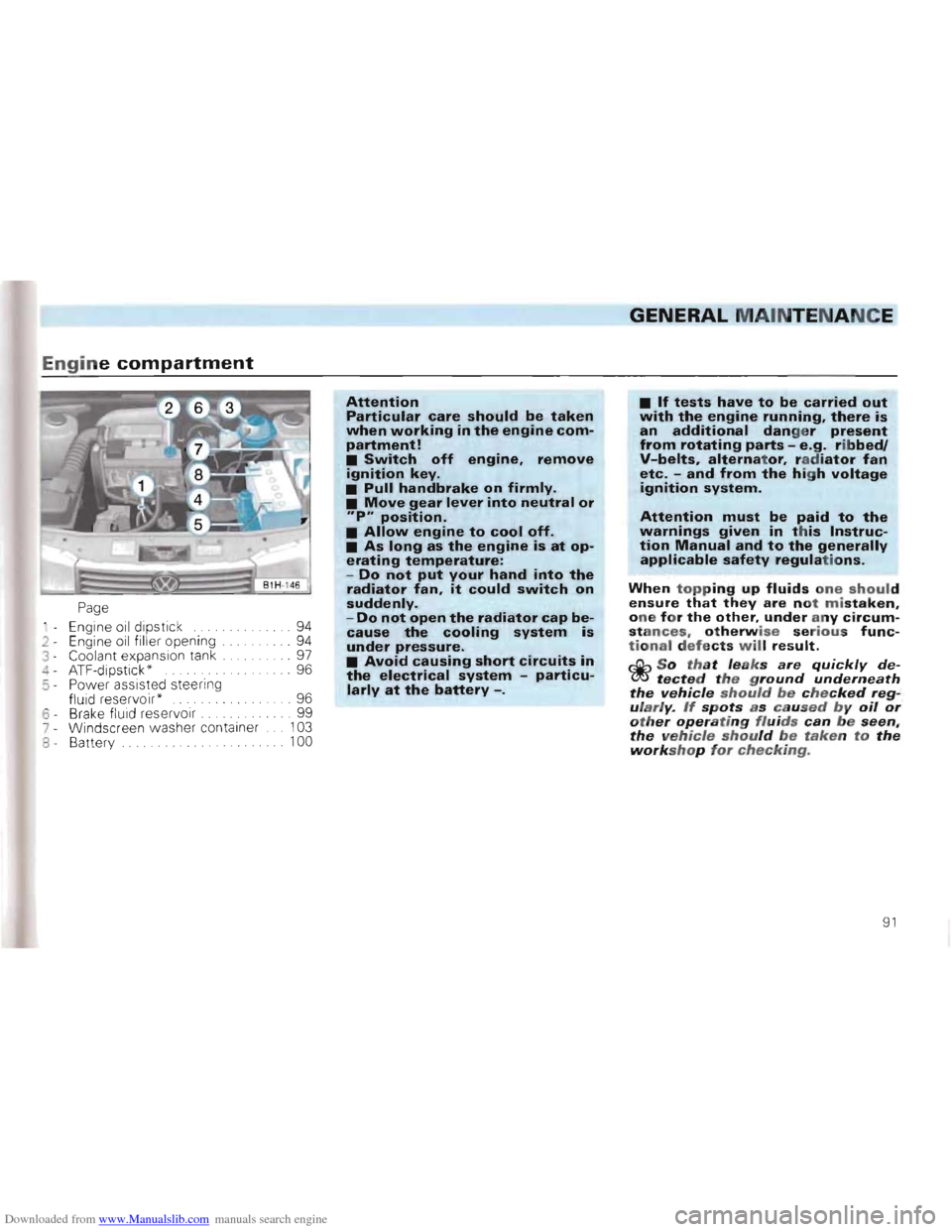
Engine c ompartmen t
Page
Engine oil dip sti ck . . 94
2 - Eng ine o
il filler openi ng ... ...... . 94
3 - Coolant exp ansion ta nk .. 97
4 -ATF-dip sti ck " . . . . . . . . . . . .. . 96
5 - Power assist ed steering flu id r eservoir '
6 Brak e fl uid re se rvo ir .
7 - Wi nd sc reen w ash er c on tainer
8 Battery .
Attention
Particular care should be taken
when working in the engine com
partment!
• Switch off engine. remove ignition key_
•
Pull handbrake on firmly.
• Move gear lever into neutral or
"P" position.
• Allow engine to cool off.
• As long as the engine is at op
erating temperature:
-Do not put your hand into the
radiator fan. it could switch on
suddenly.
-Do not open the radiator cap be
cause the cooling system is
under pressure.
• Avoid causing short circuits in
the electrical system -particu
larly at the battery -.
. .. 96
. .. 99
10 3
100
• If tests have to be ca rried o ut with the engine running. there is an additional dang e r present from rotating parts - e.g . ribbedl V-belts, alternator, ra d iator fan etc. -and fro m the high voltage ignition system.
Attention m ust be paid to the w arn ings given in this Instruction Manual and to the generally ap plicable safety regulations.
When topp ing up fluids one should ensure that they are not mistaken. one for the other, under any circum stances. otherwise serious fu nctional defects will result.
rJjh So that leaks are quickly de(!J!J tected the ground underneath the vehicle should be checked regularly. If spots as caused by oil or other operating fluids can be seen, the vehicle should be taken to the workshop for checking.
91