1993 VOLKSWAGEN GOLF towing
[x] Cancel search: towingPage 36 of 156
Downloaded from www.Manualslib.com manuals search engine CONTROLS AND EQUIPMENT
• Attention • When the engine is running it is necessary to hold the vehicle with the foot brake in all gears. Because with an automatic gearbox the transfer of power is not fully interrupted even at idling speed -and the vehicle tends to "creep". If a driving range is selected while the vehicle is stationary, the throttle must on no account be opened (e.g. by hand from inside the engine compartment). The vehicle can then start moving, possibly even when the hand brake is applied.
Before working on a running engine, ensure that selector lever is
in position "p" and thatthe handbrake is applied.
Moving off
Select driving range (R, 0, 3, 2, 1) Wait until the gearbox has shifted and the power flow is made to the driving
wheels (light selection jerk perceptible). Then one can accelerate.
Stopping
To stop vehicle temporarily such as at traffic
lights, it is only necessary to apply the
brakes. It is not necessary to move selector
lever to "N". The engine should however on ly be running at idling speed.
Parking
On level ground all you need do is engage
the parking lock. On a gradient the hand
brake should be applied firmly first and then
the parking lock engaged. This will ensure
that the locking mechanism
is not too heav
ily loaded and makes the lock easier to dis
engage .
Tow starting
On vehicles w ith automatic gearbox the en
gine cannot be started by towing or pushing
the vehicle. See page130 .
When the battery
is flat. the engine can be started from the battery of another vehicle
by using jumper cables See" Emergency starting", page 128.
Towing
If the vehicle has to be towed at any time ,
you must read the instructions in the sec
tion "Towing/tow starting on page 129.
Emergency programme
If functional defects occur in the electronic system the gearbox can, amongst other
things, carry on operating in two emergency
programmes: •
The gearbox continues to change up
and
down automatically as before but hard shift
jerks are however noticeable. The vehicle
should
be taken to a Volkswagen dealer.
• The gearbox no longer changes up and
down automatically.
The gearbox can then be shifted manually
but in the selector leve r positions "0", "3"
and "2" only the 3rd gear is available.
I n se lector lever positions " 1 " and " R", the
1 st and reverse gears
are available as nor
mal .
However, the converter must. due to the
absence of 2nd gear work harder ,
and under
certain circumstances this causes the con
verte r to overheat.
In a case such as this the
vehicle should be taken, as soon as poss
ible, to a Volkswagen dealer.
34
Page 38 of 156
Downloaded from www.Manualslib.com manuals search engine CONTROLS AND EQUIPMEN-=-T-=------___
Starting the engine
General hints
Attention When starting the engine in confined spaces there is a danger of poisoning.
• Before starting, move gear lever to neu·
tral (with automatic gearbox: Selector lever in "P" or"N" position) and apply handbrake fi rmly
•
On vehicles with a manual gearbox de
press the clutch pedal when operating
starter
so that starter only has to turn en
gine .
• As soon
as engine starts, release the
ignition key so that starter can dise ngage .
• After starting a co
ld engine It may sound
noisy for a moment or two because the 011 pressure has to build up in the hydraulic
tappets first. This is normal and no cause for
alarm .
~Do not warm engine up by run~ning it with vehicle stationary. Drive off straight away.
Do not overrev or use full throttle until the
engine has reached the normal operating
temperature .
• On vehicles with a catalytic converter the engine must not be started by towing the vehicle in ex· cess of 50 m. Otherwise unburnt fuel can pass into the converter and lead to damage.
• Before trying to start engine by towing, the battery from another ve· hicle should be used for starting if possible -see page 128.
Petrol engines
These engines are equipped with a petrol in
jection system that automat ically supp lies
the correct fuel/air mixture at all ambient
temperatures.
When engine
is cold or at operating temperature do not accelerate before or
during the starting procedure.
I f the engin e does not start at once, stop
us ing th e starter after 10 secs. wait about
half a m in ute and then try again.
If the engine sti
ll does not start, the electric
fuel pump fuse may have blown -see page
119 .
When the engine
is very hot it may be
neces sary to accelerate slightl y after the
engine has start
ed.
/
36
Page 50 of 156
Downloaded from www.Manualslib.com manuals search engine CONTROLS AND EQUIPMENT
5 -Brake system
(CD)
The warning lamp* co mes on when
• the handb rake is
on • the brake fluid level is too low The ignition must be switched on.
Attention
If the lamp does not go out when handbrake is released or comes on when driving, the fluid level in the reservoir is too low. Immedi
ately contact a Volkswagen dealer and have the brake system
examined.
You can drive on carefully to the
nearest Volkswagen dealer but allow for higher pedal pressures and longer braking distances on
the way.
I6 -Brake pad wear I,'0',
indicator*
The wa rning lamp lights up for one second when the ignition is switched on as a func
tiona l check.
If the lamp then does not go out or it lights
up dur ing the Journey , the front brake pads
are worn. You should visit a Volkswagen
dealer to have the brake pads checked.
As the brake pad wea r indicator only moni
t ors the front brake pads, we recommend
that you have the rear brake linings checked as well.
7 -Turn signals
The warn ing lamp flashe s when turn signals are sWitched on. If a turn signal fails, the
warning lamp flashes tw ice as fast. (Not
w hen towing a trailer )
Fur ther details are given
on pages 49 and 53.
8 -Main beam
The warning lamp come s on when th e main
beam is on or when the headligh t flas her is used.
48
Page 51 of 156
Downloaded from www.Manualslib.com manuals search engine ----CONTROLS AND EQUIPMENT
Q1~ Trailer turn signals(8 ) Anti-locking Brake System
(ABS)* The warning lamp" flashes when turn sig
nals are switched on when towing a trailer. The warning lamp comes on for a few sec
onds when the ignition is switched on. The If a turn signal fai ls on the trailer or vehicle,
lamp goes out after
an automatic test se the
warning lamp does not flash.
quence has taken place,
If the ASS warning lamp does not go out. or if the ASS warning lamp comes on when
driving, the system is fau lty The vehicle can then only be braked with the normal system
- that is w ith out ASS. The vehicle must be taken to a Vol kswagen dealer as soon as possible .
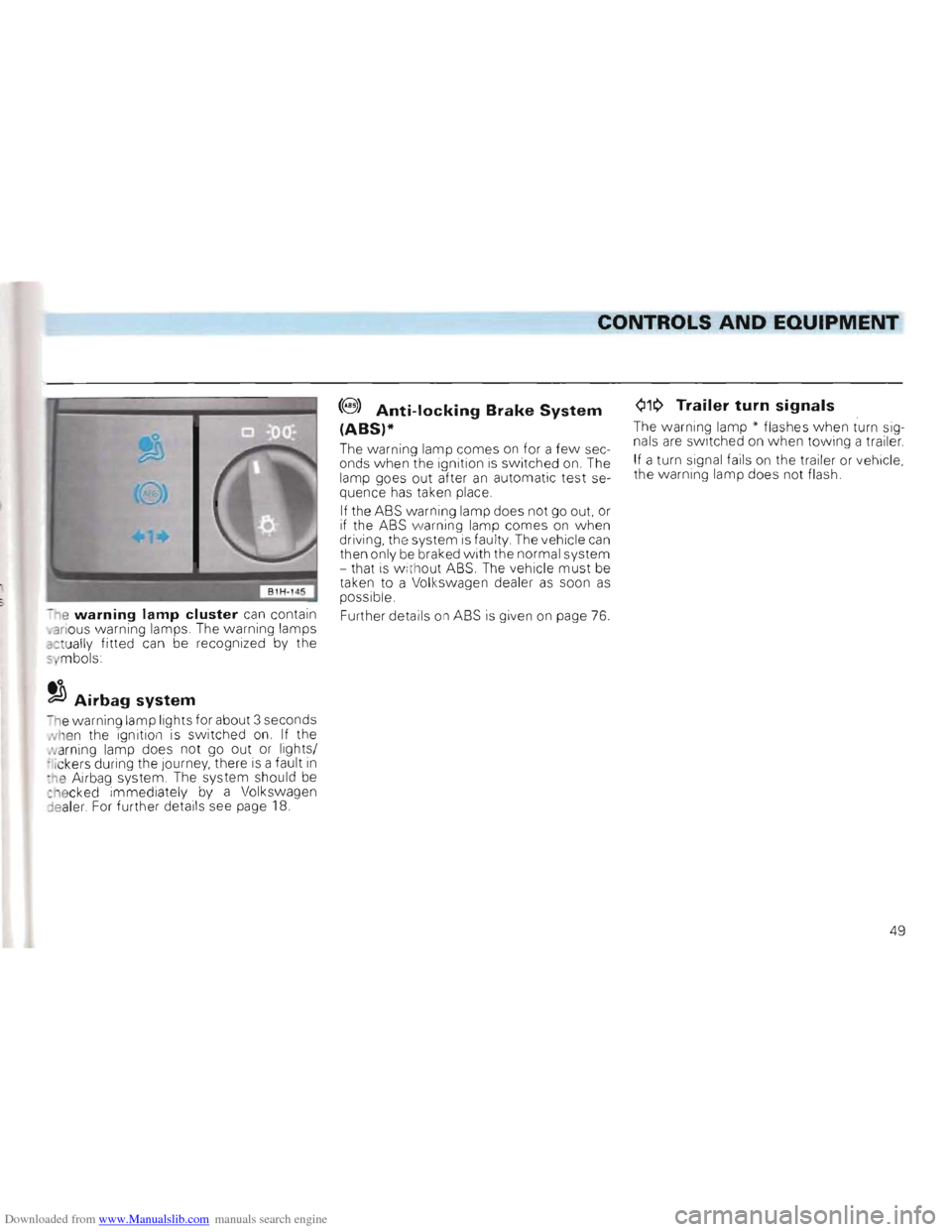
- ne
warning lamp cluster can contain Further details on ASS is given on page 76 . •anous warning lamps. The warning lamps actually fitted can be recognized by the 5 mbols
to ~Airbag system
n e warning lamp lights for about 3 seconds Nhen the ignition is switched on. If the
N arning lamp does not go out or lights/
;Iickers during the Journey, there is a fault in :he Airbag system , The system should be ct16cked immediately by a Volkswagen
:lealer For further details see page 18.
49
Page 73 of 156
Downloaded from www.Manualslib.com manuals search engine DRIVING TIPS
The first 1500 km -and afterwards
Running-in
D Uring the first few opera ting hours the engine interna l friction is hig her than later on
w hen all the moving parts have b edded
d own . How well this running-in process is
d one depe nds to a considerab le exten t on th e w ay the vehicle is dri ven during the first
1 500 km (1000 miles)
Up to 1000 kilometers
the follo win g general rules apply :
• Do not use full throttle • Do not drive faster than 3/4 of top speed • Avoid high engine speeds
• Trailer towing should if possib le be
avoided .
Attention • New tyres must also be .. run in" because they do not have maximum adhesion at the start. This must be taken into account by driving carefully during the first 100 km_ •
•
New brake linings must also be run in and do not have the optimum friction properties during the first 200 km. The slightly reduced braking effect can be compensated for by more pressure on the brake pedal. This also applies when new linings have been fitted.
From 1000 -1500 km
The speed can gradu ally be increased to the
road or eng in e maximum.
During and after the running-in
period the following applies:
• Do not overre v th e engine when cold
eithe r in neutra l or in th e gears .
All speeds and revs given are only valid
w hen engine is properly warm.
r:Gb Do not drive with the engine C!!t) speed unnecessarily high changing up early helps to save fuel, reduces noise and protects the environment -see also page 72.
• Do not let engine labour -ch ange down
when eng ine no lo nger runs s m oothly .
After the running-in period
• On v ehic les with a rev counter* th e maxim um perm issib le e ngine speed is shown by the begin ning of the red zone on
the rev counter scale. The needle of the
c o unter must not mov e into this zone.
E xtreme ly
hig h engine revs w ill be auto
matically go verned.
71
Page 79 of 156
Downloaded from www.Manualslib.com manuals search engine DRIVING TIPS
Trailer towing
The vehicle is intended main ly for the trans
portation of persons and luggage but it can, with the appropriate technical equipment,
also be used to tow a trailer.
Technical requirements
• If the vehicle is suppl ied with a factoryfi tted towing bracket, all that is technically
a nd legally necessary for trailer towing wil l
have been taken into account.
• If the trailer to be towed
has a 7 pin plug, an adapte r cable can be used whi ch IS ob
tained from a Volkswagen dealer.
• Volkswagen dealers have
all the necessary information on the In stallation of towing
brackets and the fitti ng of a heavy-duty cooling system. The installation should there
f ore be done by them .
Operations instructions
• On the Golf saloon with a factory
fitted towing bracket* the removable ball
coupling will
be fitted. Fitting/remo ving in
struc tions and instructions on correct stowage of the ball coupling in the spare wheel
well can be found in a linen bag in the ve
hicle luggage compartment.
•
On the Golf estate with a factory fitted
towing bracket* the remova ble ball coupl
ing is stored inside the vehicle next to the
spare wheel, together w ith instructions on
fitting.
• Pitching movements between towing
vehicle
and trailer can be reduced by hea vy
duty springs and shock absorbers on the
rear axle. If these springs and shock absorbers have not alread y been fitted at the
factory, they can, in many cases, be service
installed by a Volkswagen dealer.
• The permissible trailer weight -see
page 144 -m ust not
be exceeded on any account.
• If the the trailer weight
is below the
permissible maximum, a correspondingly
steeper gradient
can be climbed. •
The given trailer weights
are only appli
cable for altitudes up to 1000 m above sea level. As the engine output and thus the
climbing ability drops due to the decreasing
air density , the weight of vehic le and trailer
must also be reduced by 10 % for each
further 1000 m or part thereof.
• Where possible make full use of the
maximum permissible drawbar weight
on ball of the towing bracket -see page 144
but do not exceed it.
• While observing the permissible trailer
and drawbar weight, distribute the load in the trailer so that heavy objects are as nea r as possible to the axle. The objects must
also be secured so that they cannot slip
about.
• Check the ty
re pressures on the towing
v ehicle, and adjust for full load conditions,
and also check the pressures on the trailer
• T he headlight settings, should
be checked w ith trailer attached before mov
ing off and adjusted as necessary. On vehicles with headlight beam control it is on ly necessary to turn the knurled disc in dash in the appropriate directIOn .
77
Page 80 of 156
Downloaded from www.Manualslib.com manuals search engine DRIVING TIPS
Driving instructions
To obtain the best possible handling of ve
hicle and trailer, the following should be
noted :
•
Try to avoid driving w ith an unladen ve
hicle and a loaded trailer. If this cannot be
avoided, only drive
slowly to allow for the
unfavourable weight distribution .
• As driving stability
of vehicle and trailer
decreases when the speed increases do not drive at the maximum permissible top speed in unfavourable road, weather or wind conditions -particularly when going
downhill.
In any case the speed must be reduced im
mediately the trailer shows the slightest
sign of snaking . On no account try to stop
the snakin g by accelerating.
• For safety reasons one should not drive
faster than 80
km/h (50 mph). This also
applies in countries where higher speeds
are permitted. •
Al
ways brake in good time. If the trailer
has an overrun brake, apply the brakes gen
tl y at firs t then firmly. This will avoid the Je rk
ing caused by the trailer wheels loc king. Change down before going down a steep
hill so that the engine can act as a braka.
•
When a lon g climb in a low gear with ex
tremel y high engine revs must be nego
tiated at exceptionally high ambient temperatures the coolant temperature gauge must be observed. When the gauge needle
moves to the upper end of the scale, the
road speed must be reduced immediately
If nevertheles s the warning lamp flashes,
stop
immediatel y and allow the engine to
cool off at id l ing speed for several minutes.
• The coo ling
effect of the radiator fan can
not be increased by changing down, be
cause the speed of the fan is not dependent
on the engine speed. One should the refore
not change down even when towing a
trailer as 10ll g as the engine can cope without the vehicle speed dropping too much .
General notes
• It is advisable to hav e the vehicle serviced between the Insp ection in tervals it it
is used frequently for towing a trailer .
• The trailer and draw
bar load figures on
the data plate of the towing bracke t are for test ce rtific ation only. The correct figures
for the vehicle, which may be lower t han
th ese figures, are given in the eh icle documents and in this manual.
78
Page 96 of 156
Downloaded from www.Manualslib.com manuals search engine GENERAL MAINTENANCE
Checking oil level
Every eng ine uses a certain amount of oil. The oil consumption can be up to 1.0
litr es per 1000 km -see also page 73. The
engine oil l eve l must therefore be ch ecke d
a t regula r int ervals, preferab ly w hen fillin g
the tank and before a long Journey.
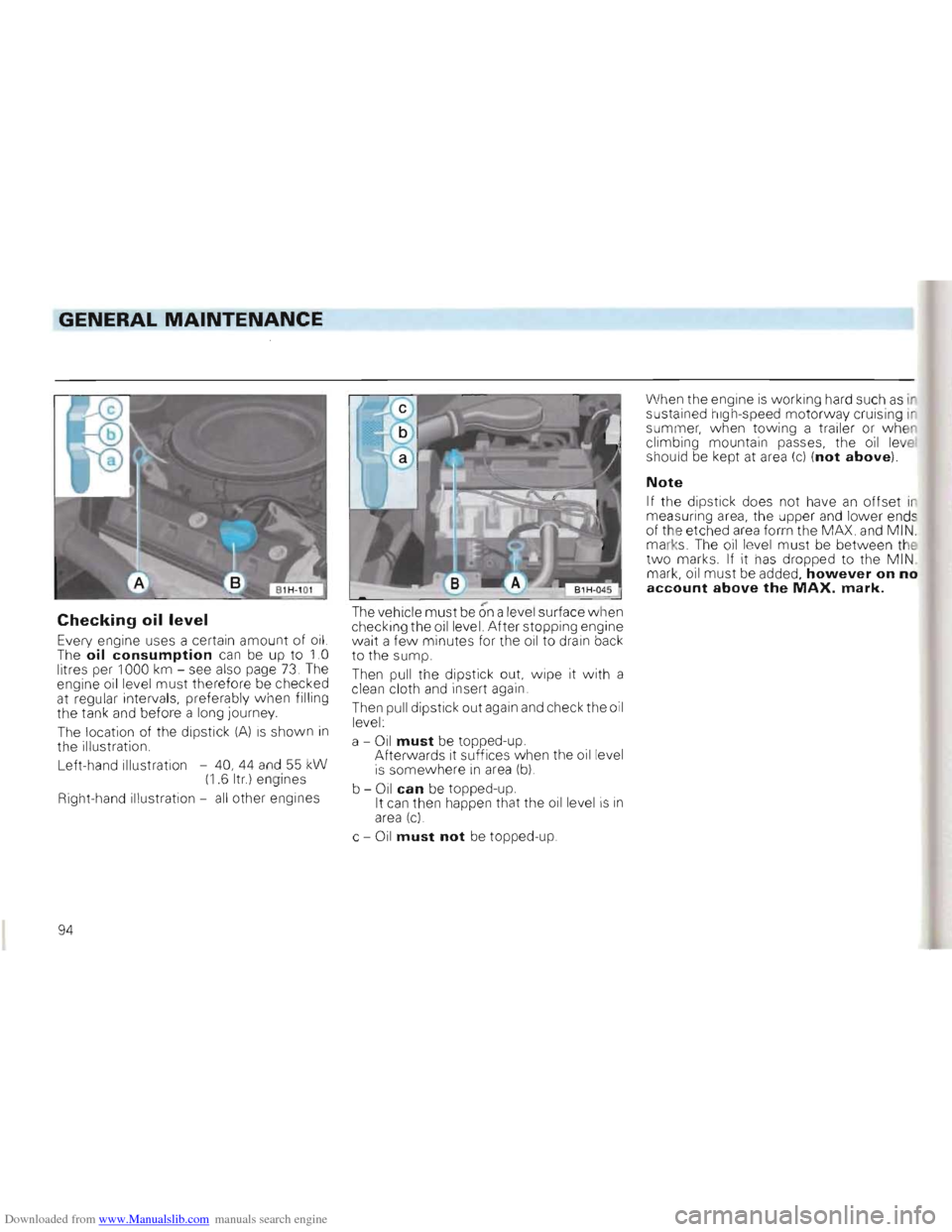
The locat ion of the dipst ick (A) IS shown in th e illustration.
Left-hand illustration -40 , 44 an d
55 kW (1 .6 Itr) en gi nes
Right-hand illustration -
all other engines
The ve hicle must be on a leve l surface when checking the oil level. A fter stopping engine
wa it a fe w minutes for the oil to drain back
to the sum p.
T hen pu ll the dipstick out, wipe it with a
clean cloth and insert again
Then pull dipstick out again
and check th e oi l
level :
a -
Oil must be topped-up.
Afterwards it suffices when the oil level
is somewhere in area (b)
b -Oil can be topped-up.
I t can then happen that the oil level is in area (c)
c -Oil must not be topped-up. When
the engine
is working hard such as ir
sustained high-speed motorway cruisin g in
summer, when towing a trailer or w he n
c limbing mountain passes , the o
il lev e! should be kept at area (c) (not above).
Note
If t he dipstick does not have an offset in
meas uring area, the upper and lower ends
of the etched area forrn the MAX. and MIN .
marks. The oil level must be between the two marks. If it has dropped to the M I N . mark, oil mu st be added, however on no account above the MAX. mark.
94