1993 VOLKSWAGEN GOLF cooling
[x] Cancel search: coolingPage 5 of 156
Downloaded from www.Manualslib.com manuals search engine CONTROLS AND EQUIPMENT
Dashboard and Controls ..... 4
. ey s, Cen tral locking . . .... 6, 7
::"tl-thef t warning system .... 8
Joors .......................... .... 9
oot lid .... ........... . . . . . 10
::Iectric windows .. . .. 10
• ~Irrors . . ..... . ... 12
Seal belts 13
"" rbag System . . . . . 18
Safe ty for children .. ... 21
ead restraints . . . . . .. 24
= ro nt seats . . . . . . . . . . . .. 25
Rear seat . . . 27
L u ggage compartment ... . ... . ...... 28
M esh partition (Estate) ...... 29
L u ggage compartment cover /
F olding/sliding cover
... 30
Pedals, Hand brake .. 31
Manual gearbox .... ... .... 31
Automati c gearbox . . . .. .......... 32
H eig ht-adjustable steering wheel ..... 35
I gnition lock. . . . . .. 35
Starting/stopp ing engine 36, 38
\lIstrumellts .. .... 39
Warning lamps ....... 46
Switches . . . . . . . . . . . . . . 50
Turn signal and dip lever ............. 53
Cruise control system ........... 54
Wi ndscreen wipe r and washer system 55
Heating an d ventilation .. . ...... 56
Air cond itioner ......' 59
Sliding/ti ltin g roof. . . . . . . . . . . . ... 65
Sun visors / Interior lights 66,67
Cigarette lighter, Ash tray ..... 68
Shelves and boxes . . . . . . . . . . . ... 69
Roof rack / Roof ra ilings ... 70
DRIVING TIPS
The firs t 1500 km -and after wards .... 71
Driving economically and ecologically .. 72
Brakes. . . . . . . . . . . . . . . . 75
Tra iler tow ing . .. ..... . .... ... ...... 77
Driving a four- wheel drive vehicle .. 79
GENERAL MAINTENANCE
Filling the tan k, Fuel. 81, 82
Care of vehicle ........ .. . . 85
Bonnet . . ... 90
Engine compartment .. ...... .... .... 91
Engine oil ..... .......... ........... 92
Automatic transmission fluid (ATF)* ... 96
Power-assisted steering .. 96
Cooling system . . . . . . . . . . .. . 97
B rake fluid ...... 99
Battery . . . . .. 100
Spark plugs. V-belts . . . . . . . . . 102
Washer system
... . .. 103
Windscreen w iper blades . . . 104
Dust a
nd pollen filter * . 104
Wheel s . 105
D riving abroad ..... ............... 110
Accessories, modifications and
renewa l ot parts .............. III
Mobile telephones and tw o-way rad ios 111
DO -lT-YOURSELF
First -aid kit, Warn ing triangle ........ 112
Storage of vehicle tools, spare wheel
a n d ball coupling trailer bracket ...... 113
Vehicle tools, Spare wheel 114
CONTENTS
Changing w heels . 116
F uses . ........ .. .. . . . ... . .... 119
Changing bulbs. . .... .. . 121
Installing radio . . . . .. 127
E mergency starting .. .. 128
Tow starting / to wing . . .. 129
L ift ing vehicle ......... 131
SPECIAL INFORMATION
Body ..... .... . .......... 132
Environmental compatibility ... 133
TECHNICAL DATA
Engine data . .. , .... .... . 134
P er forman ce .. ... ... ... . .. 136
Fuel consump tion .. 137
Wh eels
. . 139
T yre pressures
.. .. ... .. . . .. ... 1 4 1
Weights ... 143
Trailer weights .. 144
Dimensions. ...... .. ... 145
Capacities " ..... 146
Vehicle identification data ... 147
ALPHABETICAL INDEX
Alph abetical index ... 148
3
Page 47 of 156
Downloaded from www.Manualslib.com manuals search engine CONTROLS AND EQUIPMENT
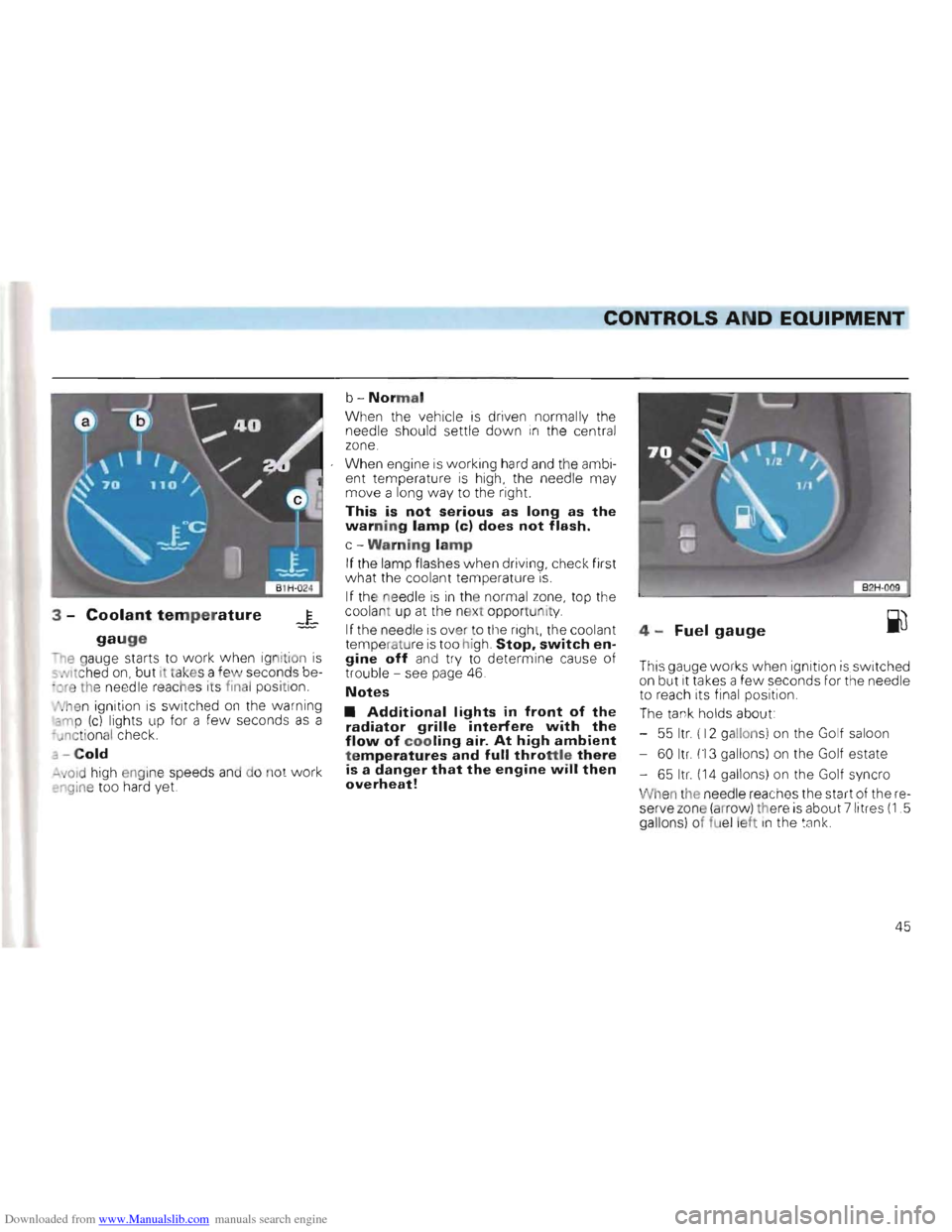
3 -Coolant temperature _~_
gauge
-I
' he n ignition
is switched on the warning amp (c) light s up for a few seconds as a
- u ncti onal check.
3 -Cold
~old high engin e speeds and do no t work engine too hard yet.
b-Normal
When the ~ehicle is dri~en normally the
needle should settle down in the central
zone.
When engine
is working hard and th e ambi
ent temperature is high, the needle may
move a long way to the right.
This is not serious as long as the warning lamp (c) does not flash.
c -Warning lamp
If the lamp flashes when driving , check first
what the coolant temperature is.
If th e needle
is in th e normal zone, top the
coolan t up at the next opportu nity.
If the needle is over to th e rig ht, the coolant
temperat ure is to o high. Stop. switch engine off an d try to determine cause of trouble -see page 46 .
Notes
• Additional lights in front of the radiator grille interfere with the flow of cooling air. At high ambient temperatures and full tt:arottl~ there is a danger that the engme Will then overheat!
4 -Fuel gauge
This gauge works when ign ition is. switched
on but it takes a few seconds for the need le
to reach its fina l posit ion.
The ta holds about
-55 ItL (1 2 gallons) on the Golf saloon
- 60
Itr. (1 3 gallons) on the Golf estat e
- 65 Itr.
(14 gallons) on the Golf syncro
W
hen the needle reaches the start of the re
serve zone (arrow) th ere is about 7 litres (1. 5
gallons) of fue l left in the tank .
45
Page 48 of 156
Downloaded from www.Manualslib.com manuals search engine CONTROLS AND EQUIPMENT
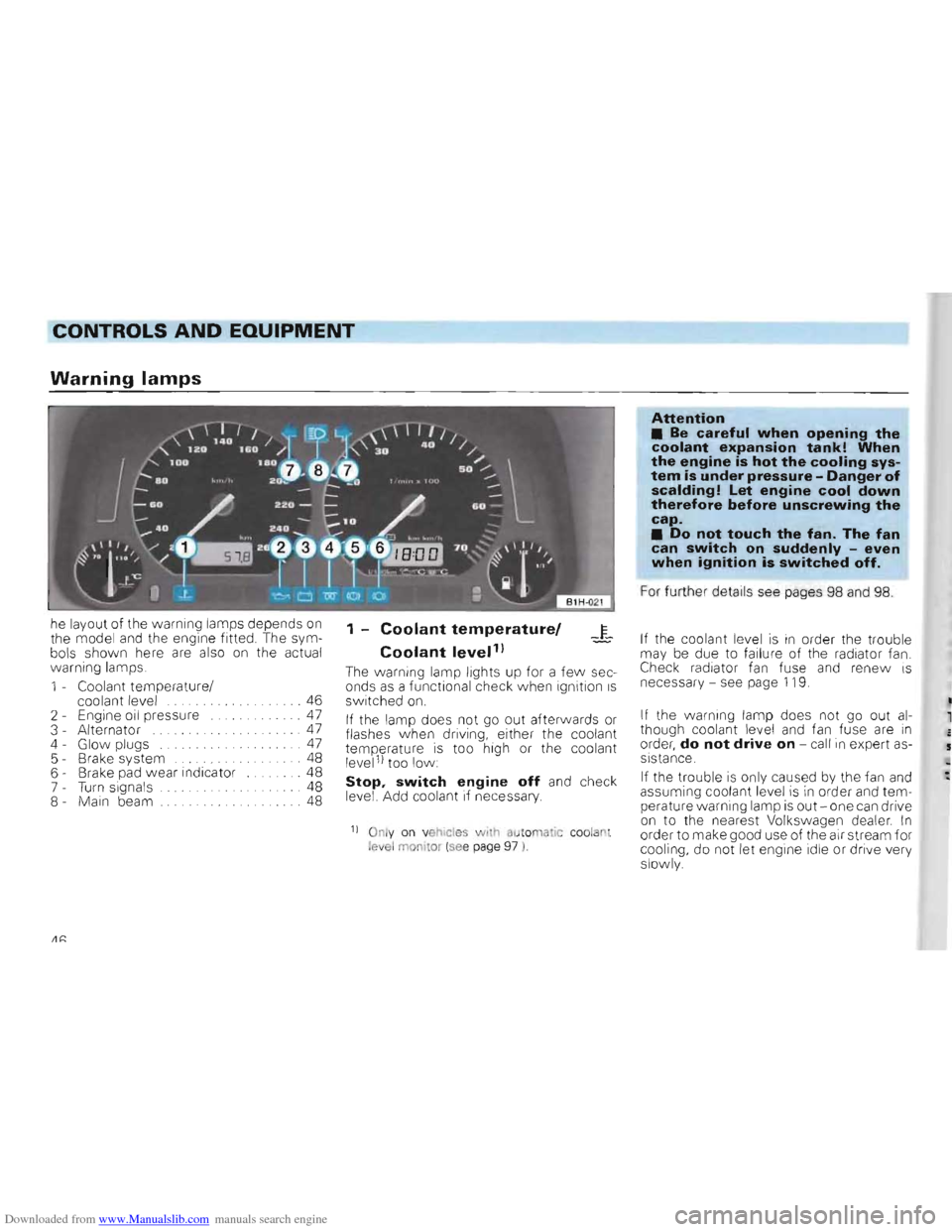
Warning lamps
Attention • Be careful when opening the coolant expansion tank! When the engine is hot the cooling system is under pressure -Danger of scalding! Let engine cool down therefore before unscrewing the cap_
• Do not touch the fan. The fan can switch on suddenly -even when ignition is switched off.
For furthe r details see pages 98 and 98.
1 -Coolant temperaturel _~_ If the coolant le vel is in orde r the trouble Coolant level') may be due to failure of the radiato r fan.
Check radiator fan fuse and renew is
T he wa rni ng lamp lights up for a few sec
necessary -see page 119.onds as a functional check when ign ition IS coo lant level .
. 46 switched on.
2 - Engine oil pressure ... .. 47 If the warning lamp does not go out al
If the lamp does not go out afterwards or 3 -Alternator . 47 though coolant level and fan fuse are inflashes when driving, either the coolant 4 -Glow plugs ... 47 orde r, do not drive on -call in expe rt astempe ratur e is too high or the coolant 5 -Brake system .. 48 sistance
.
level1 l too low: 6 -Brake pad wear indicator .48 If the trouble is only caused by the fan andStop, switch engine off and check7 -Turn signals 48
assuming coolant level is in order and temlevel . Add coolant if necessary . 8 -Main beam .
48
perature warning lamp is out -one can drive on to the nearest Volkswagen dealer. In 11 Only 011 vehicl es wi h a t omatic coolant order to make good use of the air stream for level lllonit or (see page 97 l. cooling , do not let engine idle or drive very
slowly .
he
layout
of the warning lamps depends on the model and the engine fitted. The sym
bols shown here are also on the actual
warn ing lamps.
1 -Coolant temperature /
Page 61 of 156
Downloaded from www.Manualslib.com manuals search engine CONTROLS AND EQUIPMENT
Air conditioner*
-'le air conditioner is available as a normal :r fu lly automatic system (Climatronic*)
'le air conditioner in both cases is a com
u ne d cooling and heating system which
c " ers maximum comfort at all seasons of "18 year.
h e air conditioner
works only when the en
gine is running, the ambient temperature is
,:move about + 5°C and the blower speed is
cetween 1 and 4.
. 'hen air conditione r is switched on it re
d uc es not only the temperature inside the
. e hicle but also the air humidity When the .ambient air humidity is high this not only
a kes the vehicle occupants feel more
_ o m fortable but also prevents the
windows
c ~rom steaming up.
Ni th
the Climatronic* the selected veIcle interior temperature is maintained fully
a u tomatically. This is done by automatically
. I a rying the temperature of the air from the "e nts, the blower speed (air volume) and meair distribution.
Notes
• The operation of the normal air conditioner* is described on pages 59 -61. • The differences for the Climatronic* are given on pages 62 and 63.
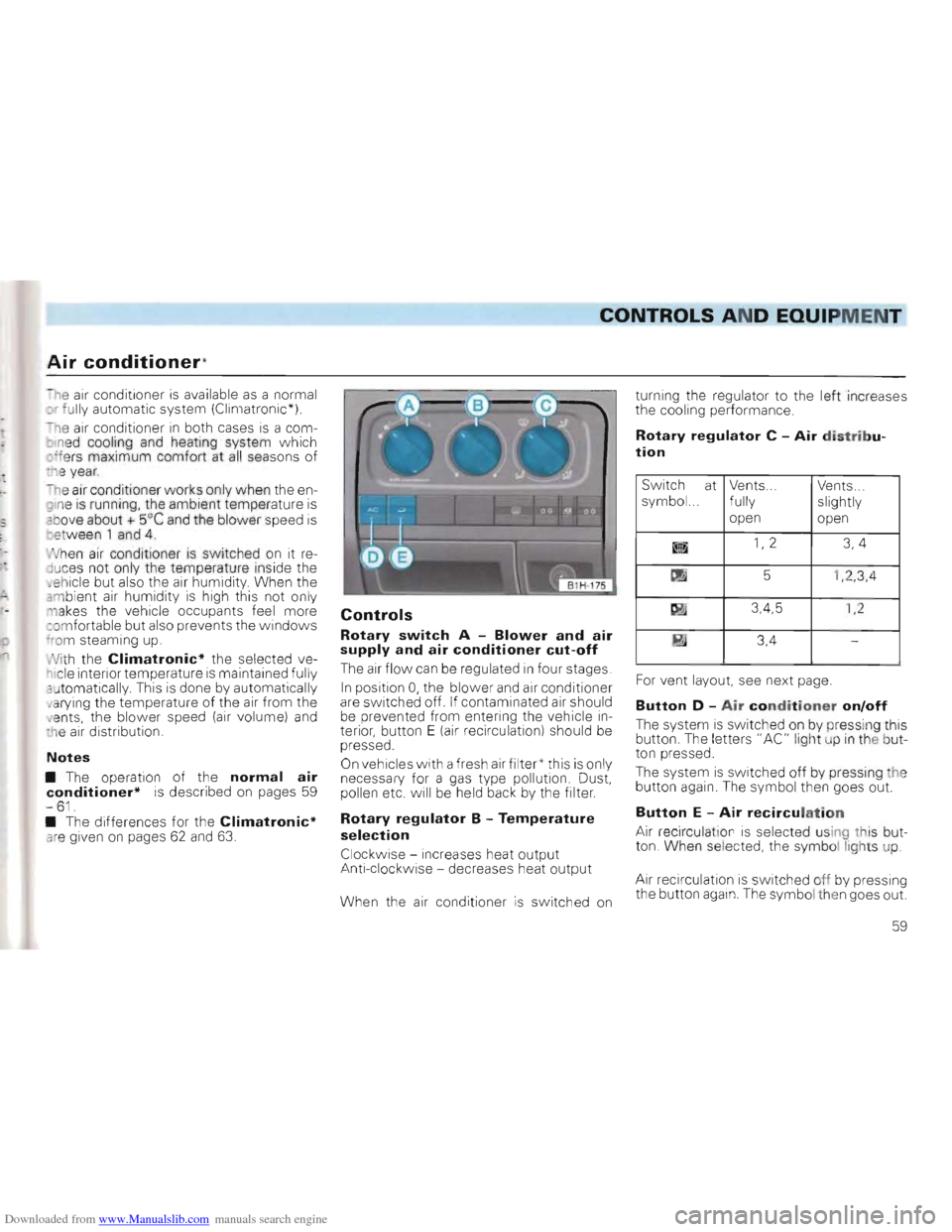
Controls
Rotary switch A -Blower and air supply and air conditioner cut-off
The air flow can be regulated in four stages.
In position 0, the blower and air conditioner
are switched off. If contaminated air should
be prevented from entering the vehicle in
terior, button E (air recirculation) should be
pressed.
On vehicles
with a fresh airfilter' this is only
necessary for a gas type pollution. Dust,
pollen etc. will be held back by the filter.
Rotary regulator B -Temperature
selection
Clockwise -increases heat output Anti-clockwise -decreases heat output
When the air conditioner is switched on turning
the regulator to the l
eft increases the cooling performance.
Rotary regulator C -Air distribu
tion
Switch
at
symbol. Vents..
fully
open V
ents ..
slig htly
open
~ 1,2 3,4
m 5 1 ,2,3,4
~ 3,4, 5
1,2
81 3,4 -
For vent layout, see next page.
Button D -Air conditioner on/off
The syste m is switched on by pressing this
button. The letters" AC" ligh t up i n t he but
ton pressed.
The system
is switched off by pre ss ing th e
button again. The symbol then goes out.
Button E -Air recirculation
Air rec ircula tion is selected usin g this button. When se le cted, the symbol lights up .
Air recir cu lation
is switched off b y pressing
the button ag ain , T he symbo l th e n goes out.
59
Page 63 of 156
Downloaded from www.Manualslib.com manuals search engine __C_ONTROLS AND EQUIPMENT
Heating interior quickly
• Rotary switch A to stage 3.
• Rotary regulator B fully to right. PWll
• Rotary regulator C
to .. ~
• Vents 3 closed .
• Vents 4 fully or partially opened w ith
1 u rled discs
as required
Heating interior comfortably
hen the w indows are clear and the de
s red tempera ture has been reached we rec ommend the following settings
Rotary
switch A at stage 1 or 2.
• Rotary regulator B at the desired heat
Jt put.
Depending on air distribution
esir ed , turn rotary regulator C
re ween .. .. ~
'ld ~
, the windscreen mists over again,
e regulator can also be turned
etw een
•
Vents 3 closed.
•
With vents 4 the desired amount of
warm air and the air flow direction can be
set.
Ventilation (fresh air operation)
With the following settings, unheated fresh
air flows from vents 3 and 4:
• Switch air conditioner off with button D
• Rotary switch A to desired stage.
• Rotary regulator B anti-clockwise to the
stop D.1
• Rotary regulator C to . .. ~
• Vents 3 and 4 open.
If required, regulator C can be turned to
another position.
Maximum cooling
• All windows and sliding/tilting roof*
closed.
• Rotary s
witch A to stage 4.
• Rotary regulator B to left.
• Rotary regulator C to
• Right-hand button 0 (max) pressed.
• Select air recirculation by pressing but
ton E
• Vents 3 and 4 open.
In this mod e, air is drawn from inside the ve
hicle and cooled (air recircu lation) The air
recirculation mode should not be selected for long periods of time as no fresh air is then supplied.
Note
Smoking should be avoided w hen air recir
culation is selected , as the smoke drawn in from the vehicle interior deposits on the
evaporator of the air conditioner. This leads
to permanent odours when the air condi
tioner is i n operation. These can only be
eliminated by exchanging the evaporator,
which is time-consuming and expensive.
Normal cooling
• Switch air condit ioner on by pressing
button 0
• Rotary
switch A to stage 1 -4 as re
quired.
• Rotary regula
tor B to the desired air temperature (so that heating is also possible)
• Rotary regulator C to desired position
• Vents 3 and 4 set
as required.
I n this operating mode air is drawn in from
outside and cooled (fresh air operation)
To operate the Climatronic*, see pages 62 and 63.
61
Page 65 of 156
Downloaded from www.Manualslib.com manuals search engine 2
CONTROLS AND EQUIPMENT
r Notes on Automatic mode
• The interior temperature can be freely
s e lected w ith buttons 16 and 17 and is S ored alw ays until another temperature is selected , -he interior temperature can be set be
-we an + 18°C (64°F) and + 29°C (86°F) In th iS range it is automatically regulated,
f tempe ratures below 18°C are selected
LO" appears in the display , With tempera
-res abo ve 29 °C (86 ° Fl. "HI " is displayed ,
., these two end positions the system
N or ks continuous ly at ma ximum cooling or
n eating output. The temperatu re is not
r egulated
•
In certain operating con ditions it may be fo und that the syste m temporarily carries
o ut functions which are not quite as ex
5-pe cted, This includes, for examp le, that for
a few seconds after sta rting from cold, air is directed mainly into the fo ot wel l. This is ntentional so that damp air in the sys tem
d oes not cause the windo ws to mist up ,
Deviating from Automatic mode
In nearly all cases the Automatic mode
offers the best conditions for the comfort of
the vehicle occupants all the year round,
I n isolated cases however it might
be necessary to deviate from some functions
of Automatic mode by pressing certain but
tons, The Climatronic still works fu lly auto
matically
• With buttons 9 and 10 the blo w er speed
and thus the air vo lume can be increased or
r educed, Th is is sho wn by a change in the
number of lin es in display field 1
• With
bu tton 11 the de-humidifying and defrosting effect for the windsc reen can be
increased if, for example persons w ith
damp clothing
are picked-up shortly after
moving off,
• W ith button
12 air recircu lation can be
se lected to pre vent for examp le dust or
st rong smells
from entering the vehicle in
terio
r. At ambient temperatures below 5cC the sy ste m auto mat icall y sw itches off, This can lead to the window misting u p as t he air is no longer de-humidified.
Note
Smoking should be avoided when air recirculation is selected as t h e smoke drawn in from the vehicle interior deposits on the
evaporator of the air conditioner, This leads
to permanent odours when the air condition
is in operation These can only be efiminated b
y e xchanging the evaporator, which is
time-consuming
and expensive.
• With buttons
13 and 14 the air flow can
be to the upper part of the body or into the
footwe ll,
The air distribution buttons 11, 13 and 14
can be used in combination ,
• With button
18 (OFF) the complete sys
tem is sw itched off, This button should only
be pre ssed in isol ated cases eg when
the re is a fault in the system .
Wh en th e sp ecial functions are no longer re
quired the Automatic mode should be
s w itch ed on again without delay by pres
sin g the AUTO button,
63
Page 66 of 156
Downloaded from www.Manualslib.com manuals search engine CONTROLS AND EQUIPMENT
Operating instructions
• Ensure that the sensor betvveen the
windscreen defrost outlets in the centre of
the instrument panel and the air grille next
to the radio is not covered.
• If, after switching on the ignition,
all sym
bols in the display area flash for about 15
seconds, there is a fault in the system -con
tact a Volkswagen dealer.
Notes for both air conditioning
systems
• To ensure that the heating, ventilation
and air conditioner can work properly, the air
inlet in front of the windscreen should be
kept free of ice, snow and leaves.
• The heat output depends
on the coolant
temperature -the full heat output is there
fore available when the engine IS warm.
• The stale air escapes through openings
in the luggage compartment side panels.
Therefore when loading the luggage com
partment ensure that the openings are not
covered .
• When the ambient temperature
is high
and the air very humid, condensed water can drip off the evaporator and form a
puddle under the vehicle. This is quite nor
mal and does not indicate a leak.
Notes for the normal air condi
tioner
• All controls except the rotar y switch A and buttons 0 and E can be set to any inter
mediate position.
•
To prevent the windows from misting up
the blower should be running slowly when driving at low speeds.
Using air conditioners economi
cally
In cooling operation the air conditioner com
pressor places demands on the engine and
therefo re influences the fuel consumption.
To keep the period switched on as short as possible, the following points should be
noted:
• If the
in side temperature is very high
after the car has been parked in the sun, it is recommended to open doors or windows briefly to enable the hot air to escape
• The air conditioner should not be
switched on during a Journey if the
windows or sliding/tilting roof* are open.
• If the desired interior temperature
can be attained w ithout switching on the air
cond itioner the fresh air operation should
be selected (does not apply to Climatronicl.
Operating faults
• Should the air cond i:ioner not work at
any time, either .
- the ambient temperatu re IS below about +5 °C,
-or the fuse has blown.
Check fuse and if necessary r
enew it - see
page 119. If the troub le is n ot due to a defec
tive fuse, SWitch the system off and have It
checked.
- the air conditioner
has svvitched off due
to coolant temperature being too high -see
page 45.
• If the cooling output drops off, switch
the AlC
off and have the system checked.
64
Page 93 of 156
Downloaded from www.Manualslib.com manuals search engine GENERAL MAINTE NA NCE
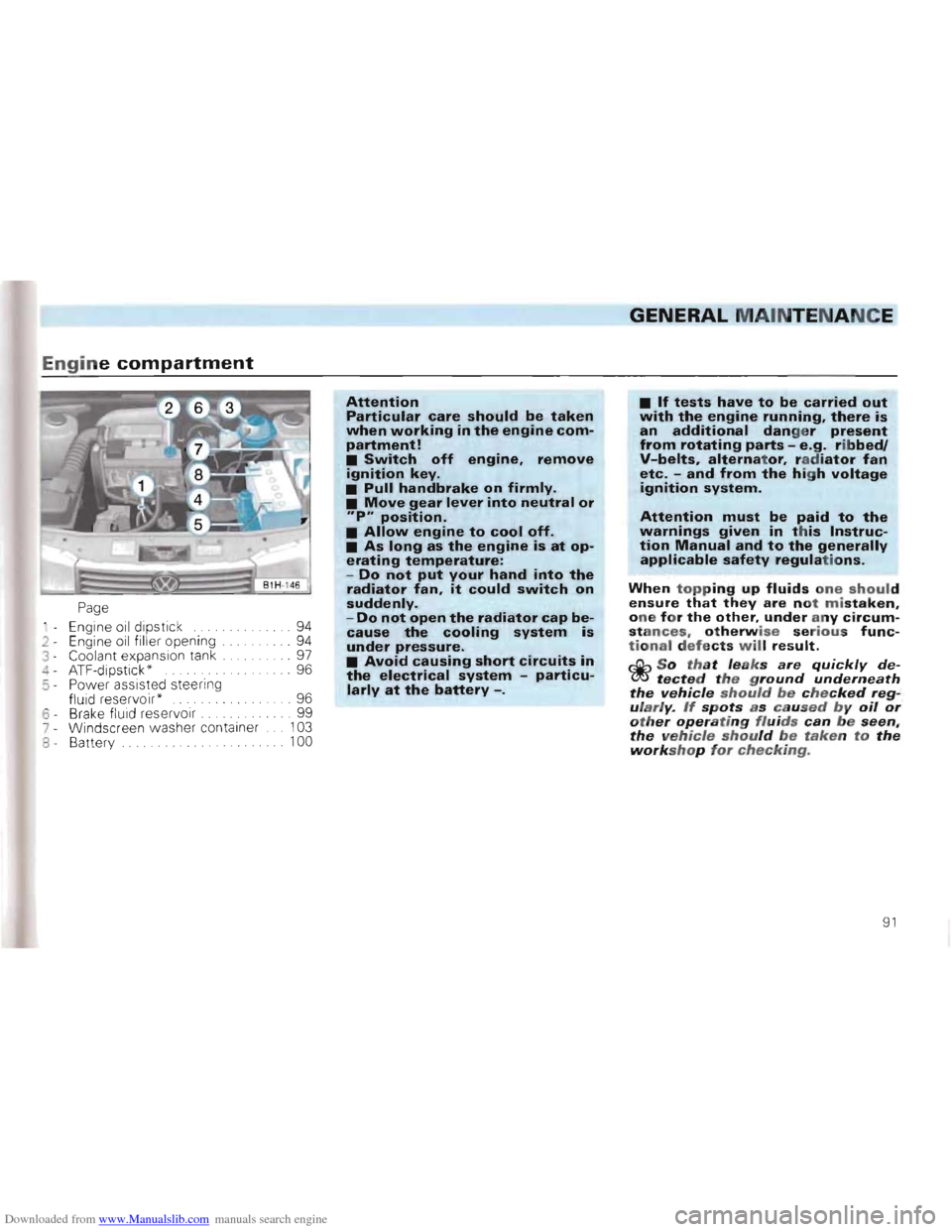
Engine c ompartmen t
Page
Engine oil dip sti ck . . 94
2 - Eng ine o
il filler openi ng ... ...... . 94
3 - Coolant exp ansion ta nk .. 97
4 -ATF-dip sti ck " . . . . . . . . . . . .. . 96
5 - Power assist ed steering flu id r eservoir '
6 Brak e fl uid re se rvo ir .
7 - Wi nd sc reen w ash er c on tainer
8 Battery .
Attention
Particular care should be taken
when working in the engine com
partment!
• Switch off engine. remove ignition key_
•
Pull handbrake on firmly.
• Move gear lever into neutral or
"P" position.
• Allow engine to cool off.
• As long as the engine is at op
erating temperature:
-Do not put your hand into the
radiator fan. it could switch on
suddenly.
-Do not open the radiator cap be
cause the cooling system is
under pressure.
• Avoid causing short circuits in
the electrical system -particu
larly at the battery -.
. .. 96
. .. 99
10 3
100
• If tests have to be ca rried o ut with the engine running. there is an additional dang e r present from rotating parts - e.g . ribbedl V-belts, alternator, ra d iator fan etc. -and fro m the high voltage ignition system.
Attention m ust be paid to the w arn ings given in this Instruction Manual and to the generally ap plicable safety regulations.
When topp ing up fluids one should ensure that they are not mistaken. one for the other, under any circum stances. otherwise serious fu nctional defects will result.
rJjh So that leaks are quickly de(!J!J tected the ground underneath the vehicle should be checked regularly. If spots as caused by oil or other operating fluids can be seen, the vehicle should be taken to the workshop for checking.
91