1993 VOLKSWAGEN GOLF tyre pressure
[x] Cancel search: tyre pressurePage 75 of 156
Downloaded from www.Manualslib.com manuals search engine DRIVING TIPS
The technical prerequisites
for a low fuel consumpt ion and efficienc y "" ere " built in" at the factory. Particular Im
p ortance was placed on the lowes t possible
d is turban ce to the enviro nme nt. To retain and make the best possible use of these characteristics attent ion should be paid to the fo llow ing points
~Even those vehicles which do W not have a catalytic converter should be driven on unleaded petrol for the sake of the environment.
~The prescribed maintenance W operations should be carried out exactly as specified in the Service Schedule.
Having your vehicle regularly serviced by a Volkswagen dealer not only ensures that it is always operationally fit, but it also ensures economy, lowest possible burden on the environment and a long service life.
~Check the tyre pressures every 4 W weeks.
Low tyre pressures increase the rolling resistance. This not only increases the fuel consumption and tyre wear, but the handling is also impaired.
~Do not carry unnecessary ballast W in the luggage boot
Particularly in town traffic when one has to accelerate often, weight has a great influence on the fuel consumption. As a
rule ofthumb: For every 100 kg ofweight the consumption increases by approximately litre per 100 km.
~Remove roof rack immediately Wafter use
Particularly at high speeds the increased air resistance makes itself felt considerably.
~Electrical consumers should W only be switched on when they are actually required
Heated rear windows, additional driving lights and heater blower consume a considerable amount of current. The higher alternator load also increases the fuel consumption. For instance, overa period of 10 hours, the heated rear window will increase the fuel consumption by approximately 1 litre.
~Check the fuel consumption regW ularly
The fuel consumption should be checked each time the tank is filled up. By doing this inconsistencies on the vehicle which lead to an increased fuel consumption can be discovered sooner.
• Check the engine oil level each time the tank is filled up The oil consumption depends to a g reat ex
tent on the engine load and speed. Depend
ing on the style of driving the consumption
can be as much as 1 .0 litr es/1 000 km .
It
IS no rmal fo r the oil consumption of a ne w
engine to reach its lowest level after a cer
tain mileage has be en covered . The con
sumption cannot be properly assessed until
the vehicle has run appro x. 5000 km.
This also applies to the fuel consumption
and the engine output.
73
Page 88 of 156
Downloaded from www.Manualslib.com manuals search engine GENERAL MAINTENANCE
W ashing the vehicle by hand
~In the interests ofe n vironmental ~protection the vehicle s hould only be washed in specially provided wash bays. In some districts, washing cars elsewhere may even be forbidden .
First soften the dirt
with plenty of water and
rinse off as well as possible.
Th en clean the car with a soft sponge, glove
or brush starting on the roof and going from
t o p to bottom using only slight pressure.
Pain t sham poo should only be used for very
p ersis tent dirt.
Rinse the s ponge or glove out thoroughly at
s l
lort intervals.
Wheels and sill panels should be cleaned
last, using a different sponge if possible.
After clea nin g the vehicle, rinse thoroughly
with water and leather it off.
Notes
• The vehicle should not be washed In strong sunshine.
• If the vehicle
is rinsed with a hose, do not
direct the jet of water at the lock cylinders
- they can freeze up in the winter.
Washing vehicle with high pressure
cleaner
• The operating instructions for the high
pressure cleaner must be followed closely
- particularly with regard to pressu re and working distance.
•
Do not use a concentrated Jet. • The water temperature must not be
above 60°e.
Attention
Tyres must never be cleaned with
a concentrated jet! Even at a rela
tively large working distance and
a very short spraying time, dam
age can occur.
Waxing
A good coat of "vax pro tects the vehicle
paintwork to a large extent again st the envi
ronmental influences listed under "Washing" on the previous page an d even against
light mechanical damage
At the latest
when water on th e clean paint
does not form small drops an d roll off, the
vehicle should be protec te d b y applying a
coat of good hard wax. Even when a wax
solution
is used regular ly in the washing water it is advisable to prote ct th e paint vVlth a coat of hard wax at least twice a year.
Polishing
Should only be done if paint has lost its
shine and gloss cannot be brought back
with wax. If the polish used does not con
tain preservative compounds, th~ pain t must be waxed afterwards.
Note
Matt painted and plastic parts should
not be treated with pol is h or hard wax.
86
Page 107 of 156
Downloaded from www.Manualslib.com manuals search engine GENERAL MAINTENANCE
Wheels
General notes
• New tyres do not give maximum grip
str aight away and should therefore be run in
a moderate speeds and a careful style of
driving for about the first 100 km . This will
"Ielp to make the tyres last longer.
• The tread depth of
new tyres can vary
du e to constructi on and design features,
and depending on version and manufac
:u res.
• Check tyres for damage from
time to
-lin e (cuts, splits, cracks and lumps) and re
m ove any foreign bodies embedded in the
- r eads.
•
To a v oid damage to tyres and wheels
drive over curbs and similar obst acles very
slowly and as nearly at right angles as poss
Ible .
Damage to w he els and tyres is not always
e asy to see, so if you think that a wheel is
d a maged, It must be checked by a Volks
w agen dealer.
• Keep grease,
011 and fuel off the tyres.
• Replace missing dust caps as soon as possib le.
• Mark wheels before taking them off so
that they rotate in the same direction when put back on again
•
When taken off, the tyres should be
stored in a cool, dry and preferably dark
place
T y res
which are not on wheels shou ld be
stored In a vertical position.
Tyre life
Tyre life depends to a considerable extent
on the following factors:
Inflation pressure ..-
Tyre pressures can be found on page 141
and on a sticker on the inside of of the tank
filler flap -see page 81.
The inflation pressure
is very important par
ticularly at high speeds . Therefore, the pres
sures should be che cked at least once a
month and before every long Journey.
At this opportunity do not
forget the spare
w heel
• On the temporary spare the pressure is shown on the side wall.
• The spare
wheel w ith normal tyre shou ld alw ays be inflated to the highest pressure required on the veh icle. •
Always check the pressures
when the
ty res are cold. When warm, the pressure is higher but do not reduce. If the load changes a great deal the pressure must be altered to suit.
Pressures
which are too high or too low short en tyre life -quite apart from the detrimental influence on vehicle handling .
Attention
At continuous high speeds a tyre
in which the pressure is too low
flexes more and heats up excess
ively. This can cause tread separ
ation and tyre blowout.
dit-. A pressure which is too low in~creases the fuel consumption and this burdens the environment unnecessarily.
Mode of driving
Fast cornering, hard acceleration and Viol
ent braking also increase tyre wear.
105
Page 111 of 156
Downloaded from www.Manualslib.com manuals search engine GENERAL MAINTENANCE
Winter tyres
winter conditions win ter tyres w ill dis
- n ctly improve the vehicle's handling even
th e case of four
wheel drive ve hicles. This
ap plies In particular to veh icles that are
eq uipped with wide/high -speed tyres (Code
e
tters H or V in the tyre designation on the
: r e wall). Because of their construction
,lIdth, rubber mixture, tread formation etc) :n se tyres provide less traction on ice and
sn ow.
h
en fitting winter tyres note the follow
n g:
• Onl y radial ply winter tyres may
be fitted.
h e factory recommended tyre sizes are given on page 139.
•
To obtain the best possible handling ch aracteristics, wint er tyres must be fitted o n all fou r wheels.
• The pressures for
winter tyres must be
0.2 bar higher than with summer tyres
s e e Technical Data on page 142.
•
Winter tyres are no longe r fully effec tive
h en the tread has worn down to a depth
o f 4 mm.
The following speed limits are valid for winter tyres:
Code letter
Q max. 160 km/h
Code letter T max. 190 km/h
Code letter H ma
x. 210 km/h
In Germany, vehicles w hich can exceed this
speed must have an appropriate sticker in the driver's field of view. Suitable stickers
are available from Volkswagen dealers.
Please note regulations to this effect
in your
cou ntry .
• All-weath er t yres
can also be used in
stead of winter ty res .
• If you have a flat tyre the remarks on
using the spare wheel on page 114 should
be noted .
•
Do not leave winter tyres fitted for an un
necessary long period because w hen the
roads are free of
snow and ice the handling with summer tyres is better.
r:lil:.-. For environmental reasons (!Jtf summer tyres should be fitted again as soon as possible because normally they are quieterin running, tyre wear is reduced and the fuel consumption is lower_
Snow chains
Snow chains can be used on all tyre sizes
listed on page 139. The chains may only be fitted on the front wheels -this applies also to the syncro.
The use of sno w chains on the temporary
spare wheel is not permitted for technical
reasons. Further details are given on page
114 .
Only use thin chains w hich do not stand
clea r
more than 15 mm (including ten
sioner).
When using snow chains wheel trim plates
and trim rings must be ta ken off . For sa fety
reasons the w heel bolts must then be fitted with caps w hich are available from Volks
wagen dealers.
When driving over roads whic h are free of snow you must remo ve the chains. On such
road s they are detrimental to vehic le handl
ing, damage
the tyres and wear out Quickly .
In Germany , the maximum permissible
speed w ith snow chains is 50 m/h
109
Page 117 of 156
Downloaded from www.Manualslib.com manuals search engine DO-lT-YOURSELF
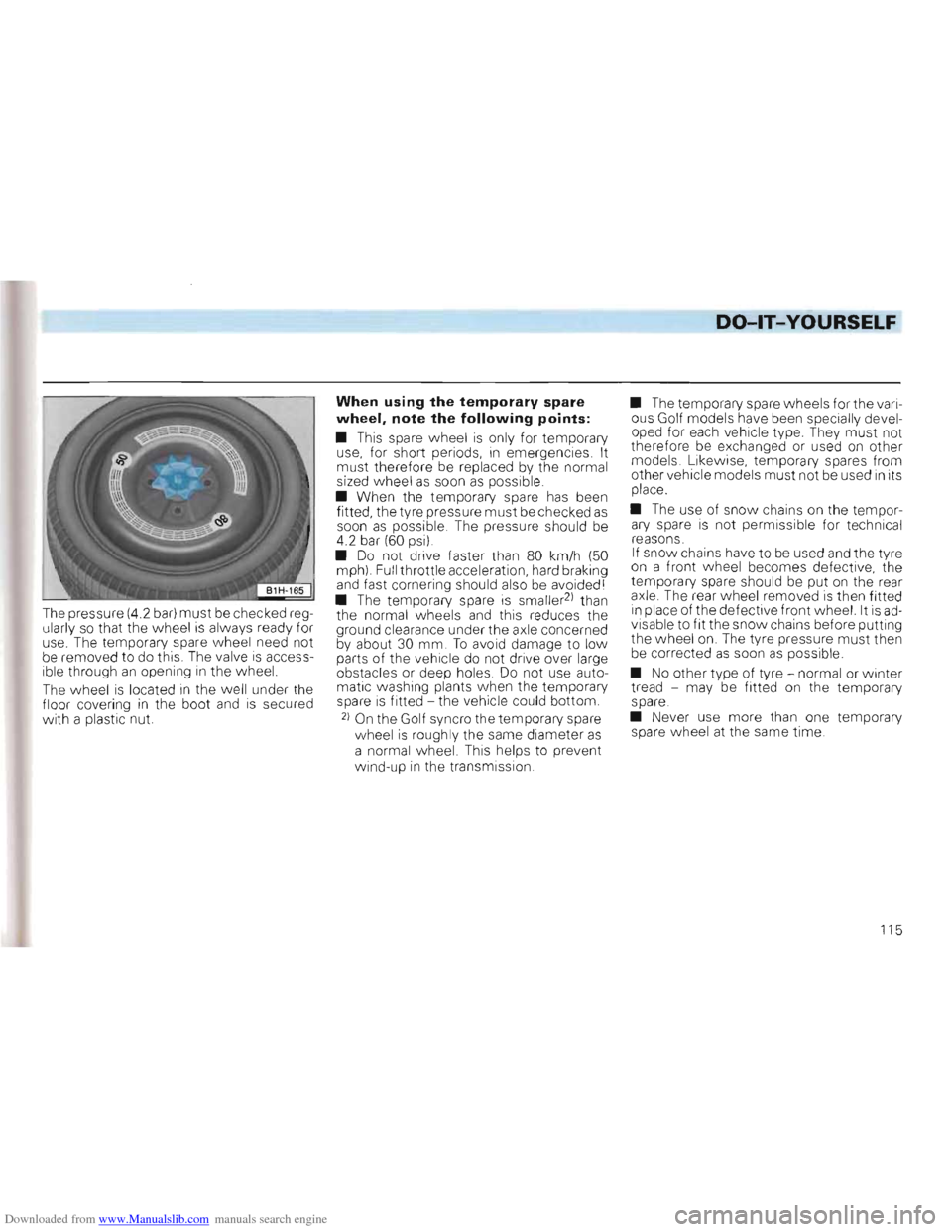
The pressure (4.2 bar) must be checked reg
u larly so that the wheel is always ready for
use. The temporary spare w heel need not
be removed to do this. The valve is access
ible through an opening in the wheel.
The w heel
is located in the well under the
floor covering in the boot and is secured
with a plastic nut
When using the temporary spare
wheel. note the following points:
• This spare wheel is only for temporary
use, for short periods, in emergencies. It
must therefore be replaced by the normal
sized wheel as soon as possible .
• When the temporary spare
has been
fitted , the tyre pressure must be checked as soon as possible. The pressure should be
4.2 bar (60 psi) .
•
Do not drive faster than 80 km/h (50 mph). Full throttle acceleration, hard braking and fast cornering should also be avoided I
• The temporary spare is smaller2
) than
the normal w heels and this reduces the
ground clearance under the axle concerned
by about 30 mm.
To avoid damage to low
parts of the vehicle do not drive over large
obstacles or deep holes. Do not use auto
matic washing plants when the temporary
spare
is fitted -the vehicle could bottom.
2) On the Golf syncro the temporary spare
vvheel is roughly the same diameter as a normal wheel. This helps to prevent
wind-up in the transmission . •
The temporary spare
wheels for the vari
ous Golf models have been specially devel
oped for each vehicle type. They must not
therefore be exchanged or used on other
models. Likewise, temporary spares from
other vehicle models must not
be used in its
place
• The use of
snow chains on the temporary spare is not permissible for technical
reasons. If snow chains have to be used
and the tyre on a front wheel becomes defective, the
temporary spare should be put on the rear
axle. The rear wheel removed is then fitted in place of the defecti ve front wheel. It is advisable to fit the snow chains before putting
the wheel on. The tyre pressure must then be corrected as soon as possible .
•
No other type of tyre - normal or winter
tread -may be fitted on the temporary
spare.
• Never use more than one temporary
spare wheel
at the same time.
115
Page 120 of 156
Downloaded from www.Manualslib.com manuals search engine DO-lT-YOURSELF
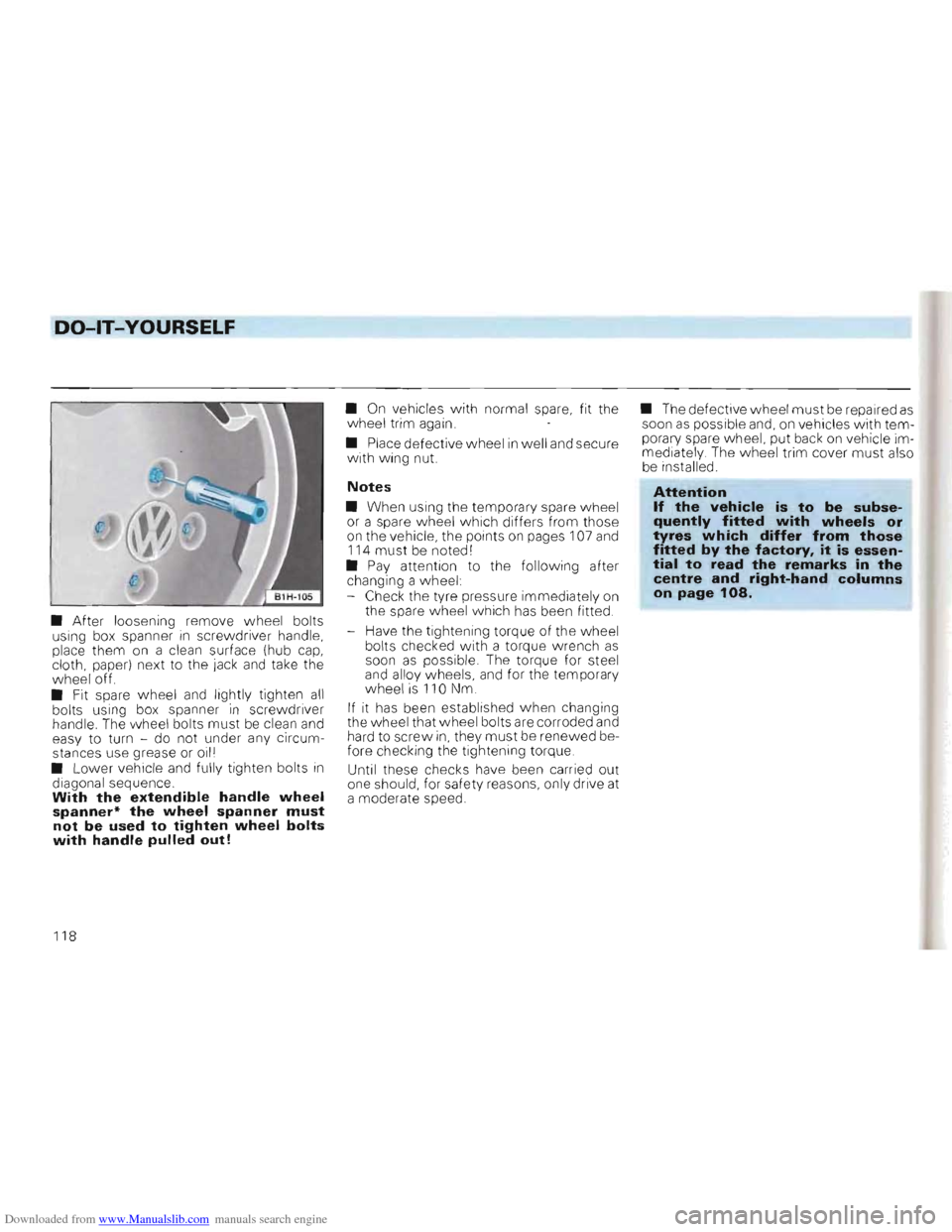
• After loosening remove wheel bolts
using box spanner in screwdriver handle,
place them on a clean surface (hub cap, cloth, paper) next to the jack and take the
wheel off.
• Fit spare w heel
and lightly tighten all bolts using box spanner in screwdriver
handle. The wheel bolts must be clean and
easy to turn -do not under any circum
stances use grease or oill
• L o
wer vehicle and fully tighten bolts in diagonal sequence. With the extendible handle wheel spanner* the wheel spanner must not be used to tighten wheel bolts with handle pulled out!
• On vehicles w ith normal spare, fit the
wheel trim again.
• Place defective wheel
in well and secure
with wing nut.
Notes
• When using the temporary spare wheel
or a spare wheel wh ich differs from those
on the vehicle, the points on pages 107 and
114 must be noted I
• Pay attention to the following after
changing a wheel:
- Check the tyre pressure immediatel y on
the spare wheel which has been fitted .
-
Have the tightening torque of the wheel
bolts checked with a torque wrench as soon as possible. The torque for steel and alloy wheels, and for the temporary
wheel is 110 Nm .
If it has been established when changing
the wheel that wheel bolts are corroded and
hard to screw
in, they must be renewed be
fore checking the tightening torque.
Until these checks have been carried out
one should, for safe ty reasons, only drive at
a moderate speed. •
The defective wheel
must be repaired as soon as possible and, on vehicles with tem
porary spare wheel, put back on vehicle im
mediately. The wheel trim cover must also be installed.
Attention If the vehicle is to be subsequently fitted with wheels or tyres which differ from those fitted by the factory. it is essential to read the remarks in the centre and right-hand columns on page 108.
118
Page 143 of 156
Downloaded from www.Manualslib.com manuals search engine ---TECHNICAL DATA
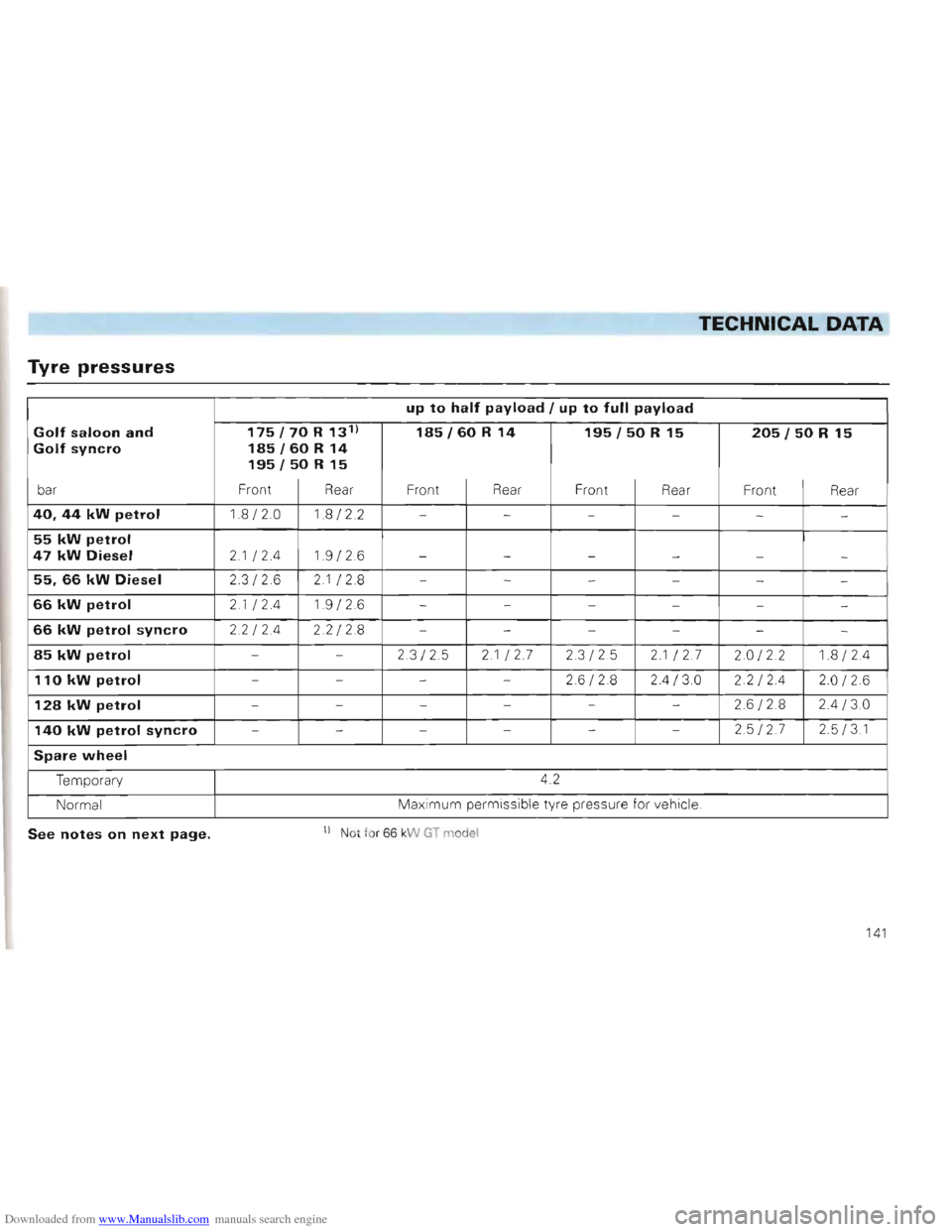
Tyre pressures
Golf saloon and Golf syncro
bar
up to half payload / up to full payload
175/70 R 131)
185/60 R 14 195/50 R 15
Front
Rear
185/60 R 14
Fron t Rea r
195/50 R 15
Fron
t Rear
205/50 R 15
Fro nt Rea r
40, 44 kW petrol 18 /20 1 8/22 -----
-
55 kW petrol
47 kW Diesel 2.1 /24 1 9/26 --- ---
55, 66 kW Diesel 2.3/2.6
2 1 /28 --
---
-
66 kW petrol 2. 1 /2 4 1 9/26 - ---- -
66 kW petrol syncro 2.2/2.4 2.2/2.8 ----
-
-
85 kW petrol --2.3/ 2.5 2.1/2.7 23 / 25 2.1 /2.7
2.0 / 2.2 1 8/ 2
.4
110 kW petrol -- --2.6/2.8 24/30 2.2/2.4 2.0/ 2.6
128 kW petrol -- --- -2.6/ 2.8 24 /3.0
140 kW petrol syncro - --- --25/27 2.5 /3 1
Spare wheel
T
e mp orary 4.2
Norma l Maximum per miss ib le tyr e press ure for vehi cle.
See notes on next page. 1) Not fo r 66 kW GT m odel
14 1
Page 144 of 156
Downloaded from www.Manualslib.com manuals search engine TECHNICAL DATA
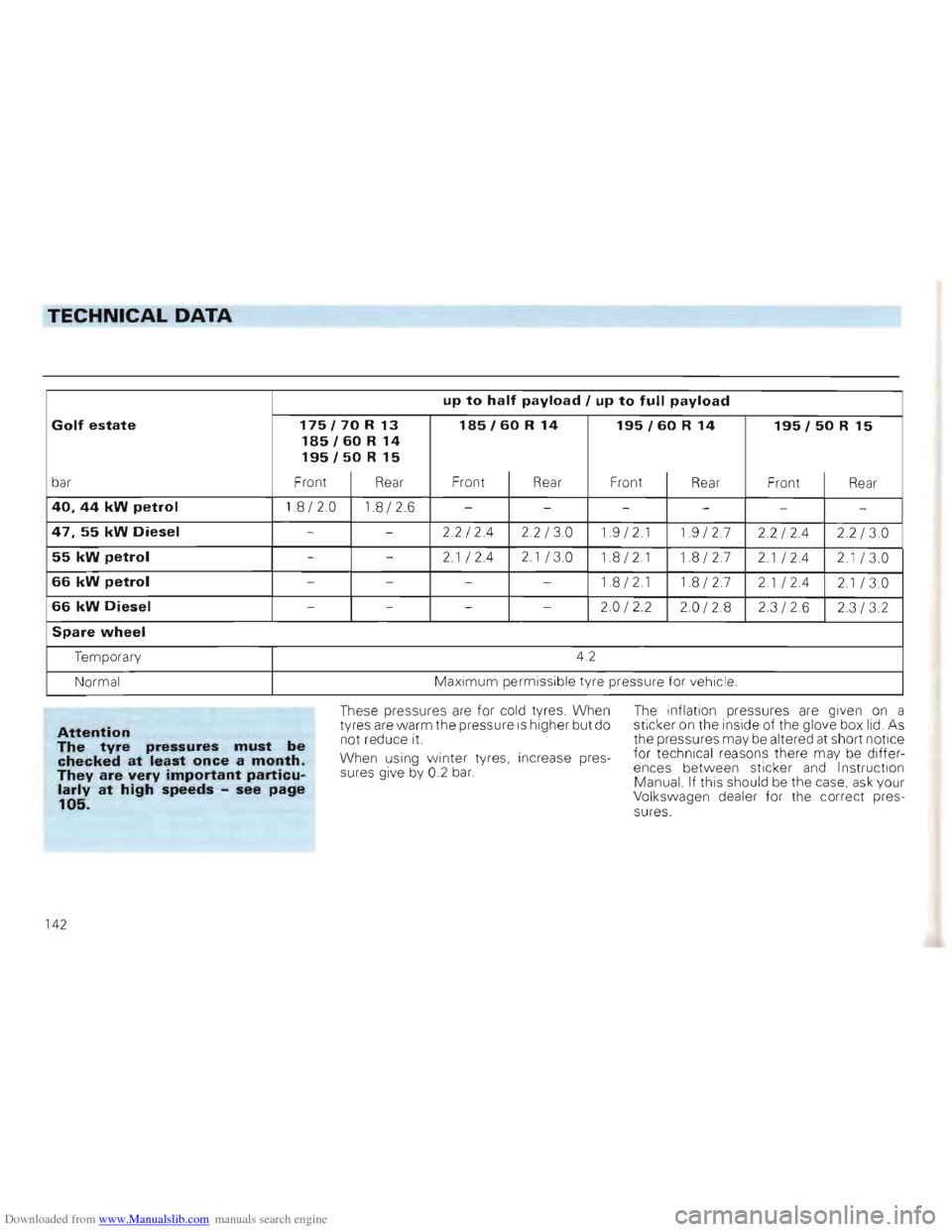
up to half payload / up to full payload
Golf estate 175/70R13 185/60R14 195/60 R 14 195/50 R 15 185/60R14
195/50 R 15
bar Front
40, 44 kW petrol 18/20
47,55 kW Diesel
55 kW petrol
66 kW petrol
66 kW Diesel
Spare wheel
T
emporary
Normal
-
-
Rear Front Rear Front Rear Fron t Rear
18 / 26 ------
-
2. 2/ 2.4 2.2 / 3.0 19/ 21 19/27 2.2 / 2.4 2.2/3.0
-21 /2.4 2.1/ 3 0 18/21 18/27 2.1 / 2.4 2.1 /3.0
--18/21 18/27 2.1/2.4 2.1/3.0
---2.0 / 2.2
2.0 / 2.8 2. 3 /2.6 2 3/ 32
4.2
Ma ximum permissib le tyre pressure for vehicle .
These pressures are for cold tyres. When
t y res are wa rm the pressure is higher but do Attention not reduce it. The tyre pressures must be checked at least once a month. When using winter tyres, increase pres
They are very important particusures give b y 0.2 bar.
larly at high speeds -see page
105.
The inf lation pressures are given on a
sticker on the inside of the glo ve box lid. As
the pressures may be alt ered at short notice
for technic al reasons there may be differ
ences between sticker and Instruction
Manual. If this shou ld
be th e case, ask your Volkswagen dealer for the correct pres
sures.
142