1993 VOLKSWAGEN GOLF engine overheat
[x] Cancel search: engine overheatPage 36 of 156
Downloaded from www.Manualslib.com manuals search engine CONTROLS AND EQUIPMENT
• Attention • When the engine is running it is necessary to hold the vehicle with the foot brake in all gears. Because with an automatic gearbox the transfer of power is not fully interrupted even at idling speed -and the vehicle tends to "creep". If a driving range is selected while the vehicle is stationary, the throttle must on no account be opened (e.g. by hand from inside the engine compartment). The vehicle can then start moving, possibly even when the hand brake is applied.
Before working on a running engine, ensure that selector lever is
in position "p" and thatthe handbrake is applied.
Moving off
Select driving range (R, 0, 3, 2, 1) Wait until the gearbox has shifted and the power flow is made to the driving
wheels (light selection jerk perceptible). Then one can accelerate.
Stopping
To stop vehicle temporarily such as at traffic
lights, it is only necessary to apply the
brakes. It is not necessary to move selector
lever to "N". The engine should however on ly be running at idling speed.
Parking
On level ground all you need do is engage
the parking lock. On a gradient the hand
brake should be applied firmly first and then
the parking lock engaged. This will ensure
that the locking mechanism
is not too heav
ily loaded and makes the lock easier to dis
engage .
Tow starting
On vehicles w ith automatic gearbox the en
gine cannot be started by towing or pushing
the vehicle. See page130 .
When the battery
is flat. the engine can be started from the battery of another vehicle
by using jumper cables See" Emergency starting", page 128.
Towing
If the vehicle has to be towed at any time ,
you must read the instructions in the sec
tion "Towing/tow starting on page 129.
Emergency programme
If functional defects occur in the electronic system the gearbox can, amongst other
things, carry on operating in two emergency
programmes: •
The gearbox continues to change up
and
down automatically as before but hard shift
jerks are however noticeable. The vehicle
should
be taken to a Volkswagen dealer.
• The gearbox no longer changes up and
down automatically.
The gearbox can then be shifted manually
but in the selector leve r positions "0", "3"
and "2" only the 3rd gear is available.
I n se lector lever positions " 1 " and " R", the
1 st and reverse gears
are available as nor
mal .
However, the converter must. due to the
absence of 2nd gear work harder ,
and under
certain circumstances this causes the con
verte r to overheat.
In a case such as this the
vehicle should be taken, as soon as poss
ible, to a Volkswagen dealer.
34
Page 47 of 156
Downloaded from www.Manualslib.com manuals search engine CONTROLS AND EQUIPMENT
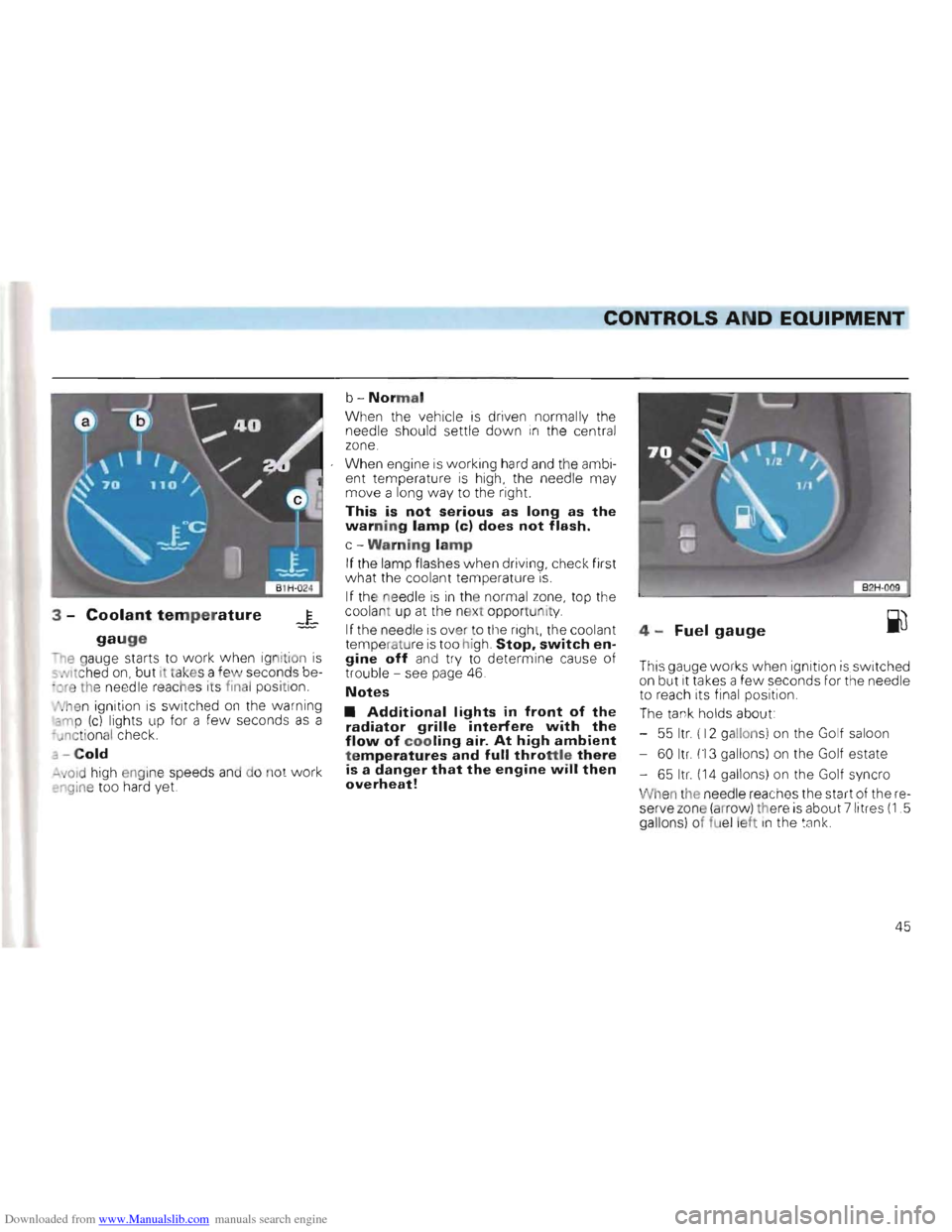
3 -Coolant temperature _~_
gauge
-I
' he n ignition
is switched on the warning amp (c) light s up for a few seconds as a
- u ncti onal check.
3 -Cold
~old high engin e speeds and do no t work engine too hard yet.
b-Normal
When the ~ehicle is dri~en normally the
needle should settle down in the central
zone.
When engine
is working hard and th e ambi
ent temperature is high, the needle may
move a long way to the right.
This is not serious as long as the warning lamp (c) does not flash.
c -Warning lamp
If the lamp flashes when driving , check first
what the coolant temperature is.
If th e needle
is in th e normal zone, top the
coolan t up at the next opportu nity.
If the needle is over to th e rig ht, the coolant
temperat ure is to o high. Stop. switch engine off an d try to determine cause of trouble -see page 46 .
Notes
• Additional lights in front of the radiator grille interfere with the flow of cooling air. At high ambient temperatures and full tt:arottl~ there is a danger that the engme Will then overheat!
4 -Fuel gauge
This gauge works when ign ition is. switched
on but it takes a few seconds for the need le
to reach its fina l posit ion.
The ta holds about
-55 ItL (1 2 gallons) on the Golf saloon
- 60
Itr. (1 3 gallons) on the Golf estat e
- 65 Itr.
(14 gallons) on the Golf syncro
W
hen the needle reaches the start of the re
serve zone (arrow) th ere is about 7 litres (1. 5
gallons) of fue l left in the tank .
45
Page 76 of 156
Downloaded from www.Manualslib.com manuals search engine DRIVING TIPS
Trouble-free functioning of the exhaust emission control system is de
c isi ve for the enviro nment-friendly oper
ation of the vehicle .
The follow ing points should therefore
be noted:
• Vehicles fitted with a catal ytic con verter
may onl y be driven on unleaded petrol (see
page 82).
• Never drive until the fuel tank
is com
pletely empty on vehicles with a catal yst.
The irregular fuel supply ca n cause misfir
ing This allows un burnt fuel into the ex
haust system. This can cause overheating
and damage to the catalyst.
• If whilst driving, the engine misfires,
loses power and runs unevenly, this could
be due to a fault in the ignition system . In a
case like this, unburnt fuel can enter the ex
haust system and then escape to atmos
phere. Furthermore, the catalytic converter
could become damaged due to overheat
ing The vehicle speed
must be reduced im
mediately and the defect should be elImIn
ated at the nearest Volkswagen dealer.
• Do not sw itch
off ignition whilst driving
- see page 38 . •
Do not
overfill engine oil-see page 95.
•
Do not tow start vehicle for more than 50 m -see page 130.
Attention Due to high temperatures which can occur in the catalytic converter on petrol engine vehicles in very unfavourable conditions, the vehicle should not be parked so that the catalytic converter can come into contact with inflammable materials_
Note
Even in the case of a perfectl y working ex
haust emission control sy stem there can,
under certain engine operating conditions,
be a sulphur-type exhaust smell.
This depends upon the sulphur content
in
the fuel being used.
Quite often this
can be remedied by select
ing another brand of fuel or, filling up with
unleaded premium petrol.
74
Page 77 of 156
Downloaded from www.Manualslib.com manuals search engine DRIVING TIPS
Brakes
General notes
• Brake lining wear depends to a la rge ex
t e nt on the operating conditions and style of riving. On vehicles which are used mainly
n town traffi c and stop/start conditions or are driven hard it may be nece ssary to have the thickness of the brake linings checked by a Volkswagen dealer in be tween the in
t er vals given in the Ser vice Schedule. On 'ehic les with brake pad wear indicato r, worn front pads w ill b e indic ated by a wa rnIng lamp -see page 48.
• Change down in good time when driving
d ownhill , in order to make use of the engine
braking effect. This relieves strain on the
brake system . When the brakes are appl ied
d o not keep them on conti nuo usly, apply
a n d release alternately.
• Under certain
operating conditions, for
ex ample after driv ing through water, after
h eavy ra in or after washi ng the vehicle the
braking effect may be reduced by wet, or in linter iced-up brake discs and linings -the
brakes must be dried out first by applying th e footbrake. The
fu
ll braking effect may also be reduced
when vehicle has been driven for som e
tim e on heavily salted roads witho ut using the bra kes, because th e layer of salt on
discs and pads has to wear off first.
Attention
If a front spoiler or full size wheel trims are retrofitted, it is necessary to ensure that the flow of air to the front brakes is not restricted -otherwise the brakes can overheat.
Brake serve
Attention The servo is operated by vacuum which is only generated when en
gine is running. For this reason the vehicle should not be allowed to roll with the engine switched off.
When the brake servo is not working because, for example, the vehicle is being towed or because a defect has occurred on the brake servo itself, the brake pedal must be pressed considerably harder to compensate for the absence of servo assistance.
75
Page 83 of 156
Downloaded from www.Manualslib.com manuals search engine Filling the tank
B1H-040
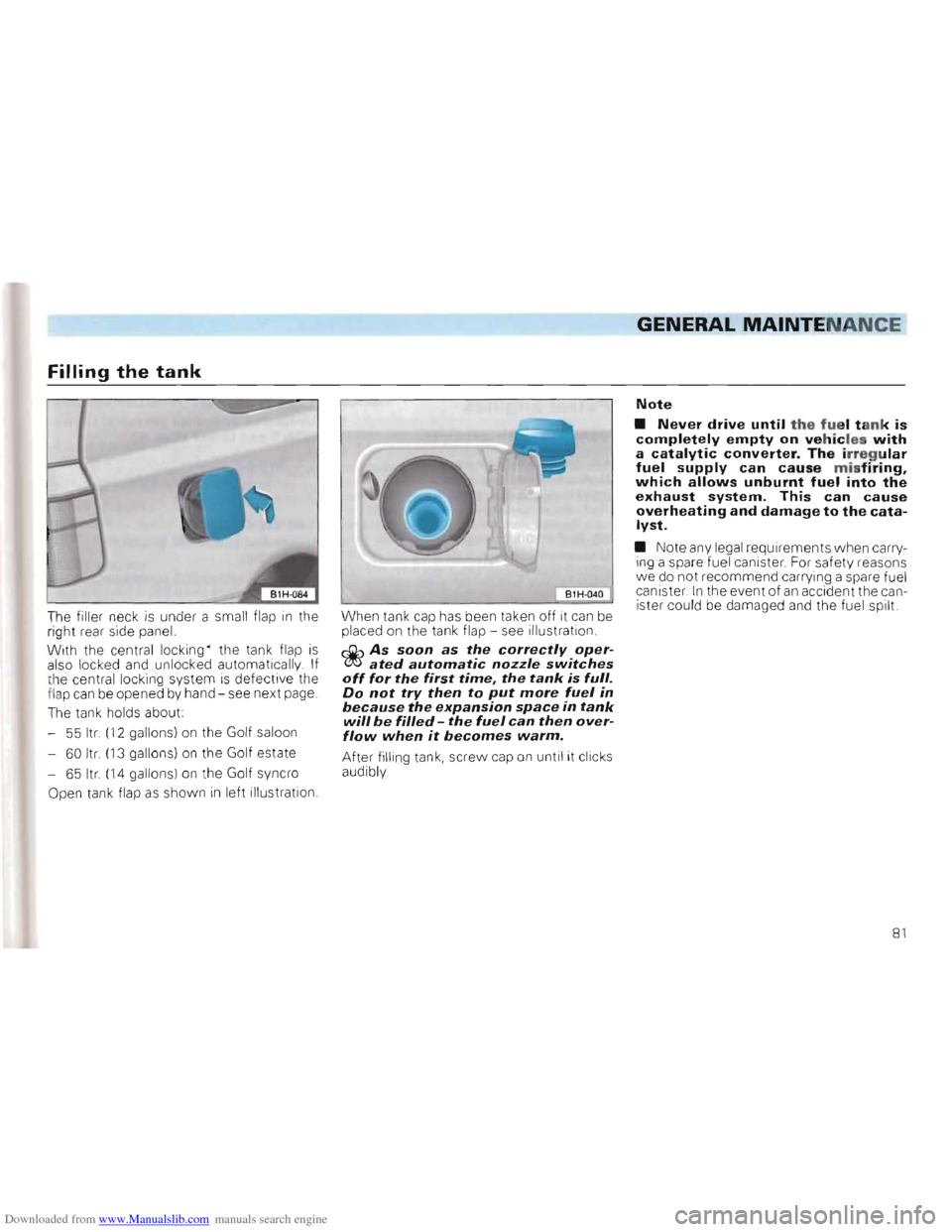
When tank cap has been taken off it can be
placed on the tank flap -see illustration.
r::ljb As soon as the correctly oper~ated automatic nozzle switches off for the first time, the tank is full. Do not try then to put more fuel in because the expansion space in tank will be filled -the fuel can then overflow when it becomes warm.
After filling tank, screw cap on until it clicks
audibly .
The
filler neck
is under a small flap in the
right rear side panel.
With the central locking ' the tank flap is also locked and unlocked automatically. If the central locking system is defective the fiapcanbeopenedbyhand-seene~page.
The tank holds about
-55 Itr (12 gallons) on the Golf saloon
- 60 Itr.
(13 gal lons) on the Golf estate
- 651tr .
(14 gallons) on the Golf syncro
Open
tank flap as shown in left illustr ation.
Note
• Never drive until 1he fuel tank is completely empty on vehicles with a catalytic converter. The irregular fuel supply can cause misfiring, which allows unburnt fuel into the exhaust system. This can cause overheating and damage to the catalyst.
• Note any lega l requirements when carry
ing a spa re fuel canis ter. For safety reasons we do not recommend carrying a spare fuel
canister. In the event of an accident the can
ister could be damaged and the fuel spilt.
81
Page 100 of 156
Downloaded from www.Manualslib.com manuals search engine GENERAL MAINTENANCE
Coolant losses
Coolant loss normally indicates leaks in the
system . In this case the cooling system
should be checked by a Volkswagen dealer
w it h out delay . It is not sufficient merely to
add coolant.
Ii'! ~ ~MI~d ~v~t~m IMMS canonly occur if the boiling point of the coolant is exceeded as a result of overheating, and coolant is forced out of the system.
Topping up coolant
Switch engine off and let it cool down . Then
cover expansion tank cap with a cloth and
turn cap carefully
to the left
and remove.
Attention Do not remove expansion tank cap when engine is hot -Danger of scalding. System is under pressure.
If, in an emergency only water can be added the correct mixture concentration
must be restored with the specified coolant
additive (see previous page) as soon as possible. If
a lot of coolant has been lost.
on l y add cold
coolant after the engine has cooled down.
This will prevent engine damage.
Do not fill above the MAX. mark.
The excess coolant will be forced out
through the pressure rel ief valve in the cap
when engine becomes hot.
Screw cap on again tightly.
Attention The coolant additive and the coolant are a danger to health. The additive must therefore only be stored in the original container well out of reach of children. If the coolant has to be drained at any time it must be caught and also stored in a safe place.
dih Drained coolant should not nor~mally be reused, it must be disposed of, bearing in mind environmental protection regulations.
Fan
The radiator fan is driven electrically and controlled by a thermoswitch from the cool
ant temperature (also from the engine com
partment temperature
on some models).
Attention After the engine has been stopped the fan can continue running for a while -even with the engine switched off -(up to about 10 minutes). It can also start to run again suddenly after a short time if -the coolant temperature increases due to heat build-up
when engine is hot and the engine compartment is heated additionally by strong sunlight.
Special care must therefore be taken when working in the engine compartment.
98