1993 VOLKSWAGEN GOLF steering
[x] Cancel search: steeringPage 5 of 156
Downloaded from www.Manualslib.com manuals search engine CONTROLS AND EQUIPMENT
Dashboard and Controls ..... 4
. ey s, Cen tral locking . . .... 6, 7
::"tl-thef t warning system .... 8
Joors .......................... .... 9
oot lid .... ........... . . . . . 10
::Iectric windows .. . .. 10
• ~Irrors . . ..... . ... 12
Seal belts 13
"" rbag System . . . . . 18
Safe ty for children .. ... 21
ead restraints . . . . . .. 24
= ro nt seats . . . . . . . . . . . .. 25
Rear seat . . . 27
L u ggage compartment ... . ... . ...... 28
M esh partition (Estate) ...... 29
L u ggage compartment cover /
F olding/sliding cover
... 30
Pedals, Hand brake .. 31
Manual gearbox .... ... .... 31
Automati c gearbox . . . .. .......... 32
H eig ht-adjustable steering wheel ..... 35
I gnition lock. . . . . .. 35
Starting/stopp ing engine 36, 38
\lIstrumellts .. .... 39
Warning lamps ....... 46
Switches . . . . . . . . . . . . . . 50
Turn signal and dip lever ............. 53
Cruise control system ........... 54
Wi ndscreen wipe r and washer system 55
Heating an d ventilation .. . ...... 56
Air cond itioner ......' 59
Sliding/ti ltin g roof. . . . . . . . . . . . ... 65
Sun visors / Interior lights 66,67
Cigarette lighter, Ash tray ..... 68
Shelves and boxes . . . . . . . . . . . ... 69
Roof rack / Roof ra ilings ... 70
DRIVING TIPS
The firs t 1500 km -and after wards .... 71
Driving economically and ecologically .. 72
Brakes. . . . . . . . . . . . . . . . 75
Tra iler tow ing . .. ..... . .... ... ...... 77
Driving a four- wheel drive vehicle .. 79
GENERAL MAINTENANCE
Filling the tan k, Fuel. 81, 82
Care of vehicle ........ .. . . 85
Bonnet . . ... 90
Engine compartment .. ...... .... .... 91
Engine oil ..... .......... ........... 92
Automatic transmission fluid (ATF)* ... 96
Power-assisted steering .. 96
Cooling system . . . . . . . . . . .. . 97
B rake fluid ...... 99
Battery . . . . .. 100
Spark plugs. V-belts . . . . . . . . . 102
Washer system
... . .. 103
Windscreen w iper blades . . . 104
Dust a
nd pollen filter * . 104
Wheel s . 105
D riving abroad ..... ............... 110
Accessories, modifications and
renewa l ot parts .............. III
Mobile telephones and tw o-way rad ios 111
DO -lT-YOURSELF
First -aid kit, Warn ing triangle ........ 112
Storage of vehicle tools, spare wheel
a n d ball coupling trailer bracket ...... 113
Vehicle tools, Spare wheel 114
CONTENTS
Changing w heels . 116
F uses . ........ .. .. . . . ... . .... 119
Changing bulbs. . .... .. . 121
Installing radio . . . . .. 127
E mergency starting .. .. 128
Tow starting / to wing . . .. 129
L ift ing vehicle ......... 131
SPECIAL INFORMATION
Body ..... .... . .......... 132
Environmental compatibility ... 133
TECHNICAL DATA
Engine data . .. , .... .... . 134
P er forman ce .. ... ... ... . .. 136
Fuel consump tion .. 137
Wh eels
. . 139
T yre pressures
.. .. ... .. . . .. ... 1 4 1
Weights ... 143
Trailer weights .. 144
Dimensions. ...... .. ... 145
Capacities " ..... 146
Vehicle identification data ... 147
ALPHABETICAL INDEX
Alph abetical index ... 148
3
Page 15 of 156
Downloaded from www.Manualslib.com manuals search engine CONTROLS AND EQUIPMENT
Seat belts
Why have seat belts?
It has been proven that seat belts give good protection in accidents. In most countries therefore the wearing of seat belts is required by law.
Attention • The belts should be put on be
fore every journey -even in town
traffic. This also applies to the
rear seats.
Pregnant women too should al
ways wear a seat belt.
• The routing of the belt is of
major importance to the protec
tive effect of the belt. How the
belt should be worn is described
on the next pages.
How children can be carried safely in the ve
h icle is explained on pag e 21 .
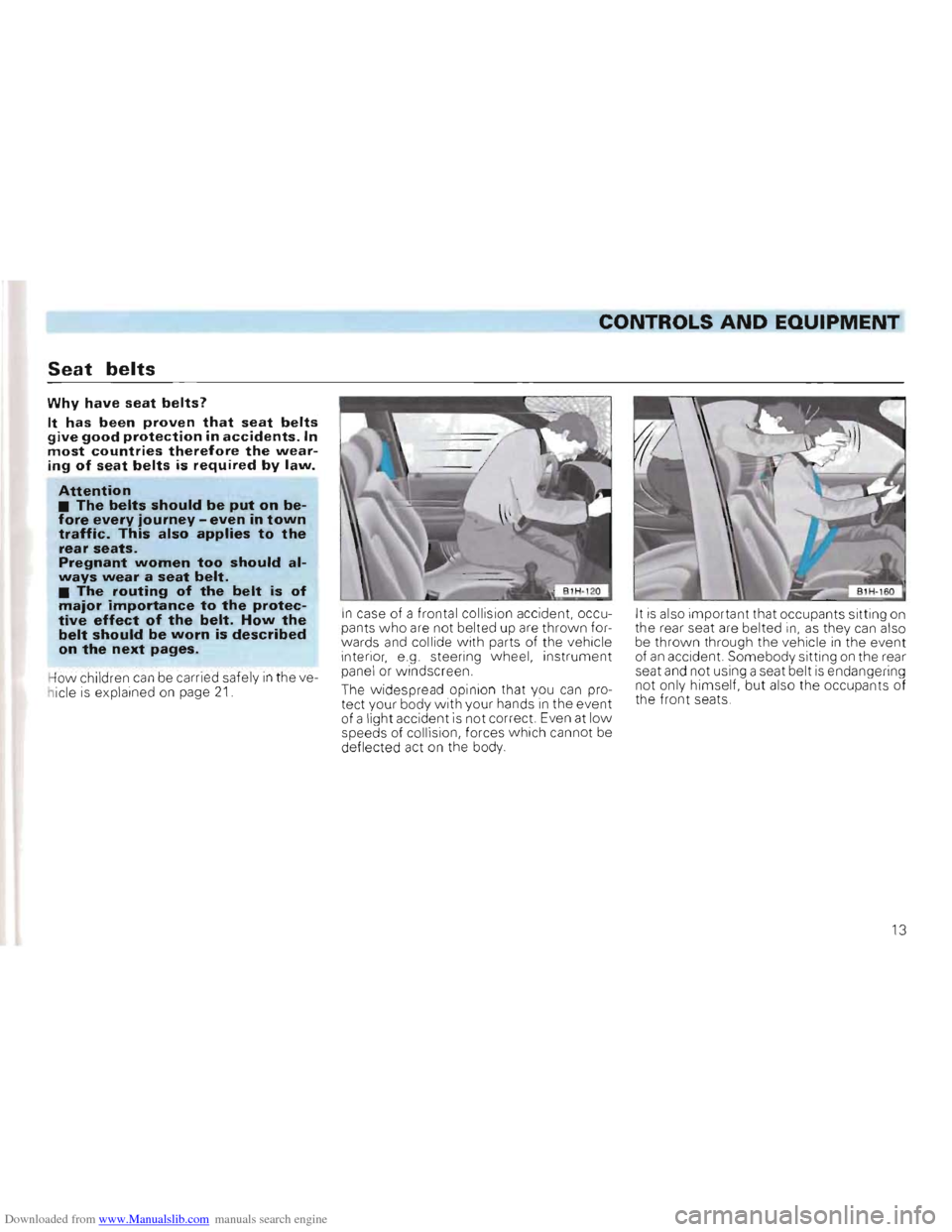
In case of a frontal collision accident, occu
pants w ho are not belted up are thrown for
w ards and collide with parts of the vehicle
interior, e.g steering wheel, instrument panel or w ind screen.
The wide spread opinion that you can pro
tect your body with your hands in the event
of a light accident is not corr ect. Even at low speeds of collision, forces which cannot be
deflected act on the body. It
is also
important that occupants sitting on
the rear se at are belted in, as they can also
be th rown throu gh the vehicle in the event
of an accident. Somebody sitting on the rear
seat and not u sing a seat belt is endangering
not only himself , but also the occupants of the front seats.
13
Page 20 of 156
Downloaded from www.Manualslib.com manuals search engine CONTROLS AND EQUIPMENT
Airbag-System*
Vehicles with Airbag System for the driver and passenger can be recognized by an inscription "AI RBAG" on the steering wheel padded plate and on the right end of the dash panel.
Supplementary to the three point seat belts the Airbag System offers additional protection for the driver's and passenger's head and chest In a serious
frontal collision.
Apart
from its normal protective function the seat belt also has the task of keeping the
driver or passenger in such a position so
that the Airbag can offer maximum protec
tion in the case of a frontal collision.
The Airbag system will not be triggered for:
• Side collisions
• Rear collisions
•
Rol l i ng-over
• Minor frontal collisions
Therefore the seat belts should always be used not only for reasons of statutory regulations, but also for safety reasons!
Essentially the system consists of
• The electronic control and monitoring
unit
• Both airbags (air sack
with gas gener
ator) with gas generator for the:
- Driver (in steering wheel),
- Passenger (in right of dash panel)
• A
warning lamp in the dash panel -see
page 49.
The functional readiness of the Airbag
System is electronically monitored.
Each
time the ignition is switched on the
warning lamp lights for about 3 seconds
(self diagnosis).
The system has a fault, if
• When switching on the ignition the warn ing lam p does not light.
•
After swi tching on the ignition the warn
ing la m p does not extinguish after about 3
second s
• The warning lamp
comes on or flickers
du rin g the Journey.
Attention
When a fault is present the sys
tem should be checked by a
Volkswagen dealer immediately.
Otherwise there is the danger
that the Airbag will not be acti
vated in the case of an accident.
18
Page 21 of 156
Downloaded from www.Manualslib.com manuals search engine ----------------------------------CONTROLS AND EQUIPMENT
•
I 81H-143 I
Function
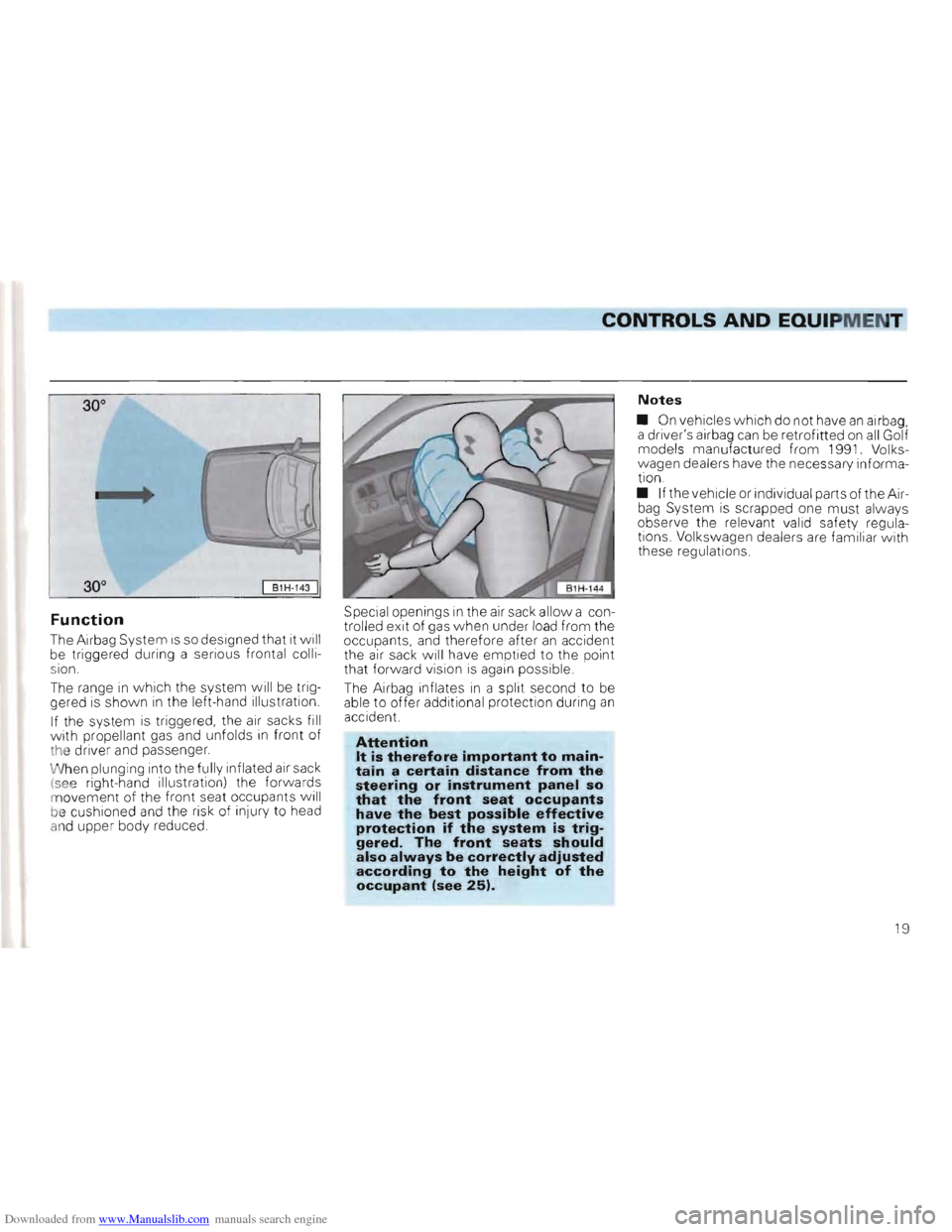
The Airbag System is so designed that it wil l
be triggered during a serious frontal colli
s lon.
The range in which the system will be trig
gered is shown in the left- hand illustrat ion .
If the system
is triggered, the air sacks fill
w ith prop ellant gas and unfolds in front of
t he driver and passenger.
W hen plunging into the full y inflated air sack
(
see right-hand illustration) the forwards
m ovement of the fron t se at occupants will
b e cushioned and the risk of in
jur y to head
a n d upper body reduced. Special
openings
in the air sack allow a con
trolled exit of gas when unde r load from the
occupants, and therefore after
an accident
the air sac k will have emptied to the point
that forward vision is again possible
The Airbag inflates
in a split second to be
able to offer add itional protection during an acc ident.
Attention It is therefore important to maintain a certain distance from the steering or instrument panel so that the front seat occupants have the best possible effective protection if the system is triggered. The front seats should also always be correctly adjusted according to the height of the occupant (see 25).
Notes
• On vehicles which do not have an airbag, a driver'S airbag can be retrofitted on all G olf
models manufactured from 1991. Volks
w agen dealers
have the necessary informa
tion .
• If the vehicle or individual parts of the Air
bag System
is scrap ped one must always
observe the relevant va lid safet y regula
tions. Volkswagen dealers are familiar w ith
these regulations.
19
Page 22 of 156
Downloaded from www.Manualslib.com manuals search engine CONTROLS AND EQUIPMENT
Attention A child seat in which the child sits with its back to the direction of travel may only be used if the passenger-side Airbag has been deactivated. Serious injuries could otherwise occur to the child. Ask your Volkswagen dealer about the conversion.
As soon as the child seat is no longer needed, the passenger-side Airbag should again be made operational.
Attention
• The steering wheel paddedplate and the padded surface of the airbag module on the passenger side of dash panel must not be bonded or covered or reworked in any other way. It must only be cleaned with a dry cloth or a cloth damped with water.
• No modifications of any kind may be undertaken on the parts of the Airbag System. • All work on the Airbag System as well as removing and installing system parts due to other repair work e.g. removing steering wheel) should only be carried out by Volkswagen dealers.
• The protective function of the Airbag System is only sufficient for one accident. If the Airbag is activated, the system must be exchanged. • No other persons, animals or articles should be carried between the front-seat occupants and the effective range of the Airbag.
• If you sell the vehicle, please pass on this Instruction Manual to the new owner.
20
Page 27 of 156
Downloaded from www.Manualslib.com manuals search engine CONTROLS AND EQUIPMENT
Front seats
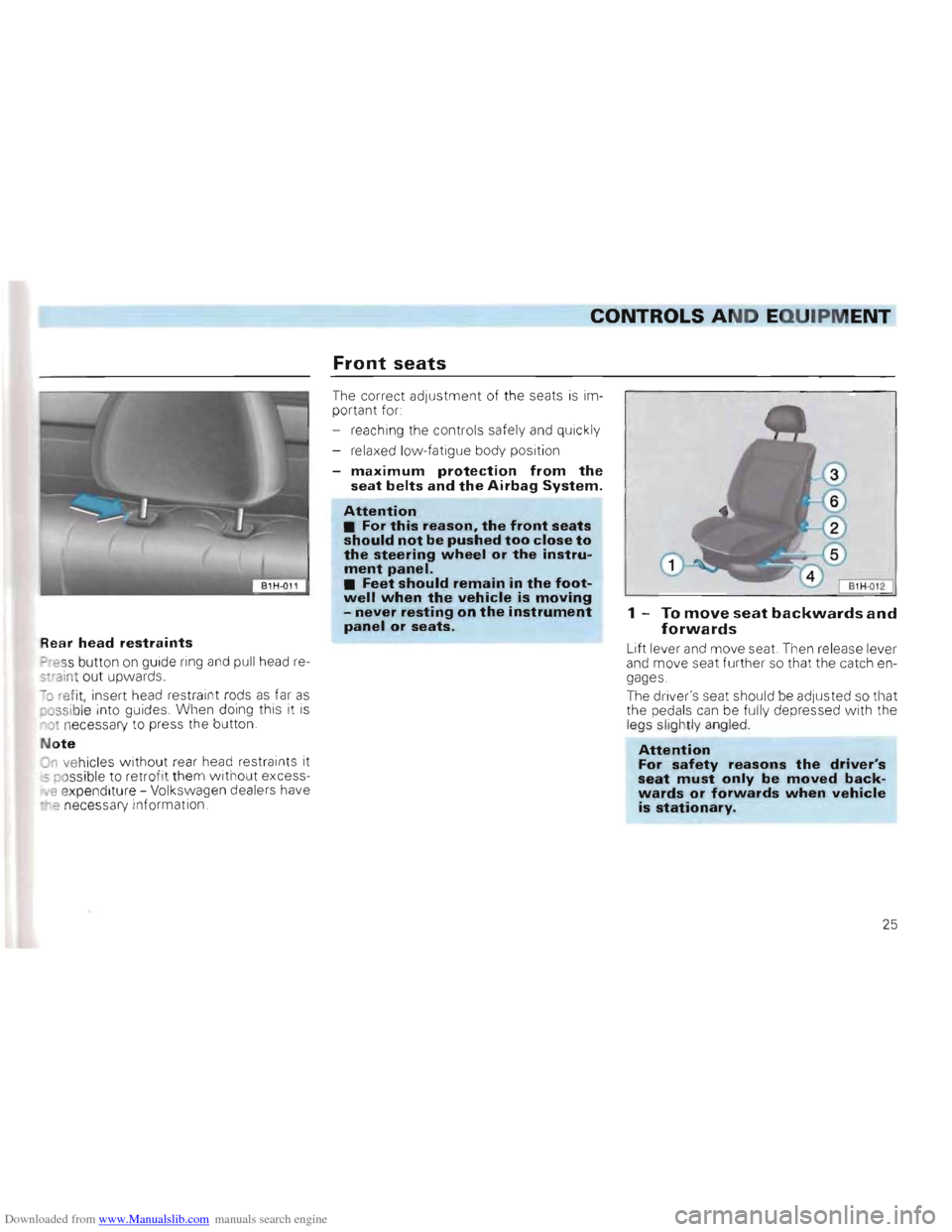
Rear hea d restraints
=>ress button on guide ring and pull head re
s-rai nt out upwards.
-0 refit, insert head restra int ro ds as far as os sible into guides. When doing this it is ~ot necessary to press the button .
N
ote
On ve hicles without rear head restra ints it 5 possibl e to r etrofit t hem without excess-
e expenditure -Vol kswagen dealers have
-'"'e n ecessary information. The
correc t adjustment of the seats
is im
portant for
- reaching the controls safely and quick
ly
- rela xed low-fatigue body po sition
-maximum protection from the seat belts and the Airbag System_
Attention • For this reason, the front seats should not be pushed too close to the steering wheel or the instrument panel. • Feet should remain in the footwell when the vehicle is moving -never resting on the instrument panel or seats_
I B1H-012 I
1 -To move seat backwards and forwards
Lift lever and move seat. Then release lever
and move seat fu rther so that the catch engages
The driver's seat
should be adjusted so that
the peda ls can be fully depr essed with the
legs slightly angled.
Attention For safety reasons the driver's seat must only be moved backwards or forwards when vehicle is stationary_
25
Page 37 of 156
Downloaded from www.Manualslib.com manuals search engine CONTROLS AND EQUIPMENT
Height adjustable
steering wheel*
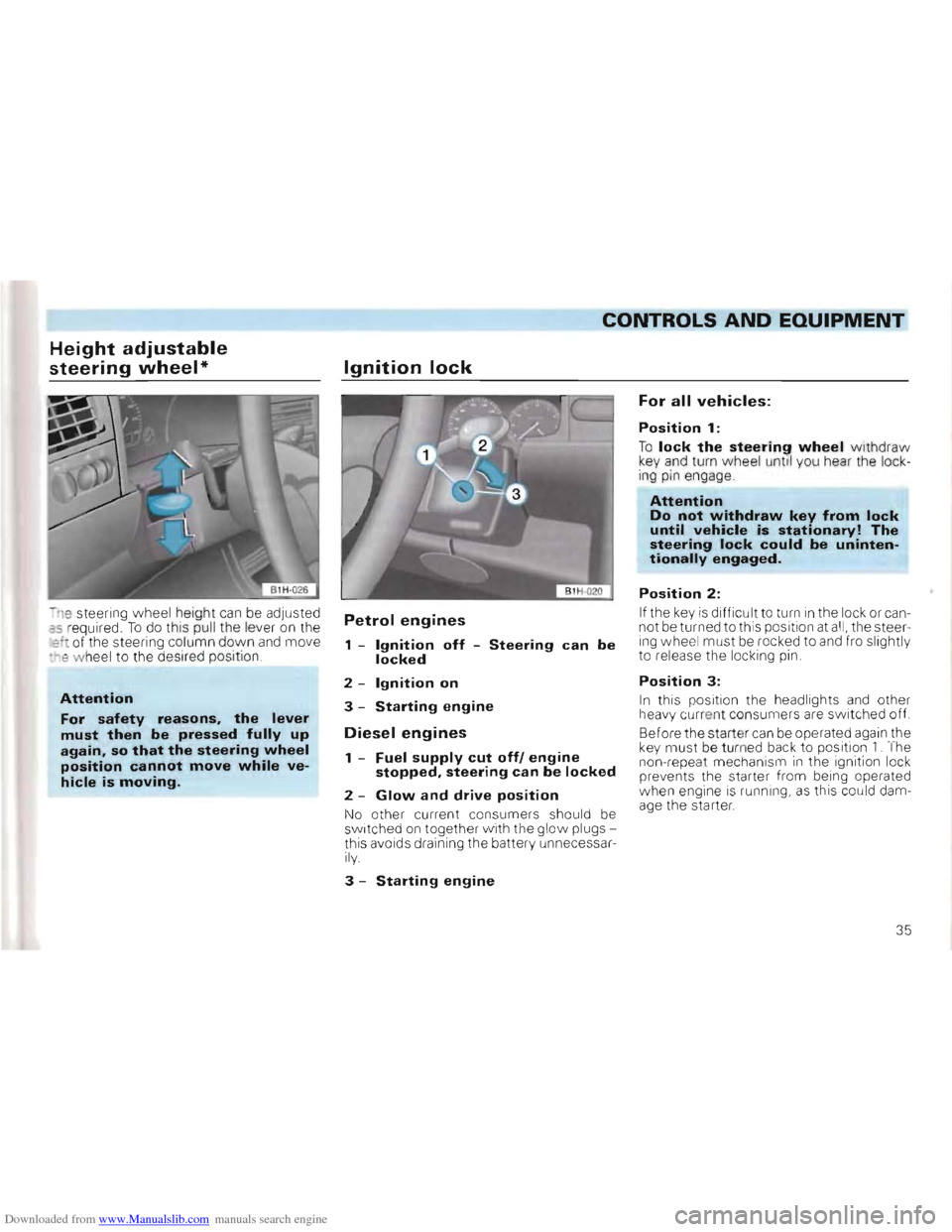
-n e steering wheel height can be adjusted as r equired . To do this pull the lever on the :::1 of th e stee ring co lumn down and move -~e w hee l to the desir ed position
Attention
For safety reasons, the lever
must then be pressed fully up again, so that the steering wheel position cannot move while ve
hicle is moving.
Ignition lock
Petrol engines
1 -Ignition off -Steering can be locked
2 -Ignition on
3 -Starting engine
Diesel engines
1 -Fuel supply cut off! engine stopped, steering can be locked
2 -Glow and drive position
No other current co nsumer s should be sw itc hed on together w ith the glow plugs
this aVOi d s dra ining the batte ry unn ecessa rily.
3 -Starting engine
For all vehicles:
Position 1:
To lock the steering wheel withdraw key and turn wheel unti l you hear the lock
ing pin engage
Attention Do not withdraw key from lock until vehicle is stationary! The steering lock could be unintentionally engaged.
Position 2:
If the key is difficult to turn in the lock or can
not be turned to this position at all, the steer
ing wheel must be rocked to and fro slightly
to release the locking pin .
Position 3:
In this pos ition the headlights and other
h eavy cu rre nt consume rs are switched off.
Before the start er
can be operated again the key must be turned back to position 1. The
non-repeat mechanism in the ignition lock
prevents th e starter from being operated
w hen engine
is ru nning, as this could dam
age the starter.
35
Page 89 of 156
Downloaded from www.Manualslib.com manuals search engine GENERAL MAINTENANCE
Paint damage
Small marks in the paint su ch as scratches
or stone damage should be touched up im
mediately with paint (Vol kswagen touch-up
stick or spray can) before the meta l starts to
rust.
H
owever, should rust be fou nd at any time it must be remo ved thoroughly and then the
area treated first with an ant i-corrosion
p rimer and then the correct pain t applied .
Y
ou can of course have this work done by a
V olkswagen dealer.
T he number of the original vehicl e paint
is given on the data sticke r (see page 147 )
Windows
Remov e sno w and ice from w indows and mirrors with a p lastic scraper only To avoid
s cratches due to dirt on the glass , the
s c raper should only be pushed in one direc
t ion and not moved to and fro.
Traces of rubber , oil, grease or silicone can
b e remo ved with a window cleaning solution or a si lic one remover.
- he
windows sho uld also be cleaned on the
n side at regular intervals.
0 0 not dry the w
indows with the leather
u sed for the paintwork because traces of paint cleaner wil l cause streaks to appear on the glass.
To avoid damaging the heating element wires in the rear window do not put
stickers over the wires on the inside.
Door, boot and window
weatherstrips
The w eatherstrips will rema in fle xible and last longer if the y are rubbed lightly with a
rubb er protec tive compound from time to
time . This will also stop the weatherstrips
from freezing on in the w inter.
Plastic parts and leatherette
Exterior plastic parts are cleaned with normal w ashing and interior parts wit h a damp
cloth. If this is not suff ic ient. these parts and
leatherette may only be cleaned with special solvent-free plastic cleaners.
Upholstery cloth and textile
trim
Upho ls tery cloth and textile trim on door
panels, parcel shelv es, lu ggage compart
ment co vers , h eadlining ete.
must be cleaned with special cleane rs or dry foam
and a soft brush .
Leather
Le athe r shou ld, depe nding on usage, be
treated from time to tim e in ac cordance with the follo wing instruc tions. It mus t be
not ed t hat on no account may solvents,
f loor w ax, shoe polish, spot remo vers and similar products be used for this purpose.
For the norma l clean ing of leather covered
steering wheels, seat upholstery etc . a cot
ton or woollen cloth lightly moistened
with w ater should be used to clean dirty leath er
surfaces. Dirtie r areas can be cleaned with a mild soap solution (2 dess er t spoonfuls of
a neutral soap to 1 litre of water) . It is essen
t ia l to note that the leather must not be made too wet and that no water seeps
th roug h th e seams . After cleaning, wipe dry with a soft cloth .
F u rthermore we recomme nd th a
t. w ith nor
mal usage, the leat her is treat ed at half
y ear ly interva ls with a special leather care
age nt which can be obtained from Volkswagen dealers. This age nt is to be app lied
very sparingly. After it has dried in, wipe w ith a soft cloth.
87