Page 13 of 407
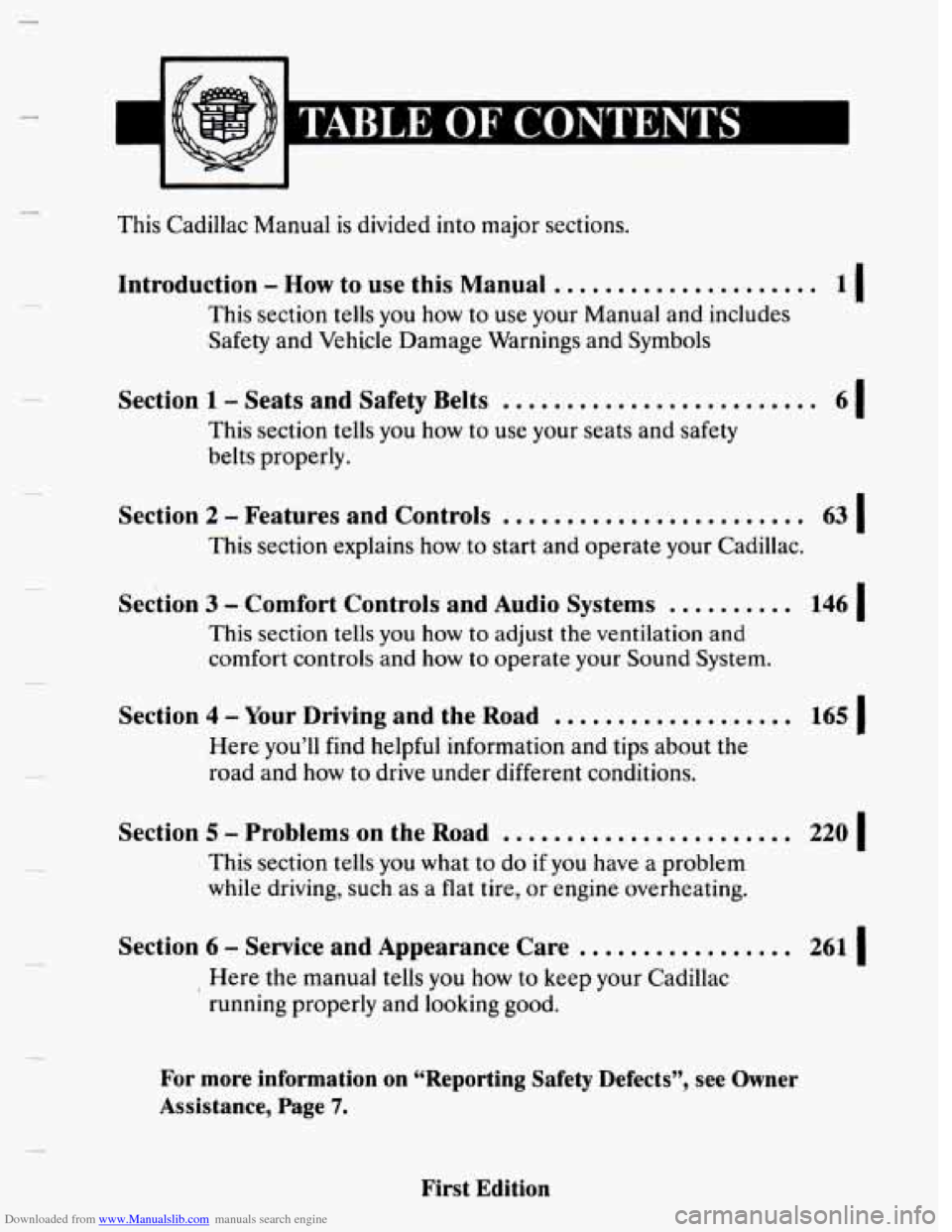
Downloaded from www.Manualslib.com manuals search engine This Cadillac Manual is divided into major sections.
Introduction - How to use this Manual .....................
This section tells you how to use your Manual and includes
Safety and Vehicle Damage Warnings and Symbols
11
Section 1 - Seats and Safety Belts .........................
This section tells you how to use your seats and safety
belts properly.
61
Section 2 - Features and Controls ........................
This section explains how. to start and operate your Cadillac.
63 I
Section 3 - Comfort Controls and Audio Systems .......... 146 I
This section tells you how to adjust the ventilation and
comfort controls
and how to operate your Sound System.
Section 4 - Your Driving and the Road ................... 165 I
Here you’ll find helpful information and tips about the
road and how
to drive under different conditions.
Section 5 - Problems on the Road ....................... 220 I
This section tells you what to do if you have a problem
while driving, such as a flat tire,
or engine overheating.
Section 6 - Service and Appearance Care ................. 261 I
Here the manual tells you how to keep your Cadillac
running properly and looking good.
For more information on “Reporting Safety Defects”, see Owner
Assistance,
Page 7.
First Edition
Page 20 of 407
Downloaded from www.Manualslib.com manuals search engine SEATS AND SAFETY BELTS
Here you’ll find information about the seats in your Cadillac, your
Supplemental Inflatable Restraint (“air bag”) system and how
to use your
safety belts properly. You can also learn about some things you
should
- not do with safety belts.
SEATS AND SEAT CONTROLS
This section tells you about the seats -- how to adjust them, and also
about reclining front seatbacks, lumbar adjustments, heated seats, and
head restraints.
Power Seat Control
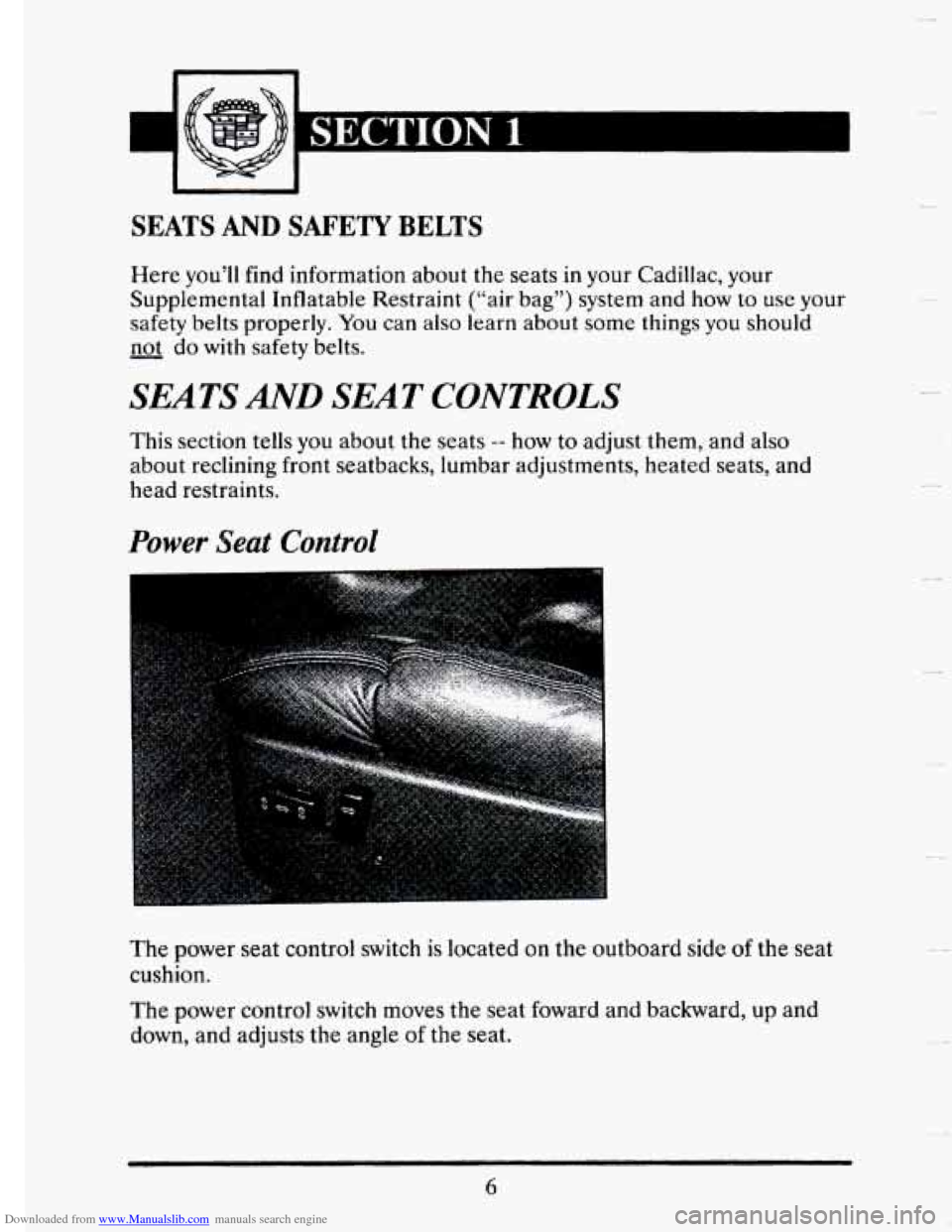
The power seat control switch is located on the outboard side of the seat
cushion.
The power control switch moves the seat foward and backward,
up and
down, and adjusts the angle
of the seat.
6
Page 24 of 407
Downloaded from www.Manualslib.com manuals search engine higher temperature. To prevent uncomfortable overheating of the seats,
the heating elements are thermostatically regulated to automatica\
lly
maintain the temperature at the selected setting.
A telltale light in the
control switch reminds you that the heating system is in use. To preserve
the battery, the heated seats can only be used when
the ignition is turned
on, and are deactivated when the ignition is turned off.
Head Restraints
I
h
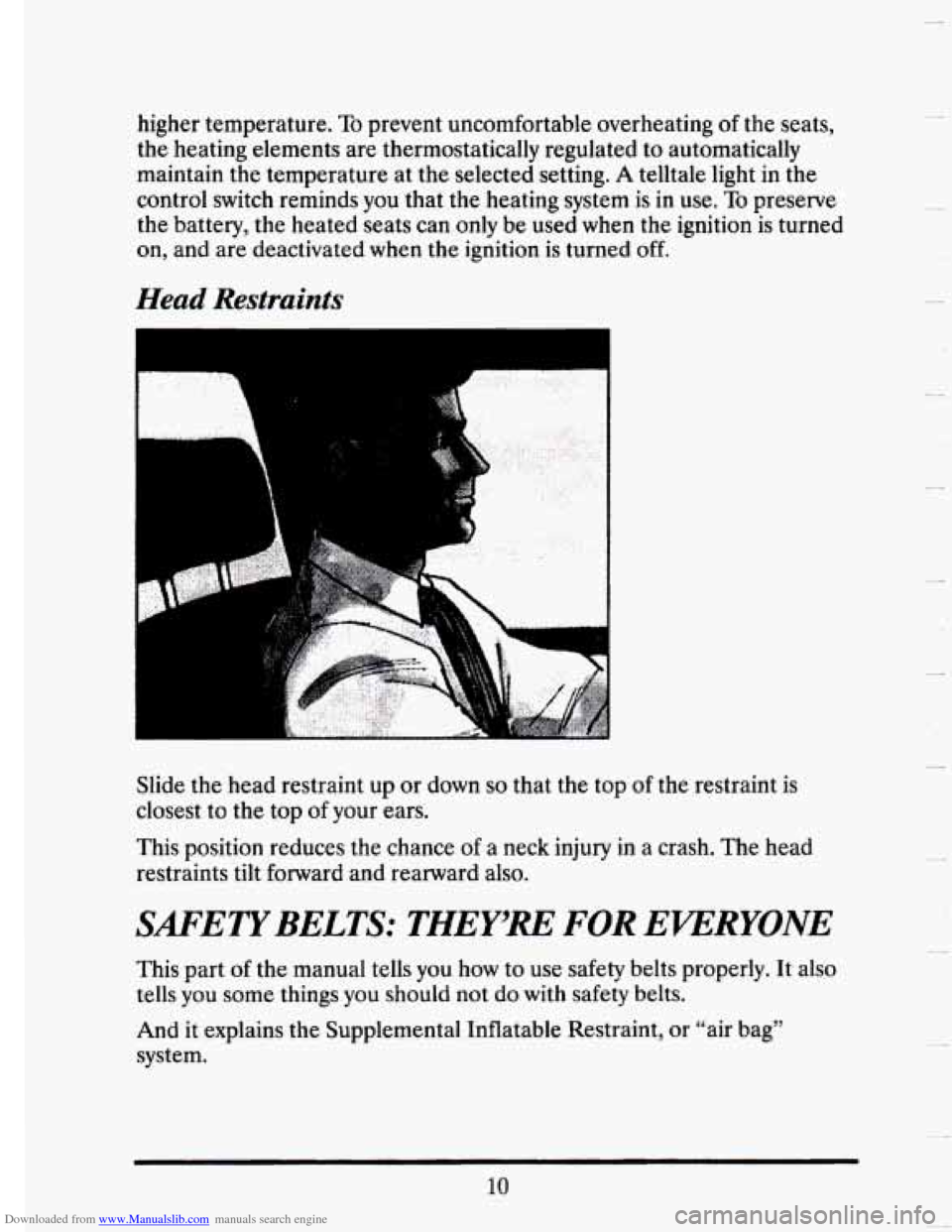
Slide the head restraint up or down so that the top of the restraint is
closest to the top of your ears.
This position reduces the chance
of a neck injury in a crash. The head
restraints tilt forward and rearward also.
SAFETYBELTS: THEY’RE FOR EKERYONE
This part of the manual tells you how to use safety belts properly. It also
tells you some things you should not do with safety
belts.
And it explains the Supplemental Inflatable Restraint, or “air bag”
system.
10
-.
Page 30 of 407
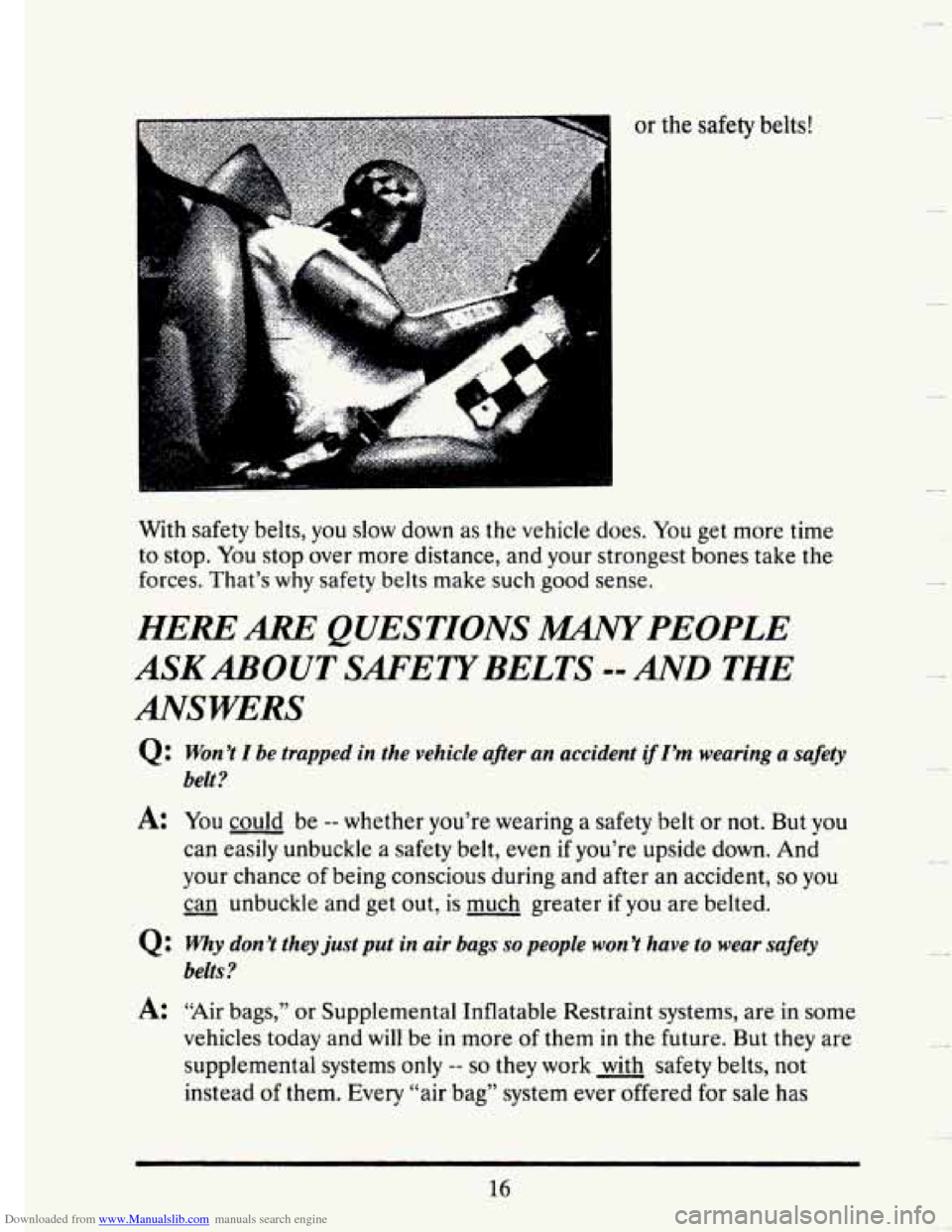
Downloaded from www.Manualslib.com manuals search engine or the safety belts!
.”
d
c
. ..
With safety belts, you slow down as the vehicle does. You get more time
to stop. You stop over more distance, and your strongest bones take the
forces. That’s
why safety belts make such good sense.
HERE ARE QUESTIONS lMANy PEOPLE
ANSWERS ASKABOUT
SAFETYBELTS
--AND THE
Q: Won’t I be trapped in the vehicle afler an accident if I’m wearing a safety
belt?
A: You could be -- whether you’re wearing a safety belt or not. But you
can easily unbuckle a safety belt, even if you’re upside down. And
your chance
of being conscious during and after an accident, so you
- can unbuckle and get out, is - much greater if you are belted.
Q t Why don’t they just put in air bags so people won’t have to wear safety
belts?
A: ‘Air bags,” or Supplemental Inflatable Restraint systems, are in some
vehicles today and
will be in more of them in the future. But they are
supplemental systems only
-- so they work with safety belts, not
instead
of them. Every “air bag” system ever offered for sale has
16
Page 44 of 407
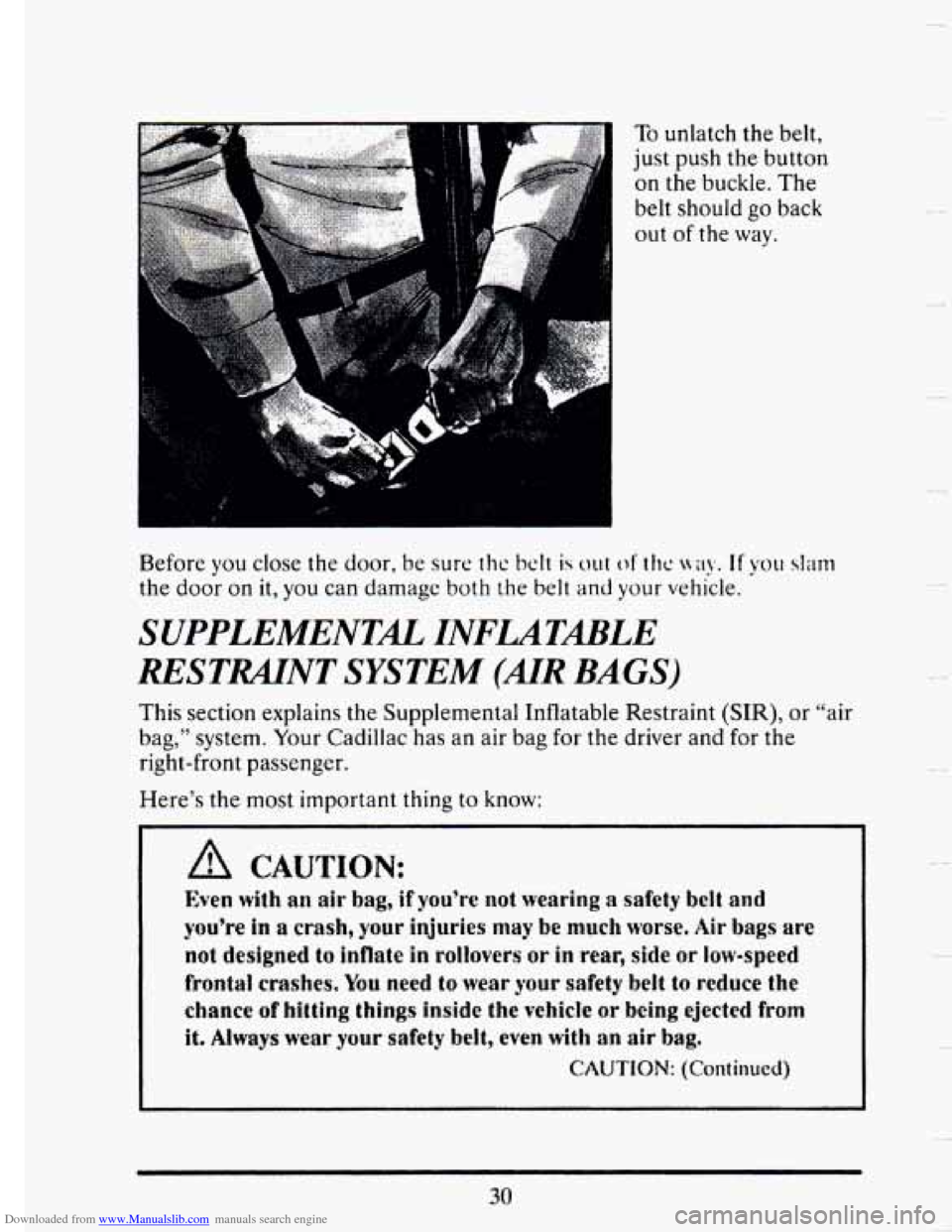
Downloaded from www.Manualslib.com manuals search engine To unlatch the belt,
just push the button
on the buckle. The
belt should go back
out of the way.
“. .
P .x .
Before you close the door, be sure thc belt is out of thc ~q’. If you slam
the door on it, you can damage both the belt and your vehicle.
SUPPLEMENTA INFLATABLE
RESTUNT SYSTEM (AIR BAGS)
This section explains the Supplemental Inflatable Restraint (SIR), or “air
bag,” system. Your Cadillac has an air bag for the driver and for the
right-front passenger.
Here’s the most important thing
to Know:
A CAUTION:
Even with an air bag, if you’re not wearing a safety belt and
you’re
in a crash, your injuries may be much worse. A.ir bags are
not designed to inflate in rollovers or in rear, side or low-speed
frontai crashes. You need to wear your safety belt to reduce the
chance of hitting things inside the vehicle or being ejected from
it,
Always wear your safety belt, even with an air hag.
CAUTION: (Continued)
30
c
11
Page 45 of 407
Downloaded from www.Manualslib.com manuals search engine CAUTION: (Continued)
Air bags inflate with great force, faster than the blink of an eye.
If you’re too close to an inflating air bag, it could seriously
injure
you. Safety belts help keep you in position for an air bag
inflation in a crash. Always wear your safety belt, even with an
air bag, and the driver
should sit as far back as possible while
still maintaining control of the vehicle.
A CAUTION:
An inflating air bag can seriously injure small chiIdren. Always
secure children properly in your vehicle. Tu read how, see the
“Children
and Safety Belts’’ section of this manual, and read
the caution
label on the front-passenger% safety belt.
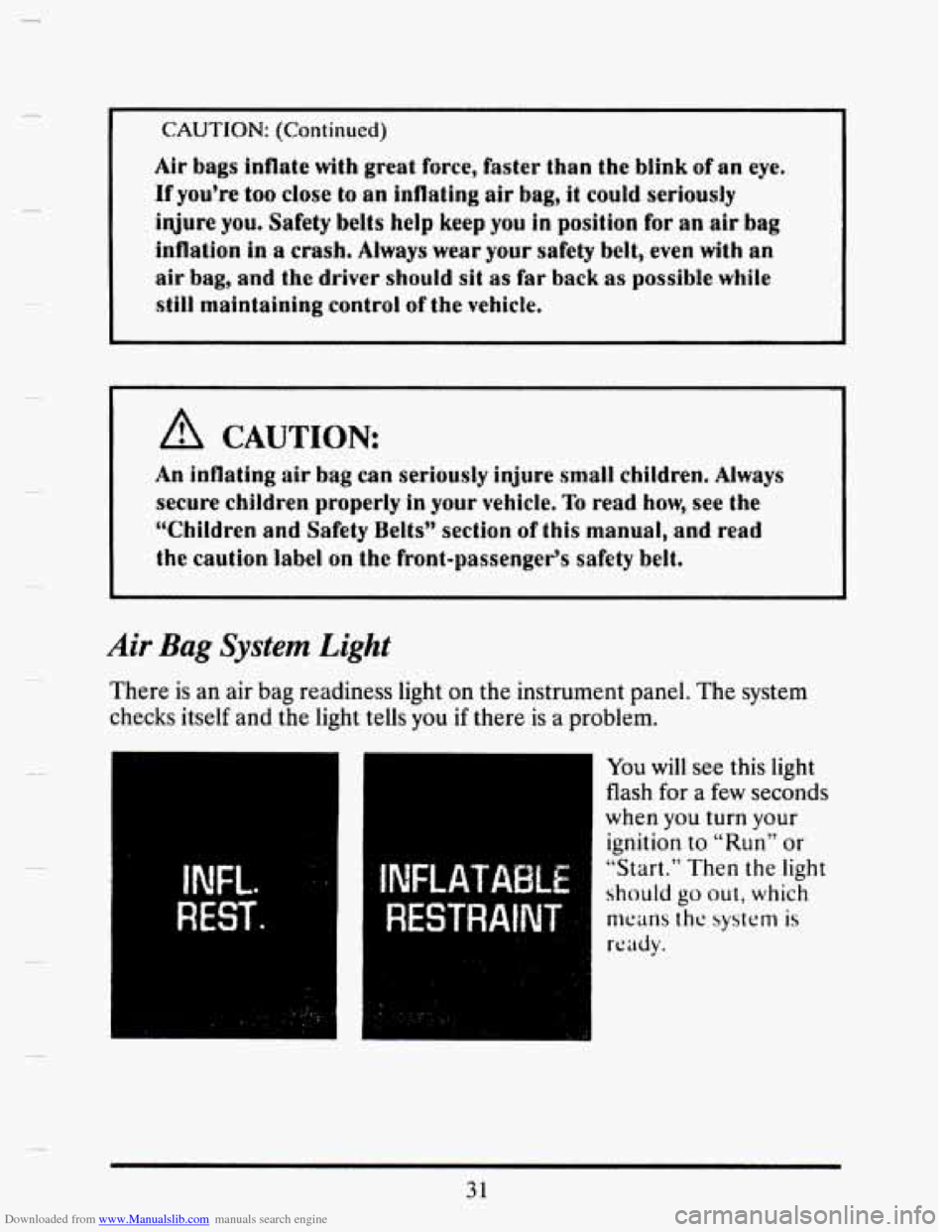
Air Bag System Light
There is an air bag readiness light on the instrument panel. The system
checks itself
and the light tells you if there is a problem.
INFL. ..
REST.
You will see this light
flash
for a few seconds
when you turn your
ignition to “Run” or
“Start.” Then the light
should go out, which
means the system is
ready.
INFLATABLE
RESTRAINT
..
31
Page 46 of 407
Downloaded from www.Manualslib.com manuals search engine I 1
If the air bag readiness light doesn't come on when you start
your vehicle, or stays on, or comes on when you are driving, your
air bag system may not work properly Have your vehicle
serviced right away
How The Air Bag System Works
..
. ..
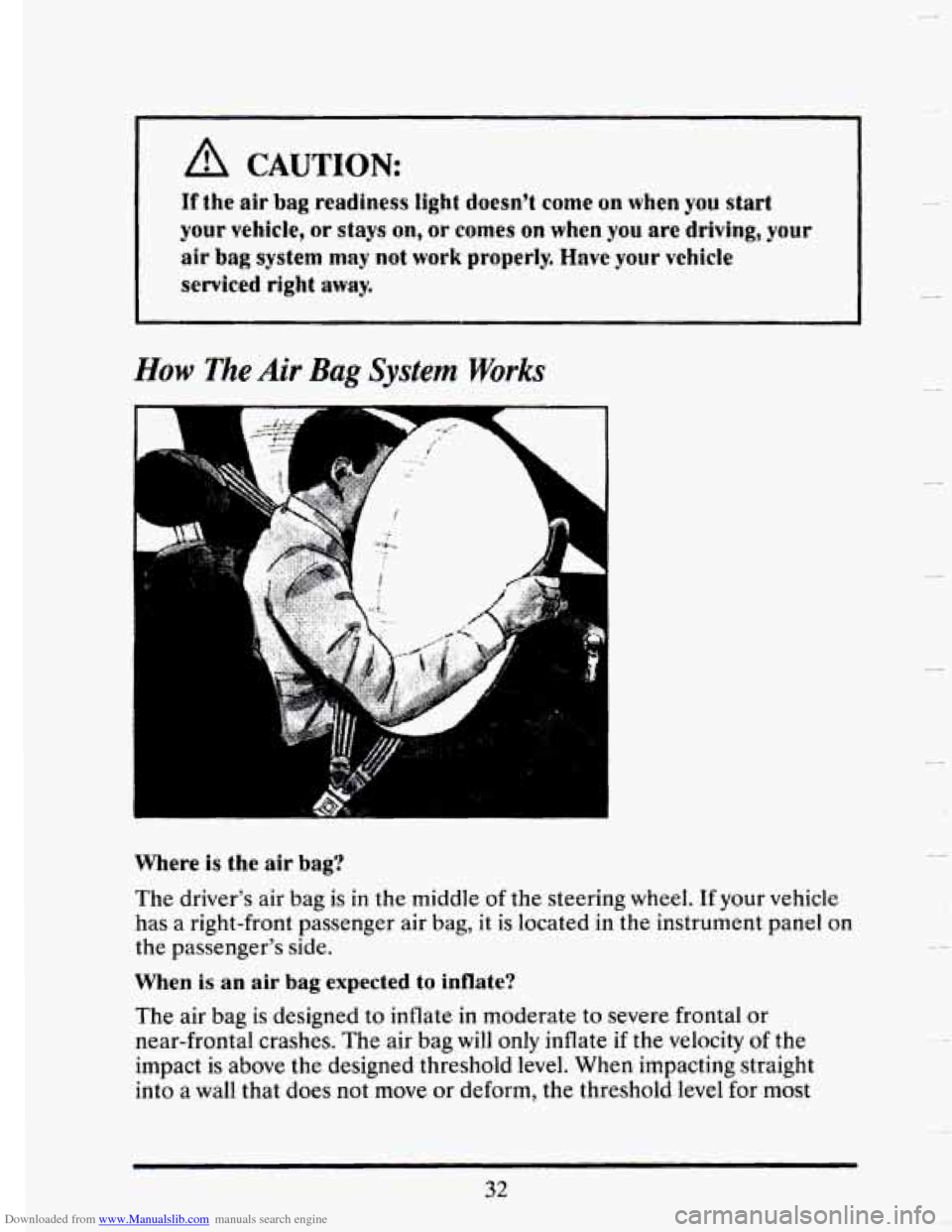
Where is the air bag?
The driver's air bag is in the middle of the steering wheel. If your vehicle
has
a right-front passenger air bag, it is located in the instrument panel on
the passenger's side.
When is an air bag expected to inflate?
The air bag is designed to inflate in moderate to severe frontal or
near-frontal crashes.
The air bag will only inflate if the velocity of the
impact
is above the designed threshold level. When impacting straight
into
a wall that does not move or deform, the threshold level for most
32
i
Page 47 of 407
Downloaded from www.Manualslib.com manuals search engine GM vehicles is between 9 and 14 mph. However, this velocity threshold
depends
on the vehicle design and may be several miles-per-hour faster
or slower. In addition, this threshold velocity will be considerably higher
if
the vehicle strikes an object such as a parked car which will move and
deform on impact. The air bag is also not designed to inflate in rollovers,
side impacts,
or rear impacts where the inflation would provide no
occupant protection benefit.
In any particular crash, the determination
of whether the air bag should
have inflated cannot be based solely on the level
of damage on the
vehicle(s). Inflation is determined by the angle
of the impact and the
vehicle’s deceleration,
of which vehicle damage is only one indication.
Repair cost is not a good indicator of whether an air bag should have
deployed.
What makes an air bag inflate?
In a frontal or near-frontal impact of sufficient severity, sensors
strategically located on the vehicle detect that the vehicle
is suddenly
stopping as a result
of a crash. These sensors complete an electrical
circuit, triggering a chemical reaction
of the sodium azide sealed in the
inflator.
The reaction produces nitrogen gas, which inflates a cloth bag.
The inflator, cloth bag, and related hardware are all part of the air bag
inflator modules packed inside the steering wheel and in the instrument
panel
in front of the passenger if there is a passenger air bag.
How does an air bag restrain?
In moderate to severe fr,ontal or near-frontal collisions, even belted
occupants can contact the steering wheel or the instrument panel. The air
bag supplements the protection provided by safety belts. Air bags
distribute the force
of the impact more evenly over the occupant’s upper
body, stopping the occupant more gradually. But air bags would not
provide protection in many types
of collisions, including rollovers and
rear and side impacts, primarily because an occupant’s motion is not
toward
the air bag. Air bags should never be regarded as anything more
than a supplement to safety belt protection
in moderate to severe frontal
and near-frontal collisions.
33