Page 229 of 407
Downloaded from www.Manualslib.com manuals search engine I
..
I -A
I ..
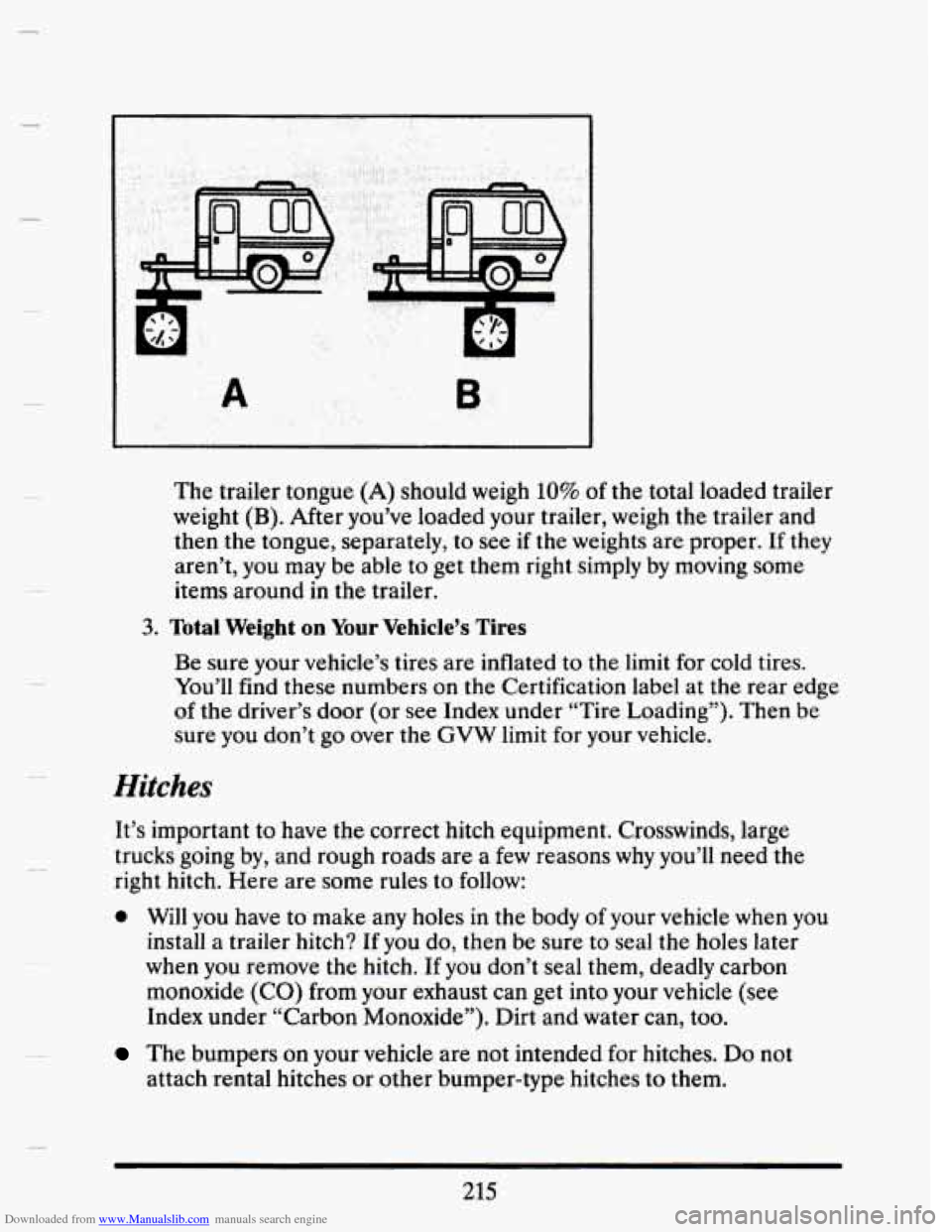
The trailer tongue (A) should weigh 10% of the total loaded trailer
weight
(B). After you’ve loaded your trailer, weigh the trailer and
then the tongue, separately,
to see if the weights are proper. If they
aren’t, you may be able to get them right simply by moving some
items around in the trailer.
3. Total Weight on Your Vehicle’s Tires
Be sure your vehicle’s tires are inflated to the limit for cold tires.
You’ll find these numbers on the Certification label at the rear edge
of the driver’s door (or see Index under “Tire Loading”). Then be
sure you don’t
go over the GVW limit for your vehicle.
Hitches
It’s important to have the correct hitch equipment. Crosswinds, large
trucks going by, and rough roads are a few reasons why you’ll need the
right hitch. Here are some rules to follow:
0 Will you have to make any holes in the body of your vehicle when you
install
a trailer hitch? If you do, then be sure to seal the holes later
when you remove the hitch. If you don’t seal them, deadly carbon
monoxide (CO) from your exhaust can get into your vehicle (see
Index under “Carbon Monoxide”). Dirt and water can, too.
The bumpers on your vehicle are not intended for hitches. Do not
attach rental hitches or other bumper-type hitches to them.
215
Page 263 of 407
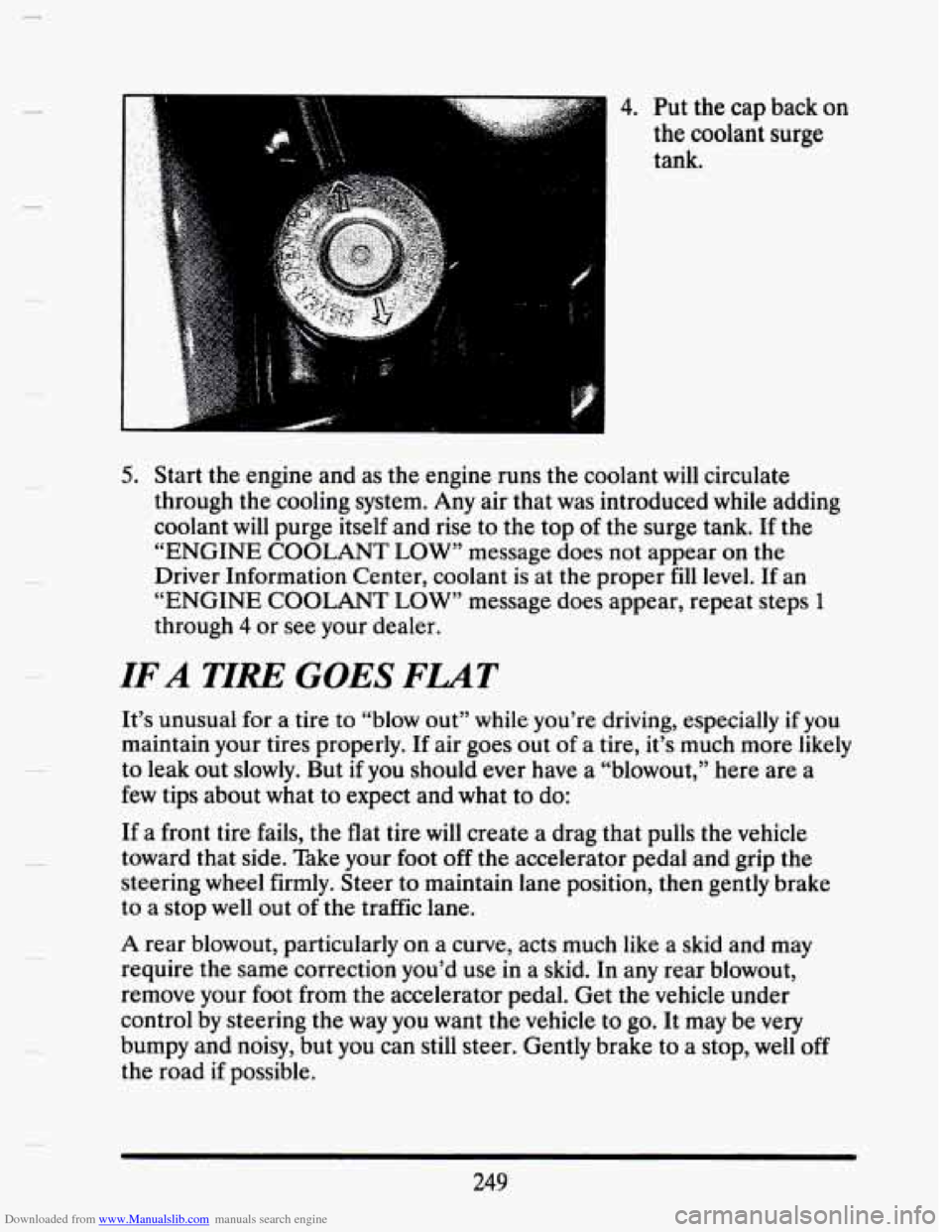
Downloaded from www.Manualslib.com manuals search engine . : 4. Put the cap back on
the coolant
surge
tank.
5. Start the engine and as the engine runs the coolant will circulate
through the cooling system. Any air that was introduced while adding
coolant
will purge itself and rise to the top of the surge tank. If the
“ENGINE COOLANT
LOW” message does not appear on the
Driver Information Center, coolant is at the proper
fill level. If an
“ENGINE
COOLANT LOW” message does appear, repeat steps 1
through 4 or see your dealer.
IFA TIRE GOES FLAT
It’s unusual for a tire to “blow out” while you’re driving, especially if you
maintain your tires properly. If air goes out of a tire, it’s much more likely
to leak out slowly. But if you should ever have a “blowout,” here are a
few tips about what to expect and what
to do:
If a front tire fails, the flat tire will create a drag that pulls the vehicle
toward that side. Take your foot off the accelerator pedal and grip the
steering
wheel firmly. Steer to maintain lane position, then gently brake
to a stop
well out of the traffic lane.
A rear blowout, particularly on a curve, acts much like a skid and may
require the same correction you’d use in a skid. In any rear blowout,
remove your foot from the accelerator pedal. Get the
vehicle under
control by steering the way you want the vehicle to
go. It may be very
bumpy and noisy, but you can still steer. Gently brake to a stop,
well off
the road if possible.
3
249
Page 264 of 407
Downloaded from www.Manualslib.com manuals search engine If your tire goes flat, the next section shows how to use your jacking
equipment
to change a flat tire safely.
CHANGING A FLAT TIRE
If a tire goes flat, avoid further tire and wheel damage by driving slowly to
a level place. Turn on your hazard warning flashers.
A CAUTION:
Changing a tire can cause an injury. The vehicle can slip off the
jack and ro11 over you or other people. You and they could be
badly injured. Find a level place
to change your tire. To help
prevent the vehicle from moving:
1. Put the shift lever in “P” (Park).
2. Set the parking brake firmly.
3. lhrn off the engine.
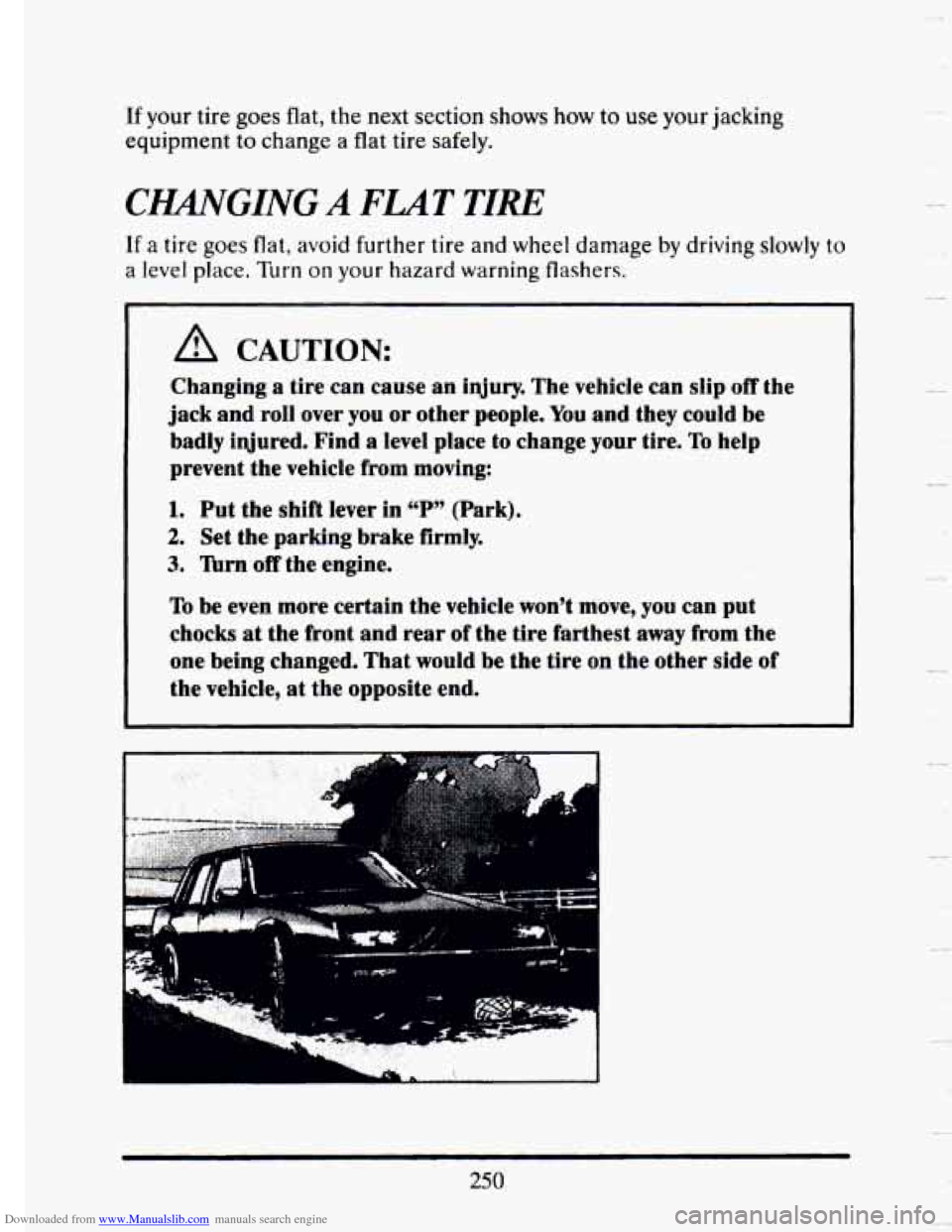
To be even more certain the vehicle won’t move, you can put
chocks
at the front and rear of the tire farthest away from the
one being changed. That would be the tire
on the other side of
the vehicle, at the opposite end.
250
.-
_-
I
u
L.
Page 266 of 407
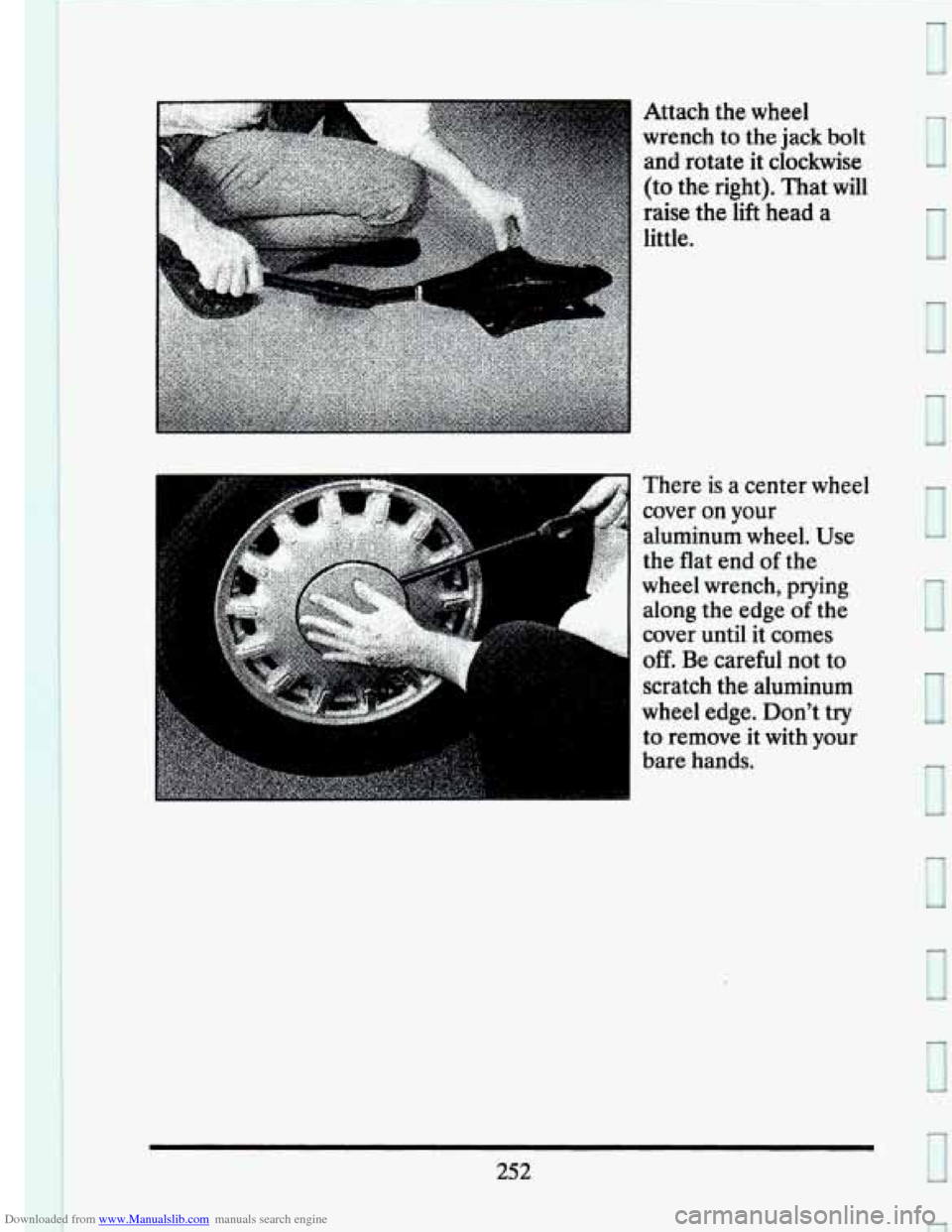
Downloaded from www.Manualslib.com manuals search engine Attach the wheel
wrench to the jack bolt
and rotate it clockwise
(to the right). That will
raise the lift head a
little.
There is a center
wheel
cover on your
aluminum wheel. Use
the flat end
of the
wheel wrench, prying along the edge
of the
cover until it comes
off. Be careful not to
scratch the aluminum
wheel edge. Don't try to remove it
with your
bare hands.
252
Page 267 of 407
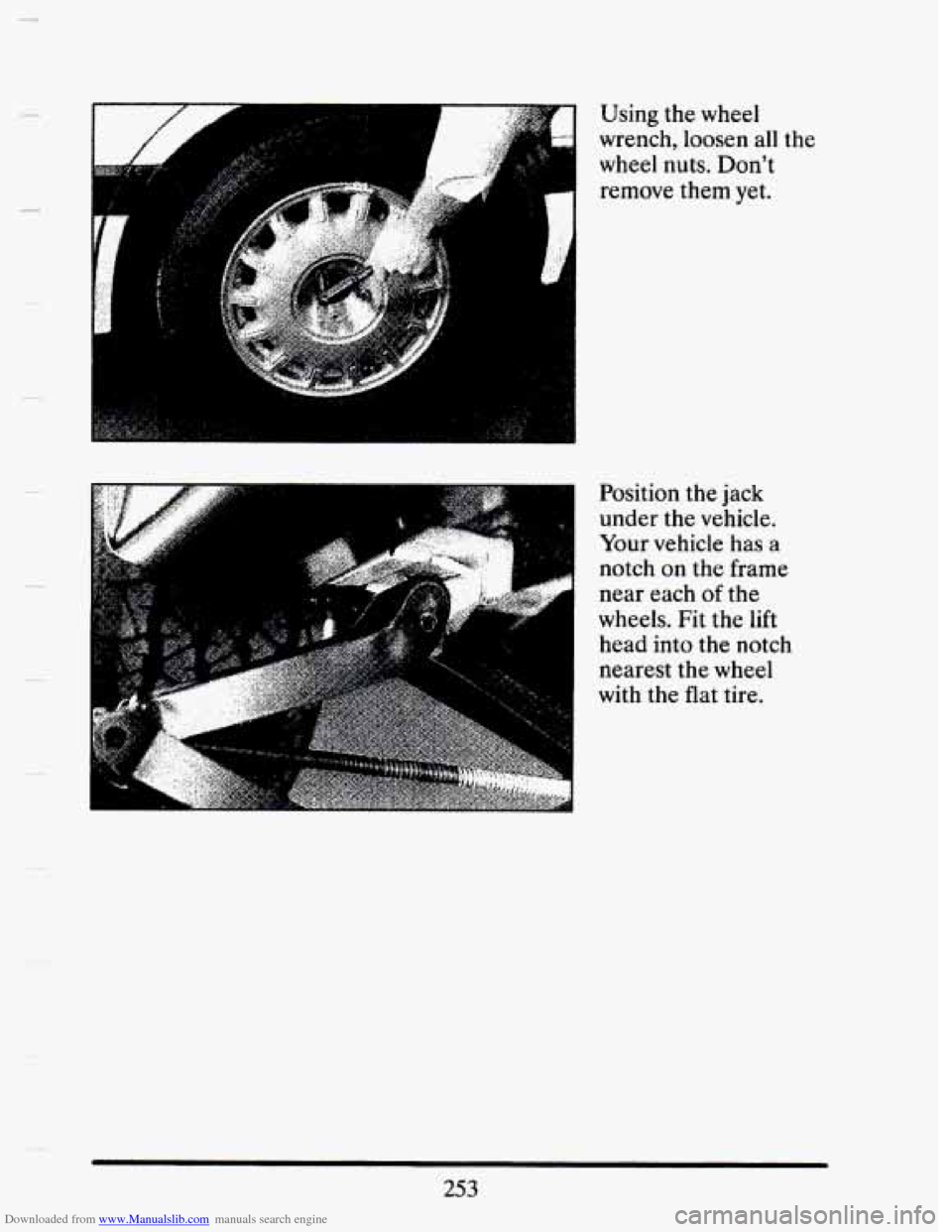
Downloaded from www.Manualslib.com manuals search engine Using the wheel
wrench, loosen all
wheel nuts. Don't
remove them yet. the
.. . Position
the jack
under the vehicle.
Your vehicle has a
notch on the frame
near each
of the
wheels. Fit the lift
head into the notch
nearest the wheel
with the flat
tire.
253
Page 269 of 407
Downloaded from www.Manualslib.com manuals search engine F
pl
P
P
P
F
c
Remove all the wheel
nuts and take
off the
flat tire.
A CAUTION: I
Rust or dirt on !he whd, or on the parts to which it is fastened,
can mahe the uhed nuts become loose after a time. The wheel
cuuld conw oll and c~use an accident. When you change a wheel,
remote un) rust or dirt from the places where the wheel
attaches
to the vehicle. In an emergency, you can use a cloth or a
paper towel to do this; but be sure to use a scraper or wire
brush later, if you need to, to get all the rust or dirt off.
255
Page 272 of 407
Downloaded from www.Manualslib.com manuals search engine A CAUTION:
Storing a jack, a tire or other equipment in the passenger
compartment
of the vehicle could cause injury. In a sudden stop
or collision, loose equipment could strike someone. Store all
these in the proper place.
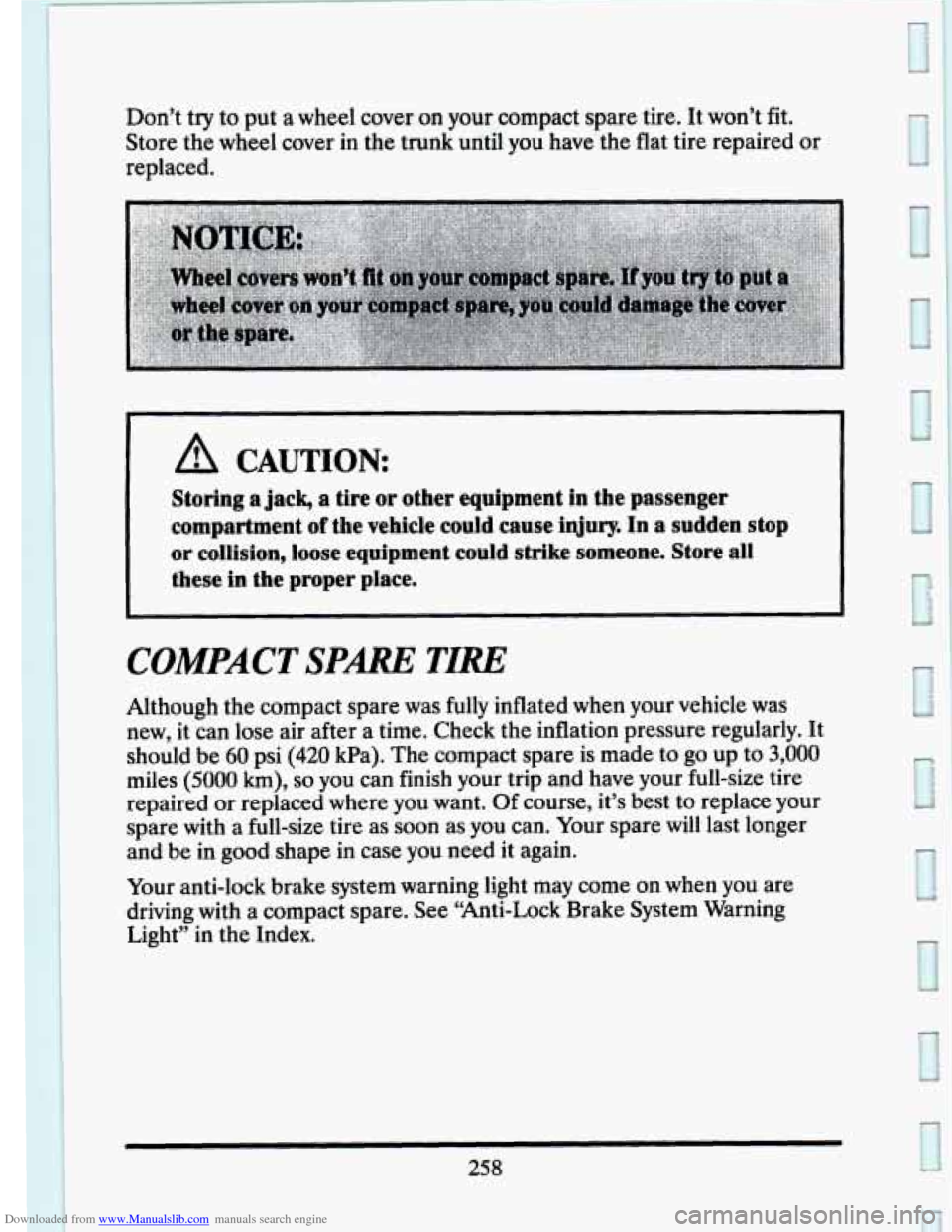
COMPACT SPARE TIRE
Although the compact spare was fully inflated when your vehicle was
new, it can lose air after a time. Check the inflation pressure regularly. It
should be
60 psi (420 kPa). The compact spare is made to go up to 3,000
miles (5000 km), so you can finish your trip and have your full-size tire
repaired or replaced where you want. Of course, it’s best to replace your
spare with a full-size tire as
soon as you can. Your spare will last longer
and be
in good shape in case you need it again.
Your anti-lock brake system warning light may come on when you are
driving with a compact spare. See “Anti-Lock Brake System Warning
Light” in the Index.
258
I
Page 273 of 407
Downloaded from www.Manualslib.com manuals search engine I!
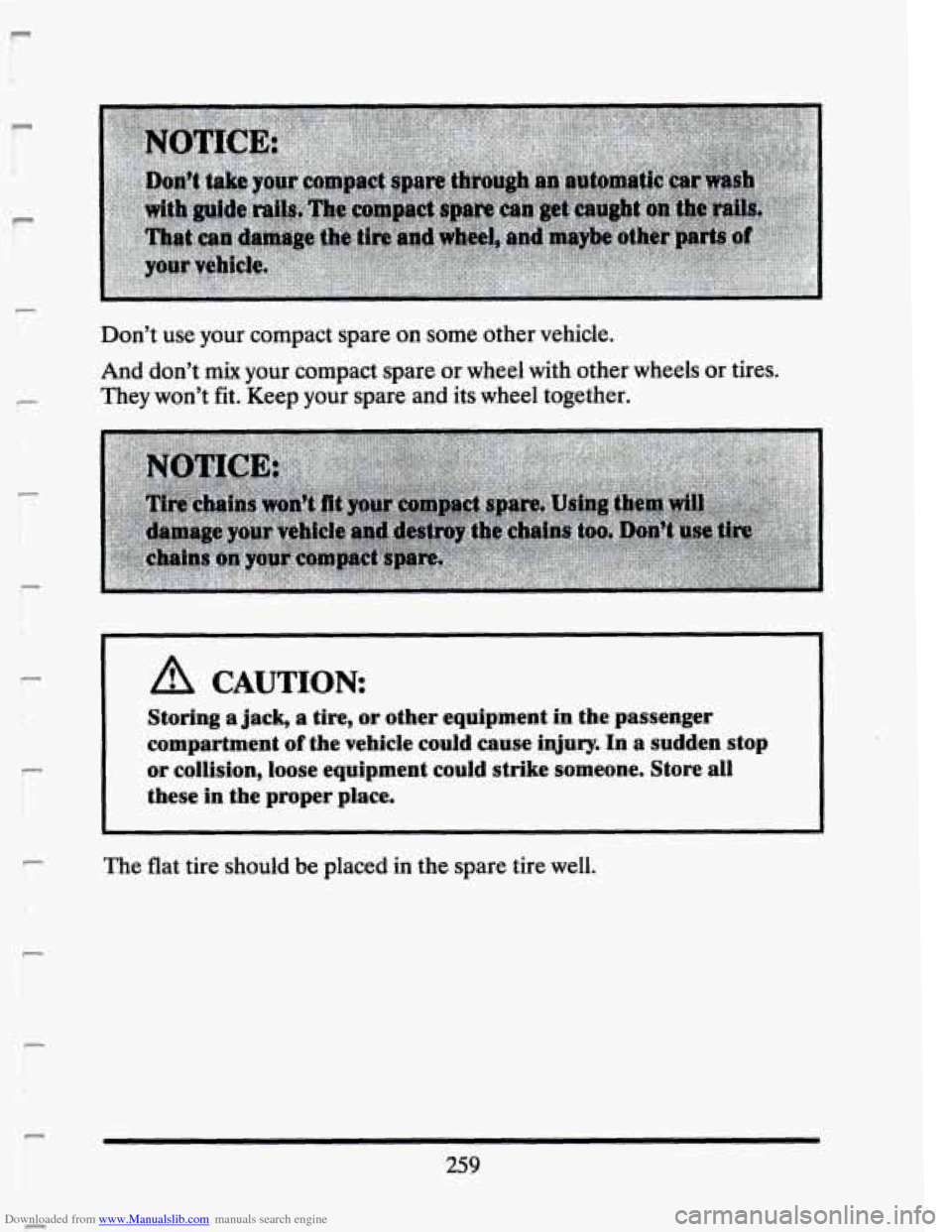
Don’t use your compact spare on some other vehicle.
P
And don’t mix your compact spare or wheel with other wheels or tires.
They won’t
fit. Keep your spare and its wheel together.
i
P
r 1 I
I I
A CAUTION
Storing a jack, a tire, or oth’er equipment in the pagsenger
compartment
of the vehicle could cause iqjury. In a sudden stop
or collision, loose equipment could strike someone. Store all
these in the proper place.
The flat tire should be placed in the spare tire well.
259