1993 CADILLAC SEVILLE flat
[x] Cancel search: flatPage 48 of 407
Downloaded from www.Manualslib.com manuals search engine What will you see after an air bag inflation?
After the air bag has inflated, it will then quickly deflate. This occurs so
quickly that some people may not even realize that the air bag inflated.
The air bag will
not impede the driver’s vision or ability to steer the
vehicle, nor will it hinder the occupants from exiting the vehicle. There
will be small amounts
of smoke coming from vents in the deflated air
bags. Some components
of the air bag module in the steering wheel hub
for the driver’s air bag
or the instrument panel for the passenger’s bag
may be
hot for a short time, but the portion of the bag that comes into
contact with
you will not be hot to the touch. The nitrogen gas used to
inflate the air bag
will have vented into the passenger compartment, and
the bag will be deflated within seconds after the collision. Nitrogen makes
up about
80% of the air we breathe and is not hazardous. As the nitrogen
vents from the bag, small particles are also vented into the passenger
compartment.
In many crashes severe enough to inflate an air bag, windshields are
broken
by vehicle deformation. Additional windshield breakage may
occur in vehicles with passenger air bags because
the windshield acts as a
reaction surface for the inflating air bag.
A CAUTION:
Don’t attach anything to the steering wheel pad. It might
injure the driver if the air bag inflates.
@ Don’t set anything on or attach anything to the instrument
panel. It might injure the passenger if the air bag inflates.
The air bags are designed to inflate only once. After they
inflate, you’ll need some new parts for your air bag system. If
yau don’t get them, the air bag system won’t be there to help
protect you in another crash. A new system will include air
bag moduCes and possibly other parts
0 Let only qualified technicians work on your air bag system.
Improper service can mean that your air bag system won’t
work properly. See your dealer for service.
34
c
Page 49 of 407
Downloaded from www.Manualslib.com manuals search engine r
F
r
r
Servicing Your Cadillac with the Air Bag System
Please tell or remind anyone who works on your Cadillac that it has the
air bag system. There are parts
of the air bag system in several places
around your vehicle. You don’t want the system to inflate while someone
is working
on your vehicle.The air bag system does not need regular
maintenance. Your Cadillac dealer and the
1993 Cadillac Service Manual
have information about the air
bag system, including repair or disposal.
When electrical work
is done under the hood or inside your vehicle, the
ignition should be
in “Lock” if possible. Avoid wires wrapped with yellow
tape, or yellow connectors. They are probably part
of the air bag system.
Your vehicle has the driver’s air bag only. The driver’s air bag must be
disconnected
if the ignition has to be on for electrical work or if the the
steering column is
to be disassembled. Disconnect the driver’s air bag like
this:
Turn off the ignition.
35
Page 50 of 407
Downloaded from www.Manualslib.com manuals search engine Remove the SIR (air bag) fuse (see “Fuses and Circuit Breakers’’ in
the Index).
Disconnect the yellow connector at the base of the steering column.
Your vehicle
also has the right-front passenger’s air bag, both the driver’s
air bag and the right-front passenger’s air bag must be disconnected
if the
ignition has
to be on for electrical work, or if the steering column or
instrument panel is to be disassembled.
Your vehicle with both
a driver’s air bag and a right-front passenger’s air
bag,
you must disconnect both air bags. Follow the procedure above for
the driver’s
air bag, then disconnect the right-front passenger’s air bag
like this:
Turn off ignition.
0 Remove the SIR (air bag) fuse (see “Fuses and Circuit Breakers” in
the Index.
0 Remove the trap door located inside the glove box.
Disconnect the yellow connector.
When the work
is complete, if the air bag system was disconnected, be
sure to reattach everything and replace the fuse before turning the
ignition on. When you turn the ignition
key on, be sure you see the
inflatable restraint light
on the instrument panel. If you don’t see this
light flash and then go out as usual, have your air bag system repaired.
S’.ETYBELT USE DURING PREGNMCY
Safety belts work for everyone, including pregnant women. Like all
occupants, they
are more likely to be seriously injured if they don’t wear
safety belts.
36
c
Page 60 of 407
Downloaded from www.Manualslib.com manuals search engine CHILD RESTMNTS
Be sure to follow the instructions for the restraint. You may find these
instructions
on the restraint itself or in a booklet, or both. These
restraints use the belt system in your vehicle, but the child also has to be
secured within the restraint to help reduce the chance
of personal injury.
The instructions that come with the infant or child restraint will show you
how to do that.
?+%ere to Put the Restraint
Accident statistics show that children are safer if they are restrained in
the rear rather than the front seat. We at General Motors therefore
recommend that
you put your child restraint in the rear seat. NEVER put
a rear-facing child restraint in the front passenger seat. Here’s
why:
A CAUTION:
A child in a rear-facing child restraint can be seriously injured
if the right-front passenger’s air bag inflates, This is because
the back of a rear-facing child restraint would be very close to
the
inflating air bag. If your vehicle has a right-frunt
passenger’s air bag, always secure a rear-facing child restraint
in the rear seat,
You may secure a fonvard-facing child restraint in the right
front seat, However, before securing a forward-facing chitd
restraint, ALWAYS move the frornt passenger seat as far back
as it will go. Or, secure the child restraint in the rear seat.
CAUTION:
A child in B child restraint in the frontenter seat can be
badly injured by the passenger air bag if it inflates. NWEK
use a child restraint in the fmnt-center seat. It’s ahvays better
to secure a child restmint in the rcar seat, You may, howeiq
secure a forward-facing child restraint in the right-front
passenger seat unty with the seat moved all the way back
c
Page 67 of 407
Downloaded from www.Manualslib.com manuals search engine 3 Securing a Child Restraint in the Right Front Seat
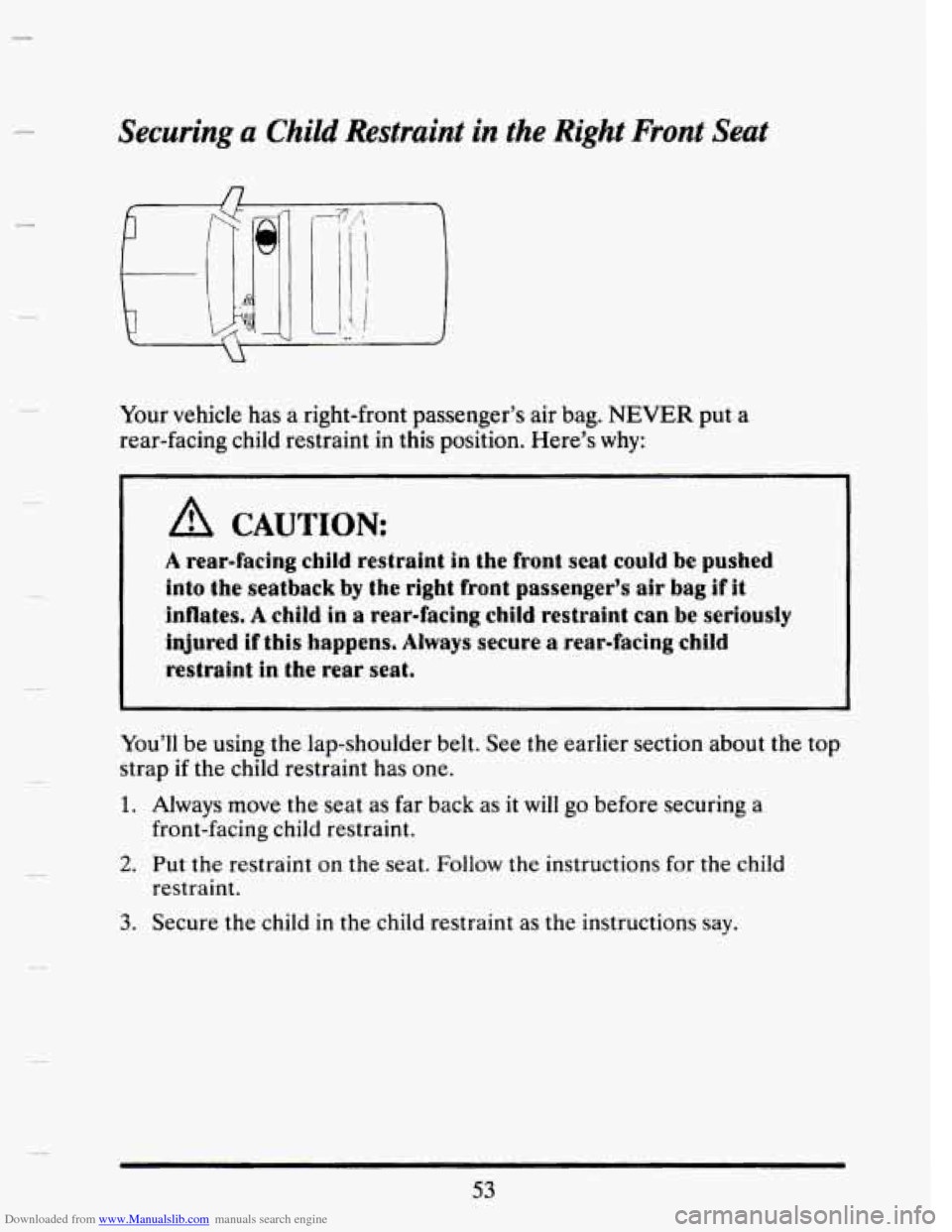
Your vehicle has a right-front passenger’s air bag. NEVER put a
rear-facing child restraint in this position. Here’s why:
A rear-facing child restraint in the front seat could he pushed
into the seatback by the right front passenger‘s air bag if it
Inflates, A child in a rear-facing child restraint can be seriously
injured if this happens. Always secure a rear-facing child
restraint in the rear seat.
You’ll be using the lap-shoulder belt. See the earlier section about the top
strap
if the child restraint has one.
1. Always move the seat as far back as it will go before securing a
front-facing child restraint.
2. Put the restraint on the seat. Follow the instructions for the child
restraint.
3. Secure the child in the child restraint as the instructions say.
53
Page 155 of 407
Downloaded from www.Manualslib.com manuals search engine SERVICE RIDE CONTROL
This message is displayed to indicate that the Suspension System is not
operating properly.
To correct this problem have your vehicle serviced at
your Cadillac dealership at your earliest convenience.
STOP ENGINE ENGINE OVERHEATING
This message will appear when your engine has overheated. Stop and
turn your engine
off immediately to avoid severe engine damage. See
“Engine Overheating”
in the Index.
SERVICE VEHICLE SOON
This message will appear if there is a problem with your Emission
Control System.
If the “SERVICE ENGINE SOON” light on the
instrument panel and this message appear and then turns off, it is an
indication that a temporary problem has cleared itself. Have your vehicle
checked at your earliest convenience.
STOP ENGINE LOW OIL PRESSURE
If this message appears while the engine is running, stop the engine and
do not operate it until the cause
of low oil pressure is corrected. Severe
damage to the engine can result.
SERVICE SUPPLEMENTAL INFLATABLE RESTRAINT
If this message appears, there is a problem with your Supplemental
Inflatable Restraint (Air Bag) system. Let only a qualified technician
work on your vehicle.
See your Cadillac dealer for service at once.
THEFT SYSTEM PROBLEWCAR MAY NOT RESTART
This message means there is atroblem in the Personalized Automotive
Security System (PASS
Key I1 ). PASS Key I1 TM will prevent the vehicle
from restarting
if it is turned off, so you should take the vehicle to a
proper service center before turning the engine off. Never leave
an
unattended vehicle with the engine running. Once you are where you can
get service, turn
the engine off and then try to restart it. If the vehicle
does not restart, the PASS
Key I1 TM system will need servicing.
TRACTION ACTIVE
If your vehicle is equipped with Traction Control, this message will be
displayed
if Traction Control is being used to reduce wheel slippage.
141
Page 216 of 407
Downloaded from www.Manualslib.com manuals search engine 0 Lights: Are they all working? Are the lenses clean?
0 Tires: They are vitally important to a safe, trouble-free trip. Is the
tread good enough for long-distance driving? Are the tires all inflated
to the recommended pressure?
Weather Forecasts: What’s the weather outlook along your route?
Should you delay your trip a short time to avoid a major storm
system?
0 Maps: Do you have up-to-date maps?
ON THE ROAD
Unless you are the only driver, it is good to share the driving task with
others. Limit turns behind the wheel
to about 100 miles (160 km) or two
hours at
a sitting. Then, either change drivers or stop for some
refreshment like coffee, tea or soft drinks and some limbering up. But
do
stop and move around. Eat lightly along the way. Heavier meals tend to
make some people sleepy.
On two-lane highways or
undivided multilane highways that do not have
controlled access, you’ll want to watch for some situations not usually
found
on freeways. Examples are: stop signs and signals, shopping centers
with direct access
to the highway, no passing zones and school zones,
vehicles turning left and right off the road, pedestrians, cyclists, parked
vehicles, and
even animals.
I
HIGWAY HypNosIS
Is there actually such a condition as “highway hypnosis”? Or is it just
plain falling asleep at the wheel? Call it highway hypnosis, lack of
awareness, or whatever.
There is something about an easy stretch
of road with the same scenery,
along with the hum
of the tires on the road, the drone of the engine, and
the rush
of the wind against the vehicle that can make you sleepy. Don’t
let it happen
to you! If it does, your vehicle can leave the road in less than
a second. and you could crash and be injured.
What can you do about highway hypnosis? First, be aware that it can
happen.
202
-*
Page 217 of 407
Downloaded from www.Manualslib.com manuals search engine Then here are some tips:
Make sure your vehicle is well ventilated, with a comfortably cool
Keep your eyes moving. Scan the road ahead and to the sides. Check
interior.
your rearview mirrors frequently and your instruments from time
to
time. This can help you avoid a fixed stare.
Wear good sunglasses in bright light. Glare can cause drowsiness. But
don't wear sunglasses at night. They will drastically reduce your
overall vision at the
very time you need all the seeing power you have.
If you get sleepy, pull off the road into a rest, service, or parking area
and take a nap, get some exercise,
or both. For safety, treat drowsiness
on the highway as an emergency.
As in any driving situation, keep pace with traffic and allow adequate
following distances.
HILL AND MOUNTMN ROADS
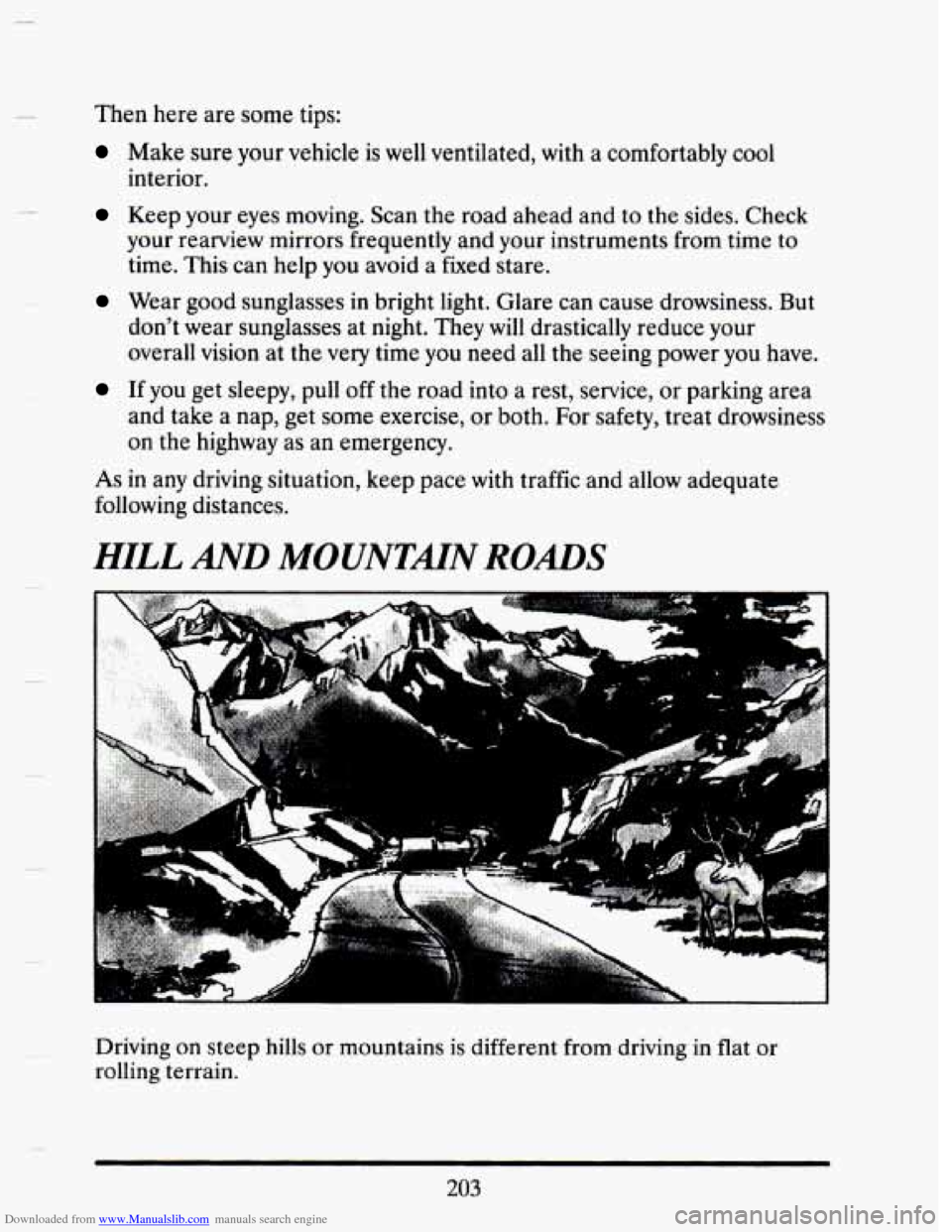
Driving on steep hills or mountains is different from driving in flat or
rolling terrain.
203