1993 CADILLAC SEVILLE flat
[x] Cancel search: flatPage 318 of 407
Downloaded from www.Manualslib.com manuals search engine LOplDING YOUR KEHICLE
TIRE-LOADING INFORMATION
‘m OCCUPANTS VEHICLE CAP. WT.
FRT. CTR. RR. TOTAL LBS. KG
MAX. LOADING & GVWR SAME AS VEHICLE
CAPACITY WEIGHT
XXX COLD TIRE
TIRE SIZE SPEED PRESSURE
RTG PSVKPa
FRT.
RR.
SPA.
IF TtRES ARE
HOT. ADD 4PS1/28KPa SEE
OWNER’S MANUAL FOR ADDITIONAL
INFORMATION
GEN GME,
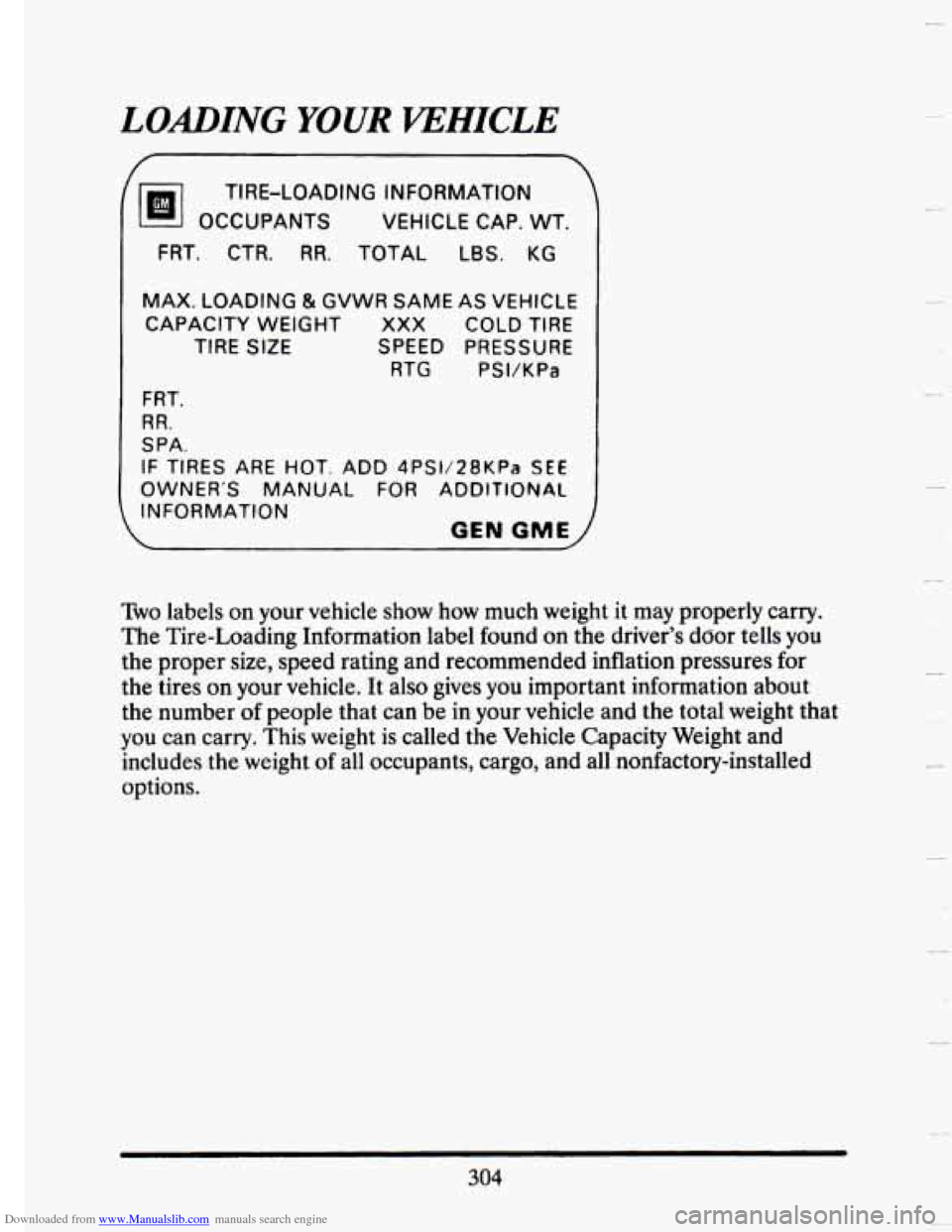
Two labels on your vehicle show how much weight it may properly carry.
The Tire-Loading Information label found on the driver’s ddor tells you
the proper
size, speed rating and recommended inflation pressures for
the tires on your vehicle.
It also gives you important information about
the number
of people that can be in your vehicle and the total weight that
you can carry. This weight
is called the Vehicle Capacity Weight and
includes the weight of
all occupants, cargo, and all nonfactory-installed
options.
304
.-
I
Page 321 of 407
Downloaded from www.Manualslib.com manuals search engine 3
A CAUTION
Poorly maintained and improperly used tires are dangerous.
Overloading your tires can cause overheating as a result of
too much fkiction. You could have an air-out and a serious
accident. See “Loading Your Vehicle” in the Index.
Underinflated tires pose the same danger as overloaded
tires. The resulting accident could cause serious iqjury.
Check all tires frequently to maintain the recommended
pressure. Tire pressure should be checked when your tires
are cold.
Overinflated tires are more likely to be cut, punctured, or
broken
by a sudden impact, such as when you hit a pothole.
Keep tires at the recommended pressure.
Worn, old tires can cause accidents. If your tread is badly
worn, or if your tires have been damaged, replace them.
See “Inflation
- Tire Pressure” in this section for inflation
pressure adjustment
for higher speed driving.
In@tion - Tire Pressure
The Tire-Loading Information label which is located on the driver’s door
shows the correct inflation pressures for your tires, when they’re cold.
“Cold” means your vehicle has been sitting
for at least three hours or
driven no more than a mile.
If you’ll be driving at speeds higher than
100 mph (160 kmh) where it is
legal, raise the “cold” inflation pressure
of each tire to 35 psi (240 kPa).
When you end this
very high speed driving, reduce the “cold” inflation
pressures
to those listed on the Tire-Loading Information label. Never
inflate the tires higher than the maximum “cold” inflation pressures
stated on the sidewall
of the tires.
307
Page 323 of 407
Downloaded from www.Manualslib.com manuals search engine STS recommended tire size is:
GA Performance Blackwall (P225/60ZR 16)
Don’t forget your compact spare tire. It should be at 60 psi (420 kPa).
How to Check Use a good quality pocket-type gage to check tire
pressure. Simply looking at the tires
will not tell you the pressure,
especially if you have radial tires
-- which may look properly inflated even
if they’re underinflated.
If your tires have valve caps, be sure to put them back on. They help
prevent leaks
by keeping out dirt and moisture.
Tire Inspection and Rotation
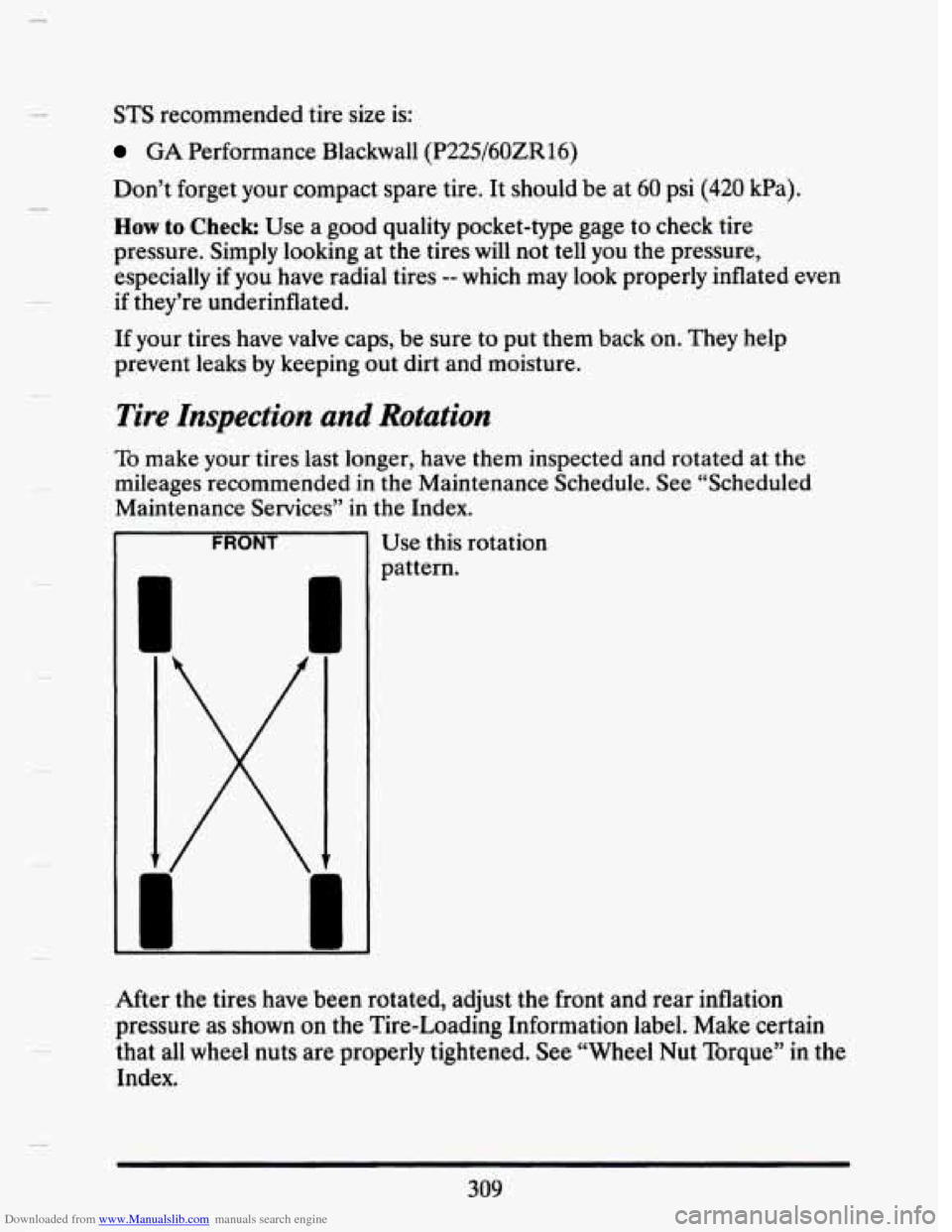
To make your tires last longer, have them inspected and rotated at the
mileages recommended
in the Maintenance Schedule. See “Scheduled
Maintenance Services”
in the Index.
FRONT Use this rotation
pattern.
After the tires have been rotated, adjust the front and rear inflation
pressure as
shown on the Tire-Loading Information label. Make certain
that
all wheel nuts are properly tightened. See “Wheel Nut Torque’’ in the
Index.
309
Page 324 of 407
Downloaded from www.Manualslib.com manuals search engine A CAUTION:
Rust or dirt on a wheel, or on the parts to which it is fastened,
can make wheel nuts become loose after a time. The wheel could
come
off and cause an accident. When you change a wheel,
remove any rust or
dirt from places where the wheel attaches to
the vehicle. In an emergency, you can use a cloth or a paper
towel to do this; but be sure to use a scraper or wire brush later,
if you need to, to get all the rust or dirt off. (See “Changing a
Flat Tire” in the Index.)
When It3 Time for New Tires
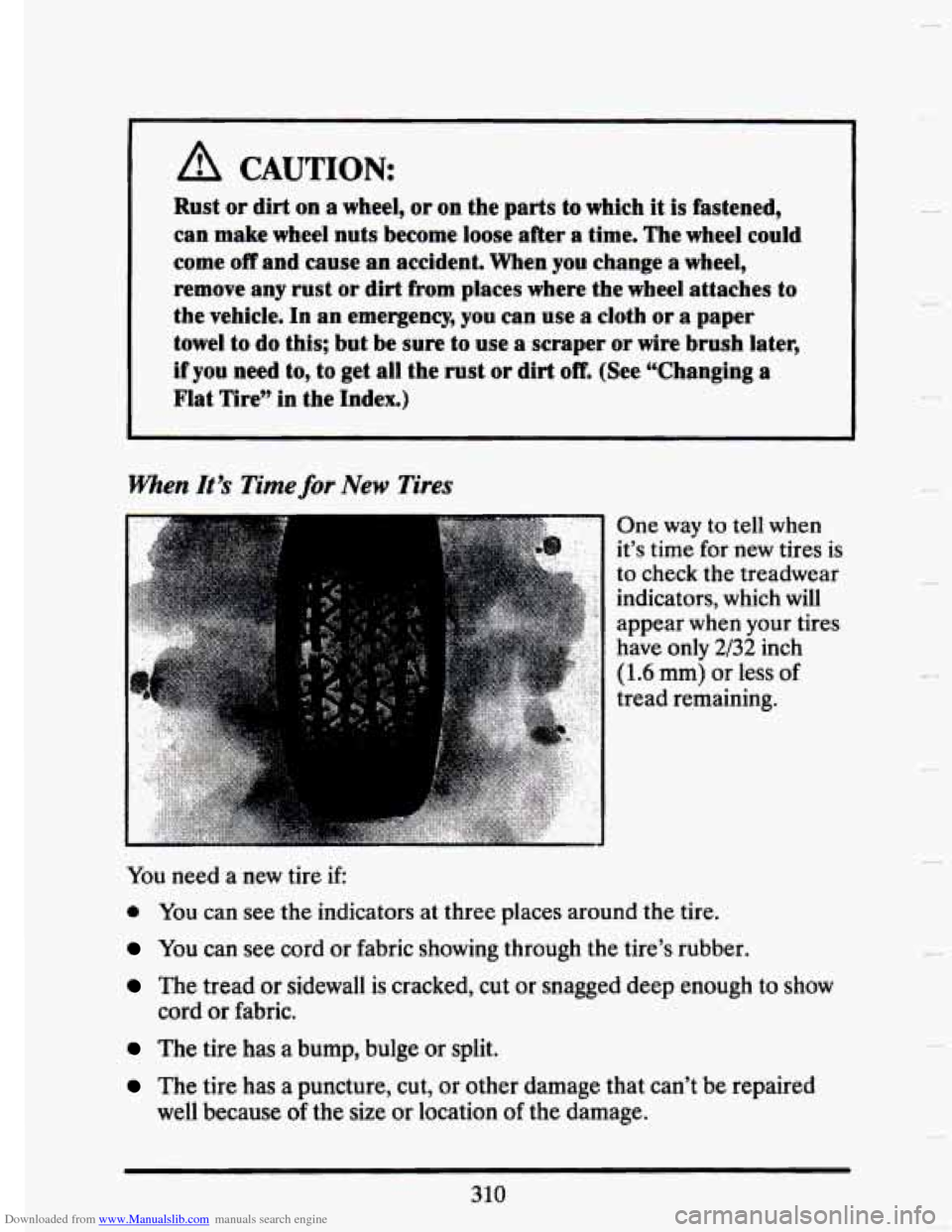
One way to tell when
it’s time for
new tires is
to check the treadwear
indicators, which
will
appear when your tires
have only
2/32 inch
(1.6 mm) or less of
tread remaining.
You need a new tire
if
0 You can see the indicators at three places around the tire.
You can see cord or fabric showing through the tire’s rubber.
The tread or sidewall is cracked, cut or snagged deep enough to show
cord or fabric.
The tire has a bump, bulge or split.
The tire has a puncture, cut, or other damage that can’t be repaired
well because of the size or location of the damage.
L
c
310
Page 326 of 407
Downloaded from www.Manualslib.com manuals search engine Deadwear
The treadwear grade is a comparative rating based on the wear rate of
the tire
when tested under controlled conditions on a specified
government test course. For example,
a tire graded 150 would wear one
and
a half (1 1/2) times as well on the government course as a tire graded
100. The relative performance of tires depends upon the actual
conditions of their use, however,
and may depart significantly from the
norm
due to variations in driving habits, service practices and differences
in road characteristics and climate.
Traction - A, B, C
The traction grades, from highest to lowest are: A, B, and C. They
represent the tire’s ability to stop
on wet pavement as measured under
controlled conditions on specified government test surfaces of asphalt
and concrete.
A tire marked C may have poor traction performance.
Warning: The traction grade assigned
to this tire is based on braking
(straight-ahead) traction tests and does not include cornering (turning)
traction.
Temperature - A, B, C
The temperature grades are A (the highest), B, and C, representing the
tire’s resistance to the generation of heat and its ability to dissipate heat
when tested under controlled conditions on a specified indoor laboratory
test wheel. Sustained high temperature can cause the material
of the tire
to degenerate and reduce tire life, and excessive temperature can lead to
sudden tire failure.
The grade C corresponds to a level of performance
which all passenger car tires must meet under the Federal Motor Vehicle
Safety Standard
No. 109. Grades B and A represent higher levels of
performance on the laboratory test wheel than the minimum required by
law.
Warning: The temperature grade for this tire is established for a tire that
is properly inflated and not overloaded. Excessive speed, underinflation,
or excessive loading, either separately
or in combination, can cause heat
buildup and possible tire failure.
Those grades are molded on the sidewalls of passenger car tires.
312
.H
c
-
Page 339 of 407
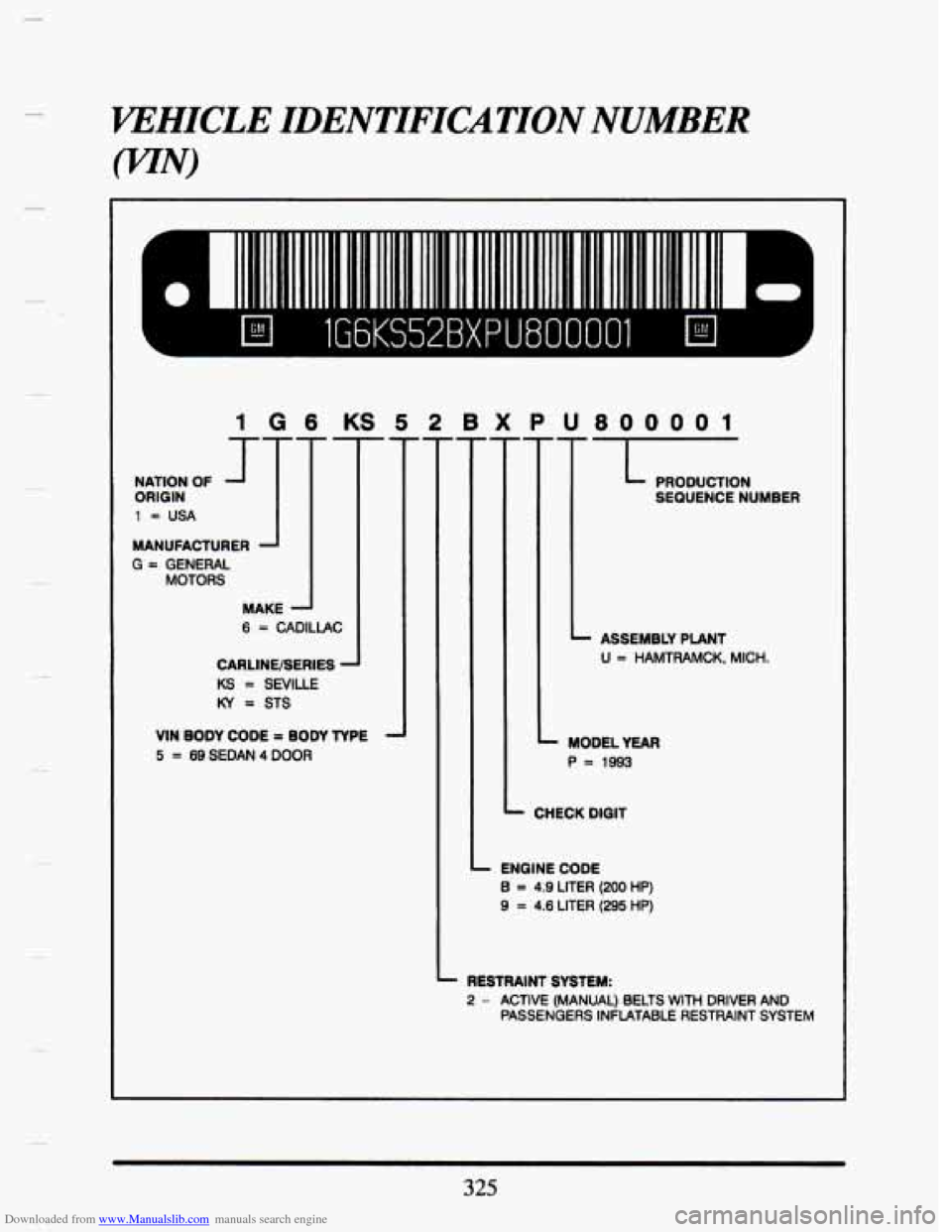
Downloaded from www.Manualslib.com manuals search engine VEHICLE IDENTIFICATION NUMBER
EI lG6KS52BXPU800001 EI
1G 6 KS 5 2 BX P U800001
G = GENERAL
MOTORS
6 = CADILLAC
CARLINE/SERIES
KS = SEVILLE
KY = STS
VIN BODY CODE
= BODY TYPE -
5 = 69 SEDAN 4 DOOR
PRODUCTION
SEQUENCE NUMBER
ASSEMBLY PLANT U
= HAMTRAMCK, MICH.
- MODELYEAR
P = 1993
- CHECK DIGIT
- ENGINE CODE
B
= 4.9 LITER (200 HP)
9 = 4.6 LITER (295 HP)
- RESTRAINT SYSTEM:
2 - ACTIVE (MANUAL) BELTS WITH DRIVER AND
PASSENGERS INFLATABLE RESTRAINT SYSTEM
325
Page 372 of 407
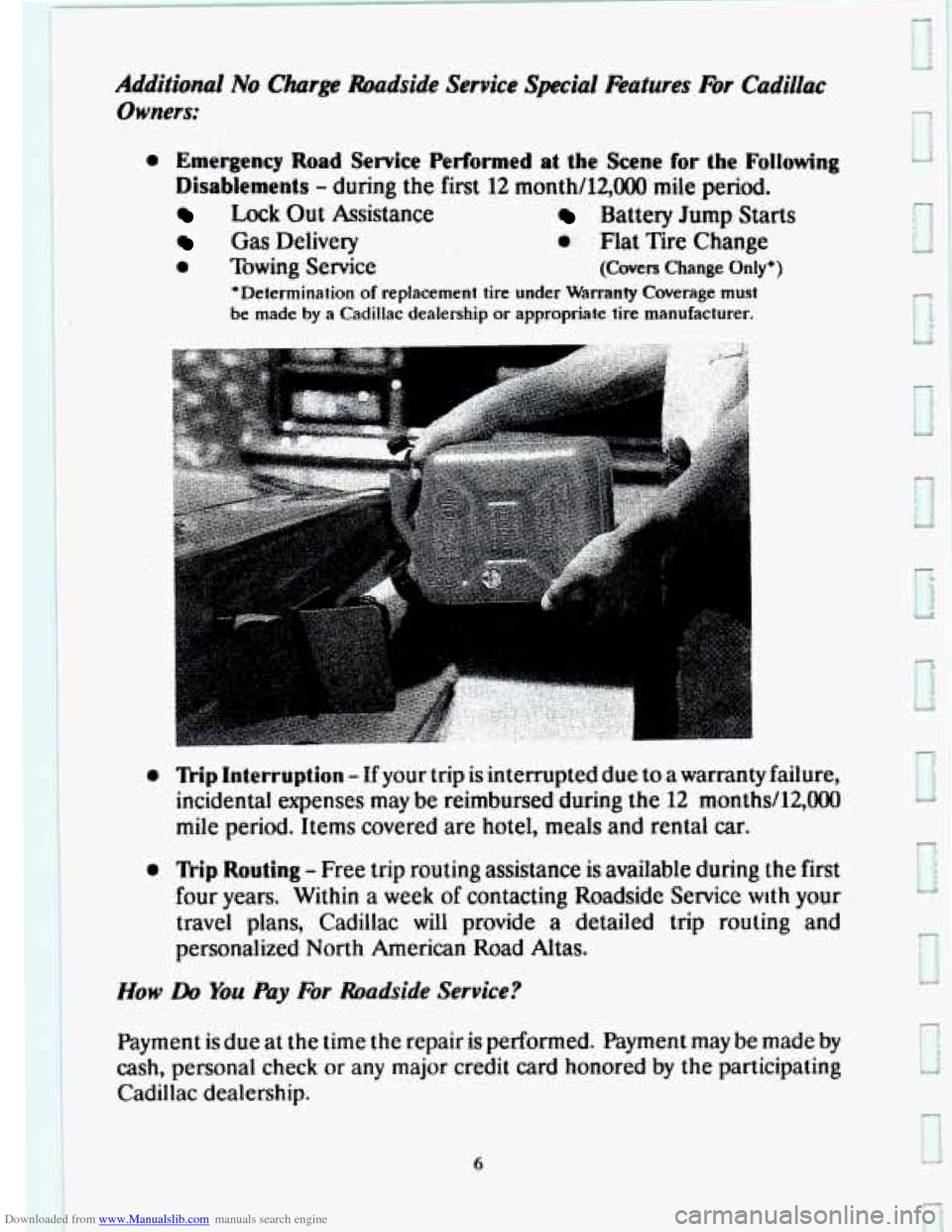
Downloaded from www.Manualslib.com manuals search engine 0 Emergency Road Service Performed at the Scene for the Following
Disablements
- during the first 12 month/12,000 mile period.
Lock Out Assistance Battery Jump Starts
Gas Delivery 0 Flat Tire Change
0 Towing Service (Coven Change Only*)
*Determination
of replacement tire under Warranty Coverage must
be made by a Cadillac dealership or appropriate tire manufacturer.
0
0
nip Interruption - If your trip is interrupted due to a warranty failure,
incidental expenses may be reimbursed during the
12 months/12,000
mile period. Items covered are hotel, meals and rental car.
'kip Routing - Free trip routing assistance is available during the first
four years. Within
a week of contacting Roadside Service wlth your
travel plans, Cadillac will provide a detailed trip routing and
personalized North American
Road Altas.
How Do You Pay For Roadside Service?
P
Payment is due at the time the repair is performed. Payment may be made by
cash, personal check or any major credit card honored by the participating
Cadillac dealership.
6
Page 374 of 407
Downloaded from www.Manualslib.com manuals search engine Other Roadside Services
Cadillac Roadside Service is committed to your total peace of mind and is
staffed
by Cadillac-trained phone advisors and technicians to provide phone
or on-site repair assistance. Beyond the coverage period Roadside Service
can also arrange a wide variety of other services to assist you, such as:
0 Tow Service Battery Jump Start 0 Flat Tire Change
0 Locksmith Fuel Delivery Trip Routing
0 mi 0 Lost Keys Hotel Information
While there is no charge for some
of these items during the specified period,
the owner
is responsible for any expenses beyond the covered period.
We hope you never need any of
the emergency services, but if you do,
Roadside Service can promptly locate and arrange them for
you wherever
you travel
in the United States or Canada. It’s part of how Cadillac Roadside
Service
is dedicated to your continued satisfaction.
Glove Compartment Decal And Wallet Card
The Roadside Service toll-free number is located on a decal in the glove
compartment, on the wallet card
in the back of the Gold Key Owner’s
Literature portfolio and on the Gold Key Card you received shortly after
taking delivery of your
new Cadillac.
.
TOLL-FREE HOTLINE
1-800-882-1112
Information To Provide When Calling Cadillac Roadside Service
When you call Cadillac Roadside Service, the advisor will ask your name and
home address, the telephone number
and location you are calling from, the
location of your Cadillac and a description of the problem. The advisor will
ask the following information about your Cadillac:
Vehicle Identification Number WIN)
I
L*
c
This 17 character code is located on the driver’s side top surface of the
instrument panel and may be seen through
the windshield.
0 Model and Year 0 Delivery Date Mileage
8