Page 196 of 407
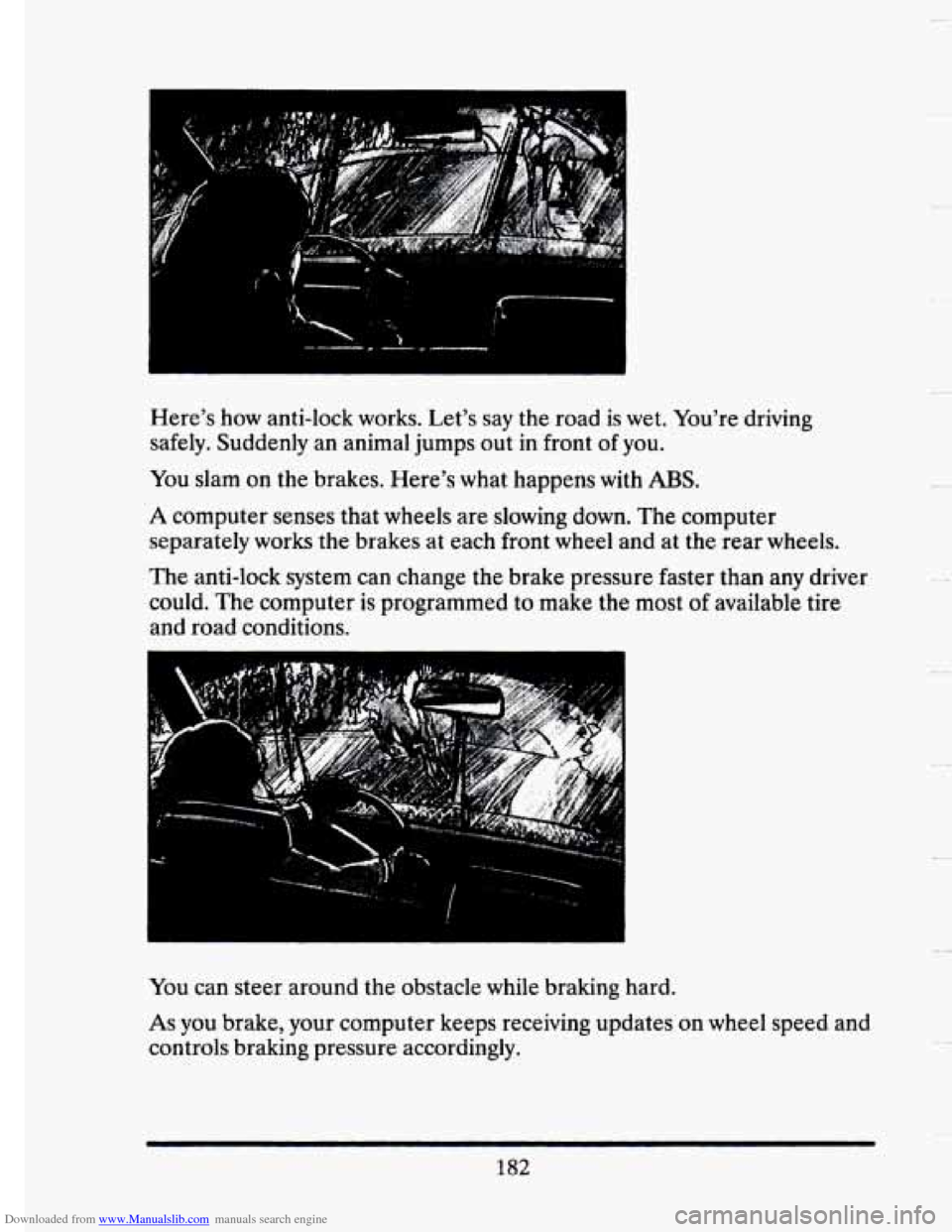
Downloaded from www.Manualslib.com manuals search engine Here’s how anti-lock works. Let’s say the road is wet. You’re driving
safely. Suddenly an animal jumps out in front of you.
You slam on the brakes. Here’s what happens with ABS.
A computer senses that wheels are slowing down. The computer
separately works
the brakes at each front wheel and at the rear wheels.
The anti-lock system can change the brake pressure faster than any driver
could. The computer is programmed to make the most
of available tire
and road conditions.
You can steer around the obstacle while braking hard.
As you brake, your computer keeps receiving updates on wheel speed and
controls braking pressure accordingly.
182
Page 209 of 407
Downloaded from www.Manualslib.com manuals search engine to pass -- or if you get hit by a gust of wind. You could suddenly find
yourself out of control.
Hydroplaning doesn’t happen often. But it can
if your tires haven’t much
tread or
if the pressure in one or more is low. It can happen if a lot of
water is standing
on the road. If you can see reflections from trees,
telephone poles, or other vehicles, and raindrops “dimple” the water’s
surface, there could be hydroplaning.
Hydroplaning usually happens at higher speeds. There just isn’t a hard
and fast rule about hydroplaning. The best advice is to slow down when it
is raining, and be careful.
Some Other Rainy Weather Tips
a
a
a
a
a
Turn on your headlights -- not just your parking lights -- to help make
you more visible to others.
Look for hard-to-see vehicles coming from behind. You may want to
use your headlights even
in daytime if it’s raining hard.
Besides slowing down, allow some extra following distance. And \
be
especially careful when you pass another vehicle. Allow yourself more
clear room ahead, and be prepared
to have your view restricted by
road spray. If the road spray is so heavy you are actually blinded, drop
back. Don’t pass until conditions improve. Going more slowly \
is better
than having an accident.
Use your defogger
if it helps.
Have good tires
with proper tread depth. (See “Tires” in the Index.)
195
Page 216 of 407
Downloaded from www.Manualslib.com manuals search engine 0 Lights: Are they all working? Are the lenses clean?
0 Tires: They are vitally important to a safe, trouble-free trip. Is the
tread good enough for long-distance driving? Are the tires all inflated
to the recommended pressure?
Weather Forecasts: What’s the weather outlook along your route?
Should you delay your trip a short time to avoid a major storm
system?
0 Maps: Do you have up-to-date maps?
ON THE ROAD
Unless you are the only driver, it is good to share the driving task with
others. Limit turns behind the wheel
to about 100 miles (160 km) or two
hours at
a sitting. Then, either change drivers or stop for some
refreshment like coffee, tea or soft drinks and some limbering up. But
do
stop and move around. Eat lightly along the way. Heavier meals tend to
make some people sleepy.
On two-lane highways or
undivided multilane highways that do not have
controlled access, you’ll want to watch for some situations not usually
found
on freeways. Examples are: stop signs and signals, shopping centers
with direct access
to the highway, no passing zones and school zones,
vehicles turning left and right off the road, pedestrians, cyclists, parked
vehicles, and
even animals.
I
HIGWAY HypNosIS
Is there actually such a condition as “highway hypnosis”? Or is it just
plain falling asleep at the wheel? Call it highway hypnosis, lack of
awareness, or whatever.
There is something about an easy stretch
of road with the same scenery,
along with the hum
of the tires on the road, the drone of the engine, and
the rush
of the wind against the vehicle that can make you sleepy. Don’t
let it happen
to you! If it does, your vehicle can leave the road in less than
a second. and you could crash and be injured.
What can you do about highway hypnosis? First, be aware that it can
happen.
202
-*
Page 222 of 407
Downloaded from www.Manualslib.com manuals search engine If “torque lock” does occur, you may need to have another vehicle pusn
yours a little uphill to take some of the pressure from the transaxle, so
you can pull the shift lever out of “P” (Park).
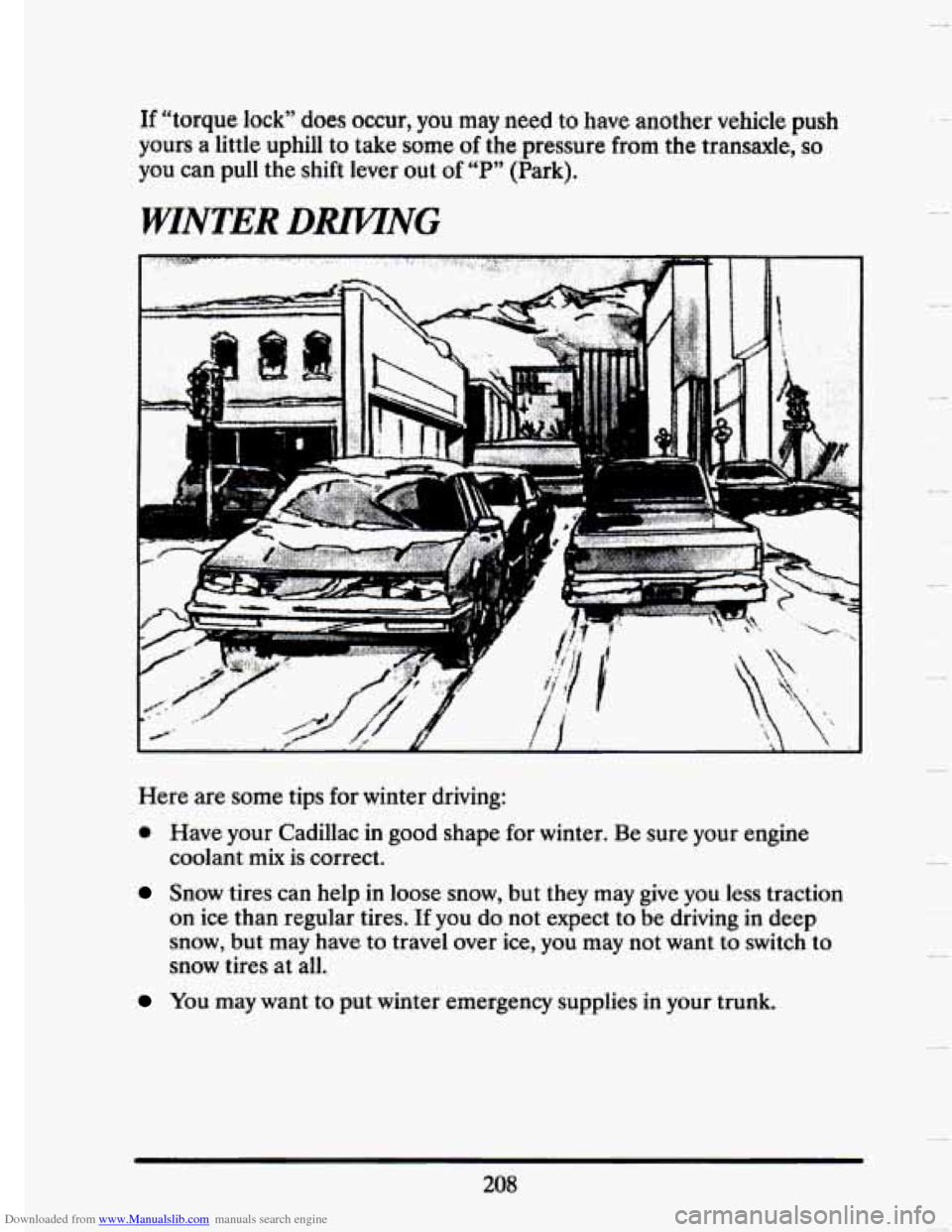
‘WINTER DmNG
V
Here are some tips for winter driving:
0 Have your Cadillac in good shape for winter. Be sure your engine
coolant
mix is correct.
Snow tires can help in loose snow, but they may give you less traction
on ice than regular tires.
If you do not expect to be driving in deep
snow,
but may have to travel over ice, you may not want to switch to
snow tires at all.
You may want to put winter emergency supplies in your trunk.
208
U
Page 272 of 407
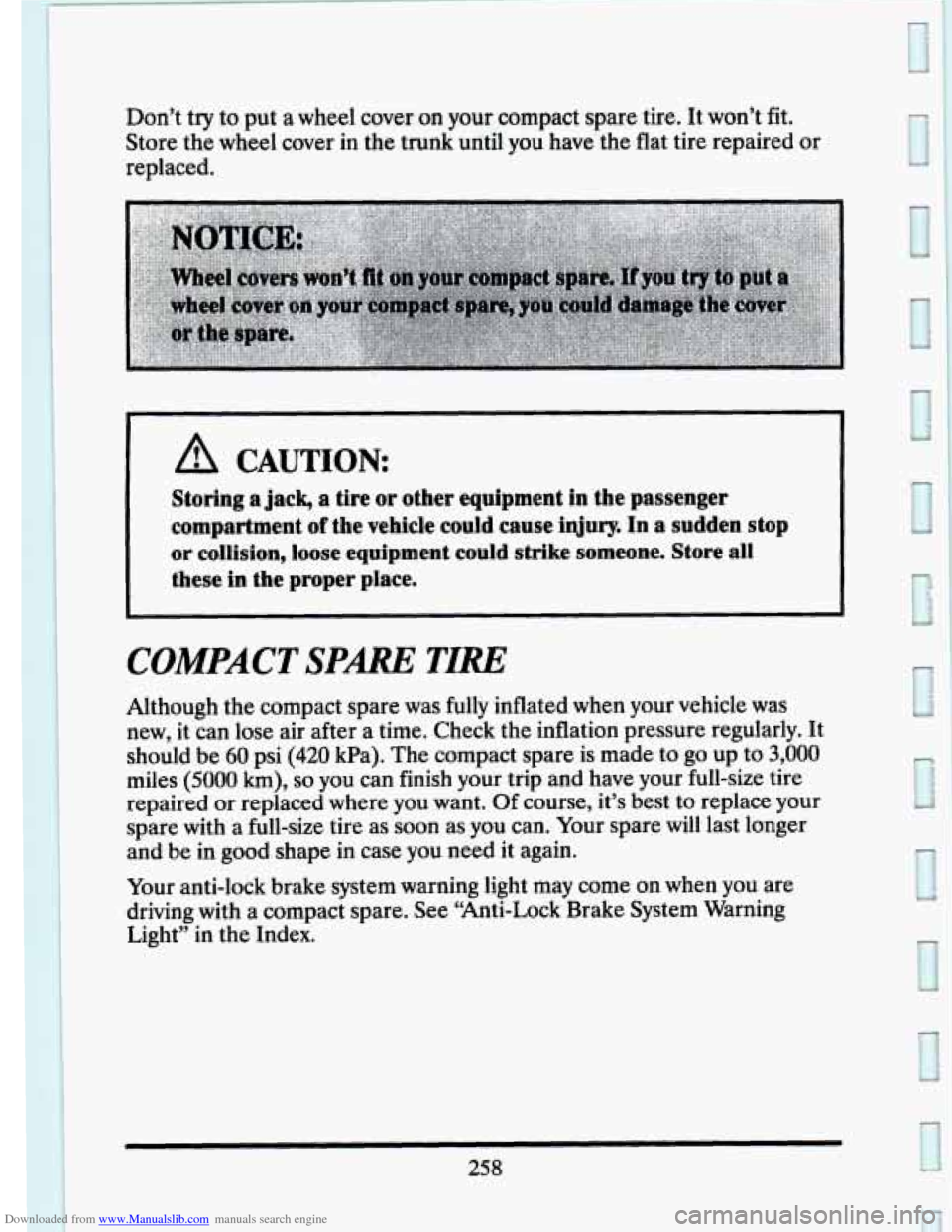
Downloaded from www.Manualslib.com manuals search engine A CAUTION:
Storing a jack, a tire or other equipment in the passenger
compartment
of the vehicle could cause injury. In a sudden stop
or collision, loose equipment could strike someone. Store all
these in the proper place.
COMPACT SPARE TIRE
Although the compact spare was fully inflated when your vehicle was
new, it can lose air after a time. Check the inflation pressure regularly. It
should be
60 psi (420 kPa). The compact spare is made to go up to 3,000
miles (5000 km), so you can finish your trip and have your full-size tire
repaired or replaced where you want. Of course, it’s best to replace your
spare with a full-size tire as
soon as you can. Your spare will last longer
and be
in good shape in case you need it again.
Your anti-lock brake system warning light may come on when you are
driving with a compact spare. See “Anti-Lock Brake System Warning
Light” in the Index.
258
I
Page 318 of 407
Downloaded from www.Manualslib.com manuals search engine LOplDING YOUR KEHICLE
TIRE-LOADING INFORMATION
‘m OCCUPANTS VEHICLE CAP. WT.
FRT. CTR. RR. TOTAL LBS. KG
MAX. LOADING & GVWR SAME AS VEHICLE
CAPACITY WEIGHT
XXX COLD TIRE
TIRE SIZE SPEED PRESSURE
RTG PSVKPa
FRT.
RR.
SPA.
IF TtRES ARE
HOT. ADD 4PS1/28KPa SEE
OWNER’S MANUAL FOR ADDITIONAL
INFORMATION
GEN GME,
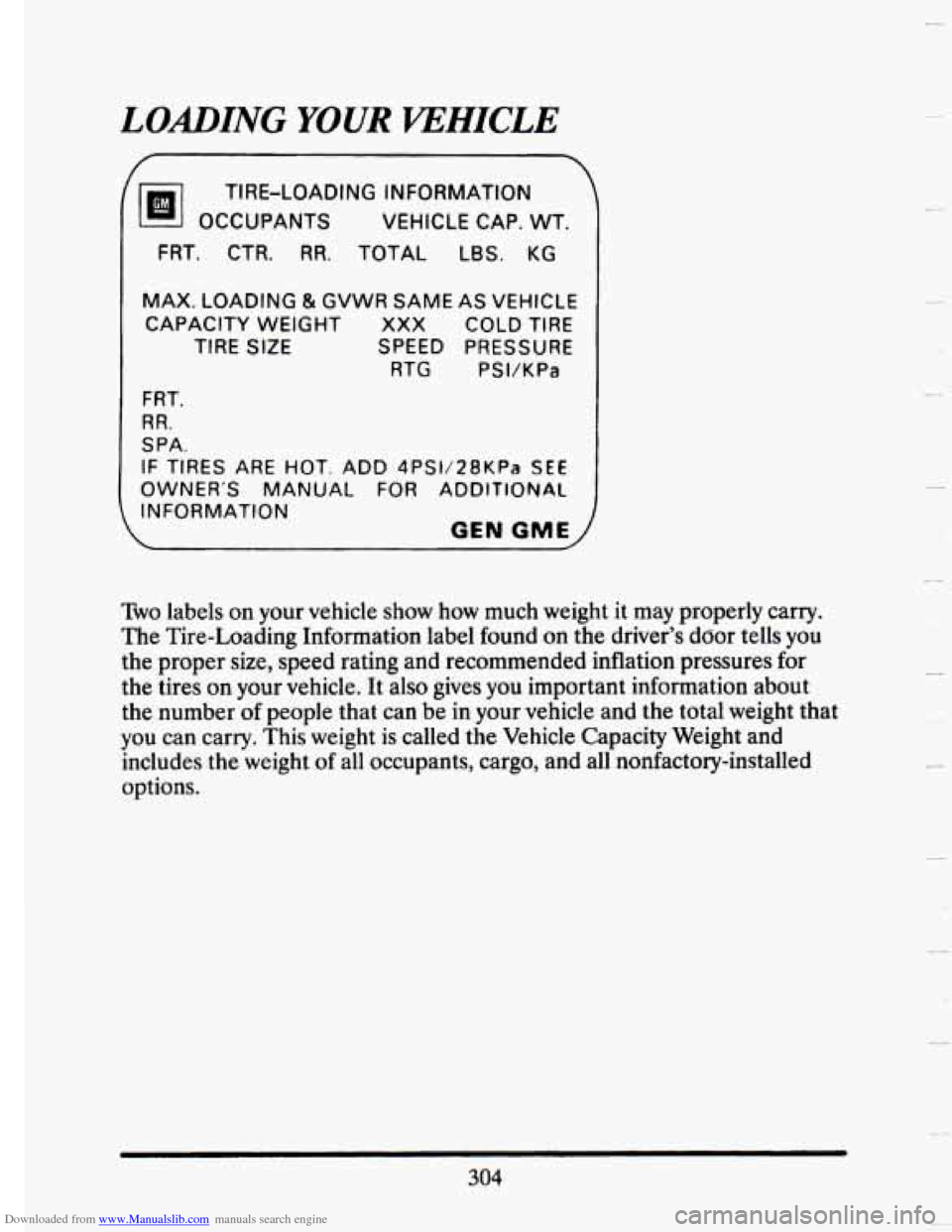
Two labels on your vehicle show how much weight it may properly carry.
The Tire-Loading Information label found on the driver’s ddor tells you
the proper
size, speed rating and recommended inflation pressures for
the tires on your vehicle.
It also gives you important information about
the number
of people that can be in your vehicle and the total weight that
you can carry. This weight
is called the Vehicle Capacity Weight and
includes the weight of
all occupants, cargo, and all nonfactory-installed
options.
304
.-
I
Page 321 of 407
Downloaded from www.Manualslib.com manuals search engine 3
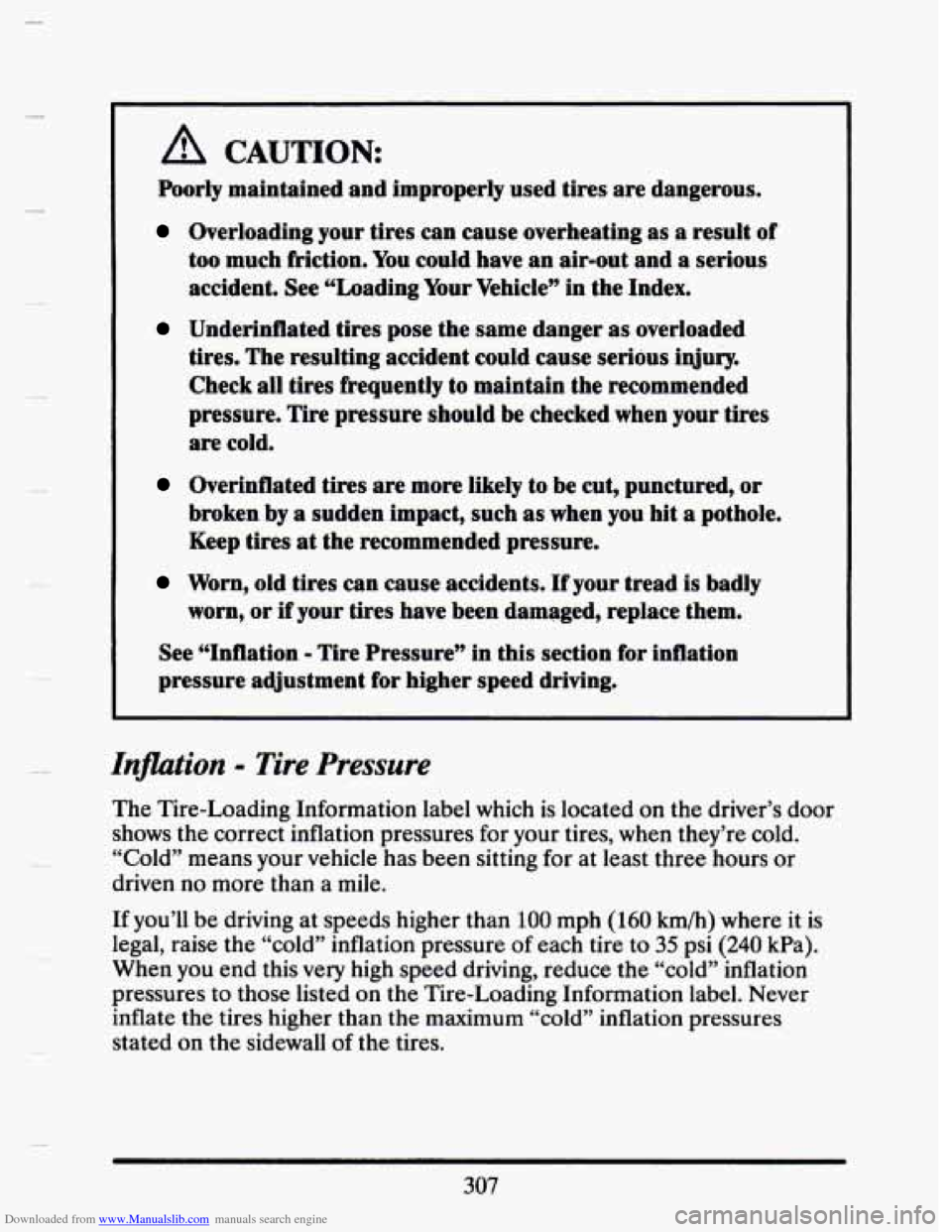
A CAUTION
Poorly maintained and improperly used tires are dangerous.
Overloading your tires can cause overheating as a result of
too much fkiction. You could have an air-out and a serious
accident. See “Loading Your Vehicle” in the Index.
Underinflated tires pose the same danger as overloaded
tires. The resulting accident could cause serious iqjury.
Check all tires frequently to maintain the recommended
pressure. Tire pressure should be checked when your tires
are cold.
Overinflated tires are more likely to be cut, punctured, or
broken
by a sudden impact, such as when you hit a pothole.
Keep tires at the recommended pressure.
Worn, old tires can cause accidents. If your tread is badly
worn, or if your tires have been damaged, replace them.
See “Inflation
- Tire Pressure” in this section for inflation
pressure adjustment
for higher speed driving.
In@tion - Tire Pressure
The Tire-Loading Information label which is located on the driver’s door
shows the correct inflation pressures for your tires, when they’re cold.
“Cold” means your vehicle has been sitting
for at least three hours or
driven no more than a mile.
If you’ll be driving at speeds higher than
100 mph (160 kmh) where it is
legal, raise the “cold” inflation pressure
of each tire to 35 psi (240 kPa).
When you end this
very high speed driving, reduce the “cold” inflation
pressures
to those listed on the Tire-Loading Information label. Never
inflate the tires higher than the maximum “cold” inflation pressures
stated on the sidewall
of the tires.
307
Page 322 of 407
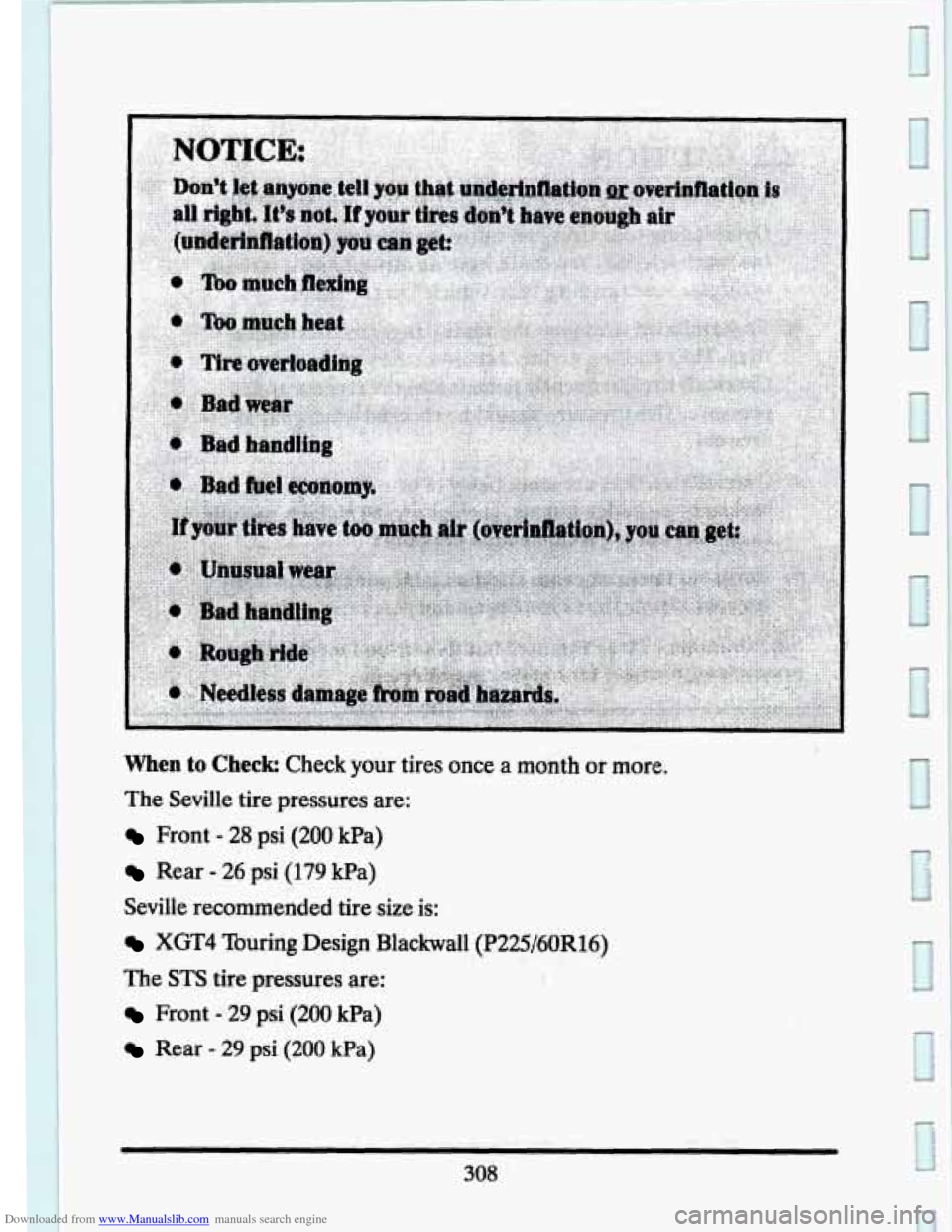
Downloaded from www.Manualslib.com manuals search engine When to Check Check your tires once a month or more.
The Seville tire pressures are:
Front - 28 psi (200 kPa)
Rear - 26 psi (179 kPa)
Seville recommended
tire size is:
XGT4 IIburing Design Blackwall (P225/6OR16)
The
STS tire pressures are:
Front - 29 psi (200 kPa)
Rear - 29 psi (200 kPa)
308