Page 157 of 407
Downloaded from www.Manualslib.com manuals search engine Road Sensing Suspension (Northstar Only)
3
The Road Sensing Suspension automatically controls the ride of your
vehicle. The system controls damping forces in the shock absorbers and
struts
in response to various road and driving conditions. The system is
capable of making these changes
within milli-seconds.
The Road Sensing Suspension controller is a computer used to control
and monitor
the system. The computer receives inputs from vertical
acceleration sensors, wheel to body position sensors, vehicle speed
sensor, lift and dive signals, and determines optimum strut valving or
(suspension stiffness) for your current operating conditions. The
computer also receives feedback from the various components to
determine proper system operation. If the computer receives an incorrect
feedback from the system, an error code
will be set in memory and a
SERVICE RIDE CONTROL message
will display on the Driver
Information Center. If this message should appear, have your vehicle
serviced at your Cadillac dealer at your earliest convenience.
Oil Life Indicator
Your Cadillac has a Driver Information Center with an Oil Change
Indicator feature. This tells you when you need to change your engine oil.
It's based
upon the engine oil temperatures and your driving patterns.
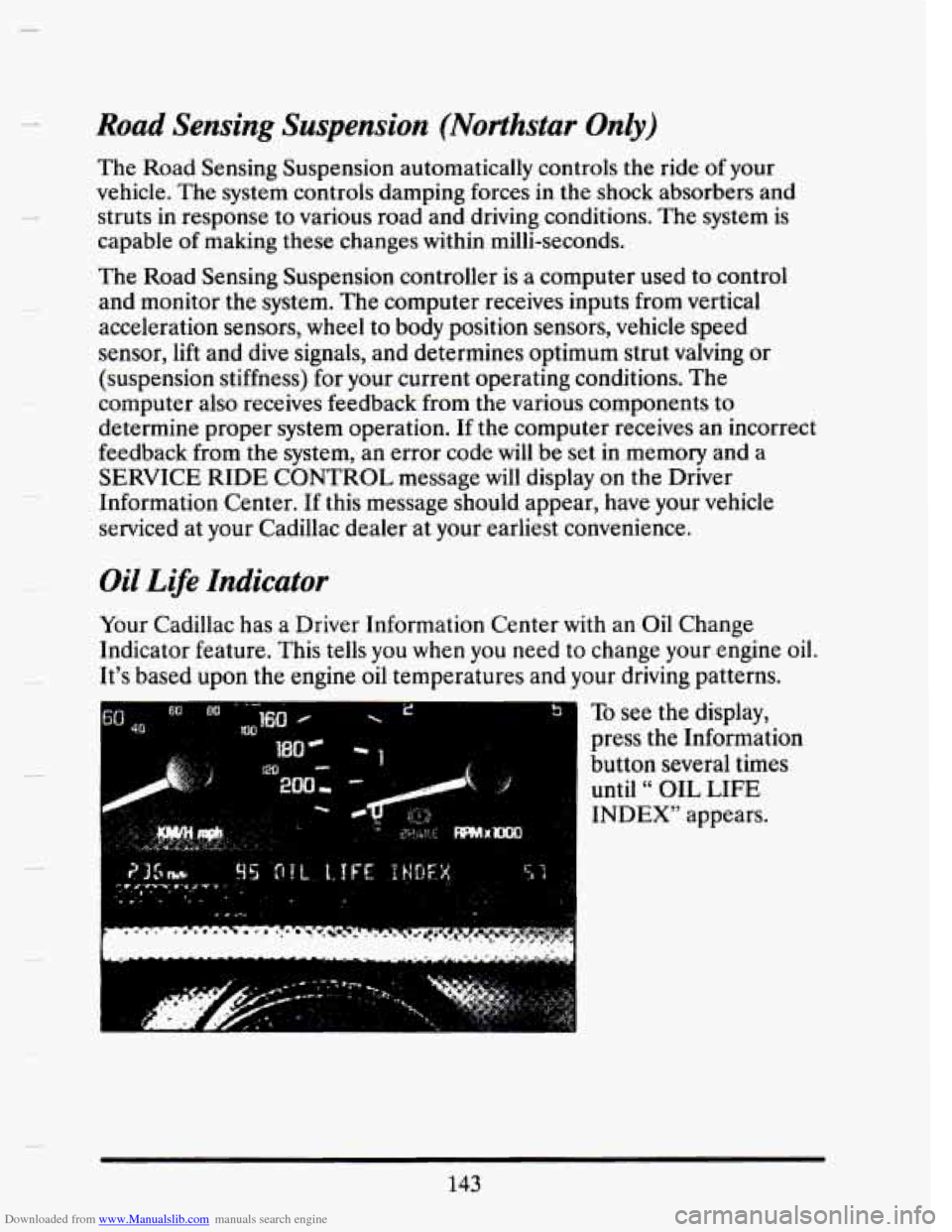
To see the display,
press the Information
button several times until
" OIL LIFE
INDEX" appears.
143
Page 159 of 407
Downloaded from www.Manualslib.com manuals search engine Speed Sensitive Suspension
The Speed Sensitive Suspension automatically controls the firmness of
your Cadillac’s ride.
An actuator in each of the four struts will change
ride firmness depending on vehicle speed and other driving conditions.
As the vehicle speed increases, the firmness of the suspension changes to
one or three damping modes “Comfort”, for speeds less than
40 mph,
“Normal” for speeds between
40 and 60 mph, and “Firm” for speeds
greater than
60 mph. The system also stiffens damping during hard
acceleration, braking and cornering for increased control.
A computer is used to control and monitor the system. The computer
receives speed, acceleration and determines optimum mode strut v\
alving
(or suspension stiffness) for your current operating conditions\
. The
computer also receives feedback from the struts to determine proper
system operation. If the computer receives an incorrect feedback from
the system,
an error code will be set in memory and a message
“SERVICE RIDE CONTROC‘
will be displayed until the problem is
corrected. If this message should appear, have your vehicle serviced at
your Cadillac dealer at your earliest convenience.
Electronic Level Control
This keeps your car level.
The ignition has
to be “ON” for the level control to work. When you turn
the ignition off, you may hear the level control exhausting. The system
consists of an electronic height sensor, a small electric air compressor,
and air adjustable shock absorbers mounted on the rear of
the vehicle.
If the system has a slight leak, the air compressor
will run frequently for a
few seconds each time.
For a massive air leak, the air compressor
will stay on for approximately 7
minutes. You should see your dealer for service, but you can keep driving
your Cadillac, though.
145
Page 195 of 407
Downloaded from www.Manualslib.com manuals search engine If you keep pace with the traffic and allow realistic following distances,
you will eliminate a lot
of unnecessary braking. That means better
braking and longer brake
life.
If your engine ever stops while you’re driving, brake normally but
don’t pump your brakes. If you do,
the pedal may get harder to push
down.
If your engine stops, you will still have some power brake assist.
But you will use it when you brake. Once the power assist is used up, it
may take longer to stop and the brake pedal
will be harder to push.
Anti-Lock Brakes (ABS)
Your Cadillac has an advanced electronic braking system that will help
prevent skidding.
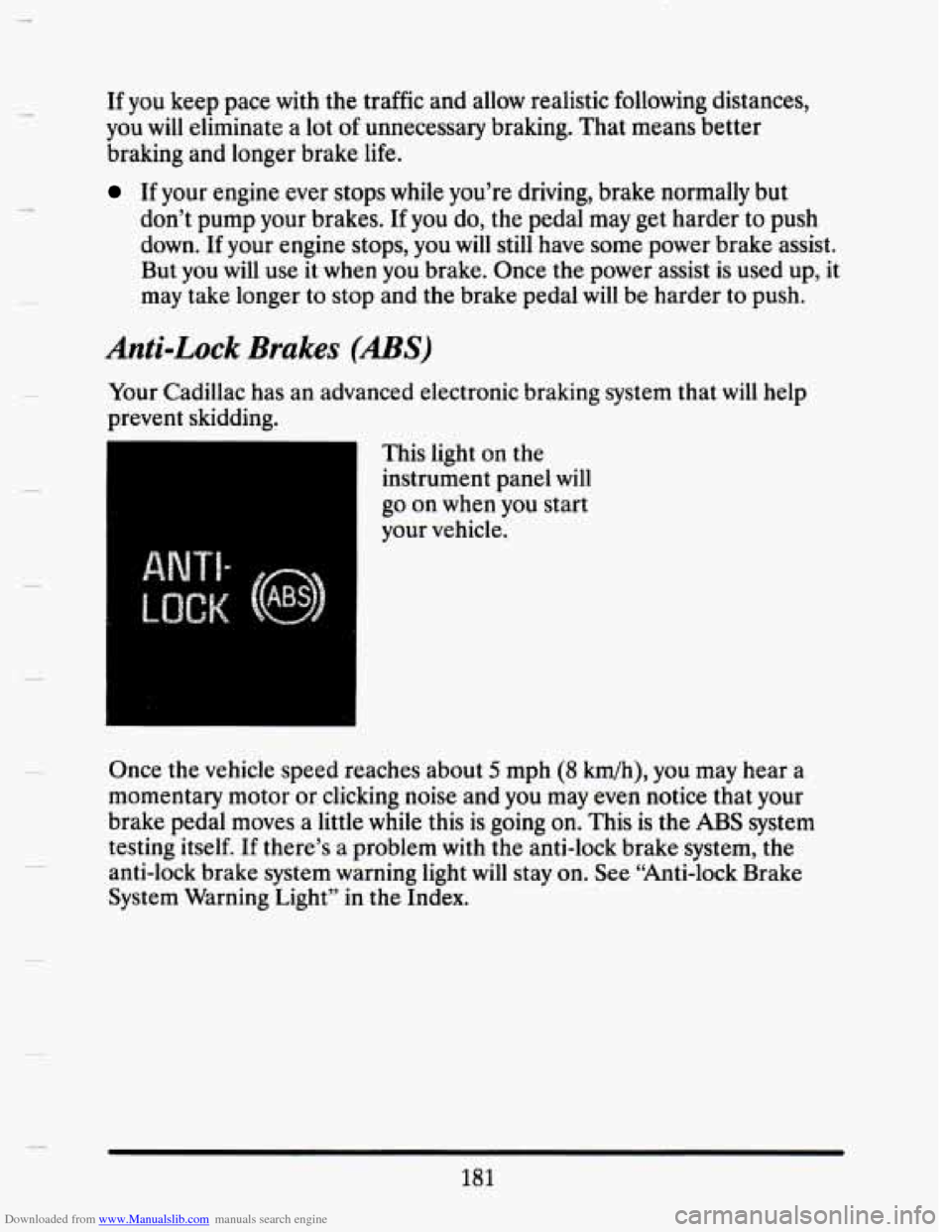
This light on the
instrument panel
will
go on when you start
your vehicle.
Once the vehicle speed reaches about
5 mph (8 krnh), you may hear a
momentary motor
or clicking noise and you may even notice that your
brake pedal moves a little
while this is going on. This is the ABS system
testing itself. If there’s a problem with the anti-lock brake system, the
anti-lock brake system warning light
will stay on. See “Anti-lock Brake
System Warning Light” in the Index.
181
Page 196 of 407
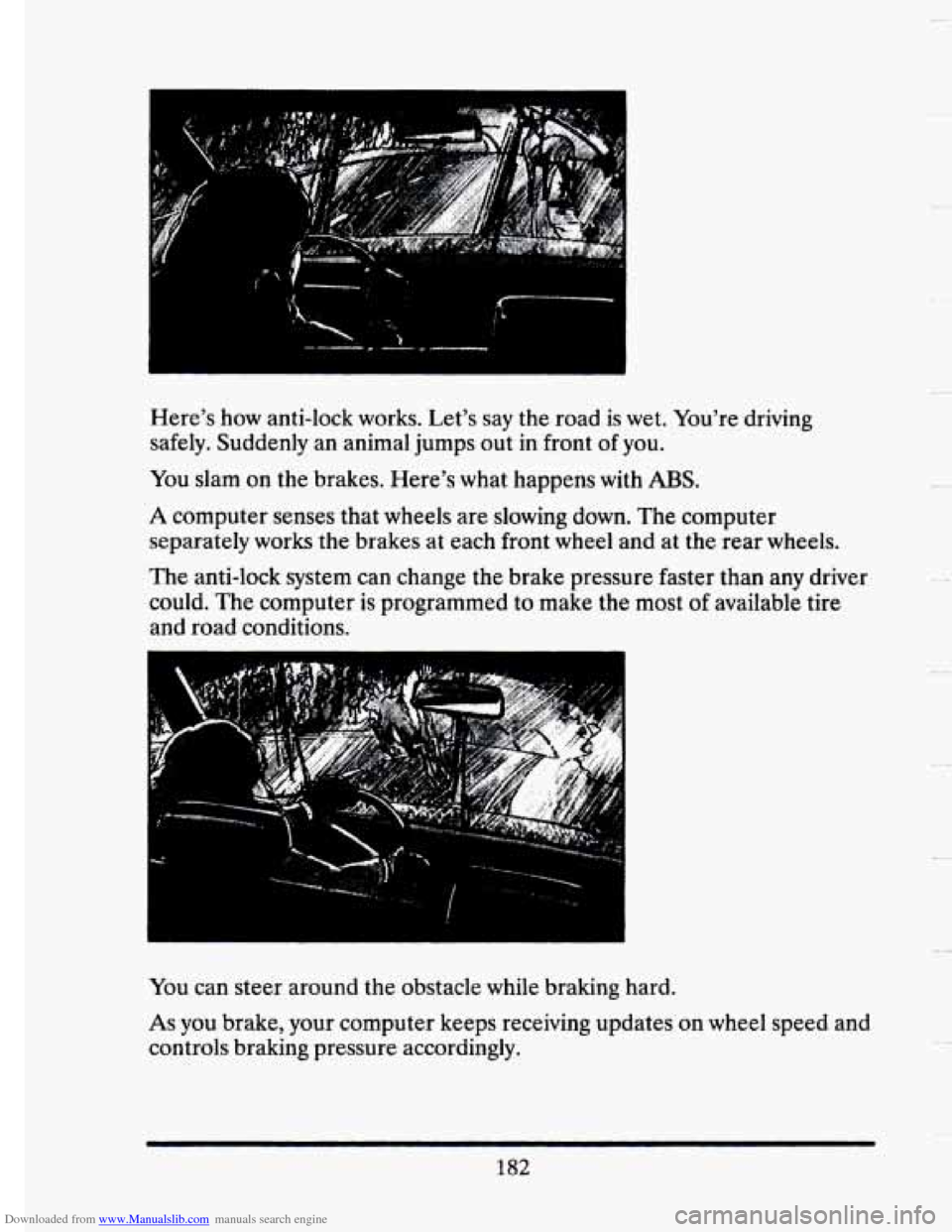
Downloaded from www.Manualslib.com manuals search engine Here’s how anti-lock works. Let’s say the road is wet. You’re driving
safely. Suddenly an animal jumps out in front of you.
You slam on the brakes. Here’s what happens with ABS.
A computer senses that wheels are slowing down. The computer
separately works
the brakes at each front wheel and at the rear wheels.
The anti-lock system can change the brake pressure faster than any driver
could. The computer is programmed to make the most
of available tire
and road conditions.
You can steer around the obstacle while braking hard.
As you brake, your computer keeps receiving updates on wheel speed and
controls braking pressure accordingly.
182
Page 204 of 407
Downloaded from www.Manualslib.com manuals search engine
Of course, traction is reduced when water, snow, ice, gravel, or other
material
is on the road. For safety, you’ll want to slow down and adjust
your driving to these conditions. It is important to slow down on slippery
surfaces because stopping distance
will be longer and vehicle control
more limited.
While driving on
a surface with reduced traction, try your best to avoid
sudden steering, acceleration, or braking (including engine braking by
shifting to a lower gear).
Any sudden changes could cause the tires to
slide. You
may not realize the surface is slippery until your vehicle is
skidding. Learn to recognize warning clues
-- such as enough water, ice 01
packed snow on the road to make a “mirrored surface” -- and slow down
when
you have any doubt.
Remember: Any anti-lock braking system
(ABS) helps avoid only the
braking skid. Steer the way
you want to go.
DRM.NG AT NIGHT
Night driving is more dangerous than day driving. One reason is that
some drivers are
likely to be impaired -- by alcohol or drugs, with night
vision problems, or
by fatigue.
Here
are some tips on night driving.
Drive defensively. Remember, this is the most dangerous time.
190
I
Page 232 of 407
Downloaded from www.Manualslib.com manuals search engine Driving On Grades
Reduce speed and shift to a lower gear before you start down a long or
steep downgrade. If you don’t shift down,
you might have to use your
brakes
so much that they would get hot and no longer work well.
On a long uphill grade, shift down and reduce your speed to around
45
mph (70 km/h) or less to reduce the possibility of engine and transaxle
overheating.
If your trailer weighs more than 1,000 pounds (450 Kg) and you have an
automatic transaxle with Overdrive, you may want to drive
in “3” instead
of Overdrive
Parking on Hills
You really should not park your vehicle, with a trailer attached, on a hill.
If something goes wrong, your rig could start to move. People can be
injured, and both your vehicle and the trailer can be damaged.
But if
you ever have to park your rig on a hill, here’s bow to do it:
1. Apply your regular brakes, but don’t shift into “P” (Park) yet.
2. Have someone place chocks under the trailer wheels.
3. When the wheel chocks are in place, release the regular brakes until
the chocks absorb the load.
4. Reapply the regular brakes. Then shift into “P” (Park) firmly and
apply your parking brake.
5. Release the regular brakes.
When You Are Ready to Leave Afler Parking on a Hill
1. Apply your regular brakes and hold the pedal down while you:
Start your engine;
Shift into a gear; and
Be sure the parking brake has released.
2. Let up on the brake pedal.
3. Drive slowly until the trailer is clear of the chocks.
c
4. Stop and have someone pick up and store the chocks.
218
Page 315 of 407
Downloaded from www.Manualslib.com manuals search engine F
P
P
P
c
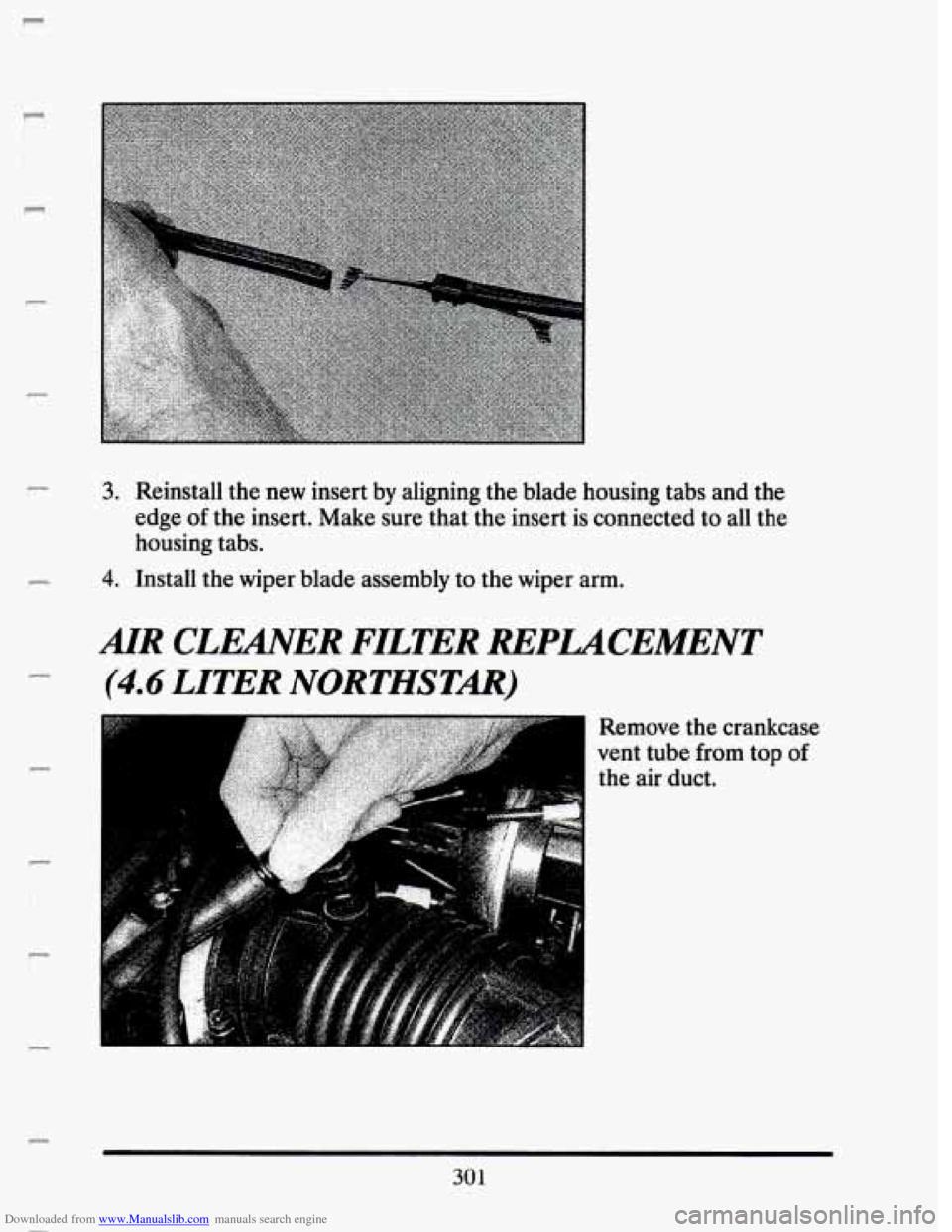
3. Reinstall the new insert by aligning the blade housing tabs and the
edge of the insert.
Make sure that the insert is connected to all the
housing tabs.
4. Install the wiper blade assembly to the wiper arm.
AIR CLEANER FILTER REPLACEMENT
(4.6 LITER NORTHSTAR)
Remove the crankcase
vent tube from top
of
the air duct.
P
301
Page 317 of 407
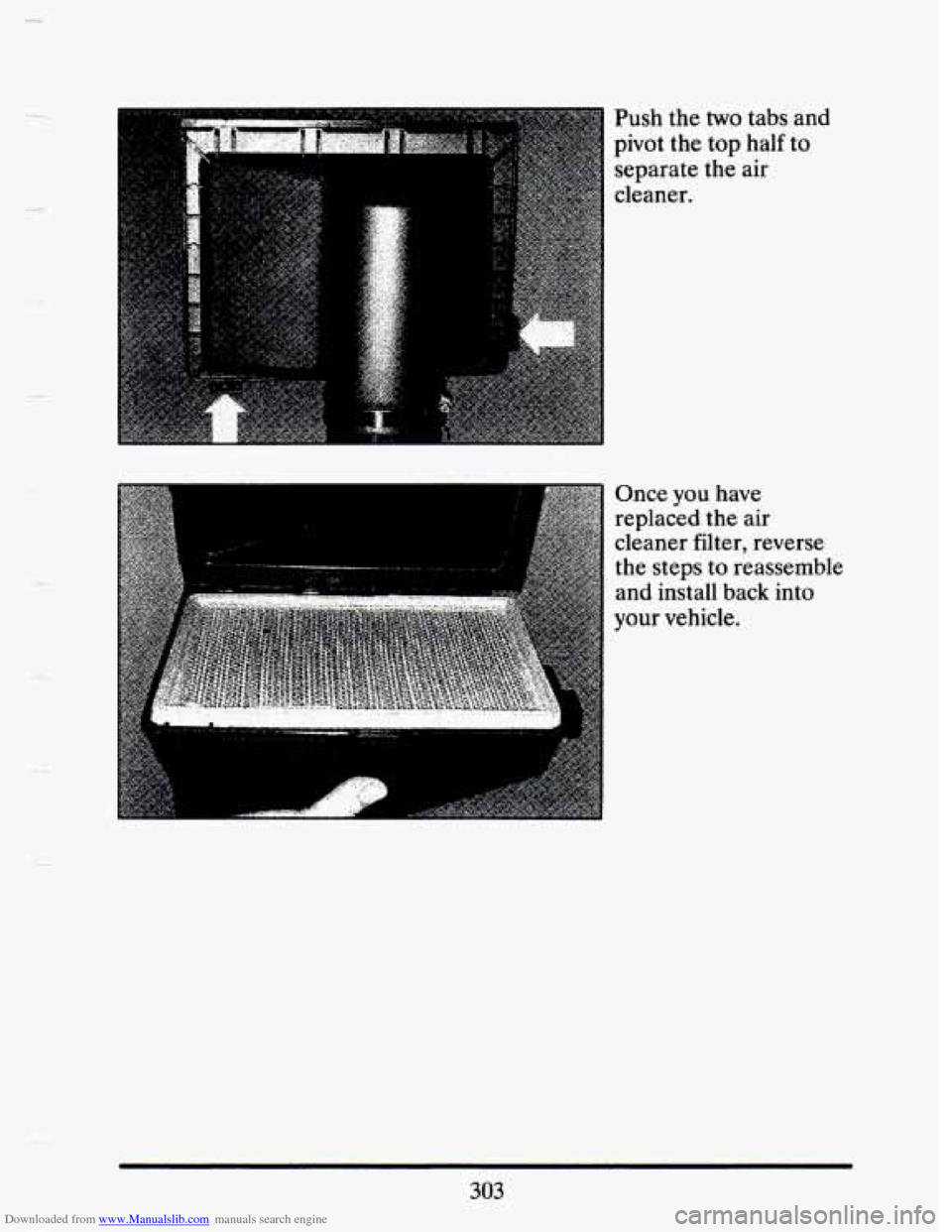
Downloaded from www.Manualslib.com manuals search engine Push the two tabs and
pivot the top half
to
separate the air
cleaner.
cleaner
filter, reverse
I
Once you nave
, replaced the air
the steps
to reassemble
and install back into
your vehicle.
303