Page 9 of 407
Downloaded from www.Manualslib.com manuals search engine For the 1948 model, Cadillac
introduced
the
which set the trend in autonlotive
styling for nearly
two decades. This
was followed by the 1949 model with
the two door hardtop Coupe DeVille
and
the modern overhead valve,
high compression
V8 engine.
Engineering innovations, con-
veniences and styling dominated the
'50s and '60s. Cruise control, auto-
matic climate control,
tilt and
telescoping steering wheels, twilight
sentinel and four door hard tops all
debuted in these years. In
1957 the
Eldorado Brougham featured ad-
vances such as air suspension, mem-
ory seat, automatic electric door
locks, transistor radio,
a brushed stainless steel
roof and
low profile
tires.
r' , The .. . . : ... . ...,:
t prado,l introduced in
1953, was redesigned for 1967 as the
first front wheel drive personal lux-
ury car.
The 472 cu. in. V8 engine
used in all Cadillacs in
1968 and
1969 was enlarged to 500 cu. in. for
all 1970 Eldorados.
An Air Cushion Restraint Sys-
tem (airbag) was available for 1974,
1975 and
1976 Cadillacs.
Analog Electronic Fuel Injec-
tion was available, on
1975 Cadillacs
and was standard on the new inter-
national size
7976 Seville. In 1978,
the Trip Computer option incor-
porated an on-board microprocessor.
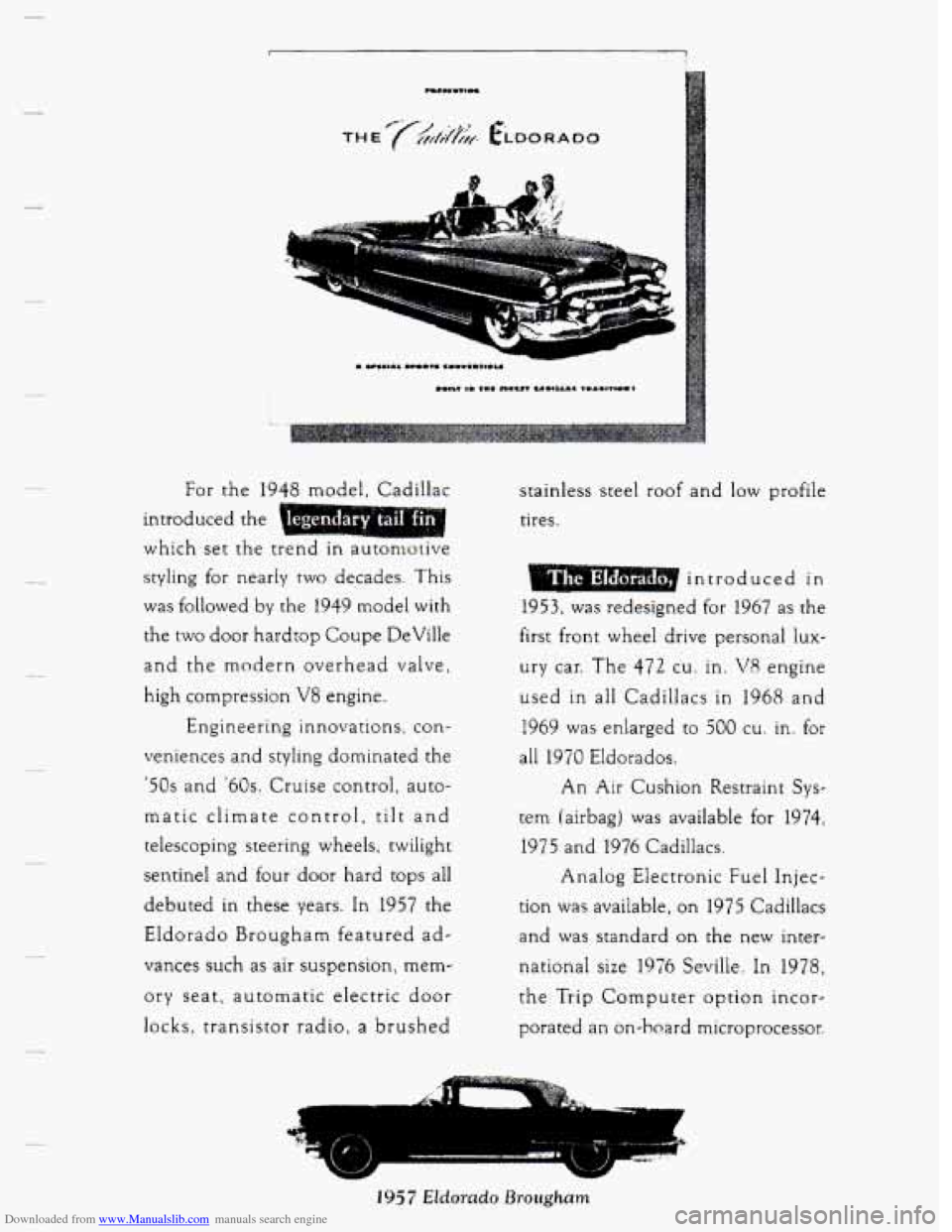
1957 Eldorado Brougham
Page 323 of 407
Downloaded from www.Manualslib.com manuals search engine STS recommended tire size is:
GA Performance Blackwall (P225/60ZR 16)
Don’t forget your compact spare tire. It should be at 60 psi (420 kPa).
How to Check Use a good quality pocket-type gage to check tire
pressure. Simply looking at the tires
will not tell you the pressure,
especially if you have radial tires
-- which may look properly inflated even
if they’re underinflated.
If your tires have valve caps, be sure to put them back on. They help
prevent leaks
by keeping out dirt and moisture.
Tire Inspection and Rotation
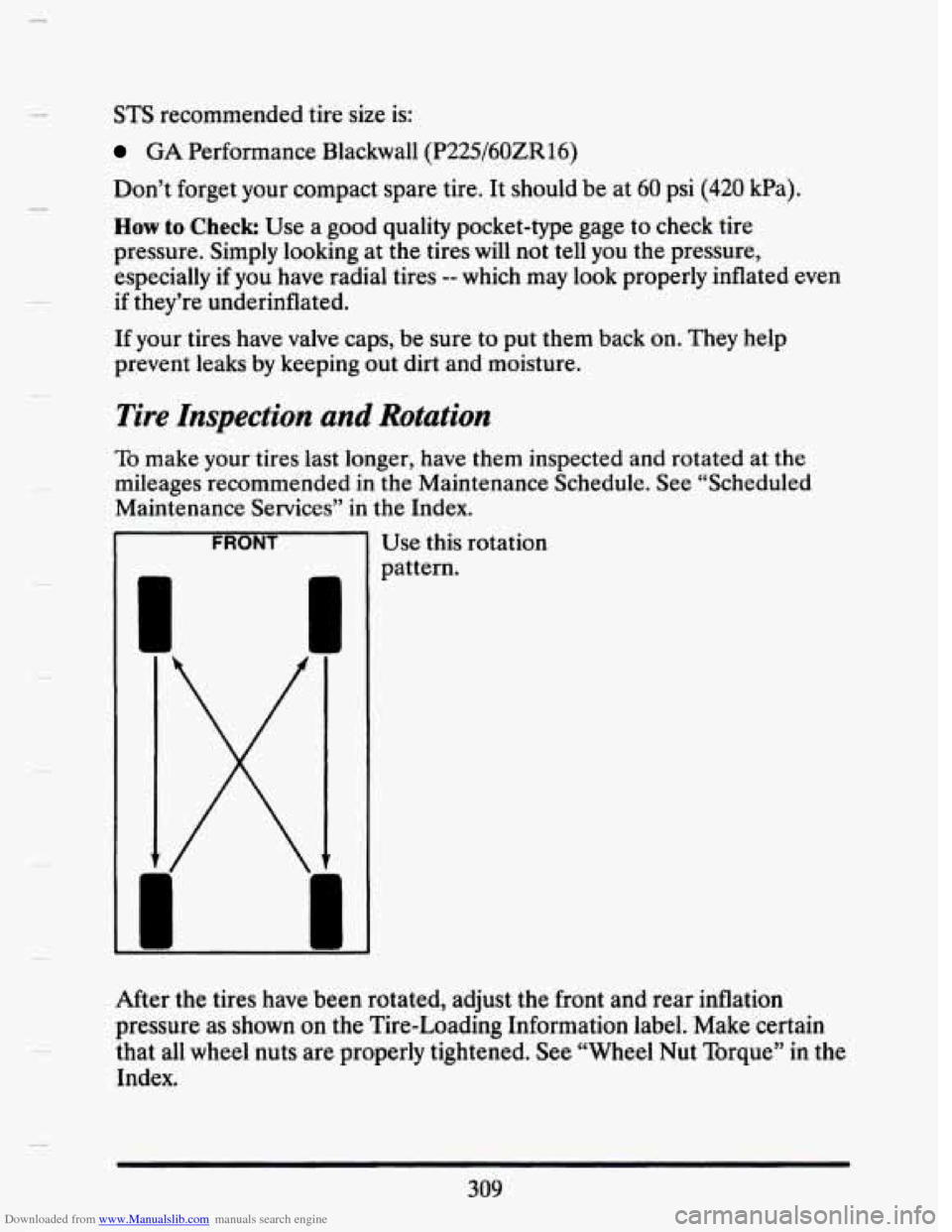
To make your tires last longer, have them inspected and rotated at the
mileages recommended
in the Maintenance Schedule. See “Scheduled
Maintenance Services”
in the Index.
FRONT Use this rotation
pattern.
After the tires have been rotated, adjust the front and rear inflation
pressure as
shown on the Tire-Loading Information label. Make certain
that
all wheel nuts are properly tightened. See “Wheel Nut Torque’’ in the
Index.
309
Page 324 of 407
Downloaded from www.Manualslib.com manuals search engine A CAUTION:
Rust or dirt on a wheel, or on the parts to which it is fastened,
can make wheel nuts become loose after a time. The wheel could
come
off and cause an accident. When you change a wheel,
remove any rust or
dirt from places where the wheel attaches to
the vehicle. In an emergency, you can use a cloth or a paper
towel to do this; but be sure to use a scraper or wire brush later,
if you need to, to get all the rust or dirt off. (See “Changing a
Flat Tire” in the Index.)
When It3 Time for New Tires
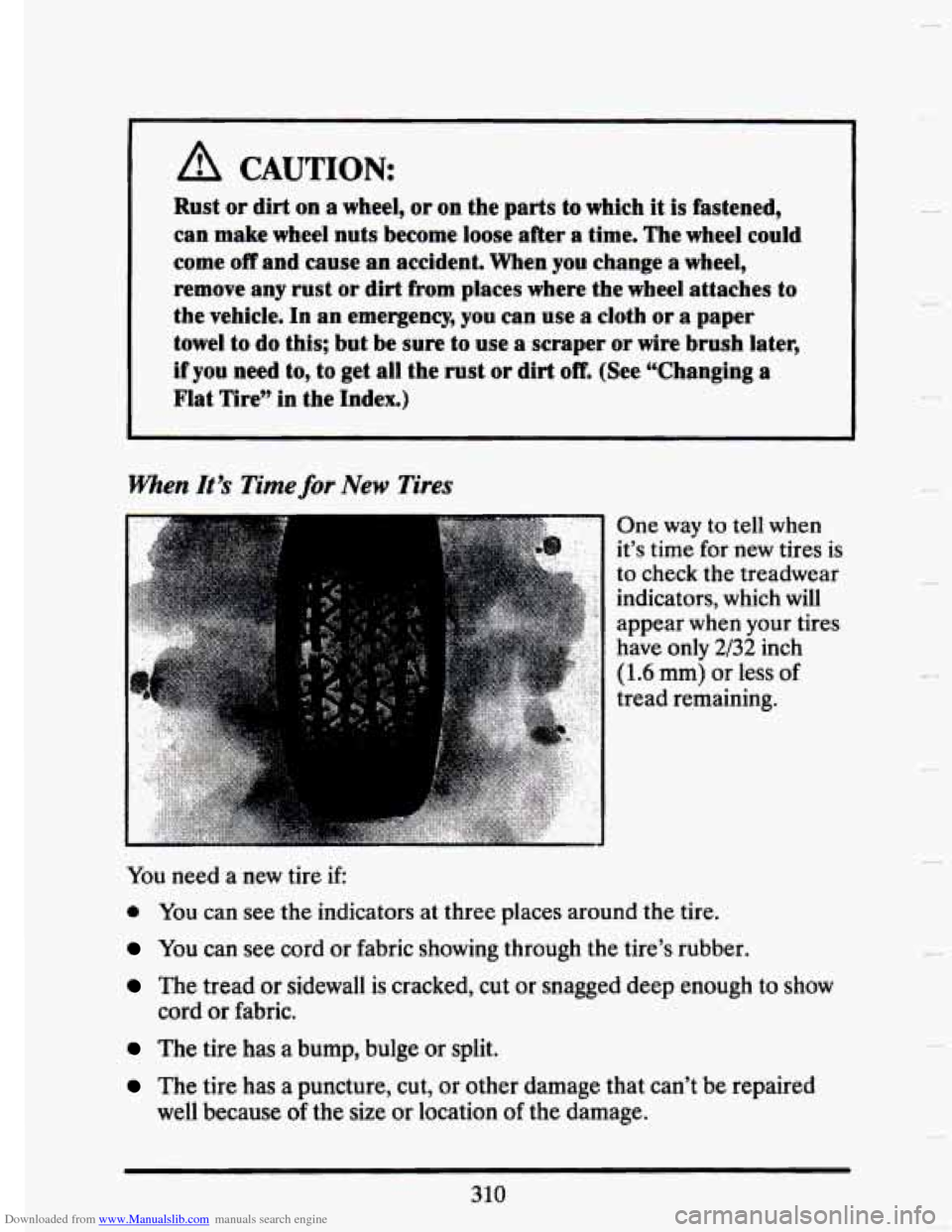
One way to tell when
it’s time for
new tires is
to check the treadwear
indicators, which
will
appear when your tires
have only
2/32 inch
(1.6 mm) or less of
tread remaining.
You need a new tire
if
0 You can see the indicators at three places around the tire.
You can see cord or fabric showing through the tire’s rubber.
The tread or sidewall is cracked, cut or snagged deep enough to show
cord or fabric.
The tire has a bump, bulge or split.
The tire has a puncture, cut, or other damage that can’t be repaired
well because of the size or location of the damage.
L
c
310
Page 325 of 407
Downloaded from www.Manualslib.com manuals search engine -
Buying New Tires
To find out what kind and size of tires you need, look at the Tire-Loading
Information label.
The tires installed
on your vehicle when it was new had a Tire
Performance Criteria Specification
(TPC Spec) number on each tire’s
sidewall. When you get new tires, get ones with that same
TPC Spec
number. That way, your vehicle will continue to have tires that are
designed to give proper endurance, handling, speed rating, traction, ride
and other things during normal service
on your vehicle. If your tires have
an all-season tread design, the
TPC number will be followed by a “MS”
(for mud and snow).
If you ever replace your tires with
those not having a TPC Spec number,
make sure they are the same size, load range, speed rating and
construction type
(bias, bias-belted or radial) as your original tires.
A CAUTION:
Mixing tires could cause you to lose control while driving. If you
mix tires of different sizes or types (radial and bias-belted
tires), the vehicle
may not handle properly, and you could have a
crash. Be sure to use the same size and type tires on all four
wheels.
It’s
all right to drive with your compact spare, though. It was
developed for use
on your vehicle.
Uniform Tire Quality Grading
The following information relates to the system developed by the United
States National Highway Traffic Safety Administration which grades tires
by treadwear, traction and temperature performance. (This applies only
to vehicles sold
in the United States.)
311