1993 CADILLAC SEVILLE coolant level
[x] Cancel search: coolant levelPage 152 of 407
Downloaded from www.Manualslib.com manuals search engine BATTERY VOLTS HIGH
This message shows that the electrical charging system is overcharging,
(more than 16 volts). To avoid being stranded have the electrical system
checked by your Cadillac dealership at your earliest convenience. You can
reduce the charging overload
by using the accessories. Turn on the lights,
radio, set the Climate Control on
“AUTO” and the fan speed on “HI”
and turn the rear window defogger on. You can monitor battery voltage
on the Driver Information Center by toggling the “INFORMATION”
button. When the engine is running, the normal range
is 11.5 to 15.5
volts.
c
BATTERY VOLTS LOW
This message will appear when the electrical system is charging less than
10 volts, or if the battery has been drained. If this message appears
immediately after starting it is possible that the generator can still
recharge the battery. The battery should recharge after driving a few
miles and the message should go out. If this message appears while
driving or after starting your vehicle and stays on, have it checked
immediately to determine the cause
of this problem. To help the
generator recharge the battery quickly,
you can reduce the load on the
electrical system by turning
off your accessories. You can monitor battery
voltage on the Driver Information Center by toggling the
“INFORMATION’’ button. The normal range is
11.5 to 15.5 volts.
CHANGE TRANS FLUID (Northstar Only)
This message will appear when it is time to replace the transaxle fluid.
See your maintenance booklet
for the proper fluid and change intervals.
CHECK BRAKE FLUID
This message is displayed to inform the driver that the brake reservoir
fluid level is low. Check the brake reservoir level and add as needed.
Have the brake system serviced by a Cadillac technician as soon as
possible.
If the brake warning light is on, follow the directions in that
section.
CHECK COOLANT LEVEL (Northstar Only)
This message will appear when there is a low level of engine coolant.
Have the cooling system serviced by a Cadillac technician as soon as
possible.
138
I
. -’
L
c
Page 153 of 407
Downloaded from www.Manualslib.com manuals search engine CHECK FUEL GAGE
This message will appear when your fuel supply is less than 4 gallons and
your display
is turned off.
CHECK OIL LEVEL (Northstar Only)
This message will appear when your engine oil is approximately a quart
low. If this message is displayed, check the
oil and add as needed.
CHANGE OIL SOON
This message will appear when your engine oil is less than 10 percent or
the mileage since
the last oil change is more than 6750 miles.
CHANGE ENGINE OIL
This means that the life of your engine oil has expired and it should be
changed immediately. See engine oil and filter recommendations
in the
Maintenance Schedule. After an oil change, the Oil Life Index must be
reset. See “Oil Life Indicator”
in the index on how to reset it.
ENGINE COOLANT HOT IDLE ENGINE
This message will appear when your engine coolant temperature is over
126°C (248°F). To avoid added strain on a hot engine, turn off your
Climate Control system and stop and allow your vehicle to idle until
it
cools down or the message is removed. If it does not cool down, turn off
your engine and have it serviced before driving it again. Severe engine
damage can result from an overheated engine. See “Engine Overheating”
in the Index.
ENGINE HOT - A/C COMPRESSOR OFF
This message will appear when the Climate Control is in “Auto” or
Defrost and the engine coolant is hotter than
the normal operating
temperature. To avoid added strain on a hot engine the air conditioning
compressor is automatically turned
off. When that happens, air
conditioned air
is not delivered. If the coolant temperature returns to
normal, you must select
“AUTO”, “DEFOG” or Defrost to return to a
normal A/C compressor operation.
FUEL LEVEL VERY LOW
This message serves as a warning that the fuel level in your tank is
critically low. It means you shwld stop for fuel immediately.
139
Page 250 of 407
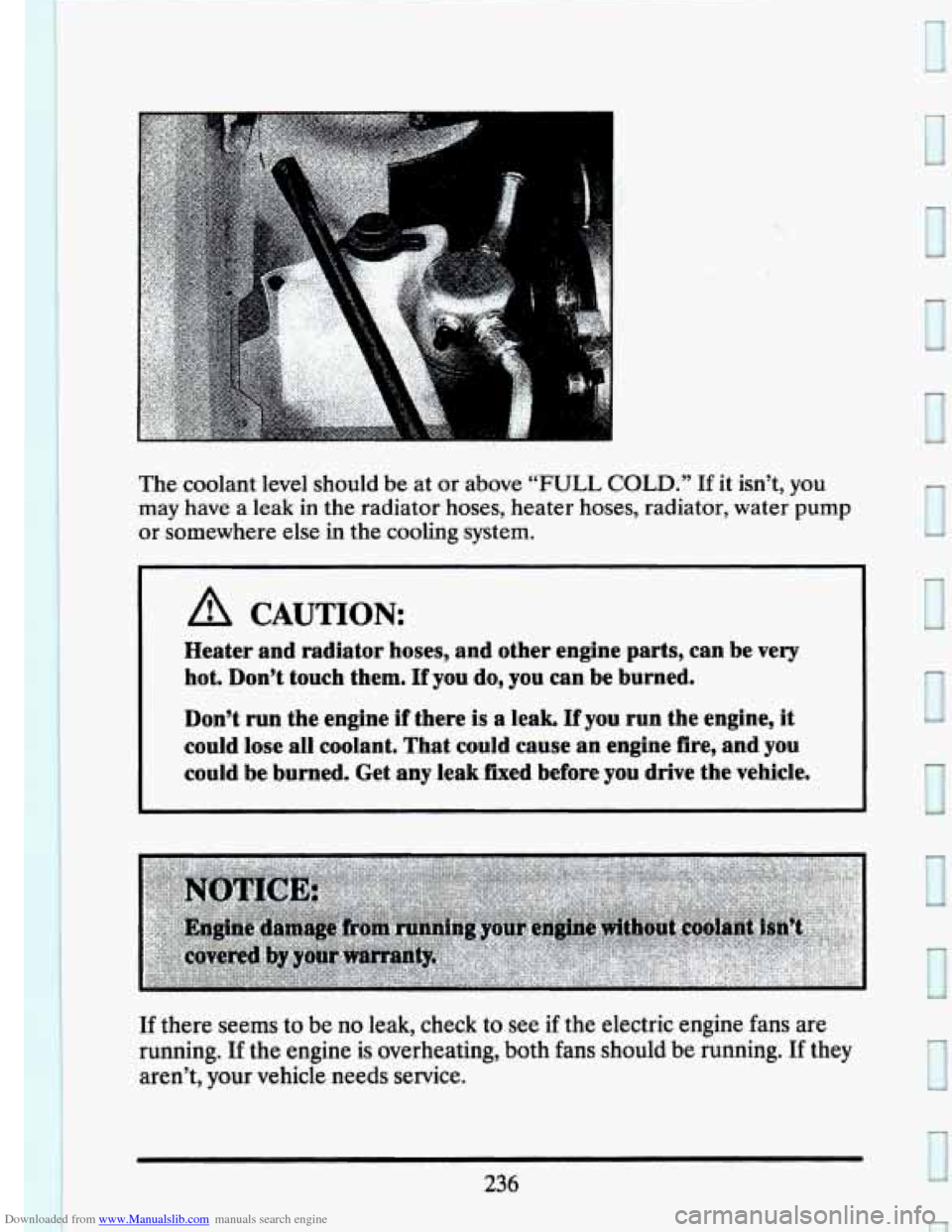
Downloaded from www.Manualslib.com manuals search engine The coolant level should be at or above “FULL COLD.” If it isn’t, you
may have a
leak in the radiator hoses, heater hoses, radiator, water pump
or somewhere else
in the cooling system.
I
A CAUTION
Heater and radiator hoses, and other engine parts, can be very
hot. Don’t touch them.
If you do, you can be burned.
Don’t run the engine
if there is a leak. If you run the engine, it
could lose all coolant. That could cause an engine fire, and you
could be burned. Get any leak
fixed before you drive the vehicle.
If there seems to be no leak, check to see if the electric engine fans are
running.
If the engine is overheating, both fans should be running. If they
aren’t, your vehicle needs service.
236
Page 251 of 407
Downloaded from www.Manualslib.com manuals search engine L ..
r-
r
r
t
How to Add Coolant to the Coolant Recovery Tank
If you haven’t found a problem yet, but the coolant level isn’t at or above
“FULL COLD,” add a 50/50 mixture of clean water (preferably distilled)
and
a proper antifreeze at the coolant recovery tank. (See “Engine
Coolant” in the Index for more information about the proper coolant
mix.)
A CAUTION
Adding only plain water to your cooling system can be
dangerous. Plain water, or some other liquid like alcohol, can
boil before the proper coolant
mix will. Your vehicle’s coolant
warning system is set for the proper coolant
mix. With plain
I water or the wrong mix, your engine could get too hot but you
~ wouldn’t get the overheat warning. Your engine could catch fire
~ and you or others could be burned. Use a 50/50 mix of clean
~ water and a proper antifreeze.
r
r 237
Page 256 of 407
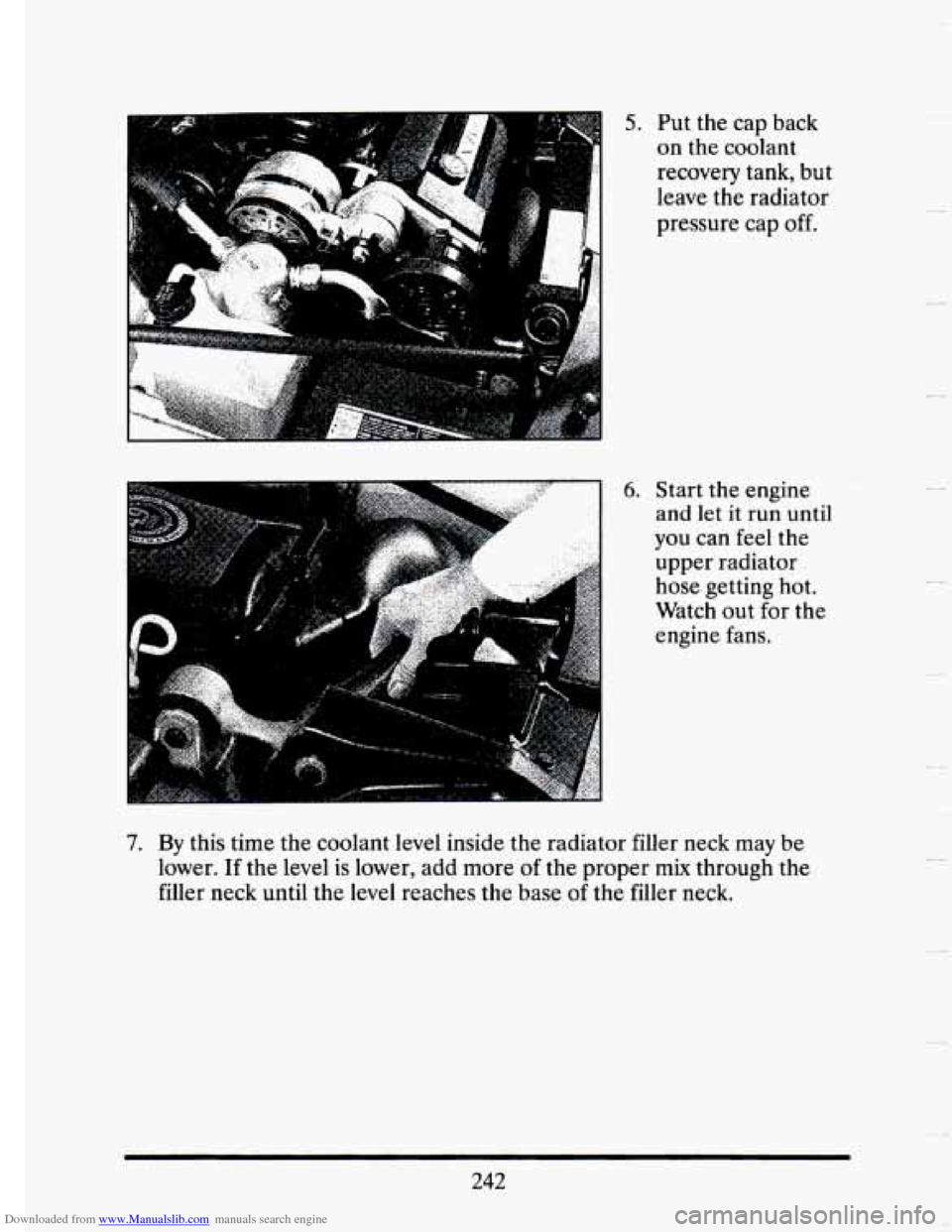
Downloaded from www.Manualslib.com manuals search engine 5. Put the cap back
on the coolant
recovery tank, but
leave the radiator
pressure cap
off.
you can feel the
upper radiator
hose getting hot.
Watch out for the
engine fans.
7. By this time the coolant level inside the radiator filler neck may be
lower.
If the level is lower, add more of the proper mix through the
filler neck until the level reaches the base
of the filler neck.
242
..
Page 258 of 407
Downloaded from www.Manualslib.com manuals search engine I A CAUTION
An electric fan under the hood can start up even when the
engine
is not running and can injure you. Keep hands, clothing
and tools
away from any underhood electric fan.
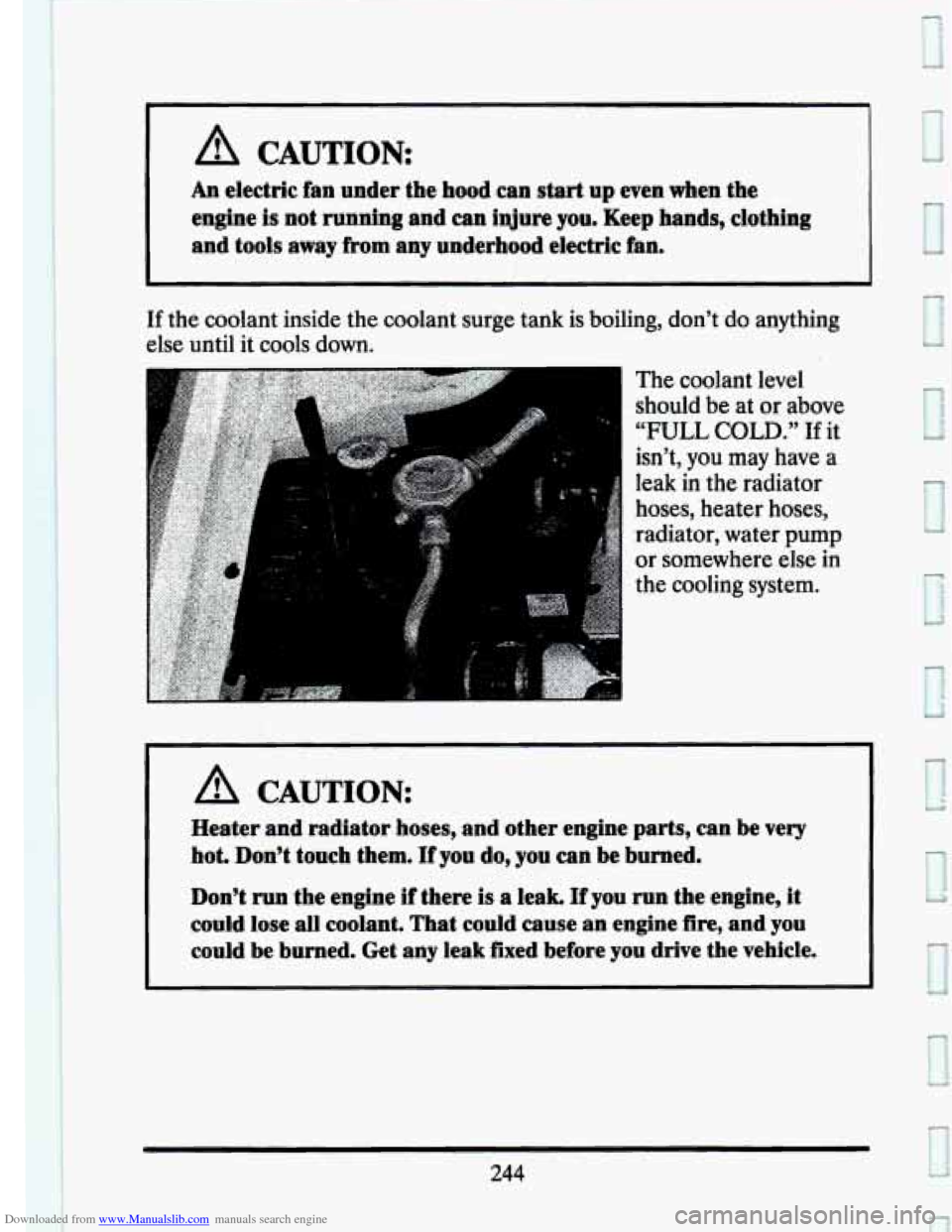
If the coolant inside the coolant surge tank is boiling, don’t do anything
else until it cools
down.
The coolant level
should be at or above
“FULL COLD.” If it
isn’t,
you may have a
leak in the radiator
hoses, heater hoses,
radiator, water pump
or somewhere else in
the cooling
system.
A CAUTION:
Heater and radiator hoses, and other engine parts, can be very
hot. Don’t touch them.
If you do, you can be burned.
Don’t
run the engine if there is a leak If you run the engine, it
could lose
all coolant. That could cause an engine fire, and you
could be burned. Get any leak fixed before you drive the vehicle.
244
Page 259 of 407
Downloaded from www.Manualslib.com manuals search engine ...-
c
If there seems to be no leak, check to see if the electric engine fans are
running. If the engine
is overheating, both fans should be running. If they
aren’t, your vehicle needs service.
How to Add Coolant to the Coolant Surge Tank
If you haven’t found a problem yet, but the coolant level isn’t at or above
“FULL COLD,” add a 50/50 mixture of clean water (preferably distilled)
and a proper antifreeze at
the coolant recovery tank. (See “Engine
Coolant”
in the Index for more information about the proper coolant
mix.)
A CAUTION
Adding only plain water to your cooling system can De
dangerous. Plain water, or some other liquid like alcohol, can
boil before the proper coolant mix will.
Your vehicle’s coolant
warning system is set
for the proper coolant mix. With plain
water
or the wrong mix, your engine could get too hot but you
wouldn’t get the overheat warning. Your engine could catch fire
and you or others could be burned. Use a
50/50 mix of clean
water and
a proper antifreeze.
245
Page 263 of 407
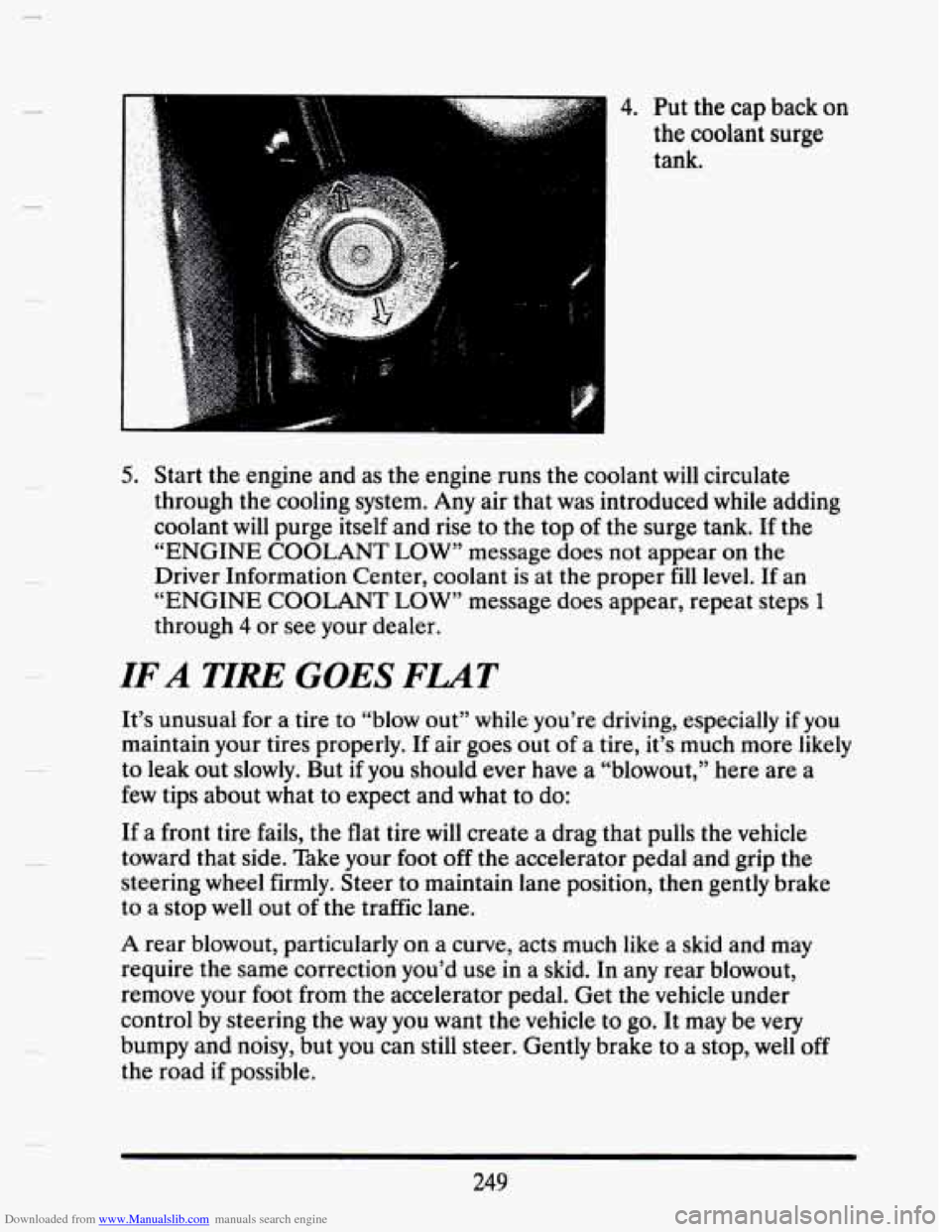
Downloaded from www.Manualslib.com manuals search engine . : 4. Put the cap back on
the coolant
surge
tank.
5. Start the engine and as the engine runs the coolant will circulate
through the cooling system. Any air that was introduced while adding
coolant
will purge itself and rise to the top of the surge tank. If the
“ENGINE COOLANT
LOW” message does not appear on the
Driver Information Center, coolant is at the proper
fill level. If an
“ENGINE
COOLANT LOW” message does appear, repeat steps 1
through 4 or see your dealer.
IFA TIRE GOES FLAT
It’s unusual for a tire to “blow out” while you’re driving, especially if you
maintain your tires properly. If air goes out of a tire, it’s much more likely
to leak out slowly. But if you should ever have a “blowout,” here are a
few tips about what to expect and what
to do:
If a front tire fails, the flat tire will create a drag that pulls the vehicle
toward that side. Take your foot off the accelerator pedal and grip the
steering
wheel firmly. Steer to maintain lane position, then gently brake
to a stop
well out of the traffic lane.
A rear blowout, particularly on a curve, acts much like a skid and may
require the same correction you’d use in a skid. In any rear blowout,
remove your foot from the accelerator pedal. Get the
vehicle under
control by steering the way you want the vehicle to
go. It may be very
bumpy and noisy, but you can still steer. Gently brake to a stop,
well off
the road if possible.
3
249