1993 CADILLAC SEVILLE night vision
[x] Cancel search: night visionPage 204 of 407
Downloaded from www.Manualslib.com manuals search engine
Of course, traction is reduced when water, snow, ice, gravel, or other
material
is on the road. For safety, you’ll want to slow down and adjust
your driving to these conditions. It is important to slow down on slippery
surfaces because stopping distance
will be longer and vehicle control
more limited.
While driving on
a surface with reduced traction, try your best to avoid
sudden steering, acceleration, or braking (including engine braking by
shifting to a lower gear).
Any sudden changes could cause the tires to
slide. You
may not realize the surface is slippery until your vehicle is
skidding. Learn to recognize warning clues
-- such as enough water, ice 01
packed snow on the road to make a “mirrored surface” -- and slow down
when
you have any doubt.
Remember: Any anti-lock braking system
(ABS) helps avoid only the
braking skid. Steer the way
you want to go.
DRM.NG AT NIGHT
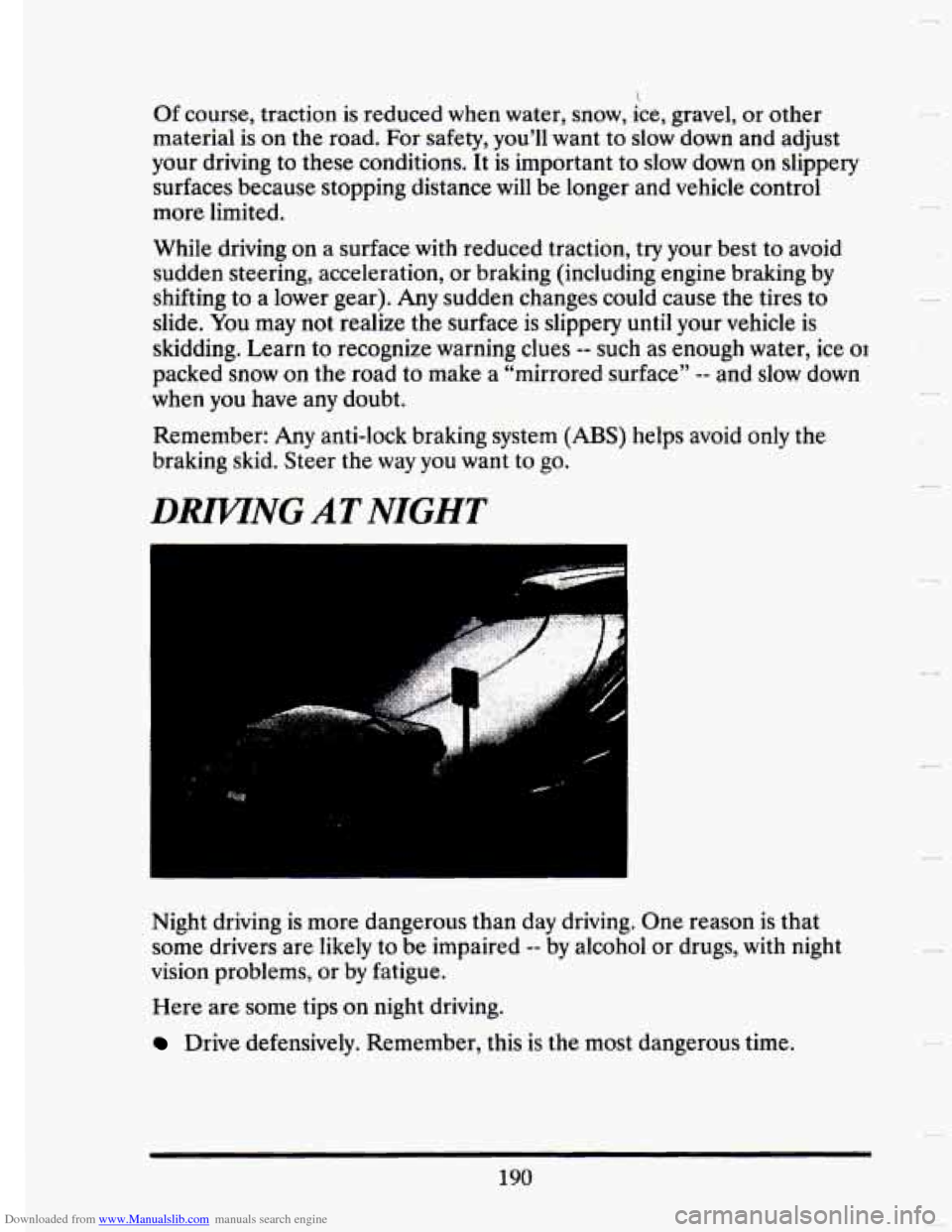
Night driving is more dangerous than day driving. One reason is that
some drivers are
likely to be impaired -- by alcohol or drugs, with night
vision problems, or
by fatigue.
Here
are some tips on night driving.
Drive defensively. Remember, this is the most dangerous time.
190
I
Page 205 of 407
Downloaded from www.Manualslib.com manuals search engine 0
0 0
0
0
Don’t drink and drive. (See “Drunken Driving” in the Index for more
on this problem.)
Adjust your inside rearview mirror to reduce the glare from headlights
behind
you.
Since you can’t see as well, you may need to slow down and keep more
space between you and other vehicles. It’s hard to tell how fast the
vehicle ahead is going just by looking at its taillights.
Slow down, especially on higher speed roads. Your headlights can light
up only
so much road ahead.
In remote areas, watch for animals.
If you’re tired, pull off the road in a safe place and rest.
Night Vision
No one can see as well at night as in the daytime. But as we get older
these differences increase. A 50-year-old driver may require at least twice
as much light to see the same thing at night as a 20-year-old.
What you
do in the daytime can also affect your night vision. For
example, if you spend the day in bright sunshine you are wise to wear
sunglasses. Your eyes
will have less trouble adjusting to night.
But
if you’re driving, don’t wear sunglasses at night. They may cut down
on glare from headlights, but they also make a lot
of things invisible that
should remain visible
- such as parked cars, obstacles, pedestrians, or
even trains blocking railway crossings. You may want to put on your
sunglasses after you have pulled into a brightly-lighted service or
refreshment area. Eyes shielded from that glare may adjust more quickly
to darkness back
on the road. But be sure to remove your sunglasses
before you leave the service area.
You can be temporarily blinded by approaching lights. It can take a
second
or two, or even several seconds, for your eyes to readjust to the
dark. When
you are faced with severe glare (as from a driver who doesn’t
lower the high beams, or a vehicle with misaimed headlights), slow down
a little. Avoid staring directly into the approaching lights. If there is a line
of opposing traffic, make occasional glances over the line
of headlights to
make certain that
one of the vehicles isn’t starting to move into your lane.
191
Page 206 of 407
Downloaded from www.Manualslib.com manuals search engine Once YOU are past the bright lights, give your eyes time to readjust before
resuming speed.
High Beams
If the vehicle approaching you has its high beams on, signal by flicking
yours to high and
then back to low beam. This is the usual signal to lower
the headlight beams. If the other driver still doesn't lowcr thc beams,
resist the temptation to put your high beams on. This only makcs two
half-blinded drivers.
When you follow another
vehiclc on ii Irt'CHiI! or h1gh;n. uw I(VH
beams. True, most vehicles now have d;wnight mirror that cn;rblc rhc
driver to reduce glare. But outside mirrbrs arc' not of thi< typc i\d high
beams from behind can bother the driver ahcad.
A Few More Night Driving Suggestions
Keep your windshield and all the glass on your vehicle clean -- inside and
out. Glare at night is made much worse
by dirt on the glass. Even the
inside
of the glass can build up a film caused by dust. Tobacco smoke also
makes inside glass surfaces
very filmy and can be a vision hazard if it's left
there.
Dirty glass makes lights dazzle and flash more than clean glass would,
making the pupils
of your eyes contract repeatedly. You might even want
to keep a cloth and some glass cleaner
in your vehicle if you need to clean
your glass frequently.
Remember that your headlights light up far less
of a roadway when you
are in
a turn or curve.
Keep your eyes moving; that way, it's easier to pick out dimly lighted
objects.
Just as your headlights should be checked regularly for proper aim, so
should your eyes be examined regularly. Some drivers suffer from night
blindness
-- the inability to see in dim light -- and aren't even aware of it,
192
Page 217 of 407
Downloaded from www.Manualslib.com manuals search engine Then here are some tips:
Make sure your vehicle is well ventilated, with a comfortably cool
Keep your eyes moving. Scan the road ahead and to the sides. Check
interior.
your rearview mirrors frequently and your instruments from time
to
time. This can help you avoid a fixed stare.
Wear good sunglasses in bright light. Glare can cause drowsiness. But
don't wear sunglasses at night. They will drastically reduce your
overall vision at the
very time you need all the seeing power you have.
If you get sleepy, pull off the road into a rest, service, or parking area
and take a nap, get some exercise,
or both. For safety, treat drowsiness
on the highway as an emergency.
As in any driving situation, keep pace with traffic and allow adequate
following distances.
HILL AND MOUNTMN ROADS
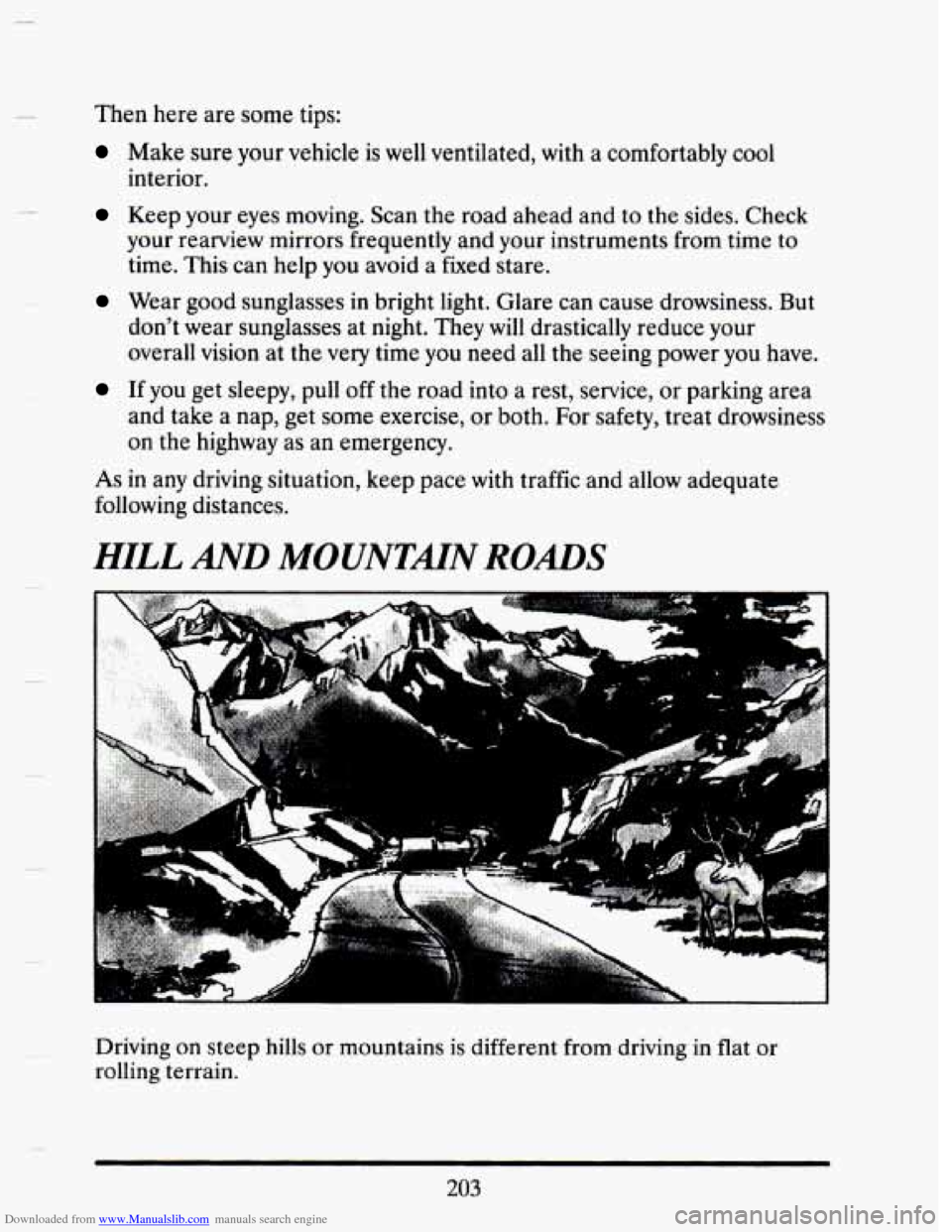
Driving on steep hills or mountains is different from driving in flat or
rolling terrain.
203
Page 367 of 407
Downloaded from www.Manualslib.com manuals search engine OUR COMMITMENT TO YOUR SATISFACTION
c We are committed to providing you the finest ownership experience in the
world, starting the moment you take delivery
of your new Cadillac.
Cadillac offers another major step toward your continued satisfaction
... with
Cadillac Roadside Service. Roadside Service is your key to peace of mind
ownership--one that covers you on
the road, far from home, all day and
night, and during the weekend. Roadside Service represents the spirit of
luxury leadership at Cadillac Motor Car Division. We hope the need never
arises,
but if it does, Roadside Service can help.
How Can Roadside Service Help You?
Cadillac Roadside Service with a staff of phone advisors trained in Cadillac
service excellence offers assistance exclusively to Cadillac owners.
In many
cases, the advisor can quickly help resolve your car problem over the phone.
If the phone advisor determines that it may be possible to repair your car at
roadside and
a technician is available, the advisor will arrange for an
experienced Cadillac dealership technician to contact you, and if appropri-
ate, travel to your location
in a specially equipped vehicle and attempt to
repair your car on-site. The Roadside Service vehicle contains the necessary
tools
and parts to complete most minor repairs to get you back on the road.
HtbirJsidc Scnicc. phonc idvtsors and tcchnicians arc trained by Cadillacand
;Lrc 1mIII.u with )(bur c.u. u hlch providcs a level of service knowledge
uw,rll) fawn3 orll) .rl )&Bur ( 'ddlx I )c;rlcrship. Because Roadside Service
msirh t.dilldc owners uulusiwl~. pur c;rll always receives top priority and
ImInt.Jl.~Ic Lab tttw 5htIulJ )~BU rcqulrc a tow truck, locksmith, hotel
,~~~~~II~II~,~.I~~~~~~~. or rbttlc*r h11,tI W~IC'CS on a moments notice, Roadside
hc-n ILC udl Io~,tk ,rnJ rruhc thc irrrangcmcnts for you promptly.
1
Page 399 of 407
Downloaded from www.Manualslib.com manuals search engine Mirrors. Front Seat Vanity ........................... 117
Mirrors. Inside Daymight Rearview ................... 115
Mirrors. Outside ................................... 118
Mist. Driving In .................................... 196
Mobile Telephone. Adding A ...................... 155. 326
Mountain Driving .................................. 203
MTBE In Gasoline ................................. 263
Mud. If You’re Stuck In ............................. 260
N
“N” (Neutral) Gear Position .......................... 86
New Vehicle “Break-In” .............................. 79
Night. Driving At ................................... 190
Night Vision ....................................... 191
Notices About Damage ................................ 2
.
Occupant Restraint .................................. 10
Octane Required For Your Car ....................... 262
Odometer ......................................... 127
Odometer And Speedometer ......................... 125
Odometer. Trip .................................... 126
Off (Ignition Key Position) ............................ 80
Off Road Recovery ................................. 186
Oil. Engine ........................................ 269
Oil. When To Change Your Engine .................... 275
Oil Life Indicator ................................... 143
OilQuality ........................................ 273
Oil Thickness (Viscosity) ............................ 274
Operating Record .................. See Maint . Book. p . 44
Operation in Foreign Countries ....................... 264
Outside Air ....................................... 146
Outside Mirrors .................................... 118
Overdrive. Automatic ................................ 86
Overheated Engine. Warning Light For ................ 130
Owner Checks & Services ............ See Maint . Book. p.26
P
“P” (Park) Position .................................. 84
Paint Spotting. Chemical ............................ 323
Park Position ....................................... 84
Park. Shifting Into ................................... 90
10
.
c
..
.
.
.