1993 CADILLAC SEVILLE sensor
[x] Cancel search: sensorPage 47 of 407
Downloaded from www.Manualslib.com manuals search engine GM vehicles is between 9 and 14 mph. However, this velocity threshold
depends
on the vehicle design and may be several miles-per-hour faster
or slower. In addition, this threshold velocity will be considerably higher
if
the vehicle strikes an object such as a parked car which will move and
deform on impact. The air bag is also not designed to inflate in rollovers,
side impacts,
or rear impacts where the inflation would provide no
occupant protection benefit.
In any particular crash, the determination
of whether the air bag should
have inflated cannot be based solely on the level
of damage on the
vehicle(s). Inflation is determined by the angle
of the impact and the
vehicle’s deceleration,
of which vehicle damage is only one indication.
Repair cost is not a good indicator of whether an air bag should have
deployed.
What makes an air bag inflate?
In a frontal or near-frontal impact of sufficient severity, sensors
strategically located on the vehicle detect that the vehicle
is suddenly
stopping as a result
of a crash. These sensors complete an electrical
circuit, triggering a chemical reaction
of the sodium azide sealed in the
inflator.
The reaction produces nitrogen gas, which inflates a cloth bag.
The inflator, cloth bag, and related hardware are all part of the air bag
inflator modules packed inside the steering wheel and in the instrument
panel
in front of the passenger if there is a passenger air bag.
How does an air bag restrain?
In moderate to severe fr,ontal or near-frontal collisions, even belted
occupants can contact the steering wheel or the instrument panel. The air
bag supplements the protection provided by safety belts. Air bags
distribute the force
of the impact more evenly over the occupant’s upper
body, stopping the occupant more gradually. But air bags would not
provide protection in many types
of collisions, including rollovers and
rear and side impacts, primarily because an occupant’s motion is not
toward
the air bag. Air bags should never be regarded as anything more
than a supplement to safety belt protection
in moderate to severe frontal
and near-frontal collisions.
33
Page 126 of 407
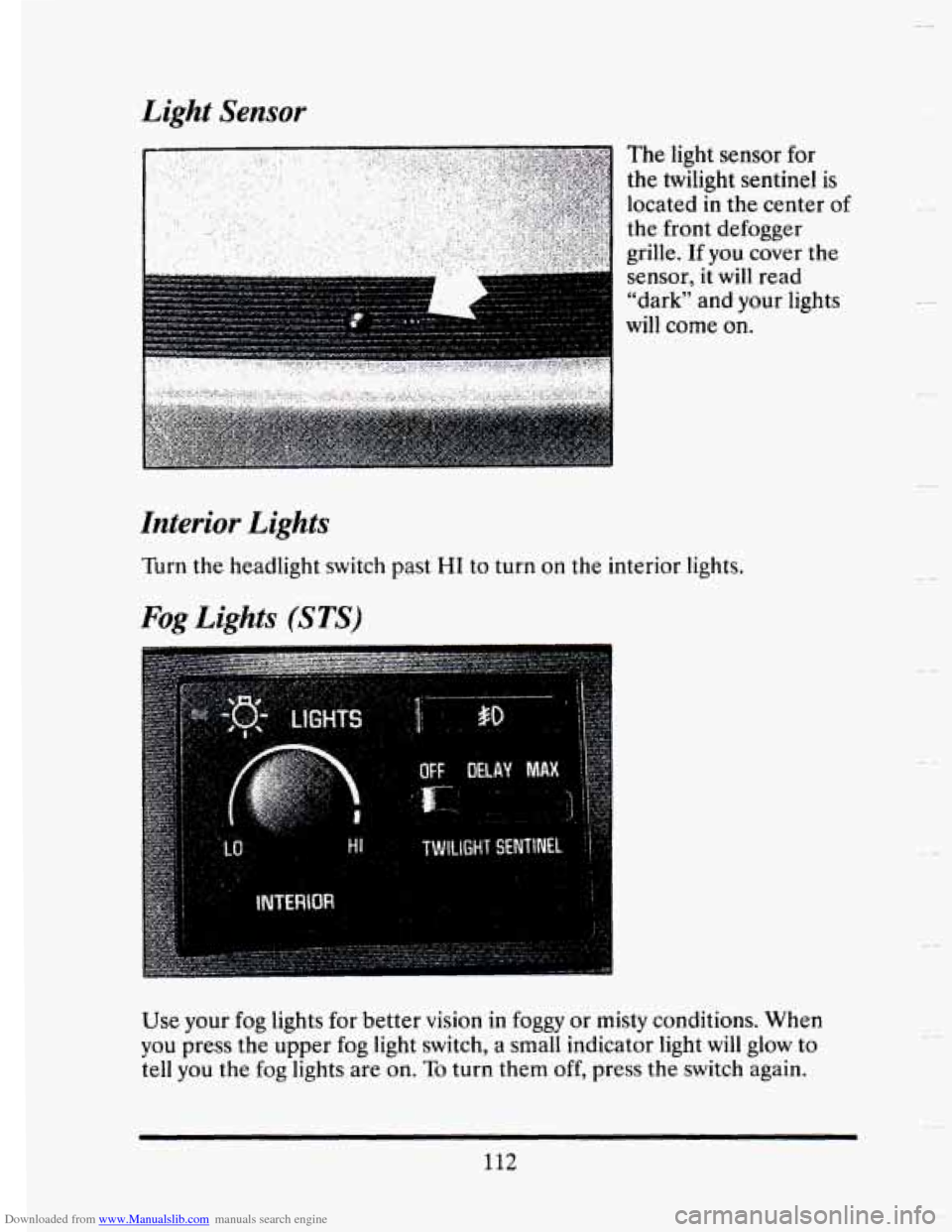
Downloaded from www.Manualslib.com manuals search engine Light Sensor
Interior Lights
Turn the headlight switch past HI to turn on the interior lights.
Fog Lights (STS)
Use your fog lights for better vision in foggy or misty conditions. When
you
press the upper fog light switch, a small indicator light will glow to
tell you the fog lights are on. To turn them off, press the switch again.
112
c
i
Page 127 of 407
Downloaded from www.Manualslib.com manuals search engine If you switch on your high beam headlights, your fog lights will turn off.
They’ll turn back on again when you switch to low beam headlights.
When the twilight sentinel
is on, only the headlights will turn off
automatically. Your fog and parking lights will remain on.
Rear Fog Lights (Export Only)
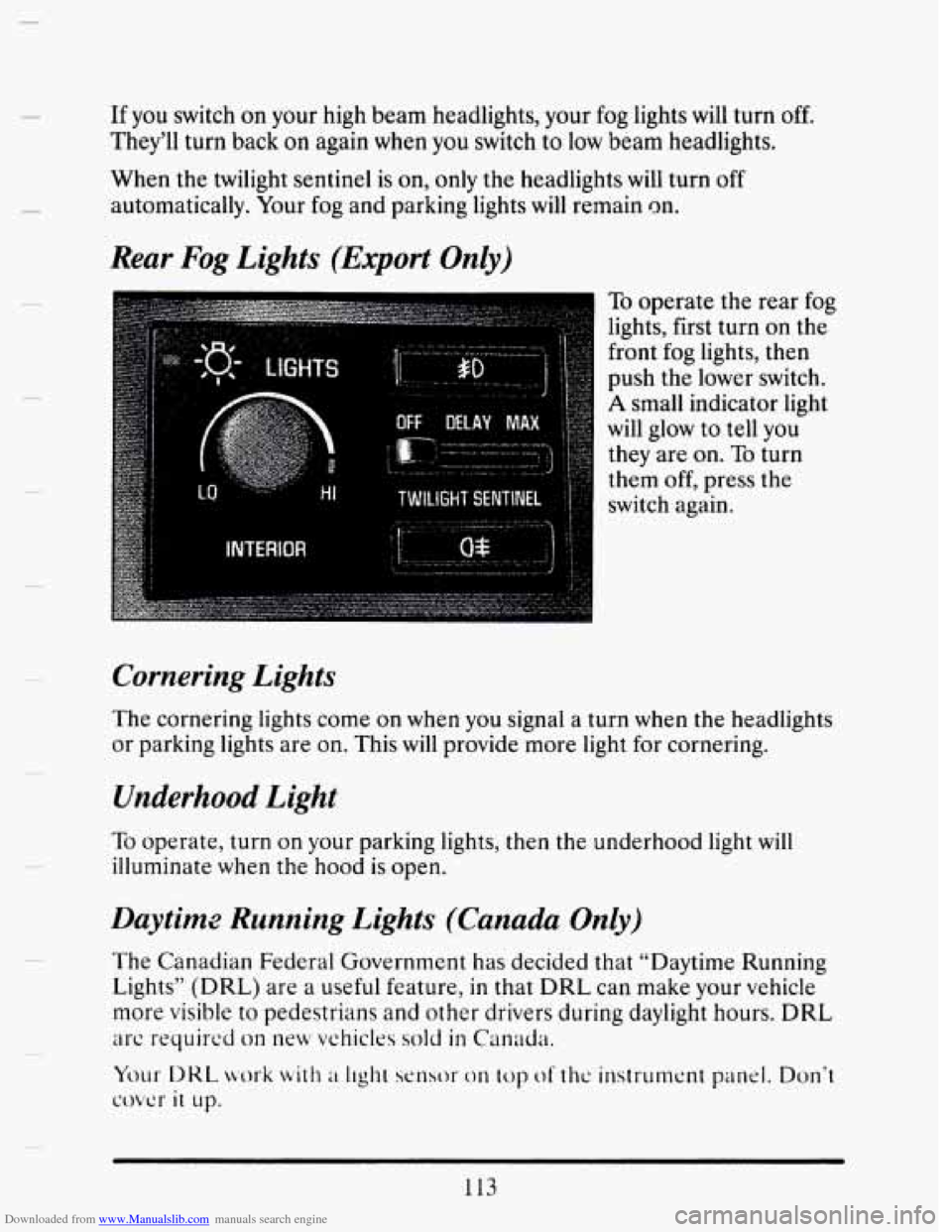
To operate the rear fog
lights, first turn on the
front fog lights, then
push the lower switch.
A small indicator light
will glow to tell you
they are on.
To turn
them off, press the
switch again.
Cornering Lights
The cornering lights come on when you signal a turn when the headlights
or parking lights are
on. This will provide more light for cornering.
Underhood Light
To operate, turn on your parking lights, then the underhood light will
illuminate when the hood
is open.
Daytims Running Lights (Canada Only)
The Canadian Federal Government has decided that “Daytime Running
Lights” (DRL) are a useful feature,
in that DRL can make your vehicle
more visible to pedestrians and other drivers during daylight hours.
DRL
arc required on new vehicles sold in Canada.
Your DKL nw-k with ;I Ilght sensor on top of thc instrument panel. Don’t
covcr it up.
113
Page 154 of 407
Downloaded from www.Manualslib.com manuals search engine LOW A/C REFRIGERANT - SERVICE A/C SOON
This message will appear when the A/C refrigerant is so low that it no
longer can cool well. This message shows that some of the refrigerant has
leaked out
of the system, and that the A/C needs recharging. If you do
not have it recharged, the system may not cool at all.
CHECK WASHER FLUID
This message shows that the washer fluid reservoir is nearly empty.
REDUCE ENGINE POWER (Northstar Only)
This message will appear if the engine starts to cut cylinders to reduce
power.
If this message is ever displayed, have your vehicle serviced as
soon as possible.
SERVICE A/C SYSTEM A/C COMPRESSOR OFF
This message appears when the electronic sensors that control the A/C
and heating system are
no longer working. You may notice a drop in
heating and A/C efficiency when this message appears. Have your
Climate Control system serviced
if this message appears.
STARTING DISABLED DUE TO THEFT SYSTEM REMOVE
IGNITION KEY
This message will appear when the Personalized Automotive Security
System (PASS
Key I1 TM ) senses that an improper ignition key is being
used to try to start
the vehicle. Check the ignition key for damage. If it is
damaged,
it may need to be replaced. If you see no damage, clean the
pellet contacts with a soft cloth
or napkin. Remove the ignition key and
wait for
the Driver Information Center to display “WAIT 3 MINUTES”.
The Instrument Panel Cluster will then run a timer and change the
messages to “WAIT 2 MINUTES”, “ WAIT 1 MINUTE”, and then
“START CAR”. When the “START CAR” message is displayed, try again
to start the engine.
d
c
t.
c
U
I
u
SERVICE NOW - REFER TO OWNERS MANUAL
This message appears if you have a problem with the Electronic Control
Module (ECM).
To correct this problem have your vehicle serviced at
your Cadillac dealership.
140
Page 157 of 407
Downloaded from www.Manualslib.com manuals search engine Road Sensing Suspension (Northstar Only)
3
The Road Sensing Suspension automatically controls the ride of your
vehicle. The system controls damping forces in the shock absorbers and
struts
in response to various road and driving conditions. The system is
capable of making these changes
within milli-seconds.
The Road Sensing Suspension controller is a computer used to control
and monitor
the system. The computer receives inputs from vertical
acceleration sensors, wheel to body position sensors, vehicle speed
sensor, lift and dive signals, and determines optimum strut valving or
(suspension stiffness) for your current operating conditions. The
computer also receives feedback from the various components to
determine proper system operation. If the computer receives an incorrect
feedback from the system, an error code
will be set in memory and a
SERVICE RIDE CONTROL message
will display on the Driver
Information Center. If this message should appear, have your vehicle
serviced at your Cadillac dealer at your earliest convenience.
Oil Life Indicator
Your Cadillac has a Driver Information Center with an Oil Change
Indicator feature. This tells you when you need to change your engine oil.
It's based
upon the engine oil temperatures and your driving patterns.
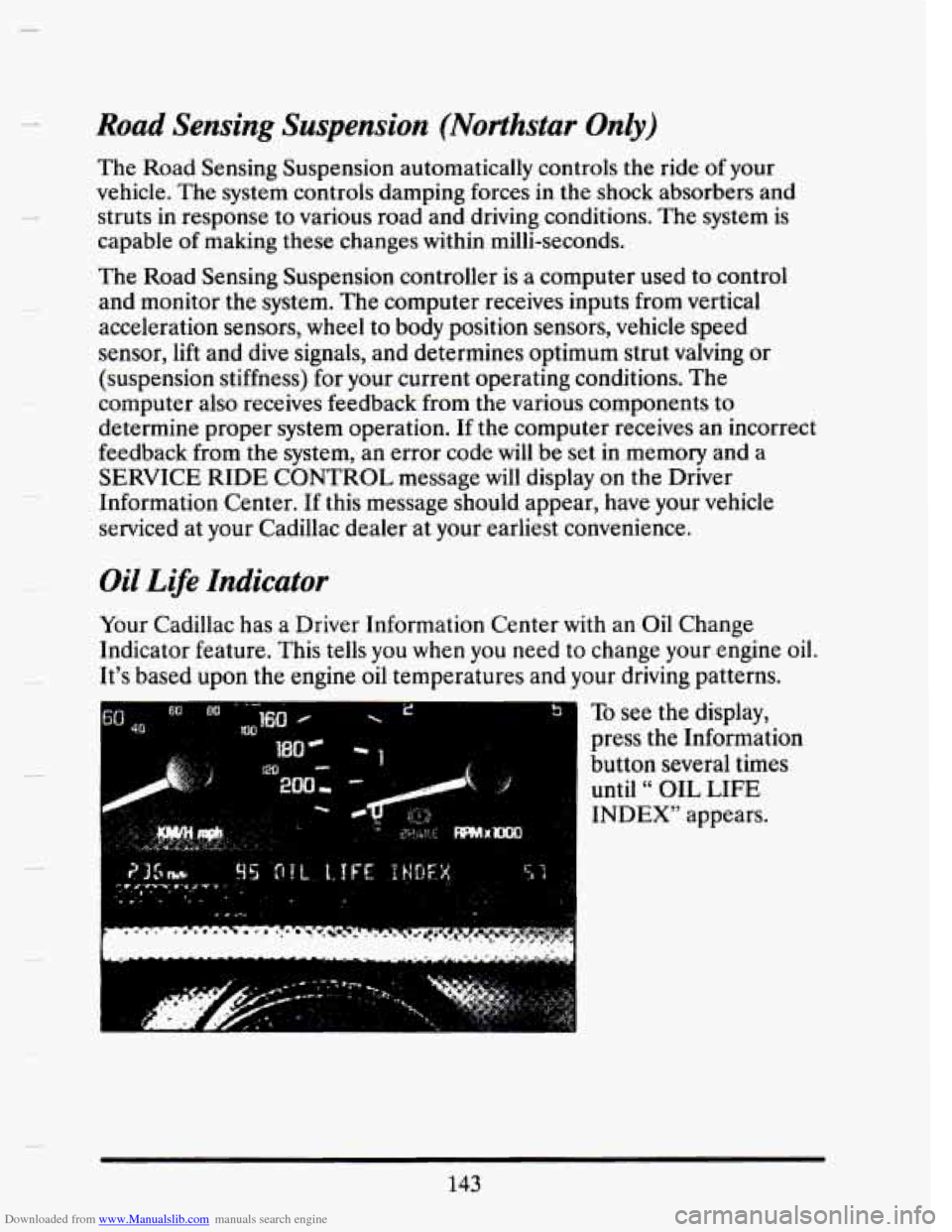
To see the display,
press the Information
button several times until
" OIL LIFE
INDEX" appears.
143
Page 159 of 407
Downloaded from www.Manualslib.com manuals search engine Speed Sensitive Suspension
The Speed Sensitive Suspension automatically controls the firmness of
your Cadillac’s ride.
An actuator in each of the four struts will change
ride firmness depending on vehicle speed and other driving conditions.
As the vehicle speed increases, the firmness of the suspension changes to
one or three damping modes “Comfort”, for speeds less than
40 mph,
“Normal” for speeds between
40 and 60 mph, and “Firm” for speeds
greater than
60 mph. The system also stiffens damping during hard
acceleration, braking and cornering for increased control.
A computer is used to control and monitor the system. The computer
receives speed, acceleration and determines optimum mode strut v\
alving
(or suspension stiffness) for your current operating conditions\
. The
computer also receives feedback from the struts to determine proper
system operation. If the computer receives an incorrect feedback from
the system,
an error code will be set in memory and a message
“SERVICE RIDE CONTROC‘
will be displayed until the problem is
corrected. If this message should appear, have your vehicle serviced at
your Cadillac dealer at your earliest convenience.
Electronic Level Control
This keeps your car level.
The ignition has
to be “ON” for the level control to work. When you turn
the ignition off, you may hear the level control exhausting. The system
consists of an electronic height sensor, a small electric air compressor,
and air adjustable shock absorbers mounted on the rear of
the vehicle.
If the system has a slight leak, the air compressor
will run frequently for a
few seconds each time.
For a massive air leak, the air compressor
will stay on for approximately 7
minutes. You should see your dealer for service, but you can keep driving
your Cadillac, though.
145
Page 161 of 407
Downloaded from www.Manualslib.com manuals search engine Electronic Climate Control (ECC)
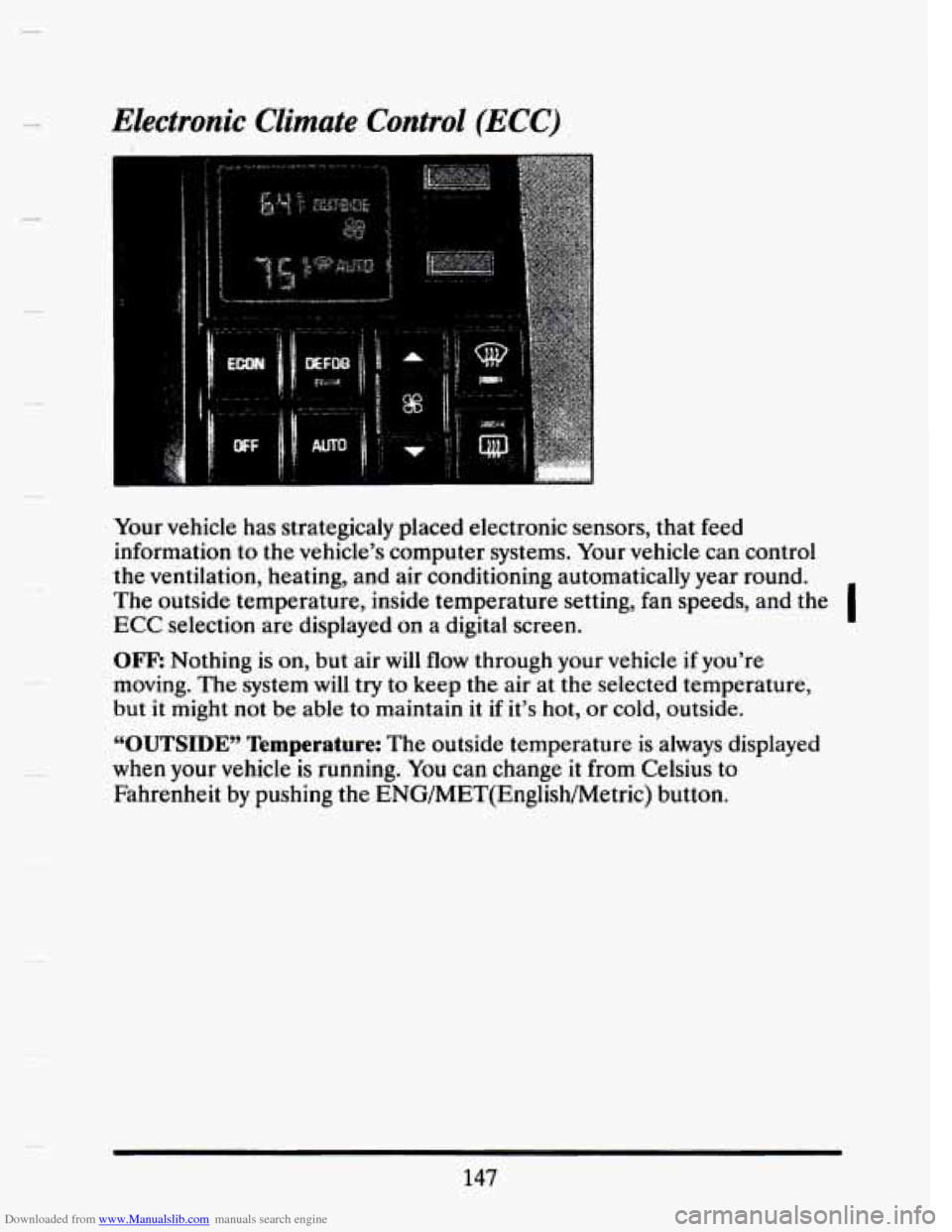
Your vehicle has strategicaly placed electronic sensors, that feed
information to the vehicle’s computer systems. Your vehicle can control
the ventilation, heating, and air conditioning automatically year round.
The outside temperature, inside temperature setting, fan speeds, and the
ECC selection are displayed on a digital screen. I
OFF: Nothing is on, but air will flow through your vehicle if you’re
moving. The system will try to keep the air at the selected temperature,
but it might not
be able to maintain it if it’s hot, or cold, outside.
“OUTSIDE” Temperature: The outside temperature is always displayed
when your vehicle is running. You can change it from Celsius
to
Fahrenheit by pushing the ENG/MET(English/Metric) button.
147
Page 165 of 407
Downloaded from www.Manualslib.com manuals search engine Ip
i i
WAR DEFOGGER P
I"
c
P
P
F
F
r
Push this button to turn
on the rear defogger.
With it,
your rear
window and both
outside rearview
mirrors are
heated.
The system will
automatically shut
off
after 10 minutes. If
further defrosting is
desired, simply push
the button again.
Ekctronic Solar Sensor
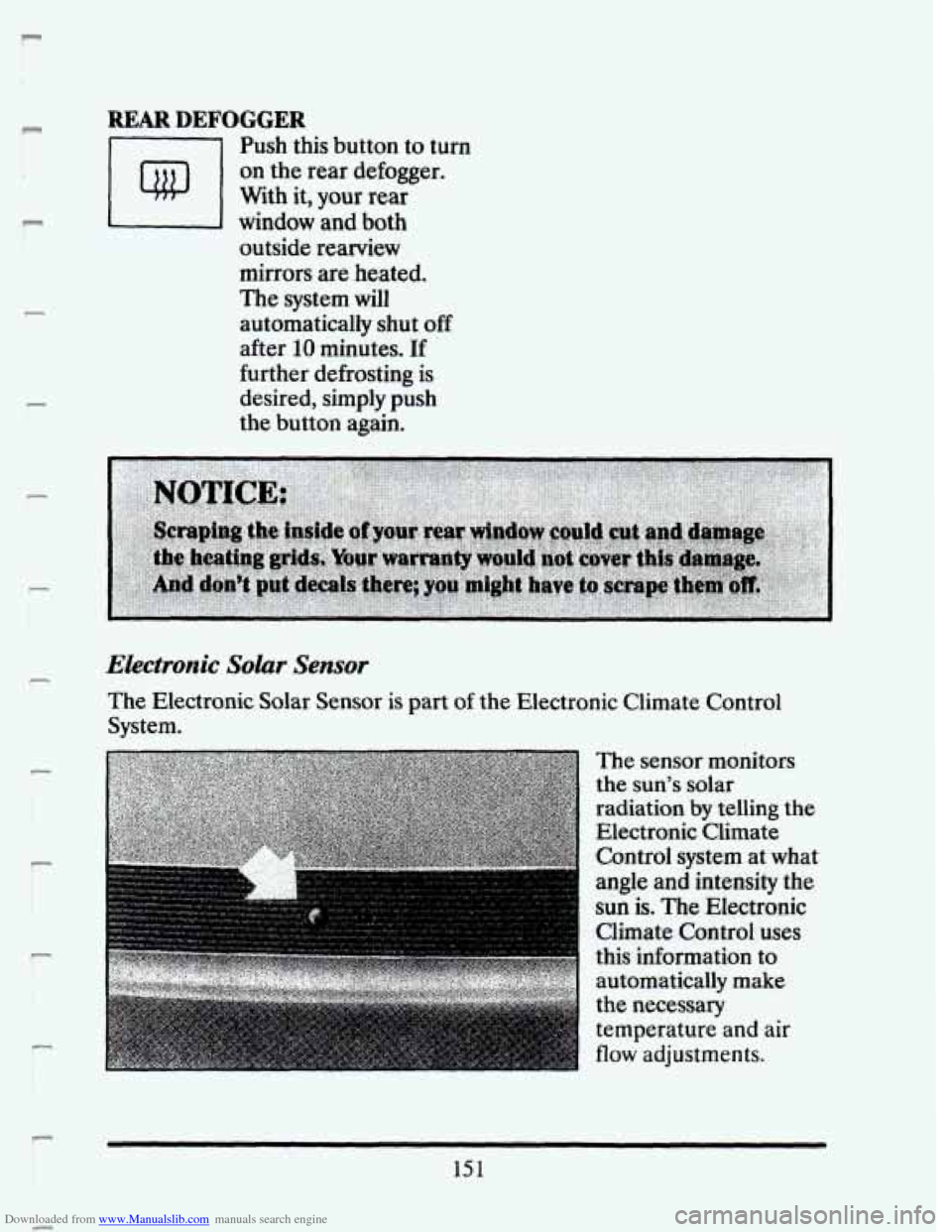
The Electronic Solar Sensor is part of the Electronic Climate Control
System.
The sensor monitors
the sun's solar
radiation
by telling the
Electronic Climate
Control system at what
angle and intensity the
sun is. The Electronic
Climate Control uses
this information
to
automatically make
the necessary
temperature and
air
flow adjustments.
151