Page 47 of 407
Downloaded from www.Manualslib.com manuals search engine GM vehicles is between 9 and 14 mph. However, this velocity threshold
depends
on the vehicle design and may be several miles-per-hour faster
or slower. In addition, this threshold velocity will be considerably higher
if
the vehicle strikes an object such as a parked car which will move and
deform on impact. The air bag is also not designed to inflate in rollovers,
side impacts,
or rear impacts where the inflation would provide no
occupant protection benefit.
In any particular crash, the determination
of whether the air bag should
have inflated cannot be based solely on the level
of damage on the
vehicle(s). Inflation is determined by the angle
of the impact and the
vehicle’s deceleration,
of which vehicle damage is only one indication.
Repair cost is not a good indicator of whether an air bag should have
deployed.
What makes an air bag inflate?
In a frontal or near-frontal impact of sufficient severity, sensors
strategically located on the vehicle detect that the vehicle
is suddenly
stopping as a result
of a crash. These sensors complete an electrical
circuit, triggering a chemical reaction
of the sodium azide sealed in the
inflator.
The reaction produces nitrogen gas, which inflates a cloth bag.
The inflator, cloth bag, and related hardware are all part of the air bag
inflator modules packed inside the steering wheel and in the instrument
panel
in front of the passenger if there is a passenger air bag.
How does an air bag restrain?
In moderate to severe fr,ontal or near-frontal collisions, even belted
occupants can contact the steering wheel or the instrument panel. The air
bag supplements the protection provided by safety belts. Air bags
distribute the force
of the impact more evenly over the occupant’s upper
body, stopping the occupant more gradually. But air bags would not
provide protection in many types
of collisions, including rollovers and
rear and side impacts, primarily because an occupant’s motion is not
toward
the air bag. Air bags should never be regarded as anything more
than a supplement to safety belt protection
in moderate to severe frontal
and near-frontal collisions.
33
Page 73 of 407
Downloaded from www.Manualslib.com manuals search engine I
A CAUTION:
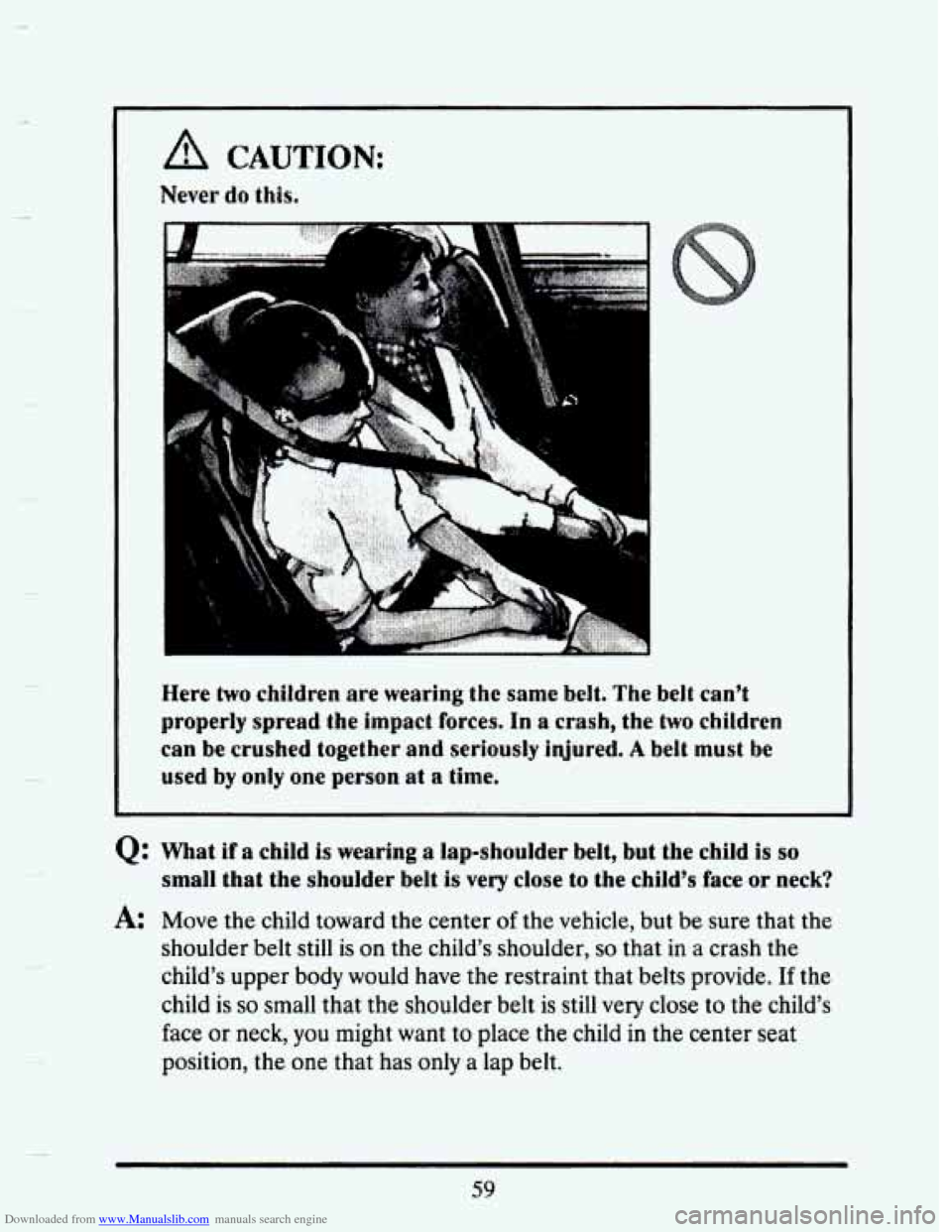
Newr do this.
F
Were two chitdren are wearing the same belt. The belt can’t
properly spread the impact forces, In
a crash, the two children
can be
crushed together and seriously iqjured. A belt must be
used by only one person at a time,
Q: What if a child is wearing a lap-shoulder belt, but the child is so
small that the shoulder belt is very close to the child’s face or neck?
A: Move the child toward the center of the vehicle, but be sure that the
shoulder belt still
is on the child’s shoulder, so that in a crash the
child’s upper body would have the restraint that belts provide.
If the
child is
so small that the shoulder belt is still very close to the child’s
face or neck,
you might want to place the child in the center seat
position, the one that has only a lap belt.
59
Page 94 of 407

Downloaded from www.Manualslib.com manuals search engine The other positions let you perform these functions:
ACC: Accessory lets you use things like the radio and the windshield
wipers when the engine
is off. To get into “ACC”, push in the key and turn
it toward
you. Your steering wheel will remain locked, just as it was
before you inserted the key.
OFF: This position lets you turn off the engine but still turn the steering
wheel. It doesn’t lock the steering wheel like “Lock.“ Use ”Off” if WLI
must have your car in motion while the engine is off (for cu:rnlplc*. if >.our
car is being pushed).
NOTICE:
If your key seems stuck in “Imk” rrnd you cdl turn it, be sure
it is all the way in. If it is, then turn the steering wheel left and
fight while you turn the key hard, But turn the key only with
your hand. Using a toooil to force it could break the key or the
ignition switch, If none .of this works, then your vehicle needs
service.
STARTING YOUR ENGINE
Engines start differently. The 8th digit of your Vehicle Identification
Number (VIN) shows
the code letter or number for your engine. You will
find the VIN at the top left
of your instrument panel. (See “Vehicle
Identification Number” in the Index.) Follow the proper steps
to start the
engine.
Move your shift lever to
“P” (Park) or “N” (Neutral). Your engine won’t
start in any other position
-- that’s a safety feature. To restart when you’re
already moving, use
“N” (Neutral) only.
80
H
c
J-r
Page 100 of 407
Downloaded from www.Manualslib.com manuals search engine N (Neutral)
In this position, your engine doesn’t connect with the wheels. To
restart when you’re already moving, use “N” (Neutral) only. Also, use
“N” when your vehicle is being towed.
I
A CAUTION=
Shifting out of“P’’ (Park) or “N” (Neutral) while your engine is
‘kacing” (running at high speed) is dangerous. Unless your foot
is firmly on the brake pedal, your vehicle could move very
rapidly. You could Iosc control and hit people or objects. Don’t
shift out of T’ (Park) or “N” (Neutral) whiic your engine is
racing.
@ Automatic Overdrive
This position
is for normal driving. If you need more power for
passing, and you’re:
Going less than about
35 mph (56 km/h), push your accelerator
pedal about halfway down.
Going about
35 mph (56 kmh) or more, push the accelerator all
the way down.
You’ll shift down to the next gear and have more power.
c-l
86
Page 101 of 407
Downloaded from www.Manualslib.com manuals search engine P
I“
P
P
t
r:,
P
3 (Third Gear)
This is like
@ but you never go into Overdrive.
Here are some times
you might choose “ 3 ” instead of @:
- When driving on hilly, winding roads
- When towing a trailer, so there is less shifting between gears
- When going down a steep hill
2 (Second Gear)
This position gives you more power but lower fuel economy. You can
use “2” on hills. It can help control your speed as you go dawn steep
mountain roads, but then
you would ako’want to use your brakes off
and on.
87
Page 103 of 407
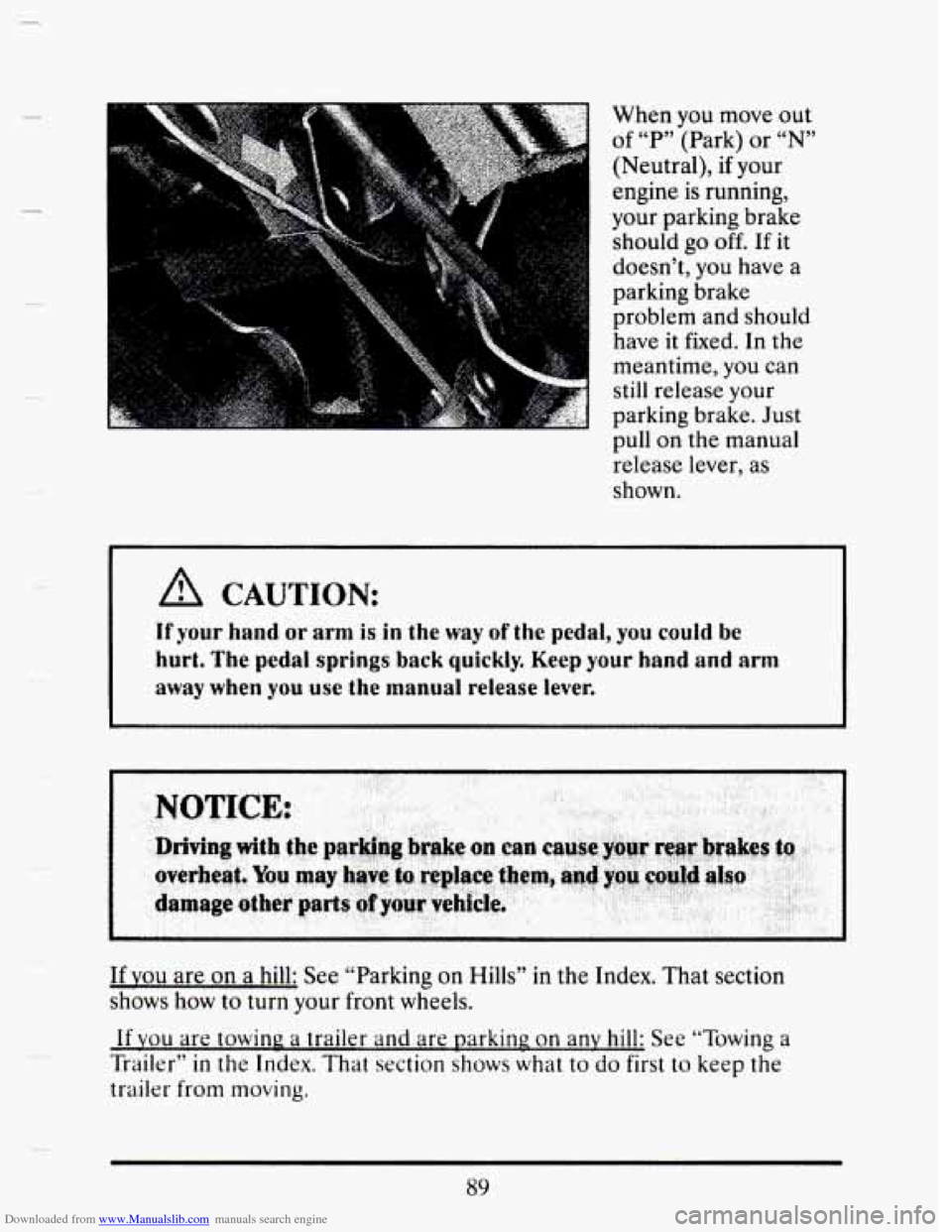
Downloaded from www.Manualslib.com manuals search engine When you move out
of “P” (Park) or “N”
(Neutral), if your
engine is running,
your parking brake
should
go off. If it
doesn’t, you have a
parking brake
problem and should
have
it fixed. In the
meantime,
you can
still release your
parking brake.
Just
pull on the manual
release lever, as
shown.
A CAUTION:
If your hand or arm is in the way of the pedal, you could be
hurt. The pedal springs back quickly. Keep your hand and arm
away when you use the manual release lever.
If vou are on a hill: See “Parking on Hills” in the Index. That section
shows how to turn your front wheels.
If YOU are towing a trailer and are Parking on any hill: See “Towing a
Trailer” in the Index. That section shows what to do first to keep the
trailer from moving.
89
Page 104 of 407
Downloaded from www.Manualslib.com manuals search engine SHIFTING INTO “P” (PARK)
d!h CAUTION:
It can be dangerous to get out of your vehicIe if the shift fever is
not fully in rrP’’ (Park) with the parking brake firmly set, Your
vehicle can roll.
If you have left the engine running, the vehicle can move
suddenly. You or others could be injured. To be sure your vehicle
won’t move, when you’re on fairIy level ground, use the steps
that follow, If you are parking on a hill, or if you’re pulling a
trailer, also see “Parking On Hills’’ or “Towing a ’nraikr’’ in the
Index.
Steering Column Sh$ Lever
1. Hold the brake pedal down with your right foot.
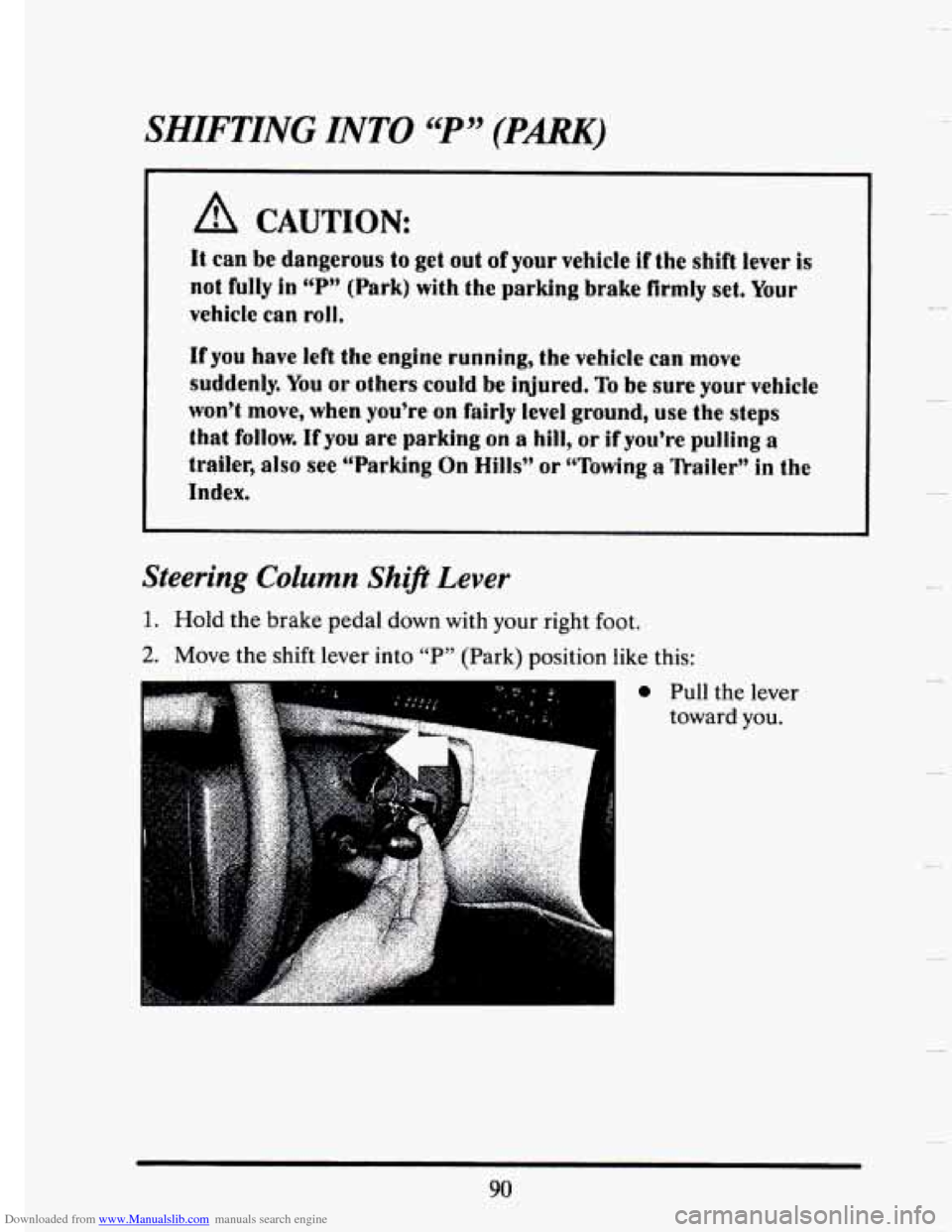
2. Move the shift lever into “P” (Park) position like this:
0 Pull the lever
toward you.
90
Page 106 of 407
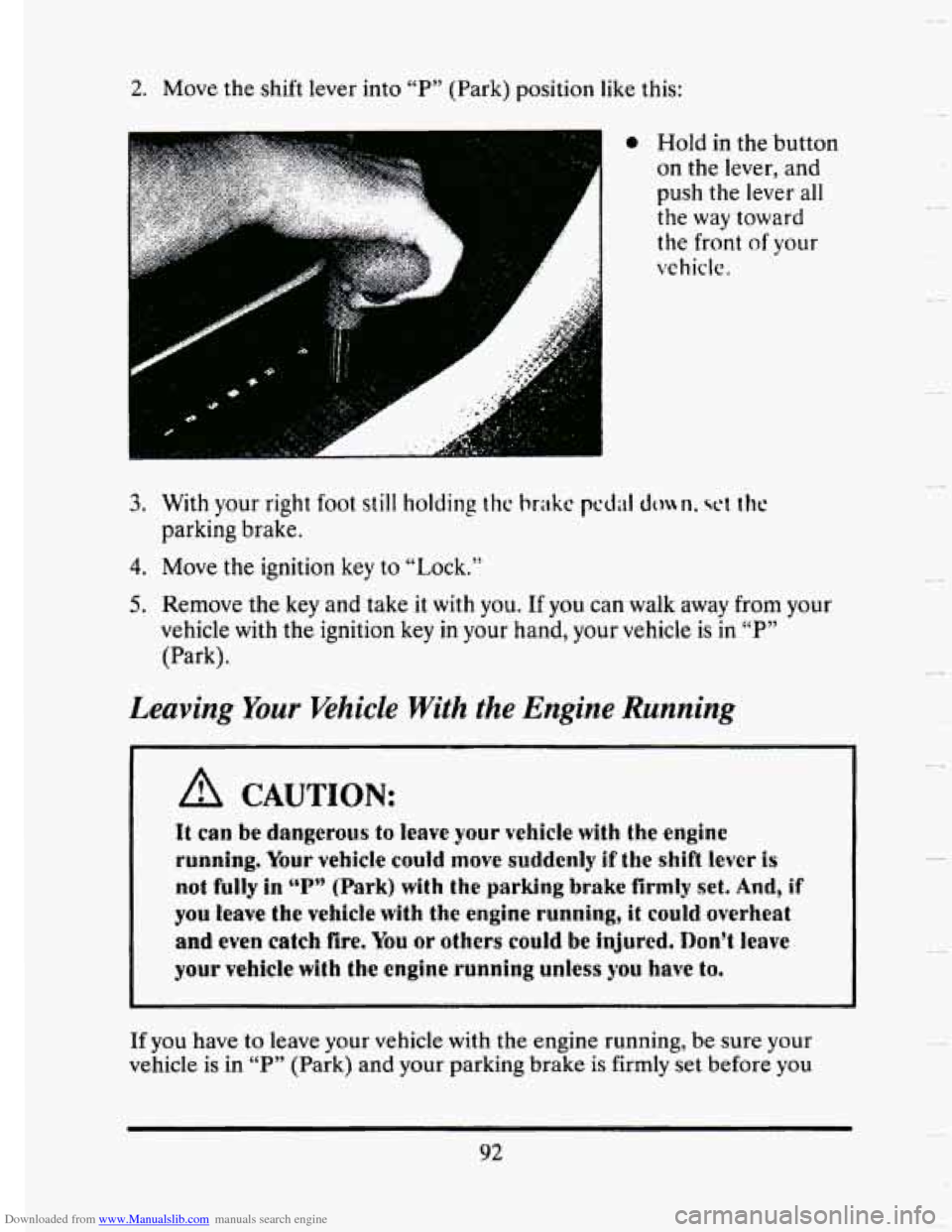
Downloaded from www.Manualslib.com manuals search engine 2. Move the shift lever into “P” (Park) position like this:
0 Hold in the button
on the lever, and
push
the lever all
the way toward
the front of your
vehicle.
3. With your right foot still holding thc hriikc pcdal doun. set tilt.
parking brake.
4. Move the ignition key to “Lock.”
5. Remove the key and take it with you. If you can walk away from your
vehicle with the ignition key in your hand, your vehicle
is in “P”
(Park).
Leaving Your Vehicle With the Engine Running
A CAUTION:
It can be dangerous to leave your vehicle with the engine
running. Your vehicle could move suddenly if the shift Lever is
not fully in ciP’’ (Pork) with the parking brake. firmly set. And, if
you leave the vehicle with the engine running, it could overheat
and even catch fire. You or others could be injured, Don’t leave
your vehicle with the engine running unless you have to,
If you have to leave your vehicle with the engine running, be sure your
vehicle is in
“P” (Park) and your parking brake is firmly set before you
92
C.
e