Page 152 of 407
Downloaded from www.Manualslib.com manuals search engine BATTERY VOLTS HIGH
This message shows that the electrical charging system is overcharging,
(more than 16 volts). To avoid being stranded have the electrical system
checked by your Cadillac dealership at your earliest convenience. You can
reduce the charging overload
by using the accessories. Turn on the lights,
radio, set the Climate Control on
“AUTO” and the fan speed on “HI”
and turn the rear window defogger on. You can monitor battery voltage
on the Driver Information Center by toggling the “INFORMATION”
button. When the engine is running, the normal range
is 11.5 to 15.5
volts.
c
BATTERY VOLTS LOW
This message will appear when the electrical system is charging less than
10 volts, or if the battery has been drained. If this message appears
immediately after starting it is possible that the generator can still
recharge the battery. The battery should recharge after driving a few
miles and the message should go out. If this message appears while
driving or after starting your vehicle and stays on, have it checked
immediately to determine the cause
of this problem. To help the
generator recharge the battery quickly,
you can reduce the load on the
electrical system by turning
off your accessories. You can monitor battery
voltage on the Driver Information Center by toggling the
“INFORMATION’’ button. The normal range is
11.5 to 15.5 volts.
CHANGE TRANS FLUID (Northstar Only)
This message will appear when it is time to replace the transaxle fluid.
See your maintenance booklet
for the proper fluid and change intervals.
CHECK BRAKE FLUID
This message is displayed to inform the driver that the brake reservoir
fluid level is low. Check the brake reservoir level and add as needed.
Have the brake system serviced by a Cadillac technician as soon as
possible.
If the brake warning light is on, follow the directions in that
section.
CHECK COOLANT LEVEL (Northstar Only)
This message will appear when there is a low level of engine coolant.
Have the cooling system serviced by a Cadillac technician as soon as
possible.
138
I
. -’
L
c
Page 162 of 407
Downloaded from www.Manualslib.com manuals search engine Temperature
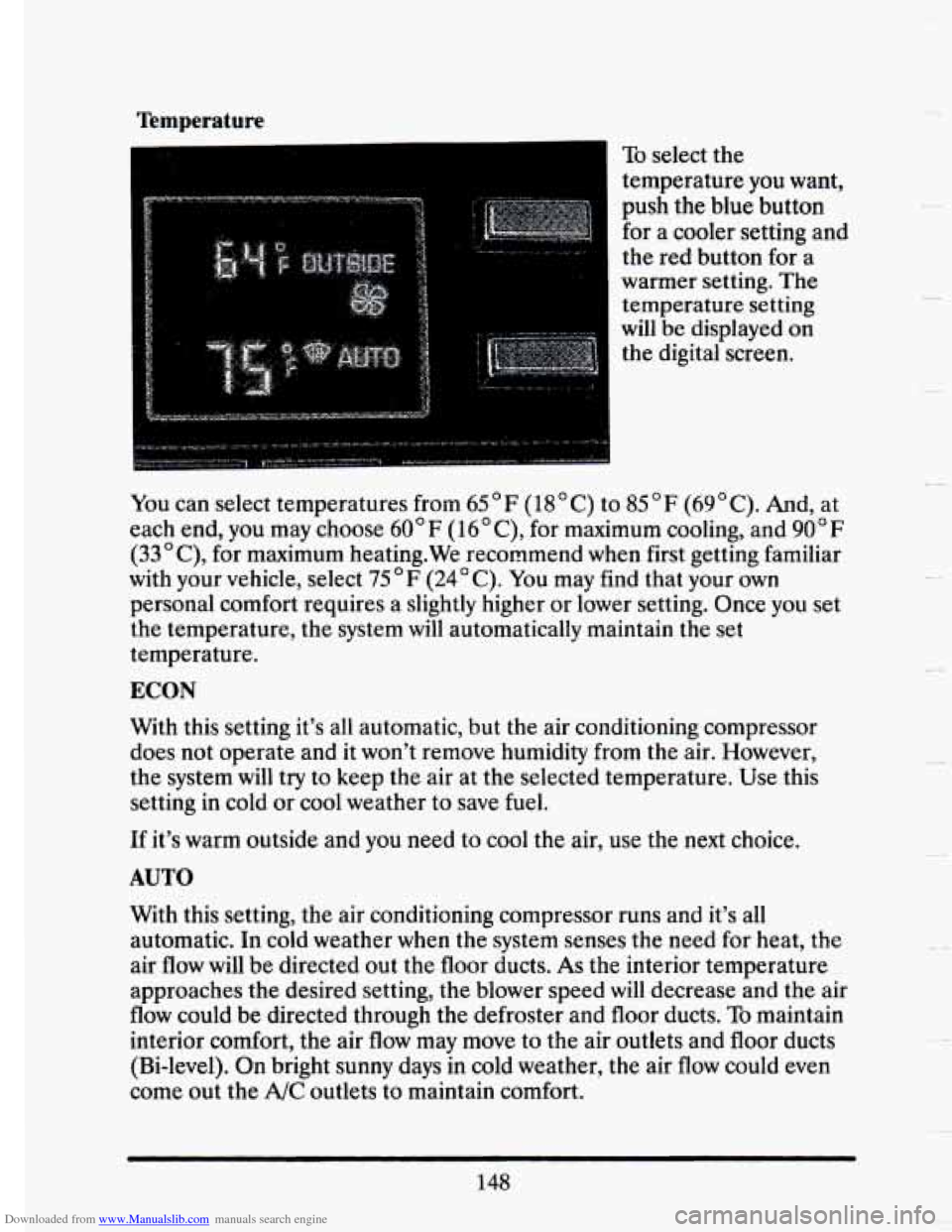
To select the
temperature you want,
push the blue button
for a cooler setting and
the red button for a
warmer setting. The
temperature setting
will be displayed on
the digital screen.
You can select temperatures from 65OF (18OC) to
85°F (69OC). And, at
each end, you may choose 60"
F (16OC), for maximum cooling, and 90°F
(33OC), for maximum heating.We recommend when first getting familiar
with your vehicle, select 75OF (24OC). You may find that your own
personal comfort requires a slightly higher or lower setting. Once you set
the temperature, the system
will automatically maintain the set
temperature.
ECON
With this setting it's all automatic, but the air conditioning compressor \
does not operate and it won't remove
humidity from the air. However,
the system
will try to keep the air at the selected temperature. Use this
setting
in cold or cool weather to save fuel.
If it's warm outside and you need to cool the air, use the next choice.
AUTO
With this setting, the air conditioning compressor runs and it's all
automatic. In cold weather when the system senses the need for\
heat, the
air flow
will be directed out the floor ducts. As the interior temperature
approaches the desired setting, the blower speed
will decrease and the air
flow could be directed through the defroster and floor ducts.
To maintain
interior comfort, the air flow may move to the air outlets and floor ducts
(Bi-level). On bright sunny days in cold weather, the air flow could even
come out the A/C outlets to maintain comfort.
148
-.
Page 218 of 407
Downloaded from www.Manualslib.com manuals search engine If you drive regularly in steep country, or if you’re planning to visit there,
here are some tips that can make your trips safer and more enjoyable.
Keep your vehicle in good shape. Check all fluid levels and also the
brakes, tires, cooling system and transaxle. These parts can work hard
on mountain roads.
Know how to go down hills. The most important thing to know is this:
let your engine do some of the slowing down. Don’t make your brakes
do it all. Shift to a lower gear when you go down a stcep or long hill.
That way, you will slow down without excessive we of !wr hrilkcs.
I
A CAUTION:
If you don’t shift down, your brakes could get so hot that tht?
wouldn’t work well. You would then have pr braking or men
none going down a hill. You could crash. Shin down to let your
engine assist your brakes on a steep downhill slope.
A CAUTION
Coasting downhill in “N” (Neutral) or with the ignition off is
dangerous. Your brakes will have
to do all the work of slowing
down. They could get
so hot that they wouldn’t work well. You
could crash. Always have your engine running and your vehicle
in
gear when you go downhill.
Know how to go uphill. You may want to shift down to a lower gear.
The lower gears help cool your engine and transaxle, and you can
climb the hill better.
Stay in your own lane when driving on two-lane roads in hills or
mountains. Don’t swing wide or cut across the center
of the road.
Drive at speeds that let you
stay in your own lane. That way, you won’t
be surprised
by a vehicle coming toward you in the same lane.
204
Page 233 of 407
Downloaded from www.Manualslib.com manuals search engine Maintenance when Trailer Towing
Your vehicle will need service more often when you’re pulling a trailer.
See the Maintenance Schedule for more on this. Things that are
especially important
in trailer operation are automatic transaxle fluid
(don’t overfill), engine oil, axle lubricant, belts, cooling system, and brake
adjustment. Each
of these is covered in this manual, and the Index will
help you find them quickly. If you’re trailering, it’s a good idea to review
these sections before you start your trip.
Check periodically to see that all hitch nuts and bolts are tight.
219
Page 249 of 407
Downloaded from www.Manualslib.com manuals search engine COOLING SYSTEM - 4.9 LITER
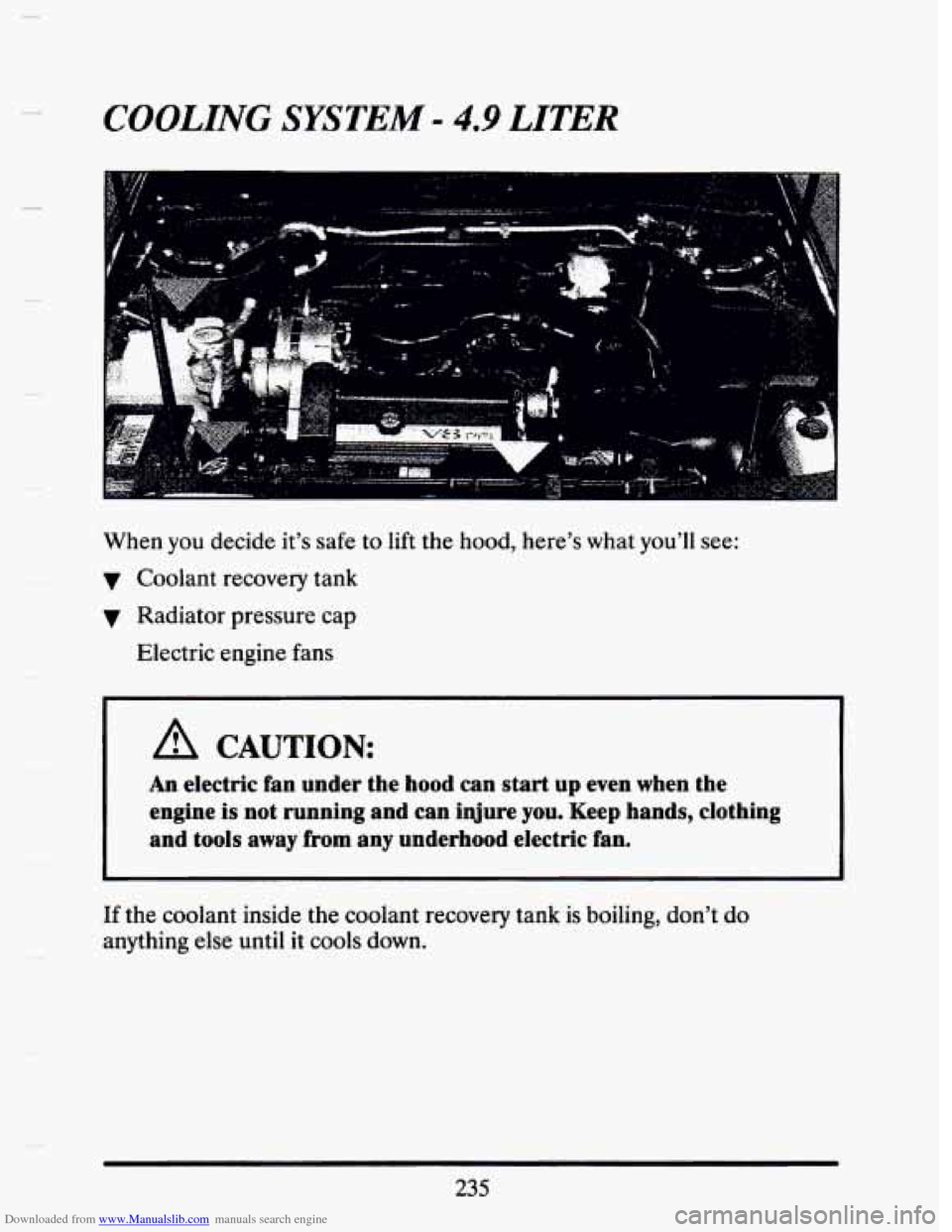
When you decide it's safe to lift the hood, here's what you'll see:
v Coolant recovery tank
v Radiator pressure cap
Electric engine fans
1 A CAUTION:
An electric fan under the hood can start up even when the
engine is not running and can injure you,
Keep hands, clothing
and
tools away from any underhood electric fan,
If the coolant inside the coolant recovery tank is boiling, don't do
anything else until
it cools down.
235
Page 250 of 407
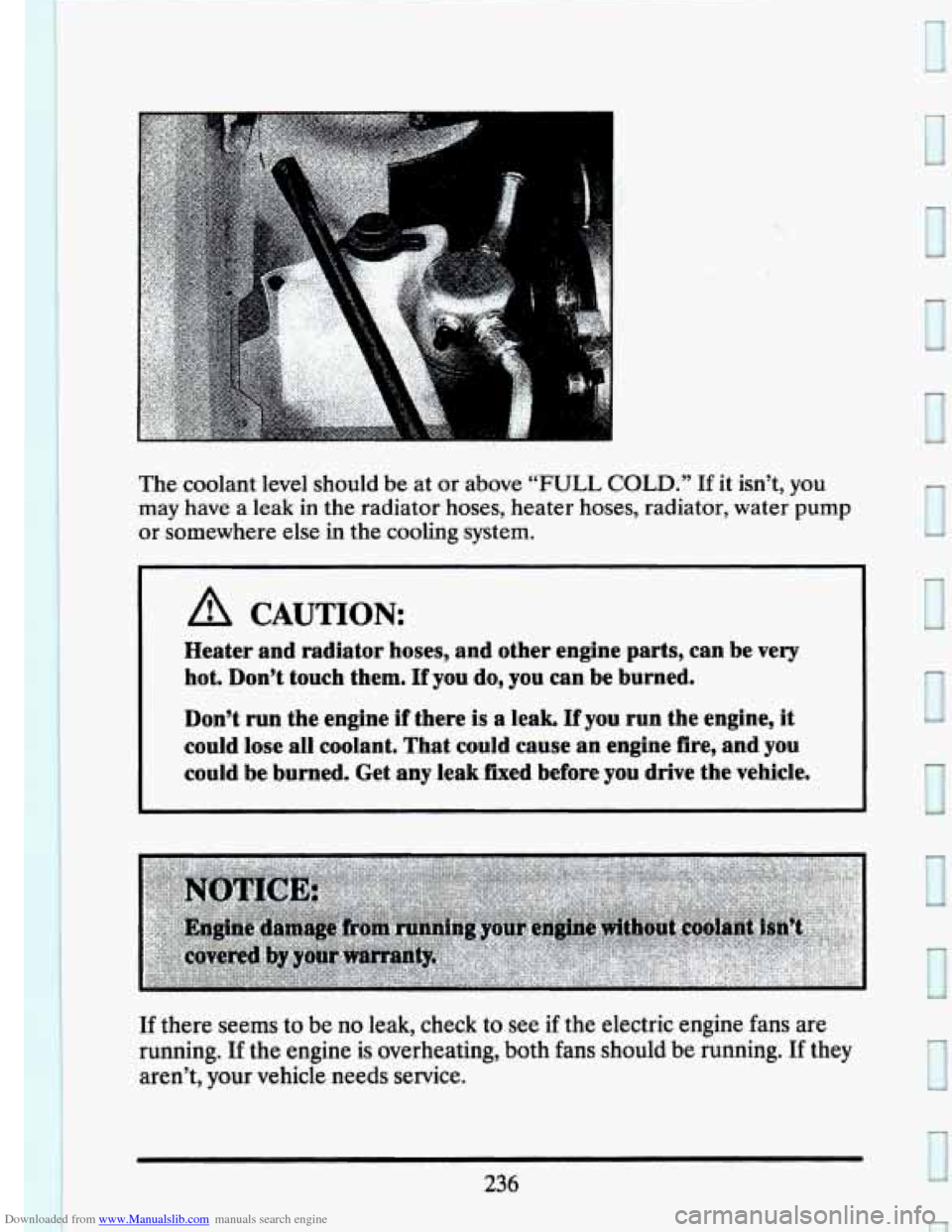
Downloaded from www.Manualslib.com manuals search engine The coolant level should be at or above “FULL COLD.” If it isn’t, you
may have a
leak in the radiator hoses, heater hoses, radiator, water pump
or somewhere else
in the cooling system.
I
A CAUTION
Heater and radiator hoses, and other engine parts, can be very
hot. Don’t touch them.
If you do, you can be burned.
Don’t run the engine
if there is a leak. If you run the engine, it
could lose all coolant. That could cause an engine fire, and you
could be burned. Get any leak
fixed before you drive the vehicle.
If there seems to be no leak, check to see if the electric engine fans are
running.
If the engine is overheating, both fans should be running. If they
aren’t, your vehicle needs service.
236
Page 251 of 407
Downloaded from www.Manualslib.com manuals search engine L ..
r-
r
r
t
How to Add Coolant to the Coolant Recovery Tank
If you haven’t found a problem yet, but the coolant level isn’t at or above
“FULL COLD,” add a 50/50 mixture of clean water (preferably distilled)
and
a proper antifreeze at the coolant recovery tank. (See “Engine
Coolant” in the Index for more information about the proper coolant
mix.)
A CAUTION
Adding only plain water to your cooling system can be
dangerous. Plain water, or some other liquid like alcohol, can
boil before the proper coolant
mix will. Your vehicle’s coolant
warning system is set for the proper coolant
mix. With plain
I water or the wrong mix, your engine could get too hot but you
~ wouldn’t get the overheat warning. Your engine could catch fire
~ and you or others could be burned. Use a 50/50 mix of clean
~ water and a proper antifreeze.
r
r 237
Page 252 of 407
Downloaded from www.Manualslib.com manuals search engine A CAUTION:
You can be burned if you spill coolant on hot engine parts.
Coolant contains ethylene glycol and
it will burn if the engine
parts are hot enough. Don’t spill coolant on a hot engine. \
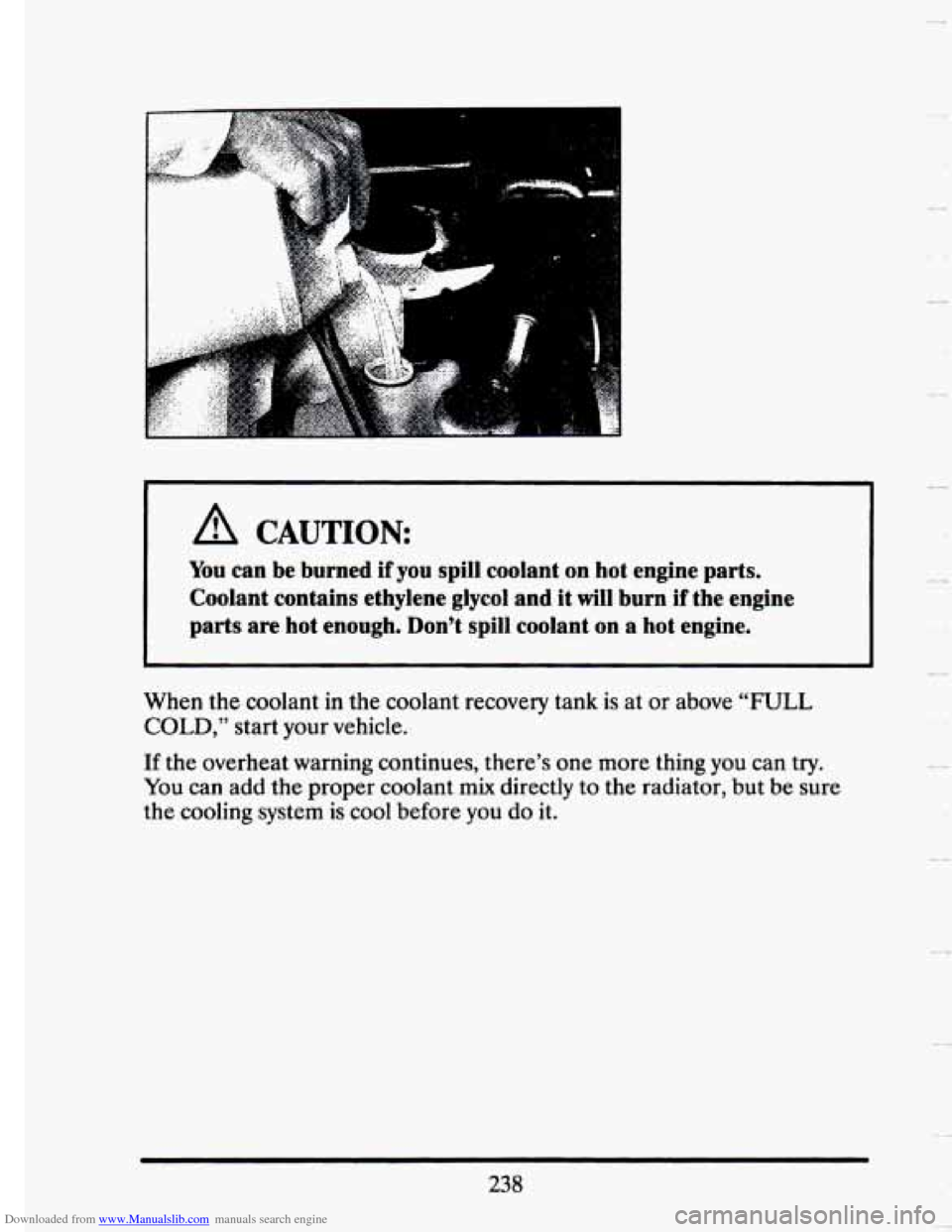
When the coolant in the coolant recovery tank is at or above “FULL
COLD,” start your vehicle.
If the overheat warning continues, there’s one more thing you can try.
You can add the proper coolant mix directly to the radiator, but be sure
the cooling system is cool before you do it.
238