1993 CADILLAC SEVILLE tire type
[x] Cancel search: tire typePage 203 of 407
Downloaded from www.Manualslib.com manuals search engine inside mirror, activate your right lane change signal and move back
into the right lane. (Remember that your right outside mirror is
convex. The vehicle you just passed may seem
to be farther away from
you than it really is.)
0 Try not to pass more than one vehicle at a time on two-lane roads.
Reconsider before passing
the next vehicle.
0 Don’t overtake a slowly moving vehicle too rapidly. Even though the
brake lights are not flashing,
it may be slowing down or starting to
turn.
If you’re being passed, make it easy for the following driver to get
ahead
of you. Perhaps you can ease a little to the right.
LOSS OF CONTROL
Let’s review what driving experts say about what happens when the three
control systems (brakes, steering and acceleration) don’t have enough
friction where the tires
meet the road to do what the driver has asked.
In any emergency, don’t give up. Keep trying to steer and constantly
seek
an escape route or area of less danger.
Skidding
In a skid, a driver can lose control of the vehicle. Defensive drivers avoid
most skids by taking reasonable care suited to existing conditions, and by
not “overdriving” those conditions. But skids are always possible.
The three types of skids correspond to your Cadillac’s three control
systems. In the braking skid your
wheels aren’t rolling. In the steering or
cornering skid, too much speed or steering
in a curve causes tires to slip
and lose cornering force. And
in the acceleration skid too much throttle
causes
the driving wheels to spin.
A cornering skid and an acceleration skid are best handled by easing your
foot
off the accelerator pedal.
If your vehicle starts to slide (as when you turn a corner on a wet, snow-
or ice-covered road), ease your foot
off the accelerator pedal as soon as
you feel
the vehicle start to slide. Quickly steer the way you want to go. If
you start steering quickly enough, your vehicle will straighten out. As it
does, straighten the front wheels.
189
Page 229 of 407
Downloaded from www.Manualslib.com manuals search engine I
..
I -A
I ..
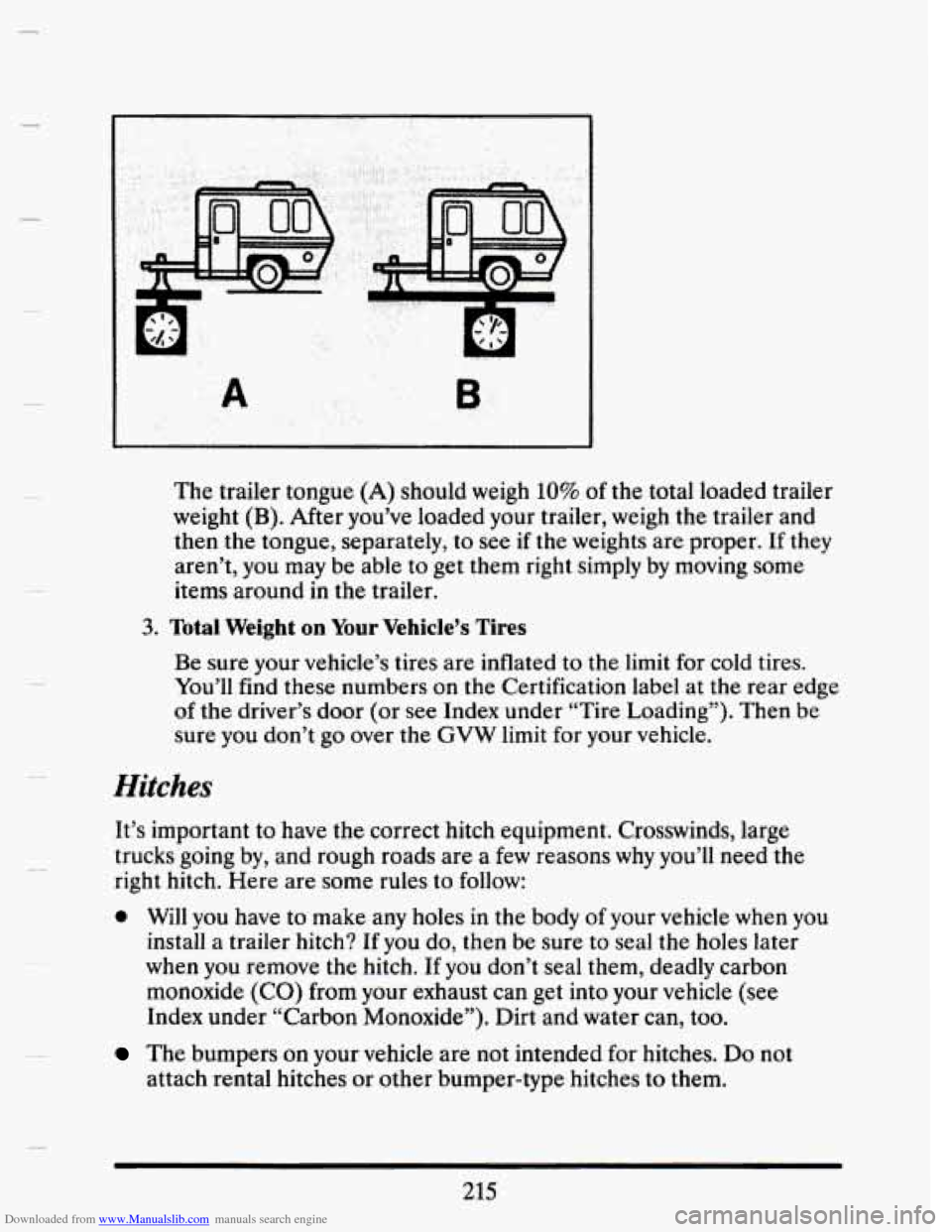
The trailer tongue (A) should weigh 10% of the total loaded trailer
weight
(B). After you’ve loaded your trailer, weigh the trailer and
then the tongue, separately,
to see if the weights are proper. If they
aren’t, you may be able to get them right simply by moving some
items around in the trailer.
3. Total Weight on Your Vehicle’s Tires
Be sure your vehicle’s tires are inflated to the limit for cold tires.
You’ll find these numbers on the Certification label at the rear edge
of the driver’s door (or see Index under “Tire Loading”). Then be
sure you don’t
go over the GVW limit for your vehicle.
Hitches
It’s important to have the correct hitch equipment. Crosswinds, large
trucks going by, and rough roads are a few reasons why you’ll need the
right hitch. Here are some rules to follow:
0 Will you have to make any holes in the body of your vehicle when you
install
a trailer hitch? If you do, then be sure to seal the holes later
when you remove the hitch. If you don’t seal them, deadly carbon
monoxide (CO) from your exhaust can get into your vehicle (see
Index under “Carbon Monoxide”). Dirt and water can, too.
The bumpers on your vehicle are not intended for hitches. Do not
attach rental hitches or other bumper-type hitches to them.
215
Page 244 of 407
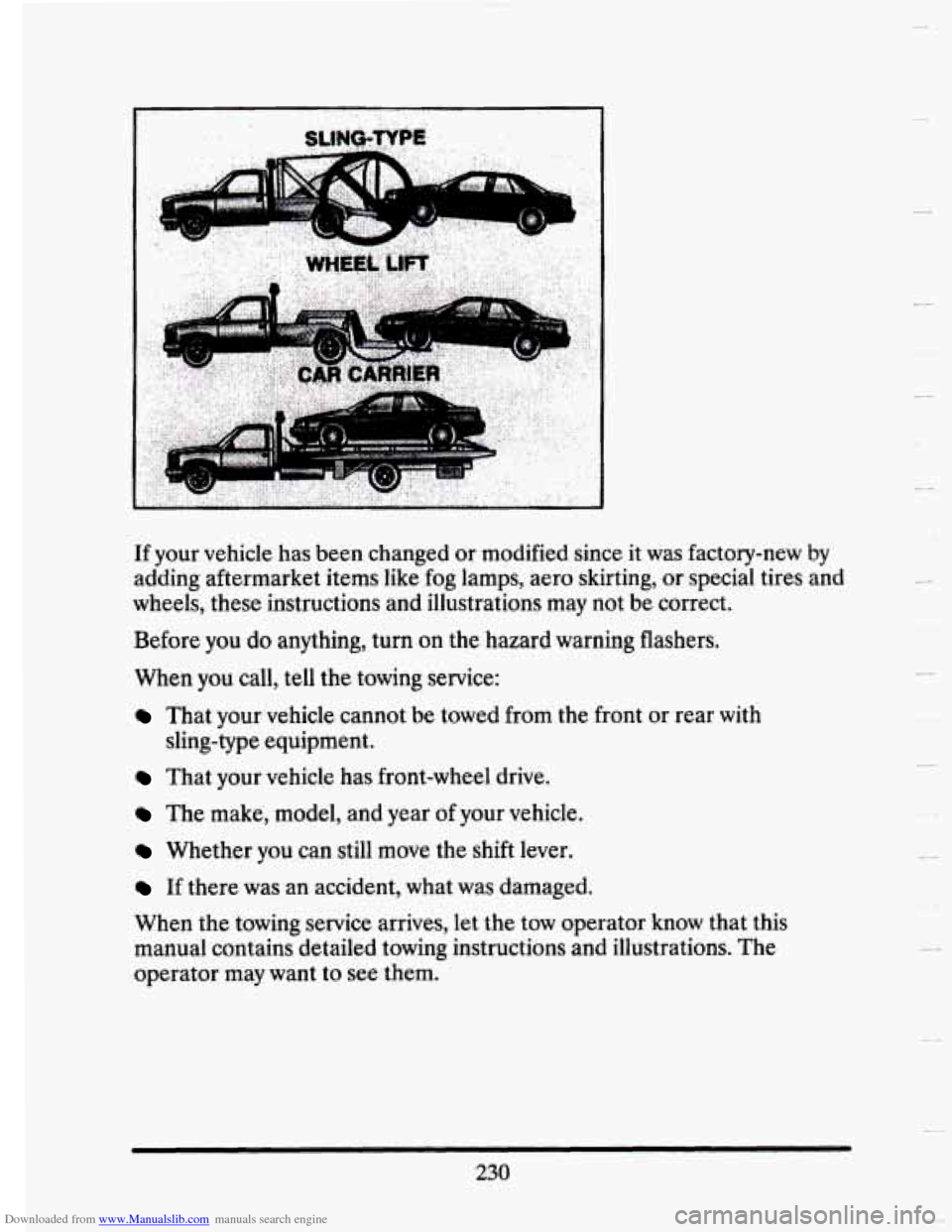
Downloaded from www.Manualslib.com manuals search engine If your vehicle has been changed or modified since it was factory-new by
adding aftermarket items like fog lamps, aero skirting, or special tires and
wheels, these instructions and illustrations may not be correct.
Before
you do anything, turn on the hazard warning flashers.
When
you call, tell the towing service:
That your vehicle cannot be towed from the front or rear with
That your vehicle has front-wheel drive.
sling-type
equipment.
The make, model, and year of your vehicle.
Whether you can still move the shift lever.
If there was an accident, what was damaged.
When the towing service arrives, let the tow operator know that this
manual contains detailed towing instructions and illustrations. The
operator may want to see them.
230
L
Y
c
CI
Page 323 of 407
Downloaded from www.Manualslib.com manuals search engine STS recommended tire size is:
GA Performance Blackwall (P225/60ZR 16)
Don’t forget your compact spare tire. It should be at 60 psi (420 kPa).
How to Check Use a good quality pocket-type gage to check tire
pressure. Simply looking at the tires
will not tell you the pressure,
especially if you have radial tires
-- which may look properly inflated even
if they’re underinflated.
If your tires have valve caps, be sure to put them back on. They help
prevent leaks
by keeping out dirt and moisture.
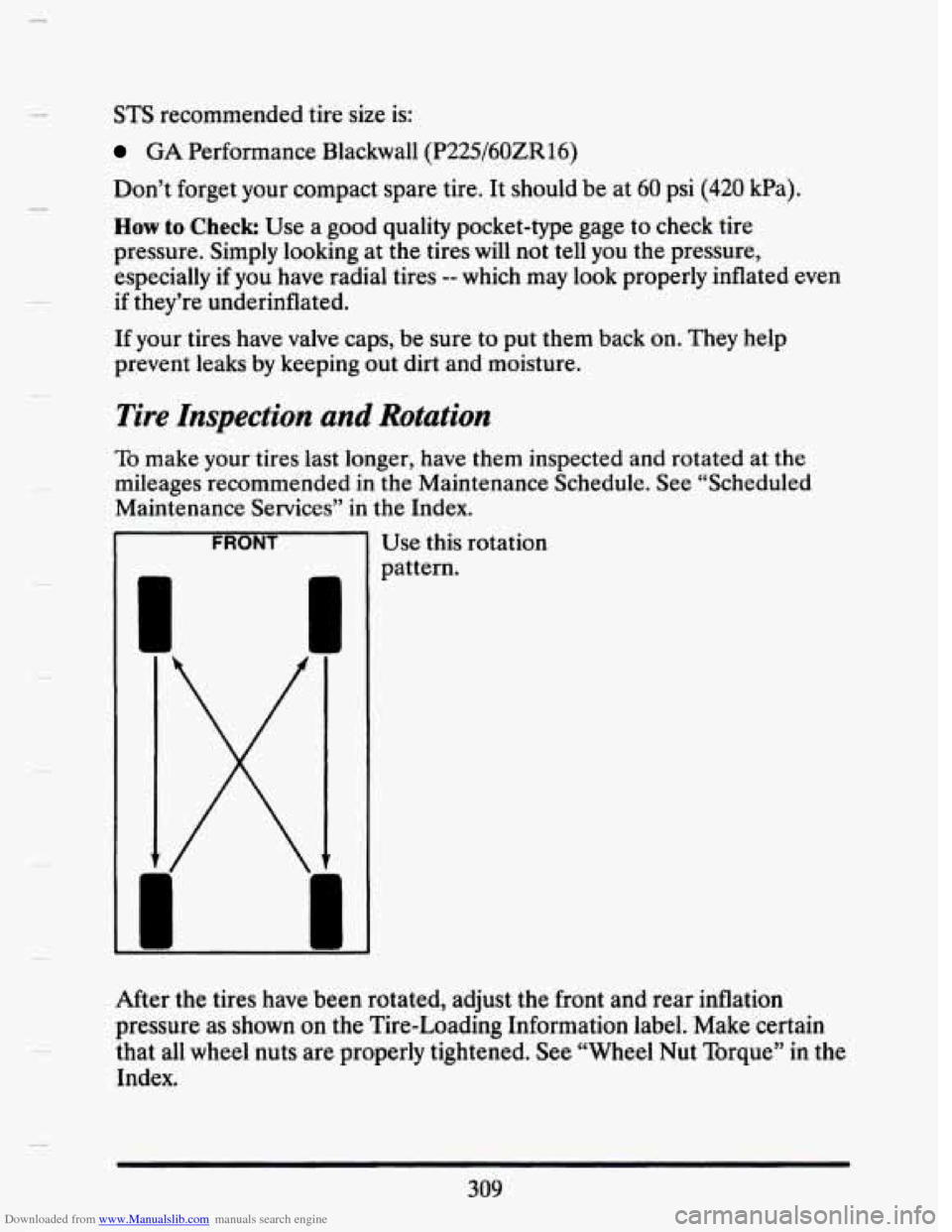
Tire Inspection and Rotation
To make your tires last longer, have them inspected and rotated at the
mileages recommended
in the Maintenance Schedule. See “Scheduled
Maintenance Services”
in the Index.
FRONT Use this rotation
pattern.
After the tires have been rotated, adjust the front and rear inflation
pressure as
shown on the Tire-Loading Information label. Make certain
that
all wheel nuts are properly tightened. See “Wheel Nut Torque’’ in the
Index.
309
Page 325 of 407
Downloaded from www.Manualslib.com manuals search engine -
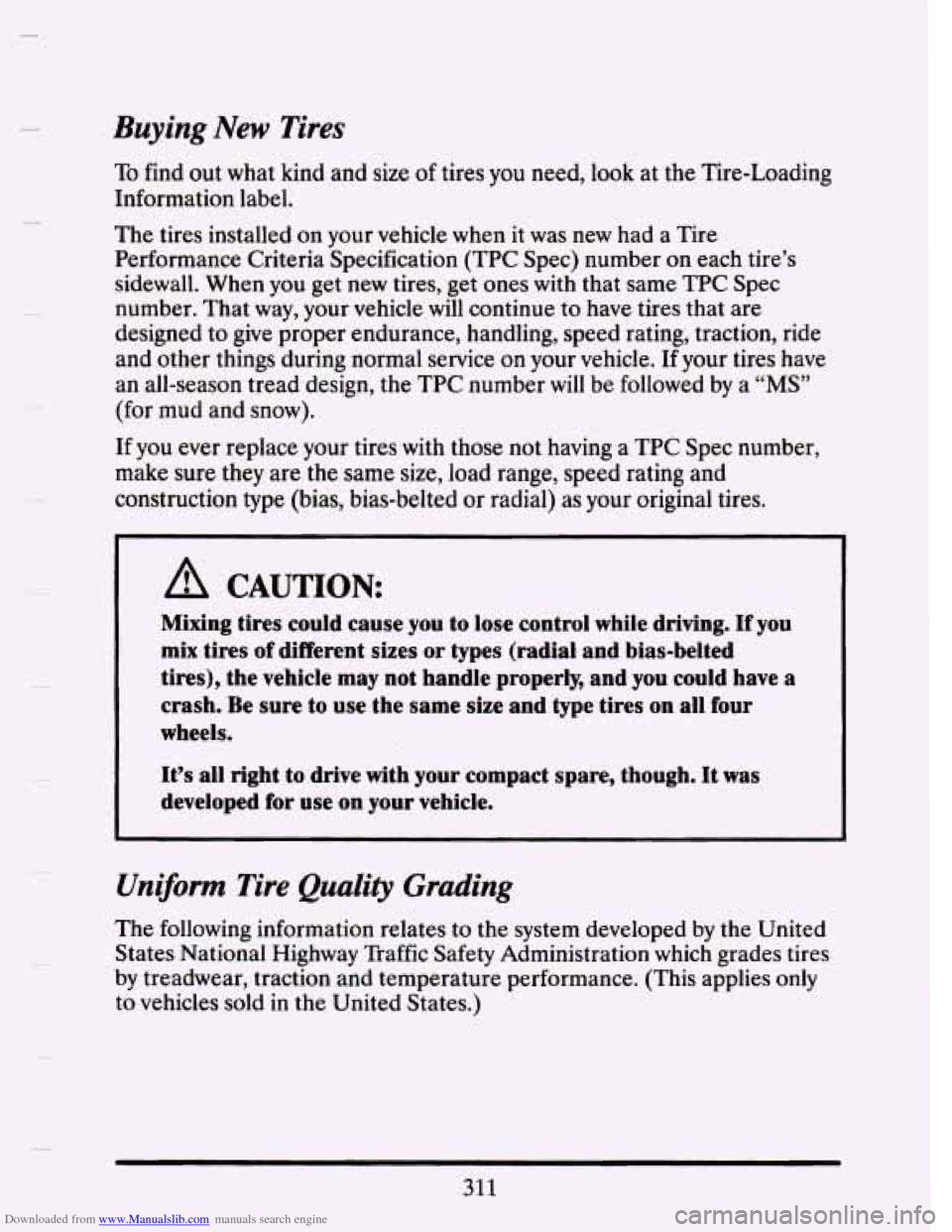
Buying New Tires
To find out what kind and size of tires you need, look at the Tire-Loading
Information label.
The tires installed
on your vehicle when it was new had a Tire
Performance Criteria Specification
(TPC Spec) number on each tire’s
sidewall. When you get new tires, get ones with that same
TPC Spec
number. That way, your vehicle will continue to have tires that are
designed to give proper endurance, handling, speed rating, traction, ride
and other things during normal service
on your vehicle. If your tires have
an all-season tread design, the
TPC number will be followed by a “MS”
(for mud and snow).
If you ever replace your tires with
those not having a TPC Spec number,
make sure they are the same size, load range, speed rating and
construction type
(bias, bias-belted or radial) as your original tires.
A CAUTION:
Mixing tires could cause you to lose control while driving. If you
mix tires of different sizes or types (radial and bias-belted
tires), the vehicle
may not handle properly, and you could have a
crash. Be sure to use the same size and type tires on all four
wheels.
It’s
all right to drive with your compact spare, though. It was
developed for use
on your vehicle.
Uniform Tire Quality Grading
The following information relates to the system developed by the United
States National Highway Traffic Safety Administration which grades tires
by treadwear, traction and temperature performance. (This applies only
to vehicles sold
in the United States.)
311
Page 327 of 407
Downloaded from www.Manualslib.com manuals search engine While the tires available as standard or optional equipment on General
Motors vehicles may vary with respect to these grades, all such tires meet
General Motors performance standards and have been approved for use
on General Motors vehicles. All passenger type (P Metric) tires must
conform to Federal safety requirements
in addition to these grades.
Wheel Alignment and Tire Balance
The wheels on your vehicle were aligned and balanced carefully at the
factory to give you the longest tire
life and best overall performance.
In most cases,
you will not need to have your wheels aligned again.
However,
if you notice unusual tire wear or your vehicle pulling one way
or the other, the alignment may need to be reset. If you notice your
vehicle vibrating when driving on a smooth road, your wheels may need
to be rebalanced.
meel Replacement
Replace any wheel that is bent, cracked or badly rusted. If wheel nuts
keep coming loose, the wheel, wheel bolts,
and wheel nuts should be
replaced. If the wheel leaks air out, replace it (except some aluminum
wheels, which can sometimes be repaired). See your Cadillac dealer if any
of these conditions exist.
Your dealer
will know the kind of wheel you need.
Each new wheel should have the same load carrying capacity, diameter,
width, offset, and be mounted the same way as the one it replaces.
If you need to replace any of your wheels, wheel bolts, or wheel nuts, replace
them only with new
GM original equipment parts. This way, you will be sure
to have the right wheel, wheel bolts, and wheel nuts for your Ca\
dillac model.
A CAUTION
Using the wrong replacement wheels, wheel bolts, or wheel nuts \
on your vehicle can be dangerous. It could affect the
braking
and handling of your vehicle, make your tires lose air and make
you lose control. You could have a collision in which you or
others could be injured. Always use the correct wheel, wheel
bolts, and wheel
nuts for replacement.
313
Page 330 of 407
Downloaded from www.Manualslib.com manuals search engine CLEANING THE INSIDE OF YOUR
CADILLAC
Use a vacuum cleaner often to gct rid of dwt i1rlll I~HIW dirt. \! ~pc t int I
with a clean, damp cloth.
Your Cadillac dealer has
two GM cleaners -- a solvent-type spot lifter and
a foam-type powdered cleaner. They
will clean normal spots and stains
very well.
Here are some cleaning tips:
Always read the instructions on the cleaner label.
Clean up stains as soon as you can -- before they set.
Use a clean cloth or sponge, and change to a clean area often. A soft
0 Use solvent-type cleaners in a well-ventilated area only. If you use
brush
may be used
if stains are stubborn.
them, don't saturate the stained area.
0 If a ring forms after spot cleaning, clean the entire area immediately
or it will set.
316
Y
c-
Page 338 of 407
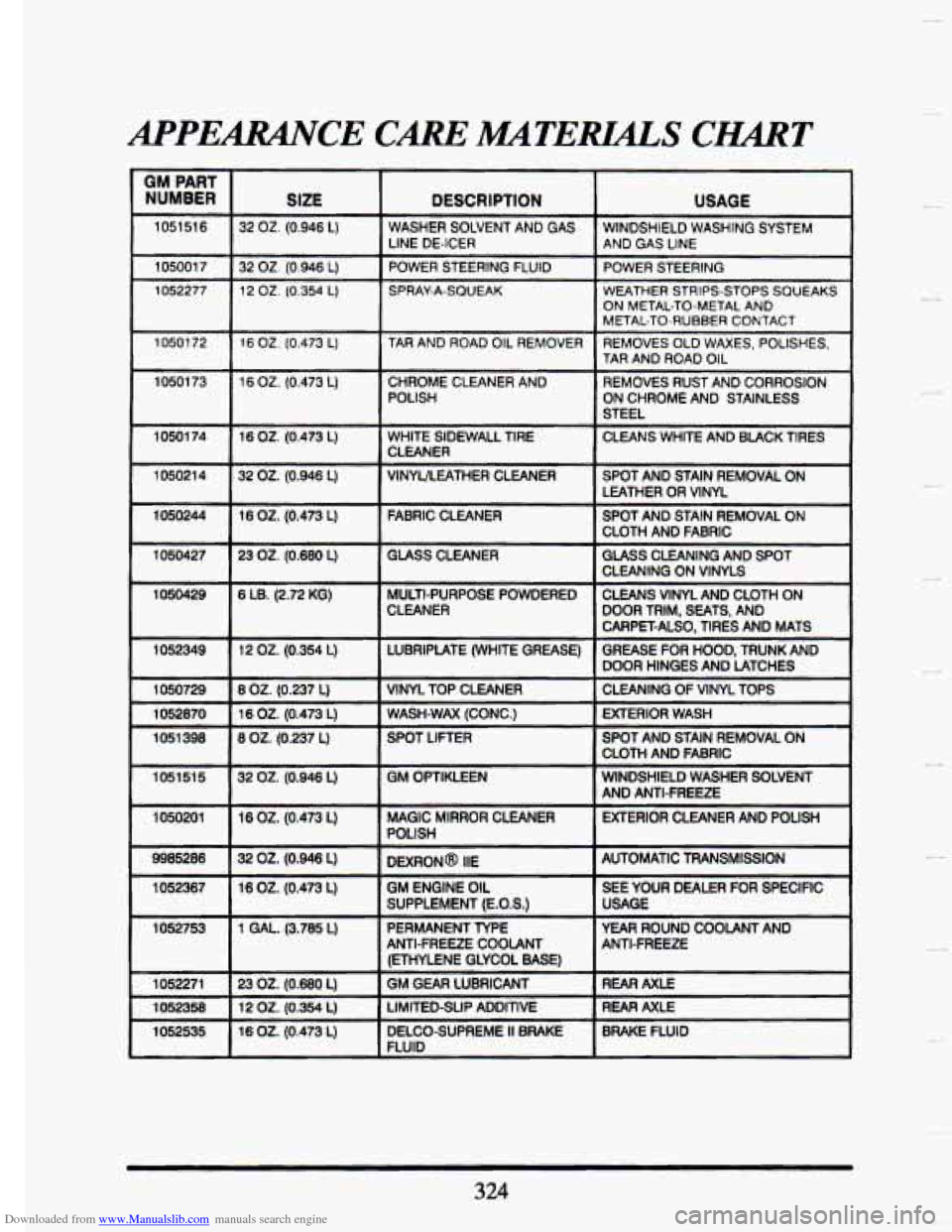
Downloaded from www.Manualslib.com manuals search engine MPERACE CAREIMATERL4LS ClYART
NUMBER
I 1050017 I 32 OZ. 10.946 Ll
1052277 12 02. (0.354 L)
10501 72 16 02. (0.473 L)
1050173 16 02. (0.473 L)
10501 74
32
OZ. (0.946 L) 1050214 16
OZ. (0.473 L)
1050244
6
LB. (2.72 KG) 1050429 23
02. (0.660 L) 1050427 16
OZ. (0.473 L)
1052349
8 OZ. (0.237 L) 1050729 12
02. (0.354 L)
+
1052870 16 OZ. (0.473 L)
1051
398 8 OZ. (0.237 L)
1 105151 5 I 32 02. (0.946 L)
+
1052367 16 02. (0.473 L)
1052753 1 GAL. (3.785 L)
1052271 I 23 02. (0.680 L)
1052358 I 12 OZ. 10.354 LI
I 1052535 I 16 OZ. (0.473 L)
DESCRIPTION
WASHER SOLVENT AND GAS
LINE DE-ICER
POWER STEERING FLUID SPRAY-A-SQUEAK
TAR AND ROAD OIL REMOVER
USAGE
WINDSHIELD WASHING SYSTEM AND GASCINE
POWER STEERING
WEATHER STRIPS-STOPS SQUEAKS ON METAL-TO-METAL AND METAL-TO-RUBBER CONTACT
REMOVES OLD WAXES, POLISHES,
I TAR AND ROAD OIL
CHROME CLEANER AND
I REMOVES RUST AND CORROSION
POLISH ON CHROMEAND STAINLESS I STEEL
WHITE SIDEWALL TIRE CLEANS WHITE AND BLACK TIRES
CLEANER
VINYULEATHER CLEANER
SPOT AND STAIN REMOVAL
ON FABRIC CLEANER SPOT AND STAIN REMOVAL
ON
. ___
LEATHER OR VINYL
CLOTH AND FABRIC
I
GLASS CLEANER I GLASS CLEANING AND SPOT I CLEANING ON VINYLS
MULTI-PURPOSE POWDERED
I CLEANS VINYL AND CLOTH ON
CLEANER
I DOOR TRIM, SEATS, AND
CARPET-ALSO. TIRES AND MATS
DOOR HINGES AND LATCHES
WASH-WAX (CONC.) EXTERIOR WASH
I CLOTH AND FABRIC
GM OPTIKLEEN
f WINDSHIELD WASHER SOLVENT
MAGIC MIRROR CLEANER
POLISH AND ANTI~FREEZE
EXTERIOR CLEANER AND POLISH
I
DEXRONQ HE I AUTOMATIC TRANSMISSION
GM ENGINE OIL
(ETHYLENE GLYCOL BASE) ANTI-FREEZE
ANTI-FREEZE COOLANT
YEAR ROUND COOLANT AND PERMANENT TYPE
USAGE
SUPPLEMENT (E.O.S.) SEE YOUR DEALER
FOR SPECIFIC
GM GEAR LUBRICANT
REAR AXLE
LIMITEDSLIP ADDITIVE I REAR AXLE
DELCO-SUPREME II BRAKE I BRAKE FLUID
324
I