1993 BUICK REGAL light
[x] Cancel search: lightPage 175 of 308
Safety Chains
You should always attach chains between your vehicle
and your trailer. Cross the safety chains under the
tongue of the trailer
so that the tongue will not drop to
the road if it becomes separated from the hitch.
Instructions about safety chains may be provided by the
hitch manufacturer or by the trailer manufacturer.
Follow the manufacturer’s recommendation for
attaching safety chains. Always leave just enough slack
so you can turn with your rig. And, never allow safety
chains to drag on the ground.
Trailer Brakes
If your trailer weighs more than 1,000 pounds (450 kg)
loaded, then it needs
its own brakes -- and they must be
adequate. Be sure
to read and follow the instructions for
the trailer brakes
so you’ll be able to install, adjust and
maintain them properly. If your vehicle has anti-lock
brakes, do not try
to tap into your vehicle’s brake
system. If you do, both brake systems won’t work well,
or at all. Even if your vehicle doesn’t have anti-lock
brakes, don’t tap into your vehicle’s brake system if
the
trailer’s brake system will use more than 0.02 cubic inch
(0.3 cc) of fluid from your vehicle’s master cylinder. If it
does, both braking systems won’t work well.
You could
even
lose your brakes.
Will the trailer brake parts take 3,000 psi (20 650
kPa) of pressure? If not, the trailer brake system
must not be used with your vehicle.
If everything checks out this far, then make the brake
fluid tap at the upper rear master cylinder port. But
don’t
use copper tubing for this. If you do, it will
bend and finally break
off. Use steel brake tubing.
Driving with a Trailer
Towing a trailer requires a certain amount of experience.
Before setting out for
the open road, you’ll want to get
to know your rig. Acquaint yourself with the feel of
handling and braking with the added weight of the
trailer. And always keep
in mind that the vehicle you are
driving is
now a good deal longer and not nearly so
responsive as your vehicle is by itself.
Before you start, check the trailer hitch and platform,
safety chains, electrical connector, lights, tires and
mirror adjustment. If the trailer has electric brakes, start
your vehicle and trailer moving and then apply the
trailer brake controller by hand to be sure
the brakes are
working. This lets you check your electrical connection
at the same time.
During your trip, check occasionally
to be sure that the
load is secure, and that the lights and any trailer brakes
are still working.
172
ProCarManuals.com
Page 176 of 308
Following Distance
Stay at least twice as far behind the vehicle ahead as you
would when driving your vehicle without a trailer. This
can help you avoid situations that require heavy braking
and sudden turns.
Passing
You’ll need more passing distance up ahead when
you’re towing a trailer. And, because you’re a good deal
longer,
you’ll need to go much farther beyond the
passed vehicle before
you can return to your lane.
Backing Up
Hold the bottom of the steering wheel with one hand.
Then, to move the trailer to the left, just move that hand
to the left. To move the trailer to the right, move your
hand to the right. Always back up slowly and, if
possible, have someone guide you.
Making Turns
When you’re turning with a trailer, make wider turns
than normal.
Do this so your trailer won’t strike soft
shoulders, curbs, road signs, trees, or other objects.
Avoid jerky or sudden maneuvers. Signal well in
advance.
firn Signals When Towing a Trailer
When you tow a trailer, your vehicle has to have a
different turn signal flasher and extra wiring. The green
arrows on your instrument panel will flash whenever
you signal a turn or lane change. Properly hooked up,
the trailer lights will also flash, telling other drivers
you’re about to turn, change lanes or stop.
When towing a trailer, the green arrows
on your
instrument panel will flash for turns even if the bulbs on
the trailer are burned out.
Thus, you may think drivers
behind you are seeing your signal when they are not.
It’s
important to check occasionally to be sure the trailer
bulbs are still working.
Driving On Grades
Reduce speed and shift to a lower gear before you start
down a long or steep downgrade. If
you don’t shift
down, you might have to use your brakes
so much that
they would get hot and no longer work well.
On a long uphill grade, shift down and reduce your
speed to around
45 mph (70 km/h) to reduce the
possibility of engine and transaxle overheating.
If you are towing a trailer that weighs more than
1,000
pounds ( 450 kg), and you have an automatic transaxle
with Overdrive, you may prefer to drive in
“D” instead
of Overdrive
(or, as you need to, a lower gear).
174
ProCarManuals.com
Page 180 of 308
k
Hazard Warning Flashers
3
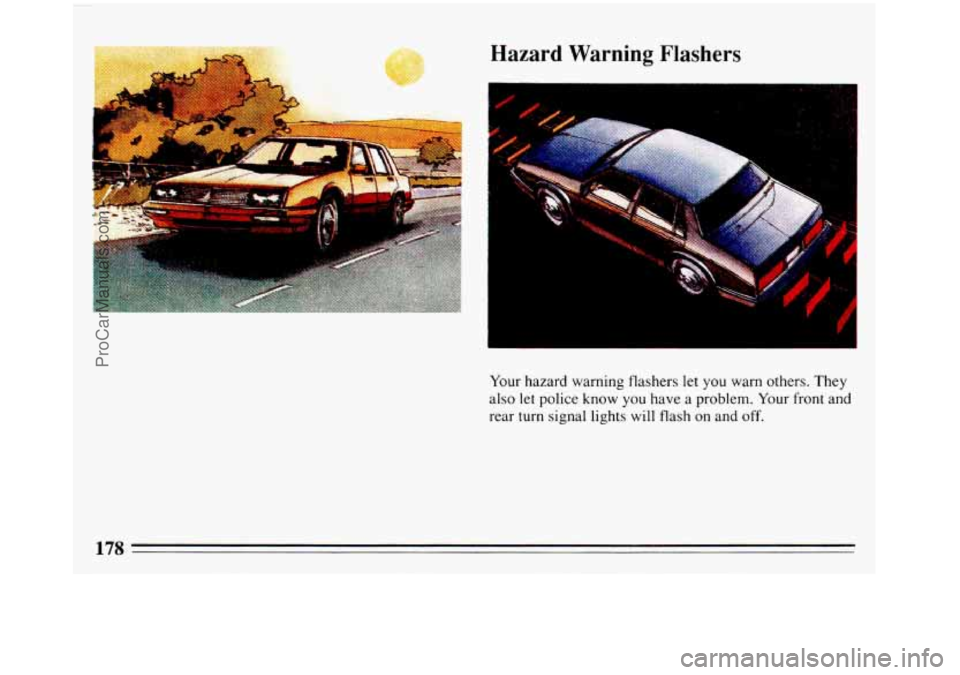
Your hazard warning flashers let you warn others. They
also let police know
you have a problem. Your front and
rear turn signal lights will flash
on and off.
ProCarManuals.com
Page 181 of 308
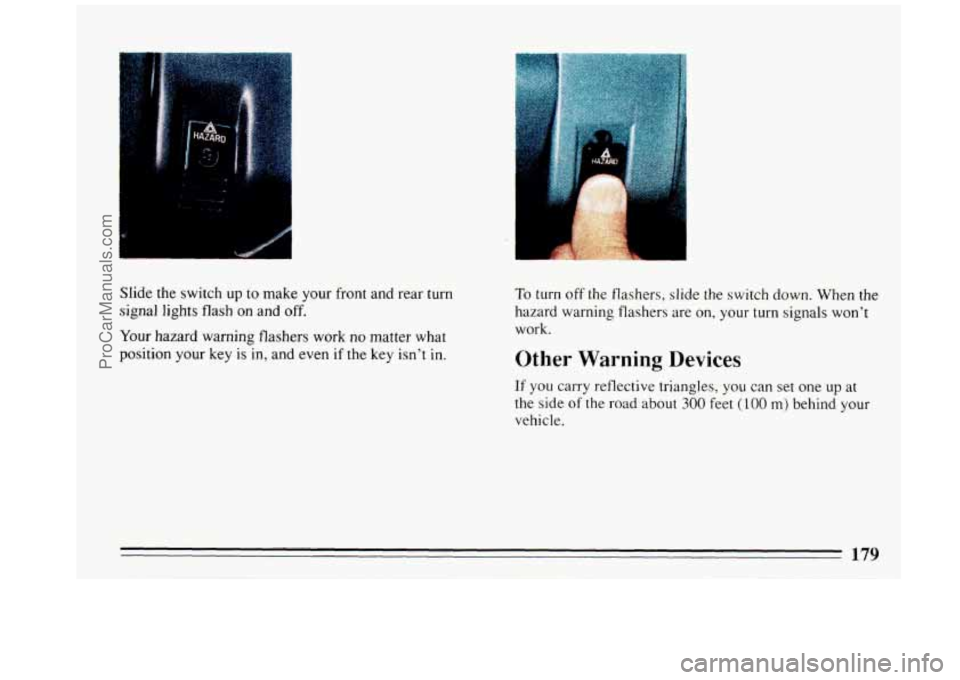
Slide the switch up to make your front and rear turn
signal lights flash
on and off.
Your hazard warning flashers work no matter what
position your key is in, and even
if the key isn’t in.
1
To turn off the flashers, slide the switch down. When the
hazard warning flashers are on, your turn signals won’t
work.
Other Warning Devices
If you carry reflective triangles, you can set one up at
the side
of the road about 300 feet (100 m) behind your
vehicle.
179
ProCarManuals.com
Page 183 of 308

1 CAUTION:
You could be injured if the vehicles roll. Set the
parking brake firmly on each vehicle. Put an
automatic transaxle
in “P” (Park) or a manual
transaxle
in “N” (Neutral).
3. Turn off the ignition on both vehicles. Turn off all
lights that aren’t needed, and radios. This will avoid
sparks and help save both batteries. And it could
save your radio!
4. Open the hoods and locate the batteries.
I
I A CAUTION:
An electric fan can start up even wheVv the engine
is not running and can injure you. Keep hands,
clothing and
tools away from any underhooc‘
electric
fan.
Find the positive (+) and negative (-) terminals on
each battery.
Your Buick has a remote positive (+)jump starting
terminal. The terminal is on the same side
of the
engine compartment as your battery.
You should always use the remote positive (+)
terminal instead of the positive (+) terminal on your
battery.
To uncover the remote positive (+) terminal, lift the
red plastic cap.
181
ProCarManuals.com
Page 184 of 308
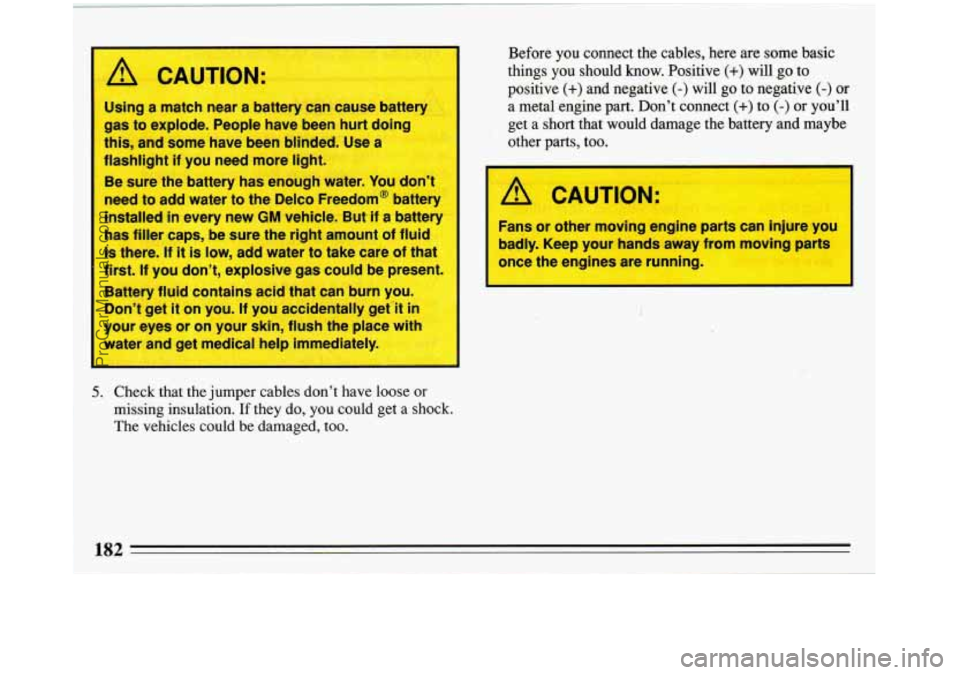
1
I A CAUTION:
Using a match near a battery can cause battery
this, and some have been blinded. Use a
I gas to explode. People have been hurt doing
I
I flashlight if you need more light.
Be sure the battery has enough water. You don‘-
need to add water
to the Delco Freedom@ battery
installed
in every new GM vehicle. But if a battery
has filler caps, be sure the right amount of fluid
is there. If it is low, add water to take care of that
First. If you don’t, explosive gas could be present.
Battery fluid contains acid that can burn you.
Don’t get
it on you. If you accidentally get-it in
your eyes or on your skin, flush the place with
water and get medical help immediately.
1 I
5. Check that the jumper cables don’t have loose or
missing insulation. If they do, you could get a shock.
The vehicles could
be damaged, too.
I
Before you connect the cables, here are some basic
things
you should know. Positive (+) will go to
positive
(+) and negative (-) will go to negative (-) or
a metal engine
part. Don’t connect (+) to (-) or you’ll
get a short that would damage the battery and maybe
other
parts, too.
I A CAUTION:
Fans or other moving engine parts can injure you
badly. Keep your hands away from moving parts
I once the engines are running.
l 182
ProCarManuals.com
Page 194 of 308
Engine Overheating
You will find a coolant temperature gage on your
Buick's instrument panel.
You may also find a low coolant warning light
on your
Buick instrument panel.
If Steam Is Coming From Your Engine:
A CAUTION:
Steam from an overheated engine can burn you
badly, even
if you just open the hood. Stay away
from the engine
if you see or hear steam coming
from it. Just turn
it off and get everyone away
from the vehicle until it cools down. Wait
until
there is no sign of steam or coolant before
opening the hood.
'* -7ou keep driving when your engine is
overheated, the liquids
in it can catch fire. You or
others could be badly burned. Stop your engine
if it overheats, and get out of the vehicle until the
engine is cool.
If your engine catch
driving with
no coolant, your vehicle can be
badly damaged. The costly repairs
w?uld not b
covered by your warranty. ,, , 1 ,.
I If No Steam Is Coming From Your Engine:
If you get the overheat warning but see or hear no
steam,
the problem may not be too serious. Sometimes
the engine can get a little too hot when you:
0 Climb a long hill on a hot day.
0 Stop after high speed driving.
0 Idle for long periods in traffic.
Tow a trailer.
ProCarManuals.com
Page 212 of 308
A CAUTION:
Storing a jack, a tire or other equipment in the
passenger compartment
of the vehicle could
cause injury.
In a sudden stop or collision, loose
equipment could strike someone. Store all these
in the p-per place.
I
Compact Spare Tire
Although the compact spare was fully inflated when
your vehicle was new, it can lose air after a time. Check
the inflation pressure regularly. It should be
60 psi
(420 kPa). The compact spare is made to go up to 3,000
miles (5000 km), so you can finish your trip and have
your full-size tire repaired or replaced where you want.
Of course, it's best to replace your spare with a full-size
tire as
soon as you can. Your spare will last longer and
be in
good shape in case you need it again.
Your anti-lock brake system warning light may come
on
when you are driving with a compact spare. See
"Anti-Lock Brake System Warning Light"
in the Index.
NOTICE:
' Don't take your compact spare through an
automatic car wash with guide rails. The
compact spare can get caught
on the rails. Tha
can damage the tire and wheel, and maybe other
parts of your vehicle.
. :s:; ?<,. $3 I "' .. x. , ., . ", ,**~. I , z .. . . ... . ." . ..--;i.~""*rSl~~,~"." ~.~=:~~~~;~~~~;~,.~:,,~~~~~
Don't use your compact spare on some other vehicle.
And don't mix your compact spare or wheel with other
wheels
or tires. They won't fit. Keep your spare and its
wheel together.
Tire chains won't fit your compact spare. Using
them will damage your vehicle and destroy the
chains too. Don't use tire chains on your
g g*
compact spare. :&
s,,.-T +.?;:a: I--- b i ,, 2s: 7,' : *&".;&&;< S? ,.:~ 'p *. . yp& '?gPS ..ar.,%: __ . .,., _, < . '*Y ., .: ~ ,
ProCarManuals.com