Page 213 of 308
/;1 CAUTION:
I
Storing a jack, a tire, or other equipment in the
passenger compartment of the vehicle could
equipment could strike someone. Store
all the$$
in the proper place.
3use
injury. In a sudden stop or collision,
loose
!-
1
NOTICE:
Spinning your wheels can destroy parts of you1
vehicle
as well as the tires. If you spin the wheels
too fast while shifting your transaxle back and
forth, you
can destroy your transaxle
Aocking your vehicle to get it out:
If - You’re Stuck: In Sand; Mud’ Ice Or First, turn your steering wheel left and right. That will
Snow clear the area around your front wheels. Then shift back
What
you don’t want to do when your vehicle is stuck is and forth between “R” (Reverse) and a forward gear,
to spin your wheels. The method known as “rocking” spinning the wheels as little as possible. Release the
can help you get out when you’re stuck, but you must accelerator pedal while
you shift, and press lightly
on
use caution. the accelerator pedal when the transaxle is in gear. If
that doesn’t get
you out after a few tries, you may need
to be towed out. If you do need to be towed out, see
“Towing Your Vehicle”
in the Index.
IT you let your tires spin at h I speea, they can
explode and you or others could be injured. And
the transaxle or other parts of the vehicle can
overheat. That could cause an engine
compartment fire or other damage. When you’re
stuck, spin the wheels as little
as possible. Don’t
spin the wheels above
35 mph (55 km/h) as
shown on the speedometer.
211
ProCarManuals.com
Page 222 of 308
Before closing the hood, be sure all the filler caps are on
properly.
Then just pull the hood down and close it firmly.
Engine Oil
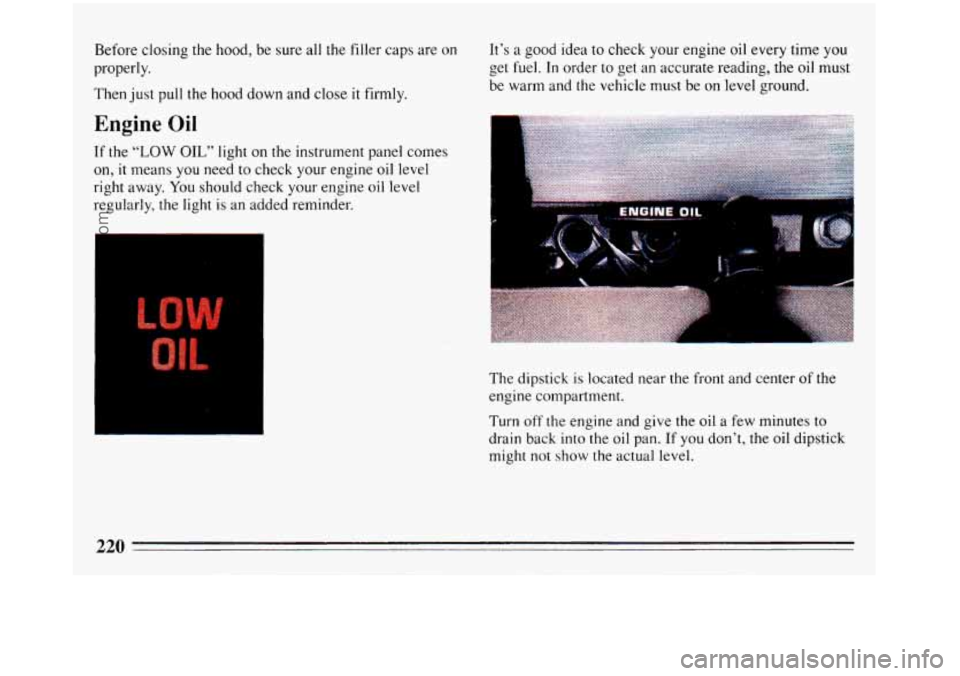
If the “LOW OIL” light on the instrument panel comes
on, it means you need to check your engine oil level
right away.
You should check your engine oil level
regularly, the light
is an added reminder. It’s
a good idea to check your engine oil every time you
get fuel.
In order to get an accurate reading, the oil must
be warm and the vehicle must be
on level ground.
The dipstick is located near the front and center
of the
engine compartment.
Turn
off the engine and give the oil a few minutes to
drain back into the oil pan. If you don’t, the oil dipstick
might not show the actual level.
ProCarManuals.com
Page 230 of 308
If the fluid level is low, add only enough of the proper
fluid to bring the level into the cross-hatched area on the
dipstick. It doesn’t take much fluid, generally less than a
pint. Don’t overfill. We recommend you use only fluid
labeled DEXRONB-IIE, because fluids with that label
are made especially for your automatic transaxle.
Damage caused by fluid other than DEXRONB-IIE is
not covered by your new vehicle warranty.
After adding fluid, recheck the fluid level as
described under “How
to Check.”
When the correct fluid level is obtained, push the
dipstick back in all the way.
Engine Coolant
The following explains your cooling system and how to
add coolant when
it is low. If you have a problem with
engine overheat.ing or if you need to add coolant to your
radiator, see “Engine Overheating”
in the Index.
The proper coolant for your Buick will:
0 Give freezing protection down to -34OF (-37OC) .
0 Give boiling protection up to 262 OF (128 “C) .
Protect against rust and corrosion.
0 Help keep the proper engine temperature.
0 Let the warning lights work as they should.
What to Use:
Use a mixture of one-half clean water (preferably
distilled) and one-half antifreeze that meets
“GM
Specification 1825-M,” which won’t damage aluminum
parts. You can also use a recycled coolant conforming to
GM Specification 1825-M with a complete coolant flush
and refill. Use GM Engine Coolant Supplement (sealer)
with any complete coolant change. If you use these, you
don’t need to add anything else.
can be aangerous. Plain water, or some other
liquid like alcohol, can boil before the proper
coolant mix will. Your vehicle’s coolant warning
system is set for the proper coolant mix. With
plain water or the wrong mix, your engine could
get too hot but you wouldn’t get the overhe-”
warning. Your engine could catch fire and
yuu or
others could be burned. Use a 50/50 mix of clean
water and a proper antifreeze.
G:~Z.+T~:, p:.t+d+s
228
ProCarManuals.com
Page 232 of 308
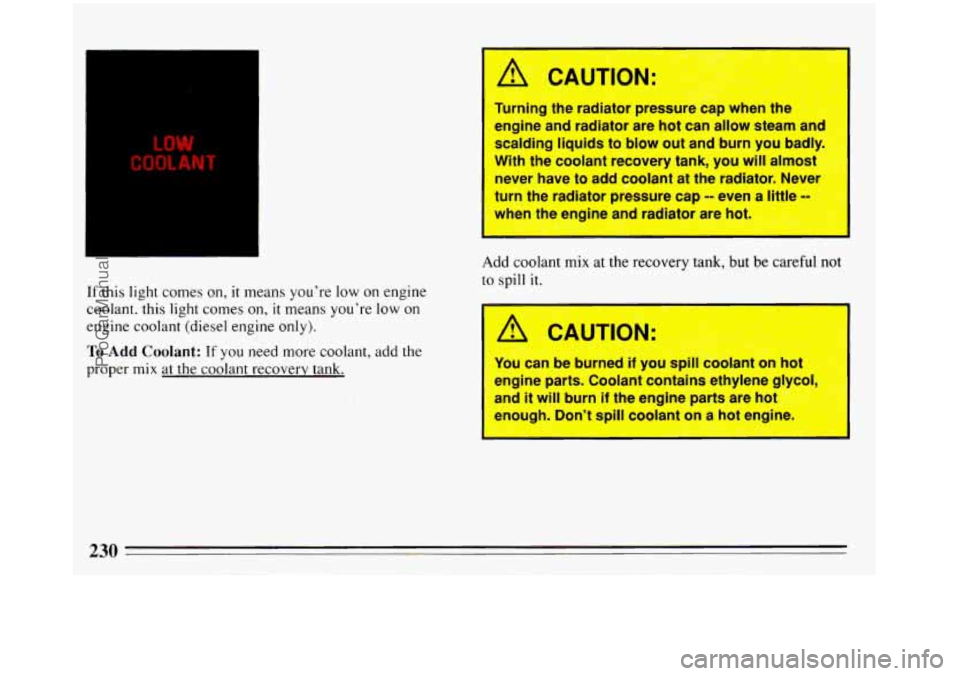
If this light comes on, it means you're low on engine
coolant. this light comes
on, it means you're low on
engine coolant (diesel engine only).
To Add Coolant: If you need more coolant, add the
proper mix at the coolant recovery tank.
A CAUTION:
Turning me raalaror pressure cap when the
--1gine and radiator are hot can allow steam ana
scalding liquids to blow out and burn you badly.
With the coolant recovery tank, you will almos'
never have to add coolant at the radiator. Never
turn the radiator pressure cap
-- even a little --
wt- -- +ha engine and radiator are hot.
Add coolant mix at the recovery tank, but be careful not
to spill it.
IU can be burned if you spill coolant on hot
gine parts. Coolant contains ethylene glycol,
and
it will burn if the engine parts are t
enough. Don't spill coolant on a hot engine.
230
ProCarManuals.com
Page 236 of 308
won’t work at all. So, it isn’t a good idea to “top off’
your brake fluid. Adding brake fluid won’t correct a
leak.
If you add fluid when your linings are worn, then
you’ll have too much fluid when you get new brake
linings. You should add (or remove) brake fluid,
as
necessary, only when work is done on the brake
hydraulic system.
a LAUTION:
1
If you have too much brake flui,, I. ;an sblll orl
the engine. The fluid will burn if the engine is hot
enough. You or others could be burned, and your
vehicle could be damaged. Add brake fluid only
when work is done on the brake hydraulic
-stem.
When your brake fluid falls to a low level, your brake
warning light will come on. See “Brake System Warning
Light” in the Index.
What to Add:
When you do need brake fluid, use only DOT-3 brake
fluid
-- such as Delco Supreme 11 @ (GM Part
N0.1052535). Use new brake fluid from a sealed
container only.
0
0
DOT-5 silicone brake fluid can damage
your vehicle. Don’t use it.
Don’t let someone put
in the wrong kind of
fluid. For example, just a few drops of
mineral-based oil, such as engine oil,
in
your brake system can damage brake
system parts
so badly that they’ll have to
be replaced.
Brake fluid can damage paint,
so be careful
not to spill brake fluid on your vehicle.
Replacing Brake System Parts
The braking system on a modern vehicle is complex. Its
many parts have to be
of top quality and work well
together if the vehicle is to have really good braking.
Vehicles we design and test have top-quality GM brake
parts in them, as your Buick does when
it is new. When
you replace parts of your braking system
-- for example,
when your brake linings wear down and
you have to
have new ones put in
-- be sure you get new genuine
GM replacement parts. If
you don’t, your brakes may no
longer work properly. For example, if someone puts
in
brake linings that are wrong for your vehicle, the
234
ProCarManuals.com
Page 238 of 308
Headlight bulbs can be changed as described by the
following procedure.
1. Remove the
electrical connector
(A) from the bulb
by raising the lock tab
(B) and pulling
the connector down
and away from the
bulb’s plastic base
(C).
2. Press and turn the plastic base (C) a 1/4 turn
counterclockwise and remove from the metal
retaining ring
(E) by gently pulling back and away
from
the headlight.
3. Install the new bulb by inserting the smallest tab (D)
located on top of the plastic base into the
corresponding
notch in the metal retaining ring (E).
Turn 1/4 turn clockwise until it stops. The small
plastic tab should be at the top
of the metal ring.
4. Install the electrical connector with slotted grooves
toward
to the front of vehicle.
Taillamp Bulb Replacement
ProCarManuals.com
Page 239 of 308
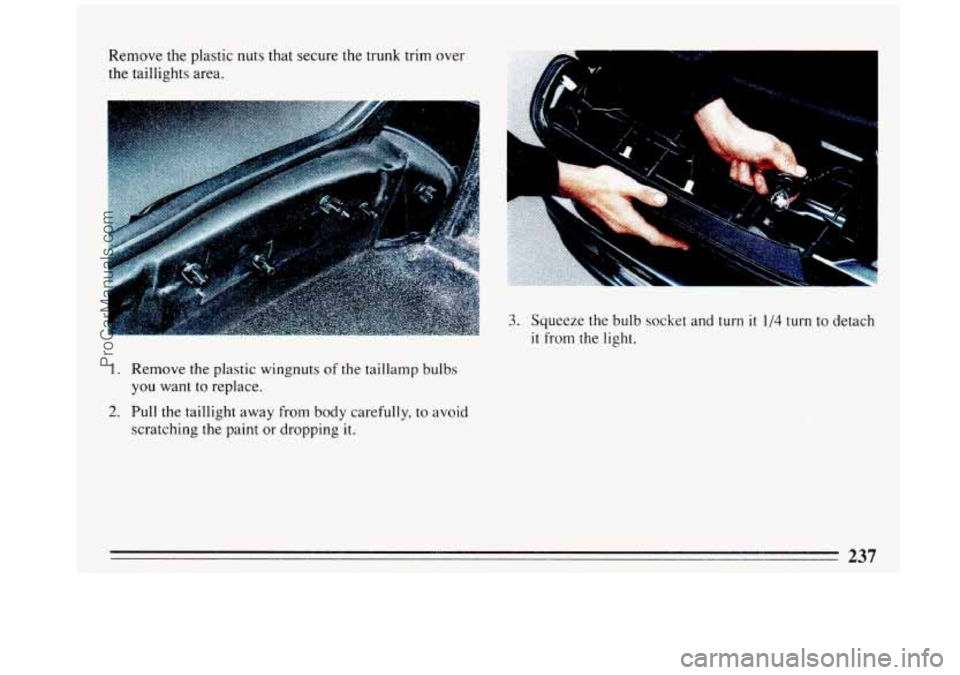
Remove the plastic nuts that secure the trunk trim over
the taillights area.
1. Remove the plastic wingnuts of the taillamp bulbs
you want
to replace.
2. Pull the taillight away from body carefully, to avoid
scratching the paint or dropping
it.
3. Squeeze the bulb socket and turn it 1/4 turn to detach
it from the light.
237
ProCarManuals.com
Page 240 of 308
I
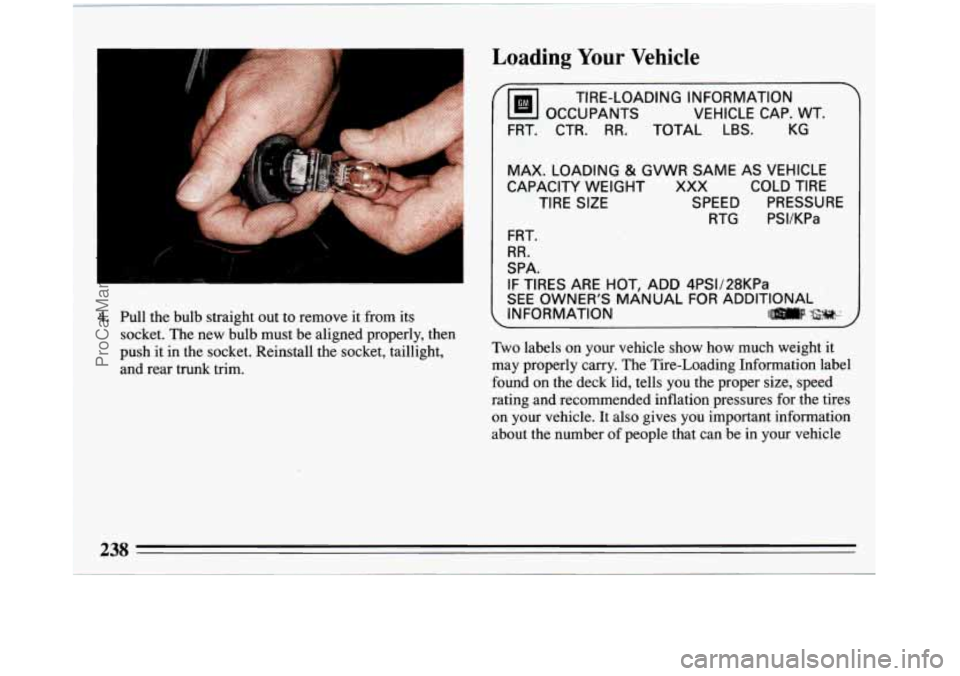
4. Pull the bulb straight out to remove it from its
socket. The new bulb must be aligned properly, then
push it in the socket. Reinstall the socket, taillight,
and rear trunk trim.
Loading Your Vehicle
OCCUPANTS VEHICLE CAP. WT.
TIRE-LOADING
INFORMATION
FRT. CTR.
RR. TOTAL LBS. KG
MAX. LOADING
& GVWR SAME AS VEHICLE
CAPACITY WEIGHT XXX COLD TIRE
TIRE SIZE SPEED PRESSURE RTG PSVKPa
FRT.
RR.
SPA. IF TIRES ARE HOT, ADD 4PSV28KPa
SEE OWNER'S MANUAL FOR ADDITIONAL
INFORMATION
ll]m' .$$;i#..:.
Two labels on your vehicle show how much weight it
may properly carry. The Tire-Loading Information label
found on the deck lid, tells you the proper size, speed
rating and recommended inflation pressures
for the tires
on your vehicle. It also gives you important information
about the number of people that can be in your vehicle
ProCarManuals.com