Page 50 of 4087
CONTROL FUNCTIONS
Interior Room Temperature Control System
(a) The desired temperature is set using the TEMP switch.
(b) From the input signals (room temperature sensor, ambient temperature sensor, evaporator temperaturesensor and solar sensor) and the temperature setting, the air conditioner con\
trol ECU determines the air
flow volume and outputs signals to the air mix servomotor.
(c) When it receives signals from the ECU, the air mix servomotor opens or close\
s the air mix damper to change the air flow temperature. When the temperature reaches the specified te\
mperature, it is detected
by the air mix damper position sensor and the ECU stops the servomotor.
HINT: If the desired temperature setting is 65 °F, the ECU forcedly sets the air mix damper to the Max Cool posi-
tion. If it is set at 85 °F, the ECU forcedly sets the air mix damper to the Max Hot position.
±
AIR CONDITIONING SYSTEM DescriptionAC±9
WhereEverybodyKnowsYourName
Page 51 of 4087
Blower Fan Speed Control System
(When AUTO Switch is ON)
(a) The desired temperature is set using the TEMP switch.
(b) From the input signals (room temperature sensor, ambient temperature sensor and solar sensor) and thetemperature setting, the air conditioner control ECU determines the air flow volume\
and outputs signals
to the power transistor.
(c) When it receives signals from the ECU, the power transistor increases or red\
uces the blower motor speed to control the air flow volume.
(When AUTO Switch is OFF)
The ECU turns the power transistor increasing or reducing the blower mot\
or speed fixing the air flow volume
in accordance with the position of the Manual switch. AC±10
±
AIR CONDITIONING SYSTEM Description
WhereEverybodyKnowsYourName
Page 52 of 4087
Air Flow Mode Control System
(When the AUTO Switch is ON)
(a) The desired temperature is set using the TEMP switch.
(b) From the input signals (room temperature sensor, ambient temperature sensor and solar sensor) and thetemperature setting, the air conditioner control ECU determines the air flow mode a\
nd outputs signals to
the mode servomotor and max cool servomotor.
(c) When it receives signals from the ECU, the servomotors open or close each of\
the dampers to change the air flow mode.
(When the AUTO Switch is OFF)
The ECU fixes the air flow mode in accordance with the Manual switch pos\
ition.
(When the Engine is Cold)
If the Mode is set on B/L or FOOT, the ECU forcedly changes the air vent to DEF if cold signals are input from
the water temperature sensor.
±
AIR CONDITIONING SYSTEM DescriptionAC±11
WhereEverybodyKnowsYourName
Page 53 of 4087
Air Inlet Control System
(When the AUTO Switch is ON)
(a) The desired temperature is set using the TEMP switch.
(b) From the input signals (room temperature sensor, ambient temperature sensor and solar sensor) and thetemperature setting, the air conditioner control ECU determines the air \
inlet and outputs signals to the air
inlet servomotor assembly.
(c) When it receives signals from the ECU, the air inlet servomotor opens or clo\
ses the damper to change the air inlet. When the air inlet is changed to the desired setting, it is detected by the air inlet damper p\
osition
sensor and the ECU stops the servomotor.
HINT: If the Mode switch is set on DEF, the ECU forcedly changes the air inlet to FRS.
(When the AUTO Switch is OFF)
The ECU fixes the air inlet according to the position of the manual swit\
ch. AC±12
±
AIR CONDITIONING SYSTEM Description
WhereEverybodyKnowsYourName
Page 62 of 4087
![LEXUS SC400 1991 Service Repair Manual
HOW TO PROCEED WITH TROUBLESHOOTING
Perform troubleshooting in accordance with the procedure on the following page.\
[1] CUSTOMER PROBLEM ANALYSIS Using the customer problem analysis check sheet for](/manual-img/36/57051/w960_57051-61.png "LEXUS SC400 1991 Service Repair Manual
HOW TO PROCEED WITH TROUBLESHOOTING
Perform troubleshooting in accordance with the procedure on the following page.\
[1] CUSTOMER PROBLEM ANALYSIS Using the customer problem analysis check sheet for")
HOW TO PROCEED WITH TROUBLESHOOTING
Perform troubleshooting in accordance with the procedure on the following page.\
[1] CUSTOMER PROBLEM ANALYSIS Using the customer problem analysis check sheet for reference, ask the c\
ustomer in as much detail as
possible about the problem. A subjective complaint such as ºpoor air conditio\
ner efficiencyº is also consid-
ered in the air conditioner complaints.
Therefore, in ºCustomer Problem Analysisº and ºProblem Symptom Confirmationº\
, check carefully to deter-
mine whether the level of performance is the actual (normal) level or whet\
her it is abnormal. Then perform
troubleshoot accordingly.
[2] CHECK AND CLEAR THE DIAGNOSTIC CODES (PRECHECK) First check the diagnostic codes to see if there are any malfunction cod\
es stored in memory. If there are
malfunction codes, make a note of them, then clear them and proceed to [3] problem \
Symptom Confirma-
tionº.
[3] PROBLEM SYMPTOM CONFIRMATION, [4] SYMPTOM SIMULATION Confirm the problem symptoms. If the problem does not reappear, be sure to simulate the problem by main-
ly checking the circuits indicated by the diagnostic code in step [2], u\
sing ºProblem Simulation Methodº.
[5] DIAGNOSTIC CODE CHECK
Check the diagnostic codes. Check for problems with the sensors or the w\
ire harness.
[6] DIAGNOSTIC CODE CHART If a malfunction code is confirmed in the diagnostic code check, proceed t\
o the check procedure indicated
by the matrix chart for each diagnostic code.
[7] MATRIX CHART OF PROBLEM SYMPTOMS
If the normal code is confirmed in the diagnostic code check, perform in\
spection in accordance with the
inspection order in the matrix chart of problem symptoms.
[8] CIRCUIT INSPECTION Proceed with diagnosis of each circuit in accordance with the inspection order c\
ofirmed in [6] and [7]. Deter-
mine whether the cause of the problem is in the sensor, actuators, wire harness and connectors, or the
ECU.
[9] ACTUATOR CHECK Check actuators for proper operation. Instructions for this diagnosis ar\
e given in the flow chart for each
circuit.
[10] REPAIRS After the cause of the problem is located, perform repairs by following the i\
nspection and replacement pro-
cedures in this manual.
[11] CONFIRMATION TEST
After completing repairs, confirm not only that the malfunction is elimi\
nated, but also perform diagnostic
code check and actuator check, etc. again to make sure the entire air condit\
ioning system is operating cor-
rectly.
AC±22
±
AIR CONDITIONING SYSTEM REPAIR INSTRUCTIONS
WhereEverybodyKnowsYourName
Page 67 of 4087
, check the circuit listed for
that code in the table below (Proceed to the page given for th")
DIAGNOSTIC CODE CHART
If a malfunction code is displayed during the diagnostic code check (sens\
or check), check the circuit listed for
that code in the table below (Proceed to the page given for that circuit.)\
Code No.Diag. Code Detecting Condition
00� Normal
11 *1� Open or short in room temperature sensor circuit.
12� Open or short in ambient temperature sensor circuit.
13� Open or short in evaporator temperature sensor circuit.
14*2� Open or short in water temperature sensor circuit.
21*3� Open in solar sensor circuit.
21*3
� Short in solar sensor circuit.
22*4
� All conditions below are detected for 3 secs. or more.
� (a) Engine rpm : 450 rpm or more.
� (b) Ratio between engine and compressor rpm deviates 20% or more in c\
omparison to normal
operation.
23
� Open in pressure sensor circuit.
� Abnormal refrigerant pressure below 206 kPa (2.1 kgf/cm, 30 psi)
over 2,650 kPa (27 kgf/cm, 385 ps\
i)
31� Short to ground or power source circuit in Air Mix Damper position sens\
or circuit.
32� Short to ground or power source circuit in Air Inlet Damper position se\
nsor circuit.
33� Short to ground or power source circuit in Air Outlet Damper position s\
ensor circuit.
41� Air mix damper position sensor value does not change even if ECU operat\
es air mix servomotor.
42� Air inlet damper position sensor value does not change even if ECU oper\
ates air inlet servomotor.
43� Air outlet damper position sensor value does not change even if ECU ope\
rates air outlet
servomotor.
HINT: *1 If the room temp. is approx. ±20 °C (±4 °F) or lower, code 11 may be output even though the system
is normal.
*2 If the ambient temperature is approx. ±50 °C (±58 °F) or lower, a malfunction code may be output
even though the system is normal.
*3 If the check is being performed in a dark place, diagnostic code 21 (so\
lar sensor circuit abnormal) could be displayed.
In this case, perform diagnostic code check again while shining a light,\
such as an inspection light,
on the solar sensor.
If code 21 is still displayed, there could be trouble in the solar senso\
r circuit
AC±28
±
AIR CONDITIONING SYSTEM Troubleshooting
WhereEverybodyKnowsYourName
Page 70 of 4087
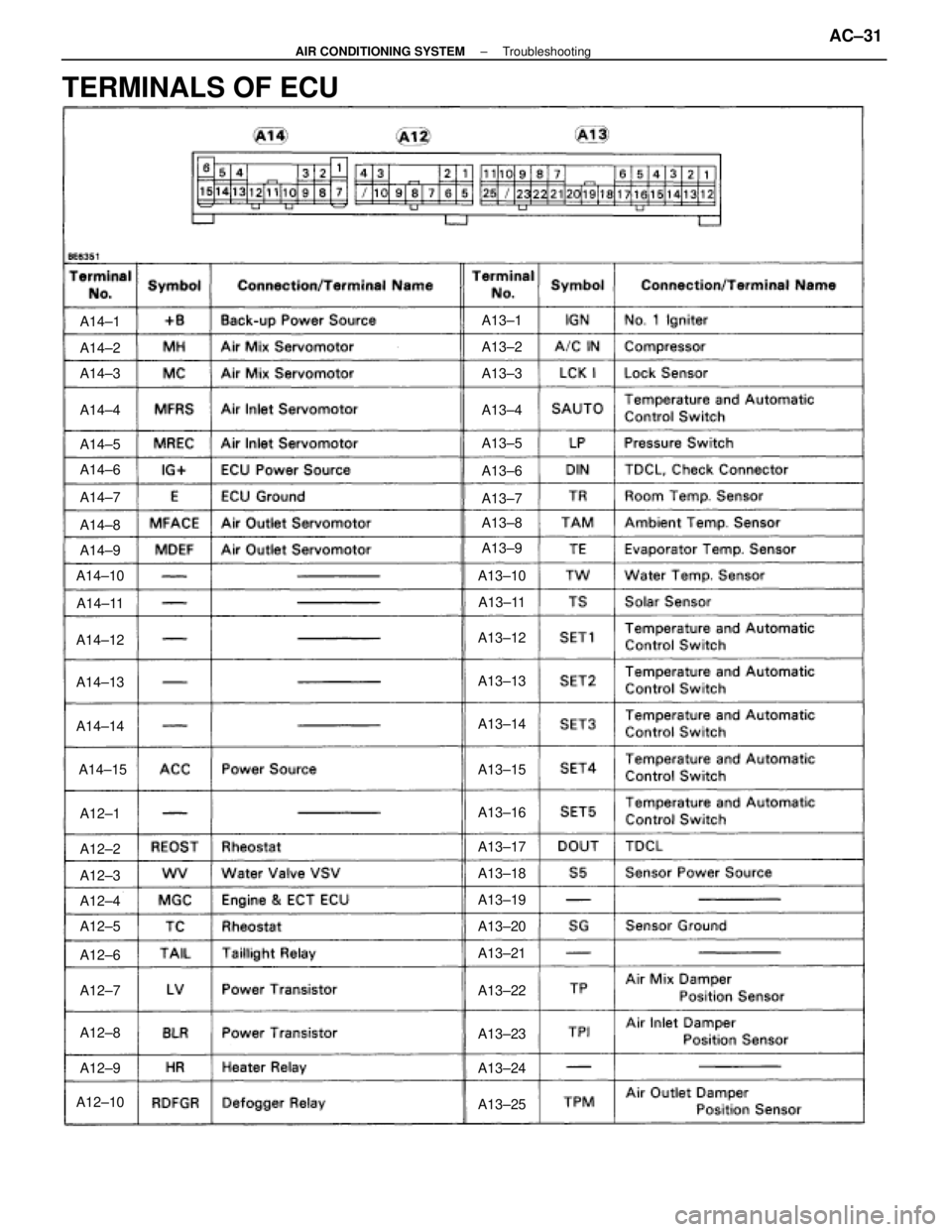
A14±1
A14±2
A14±3
A14±4
A14±5
A14±6
A14±7
A14±8
A14±9
A14±10
A14±11
A14±12
A14±13
A14±14
A12±1
A14±15
A12±2
A12±3
A12±4
A12±5
A12±6
A12±7
A12±8
A12±9
A12±10A13±25
A13±24
A13±23
A13±22
A13±21
A13±20
A13±19
A13±18
A13±17
A13±16
A13±15
A13±14
A13±13
A13±12
A13±11
A13±10
A13±9
A13±8
A13±7
A13±6
A13±5
A13±A13±4
A13±3
A13±2
A13±1
TERMINALS OF ECU
±
AIR CONDITIONING SYSTEM TroubleshootingAC±31
WhereEverybodyKnowsYourName
Page 71 of 4087

STANDARD VALUE OF ECU TERMINAL
TerminalsSymbolsWiringColorConditionStandardValue
A14±1�A14±7B� ER� W±BIG OFF10 ~ 14 V
A14±2 �A14±3MH �MCV� R±YIG OFF13 ~ 19 �
A14±4�A14±5MFRS�MRECG� G±RIG OFF13 ~ 19 �
A14±6�A14±7IG+ �ER±L �W±BIG ON10 ~ 14 V
Body
A14±7 �
Ground Body
E �
Ground Body
W±B �
GroundAlwaysBelow 1 �
A14±8�A14±9FACE �DEFW� Y±LIG OFF13 ~ 19 �
A14±15�A14±7ACC �EL±R �W±BTurn ignition switch ACC10 ~ 14 V
A12±2 �A14±7REOST �EW±G �W±B
IG ON and turn headlight control SW
to TAIL position.
Turn Rheostat volume from most
right to left position.
Most
: 0 ~ 14 V
Right
�
Most
: 10 ~ 14 V
Left
A12 3 �A14 7WV �EBY �WB
Start
the
MAX
Temp. Control Switch:
COLDBelow 1 V
A12±3 �A14±7WV �EB±Y �W±Btheen-
gine MAX
Temp. Control Switch:
HOT10 ~ 14 V
A12 4 �A14 7MGC �ELR �WB
Start the
engine andA/C switch ONBelow 1 V
A12±4 �A14±7MGC�EL±R �W±Bengine andpush AUTO
SWA/C switch OFF10 ~ 14 V
A12 5 �A14 7TC �EL� WBIG ONHLC SW
Rheostat Most
:
Volume RightBelow 1 V
A12±5 �A14±7TC�EL� W±BH.L.C. SW
: TAIL positionRheostat Turn
:
Volume Left10 ~ 14 V
A12±6 �A14±7TAIL �EG� W±BTurn the light control switch to TAILposition10 ~ 14 V
A12±7A14±7LV EYW±BIG ONPush blower SW to change
the blower speed from 1 to
10.Speed 1: 10 ~ 14 V
�
Speed 10: Below 2 V
A12±8 �A14±7BLR �EB±R �W±BIG ONTurn the blower motorBelow 1.5 V
A12±9 �A14±7HR �EL±W �W±B
IG ON
Turn the blower motorBelow 1 V
IG ONDon't turn the blower motor10 ~ 14 V
A12 10 �A14 7RDFGR �ERY �WBIG ON
Rear defogger switch ONBelow 1 V
A12±10 �A14±7RDFGR� ER±Y �W±BIG ONRear defogger switch OFF10 ~ 14 V
A13±1 �A14±7IGN �E�BW±BStart the engine10 ~ 14 V
AC±32±
AIR CONDITIONING SYSTEM Troubleshooting
WhereEverybodyKnowsYourName