Page 30 of 4087

HOW TO USE THE DIAGNOSTIC CHART AND INSPECTION
PROCEDURE
1. For troubleshooting, diagnostic code charts or problem symptom charts are p\
rovided for each circuit withdetailed inspection procedures on the following pages.
2. When all the component parts, wire harnesses and connectors of each circuit \
except the ECU are found to be normal in troubleshooting, then it is determined that the problem \
is in the ECU.
Accordingly, if diagnosis is performed without the problem symptoms occurring, the \
instruction will be to
check and replace the ECU, even if the problem is not in the ECU. So, al\
ways confirm that the problem
symptoms are occurring, or proceed with inspection while using the sympt\
om simulation method.
3. The instructions ºCheck wire harness and connectorº and ºCheck and\
replace ECUº which appear in the inspection procedure, are common and applicable to all diagnostic codes.\
Follow the procedure outlined
below whenever these instructions appear.
Check Wire Harness and Connector
The problem in the wire harness or connector is an open circuit or a short \
circuit.
OPEN CIRCUIT:
This could be due to a disconnected wire harness, faulty contact in the conn\
ector, a connector terminal pulled
out, etc.
HINT:
1. It is rarely the case that a wire is broken in the middle of it. Most cases occur at the connector. Inparticular, carefully check the connectors of sensors and actuators.
2. Faulty contact could be due to rusting of the connector terminals, to foreign materials entering terminals or a drop in the contact pressure between the male and female terminals of th\
e connector.
Simply disconnecting and reconnecting the connectors once changes the conditio\
n of the
connection and may result in a return to normal operation.
Therefore, in troubleshooting, if no abnormality is found in the wire harness and \
connector check, but the prob-
lem disappears after the check, then the cause is considered to be in th\
e wire harness or connectors.
SHORT CIRCUIT:
This could be due to a short circuit between the wire harness and the body ground or t\
o a short inside the switch,
etc.
HINT:
w When there is a short between the wire harness and body ground, check thorou\
ghly whether the wire
harness is caught in the body or is clamped properly.
±
INTRODUCTION How to Troubleshoot ECU Controlled SystemsIN±27
WhereEverybodyKnowsYourName
Page 31 of 4087

1. CONTINUITY CHECK (OPEN CIRCUIT CHECK)(1) Disconnect the connectors at both ECU and sensor sides.
(2) Measure the resistance between the applicable terminalsof the connectors.
Resistance: 1 � or less
HINT:
w Measure the resistance while lightly shaking the wire
harness vertically and horizontally.
w When tester probes are inserted into a connector, insert
the probes from the back. For waterproof connectors in
which the probes cannot be inserted from the back, be
careful not to bend the terminals when inserting the
tester probes.
2. RESISTANCE CHECK (SHORT CIRCUIT CHECK) (1) Disconnect the connectors at both ends.
(2) Measure the resistance between the applicable terminalsof the connectors and body ground. Be sure to carry out
this check on the connectors on both ends.
Resistance: 1 M � or higher
HINT: Measure the resistance while lightly shaking the wire
harness vertically and horizontally.
3. VISUAL CHECK AND CONTACT PRESSURE CHECK (a) Disconnect the connectors at both ends.
(b) Check for rust or foreign material, etc. on the terminalsof the connectors.
(c) Check crimped portions for looseness or damage and check if the terminals are secured in the lock position.
HINT: The terminals should not come out when pulled lightly.
(d) Prepare a test male terminal and insert it in the female
terminal, then pull it out.
HINT: When the test terminal is pulled out more easily than
others, there may be poor contact in that section.
IN±28
±
INTRODUCTION How to Troubleshoot ECU Controlled Systems
WhereEverybodyKnowsYourName
Page 32 of 4087
 Conti\
nuity")
Actual examples of the inspection method for open circuit and short circuit ar\
e explained below.
1. OPEN CIRCUIT CHECKFor the open circuit in the wire harness in Fig. 1, perform º(a) Conti\
nuity Checkº or º(b) Voltage Checkº to
locate the section.
(a) Continuity Check
(1) Disconnect connectors (A) and (C) and measure the resistance between\
them.In the case of Fig. 2,
Between terminal 1 of connector (A) and terminal 1 of connector (C) \
±> No continuity (open)
Between terminal 2 of connector (A) and terminal 2 of connector (C) \
±> Continuity
Therefore, it is found out that there is an open circuit between terminal 1 of con\
nector (A) and terminal 1
of connector (C).
(2) Disconnect connector (B) and measure the resistance between connectors\
(A) and (B), (B) and (C).In the case of Fig. 3,
Between terminal 1 of connector (A) and terminal 1 of connector (B) \
±> Continuity
Between terminal 1 of connector (B) and terminal 1 of connector (C) \
±> No Continuity (open)
Therefore, it is found out that there is an open circuit between termina\
l 1 of connector (B) and terminal 1
of connector (C).
±
INTRODUCTION How to Troubleshoot ECU Controlled SystemsIN±29
WhereEverybodyKnowsYourName
Page 33 of 4087
(b) Voltage CheckIn a circuit in which voltage is applied (to the ECU connector terminal)\
, an open circuit can be checked for
by conducting a voltage check.
(1) As shown in Fig. 4, with each connector still connected, measure the voltage between\
body ground andterminal 1 of connector (A) at the ECU 5V output terminal, terminal 1 of conne\
ctor (B), and terminal
1 of connector (C), in that order.If the results are:
5 V: Between Terminal 1 of connector (A) and Body Ground
5 V: Between Terminal 1 of connector (B) and Body Ground
0 V: Between Terminal 1 of connector (C) and Body Ground
then it is f ound out that there is an open circuit in the wire harness between termi\
nal 1 of (B) and termi-
nal 1 of (C).
2. SHORT CIRCUIT CHECK If the wire harness is ground shorted as in Fig. 5, locate the section by \
conducting a ºcontinuity check with
groundº.
IN±30±
INTRODUCTION How to Troubleshoot ECU Controlled Systems
WhereEverybodyKnowsYourName
Page 34 of 4087
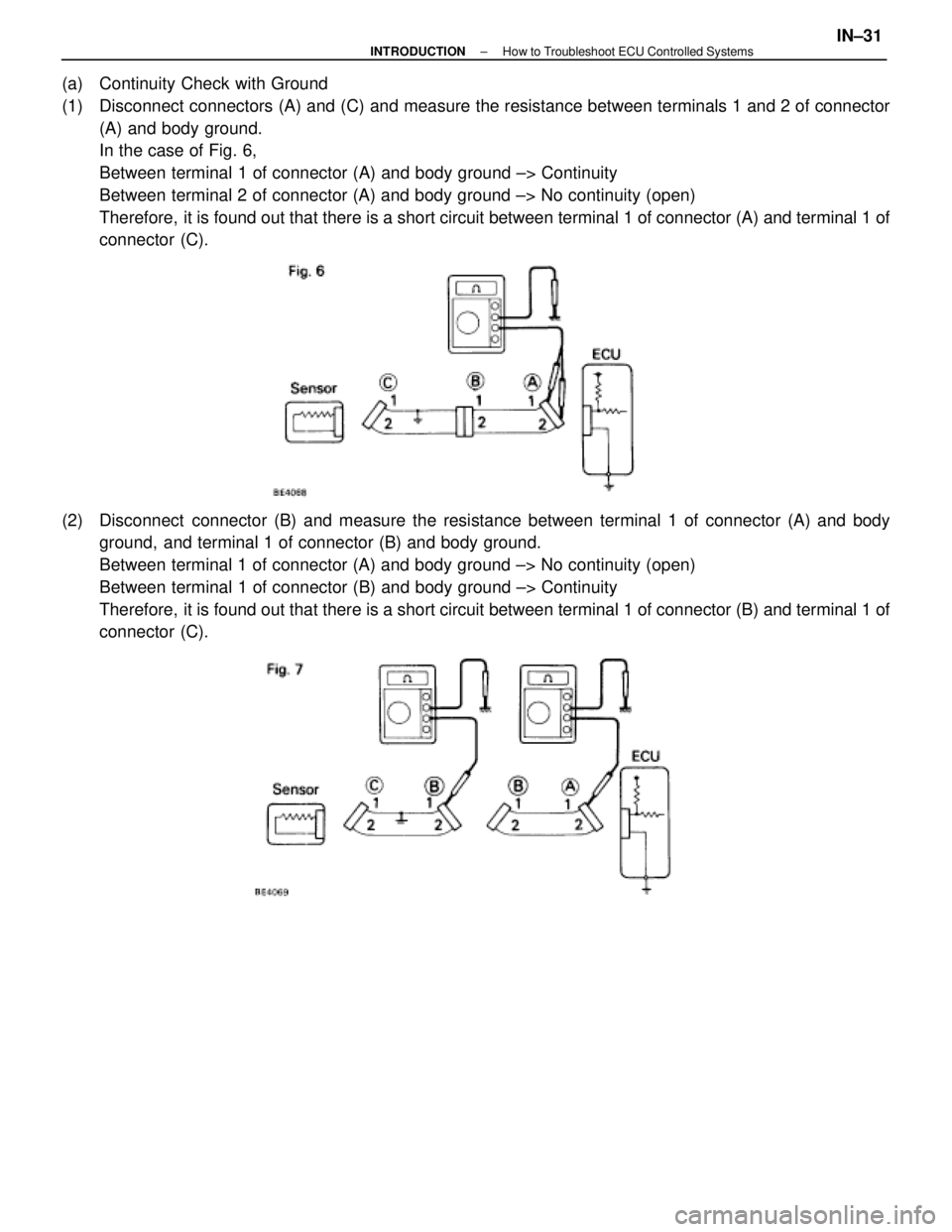
(a) Continuity Check with Ground
(1) Disconnect connectors (A) and (C) and measure the resistance between terminals 1 and 2 of connector(A) and body ground.
In the case of Fig. 6,
Between terminal 1 of connector (A) and body ground ±> Continuity
Between terminal 2 of connector (A) and body ground ±> No continuit\
y (open)
Therefore, it is found out that there is a short circuit between terminal 1 of con\
nector (A) and terminal 1 of
connector (C).
(2) Disconnect connector (B) and measure the resistance between terminal 1 of connec\
tor (A) and bodyground, and terminal 1 of connector (B) and body ground.
Between terminal 1 of connector (A) and body ground ±> No continuit\
y (open)
Between terminal 1 of connector (B) and body ground ±> Continuity
Therefore, it is found out that there is a short circuit between terminal 1 of con\
nector (B) and terminal 1 of
connector (C).
±
INTRODUCTION How to Troubleshoot ECU Controlled SystemsIN±31
WhereEverybodyKnowsYourName
Page 35 of 4087
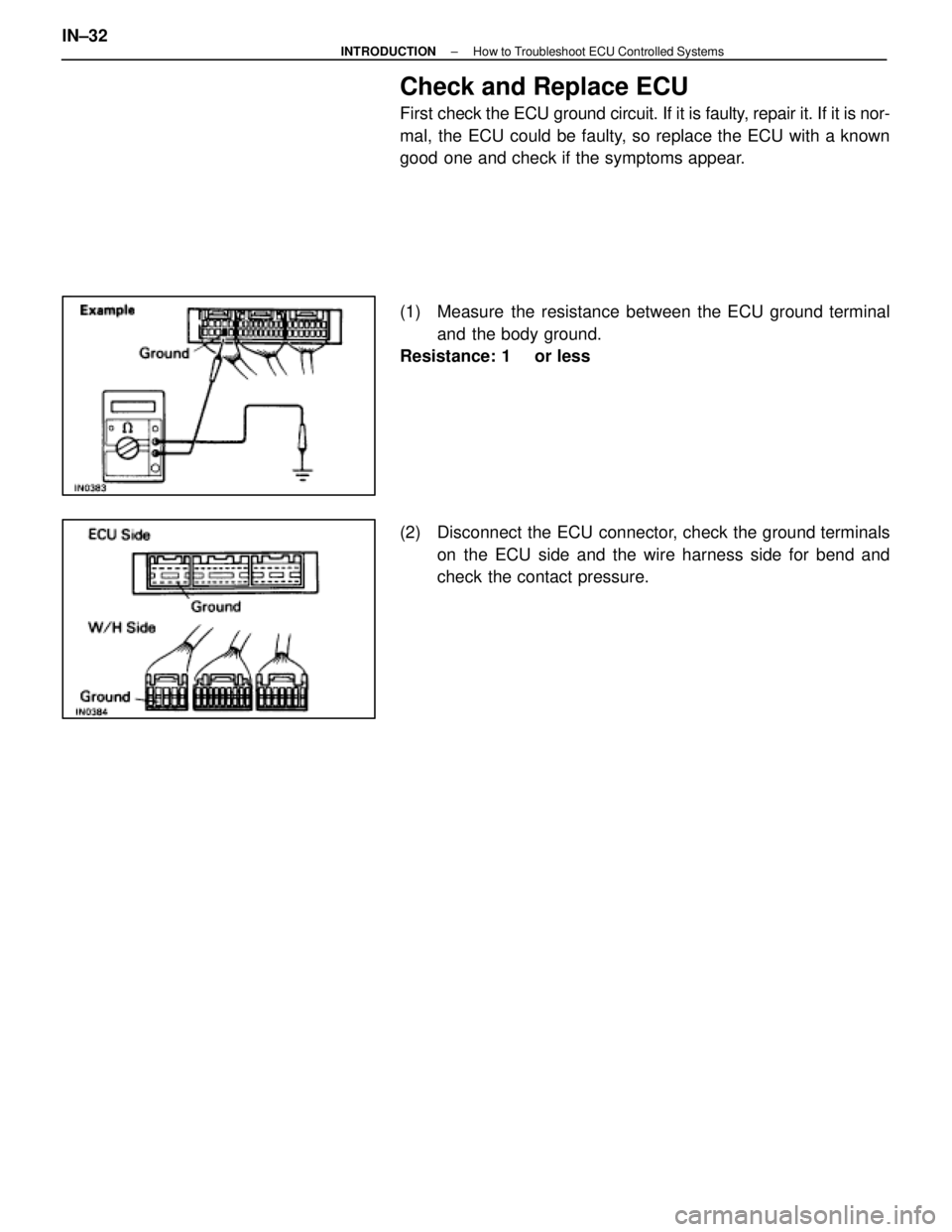
Check and Replace ECU
First check the ECU ground circuit. If it is faulty, repair it. If it is nor-
mal, the ECU could be faulty, so replace the ECU with a known
good one and check if the symptoms appear.
(1) Measure the resistance between the ECU ground terminal and the body ground.
Resistance: 1 � or less
(2) Disconnect the ECU connector, check the ground terminals on the ECU side and the wire harness side for bend and
check the contact pressure.
IN±32
±
INTRODUCTION How to Troubleshoot ECU Controlled Systems
WhereEverybodyKnowsYourName
Page 43 of 4087
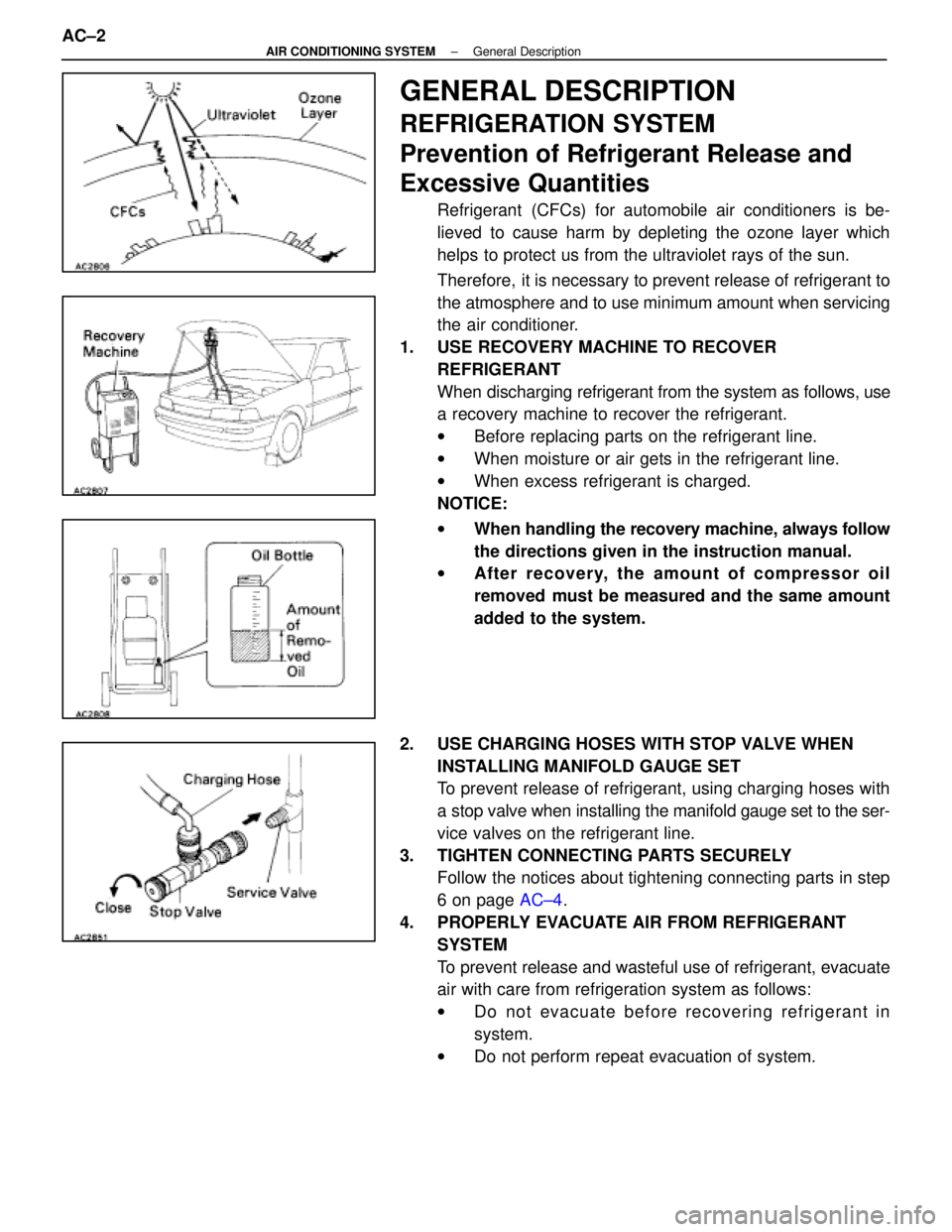
GENERAL DESCRIPTION
REFRIGERATION SYSTEM
Prevention of Refrigerant Release and
Excessive Quantities
Refrigerant (CFCs) for automobile air conditioners is be-
lieved to cause harm by depleting the ozone layer which
helps to protect us from the ultraviolet rays of the sun.
Therefore, it is necessary to prevent release of refrigerant to
the atmosphere and to use minimum amount when servicing
the air conditioner.
1. USE RECOVERY MACHINE TO RECOVER REFRIGERANT
When discharging refrigerant from the system as follows, use
a recovery machine to recover the refrigerant.
wBefore replacing parts on the refrigerant line.
w When moisture or air gets in the refrigerant line.
w When excess refrigerant is charged.
NOTICE:
w When handling the recovery machine, always follow
the directions given in the instruction manual.
w After recovery, the amount of compr essor oil
removed must be measured and the same amount
added to the system.
2. USE CHARGING HOSES WITH STOP VALVE WHEN INSTALLING MANIFOLD GAUGE SET
To prevent release of refrigerant, using charging hoses with
a stop valve when installing the manifold gauge set to the ser-
vice valves on the refrigerant line.
3. TIGHTEN CONNECTING PARTS SECURELY Follow the notices about tightening connecting parts in step
6 on page AC±4.
4. PROPERLY EVACUATE AIR FROM REFRIGERANT SYSTEM
To prevent release and wasteful use of refrigerant, evacuate
air with care from refrigeration system as follows:
wDo not evacuate before recovering refrigerant in
system.
w Do not perform repeat evacuation of system.
AC±2
±
AIR CONDITIONING SYSTEM General Description
WhereEverybodyKnowsYourName
Page 45 of 4087
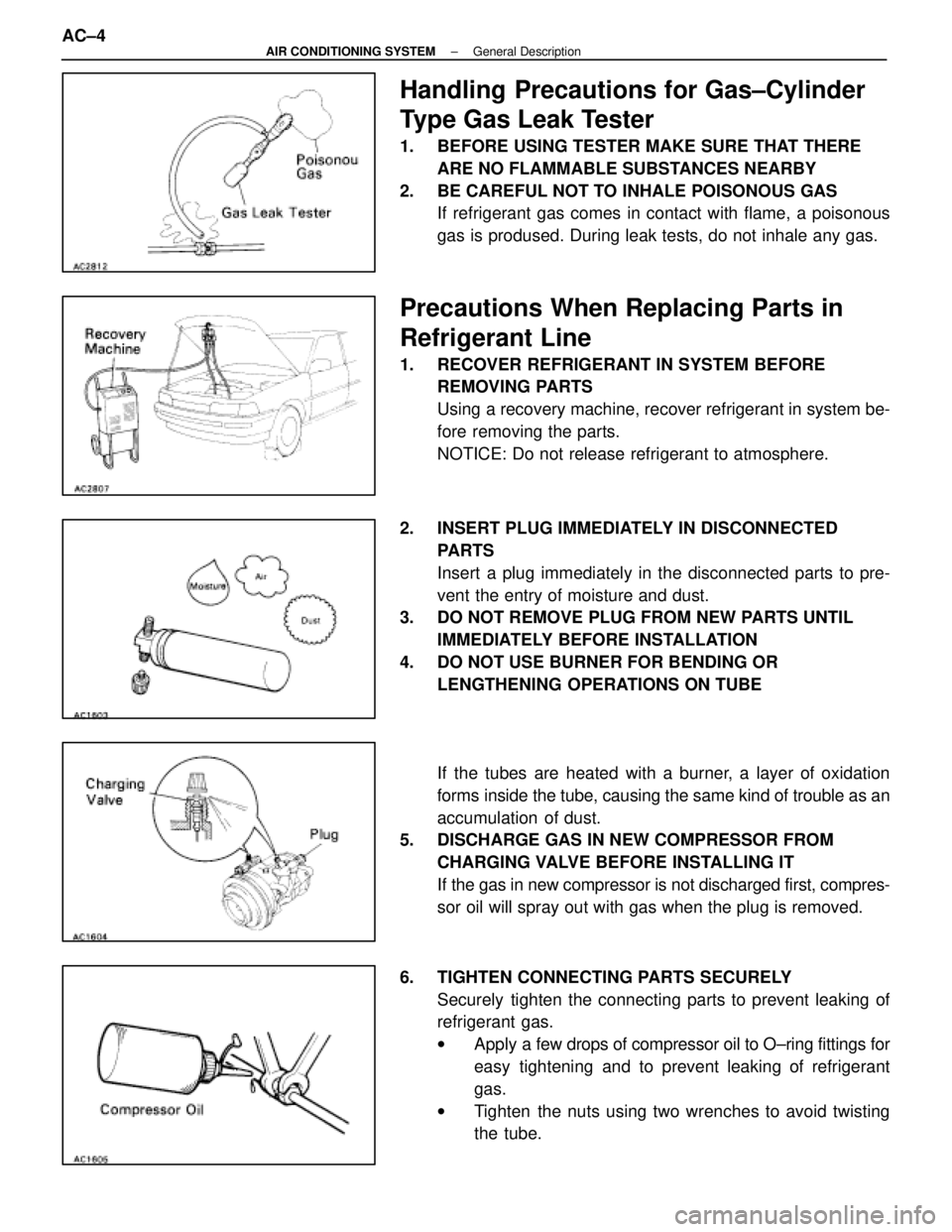
Handling Precautions for Gas±Cylinder
Type Gas Leak Tester
1. BEFORE USING TESTER MAKE SURE THAT THEREARE NO FLAMMABLE SUBSTANCES NEARBY
2. BE CAREFUL NOT TO INHALE POISONOUS GAS If refrigerant gas comes in contact with flame, a poisonous
gas is prodused. During leak tests, do not inhale any gas.
Precautions When Replacing Parts in
Refrigerant Line
1. RECOVER REFRIGERANT IN SYSTEM BEFOREREMOVING PARTS
Using a recovery machine, recover refrigerant in system be-
fore removing the parts.
NOTICE: Do not release refrigerant to atmosphere.
2. INSERT PLUG IMMEDIATELY IN DISCONNECTED PARTS
Insert a plug immediately in the disconnected parts to pre-
vent the entry of moisture and dust.
3. DO NOT REMOVE PLUG FROM NEW PARTS UNTIL
IMMEDIATELY BEFORE INSTALLATION
4. DO NOT USE BURNER FOR BENDING OR LENGTHENING OPERATIONS ON TUBE
If the tubes are heated with a burner, a layer of oxidation
forms inside the tube, causing the same kind of trouble as an
accumulation of dust.
5. DISCHARGE GAS IN NEW COMPRESSOR FROM
CHARGING VALVE BEFORE INSTALLING IT
If the gas in new compressor is not discharged first, compres-
sor oil will spray out with gas when the plug is removed.
6. TIGHTEN CONNECTING PARTS SECURELY Securely tighten the connecting parts to prevent leaking of
refrigerant gas.
wApply a few drops of compressor oil to O±ring fittings for
easy tightening and to prevent leaking of refrigerant
gas.
w Tighten the nuts using two wrenches to avoid twisting
the tube.
AC±4
±
AIR CONDITIONING SYSTEM General Description
WhereEverybodyKnowsYourName
 Voltage CheckIn a circuit in which voltage is applied (to the ECU connector terminal)\
, an open circuit can be checked for
by conducting a voltage check.
(1) As shown in Fig. 4, with each con")