1991 FORD FESTIVA Ignition switch
[x] Cancel search: Ignition switchPage 164 of 454
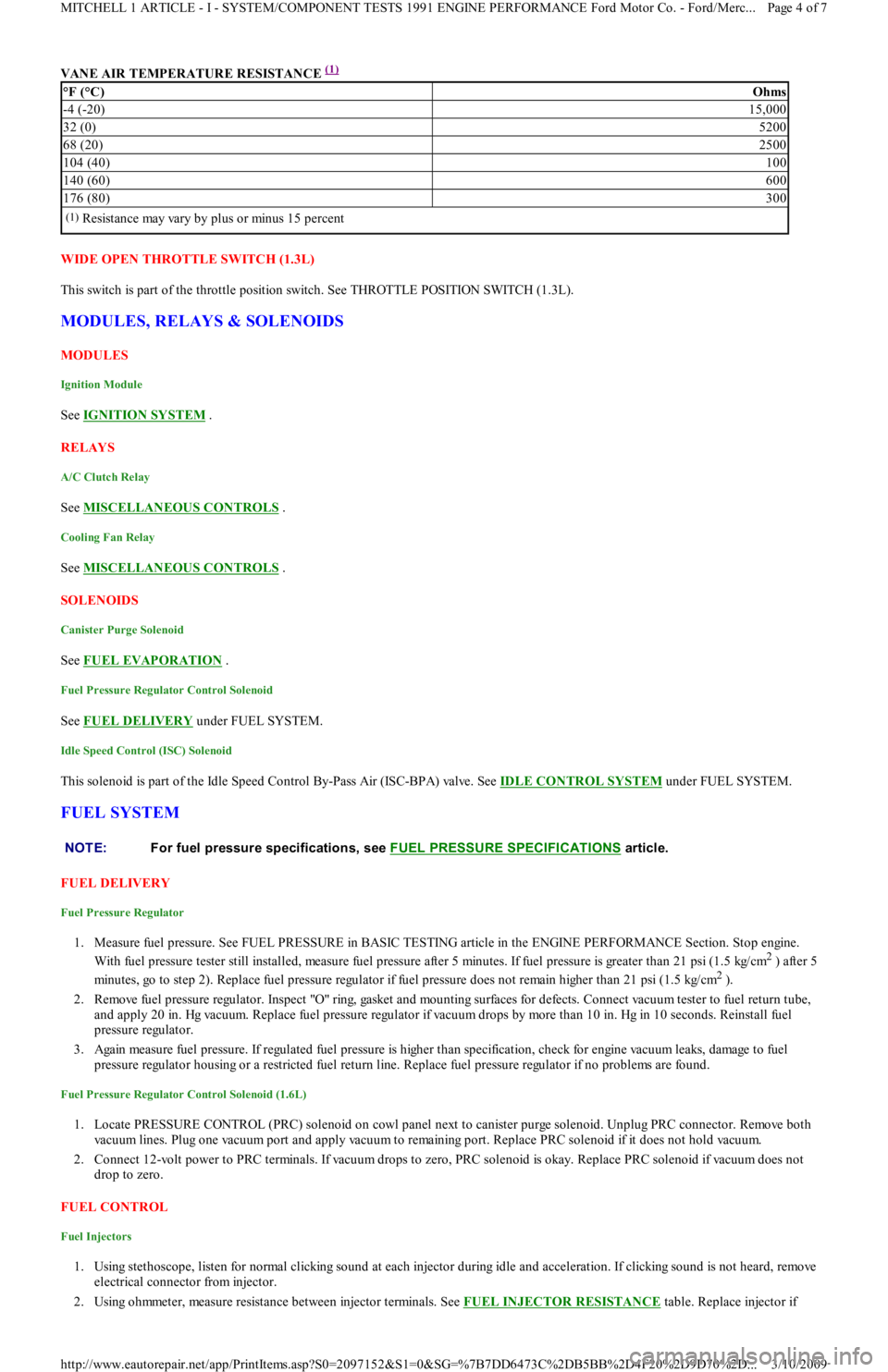
VANE AIR TEMPERATURE RESISTANCE (1)
WIDE OPEN THROTTLE SWITCH (1.3L)
This switch is part of the throttle position switch. See THROTTLE POSITION SWITCH (1.3L).
MODULES, RELAYS & SOLENOIDS
MODULES
Ignition Module
See IGNITION SYSTEM .
RELAYS
A/C Clutch Relay
See MISCELLANEOUS CONTROLS .
Cooling Fan Relay
See MISCELLANEOUS CONTROLS .
SOLENOIDS
Canister Purge Solenoid
See FUEL EVAPORATION .
Fuel Pressure Regulator Control Solenoid
See FUEL DELIVERY under FUEL SYSTEM.
Idle Speed Control (ISC) Solenoid
This solenoid is part of the Idle Speed Control By-Pass Air (ISC-BPA) valve. See IDLE CONTROL SYSTEM under FUEL SYSTEM.
FUEL SYSTEM
FUEL DELIVERY
Fuel Pressure Regulator
1. Measure fuel pressure. See FUEL PRESSURE in BASIC TESTING article in the ENGINE PERFORMANCE Section. Stop engine.
With fuel pressure tester still installed, measure fuel pressure after 5 minutes. If fuel pressure is greater than 21 psi (1.5 kg/cm
2 ) after 5
minutes, go to step 2). Replace fuel pressure regulator if fuel pressure does not remain higher than 21 psi (1.5 kg/cm
2 ).
2. Remove fuel pressure regulator. Inspect "O" ring, gasket and mounting surfaces for defects. Connect vacuum tester to fuel return tube,
and apply 20 in. Hg vacuum. Replace fuel pressure regulator if vacuum drops by more than 10 in. Hg in 10 seconds. Reinstall fuel
pressure regulator.
3. Again measure fuel pressure. If regulated fuel pressure is higher than specification, check for engine vacuum leaks, damage to fuel
pressure regulator housing or a restricted fuel return line. Replace fuel pressure regulator if no problems are found.
Fuel Pressure Regulator Control Solenoid (1.6L)
1. Locate PRESSURE CONTROL (PRC) solenoid on cowl panel next to canister purge solenoid. Unplug PRC connector. Remove both
vacuum lines. Plug one vacuum port and apply vacuum to remaining port. Replace PRC solenoid if it does not hold vacuum.
2. Connect 12-volt power to PRC terminals. If vacuum drops to zero, PRC solenoid is okay. Replace PRC solenoid if vacuum does not
drop to zero.
FUEL CONTROL
Fuel Injectors
1. Using stethoscope, listen for normal clicking sound at each injector during idle and acceleration. If clicking sound is not heard, remove
electrical connector from injector.
2. Using ohmmeter, measure resistance between injector terminals. See FUEL INJECTOR RESISTANCE
table. Replace injector if
°F (°C)Ohms
-4 (-20)15,000
32 (0)5200
68 (20)2500
104 (40)100
140 (60)600
176 (80)300
(1)Resistance may vary by plus or minus 15 percent
NOTE:For fuel pressure specifications, see FUEL PRESSURE SPECIFICAT IONS
article.
Page 4 of 7 MITCHELL 1 ARTICLE - I - SYSTEM/COMPONENT TESTS 1991 ENGINE PERFORMANCE Ford Motor Co. - Ford/Merc
...
3/10/2009 http://www.eautorepair.net/app/PrintItems.asp?S0=2097152&S1=0&SG=%7B7DD6473C%2DB5BB%2D4F20%2D9D70%2D
...
Page 168 of 454

Back To Article
G - T EST S W/CODES
1991-92 ENGINE PERFORMANCE Ford Motor Co. Self-Diagnostics
INTRODUCTION
If no faults were found while performing BASIC TESTING , proceed with self-diagnostics. If no fault codes or only pass codes are present
after entering self-diagnostics, proceed to TESTS W/O CODES article in the ENGINE PERFORMANCE Section for diagnosis by symptom
(i.e., ROUGH IDLE, NO START, etc.).
This article uses many abbreviations for devices, signal names, and wire colors. See SELF
-DIAGNOSTICS ABBREVIATIONS table.
Abbreviations for wire colors used in individual PINPOINT TEST diagrams are as follows:
BLK - Black
BLU - Blue
BRN - Brown
GRN - Green
LT GRN - Light Green
ORG - Orange
PNK - Pink
RED - Red
WHT - White
YEL - Yellow
SELF-DIAGNOSTICS ABBREVIATIONS
SELF-DIAGNOSTIC SYSTEM
Hard Failures
Hard failures cause CHECK ENGINE light (MIL) to come on and remain on until problem is repaired. If MIL comes on and remains on (light
may flash) during vehicle operation, cause of malfunction must be determined using diagnostic (code) charts. If a sensor fails, ECA will use a
substitute value in its calculations to permit continued engine operation. In this condition (limp-in mode), vehicle will run but driveability will
not be optimum.
Intermittent Failures
Intermittent failures may cause MIL to flicker or come on and go off after intermittent defect goes away. Corresponding trouble code, however,
will be retained in ECA memory. If related defect does not reoccur within a certain time frame, related trouble code will be erased from ECA
ApplicationAbbreviation
Analog Volt/OhmmeterVOM
Barometric Pressure SensorBP
Breakout BoxBOB
Canister Purge Control SolenoidCANP
CHECK ENGINE LightMIL
Crankshaft Position SensorCPS
Cylinder Identification SensorCID
Electronic Control AssemblyECA
Electronic Engine ControlEEC
Engine Coolant Temperature SensorECT
Exhaust Gas Oxygen SensorEGO
Idle Speed ControlISC
Ignition Diagnostic MonitorIDM
Keep Alive PowerKAPWR
Key On Engine OffKOEO
Key On Engine RunningKOER
Knock ControlKC
Power & Ground ConnectionsPGC
Fuel Pressure Regulator Control SolenoidPRC
Reference Voltage & Signal ReturnVREF
Self-Test InputSTI
Self-Test OutputSTO
Signal ReturnSIGRTN
Solenoid Controlled By GroundSCG
Switch Monitor LampSML
Switch To GroundSTG
Switch To PowerSTP
Throttle Position SensorTP
Vane Airflow MeterVAF
Vane Air Temperature SensorVAT
Vehicle PowerVPWR
Vehicle Speed SensorVSS
Page 1 of 20 MITCHELL 1 ARTICLE - G - TESTS W/CODES 1991-92 ENGINE PERFORMANCE Ford Motor Co. Self-Diagnostics
3/10/2009 http://www.eautorepair.net/app/PrintItems.asp?S0=2097152&S1=0&SG=%7B7DD6473C%2DB5BB%2D4F20%2D9D70%2D
...
Page 171 of 454
CLEARING CODES
Clearing Codes Procedure
Disconnect negative battery cable. Press brake pedal for 5-10 seconds. Turn off VOM or Super Star II tester. Reconnect battery.
ECA LOCATION
ECA is located on center console behind kick panel on Capri, and under instrument panel on driver side of Festiva.
QUICK TESTS
KEY ON, ENGINE OFF (KOEO) SELF-TEST
KOEO
1. This is a test of electronic engine control system, conducted with power (voltage) applied and engine not running. Activate self-test, and
record all codes displayed.
2. Erase codes, and repeat self-test. Diagnose only codes occurring during repeat self-test. See TROUBLE CODE DEFINITION
table. If
no codes are present, proceed to KEY ON, ENGINE RUNNING (KOER) SELF
-TEST .
KEY ON, ENGINE RUNNING (KOER) SELF-TEST
KOER
1. Deactivate self-test. Start and run engine at 2000 RPM for 2 minutes to warm up EGO sensor. Turn off engine and wait 10 seconds.
2. Restart engine, and activate self-test. Record all service codes displayed. See TROUBLE CODE DEFINITION
table. If no codes are
present, proceed to SWITCH MONITOR TEST
.
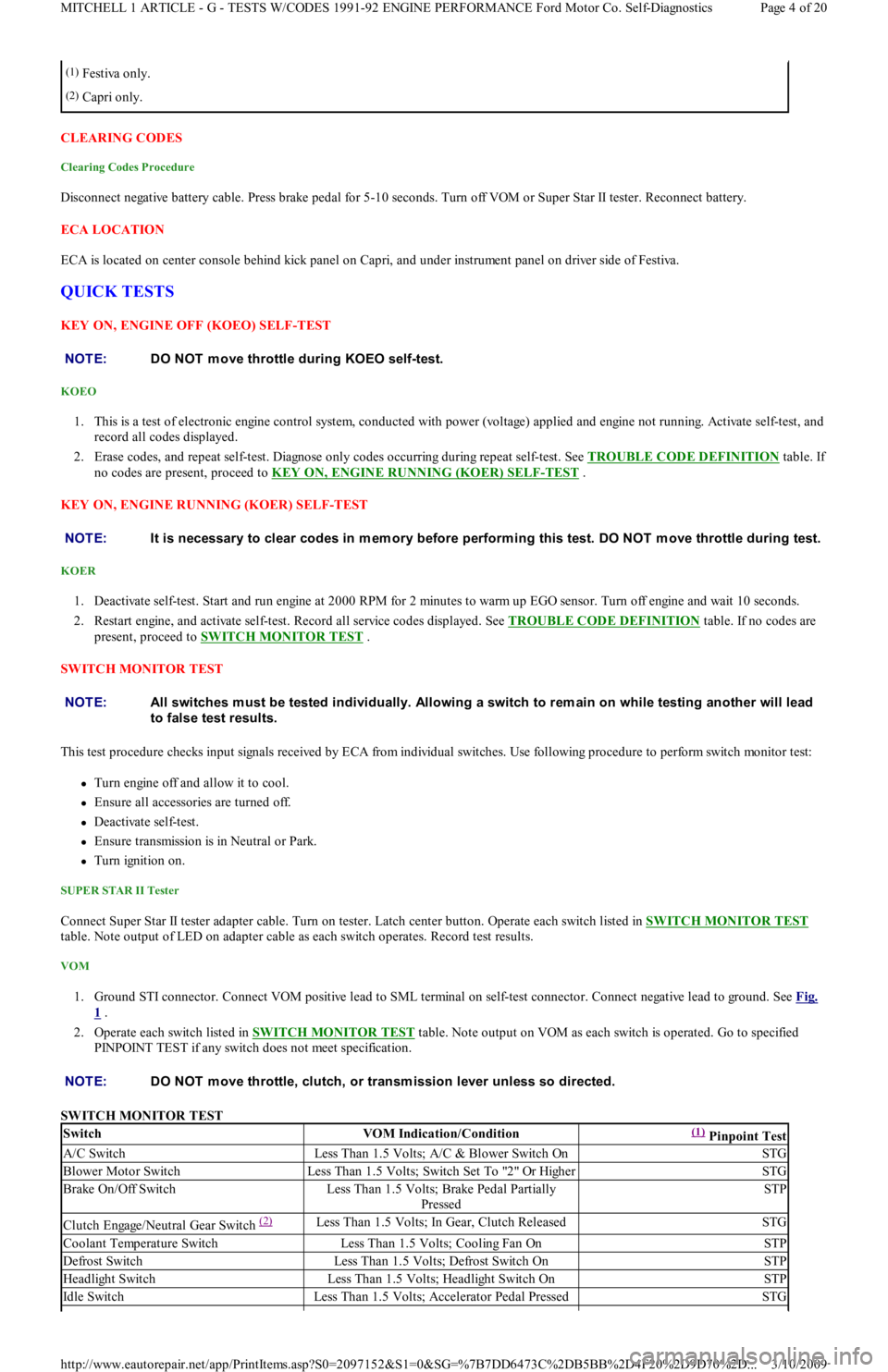
SWITCH MONITOR TEST
This test procedure checks input signals received by ECA from individual switches. Use following procedure to perform switch monitor test:
Turn engine off and allow it to cool.
Ensure all accessories are turned off.
Deactivate self-test.
Ensure transmission is in Neutral or Park.
Turn ignition on.
SUPER STAR II Tester
Connect Super Star II tester adapter cable. Turn on tester. Latch center button. Operate each switch listed in SWITCH MONITOR TEST
table. Note output of LED on adapter cable as each switch operates. Record test results.
VOM
1. Ground STI connector. Connect VOM positive lead to SML terminal on self-test connector. Connect negative lead to ground. See Fig.
1 .
2. Operate each switch listed in SWITCH MONITOR TEST
table. Note output on VOM as each switch is operated. Go to specified
PINPOINT TEST if any switch does not meet specification.
SWITCH MONITOR TEST
(1)Festiva only.
(2)Capri only.
NOTE:DO NOT m ove throttle during KOEO self-test.
NOTE:It is necessary to clear codes in m em ory before perform ing this test. DO NOT m ove throttle during test.
NOTE:All switches m ust be tested individually. Allowing a switch to rem ain on while testing another will lead
to false test results.
NOTE:DO NOT m ove throttle, clutch, or transm ission lever unless so directed.
SwitchVOM Indication/Condition(1) Pinpoint Test
A/C SwitchLess Than 1.5 Volts; A/C & Blower Switch OnSTG
Blower Motor SwitchLess Than 1.5 Volts; Switch Set To "2" Or HigherSTG
Brake On/Off SwitchLess Than 1.5 Volts; Brake Pedal Partially
PressedSTP
Clutch Engage/Neutral Gear Switch (2) Less Than 1.5 Volts; In Gear, Clutch ReleasedSTG
Coolant Temperature SwitchLess Than 1.5 Volts; Cooling Fan OnSTP
Defrost SwitchLess Than 1.5 Volts; Defrost Switch OnSTP
Headlight SwitchLess Than 1.5 Volts; Headlight Switch OnSTP
Id l e Swit chLess Than 1.5 Volts; Accelerator Pedal PressedSTG
Page 4 of 20 MITCHELL 1 ARTICLE - G - TESTS W/CODES 1991-92 ENGINE PERFORMANCE Ford Motor Co. Self-Diagnostics
3/10/2009 http://www.eautorepair.net/app/PrintItems.asp?S0=2097152&S1=0&SG=%7B7DD6473C%2DB5BB%2D4F20%2D9D70%2D
...
Page 172 of 454
WIGGLE TEST
Checking Circuitry
1. Visually inspect suspected sensor, switch, or solenoid. Enter WIGGLE TEST if using Super Star II tester. If using VOM, connect it to
STO terminal on self-test connector, and ground STI self-test connector terminal. Lightly tap sensor, switch, or solenoid.
2. Push and pull on suspected sensor, switch, or solenoid connector, but DO NOT unplug it. Test and wiggle harness vigorously, working
in small sections, from suspected device toward dash panel, and from dash panel to ECA.
3. If VOM or Super Star II tester does not display a positive indication of an intermittent defect, carefully disconnect suspected device.
Remove terminals from connector.
4. Inspect terminals at both ends for corrosion, bad crimps, or improperly seated terminals. Reconnect after inspection. Unplug harness
fro m E CA.
5. Inspect ECA and harness connector terminals for corrosion, bad crimps, or improperly seated terminals. If VOM does not indicate any
intermittent defect, reconnect wiring and erase codes.
PINPOINT TESTS
HOW TO USE PINPOINT TESTS
1. DO NOT perform any PINPOINT TEST unless directed by a QUICK TESTS procedure. Ensure all non-EEC related defects are
corrected. Follow each test step in order until defect is found. DO NOT replace any part unless so directed. When more than one service
code exists, start with first code displayed.
2. PINPOINT TESTS require ensuring electrical circuits are okay before replacing sensors or any other components. Always test circuits
for continuity between sensor and ECA. Test all circuits for shorts to power, opens, or shorts to ground. VREF and VPWR circuits
should be tested with KOEO or as specified in PINPOINT TESTS.
3. DO NOT measure voltage or resistance at ECA, or connect any test light unless specified in testing procedure. DO NOT pierce wiring.
Isolate both ends of a circuit and turn key off whenever checking for shorts or continuity, unless otherwise specified.
4. Disconnect solenoids and switches before checking circuit continuity or energizing solenoids.
5. An open is defined as any resistance greater than 10,000 ohms, unless otherwise specified.
6. To help diagnose circuits to ECA, turn ignition off and disconnect ECA harness. Connect BOB between ECA and ECA harness to
perform circuit and pinpoint tests.
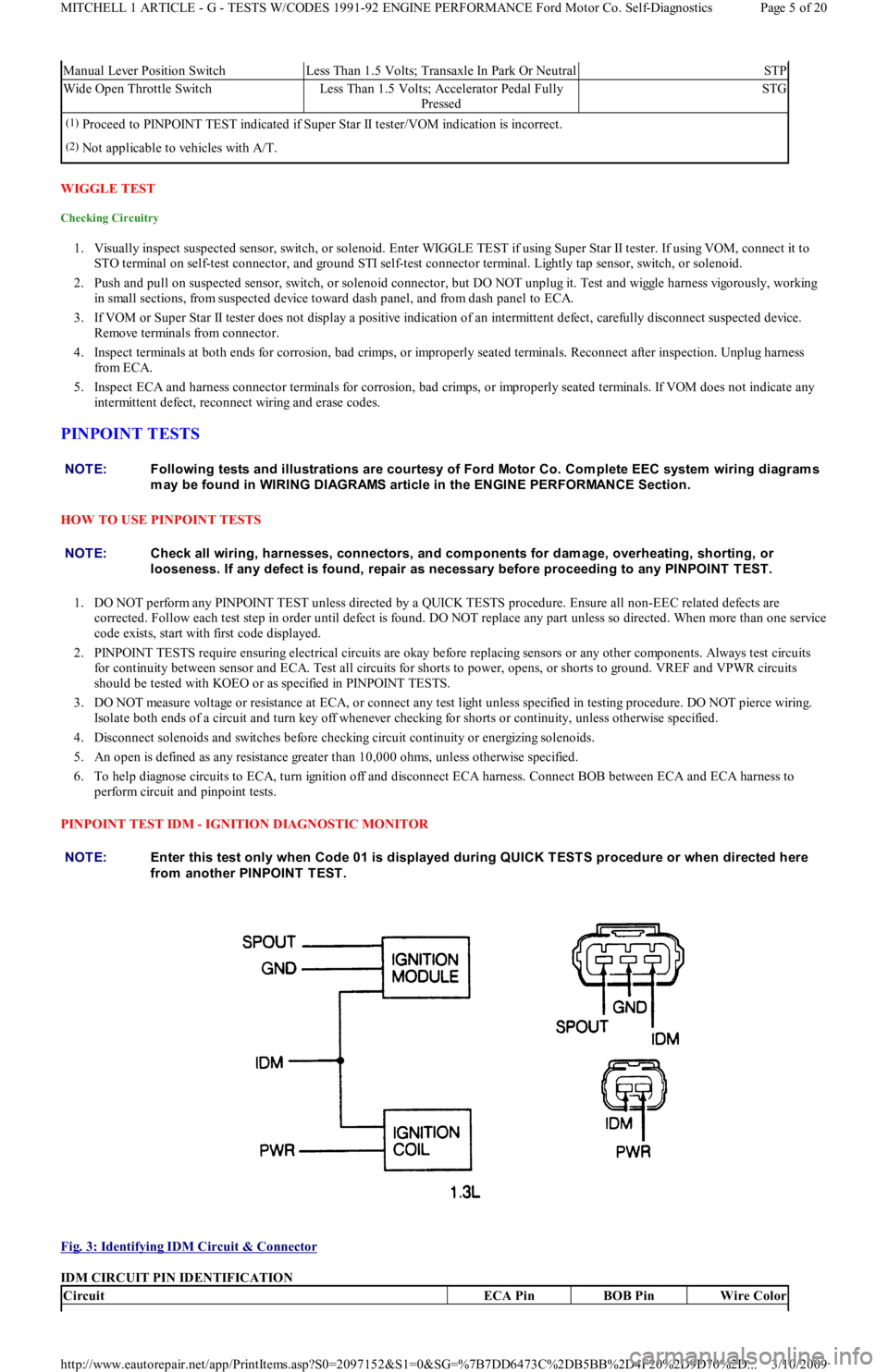
PINPOINT TEST IDM - IGNITION DIAGNOSTIC MONITOR
Fig. 3: Identifying IDM Circuit & Connector
IDM CIRCUIT PIN IDENTIFICATION
Manual Lever Position SwitchLess Than 1.5 Volts; Transaxle In Park Or NeutralSTP
Wide Open Throttle SwitchLess Than 1.5 Volts; Accelerator Pedal Fully
PressedSTG
(1)Proceed to PINPOINT TEST indicated if Super Star II tester/VOM indication is incorrect.
(2)Not applicable to vehicles with A/T.
NOTE:Following tests and illustrations are courtesy of Ford Motor Co. Com plete EEC system wiring diagram s
m ay be found in WIRING DIAGRAMS article in the ENGINE PERFORMANCE Section.
NOTE:Check all wiring, harnesses, connectors, and com ponents for dam age, overheating, shorting, or
looseness. If any defect is found, repair as necessary before proceeding to any PINPOINT T EST .
NOTE:Enter this test only when Code 01 is displayed during QUICK T EST S procedure or when directed here
from another PINPOINT TEST.
CircuitECA PinBOB PinWire Color
Page 5 of 20 MITCHELL 1 ARTICLE - G - TESTS W/CODES 1991-92 ENGINE PERFORMANCE Ford Motor Co. Self-Diagnostics
3/10/2009 http://www.eautorepair.net/app/PrintItems.asp?S0=2097152&S1=0&SG=%7B7DD6473C%2DB5BB%2D4F20%2D9D70%2D
...
Page 173 of 454
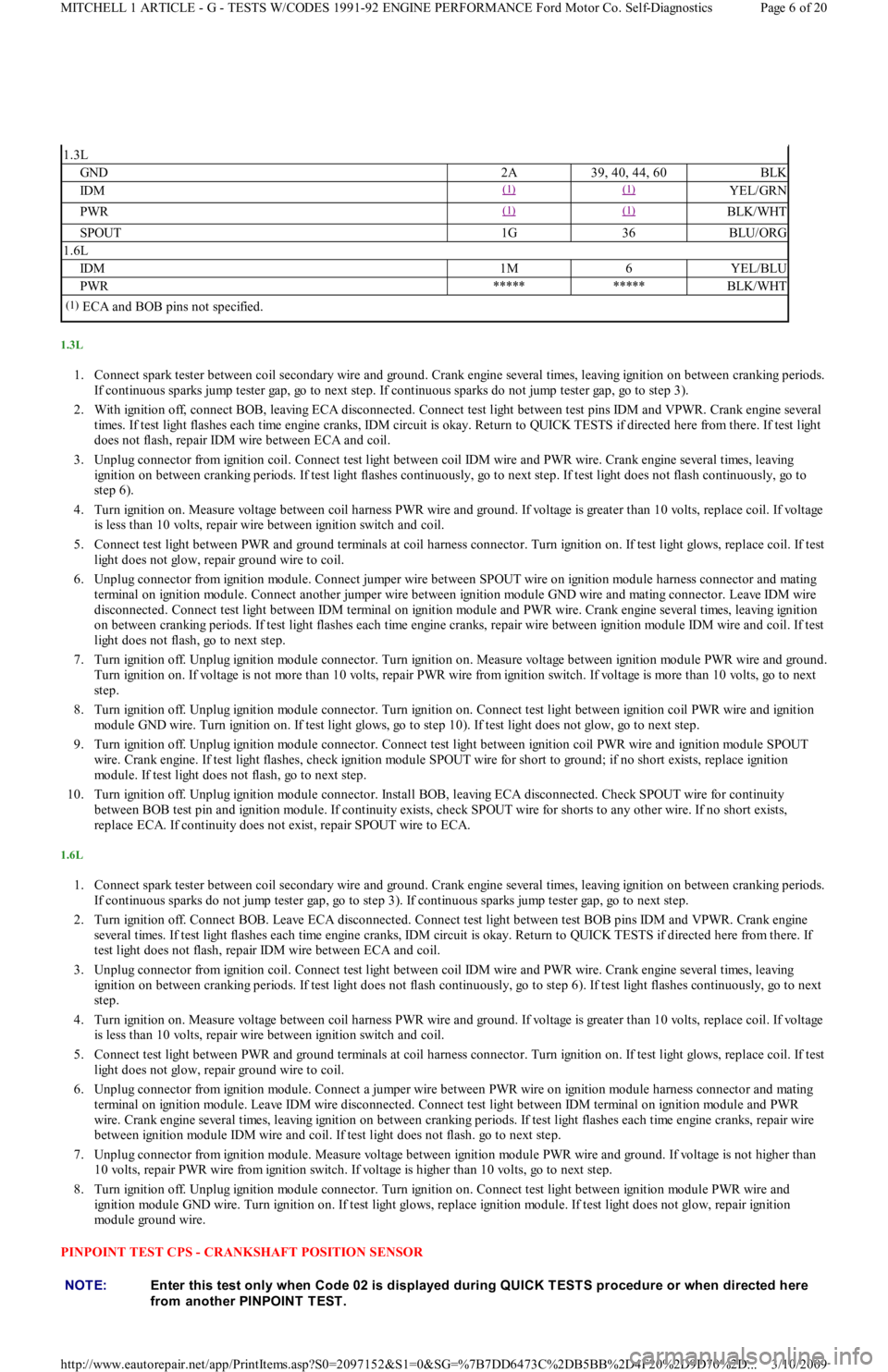
1.3L
1. Connect spark tester between coil secondary wire and ground. Crank engine several times, leaving ignition on between cranking periods.
If continuous sparks jump tester gap, go to next step. If continuous sparks do not jump tester gap, go to step 3).
2. With ignition off, connect BOB, leaving ECA disconnected. Connect test light between test pins IDM and VPWR. Crank engine several
times. If test light flashes each time engine cranks, IDM circuit is okay. Return to QUICK TESTS if directed here from there. If test light
does not flash, repair IDM wire between ECA and coil.
3. Unplug connector from ignition coil. Connect test light between coil IDM wire and PWR wire. Crank engine several times, leaving
ignition on between cranking periods. If test light flashes continuously, go to next step. If test light does not flash continuously, go to
step 6).
4. Turn ignition on. Measure voltage between coil harness PWR wire and ground. If voltage is greater than 10 volts, replace coil. If voltage
is less than 10 volts, repair wire between ignition switch and coil.
5. Connect test light between PWR and ground terminals at coil harness connector. Turn ignition on. If test light glows, replace coil. If test
light does not glow, repair ground wire to coil.
6. Unplug connector from ignition module. Connect jumper wire between SPOUT wire on ignition module harness connector and mating
terminal on ignition module. Connect another jumper wire between ignition module GND wire and mating connector. Leave IDM wire
disconnected. Connect test light between IDM terminal on ignition module and PWR wire. Crank engine several times, leaving ignition
on between cranking periods. If test light flashes each time engine cranks, repair wire between ignition module IDM wire and coil . If t est
light does not flash, go to next step.
7. Turn ignition off. Unplug ignition module connector. Turn ignition on. Measure voltage between ignition module PWR wire and ground.
Turn ignition on. If voltage is not more than 10 volts, repair PWR wire from ignition switch. If voltage is more than 10 volts, go t o n e xt
step.
8. Turn ignition off. Unplug ignition module connector. Turn ignition on. Connect test light between ignition coil PWR wire and ignition
module GND wire. Turn ignition on. If test light glows, go to step 10). If test light does not glow, go to next step.
9. Turn ignition off. Unplug ignition module connector. Connect test light between ignition coil PWR wire and ignition module SPOUT
wire. Crank engine. If test light flashes, check ignition module SPOUT wire for short to ground; if no short exists, replace ignition
module. If test light does not flash, go to next step.
10. Turn ignition off. Unplug ignition module connector. Install BOB, leaving ECA disconnected. Check SPOUT wire for continuity
between BOB test pin and ignition module. If continuity exists, check SPOUT wire for shorts to any other wire. If no short exists,
replace ECA. If continuity does not exist, repair SPOUT wire to ECA.
1.6L
1. Connect spark tester between coil secondary wire and ground. Crank engine several times, leaving ignition on between cranking periods.
If continuous sparks do not jump tester gap, go to step 3). If continuous sparks jump tester gap, go to next step.
2. Turn ignition off. Connect BOB. Leave ECA disconnected. Connect test light between test BOB pins IDM and VPWR. Crank engine
several times. If test light flashes each time engine cranks, IDM circuit is okay. Return to QUICK TESTS if directed here from there. If
test light does not flash, repair IDM wire between ECA and coil.
3. Unplug connector from ignition coil. Connect test light between coil IDM wire and PWR wire. Crank engine several times, leaving
ignition on between cranking periods. If test light does not flash continuously, go to step 6). If test light flashes continuously, go to next
step.
4. Turn ignition on. Measure voltage between coil harness PWR wire and ground. If voltage is greater than 10 volts, replace coil. If voltage
is less than 10 volts, repair wire between ignition switch and coil.
5. Connect test light between PWR and ground terminals at coil harness connector. Turn ignition on. If test light glows, replace coil. If test
light does not glow, repair ground wire to coil.
6. Unplug connector from ignition module. Connect a jumper wire between PWR wire on ignition module harness connector and mating
terminal on ignition module. Leave IDM wire disconnected. Connect test light between IDM terminal on ignition module and PWR
wire. Crank engine several times, leaving ignition on between cranking periods. If test light flashes each time engine cranks, repair wire
between ignition module IDM wire and coil. If test light does not flash. go to next step.
7. Unplug connector from ignition module. Measure voltage between ignition module PWR wire and ground. If voltage is not higher than
10 volts, repair PWR wire from ignition switch. If voltage is higher than 10 volts, go to next step.
8. Turn ignition off. Unplug ignition module connector. Turn ignition on. Connect test light between ignition module PWR wire and
ignition module GND wire. Turn ignition on. If test light glows, replace ignition module. If test light does not glow, repair ignition
module ground wire.
PINPOINT TEST CPS - CRANKSHAFT POSITION SENSOR
1.3L
GND2A39, 40, 44, 60BLK
IDM(1) (1) YEL/GRN
PWR(1) (1) BLK/WHT
SPOUT1G36BLU/ORG
1.6L
IDM1M6YEL/BLU
PWR**********BLK/WHT
(1)ECA and BOB pins not specified.
NOTE:Enter this test only when Code 02 is displayed during QUICK T EST S procedure or when directed here
from another PINPOINT TEST.
Page 6 of 20 MITCHELL 1 ARTICLE - G - TESTS W/CODES 1991-92 ENGINE PERFORMANCE Ford Motor Co. Self-Diagnostics
3/10/2009 http://www.eautorepair.net/app/PrintItems.asp?S0=2097152&S1=0&SG=%7B7DD6473C%2DB5BB%2D4F20%2D9D70%2D
...
Page 183 of 454
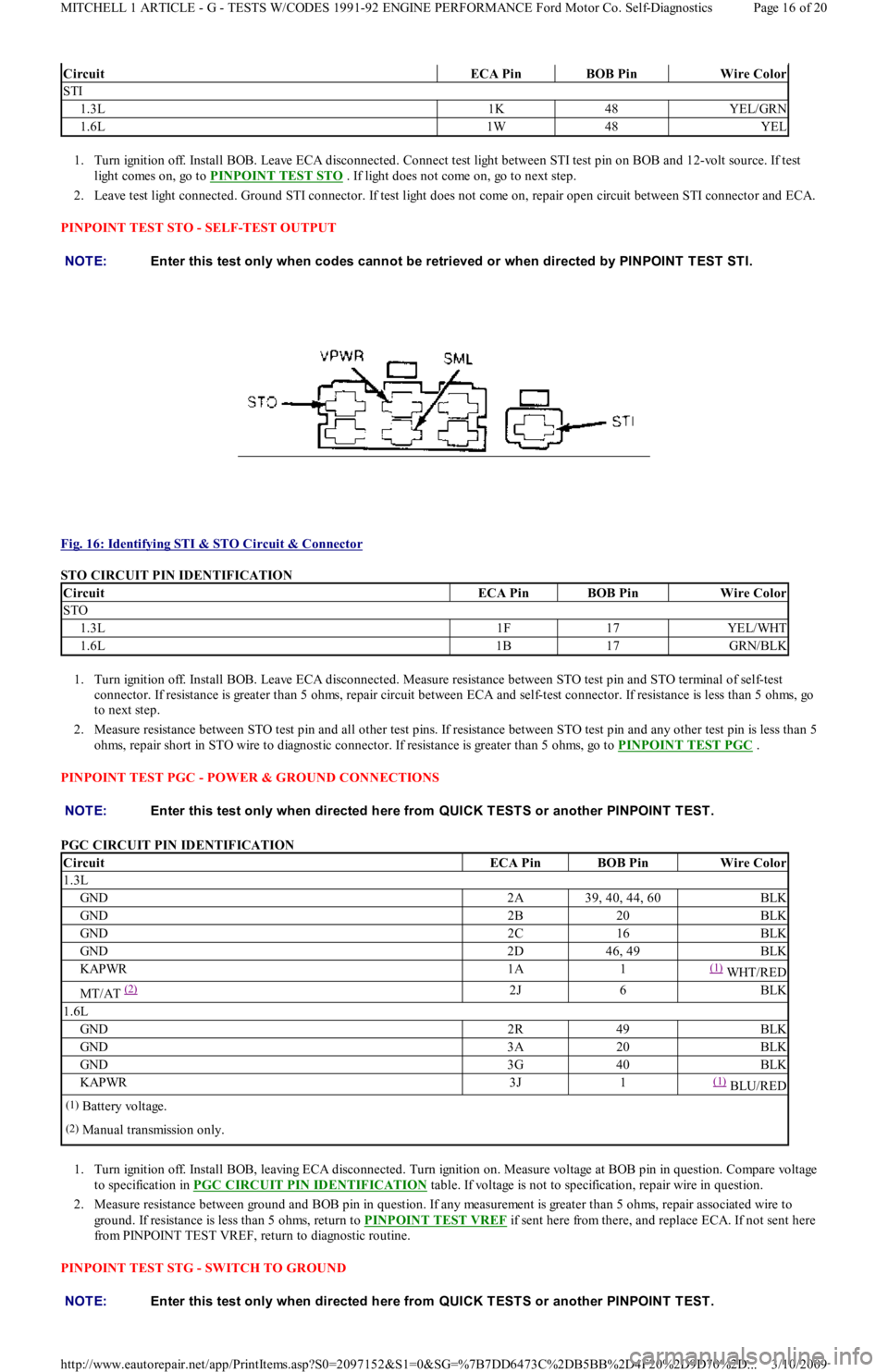
1. Turn ignition off. Install BOB. Leave ECA disconnected. Connect test light between STI test pin on BOB and 12-volt source. If test
light comes on, go to PINPOINT TEST STO
. If light does not come on, go to next step.
2. Leave test light connected. Ground STI connector. If test light does not come on, repair open circuit between STI connector and ECA.
PINPOINT TEST STO - SELF-TEST OUTPUT
Fig. 16: Identifying STI & STO Circuit & Connector
STO CIRCUIT PIN IDENTIFICATION
1. Turn ignition off. Install BOB. Leave ECA disconnected. Measure resistance between STO test pin and STO terminal of self-test
connector. If resistance is greater than 5 ohms, repair circuit between ECA and self-test connector. If resistance is less than 5 ohms, go
to next step.
2. Measure resistance between STO test pin and all other test pins. If resistance between STO test pin and any other test pin is less than 5
ohms, repair short in STO wire to diagnostic connector. If resistance is greater than 5 ohms, go to PINPOINT TEST PGC
.
PINPOINT TEST PGC - POWER & GROUND CONNECTIONS
PGC CIRCUIT PIN IDENTIFICATION
1. Turn ignition off. Install BOB, leaving ECA disconnected. Turn ignition on. Measure voltage at BOB pin in question. Compare voltage
to specification in PGC CIRCUIT PIN IDENTIFICATION
table. If voltage is not to specification, repair wire in question.
2. Measure resistance between ground and BOB pin in question. If any measurement is greater than 5 ohms, repair associated wire to
ground. If resistance is less than 5 ohms, return to PINPOINT TEST VREF
if sent here from there, and replace ECA. If not sent here
from PINPOINT TEST VREF, return to diagnostic routine.
PINPOINT TEST STG - SWITCH TO GROUND
CircuitECA PinBOB PinWire Color
STI
1.3L1K48YEL/GRN
1.6L1W48YEL
NOTE:Enter this test only when codes cannot be retrieved or when directed by PINPOINT T EST ST I.
CircuitECA PinBOB PinWire Color
STO
1.3L1F17YEL/WHT
1.6L1B17GRN/BLK
NOTE:Enter this test only when directed here from QUICK T EST S or another PINPOINT T EST .
CircuitECA PinBOB PinWire Color
1.3L
GND2A39, 40, 44, 60BLK
GND2B20BLK
GND2C16BLK
GND2D46, 49BLK
KAPWR1A1(1) WHT/RED
MT/AT (2) 2J6BLK
1.6L
GND2R49BLK
GND3A20BLK
GND3G40BLK
KAPWR3J1(1) BLU/RED
(1)Battery voltage.
(2)Manual transmission only.
NOTE:Enter this test only when directed here from QUICK T EST S or another PINPOINT T EST .
Page 16 of 20 MITCHELL 1 ARTICLE - G - TESTS W/CODES 1991-92 ENGINE PERFORMANCE Ford Motor Co. Self-Diagnostics
3/10/2009 http://www.eautorepair.net/app/PrintItems.asp?S0=2097152&S1=0&SG=%7B7DD6473C%2DB5BB%2D4F20%2D9D70%2D
...
Page 184 of 454
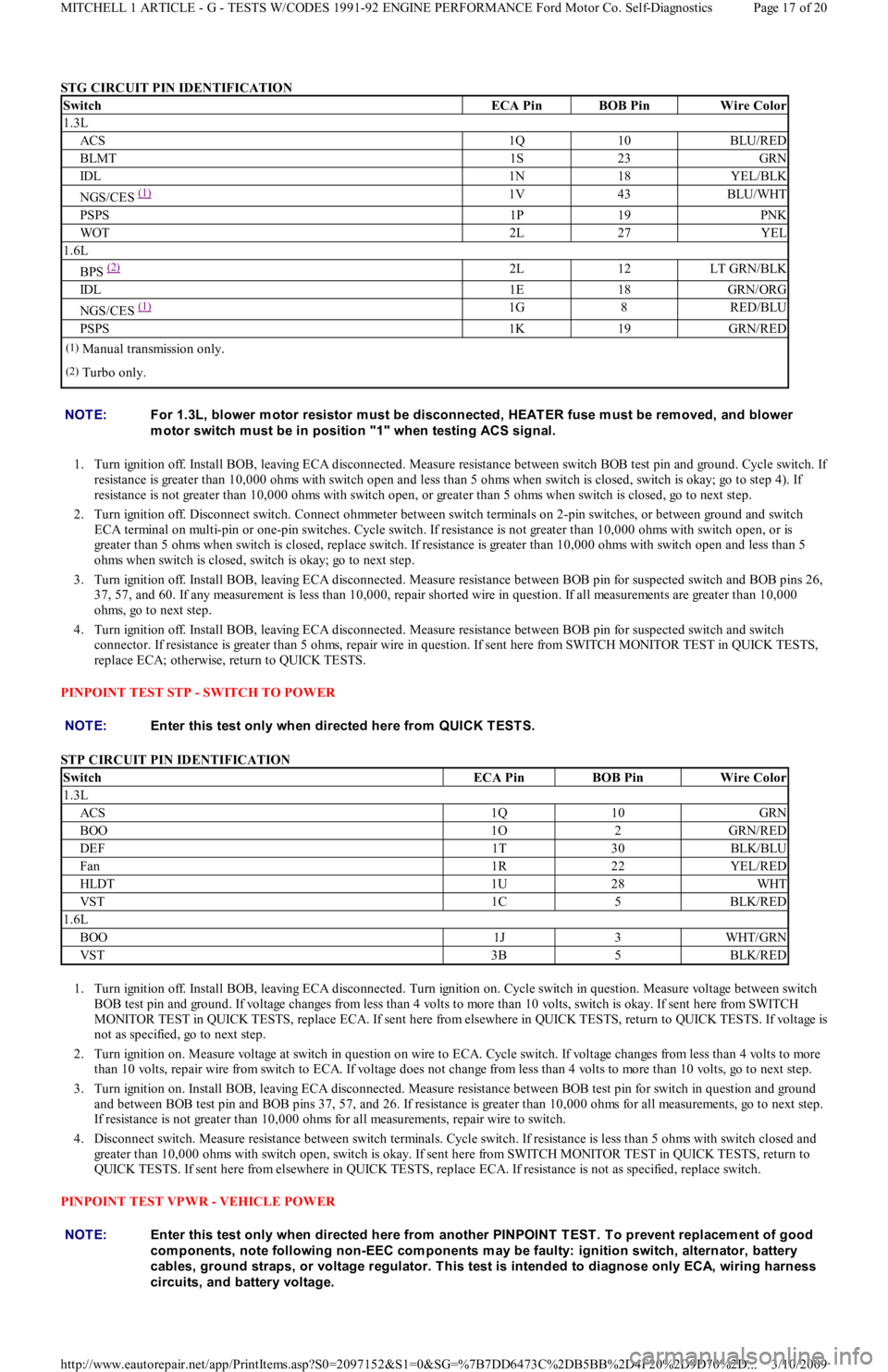
STG CIRCUIT PIN IDENTIFICATION
1. Turn ignition off. Install BOB, leaving ECA disconnected. Measure resistance between switch BOB test pin and ground. Cycle switch. I
f
resistance is greater than 10,000 ohms with switch open and less than 5 ohms when switch is closed, switch is okay; go to step 4). If
resistance is not greater than 10,000 ohms with switch open, or greater than 5 ohms when switch is closed, go to next step.
2. Turn ignition off. Disconnect switch. Connect ohmmeter between switch terminals on 2-pin switches, or between ground and switch
ECA terminal on multi-pin or one-pin switches. Cycle switch. If resistance is not greater than 10,000 ohms with switch open, or is
greater than 5 ohms when switch is closed, replace switch. If resistance is greater than 10,000 ohms with switch open and less than 5
ohms when switch is closed, switch is okay; go to next step.
3. Turn ignition off. Install BOB, leaving ECA disconnected. Measure resistance between BOB pin for suspected switch and BOB pins 26,
37, 57, and 60. If any measurement is less than 10,000, repair shorted wire in question. If all measurements are greater than 10,000
ohms, go to next step.
4. Turn ignition off. Install BOB, leaving ECA disconnected. Measure resistance between BOB pin for suspected switch and switch
connector. If resistance is greater than 5 ohms, repair wire in question. If sent here from SWITCH MONITOR TEST in QUICK TESTS,
replace ECA; otherwise, return to QUICK TESTS.
PINPOINT TEST STP - SWITCH TO POWER
STP CIRCUIT PIN IDENTIFICATION
1. Turn ignition off. Install BOB, leaving ECA disconnected. Turn ignition on. Cycle switch in question. Measure voltage between switch
BOB test pin and ground. If voltage changes from less than 4 volts to more than 10 volts, switch is okay. If sent here from SWITCH
MONITOR TEST in QUICK TESTS, replace ECA. If sent here from elsewhere in QUICK TESTS, return to QUICK TESTS. If voltage is
not as specified, go to next step.
2. Turn ignition on. Measure voltage at switch in question on wire to ECA. Cycle switch. If voltage changes from less than 4 volts to more
than 10 volts, repair wire from switch to ECA. If voltage does not change from less than 4 volts to more than 10 volts, go to next step.
3. Turn ignition on. Install BOB, leaving ECA disconnected. Measure resistance between BOB test pin for switch in question and ground
and between BOB test pin and BOB pins 37, 57, and 26. If resistance is greater than 10,000 ohms for all measurements, go to next step.
If resistance is not greater than 10,000 ohms for all measurements, repair wire to switch.
4. Disconnect switch. Measure resistance between switch terminals. Cycle switch. If resistance is less than 5 ohms with switch closed and
greater than 10,000 ohms with switch open, switch is okay. If sent here from SWITCH MONITOR TEST in QUICK TESTS, return to
QUICK TESTS. If sent here from elsewhere in QUICK TESTS, replace ECA. If resistance is not as specified, replace switch.
PINPOINT TEST VPWR - VEHICLE POWER
SwitchECA PinBOB PinWire Color
1.3L
ACS1Q10BLU/RED
BLMT1S23GRN
IDL1N18YEL/BLK
NGS/CES (1) 1V43BLU/WHT
PSPS1P19PNK
WOT2L27YEL
1.6L
BPS (2) 2L12LT GRN/BLK
IDL1E18GRN/ORG
NGS/CES (1) 1G8RED/BLU
PSPS1K19GRN/RED
(1)Manual transmission only.
(2)Turbo only.
NOTE:For 1.3L, blower m otor resistor m ust be disconnected, HEAT ER fuse m ust be rem oved, and blower
m otor switch m ust be in position "1" when testing ACS signal.
NOTE:Enter this test only when directed here from QUICK T EST S.
SwitchECA PinBOB PinWire Color
1.3L
ACS1Q10GRN
BOO1O2GRN/RED
DEF1T30BLK/BLU
Fan1R22YEL/RED
HLDT1U28WHT
VST1C5BLK/RED
1.6L
BOO1J3WHT/GRN
VST3B5BLK/RED
NOTE:Enter this test only when directed here from another PINPOINT T EST . T o prevent replacem ent of good
com ponents, note following non-EEC com ponents m ay be faulty: ignition switch, alternator, battery
cables, ground straps, or voltage regulator. T his test is intended to diagnose only ECA, wiring harness
circuits, and battery voltage.
Page 17 of 20 MITCHELL 1 ARTICLE - G - TESTS W/CODES 1991-92 ENGINE PERFORMANCE Ford Motor Co. Self-Diagnostics
3/10/2009 http://www.eautorepair.net/app/PrintItems.asp?S0=2097152&S1=0&SG=%7B7DD6473C%2DB5BB%2D4F20%2D9D70%2D
...
Page 185 of 454
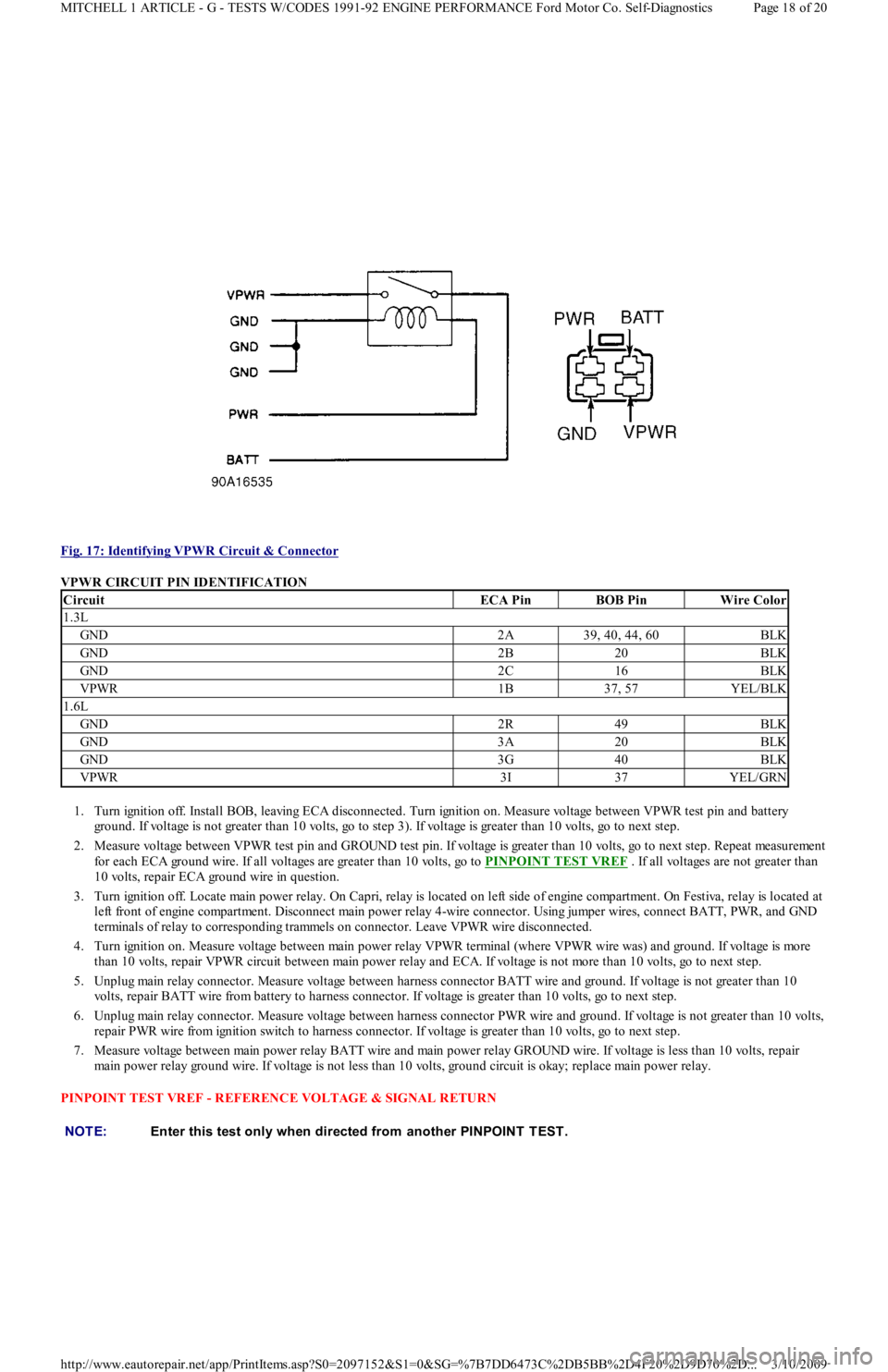
Fig. 17: Identifying VPWR Circuit & Connector
VPWR CIRCUIT PIN IDENTIFICATION
1. Turn ignition off. Install BOB, leaving ECA disconnected. Turn ignition on. Measure voltage between VPWR test pin and battery
gr o u n d . If vo l t a ge is n o t gr e a t e r t h a n 1 0 vo l t s, go t o st e p 3). If voltage is greater than 10 volts, go to next step.
2. Measure voltage between VPWR test pin and GROUND test pin. If voltage is greater than 10 volts, go to next step. Repeat measurement
for each ECA ground wire. If all voltages are greater than 10 volts, go to PINPOINT TEST VREF
. If all voltages are not greater than
10 volts, repair ECA ground wire in question.
3. Turn ignition off. Locate main power relay. On Capri, relay is located on left side of engine compartment. On Festiva, relay is located at
left front of engine compartment. Disconnect main power relay 4-wire connector. Using jumper wires, connect BATT, PWR, and GND
terminals of relay to corresponding trammels on connector. Leave VPWR wire disconnected.
4. Turn ignition on. Measure voltage between main power relay VPWR terminal (where VPWR wire was) and ground. If voltage is more
than 10 volts, repair VPWR circuit between main power relay and ECA. If voltage is not more than 10 volts, go to next step.
5. Unplug main relay connector. Measure voltage between harness connector BATT wire and ground. If voltage is not greater than 10
volts, repair BATT wire from battery to harness connector. If voltage is greater than 10 volts, go to next step.
6. Unplug main relay connector. Measure voltage between harness connector PWR wire and ground. If voltage is not greater than 10 volts,
repair PWR wire from ignition switch to harness connector. If voltage is greater than 10 volts, go to next step.
7. Measure voltage between main power relay BATT wire and main power relay GROUND wire. If voltage is less than 10 volts, repair
main power relay ground wire. If voltage is not less than 10 volts, ground circuit is okay; replace main power relay.
PINPOINT TEST VREF - REFERENCE VOLTAGE & SIGNAL RETURN
CircuitECA PinBOB PinWire Color
1.3L
GND2A39, 40, 44, 60BLK
GND2B20BLK
GND2C16BLK
VPWR1B37, 57YEL/BLK
1.6L
GND2R49BLK
GND3A20BLK
GND3G40BLK
VPWR3I37YEL/GRN
NOTE:Enter this test only when directed from another PINPOINT T EST .
Page 18 of 20 MITCHELL 1 ARTICLE - G - TESTS W/CODES 1991-92 ENGINE PERFORMANCE Ford Motor Co. Self-Diagnostics
3/10/2009 http://www.eautorepair.net/app/PrintItems.asp?S0=2097152&S1=0&SG=%7B7DD6473C%2DB5BB%2D4F20%2D9D70%2D
...