1990 VOLKSWAGEN TRANSPORTER warning
[x] Cancel search: warningPage 62 of 165

Downloaded from www.Manualslib.com manuals search engine
CONTROLS AND EQUIPMENT
Setting
the
time
•
Press
and hold clock button E.
• Set clock
with
buttons A.
The
display lights up as long as button is
oressed.
When button is released the dis
play goes out or, if a time has been pre
selected,
the selected time lights up for 2
sees.
To
switch
heater
on or off • This is done by pressing button
F.
When
-eater is switched on the warning lamp G ghts up.
To
ensure
that
the heater starts the lever ;or the heat output must be pushed fully to
:ie
right.
This
closes
an electrical contact.
Preselecting
starting
time
for
heater
stationary operation, ignition off)
With buttons C two different switch-on
:imes
can be selected within 24 hours.
•
Press
and hold button. The appropriate
*:gure 1 or 2 appears in display. The ready- •or-action lamp lights up.
• Set required switch-on time
with
but
tons A. The display remains on for about 20 seconds after releasing button C.
To
ensure
that
the heater starts up at the
selected
time, the lever for the heat output must be pushed fully over to the
right.
In
addition to this the blower must be
switched to Stage 1. On account of the higher current consumption, a higher
stage
should only be selected in isolated
cases.
Switching
preselected
time
off • The preselected time can be switched
off by briefly pressing the appropriate but
ton C. The ready-for-action lamp and the figure in display then go out.
Fuses
The
fuses for the auxiliary heater are in an additional holder behind the main fuse
box.
Notes
• Every time the heater is switched off,
the warm air and combustion air blowers
continue running briefly to cool the heater
down quicker.
• To avoid draining the battery, do not run
the heater repeatedly when the engine is not running.
• When driving through mud and snow,
the exhaust pipe may tend to get blocked.
Have
a look at it occasionally to see
that
it
is
clear.
WARNING
Never
start
the
heater
or let the
engine
or the
heater
run in an enclosed,
unventilated
area.
Exhaust
fumes
from
the
engine
or the
heater
contain
carbon monoxide,
which
is colorless and odor
less.
Carbon monoxide,
however
is a
very
harmful
gas, and may be
fatal
if in haled.
Due to the
risk
of
fire
the
heater
must
not be used
when
vehicle
is
parked
on
dry grass, brush or leaves.
www.westfaliaT3.info - a useful website for owners and enthusiasts of VW Westfalia T25 / T3 Campervans
Page 63 of 165
Downloaded from www.Manualslib.com manuals search engine
CONTROLS AND EQUIPMENT
SLIDING
ROOF*
SUN
ROOF*
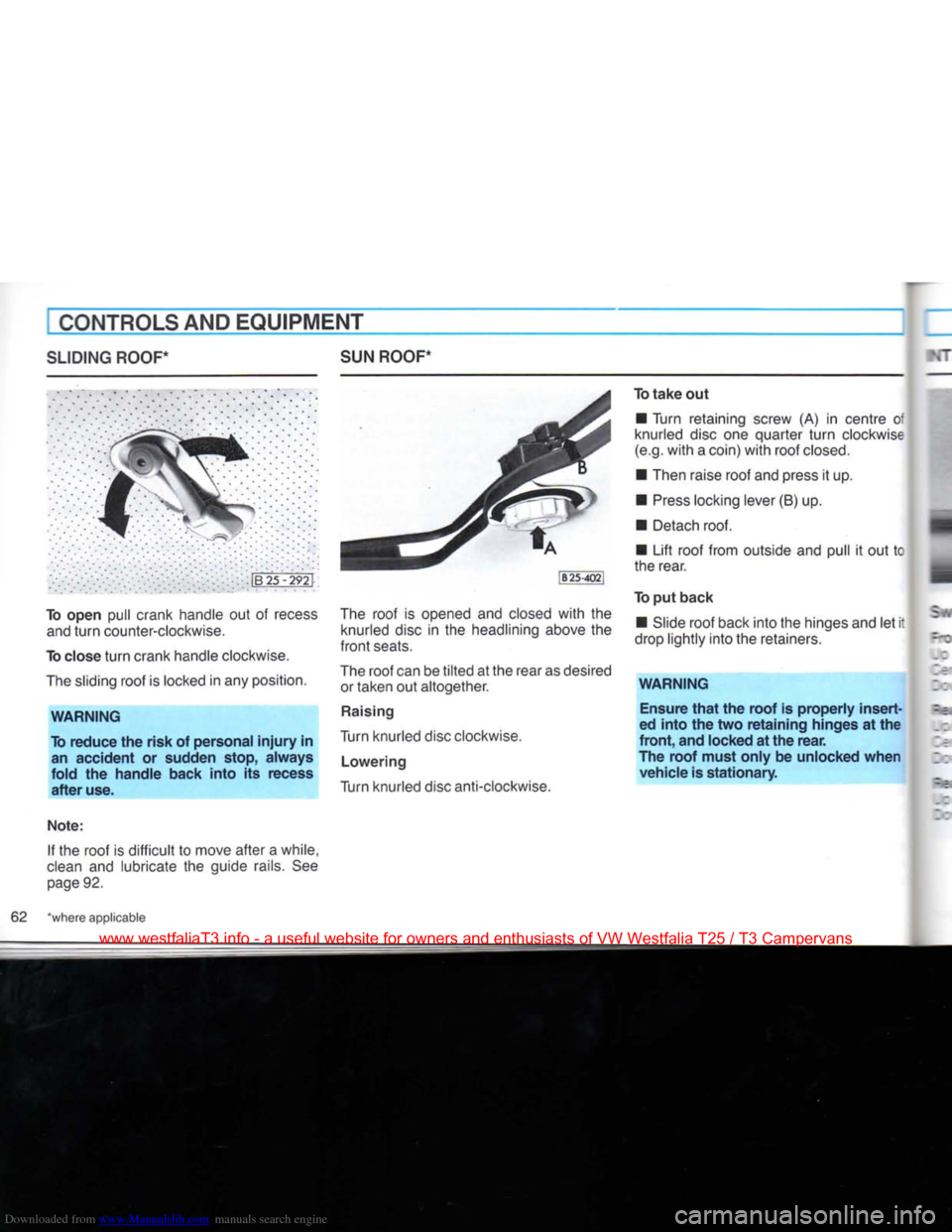
To open pull crank handle out of recess
and
turn
counter-clockwise.
To close
turn
crank handle clockwise.
The
sliding roof is locked in any position.
WARNING
To
reduce
the
risk
of personal
injury
in an
accident
or sudden stop,
always
fold
the
handle
back
into
its recess
after
use.
Note:
If the roof is difficult to move after a while,
clean
and lubricate the guide rails. See
page
92.
The
roof is opened and closed
with
the
knurled disc in the headlining above the
front
seats.
The
roof can be
tilted
at the rear as desired or taken out altogether.
Raising
Turn knurled disc clockwise.
Lowering
Turn knurled disc anti-clockwise. To
take
out
• Turn retaining screw (A) in centre of
knurled disc one quarter
turn
clockwise
(e.g.
with
a coin)
with
roof
closed.
• Then raise roof and press it up.
•
Press
locking lever (B) up. • Detach roof.
• Lift roof from outside and pull it out tc
the rear.
To put
back
• Slide roof back into the hinges and let it
drop lightly into the retainers.
WARNING
Ensure
that
the
roof
is
properly
insert
ed
into
the two
retaining
hinges at the
front,
and locked at the
rear.
The
roof
must
only
be unlocked
when
vehicle
is
stationary.
62 "where applicable
www.westfaliaT3.info - a useful website for owners and enthusiasts of VW Westfalia T25 / T3 Campervans
Page 64 of 165
Downloaded from www.Manualslib.com manuals search engine
CONTROLS AND
EQUIPMENT
NTERIOR
LIGHTS
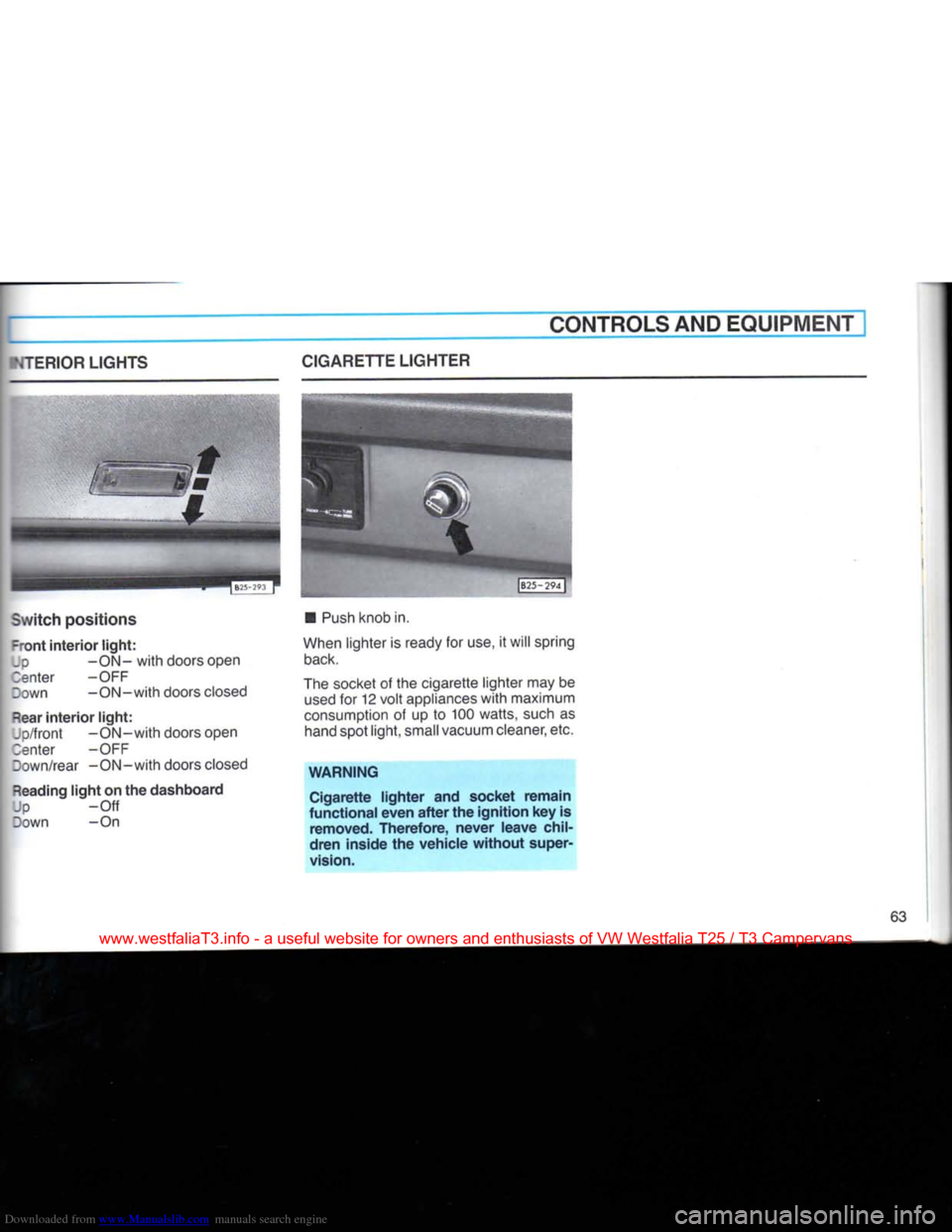
Switch
positions
-ront
interior
light:
Up
-ON-with doors open 3enter -OFF
Down -ON-with doors closed
Rear
interior
light:
Jp/front -ON-with doors open
3enter -OFF
Down/rear -ON-with doors closed
Reading
light
on the dashboard |p -Off
Down -On CIGARETTE
LIGHTER
•
Push
knob in.
When lighter is ready for use, it will spring
back.
The socket of the cigarette lighter may be
used
for 12
volt
appliances
with
maximum
consumption of up to 100 watts, such as hand spot
light,
small vacuum cleaner, etc.
WARNING
Cigarette lighter and socket remain
functional even after the ignition key is
removed.
Therefore, never leave
chil
dren inside the vehicle
without
super
vision.
63
www.westfaliaT3.info - a useful website for owners and enthusiasts of VW Westfalia T25 / T3 Campervans
Page 65 of 165
Downloaded from www.Manualslib.com manuals search engine
CONTROLS AND EQUIPMENT
ASHTRAYS
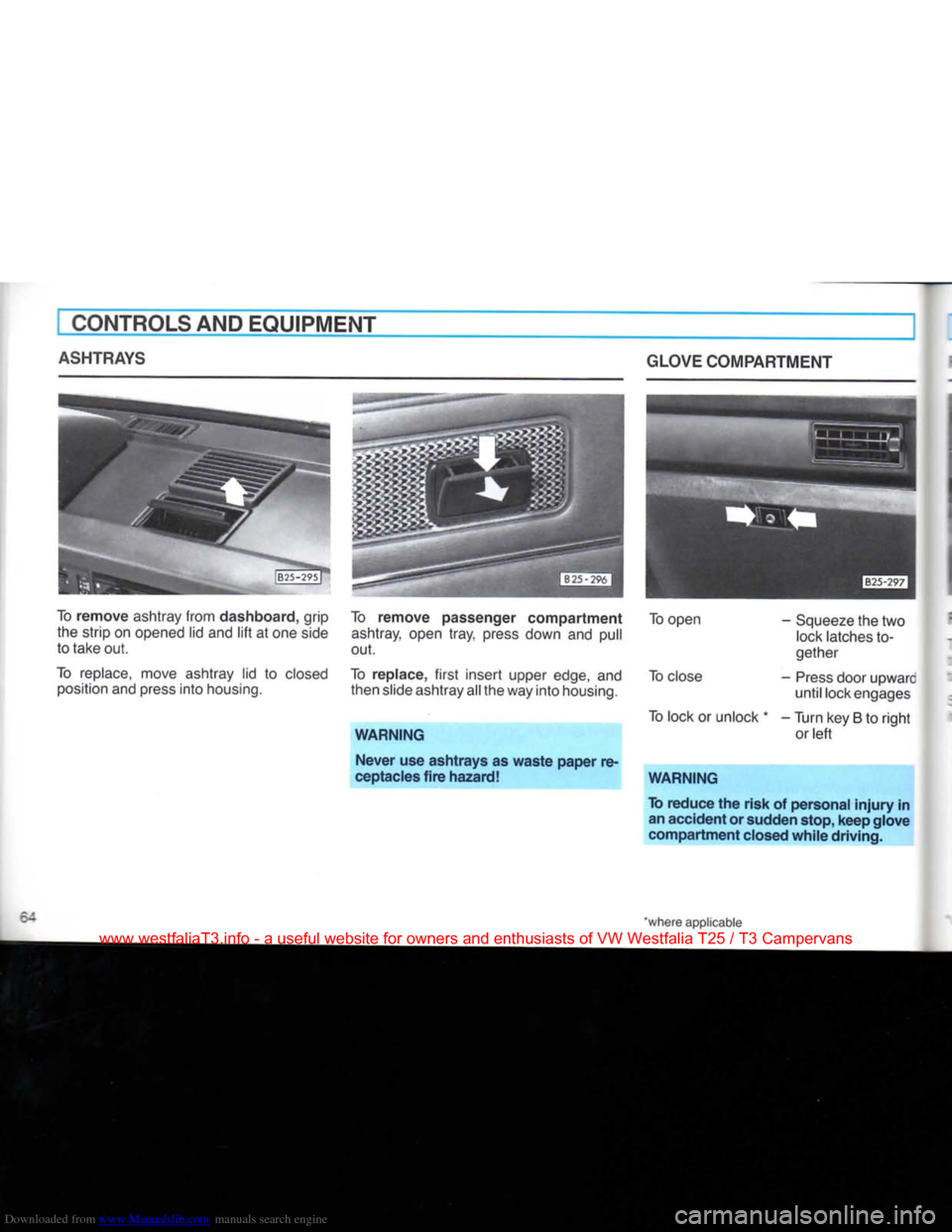
To remove ashtray from dashboard, grip the strip on opened lid and lift at one side
to take out.
To replace, move ashtray lid to closed position and press into housing. To remove passenger compartment
ashtray, open tray, press down and pull
out.
To replace, first insert upper edge, and then slide ashtray all the way into housing.
WARNING Never use ashtrays as waste paper re
ceptacles fire hazard! GLOVE COMPARTMENT
To open - Squeeze the two lock latches to
gether
To close - Press door upwarc until lock engages
To lock or unlock * - Turn key B to right or left
WARNING
To reduce the risk of personal injury in an accident or sudden stop, keep glove compartment closed while driving.
*where applicable
www.westfaliaT3.info - a useful website for owners and enthusiasts of VW Westfalia T25 / T3 Campervans
Page 66 of 165
Downloaded from www.Manualslib.com manuals search engine
CONTROLS
AND EQUIPMENT
FOLDING
TABLE*
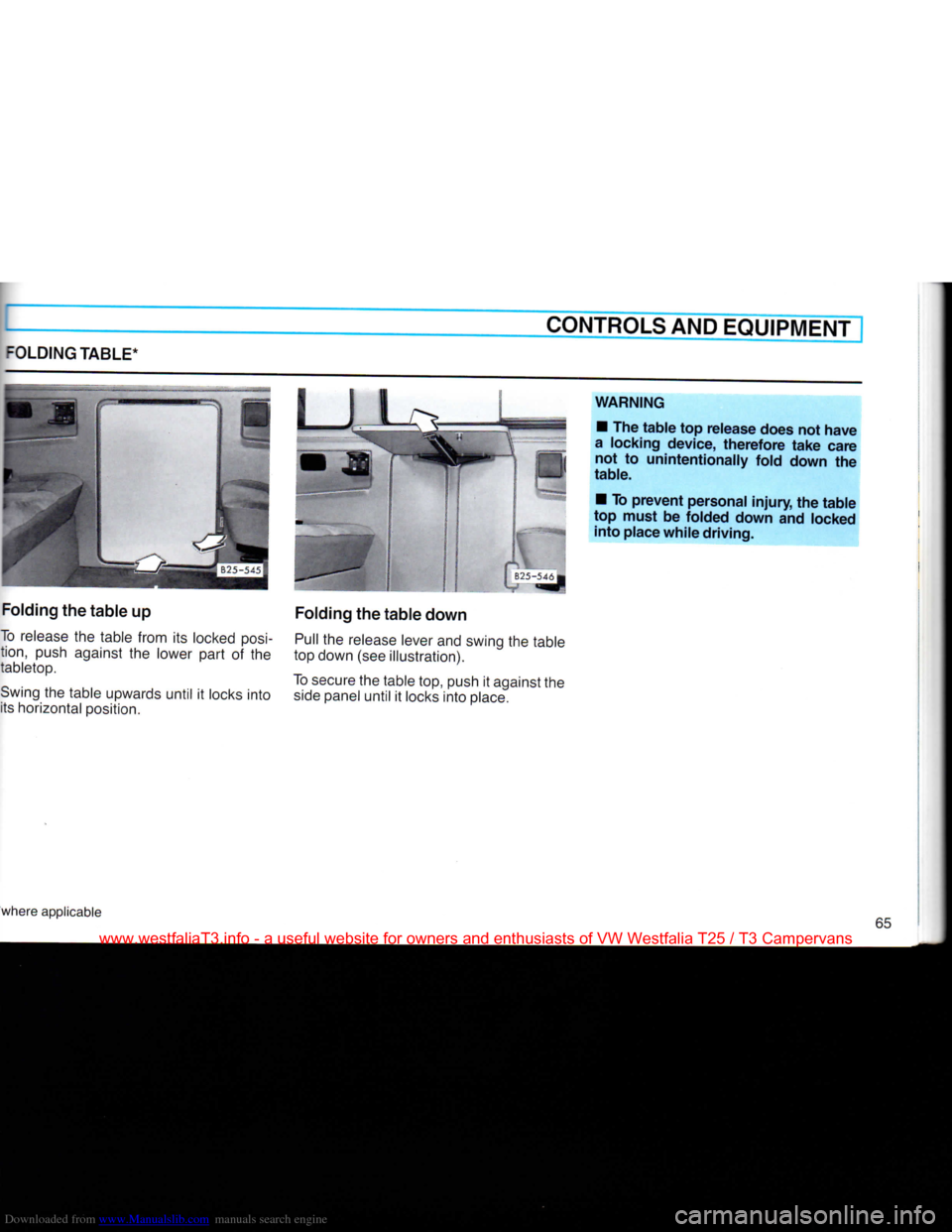
Folding
the table up
To
release
the table from its
locked
posi
tion,
push against the lower part of the
:abletop.
Swing
the table upwards until it
locks
into
its horizontal position.
Folding
the table down
Pull
the
release
lever and swing the table
top down (see illustration).
To
secure
the table top, push it against the
side
panel until it
locks
into
place.
WARNING
•
The
table
top release does not have
a locking device,
therefore
take
care not to unintentionally fold down the
table.
•
To prevent personal
injury,
the
table
top must be folded down and locked
into
place
while
driving.
where
applicable
www.westfaliaT3.info - a useful website for owners and enthusiasts of VW Westfalia T25 / T3 Campervans
Page 68 of 165
![VOLKSWAGEN TRANSPORTER 1990 T4 / 4.G Owners Manual Downloaded from www.Manualslib.com manuals search engine
CONTROLS AND EQUIPMENT]
VANITY MIRROR* ASSIST HANDLES/COAT HOOKS*
N VISORS
>fcu
can
lift
the
visor
on the
drivers side
out
cf
th](/manual-img/18/7415/w960_7415-67.png "VOLKSWAGEN TRANSPORTER 1990 T4 / 4.G Owners Manual Downloaded from www.Manualslib.com manuals search engine
CONTROLS AND EQUIPMENT]
VANITY MIRROR* ASSIST HANDLES/COAT HOOKS*
N VISORS
>fcu
can
lift
the
visor
on the
drivers side
out
cf
th")
Downloaded from www.Manualslib.com manuals search engine
CONTROLS AND EQUIPMENT]
VANITY MIRROR* ASSIST HANDLES/COAT HOOKS*
N VISORS
>fcu
can
lift
the
visor
on the
driver's side
out
cf
the
center mounting
and
move
it
toward
Te
door window
to
protect against side :
are.
[B25-377J
A
vanity mirror is
located
on the
back
of
the
sun
visor
on the
passenger's side.
To illuminate
the
vanity mirror, slide
the
switch (arrow).
When
the sun
visor
is
tilted
up,
illumination is shut
off
automatically. Assist handles
and
coat hooks
are
intended
for
your convenience.
WARNING • Hang clothes
in
such a way that they
do
not
impair
the
driver's vision.
•
Do not
hang heavy objects
on the
coat hooks,
as
they could cause per
sonal injury
in the
event
of a
sudden
stop.
'where applicable 67
www.westfaliaT3.info - a useful website for owners and enthusiasts of VW Westfalia T25 / T3 Campervans
Page 70 of 165
![VOLKSWAGEN TRANSPORTER 1990 T4 / 4.G Owners Manual Downloaded from www.Manualslib.com manuals search engine
3REAK-IN
PERIOD
VEHICLE
OPERATION]
DURING AND
AFTER
BREAK-IN PERIOD
Turing
the first few operating
hours,
the
r-gines
internal](/manual-img/18/7415/w960_7415-69.png "VOLKSWAGEN TRANSPORTER 1990 T4 / 4.G Owners Manual Downloaded from www.Manualslib.com manuals search engine
3REAK-IN
PERIOD
VEHICLE
OPERATION]
DURING AND
AFTER
BREAK-IN PERIOD
Turing
the first few operating
hours,
the
r-gines
internal")
Downloaded from www.Manualslib.com manuals search engine
3REAK-IN
PERIOD
VEHICLE
OPERATION]
DURING AND
AFTER
BREAK-IN PERIOD
Turing
the first few operating
hours,
the
r-gine's
internal friction is higher than
a:er
when all the moving parts
have
been
:-oken
in. How well this break-in
process
e
done
depends
to a
considerable
extent
:n
the way the
vehicle
is driven during the
-"-3t
900
miles
(1500 kilometers).
For
the first 600 miles
(1000 kilometers):
•
Do not use full
throttle.
•
Do not drive faster
than
3A of top
speed.
•
Avoid high engine speeds.
From
600 to 900 miles
(1000 to 1500 kilometers):
The
speed
can gradually be
increased
to
:he
maximum road
speed
or
engine
speed.
After break-in period
The maximum permissible engine speed
is
5200
rpm and should not be exceeded.
Shift into the higher gear before reaching the red area at the end of the scale of
the tachometer. See page 41.
Excessive
engine
speeds
are automati
cally
reduced.
•
Details
on how to operate the
Manual
and
Automatic
transmission
are outlined
in
the
"Controls
and
equipment"
chapter.
•
Avoid full
throttle
starts and abrupt
stops.
•
Try to avoid running the engine at
maximum speed. Shifting up early helps
to save fuel and reduces noise.
•
Do not overstrain engine; select pro
per gear before reaching top speeds.
•
Do not let engine labor. Shift down
when engine no longer runs smoothly.
•
All
revs
are only
valid
when
engine
is
properly
warm.
•
Always
observe
local
and national
speed
limits.
Applies
in addition to vehicles
with
Automatic
Transmission:
Make
it a habit to
accelerate
gradually
instead
of
using
full throttle. During
gra
dual
acceleration
the
transmission
shifts
earlier
into the next higher
gear
thus
saving
fuel.
WARNING
•
New tires do not
possess
maximum
traction. They tend to be slippery. Break new tires in by driving cautiously
at moderate speed for the first 100 miles (160 kilometers).
•
New brake pads and linings do not
have optimum friction properties and
must be "broken in" during the
initial
100 to 150 miles (150 to 200 kilometers)
of normal city driving. You can compen sate for this by applying more pressure
on
the brake pedal. This also applies
later
when new pads or linings are
installed.
www.westfaliaT3.info - a useful website for owners and enthusiasts of VW Westfalia T25 / T3 Campervans
Page 72 of 165
Downloaded from www.Manualslib.com manuals search engine
VEHICLE
OPERATION
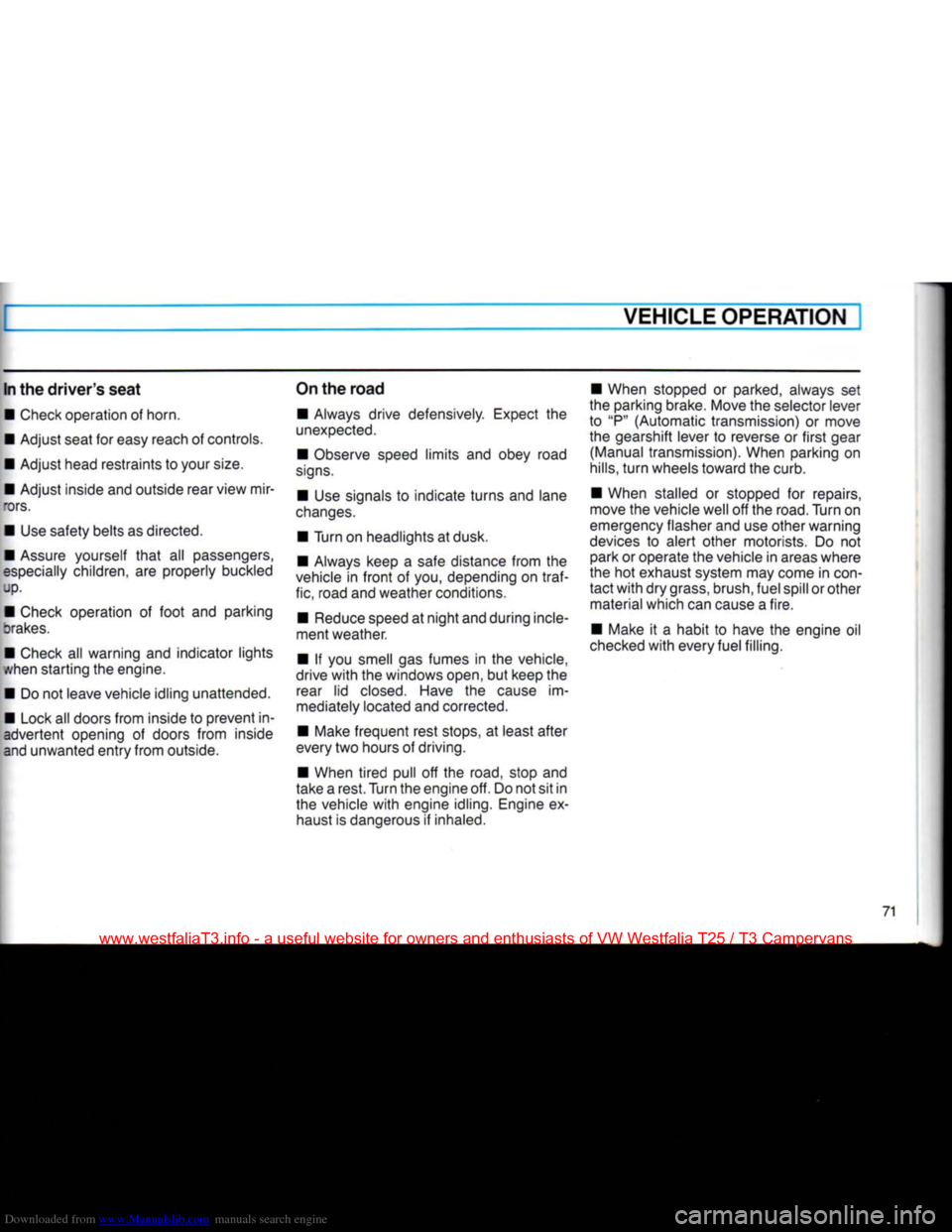
In the
driver's
seat
•
Check operation of horn.
•
Adjust seat for easy reach of controls.
•
Adjust head restraints to your
size.
•
Adjust inside and outside rear view mir-
brs.
•
Use safety belts as directed.
•
Assure yourself
that
all passengers,
especially
children, are properly buckled up.
•
Check operation of
foot
and parking
orakes.
•
Check all warning and indicator lights
v/hen starting the engine.
•
Do not leave vehicle idling unattended.
•
Lock all doors
from
inside to prevent in advertent opening of doors
from
inside
and unwanted
entry
from
outside. On the
road
•
Always drive defensively. Expect the
unexpected.
•
Observe speed
limits
and obey road
signs.
•
Use signals to indicate
turns
and lane
changes.
•
Turn on headlights at dusk.
•
Always keep a safe distance
from
the
vehicle in
front
of you, depending on
traf
fic, road and weather conditions.
•
Reduce speed at
night
and during incle
ment weather.
•
If you smell gas fumes in the vehicle,
drive
with
the windows open, but keep the rear lid
closed.
Have the cause im
mediately located and corrected.
•
Make frequent rest stops, at least
after
every two hours of driving.
•
When
tired
pull off the road, stop and
take a rest. Turn the engine off. Do not sit in the vehicle
with
engine idling. Engine exhaust is dangerous if inhaled.
•
When stopped or parked, always set
the parking brake. Move the selector lever
to "P" (Automatic transmission) or move
the gearshift lever to reverse or
first
gear (Manual transmission). When parking on
hills,
turn
wheels
toward
the curb.
•
When stalled or stopped for repairs,
move the vehicle well off the road. Turn on
emergency flasher and use other warning
devices
to alert other motorists. Do not park or operate the vehicle in areas where
the hot exhaust system may come in
con
tact
with
dry
grass,
brush, fuel spill or other material which can cause a fire.
•
Make it a habit to have the engine oil
checked
with
every fuel filling.
www.westfaliaT3.info - a useful website for owners and enthusiasts of VW Westfalia T25 / T3 Campervans