1990 VOLKSWAGEN TRANSPORTER warning
[x] Cancel search: warningPage 80 of 165
Downloaded from www.Manualslib.com manuals search engine
-
VEHICLE
OPERATION
Driving on dry roads
Attention
"his
is an
all-wheel drive multipurpose
rassenger
vehicle which
will
handle
and
maneuver
differently
from
an ordinary
pas
senger
car in driving conditions which may
occur
on
streets
and
highways
and off-
'oad.
As
with
other vehicles
of
this type,
if
you make sharp turns
or
abrupt maneu
vers,
the
vehicle
may
roll over
or
may
go
kit
of
control and
crash.
You should read
:he driving guidelines
and
instructions
in
the Owner's
Manual.
The
driver
and all
oassengers
should wear safety belts
at all
times.
Do
not
engage
the
differential lock on nor
mal
dry
roads
as it
will
not
provide any ad
vantage. Under these circumstances,
an
engaged differential lock
will
impair the ve-
nicle's
maneuverability and
will
cause
ex
cessive
tire
wear.
Driving on wet, slippery roads
Due
to the
all-wheel drive,
the
engine
power
is
transmitted evenly
to a
moder
ately slippery road surface.
On
wet surface
As
with
any
other vehicle, excessive driv ing speed on very wet roads can cause hy
droplaning
and
loss
of
vehicle control.
Therefore, slow down.
The
differential lock* must
not be
engaged.
Important
instructions
on
the
differential
locks
are to be found on page
33/34.
On
slippery surfaces
On
slippery surfaces the rear axle differen
tial
lock may only be engaged when
start
ing
from
a
standstill
or at
very low
speeds.
When
the
road surface has improved
the
lock should
be
disengaged again. On
snow covered surfaces
On
a
snow covered road, maintain traction by making gradual changes
in
speed
or
di
rection. Avoid sudden maneuvers. Be alert
to problems other drivers around you may be having which could create
a
hazardous
situation
for
you.
In heavy snow, maintaining reasonable
momentum
is
important
for
safe vehicle
operation. Try
to
keep moving
by
using
the
L-gear and
a
steady accelerator pedal
at
low
speed.
WARNING
•
Always
maintain
a safe driving
speed,
especially
when
road and
weather
conditions are poor.
•
Excessive
driving speed on very wet
roads can cause hydroplaning and
loss
of vehicle control.
•
Always avoid forceful and
abrupt
braking action.
You
could block all four
wheels simultaneously and lose
con
trol
of the vehicle.
•
The braking capability of your Vana-
gon/Transporter Syncro is
greatly
de
pendent on the
traction
of your tires.
'where applicable 79
www.westfaliaT3.info - a useful website for owners and enthusiasts of VW Westfalia T25 / T3 Campervans
Page 81 of 165
Downloaded from www.Manualslib.com manuals search engine
VEHICLE
OPERATION
WARNING continued
•
The permanently engaged allwheel-
drive
will
provide
good
performance on relatively wet or slippery
roads.
Be
sure
to use these features and advantages
wisely. Do not let the excellent traction
which your VW
SYNCRO
offers lead
you
to underestimate the difficulties
and risks involved in negotiating wet or
slippery
roads. Always drive defen
sively
and adapt vehicle operation and
driving speed to road and
traffic
condi
tions.
Driving Off-Road
WARNING
The Vanagon/Transporter
Syncro
is not an off-road or all
terrain
vehicle. Use of
this or any other vehicle under off-road
conditions
requires special skills and knowledge. The off-road operation of
this or any other
vehicle
can
lead
to per
sonal
injury.
•
Driver and all
passengers
must
wear
safety belts at all times.
•
Keep your thumbs and fingers on
the outside of the steering wheel.
Potholes
or rocks can
jerk
the
wheel
from your grip; it really hurts if a spoke
catches
you on the way around.
Off-Road
Driving
Driving off-road places extra demands
on
your vehicle and on you, the driver.
If
under
exceptional
circumstances
you
judge
it
safe
and
appropriate
to
leave
the
paved highway,
first
make sure
that
your vehicle
is
in top
mechanical condition. Make cer
tain
that
all
vehicle systems
are
function ing normally,
in
particular,
for
example,
that
the engine, especially the cooling
sys
tem,
is
operating properly and
that
trans
mission,
brakes and steering are function ing normally. Tires must have adequate
tread,
be
free
of
damage
and be
adequately inflated.
Before
driving over
difficult
terrain, such as
mud,
sand,
water, snow
or
steep
slopes,
we recommend engaging
the
differentia lock*
at low
speed.
Important
information
regarding
the
differential lock
is on
page
33/34.
Whenever
you
operate your
car you
should
be
well
and fit, but
your physical
and
mental condition
are
especially
im
portant
when driving
off
the road.
As
a
general rule
you
should
go
only where others have gone before.
Always
obey applicable
Federal,
State
and
local regulations
and
above
all re
spect
and protect the environment. Do
not
scar
the
land, avoid unnecessary wheel
spinning and other driving behavior which
will
create
ruts
and destroy vegetation.
Be
careful when parking and when standing
with
a hot
engine. The catalytic converter
with
which your vehicle
is
equipped devel
ops
very high temperatures which can set
dry grass and brush
on
fire. Respect
the
wildlife, leave animals
to
themselves
and
do not destroy their areas
of
refuge. Above
all,
be
considerate and operate your vehi
cle
sensibly and safely. Nature
is a
natural
resource
which belongs
to
all
of
us.
'where applicable
www.westfaliaT3.info - a useful website for owners and enthusiasts of VW Westfalia T25 / T3 Campervans
Page 87 of 165
Downloaded from www.Manualslib.com manuals search engine
VEHICLE OPERATION
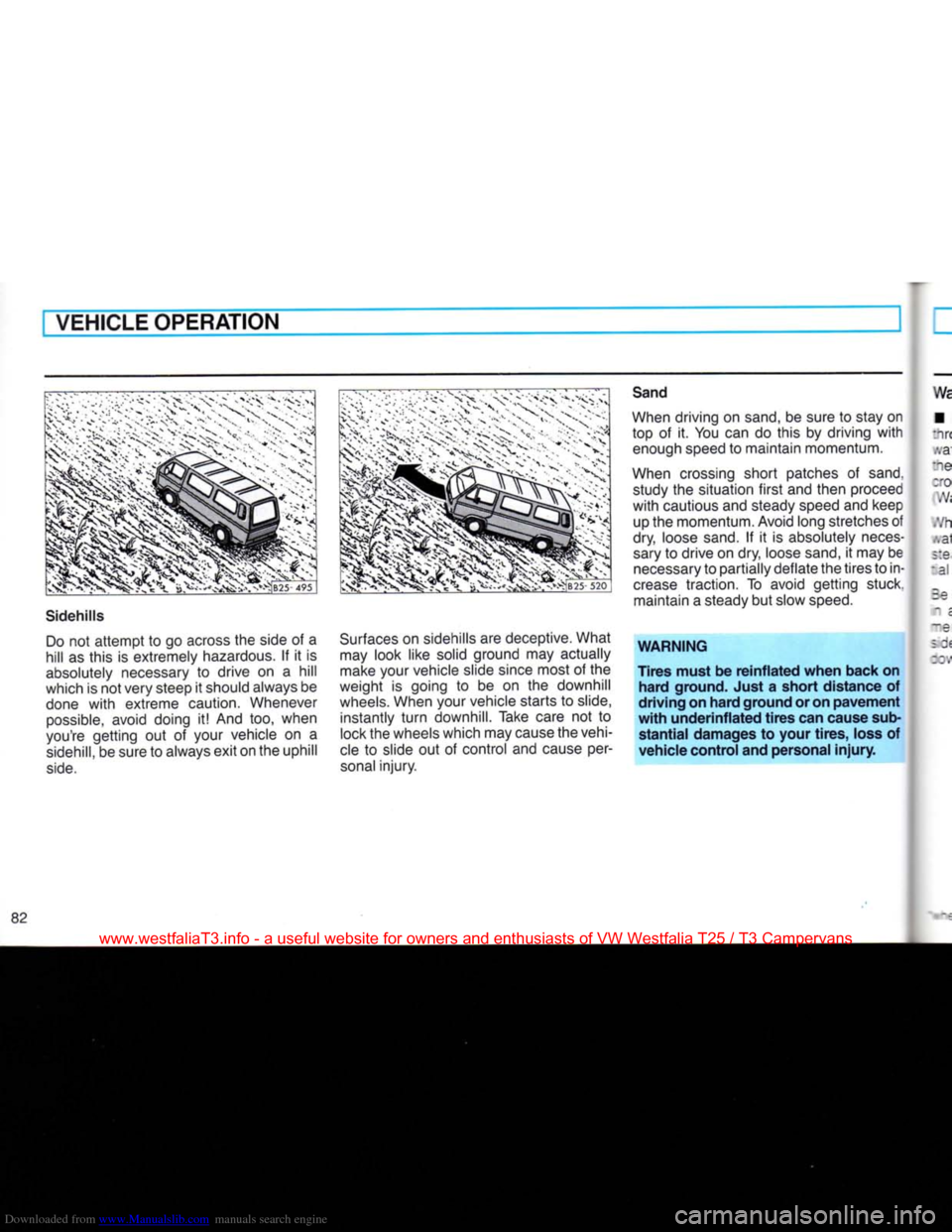
Sidehills
Do
not
attempt
to go across the side of a
hill as this is extremely hazardous. If it is
absolutely necessary to drive on a hill
which is not very steep it should always be
done
with
extreme caution. Whenever
possible,
avoid doing it! And too, when
you're getting out of your vehicle on a
sidehill,
be sure to always exit on the uphill
side.
Surfaces
on sidehills are deceptive. What
may look like solid ground may actually
make your vehicle slide since most of the
weight is going to be on the downhill
wheels.
When your vehicle starts to slide, instantly
turn
downhill. Take care not to
lock the wheels which may cause the vehi
cle
to slide out of control and cause per
sonal
injury.
Sand
When driving on
sand,
be sure to stay on top of it. You can do this by driving
with
enough speed to maintain momentum.
When crossing short patches of
sand,
study the situation
first
and then proceed
with
cautious and steady speed and keep up the momentum. Avoid long stretches of
dry, loose
sand.
If it is absolutely neces
sary
to drive on dry, loose
sand,
it may be
necessary
to partially deflate the tires to in
crease
traction. To avoid getting stuck, maintain a steady but slow
speed.
WARNING
Tires
must
be
reinflated
when
back
on
hard
ground. Just a
short
distance
of
driving
on
hard
ground
or on
pavement
with
underinflated
tires
can cause sub
stantial
damages
to
your
tires,
loss of
vehicle
control
and
personal
injury.
www.westfaliaT3.info - a useful website for owners and enthusiasts of VW Westfalia T25 / T3 Campervans
Page 90 of 165
Downloaded from www.Manualslib.com manuals search engine
VEHICLE CARE
=UELTANK
|he fuel filler neck is located above the -gnt
front
wheel. Syncro model: above the
-;nt rear wheel.
mm key A (see page 7) is used for the lock-
acle
tank cap. The syncro model has a separate key for the lockable tank cap.
capacity of the tank is 16.0 gal/60
:ers
(Reserve is 2.5 gal/10 liters of
total
rapacity).
5/ncro model: 18.5 gal/70 liters (Reserve
2
5 gal/10 liters of
total
capacity). Trouble-free refueling depends on the cor
rect use of the filler nozzle.
Always
insert the nozzle fully
into
the fuel filler neck, to completely open the spring-loaded flap located
just
below the filler
neck opening. Make sure the filler nozzle
is
not tilted.
Do
not
fill
the fuel tank too quickly, other
wise the fuel may foam up and cause the
nozzle
to switch off too
soon.
As
soon as the nozzle switches off auto matically for the
first
time, the tank is full.
Do
not try to add more fuel, because the
expansion
space in the fuel tank will be
filled - the fuel can then overflow when it
becomes
warm.
WARNING
Never
carry
additional
fuel
containers
in
your
vehicle.
Such
containers,
full
or
empty,
may
leak,
cause an explosion,
or
result
in
fire
in case of a collision.
85
www.westfaliaT3.info - a useful website for owners and enthusiasts of VW Westfalia T25 / T3 Campervans
Page 94 of 165
Downloaded from www.Manualslib.com manuals search engine
VEHICLE
CARE
.EANING PRODUCTS
.
automobile is
subjected
to
abuse
from
atrial
fumes,
corrosive
road salt,
aban-
-ed
lollipops,
muddy dog feet, etc.; to
ne
just a few. A well
cared
for
Volkswa-
-
can look like new many
years
later,
gular
and correct
care
will contribute to
ntaining
the beauty and the
value
of
far
Volkswagen.
jr
Volkswagen
dealer
has a number of
-care
products and can
advise
you
ch
ones
to use for
cleaning
the exterior
d
interior of your
vehicle,
"ether
you use
Volkswagen
recom-
nded
products or other, commercially
lilable
cleaning
agents,
make
sure
first
heir
correct
application.
WARNING
•
Cleaning agents may be poisonous.
Keep
them
out of the reach of children.
•
Observe all caution labels.
•
Always read directions on the
con
tainer
before using any product.
•
Most chemical cleaners are concen
trates
which require dilution.
•
Only use spot removing fluids in
well
ventilated
areas.
•
Do not use gasoline, kerosene,
naphtha, nail polish remover or other
volatile cleaning fluids. They may be
toxic, flammable or hazardous in other
ways.
89
www.westfaliaT3.info - a useful website for owners and enthusiasts of VW Westfalia T25 / T3 Campervans
Page 95 of 165
Downloaded from www.Manualslib.com manuals search engine
VEHICLE
CARE
EXTERIOR
Washing
and
waxing
The
paint on your Volkswagen is very dura ble but must be protected
from
losing its
luster due to outside influences. There
fore, wash and wax your Volkswagen
often. The longer the
dirt
is
left
on the paint, the greater the risk of damaging the
glossy
finish, either by scratching if the
dirt
is
rubbed
into
the paint, or simply by the
chemical
effect
dirt
particles have on the paint surface.
Do not
wash
or wax in
direct
sunlight,
or
when
the
sheet
metal
is hot. Do not use hot
water.
Lukewarm
to cool
water
is
kinder
to the
paint.
WARNING
•
Do not
wash,
wax or dry the
vehicle
with
the
engine
running.
•
Do not
clean
the
underside
of chas
sis,
fenders,
wheel
covers, etc.,
without
protecting
your
hands
and
arms.
You
may cut
yourself
on
sharp-edged
metal
parts.
•
Moisture,
ice and
road
salt
on
brakes
may
affect
braking
efficiency.
Test
the
brakes
carefully
after
each
vehicle
wash.
Do
not aim the water jet directly at door,
hatch or rear lid locks. Tape the key holes
to prevent water
from
seeping
into
the lock
cylinders.
Water in lock cylinders should be removed
with
compressed air. To pre
vent locks
from
freezing in the winter, squirt glycerine or lock de-icer
into
the lock
cylinders.
Do not use any
solution
that
can
damage
the
body
paint.
Use
plenty of water, a car-wash and wax
solution and a soft sponge or hose brush.
Begin
by spraying water over the dry sur
face
to remove all loose
dirt
before apply ing the car-wash and wax solution. Use
plenty of water to rinse the vehicle off.
Wipe
everything dry
with
a chamois to avoid water spots.
When
having your vehicle washed at an automatic car
wash,
be sure to observe all
the precautions suggested by the
esta
blishment.
The
underside of the vehicle picks up d ~
and road salt. To guard against corrosic it is important to remove mud, debris a":
road salt
from
the underside
with
i
powerful jet of water. Be sure to include t"
wheel housings, bumpers, muffler, tailp :- and brackets. This should be done twice
year
and is best accomplished after the \ hide has been driven through a hea
rain.
Let engine and exhaust cool do,"
before washing.
Waxing
is not really needed when y:.
have
used a car-wash and wax solution
you do not use a car-wash liquid
with
wa^ apply wax to preserve the natural shine :
the body paint. To obtain a long last-:
finish,
apply hard wax. Wax again whe
water remains on the surface in lar:-
patches
instead of forming beads a": rolling off.
This
will
make
dirt
easier to remove e :
will
prevent the paint
from
being damage:
from
industrial dust, tree sap or bird drz~-
pings.
Use
a polish when it becomes evident tha:
waxing no longer accomplishes the jot
the polish you are using does not conta
wax, apply hard wax after polishing.
www.westfaliaT3.info - a useful website for owners and enthusiasts of VW Westfalia T25 / T3 Campervans
Page 97 of 165
Downloaded from www.Manualslib.com manuals search engine
VEHICLE
CARE
Weatherstrips
Keep silicone sprays
off the
windshield
to avoid wiper smear
in
rain.
To seal properly, weatherstrips around
hood,
hatch, windows, doors,
etc.,
must
be pliable. Spray with silicone
or
coat with
talcum powder
or
glycerine
to
retain
flexibility
of the
rubber
and to
protect against freezing
in the
winter.
Sliding roof quide rails
To assure that
the
sliding roof* function properly, clean
the
guide rails
and
lubri
cate with silicone spray
at
least once
a
year.
See
your Volkswagen dealer
for
cor rect procedures
and
lubricant.
Dull finishes and plastics
Plastic parts, such
as
light bulb lenses,
decorative stripes, panels, bumpers,
etc.,
will come clean with regular washing. Should additional cleaning
or
spot
re
moval
be
necessary,
use a
soft brush
or
cloth soaked with
a
mild detergent
solu
tion.
Then rinse thoroughly
and im
mediately with clear water.
Do not use anything which could mar the
plastic
or
dull finished surface, such
as
wax, polish, abrasive detergents
or
chemical cleaning solvents.
Sliding door
The sliding door mounting points,
the
guide tracks
and the
roller guides should be lubricated regularly
and as
often
as
necessary.
Bright metal trim
Bright
or
black anodized trim will come
clean with regular washing.
To
protect metal
trim,
use car
wax. Remove spots
or
dirt from chrome
and
stainless steel with
a
chrome cleaner. Apply
a
chrome polish
for
continued luster and protection.
Steel wheels
Always include
the hub
caps
and
whee rims when washing your vehicle
to
remove
road dirt, salt sprays and brake dust.
If
nec
essary,
use a
commercial wheel cleaner
t:
remove accumulated brake dust. Pain:
scratches should
be
touched
up to
prever
corrosion.
Light alloy wheels
To preserve
the
decorative appearance
c-
the light aluminium cast, some specie
care
is
necessary.
In
addition
to
road
dr
and salt sprays, brake metal dust
is
alsc
corrosive.
If
left
on too
long,
brake meta
dust
can
cause pitting. Wash
the
wheels
with
a
sponge
or
hose brush every othe-
week. Road salt should
be
remove:
weekly with
an
acid free cleaning solutior Every three months (after regular clear
ing)
the
wheels should
be
coated
wit-
petroleum jelly
or car
wax.
Rub it in
firml.
with
a
soft cloth. Never
use
abrasive
c
metal polishing cleaning agents.
Remember that moisture,
ice and
roac
salt
on
brakes
may
affect braking
eff
ciency. Test
the
brakes carefully afte'
each washing. Heed warning
on
page
29.
92
*
where applicable
www.westfaliaT3.info - a useful website for owners and enthusiasts of VW Westfalia T25 / T3 Campervans
Page 99 of 165
Downloaded from www.Manualslib.com manuals search engine
VEHICLE CARE
CORROSION
PROTECTION
The transmission,
front
and rear axle
assembly
surfaces have been treated at
the factory
with
a wax based coating for protection against corrosion. However, we
recommend to have the and the underside
inspected twice a year for any damage to
the protective coating preferably before and after the winter
season.
Have
neces
sary
repairs done as soon as possible.
See
your dealer for correct procedures
and materials.
WARNING
Do not
apply
additional
undercoating
or
rustproofing
on or
near
the
exhaust
manifold,
exhaust
pipes,
catalytic
converter
or
heat
shields.
During
driv
ing, the substance used for
under-
coating
could
overheat
and cause a
fire.
Engine
Compartment
When washing the engine compartment, only use commercially available grease
cutting solvents made especially for this
purpose.
Carefully follow directions
print
ed
on the container by the manufacturer.
WARNING
Never
use gasoline,
Diesel
fuel
or sol
vents
which
could
damage
rubber
parts
or
painted
surfaces and could
cause a
fire.
Chassis
The lower body shell of your Volkswagen
is
thoroughly protected against corrosion. However, it is recommended to have the
underside inspected twice a year. Any de
tected damage to the undercoating, due to road hazards, should be repaired prompt
ly. Oil based protective sprays must not be
applied.
Only tar or wax based anticorro-
sion
protectors are compatible
with
the
factory applied undercoating. Before ap plication, road
dirt,
salt spray deposits and
oily substances must be removed.
Whenever
the lower body
shell,
axle, transmission or engines assemblies have been repaired, the lost anti-corrosion
coating of the affected surfaces should be
reapplied.
Your
Volkswagen dealer has the appro priate materials, the necessary equipment
and is familiar
with
the application proce
dure. Therefore, any additional corrosion protection work should be performed by a
Volkswagen
dealer.
Body
cavity sealing
All
body cavities which could be affecte: by corrosion have been given a thorouc"
protection at the factory.
This
sealing does not require any inspe:
tion
or additional treatments. If any wa should seep out of the cavity when tN
ambient temperature is high, it can M removed
with
a plastic scraper and -.
suitable solvent. Be sure to observe a
safety and environmental regulations.
94
www.westfaliaT3.info - a useful website for owners and enthusiasts of VW Westfalia T25 / T3 Campervans