1990 VOLKSWAGEN TRANSPORTER child seat
[x] Cancel search: child seatPage 15 of 165
Downloaded from www.Manualslib.com manuals search engine
CONTROLS
AND
EQUIPMENT
SAFETY
BELTS
WARNING Safety belts have been shown to be the
single most effective means available
for reducing the
potential
for serious in
jury
and death in automobile
acci
dents.
Therefore
for
your
own protec
tion as well as that of
your
passengers always properly wear safety
belts
when
the vehicle is in
motion.
Also, pregnant
women,
injured or physically impaired persons should use safety belts.
In order to provide the maximum level
of protection safety belts must be pro perly positioned on the
body.
Impro
perly positioned safety belts
can
cause
serious personal
injury
in
case
of
an
ac
cident.
Therefore
read and always ob serve all of the following instructions
and warnings pertaining to the use of
the safety belts installed in
your
vehi
cle.
•
The shoulder belt should be
positioned midway
over
the shoulder
never
across the neck. See illustration
on page
17.
•
Always make certain that the safety
belt tongue is inserted into the safety
belt buckle associated with the corres
ponding seat. Attaching the safety belt to the buckle for another seat could re
duce safety belt effectiveness and
cause
injury.
•
Do not wear shoulder part of belt
under
your
arm
or otherwise out of po
sition.
This
would increase the risk of
serious
injury
in case of
an
accident.
•
Do not use comfort clips or devices
which create slack in the shoulder belt portion and can increase the risk of in
jury
in an accident.
However
such clips may be required in the proper use of
some
child restraint systems.
•
Never
strap in more than one per
son,
including
small
children, with
each
belt. It is especially dangerous to
place
a safety belt
over
a child sitting
on
your
lap.
•
The lap belt must be
worn
low and
tight across the pelvis. Make sure any
slack
is wound on the retractor.
•
Belts should not be
worn
twisted.
•
Do not wear belts
over
rigid or
breakable
objects in or on
your
clothing,
such as eye glasses, pens,
keys,
etc. as these may cause
injury.
•
Several layers of
heavy
clothing
may
interfere with proper positioning of
belts
and reduce the
over
all effective
ness
of the system.
•
Keep belt buckles free of any
obstruction that may
prevent
secure
locking.
•
Make sure the belts of the unoc
cupied seats are in their stowed posi
tions.
•
Belts that have been subjected to
excessive stretch forces in
an
accident must be replaced.
•
Belts must not rub against sharp
objects.
•
Do not allow safety belts to become
damaged
by becoming caught in door
or seat hardware.
•
Inspect
your
belts periodically. If
belts
show damage to webbing, bind
ings,
buckles or retractors,
they
must
be replaced.
•
If belts do not work properly, see
your
Volkswagen dealer.
www.westfaliaT3.info - a useful website for owners and enthusiasts of VW Westfalia T25 / T3 Campervans
Page 16 of 165
Downloaded from www.Manualslib.com manuals search engine
CONTROLS
AND
EQUIPMENT
• Do not modify or disassemble the
safety belts in
your
vehicle.
• The belts must be kept clean as other
wise the retractors may not work prop
erly
(also see "Vehicle care", page 93).
•
Never
bleach or dye safety belts.
• Do not allow safety belts to retract
until
they
are completely dry. Child safety
WARNING
All
vehicle occupants and especially children should be restrained when
ever
riding in cars. Holding a child in
your
arms is not
a
substitute for
a
child restraint system. In an accident,
a
child
held in a person's arms can be struck
or crushed by any unrestrained rider.
An unrestrained child could also be in
jured
by striking the interior, or by
being
ejected from the vehicle during a
sudden maneuver or impact. Do not
allow children to stand or kneel on the
seat.
A child restraint system can help protect
a
child in
a
car.
Accident statistics have shown that children are generally safer in the rear
seat area than in the
front
seating posi
tions.
A suitable child restraint properly in
stalled
and used in one of the rear seat
ing
positions provides the highest de
gree of protection for infants and
small
children in most accident situations. Commercially available child seats are
required to comply with U.S. Federal
Motor Vehicle Safety Standard
(FMVSS)
213 (or in Canada, CMVSS
213).
These
standards include
installa
tion requirements which utilize a lap belt or the lap portion of
a
combination lap-shoulder belt such as that installed
in
your
vehicle.
Should these safety belts be too short,
a
special lap belt adapter is available
from
your
Volkswagen dealer.
When purchasing a child restraint, select one which properly fits
your
child and
your
car.
Only
use child restraint systems which
fully contact the flat portion of the seat
cushion.
The child seat must not tip or
lean
to either side. We do not recom
mend the use of child seats which rest
on legs or tube
like
frames because
they
do not provide adequate contact
with the seat.
15
www.westfaliaT3.info - a useful website for owners and enthusiasts of VW Westfalia T25 / T3 Campervans
Page 17 of 165
Downloaded from www.Manualslib.com manuals search engine
CONTROLS
AND
EQUIPMENT
WARNING continued
Improperly
or inadequately installed
child
restraint systems can increase
the risk of
injury
to children in
acci
dents, therefore always carefully read
and follow all instructions on
installa
tion and use that come with the sys
tem.
Children
must
be
positioned so
that
the
shoulder belt does not contact or re
main
in
front
of the face,
chin,
neck or
throat Failure to follow this precaution
can
increase the risk or severity of in
jury
in the
event
of
a
collision.
In summary:
Children who are
less
than
12
years old
should always sit in the rear. For reasons of safety a child should
only occupy the
front
seat if all of the rear seating positions are already oc
cupied by other children.
The children should wear, depending on age and
body
size, either
a
child re
straint system or the existing safety
belts:
•
Babies and children up to about
6
or
7
years should be secured with a child restraint system designed for their
size.
Children of average size of about 6
or 7 years of age may use available
safety belts. Always
make
sure that the
shoulder portion of
a
three point belt is
positioned midway
over
the shoulder
-
it must
never
rest against or across
the neck. See illustration page
17.
The
lap
belt or the lap belt portion of the
three point belt must always pass as low as possible across the pelvis,
never
over
the
abdomen.
If the safety belt will not properly fit the
child,
we recommend the use of a suit
able
booster seat in a rear seating
posi
tion in order to raise the child's seating height so that the safety belt will pro
perly fit the
child.
www.westfaliaT3.info - a useful website for owners and enthusiasts of VW Westfalia T25 / T3 Campervans
Page 27 of 165
Downloaded from www.Manualslib.com manuals search engine
CONTROLS AND
EQUIPMENT
REAR SEAT BENCH/BED
COMBINATION*
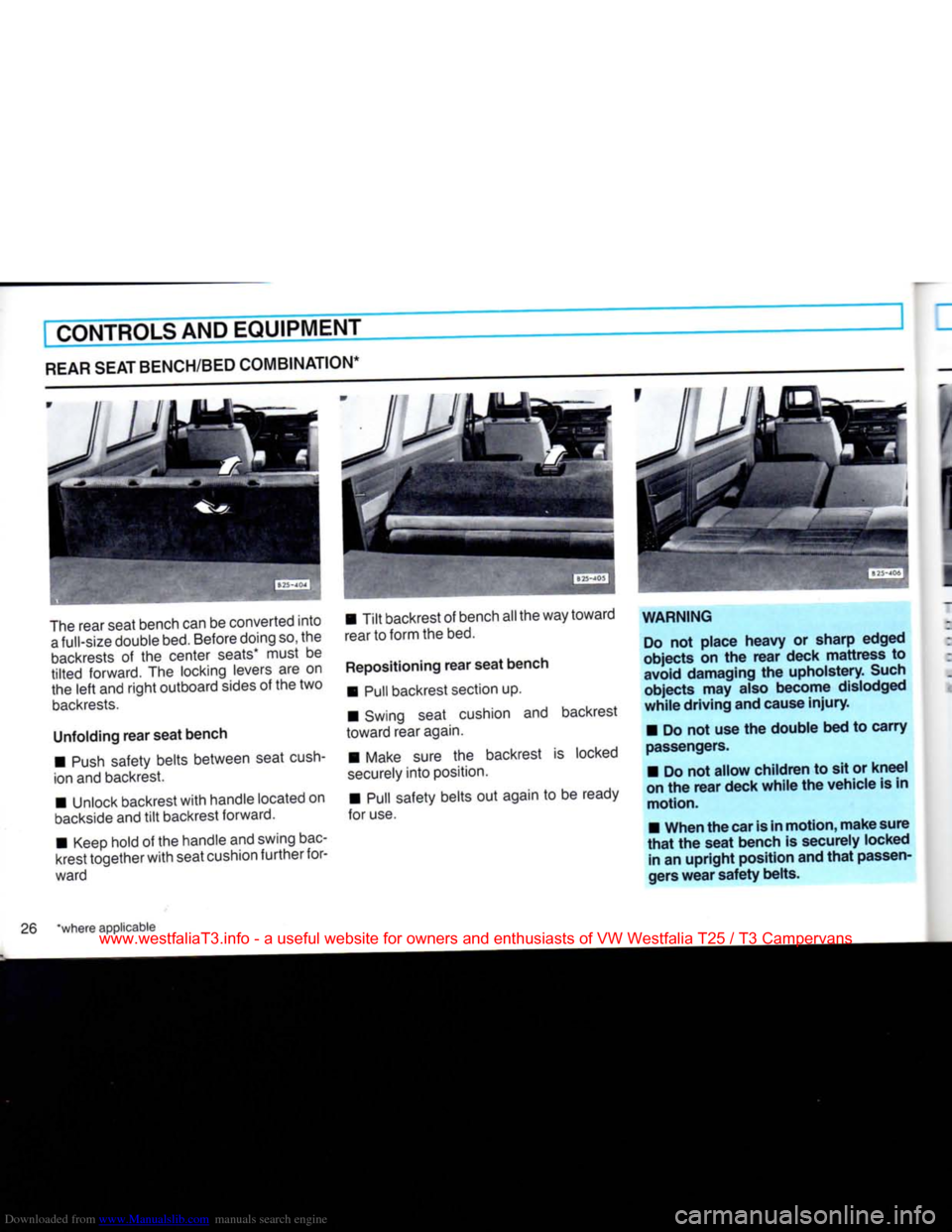
The rear seat bench can be converted
into
a
full-size double bed. Before doing so, the
backrests
of the center seats* must be
tilted
forward. The locking levers are on
the
left
and
right
outboard sides of the two
backrests.
Unfolding
rear
seat
bench •
Push
safety belts between seat
cush
ion and backrest.
• Unlock backrest
with
handle located on
backside
and
tilt
backrest forward.
• Keep hold of the handle and swing bac
krest together
with
seat cushion
further
for
ward •
Tilt
backrest of bench all the way toward
rear to form the bed.
Repositioning
rear
seat
bench • Pull backrest section up.
• Swing seat cushion and backrest
toward rear again.
• Make sure the backrest is locked
securely
into
position.
• Pull safety belts out again to be ready
for use.
WARNING
Do not
place
heavy
or
sharp
edged
objects
on the
rear
deck
mattress
to
avoid
damaging
the
upholstery.
Such
objects
may also
become
dislodged
while
driving
and cause
injury.
• Do not use the
double
bed to
carry
passengers.
• Do not
allow
children
to sit or
kneel
on the
rear
deck
while
the
vehicle
is in
motion.
•
When
the car is in
motion,
make
sure
that
the
seat
bench is securely locked in an
upright
position
and
that
passen
gers
wear
safety
belts.
26 *where applicable
www.westfaliaT3.info - a useful website for owners and enthusiasts of VW Westfalia T25 / T3 Campervans
Page 72 of 165
Downloaded from www.Manualslib.com manuals search engine
VEHICLE
OPERATION
In the
driver's
seat
•
Check operation of horn.
•
Adjust seat for easy reach of controls.
•
Adjust head restraints to your
size.
•
Adjust inside and outside rear view mir-
brs.
•
Use safety belts as directed.
•
Assure yourself
that
all passengers,
especially
children, are properly buckled up.
•
Check operation of
foot
and parking
orakes.
•
Check all warning and indicator lights
v/hen starting the engine.
•
Do not leave vehicle idling unattended.
•
Lock all doors
from
inside to prevent in advertent opening of doors
from
inside
and unwanted
entry
from
outside. On the
road
•
Always drive defensively. Expect the
unexpected.
•
Observe speed
limits
and obey road
signs.
•
Use signals to indicate
turns
and lane
changes.
•
Turn on headlights at dusk.
•
Always keep a safe distance
from
the
vehicle in
front
of you, depending on
traf
fic, road and weather conditions.
•
Reduce speed at
night
and during incle
ment weather.
•
If you smell gas fumes in the vehicle,
drive
with
the windows open, but keep the rear lid
closed.
Have the cause im
mediately located and corrected.
•
Make frequent rest stops, at least
after
every two hours of driving.
•
When
tired
pull off the road, stop and
take a rest. Turn the engine off. Do not sit in the vehicle
with
engine idling. Engine exhaust is dangerous if inhaled.
•
When stopped or parked, always set
the parking brake. Move the selector lever
to "P" (Automatic transmission) or move
the gearshift lever to reverse or
first
gear (Manual transmission). When parking on
hills,
turn
wheels
toward
the curb.
•
When stalled or stopped for repairs,
move the vehicle well off the road. Turn on
emergency flasher and use other warning
devices
to alert other motorists. Do not park or operate the vehicle in areas where
the hot exhaust system may come in
con
tact
with
dry
grass,
brush, fuel spill or other material which can cause a fire.
•
Make it a habit to have the engine oil
checked
with
every fuel filling.
www.westfaliaT3.info - a useful website for owners and enthusiasts of VW Westfalia T25 / T3 Campervans
Page 162 of 165
Downloaded from www.Manualslib.com manuals search engine
ALPHABETICAL
INDEX
page
Accessories
122
Air
cleaner 103
Air
Conditioner 54 All-wheel-drive 75
Alternator warning
light
44
Ashtrays
64
Assist
handles and coat hooks ... 67
Automatic safety belts 14
Automatic Transmission 35
Automatic Transmission Fluid .... 102 Auxiliary Heater 57, 60
Battery 109
Battery charging 110
Brake
fluid reservoir 108
Brake
warning
light
43
Brakes
29
Break-in
period 69
Bulb
chart 130
Bulb
replacing 130
Buzzer
7,35
Capacities
147
Catalytic
converter 144
Central
locking system 8
Cigarette lighter 63
Child
safety 15
Chime
7,35
Cleaning
products 89
Climate
controls 51
Clock
41 page
Coolant
temperature gauge .... 41
Cooling
system 104
Consumer
information 152
Corrosion
protection 94
Cruise
control 49
Curtains
27
Cup
holder 66
Dashboard
4
Data
146
Defogging/defrosting 52 Differential lock 33
Dimensions
148
Do-it-yourself service 123
Doors
9
Economically
driving 72
Electric
windows 12
Emergency
equipment 70
Emergency
flasher 46
Emergency
starting 136
Emergency
towing 138
Emission
Control System 144
Engine
code letter 151
Engine
compartment lid 97
Engine
cooling 41,104
Engine
exhaust 144
Engine
number 151
Engine
oil changing 100
pace
Engine
oil checking 9?
Engine
oil grades 9E
Expansion
tank 105
Fan
41, 10c
Folding
table 65
Foreign
country driving 120 Front seats 20
Fuel
economy 72
Fuel
gauge 42
Fuel
injection 142
Fuel
supply 86
Fuel
tank 85
Fuses
12E
Gas
Station
Information
156
Gasoline
additives 86
Gearshift lever 32
Glove
compartment 64
Headlight dimmer and flasher .... 48 Headlights 13C
Headlight adjustment 134
Headlight switch 46
Head
restraints 19 HeatingA/entilation 51
High beam 45,48
Horn 4
Identification label and number ... 151
Ignition/steering lock 38
Indicator lights 43
www.westfaliaT3.info - a useful website for owners and enthusiasts of VW Westfalia T25 / T3 Campervans