1990 VOLKSWAGEN TRANSPORTER parking brake
[x] Cancel search: parking brakePage 45 of 165
Downloaded from www.Manualslib.com manuals search engine
I CONTROLSAND EQUIPMENT
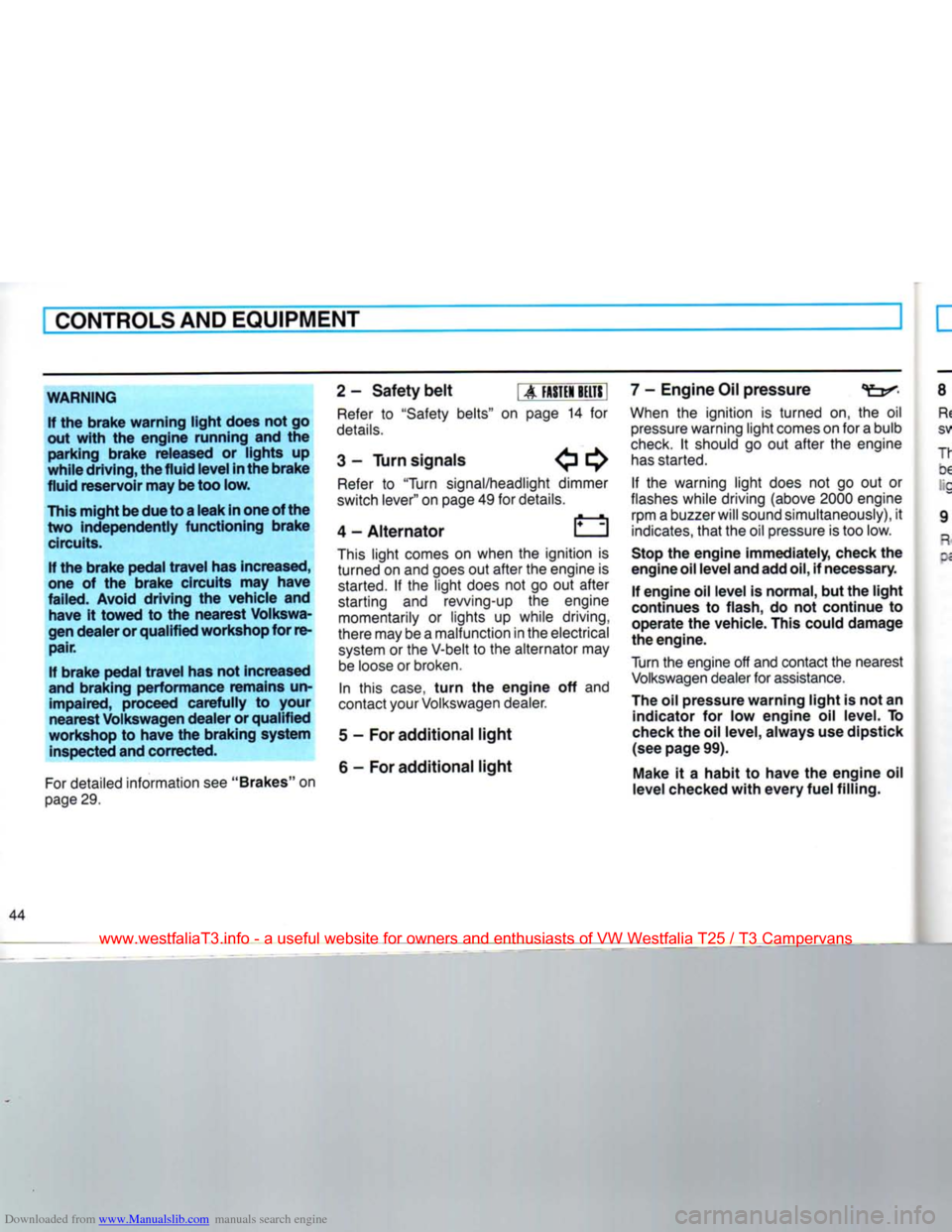
WARNING If the brake warning
light
does not go
out
with
the engine running and the parking brake released or lights up
while driving, the fluid level
in
the brake
fluid reservoir may
be
too low.
This might be
due
to
a
leak in one of the two independently functioning brake circuits.
If the brake pedal travel has increased,
one of the brake circuits may have
failed.
Avoid driving the vehicle and have it towed to the nearest Volkswa
gen dealer or qualified workshop for re pair.
If brake pedal travel has not increased
and
braking performance remains un
impaired,
proceed carefully to
your
nearest Volkswagen dealer or qualified
workshop to have the braking system inspected and corrected.
For detailed information see
"Brakes" on
page 29. 2-
Safety belt
|
A
FASTEN
BELTS
Refer
to
"Safety belts"
on
page
14 for
details.
3
-
Turn
signals E^
Refer
to
"Turn
signal/headlight dimmer
switch lever" on page 49 for details.
4
- Alternator
This
light comes
on
when
the
ignition
is
turned on and goes out after the engine
is
started.
If the
light does
not go out
after
starting
and
revving-up
the
engine
momentarily
or
lights
up
while driving,
there may be a malfunction
in
the electrical system
or
the V-belt
to
the alternator may be loose
or
broken.
In
this
case,
turn
the engine off and
contact
your
Volkswagen dealer.
5
- For additional
light
6
- For additional
light
7
- Engine Oil pressure
When
the
ignition
is
turned
on, the oil
pressure warning light comes on for a bulb
check.
It
should
go out
after
the
engine
has
started.
If the
warning light does
not go out or
flashes
while driving
(above
2000
engine rpm a buzzer
will
sound simultaneously),
it
indicates,
that the oil pressure is too low.
Stop the engine immediately, check the
engine
oil
level
and add
oil, if necessary.
If engine oil level is normal, but the
light
continues to flash, do not continue to
operate the vehicle. This could damage
the engine.
Turn
the engine off and contact the nearest Volkswagen dealer for assistance.
The oil pressure warning
light
is not an indicator for low engine oil level. To
check
the oil level, always use dipstick
(see page 99).
Make
it a habit to have the engine oil
level checked
with
every
fuel filling.
www.westfaliaT3.info - a useful website for owners and enthusiasts of VW Westfalia T25 / T3 Campervans
Page 72 of 165
Downloaded from www.Manualslib.com manuals search engine
VEHICLE
OPERATION
In the
driver's
seat
•
Check operation of horn.
•
Adjust seat for easy reach of controls.
•
Adjust head restraints to your
size.
•
Adjust inside and outside rear view mir-
brs.
•
Use safety belts as directed.
•
Assure yourself
that
all passengers,
especially
children, are properly buckled up.
•
Check operation of
foot
and parking
orakes.
•
Check all warning and indicator lights
v/hen starting the engine.
•
Do not leave vehicle idling unattended.
•
Lock all doors
from
inside to prevent in advertent opening of doors
from
inside
and unwanted
entry
from
outside. On the
road
•
Always drive defensively. Expect the
unexpected.
•
Observe speed
limits
and obey road
signs.
•
Use signals to indicate
turns
and lane
changes.
•
Turn on headlights at dusk.
•
Always keep a safe distance
from
the
vehicle in
front
of you, depending on
traf
fic, road and weather conditions.
•
Reduce speed at
night
and during incle
ment weather.
•
If you smell gas fumes in the vehicle,
drive
with
the windows open, but keep the rear lid
closed.
Have the cause im
mediately located and corrected.
•
Make frequent rest stops, at least
after
every two hours of driving.
•
When
tired
pull off the road, stop and
take a rest. Turn the engine off. Do not sit in the vehicle
with
engine idling. Engine exhaust is dangerous if inhaled.
•
When stopped or parked, always set
the parking brake. Move the selector lever
to "P" (Automatic transmission) or move
the gearshift lever to reverse or
first
gear (Manual transmission). When parking on
hills,
turn
wheels
toward
the curb.
•
When stalled or stopped for repairs,
move the vehicle well off the road. Turn on
emergency flasher and use other warning
devices
to alert other motorists. Do not park or operate the vehicle in areas where
the hot exhaust system may come in
con
tact
with
dry
grass,
brush, fuel spill or other material which can cause a fire.
•
Make it a habit to have the engine oil
checked
with
every fuel filling.
www.westfaliaT3.info - a useful website for owners and enthusiasts of VW Westfalia T25 / T3 Campervans
Page 75 of 165
Downloaded from www.Manualslib.com manuals search engine
VEHICLE OPERATION
For
best roadability adjust your load to the
maximum allowed tongue load. To be sure
measure
tongue load of loaded trailer on
bathroom
scales.
Check
that
both sides of your trailer can be
seen
from the driver's seat. If necessary in
stall extended rear-view mirrors.
Check
proper working of vehicle and
trailer lights.
Check
cold
tire
pressure of both vehicle
and
trailer.
Be
sure trailer safety chains are properly
connected
from trailer to the hitch on the
vehicle.
Leave enough slack in the chains
to permit turning corners.
Trailer
towing
tips
Your
vehicle handles differently when tow ing a trailer because of the additional
weight. Safety, performance and economy
will greatly depend on how carefully you
load
your trailer and operate your "rig."
Before
you actually tow your trailer, prac
tice turning, stopping and reversing in an
area
away from
traffic
until
you learn the
feel of your vehicle and trailer
unit.
Reversing
is
difficult
and requires practice.
Steering
while reversing is generally oppo
site of
that
when backing your vehicle with
out a trailer.
Observe
speed limits. In some areas
speeds
for vehicles towing trailers are lower than for regular vehicles.
Maintain a greater distance between your
vehicle
and the one in
front.
You will need more room to stop.
When
passing remember
that
you cannot
accelerate
as fast as you normally would
because
of the added load. Make sure you
have
enough room to
pass.
After passing
allow plenty of room for your trailer before
changing
lanes again.
Avoid
jerky starts or sudden acceleration.
Slow
down in crosswinds and on rougi"
roads.
Be especially carefull when
pas
sing
other vehicles and trucks.
When
parking always block the wheels o: both vehicle and trailer. Do not park
with
a
trailer on a slope. If it cannot be avoided dc
so
only after the following:
• Apply brakes.
• Have someone place wheel blocks
under both vehicle and trailer wheels.
• With wheel blocks in place slowly re
lease
brakes
until
wheel blocks absorb the
load.
• Apply parking brake.
•
Place
transmission in
"P"
for automatic
or in
first
or reverse gear for manual trans
mission.
74
www.westfaliaT3.info - a useful website for owners and enthusiasts of VW Westfalia T25 / T3 Campervans
Page 81 of 165
Downloaded from www.Manualslib.com manuals search engine
VEHICLE
OPERATION
WARNING continued
•
The permanently engaged allwheel-
drive
will
provide
good
performance on relatively wet or slippery
roads.
Be
sure
to use these features and advantages
wisely. Do not let the excellent traction
which your VW
SYNCRO
offers lead
you
to underestimate the difficulties
and risks involved in negotiating wet or
slippery
roads. Always drive defen
sively
and adapt vehicle operation and
driving speed to road and
traffic
condi
tions.
Driving Off-Road
WARNING
The Vanagon/Transporter
Syncro
is not an off-road or all
terrain
vehicle. Use of
this or any other vehicle under off-road
conditions
requires special skills and knowledge. The off-road operation of
this or any other
vehicle
can
lead
to per
sonal
injury.
•
Driver and all
passengers
must
wear
safety belts at all times.
•
Keep your thumbs and fingers on
the outside of the steering wheel.
Potholes
or rocks can
jerk
the
wheel
from your grip; it really hurts if a spoke
catches
you on the way around.
Off-Road
Driving
Driving off-road places extra demands
on
your vehicle and on you, the driver.
If
under
exceptional
circumstances
you
judge
it
safe
and
appropriate
to
leave
the
paved highway,
first
make sure
that
your vehicle
is
in top
mechanical condition. Make cer
tain
that
all
vehicle systems
are
function ing normally,
in
particular,
for
example,
that
the engine, especially the cooling
sys
tem,
is
operating properly and
that
trans
mission,
brakes and steering are function ing normally. Tires must have adequate
tread,
be
free
of
damage
and be
adequately inflated.
Before
driving over
difficult
terrain, such as
mud,
sand,
water, snow
or
steep
slopes,
we recommend engaging
the
differentia lock*
at low
speed.
Important
information
regarding
the
differential lock
is on
page
33/34.
Whenever
you
operate your
car you
should
be
well
and fit, but
your physical
and
mental condition
are
especially
im
portant
when driving
off
the road.
As
a
general rule
you
should
go
only where others have gone before.
Always
obey applicable
Federal,
State
and
local regulations
and
above
all re
spect
and protect the environment. Do
not
scar
the
land, avoid unnecessary wheel
spinning and other driving behavior which
will
create
ruts
and destroy vegetation.
Be
careful when parking and when standing
with
a hot
engine. The catalytic converter
with
which your vehicle
is
equipped devel
ops
very high temperatures which can set
dry grass and brush
on
fire. Respect
the
wildlife, leave animals
to
themselves
and
do not destroy their areas
of
refuge. Above
all,
be
considerate and operate your vehi
cle
sensibly and safely. Nature
is a
natural
resource
which belongs
to
all
of
us.
'where applicable
www.westfaliaT3.info - a useful website for owners and enthusiasts of VW Westfalia T25 / T3 Campervans
Page 86 of 165
Downloaded from www.Manualslib.com manuals search engine
VEHICLE OPERATION
I'iving
off-road on Steep Inclines
I Sidehills
Before reviewing how to drive up steep
• s and along sidehills, make note of an -oortant point. If you don't make it to the
co.
or your vehicle is about to slide or roll
= :eways,
turn
off the engine, put it
into
I
'3t
gear, put on the parking brake and get
W
on the uphill side and walk down. An
:^nce
of prevention is
worth
a pound of i.re.
Steep
Inclines
When preparing to climb a steep incline,
first
find out whether you can make it. If
necessary,
walk the course. Be sure there
is
enough clearance on all sides of the ve
hicle to avoid damage. If you have the
slightest doubt don't try it! It is always a
good idea to make a
trial
run to get the feel
of the surface and how much
effort
is
needed.
Go straight uphill. When the tires
begin to
spin,
apply a
little
extra gas and let
them dig in slightly. Step on the brakes
while you shift
into
reverse and drive straight back down. That's
right
- in re
verse
gear, clutch out and driving.
Abso
lutely not in neutral and
trying
to let your
self down on the brakes. To avoid sideroll remember never
turn
your vehicle
side
ways on a hill or steep incline.
On
your attempt, give yourself a running
start. Accelerate to the hill and then,
just
as
you approach the top,
ease
off the gas
to slow down.
When driving down, keep the vehicle heading straight downhill in low gear and
under control. If it begins to slide, don't lock up the brakes. You can't steer a
skid
ding wheel. Touch the gas instead to
straighten your car out.
www.westfaliaT3.info - a useful website for owners and enthusiasts of VW Westfalia T25 / T3 Campervans
Page 102 of 165
Downloaded from www.Manualslib.com manuals search engine
VEHICLE
CARE
ENGINE
COMPARTMENT LID
mu
have access to the engine compart-
•Mit
lid from inside the luggage compart- -ent.
"lb
open the
lid,
roll the floor covering out of
~9
way and
turn
both lock handles to the
Tb close the lid, reverse the above proce- ;jre.
ENGINE
COMPARTMENT
Always exercise extreme caution when
working on the engine. WARNING
•
Before you check anything in the en
gine compartment, stop the engine,
fully set the parking brake and remove
the ignition key.
•
Do not work on
your
car if you are
tired or ill, under emotional stress or under influence of drugs, medication
or alcohol.
•
Always let the engine cool down. Hot
components will burn skin on contact.
•
Do not spill engine oil, ATF, brake
fluid,
antifreeze and washer solvent on hot engine components, especially not
on the exhaust system.
These
fluids
are
flammable.
•
Always disconnect the battery
ground strap if you must work on the
fuel
system or the electrical system.
Never
smoke or work near heaters or
other fire hazards if you must work
around
fuel.
Always keep an approved
fire extinguisher immediately
avail
able.
Be
especially careful if engine is run
ning:
•
If work must be done with the engine
running, always fully set the parking
brake,
and make sure the shift lever is
in Neutral (Manual transmission) or
Park
(Automatic transmission).
•
Always be alert and extremely
cau
tious around the engine at
all
times par
ticularly when the engine is running.
•
Always exercise extreme caution to
prevent
neckties,
jewelry,
long hair or
loose clothing from getting caught in
the fan blades, the V-belts, or any other
moving
engine parts.
•
To avoid electrical shock and per
sonal
injury
never
touch ignition ca
bles
or components of the high voltage
electronic ignition system while the en
gine is running or even when starter is
cranked.
97
www.westfaliaT3.info - a useful website for owners and enthusiasts of VW Westfalia T25 / T3 Campervans
Page 107 of 165
Downloaded from www.Manualslib.com manuals search engine
VEHICLE CARE
AUTOMATIC TRANSMISSION FLUID / MANUAL TRANSMISSION OIL
Automatic Transmission Fluid
The torque converter and the transmis
sion are lubricated with Automatic Trans mission Fluid (ATF).
The final drive requires hypoid oil SAE 90,
which does not have to be changed.
Checking the ATF level
The ATF has to be checked at frequent intervals, for instance, when the engine
oil is being checked or at least at the intervals specified in your Maintenance
booklet.
Always heed WARNINGS on page 97. A correct ATF level is very important for
transmission operation.
To obtain an accurate reading, the
vehicle must be on level ground, and the
fluid must have reached operating
tem
perature. Normally, after a cold-start the
fluid will reach operating temperature when the vehicle has been driven for ab
out 6 miles or 10 km. If the ATF is too cool
or too hot, the fluid level reading will be inaccurate.
WARNING Before checking the ATF, the selector
lever must be securely locked in the Park position and the parking brake ap
plied firmly.
Checking the ATF level is potentially hazardous because the hot engine has
to be running during the check. Do not
attempt to check the ATF before read ing all WARNINGS on page 97.
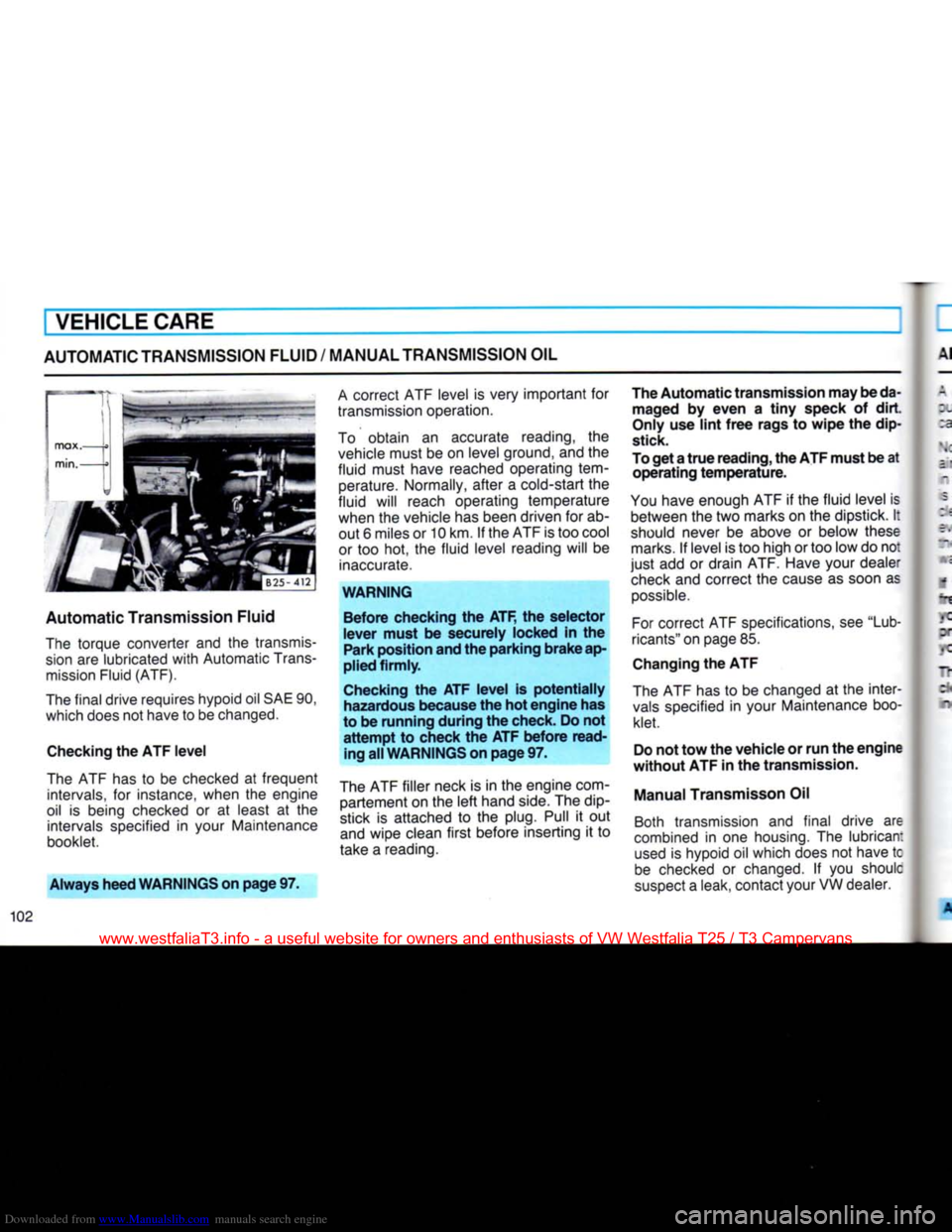
The ATF filler neck is in the engine com- partement on the left hand side. The dip
stick is attached to the
plug.
Pull it out
and wipe clean first before inserting it to
take a reading. The Automatic transmission may be da
maged by even a tiny speck of dirt.
Only use lint free rags to wipe the dip
stick.
To get a true reading, the ATF must be at operating temperature.
You have enough ATF if the fluid level is between the two marks on the dipstick. I:
should never be above or below these marks. If level is too high or too low do not
just add or drain ATF. Have your dealer check and correct the cause as soon as possible.
For correct ATF specifications, see "Lub
ricants" on page 85.
Changing the ATF
The ATF has to be changed at the inter vals specified in your Maintenance booklet.
Do not tow the vehicle or run the engine
without ATF in the transmission.
Manual Transmisson Oil Both transmission and final drive are
combined in one housing. The lubrican: used is hypoid oil which does not have tc
be checked or changed. If you shoulc
suspect a leak, contact your VW dealer.
www.westfaliaT3.info - a useful website for owners and enthusiasts of VW Westfalia T25 / T3 Campervans
Page 130 of 165
Downloaded from www.Manualslib.com manuals search engine
HANGING
AWHEEL
DO-IT-YOURSELF-SERVICE
WARNING
•
If you have a flat tire, move a safe
distance
off the road.
Turn
off the
engine, the emergency flasher on and use other warning devices to alert
other motorists.
•
Passengers must not remain in the
vehicle when it is
jacked
up.
•
Make
sure that passengers wait in a
safe
place away from the vehicle and
well
away
from
the roadway
and
traffic.
•
Before you change a wheel, be sure
the ground is level and
firm.
If neces
sary, use
a
board under the jack.
•
Set the parking brake and block the
wheel opposite the defective wheel on
the other side of the vehicle. Engaging
a
gear or placing the Automatic trans
mission
selector lever in P (Park)
posi
tion is not a substitute for fully setting
the parking brake.
Stepl
•
Take out the bag with jack and tools
from under the driver's seat.
Step 2
•
With the wheels
still
firmly resting on
the ground, remove the hub cap/wheel
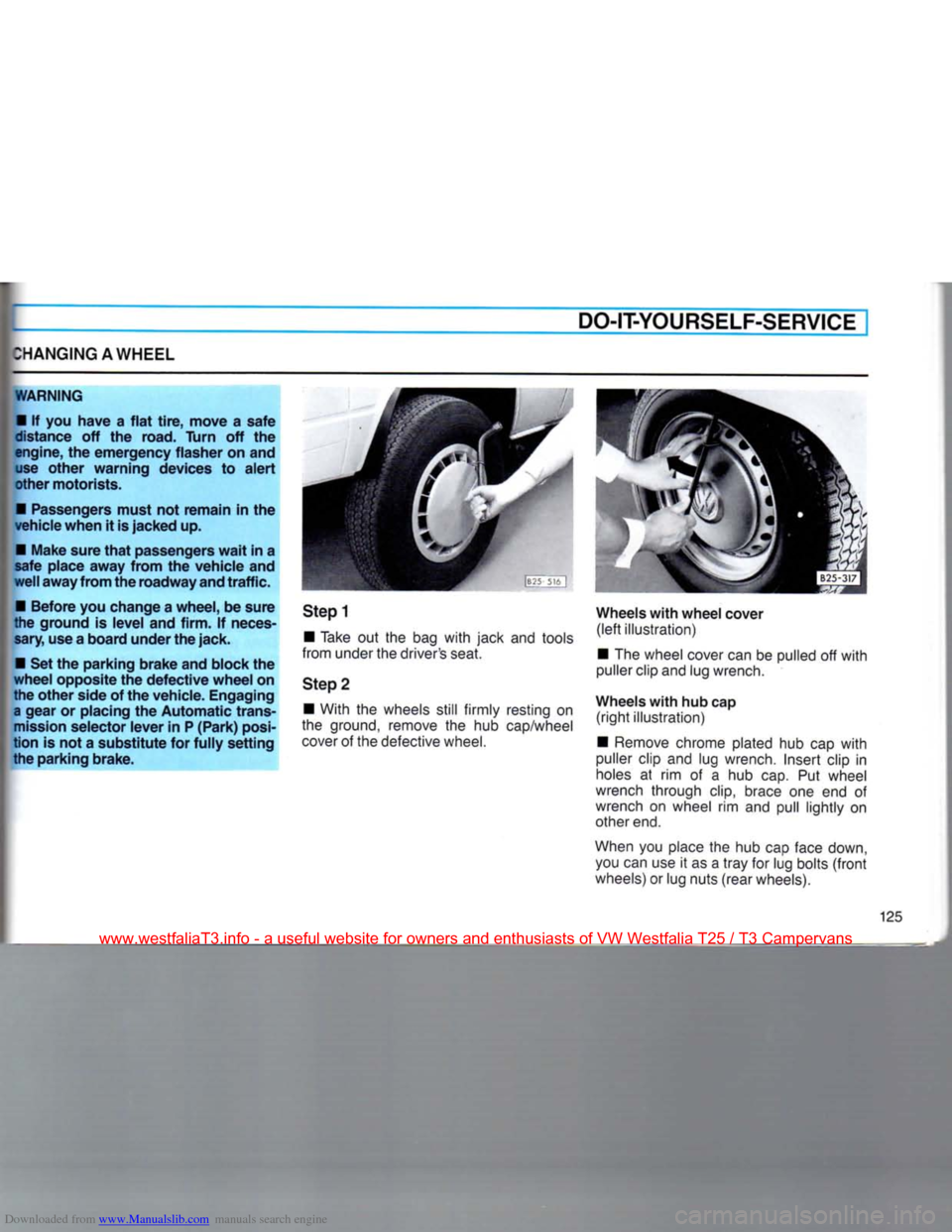
cover of the defective wheel. Wheels with wheel cover
(left
illustration)
•
The wheel cover can be pulled off with
puller clip and lug wrench.
Wheels with hub cap
(right
illustration)
•
Remove chrome plated hub cap with
puller clip and lug wrench.
Insert
clip in
holes at rim of a hub cap. Put wheel
wrench through
clip,
brace one end of
wrench on wheel rim and pull lightly on
other end.
When you place the hub cap face down, you can use it as a
tray
for lug bolts
(front
wheels) or lug nuts
(rear
wheels).
125
www.westfaliaT3.info - a useful website for owners and enthusiasts of VW Westfalia T25 / T3 Campervans