1987 PORSCHE 944 engine
[x] Cancel search: enginePage 36 of 66
944
944 S
944 Turbo Engine Oil Level
Engine oil consumption
It is normal for your engine to consume oil.
The rate of oil consumption depends on the
quality and viscosity of oil, the speed at which
the engine is operated, the climate, road
conditions as well as the amount of dilution
and oxidation of the lubricant.
Because of these variables, no standard rate
of oil consumption can be established, but
drivers should expect an increased oil
consumption at high speeds and when the
engine is new.
The engine in your vehicle depends on oil to lubricate and cool all of its moving
parts. Therefore, the engine oil should be
checked regularly and kept at the required level.
Make it a habit to have the engine oil level checked with every fuel filling. Lack of sufficient engine oil may lead to severe engine damage. The oil pressure warning light is not an oil level indicator.
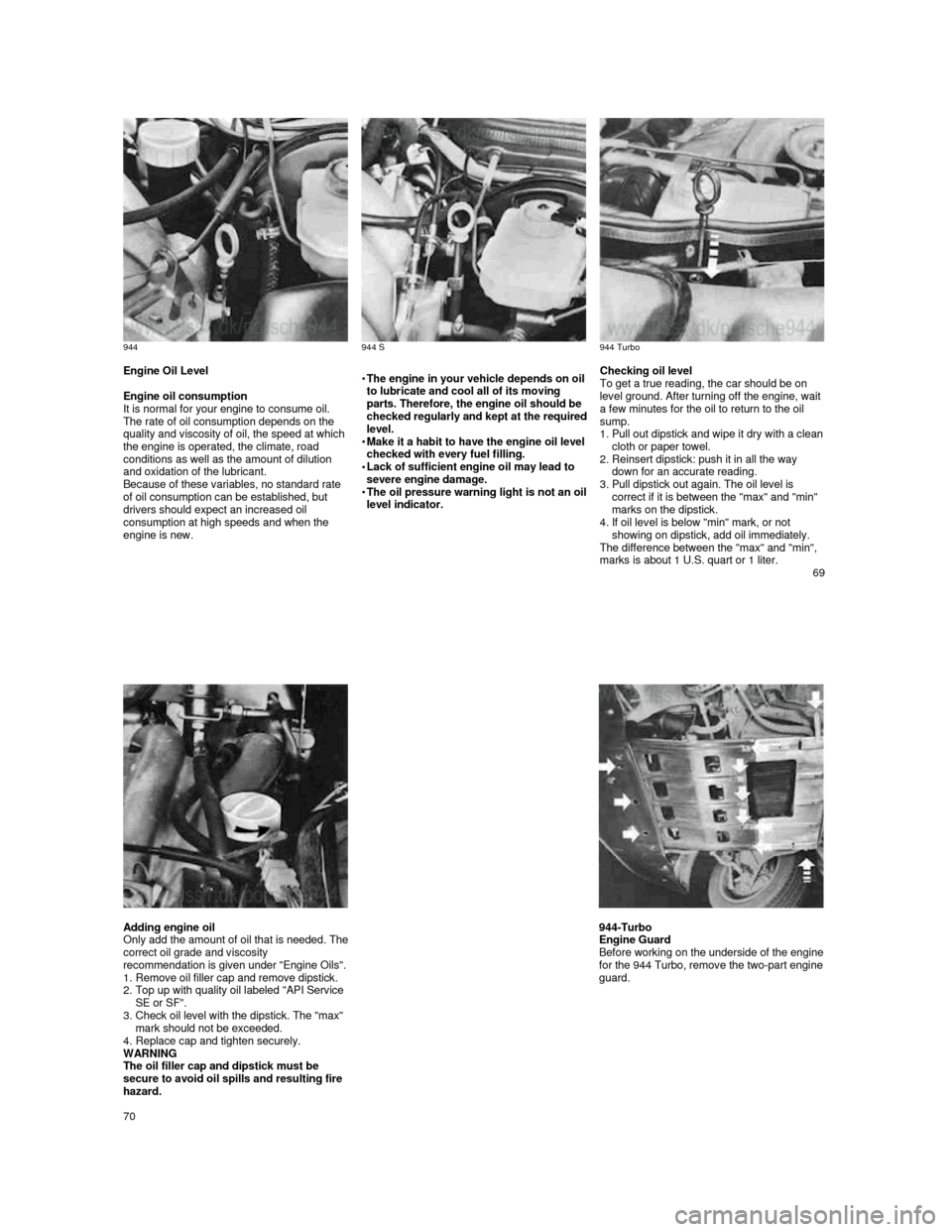
Checking oil level
To get a true reading, the car should be on
level ground. After turning off the engine, wait
a few minutes for the oil to return to the oil
sump.
1. Pull out dipstick and wip
e it dry with a clean cloth or paper towel.
2. Reinsert dipstick: push it in all the way
down for an accurate reading.
3.
Pull dipstick out again. The oil level is
correct if it is between the "max" and "min"
marks on the dipstick.
4.
If oil level is below "min" mark, or not
showing on dipstick, add oil immediately.
The difference between the "max" and "min",
marks is about 1 U.S. quart or 1 liter. 69
Adding engine oil Only add the amount of oil that is needed. The correct oil grade and viscosity
recommendation is given under "Engine Oils". 1. Remove oil filler cap and remove dipstick.
2. Top up with quality oil labeled "API Service
SE or SF".
3.
Check oil level with the dipstick. The "max"
mark should not be exceeded.
4.
Replace cap and tighten securely.
WARNING
The oil filler cap and dipstick must be
secure to avoid oil spills and resulting fire
hazard.
944-Turbo
Engine Guard
Before working on the underside of the engine for the 944 Turbo, remove the two-part engine guard.
70
Page 37 of 66
Changing Engine Oil
and Filter
High quality-multi-
grade oils are suitable for all year round driving. Seasonal oil changes are
therefore not necessary. Only if multi-grade
oils are not readily available, a single-
grade oil of the correct viscosity can be used.
Specifications of the various oils to be used
are detailed under "Filling Capacities and
Engine Oil". The use of oil additives is not
recommended by Porsche.
WARNING
When removing oil drain plug with your fingers, keep your arms as high as
possible. This will prevent hot oil from
running down your arm. Wear eye
protection.
Always use a new gasket when reinstalling the plug. Do not overtighten
the plug.
Before changing the engine oil yourself,
make sure that the disposal of the engine
oil and the oil filter, as special wastes, can
be carried out in the proper manner. Under absolutely no circumstance should used
oil find its way into the sewage system,
soil, rivers, ponds, or other
environmentally damaging areas. If there is no possibility of disposing of used oil in the proper manner
(when in doubt, consult local authorities),
please have the oil changed by your dealer or a service station.
Oil change intervals specified in the Warranty
& Maintenance booklet accompanying the
vehicle apply to normal operating conditions
and must be adhered to, including intervals for oil filter change.
If you drive mostly short distances, or if you
operate the vehicle in dusty areas, or under
predominantly stop-and-go traffic conditions,
or when temperatures remain below freezing
for extended periods, the engine oil should be
changed more frequently.
When chang
ing the engine oil and the oil filter, the splash shield under the car has to be
removed first.
Drain the oil when the engine is still warm.
71
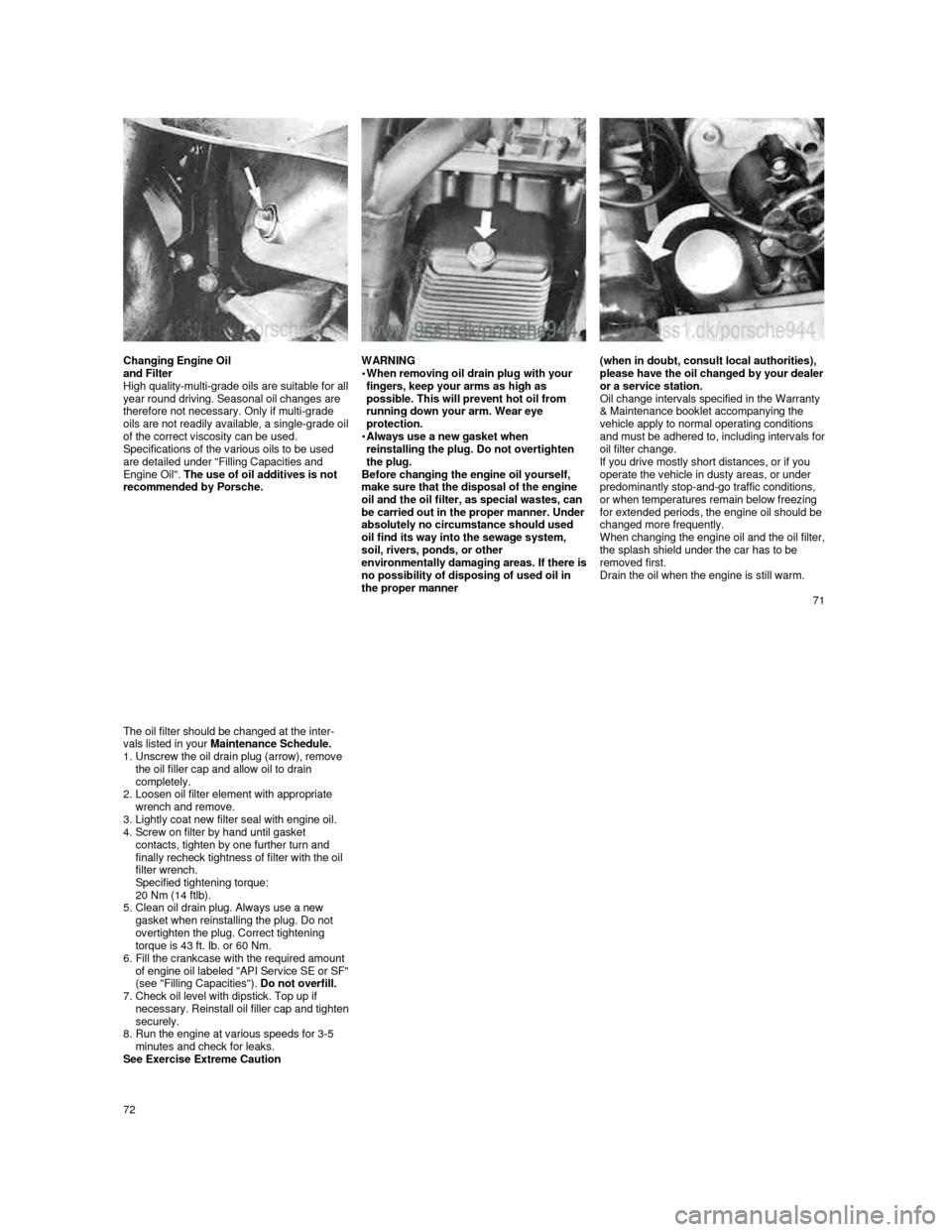
The oil filter should be changed at the inter-
vals listed in your Maintenance Schedule.
1. Unscrew the oil drain plug (arrow), remove the oil filler cap and allow oil to drain
completely.
2.
Loosen oil filter element with appropriate wrench and remove.
3. Lightly coat new filter seal with engine oil.
4. Screw on filter by hand until gasket
contacts, tighten by one further turn and
finally recheck tightness of filter with the oil
filter wrench.
Specified tightening torque:
20 Nm (14 ftlb).
5.
Clean oil drain plug. Always use a new
gasket when reinstalling the plug. Do not
overtighten the plug. Correct tightening
torque is 43 ft. Ib. or 60 Nm.
6.
Fill the crankcase with the required amount of engine oil labeled "API Service SE or SF" (see "Filling Capacities"). Do not overfill.
7. Check oil level with dipstick. Top up if necessary. Reinstall oil filler cap and tighten securely.
8. Run the engine at various speeds for 3-5
minutes and check for leaks.
See Exercise Extreme Caution
72
Page 38 of 66
Power Assisted Steering
The hydraulic assistance system allows
effortless steering under all driving conditions.
Slight hissing or squeaking sounds during
sharp turns (turning steering wheel from lock
to lock) are normal and do not indicate a
defective steering mechanism.
If the engine is not running, po
wer assisted steering is no longer effective. You can
continue to steer the car but more effort
will be required to turn the steering wheel.
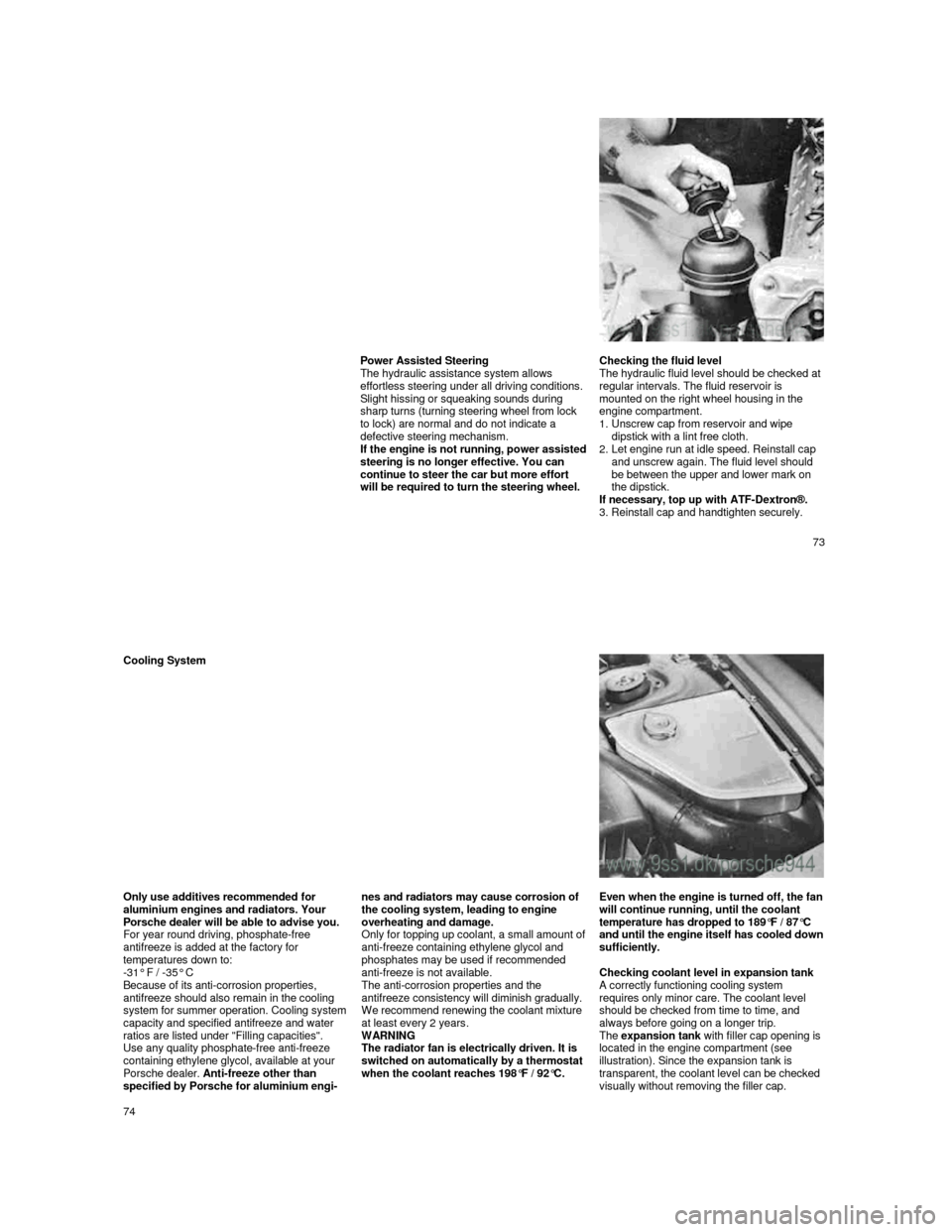
Checking the fluid level
The hydraulic fluid level should be checked at
regular intervals. The fluid reservoir is
mounted on the right wheel housing in the
engine compartment.
1.
Unscrew cap from reservoir and wipe
dipstick with a lint free cloth.
2.
Let engine run at idle speed. Reinstall cap
and unscrew again. The fluid level should
be between the upper and lower mark on
the dipstick.
If necessary, top up with ATF-Dextron®.
3. Reinstall cap and handtighten securely.
73
Cooling System
Only use additives recommended for
aluminium engines and radiators. Your
Porsche dealer will be able to advise you.
For year round driving, phosphate-free
antifreeze is added at the factory for
temperatures down to:
-31° F / -35° C
Because of its anti-corrosion properties,
antifreeze should also remain in the cooling
system for summer operation. Cooling system capacity and specified antifreeze and water
ratios are listed under "Filling capacities".
Use any quality phosphate-free anti-freeze
containing ethylene glycol, available at your
Porsche dealer. Anti-freeze other than
specified by Porsche for aluminium engi-
nes and radiators may cause corrosion of
the cooling system, leading to engine
overheating and damage.
Only
for topping up coolant, a small amount of anti-freeze containing ethylene glycol and
phosphates may be used if recommended
anti-freeze is not available.
The anti-corrosion properties and the
antifreeze consistency will diminish gradually.
We recommend renewing the coolant mixture
at least every 2 years.
WARNING
The radiator fan is electrically driven. It is
switched on automatically by a thermostat
when the coolant reaches 198°F / 92°C.
Even when the engine is turned off, the fan will continue running, until the coolant
temperature has dropped to 189°F / 87°C
and until the engine itself has cooled down sufficiently.
Checking coolant level in expansion tank
A correctly functioning cooling system requires only minor care. The coolant level
should be checked from time to time, and
always before going on a longer trip.
The
expansion tank with filler cap opening is
located in the engine compartment (see
illustration). Since the expansion tank is
transparent, the coolant level can be checked
visually without removing the filler cap.
74
Page 39 of 66
When the engine is cold, the coolant level
should reach the minimum mark on the
expansion tank. When the engine is warm, the coolant level will be above the minimum mark. Since the closed cooling system loses almost
no coolant, topping up is normally not
required. An obvious loss of coolant indicates
leakage. In this case contact your dealer.
WARNING
Do not open the filler cap when the engine is hot because of the danger of
scalding. Allow the engine to cool down.
Protect your hands, arms and face.
Using a thick rag, open the cap carefully and only enough to allow excess
pressure to escape before removing the
cap.
To avoid damage to the engine, only add
cold antifreeze and cold water
to the cooling system when the engine is also cold. A warm engine should only be topped up if the coolant level has dropped appreciably below
the minimum mark. Too much added coolant
will escape through the pressure cap when coolant warms up.
If more than about 1.06 U.S qt or 1 liter must
be added, the cooling system should be bled.
Winter operation At the beginning of the winter season, have the coolant checked for anti-freeze
concentration.
The ratio between water and anti-freeze
necessary to prevent freezing depends on the
anticipated outside temperatures. The ratios
can be taken from the mixing chart listed
under "Filling Capacities" or from the container of the antifreeze manufacturer.
Increasing the anti-freeze in the coolant
further than shown on the container is not
only uneconomical, it is also detrimental to engine cooling.
75
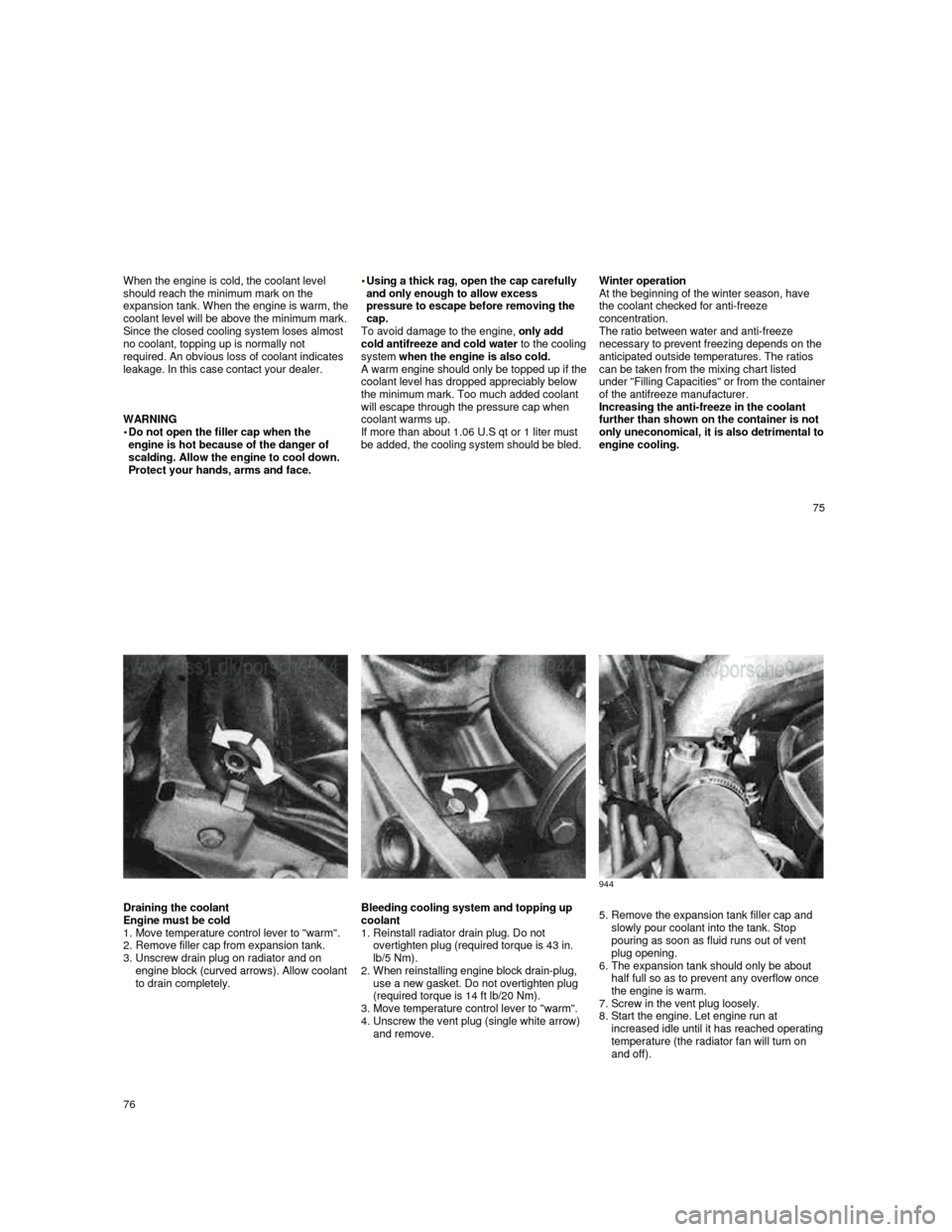
944 Draining the coolant
Engine must be cold
1. Move temperature control lever to "warm".
2.
Remove filler cap from expansion tank.
3. Unscrew drain plug on radiator and on engine block (curved arrows). Allow coolant to drain completely.
Bleeding cooling system and topping up
coolant
1. Reinstall radiator drain plug. Do not overtighten plug (required torque is 43 in.
lb/5 Nm).
2.
When reinstalling engine block drain-plug,
use a new gasket. Do not overtighten plug
(required torque is 14 ft lb/20 Nm).
3.
Move temperature control lever to "warm".
4. Unscrew the vent plug (single white arrow)
and remove.
5. Remove the expansion tank filler cap and
slowly pour coolant into the tank. Stop
pouring as soon as fluid runs out of vent
plug opening.
6.
The expansion tank should only be about
half full so as to prevent any overflow once
the engine is warm.
7.
Screw in the vent plug loosely.
8. Start the engine. Let engine run at increased idle until it has reached operating temperature (the radiator fan will turn on
and off).
76
Page 40 of 66
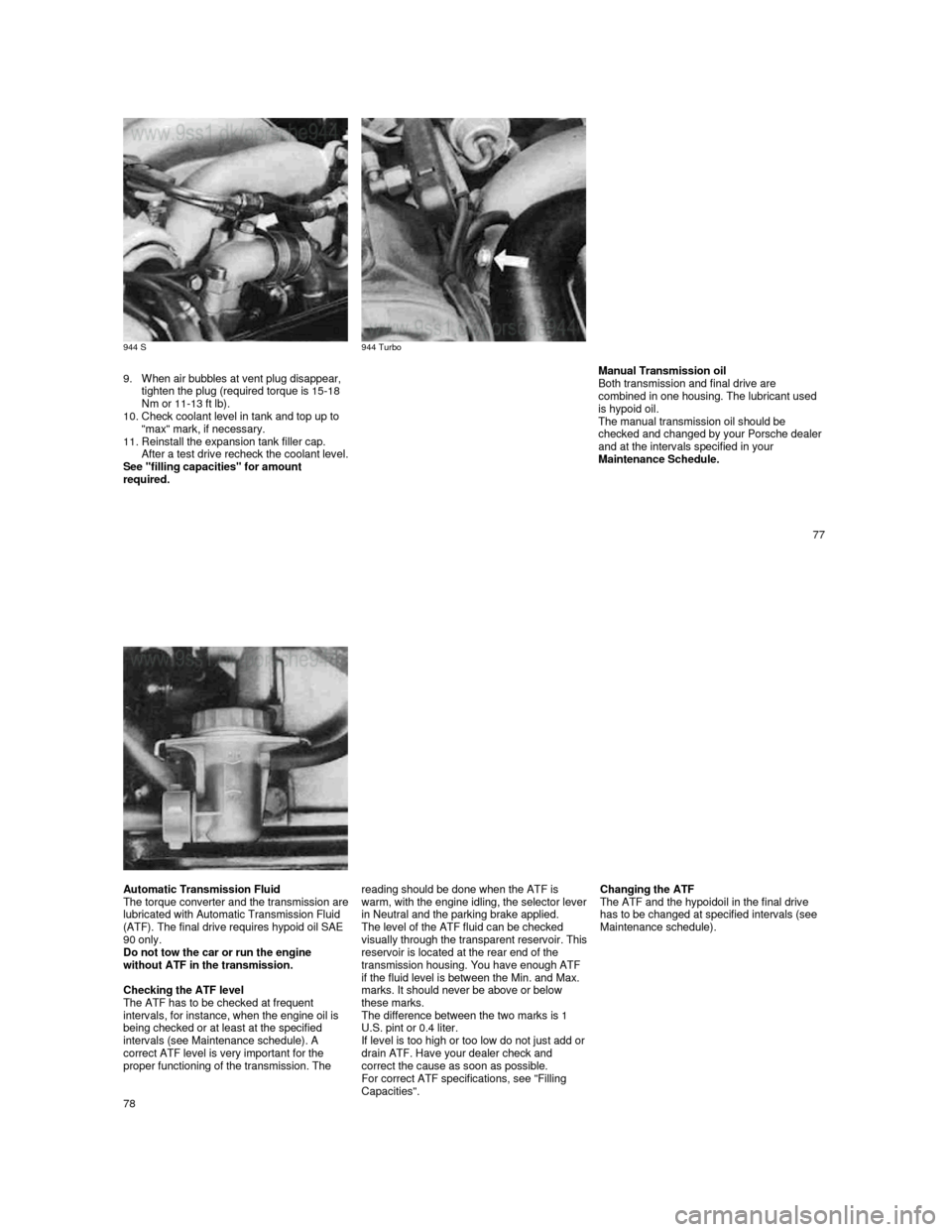
944 S
944 Turbo
9. When air bubbles at vent plug disappear, tighten the plug (required torque is 15-18
Nm or 11-13 ft lb).
10.
Check coolant level in tank and top up to
"max" mark, if necessary.
11.
Reinstall the expansion tank filler cap. After a test drive recheck the coolant level. See "filling capacities" for amount
required.
Manual Transmission oil
Both transmission and final drive are
combined in one housing. The lubricant used
is hypoid oil.
The manual transmission oil should be
checked and changed by your Porsche dealer
and at the intervals specified in your
Maintenance Schedule.
77
Automatic Transmission Fluid The torque converter and the transmission are lubricated with Automatic Transmission Fluid
(ATF). The final drive requires hypoid oil SAE
90 only.
Do not tow the car or run the engine
without ATF in the transmission.
Checking the ATF level
The ATF has to be checked at frequent
intervals, for instance, when the engine oil is
being checked or at least at the specified
intervals (see Maintenance schedule). A
correct ATF level is very important for the
proper functioning of the transmission. The
reading should be done when the ATF is warm, with the engine idling, the selector lever in Neutral and the parking brake applied.
The level of the ATF fluid can be checked
visually through the transparent reservoir. This reservoir is located at the rear end of the
transmission housing. You have enough ATF
if the fluid level is between the Min. and Max.
marks. It should never be above or below
these marks.
The difference between the two marks is 1
U.S. pint or 0.4 liter.
If level is too high or too low do not just add or
drain ATF. Have your dealer check and
correct the cause as soon as possible.
For correct ATF specifications, see "Filling
Capacities".
Changing the ATF
The ATF and the hypoidoil in the final drive
has to be changed at specified intervals (see
Maintenance schedule).
78
Page 41 of 66
Brake Fluid Reservoir
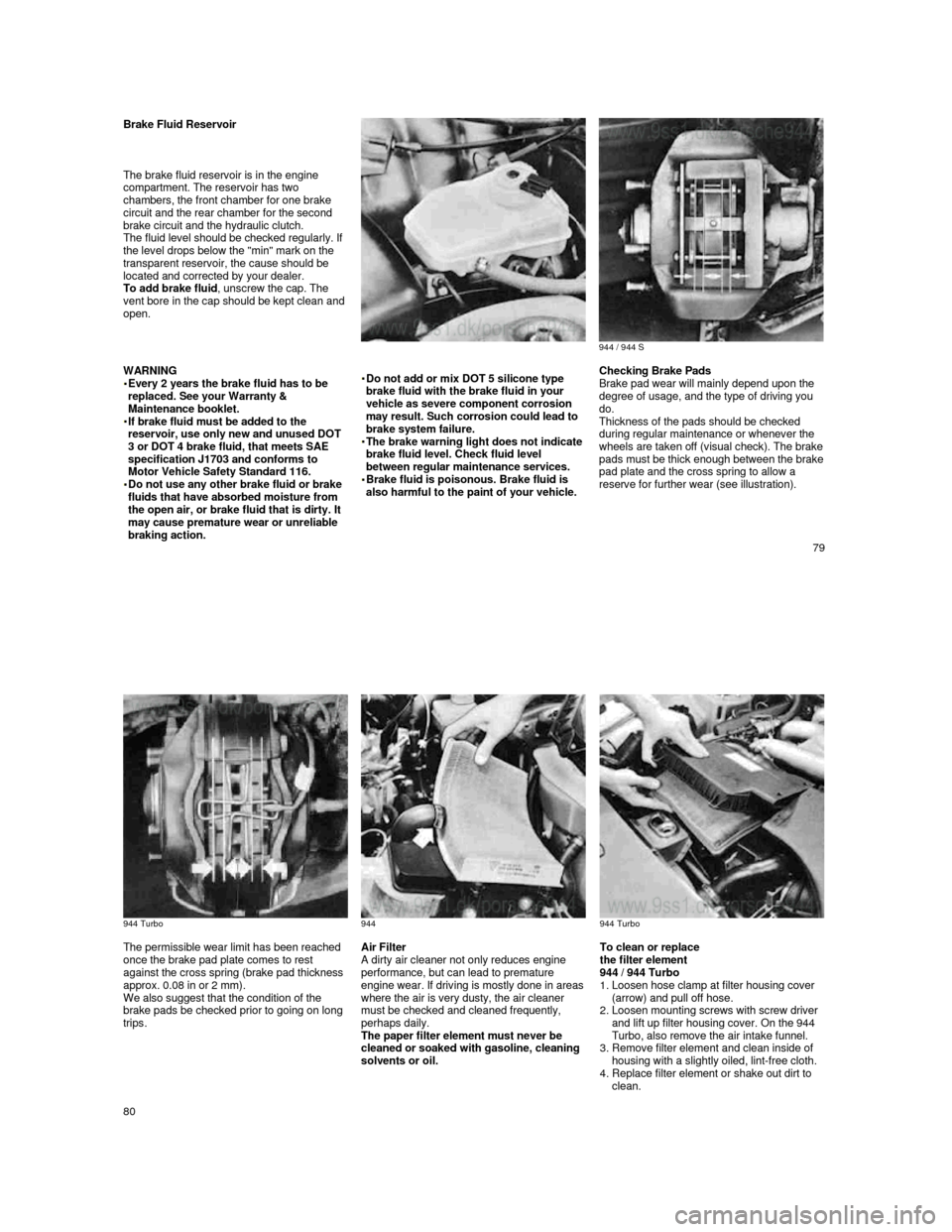
The brake fluid reservoir is in the engine
compartment. The reservoir has two
chambers, the front chamber for one brake
circuit and the rear chamber for the second
brake circuit and the hydraulic clutch.
The fluid level should be checked regularly. If
the level drops below the "min" mark on the
transparent reservoir, the cause should be
located and corrected by your dealer.
To add brake fluid , unscrew the cap. The
vent bore in the cap should be kept clean and
open.
944 / 944 S WARNING
Every 2 years the brake fluid has to be replaced. See your Warranty &
Maintenance booklet.
If brake fluid must be added to the reservoir, use only new and unused DOT
3 or DOT 4 brake fluid, that meets SAE
specification J1703 and conforms to
Motor Vehicle Safety Standard 116.
Do not use any other brake fluid or brake fluids that have absorbed moisture from
the open air, or brake fluid that is dirty. It
may cause premature wear or unreliable
braking action.
Do not add or mix DOT 5 silicone type brake fluid with the brake fluid in your
vehicle as severe component corrosion
may result. Such corrosion could lead to
brake system failure.
The brake warning light does not indicate brake fluid level. Check fluid level
between regular maintenance services.
Brake fluid is poisonous. Brake fluid is also harmful to the paint of your vehicle.
Checking Brake Pads
Brake pad wear will mainly depend upon the
degree of usage, and the type of driving you
do.
Thickness of the pads should be checked
during regular maintenance or whenever the
wheels are taken off (visual check). The brake pads must be thick enough between the brake pad plate and the cross spring to allow a
reserve for further wear (see illustration).
79
944 Turbo
944
944 Turbo
The permissible wear limit has been reached
once the brake pad plate comes to rest
against the cross spring (brake pad thickness
approx. 0.08 in or 2 mm).
We also suggest that the condition of the
brake pads be checked prior to going on long
trips. Air Filter
A dirty air cleaner not only reduces engine performance, but can lead to premature
engine wear. If driving is mostly done in areas
where the air is very dusty, the air cleaner must be checked and cleaned frequently,
perhaps daily.
The paper filter element must never be
cleaned or soaked with gasoline, cleaning
solvents or oil.
To clean or replace
the filter element
944 / 944 Turbo
1. Loosen hose clamp at filter housing cover (arrow) and pull off hose.
2.
Loosen mounting screws with screw driver
and lift up filter housing cover. On the 944
Turbo, also remove the air intake funnel.
3.
Remove filter element and clean inside of
housing with a slightly oiled, lint-free cloth.
4.
Replace filter element or shake out dirt to
clean.
80
Page 42 of 66
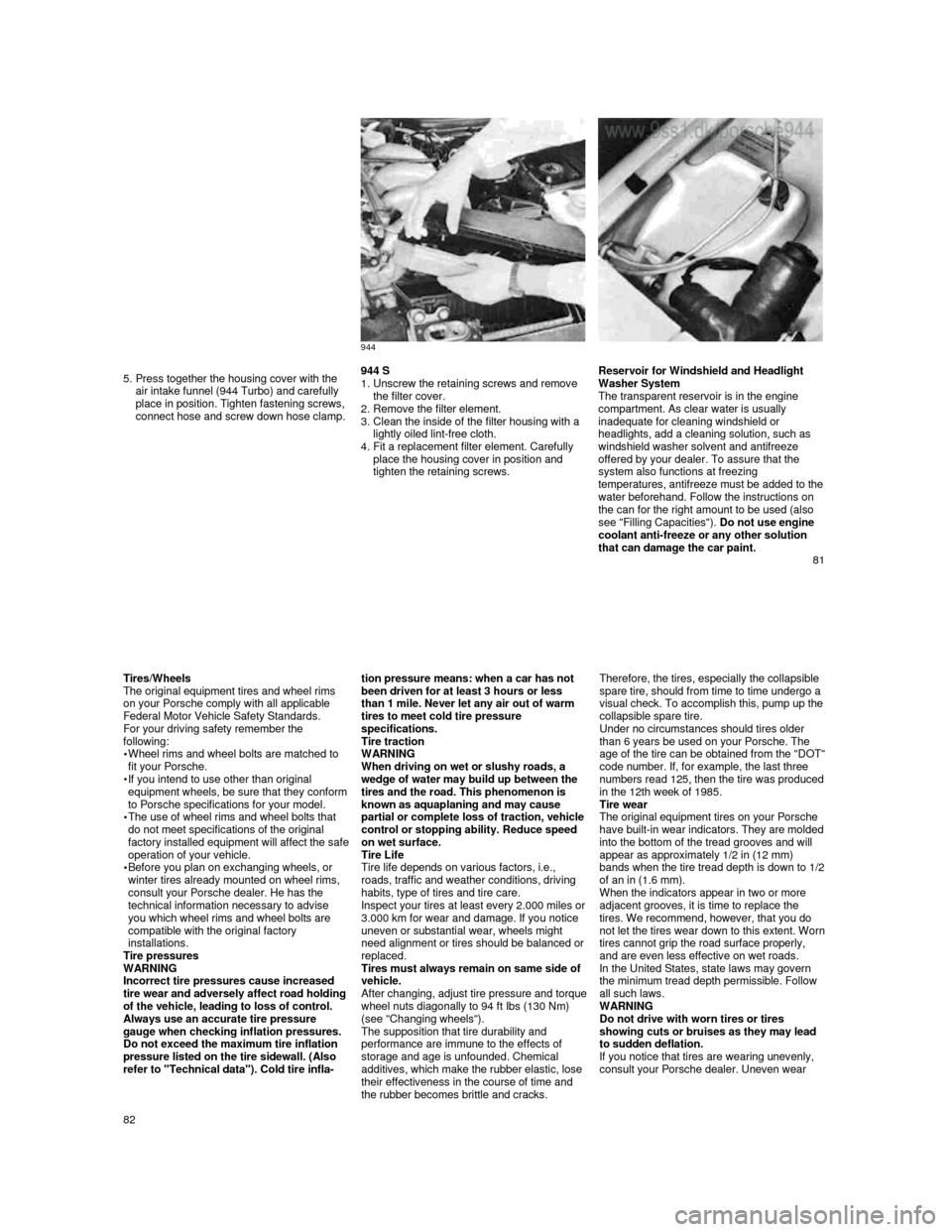
944
5. Press together the housing cover with the air intake funnel (944 Turbo) and carefully
place in position. Tighten fastening screws,
connect hose and screw down hose clamp.
944 S
1. Unscrew the retaining screws and remove
the filter cover.
2.
Remove the filter element.
3. Clean the inside of the filter housing with a
lightly oiled lint-free cloth.
4.
Fit a replacement filter element. Carefully
place the housing cover in position and
tighten the retaining screws.
Reservoir for Windshield and Headlight
Washer System
The transparent reservoir is in the engine
compartment. As clear water is usually
inadequate for cleaning windshield or
headlights, add a cleaning solution, such as
windshield washer solvent and antifreeze offered by your dealer. To assure that the
system also functions at freezing
temperatures, antifreeze must be added to the water beforehand. Follow the instructions on the can for the right amount to be used (also
see "Filling Capacities"). Do not use engine
coolant anti-freeze or any other solution
that can damage the car paint.
81
Tires/Wheels
The original equipment tires and wheel rims
on your Porsche comply with all applicable
Federal Motor Vehicle Safety Standards.
For your driving safety remember the
following:
Wheel rims and wheel bolts are matched to
fit your Porsche.
If you intend to use other than original equipment wheels, be sure that they conform to Porsche specifications for your model. The use of wheel rims and wheel bolts that
do not meet specifications of the original
factory installed equipment will affect the safe operation of your vehicle. Before you plan on exchanging wheels, or winter tires already mounted on wheel rims, consult your Porsche dealer. He has the
technical information necessary to advise
you which wheel rims and wheel bolts are
compatible with the original factory
installations.
Tire pressures
WARNING
Incorrect tire pressures cause increased
tire wear and adversely affect road holding of the vehicle, leading to loss of control.
Always use an accurate tire pressure
gauge when checking inflation pressures.
Do not exceed the maximum tire inflation
pressure listed on the tire sidewall. (Also
refer to "Technical data"). Cold tire infla-
tion pressure means: when a car has not been driven for at least 3 hours or less
than 1 mile. Never let any air out of warm
tires to meet cold tire pressure
specifications.
Tire traction
WARNING
When driving on wet or slushy roads, a
wedge of water may build up between the
tires and the road. This phenomenon is
known as aquaplaning and may cause
partial or com
plete loss of traction, vehicle control or stopping ability. Reduce speed
on wet surface.
Tire Life
Tire life depends on various factors, i.e.,
roads, traffic and weather conditions, driving
habits, type of tires and tire care.
Inspect your tires at least
every 2.000 miles or 3.000 km for wear and damage. If you notice
uneven or substantial wear, wheels might
need alignment or tires should be balanced or
replaced.
Tires must always remain on same side of
vehicle.
After changing, adjust tire pressure and torque wheel nuts diagonally to 94 ft Ibs (130 Nm) (see "Changing wheels").
The supposition that tire durability and
performance are immune to the effects of
storage and age is unfounded. Chemical
additives, which make the rubber elastic, lose
their effectiveness in the course of time and
the rubber becomes brittle and cracks.
Therefore, the tires, especially the collapsible
spare tire, should from time to time undergo a
visual check. To accomplish this,
pump up the collapsible spare tire.
Under no circumstances should tires older
than 6 years be used on your Porsche. The
age of the tire can be obtained from the "DOT" code number. If, for example, the last three
numbers read 125, then the tire was produced in the 12th week of 1985.
Tire wear
The original equipment tires on your Porsche
have built-
in wear indicators. They are molded into the bottom of the tread grooves and will
appear as approximately 1/2 in (12 mm)
bands when the tire tread depth is down to
1/2 of an in (1.6 mm).
When the indicators appear in two or more
adjacent grooves, it is time to replace the
tires. We recommend, however, that you do
not let the tires wear down to this extent. Worn tires cannot grip the road surface properly,
and are even less effective on wet roads.
In the United States, state laws may govern
the minimum tread depth permissible. Follow
all such laws.
WARNING
Do not drive with worn tires or tires
showing cuts or bruises as they may lead
to sudden deflation.
If you notice that tires are wearing unevenly,
consult your Porsche dealer. Uneven wear
82
Page 45 of 66
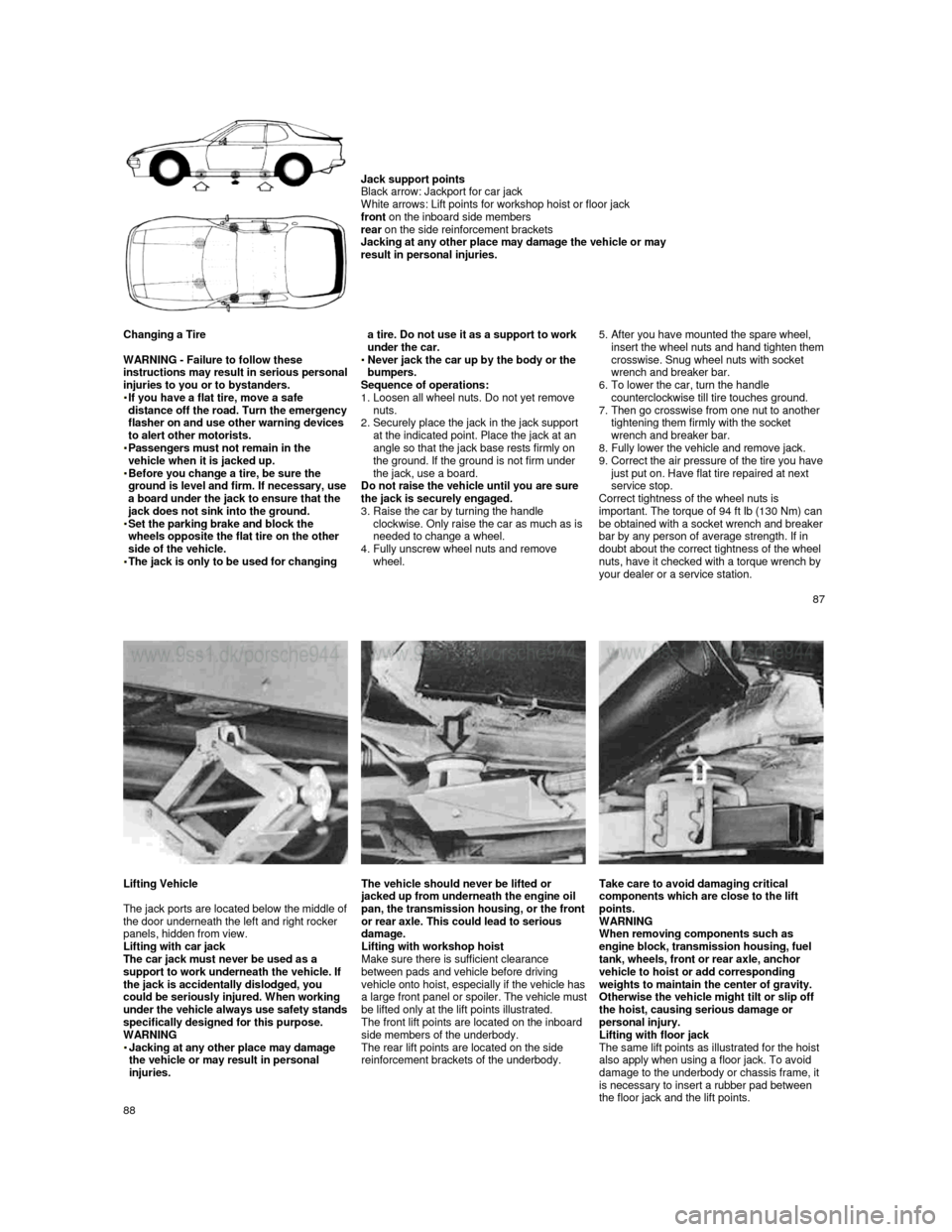
Jack support points
Black arrow: Jackport for car jack
White arrows: Lift points for workshop hoist or flo or jack
front on the inboard side members
rear on the side reinforcement brackets
Jacking at any other place may damage the vehicle o r may
result in personal injuries.
Changing a Tire
WARNING - Failure to follow these
instructions may result in serious personal injuries to you or to bystanders.
If you have a flat tire, move a safe distance off the road. Turn the emergency flasher on and use other warning devices
to alert other motorists.
Passengers must not remain in the vehicle when it is jacked up. Before you change a tire, be sure the ground is level and firm. If necessary, use a board under the jack to ensure that the jack does not sink into the ground. Set the parking brake and block the wheels opposite the flat tire on the other
side of the vehicle.
The jack is only to be used for changing
a tire. Do not use it as a support to work
under the car.
Never jack the car up by the body or the bumpers.
Sequence of operations:
1.
Loosen all wheel nuts. Do not yet remove
nuts.
2.
Securely place the jack in the jack support
at the indicated point. Place the jack at an
angle so that the jack base rests firmly on
the ground. If the ground is not firm under
the jack, use a board.
Do not raise the vehicle until you are sure
the jack is securely engaged.
3.
Raise the car by turning the handle
clockwise. Only raise the car as much as is
needed to change a wheel.
4.
Fully unscrew wheel nuts and remove wheel.
5. After you have mounted the spare wheel, insert the wheel nuts and hand tighten them crosswise. Snug wheel nuts with socket wrench and breaker bar.
6. To lower the car, turn the handle
counterclockwise till tire touches ground.
7.
Then go crosswise from one nut to another
tightening them firmly with the socket
wrench and breaker bar.
8. Fully lower the vehicle and remove jack.
9. Correct the air pressure of the tire you have just put on. Have flat tire repaired at next service stop.
Correct tightness of the wheel nuts is
important. The torque of 94 ft Ib (130 Nm) can
be obtained with a socket wrenc
h and breaker bar by any person of average strength. If in
doubt about the correct tightness of the wheel
nuts, have it checked with a torque wrench by
your dealer or a service station.
87
Lifting Vehicle
The jack ports are located below the middle of the door underneath the left and right rocker
panels, hidden from view.
Lifting with car jack
The car jack must never be used as a
support to work underneath the vehicle. If
the jack is accidentally dislodged, you
could be seriously injured. When working
under the vehicle always use safety stands specifically designed for this purpose.
WARNING
Jacking at any other place may damage the vehicle or may result in personal injuries.
The vehicle should never be lifted or jacked up from underneath the engine oil pan, the transmission housing, or the front or rear axle. This could lead to serious
damage.
Lifting with workshop hoist
Make sure there is sufficient clearance
between pads and vehicle before driving
vehicle onto hoist, especially if the vehicle
has a large front panel or spoiler. The vehicle must be lifted only at the lift points illustrated.
The front lift points are located on the inboard
side members of the underbody.
The rear lift points are located on the side
reinforcement brackets of the underbody.
Take care to avoid damaging critical
components which are close to the lift
points.
WARNING
When removing components such as
engine block, transmission housing, fuel
tank, wheels, front or rear axle, anchor
vehicle to hoist or add corresponding
weights to maintain the center of gravity.
Otherwise the vehicle might tilt or slip off
the hoist, causing serious damage or
personal injury.
Lifting with floor jack
The same lift points as illustrated for the hoist
also apply when using a floor jack. To avoid
damage to the underbody or chassis frame, it
is necessary to insert a rubber pad between
the floor jack and the lift points.
88