1987 PORSCHE 944 winter tires
[x] Cancel search: winter tiresPage 33 of 66

Tar or oil
Do not allow tar or oil to remain on the paint.
Remove as soon as possible with a cloth
soaked with a special paint cleaner. If you do
not have a tar or oil remover, you may
substitute with turpentine. After applying a
cleaning fluid, always wash with a lukewarm
soap water solution and apply a new wax
coat.
Insects
Remove as soon as possible with a lukewarm
soap/water solution or apply insect remover.
Tree sap Remove with a lukewarm soap/water solution. Do not allow tree sap or bird droppings to
harden on the paint.
Windows
Keep silicone sprays off the windshield to
avoid wiper smear in rain.
Generally, highway dust that settles on the
outside of the windshield contains material
worn from tires and oil residues. On the inside surfaces of the windshields, particularly in
strong sunlight, there are build-ups of dust
from the interior decor. These buildups are
reinforced by pollution in the air
brought in with the fresh air supply. Use a
lukewarm soap/water solution or an alcohol
based commercial window cleaning agent for t
he inside and outside. If a chamois is used for polishing the glass, it should exclusively be
used for that purpose.
To assure that windshield washers also
function at freezing temperatures, antifreeze
must be added to the washer fluids reservoirs
beforehand. It is advisable to use window
washer solvent with anti-freeze all year round. Follow directions on the can for the right
amounts to be used. Do not use engine
coolant anti-freeze or any other solution
that can damage the paint.
In vehicles with Sekurif
lex windshields, the plastic coating on the inside of the
windshield must not have gummed labels
put on it or be cleaned using abrasive
agents or dry methods. If very dirty, it can
be cleaned with benzine. The use of
benzine in a confined environment may be
dangerous to your health. Make certain
that the plastic coating is not damaged in
cleaning by hard objects such as jewelry
or wristwatches.
Do not remove ice on the inside of the
windshield by any means except warm air
from the defroster nozzles. Do not use any
deicer sprays, scratching tools, or
scrapers!
A foil base must be applied to the windshield prior to application of any labels or stickers
such as those used for state registration or
inspections. Failure to utilize foil base
between sticker or label and the Sekuriflex
coating will result in damage to the Sekuriflex
coating. Three foil bases were included with
the vehicle and additional foil bases may be
ordered from any Porsche dealer.
Instructions:
1. Clean the windshield in the area for
application.
2.
Cut the base of the foil to the required size.
Round off the edges.
3.
Pull off the protective film.
4. Spray the gummed side of the foil base and the windshield with a soap solution (distilled water and liquid soap or grease-free
detergent in a mixing ratio 10:1).
5.
Apply the foil base to the windshield and spray it once again.
6. Any liquid and bubbles under the foil base must be brushed out using a flexible plastic
scraper.
7.
Dry the windshield using a soft cloth.
8. Install label/sticker on the foil base.
63
When removing the label/sticker or the
backing foil, first spray the foil with a soapy
solution (see point 4).
Wiper blades
Always loosen frozen wiper blades from glass as they may tear otherwise.
Remove all wiper blades periodically and
clean them thoroughly with an alcohol base
cleaning solution. Use a sponge or soft cloth
and wipe lengthwise.
Weatherstrips
To seal properly, weatherstrips around hood,
hatch, windows, doors, etc., must be pliable.
Spray with silicone or coat with talcum powder or glycerin to retain flexibility of the rubber and to protect against freezing in the winter.
Light alloy wheels
To preserve the decorative appearance of the
light aluminium castings, some special care is
necessary. Aside from road dirt and salt
sprays, brake metal dust will exert corrosive
effects.
If left on too long, brake metal dust can cause
pitting. Wash the wheels with a sponge or
hose brush every other week.
Roads salts should be removed weekly with
an acid free cleaning solution.
The acid free cleaning solution must not have
a pH value greater than 10 (see explanation),
in case of doubt, it is recommended to check
with the manufacturer of that particular cleaner.
Every three months (after regular cleaning)
the wheels should be coated with petroleum
jelly. Rub it in firmly with a soft cloth. Never use abrasive or metal polishing cleaning
agents.
Explanation of pH value
The pH value is a measurement for the
hydrogen-ion concentration in a liquid. This
value tells if the liquid reaction is sour (acid) o r alkaline (lye solution). At a pH value of 7, the reaction of the liquid is
neutral (that is, chemically clean water), it is
not an acid or alkaline. Acids have a pH value
under 7, the strength of the acid increases
with a lower pH value. Alkaline lies between a pH value of 7 and 14, the strength of the
alkaline increases with higher pH values.
For example: a mineral water mixed with
carbon dioxide has a pH value of 6-6.5,
reaction is also light sour. Battery acid in
comparison has a pH value of 1.
or
the pH value for normal soap solution is 8-9,
but the soap solution for a dishwasher is
approximately 12.5, this would not be suitable
for wheel cleaning.
Your Porsche dealer can advise you which
product to use.
Remember that moisture and road salt on
brakes may affect braking efficiency. Test
the brakes after each car or wheel wash.
64
Page 42 of 66
944
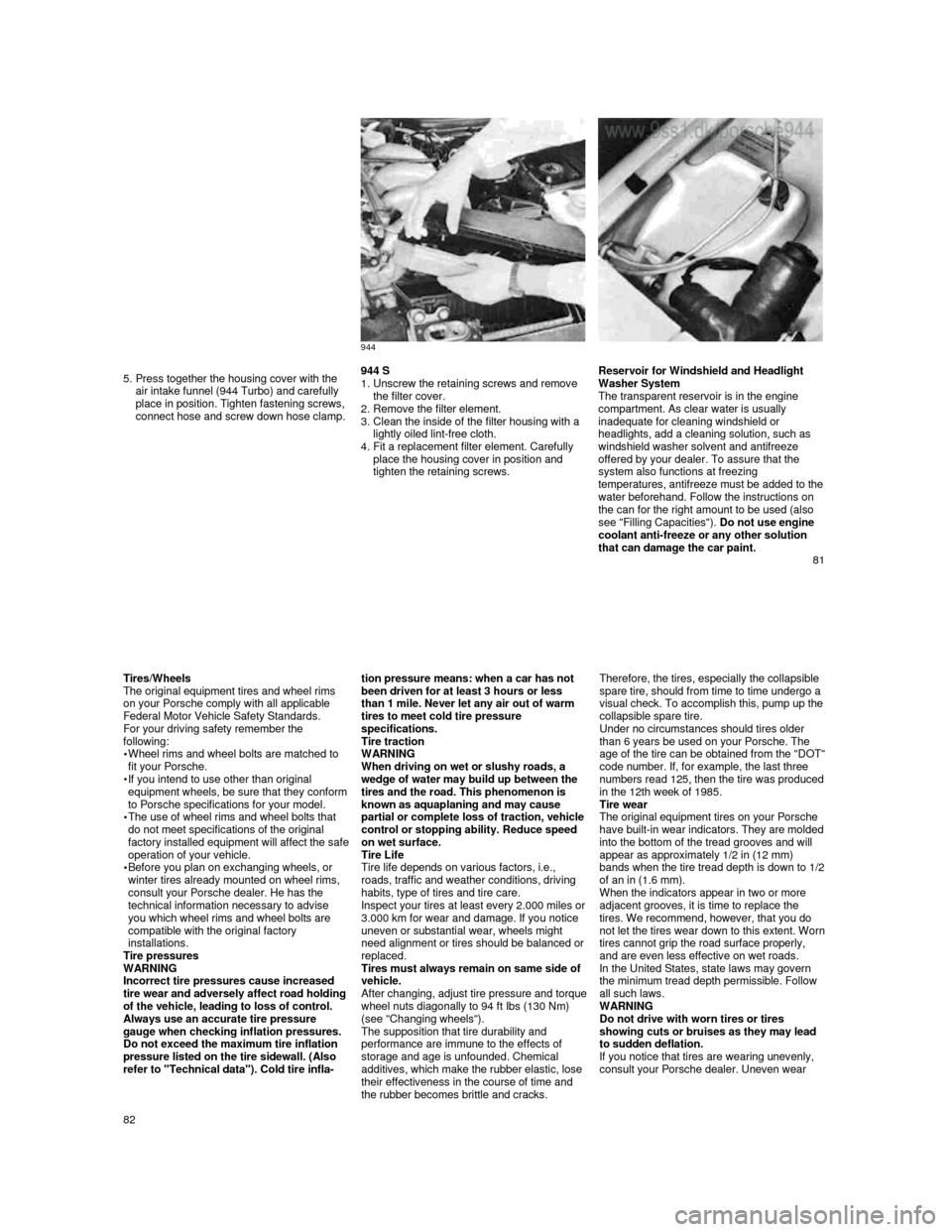
5. Press together the housing cover with the air intake funnel (944 Turbo) and carefully
place in position. Tighten fastening screws,
connect hose and screw down hose clamp.
944 S
1. Unscrew the retaining screws and remove
the filter cover.
2.
Remove the filter element.
3. Clean the inside of the filter housing with a
lightly oiled lint-free cloth.
4.
Fit a replacement filter element. Carefully
place the housing cover in position and
tighten the retaining screws.
Reservoir for Windshield and Headlight
Washer System
The transparent reservoir is in the engine
compartment. As clear water is usually
inadequate for cleaning windshield or
headlights, add a cleaning solution, such as
windshield washer solvent and antifreeze offered by your dealer. To assure that the
system also functions at freezing
temperatures, antifreeze must be added to the water beforehand. Follow the instructions on the can for the right amount to be used (also
see "Filling Capacities"). Do not use engine
coolant anti-freeze or any other solution
that can damage the car paint.
81
Tires/Wheels
The original equipment tires and wheel rims
on your Porsche comply with all applicable
Federal Motor Vehicle Safety Standards.
For your driving safety remember the
following:
Wheel rims and wheel bolts are matched to
fit your Porsche.
If you intend to use other than original equipment wheels, be sure that they conform to Porsche specifications for your model. The use of wheel rims and wheel bolts that
do not meet specifications of the original
factory installed equipment will affect the safe operation of your vehicle. Before you plan on exchanging wheels, or winter tires already mounted on wheel rims, consult your Porsche dealer. He has the
technical information necessary to advise
you which wheel rims and wheel bolts are
compatible with the original factory
installations.
Tire pressures
WARNING
Incorrect tire pressures cause increased
tire wear and adversely affect road holding of the vehicle, leading to loss of control.
Always use an accurate tire pressure
gauge when checking inflation pressures.
Do not exceed the maximum tire inflation
pressure listed on the tire sidewall. (Also
refer to "Technical data"). Cold tire infla-
tion pressure means: when a car has not been driven for at least 3 hours or less
than 1 mile. Never let any air out of warm
tires to meet cold tire pressure
specifications.
Tire traction
WARNING
When driving on wet or slushy roads, a
wedge of water may build up between the
tires and the road. This phenomenon is
known as aquaplaning and may cause
partial or com
plete loss of traction, vehicle control or stopping ability. Reduce speed
on wet surface.
Tire Life
Tire life depends on various factors, i.e.,
roads, traffic and weather conditions, driving
habits, type of tires and tire care.
Inspect your tires at least
every 2.000 miles or 3.000 km for wear and damage. If you notice
uneven or substantial wear, wheels might
need alignment or tires should be balanced or
replaced.
Tires must always remain on same side of
vehicle.
After changing, adjust tire pressure and torque wheel nuts diagonally to 94 ft Ibs (130 Nm) (see "Changing wheels").
The supposition that tire durability and
performance are immune to the effects of
storage and age is unfounded. Chemical
additives, which make the rubber elastic, lose
their effectiveness in the course of time and
the rubber becomes brittle and cracks.
Therefore, the tires, especially the collapsible
spare tire, should from time to time undergo a
visual check. To accomplish this,
pump up the collapsible spare tire.
Under no circumstances should tires older
than 6 years be used on your Porsche. The
age of the tire can be obtained from the "DOT" code number. If, for example, the last three
numbers read 125, then the tire was produced in the 12th week of 1985.
Tire wear
The original equipment tires on your Porsche
have built-
in wear indicators. They are molded into the bottom of the tread grooves and will
appear as approximately 1/2 in (12 mm)
bands when the tire tread depth is down to
1/2 of an in (1.6 mm).
When the indicators appear in two or more
adjacent grooves, it is time to replace the
tires. We recommend, however, that you do
not let the tires wear down to this extent. Worn tires cannot grip the road surface properly,
and are even less effective on wet roads.
In the United States, state laws may govern
the minimum tread depth permissible. Follow
all such laws.
WARNING
Do not drive with worn tires or tires
showing cuts or bruises as they may lead
to sudden deflation.
If you notice that tires are wearing unevenly,
consult your Porsche dealer. Uneven wear
82
Page 57 of 66
Engine Oils
Use only engine oils which meet the
specifications designated by PORSCHE. Your Porsche dealer will be glad to advise you on
the correct type of oil for your engine.
All current engine oils are compatible with each other, i. e. when making an oil change it
is not necessary to flush the engine if you
wish to use a different brand or grade of oil. Since, however, each brand of oil has a
special composition, you should, if possible,
use the same oil brand if it becomes
necessary to top up between oil changes.
PORSCHE engines have long intervals
between oil changes. You can make best use
of these long oil change intervals by using
multigrade oils since these are largely
independent of seasonal fluctuations in
temperature.
If your vehicle is used frequently in stop-and-
go traffic in winter, the engine will not always
be properly warmed up. Condensation from
products of combustion may accumulate in
the oil. In this case, it is advisable to change
the oil in spring so that your engine once
again has a 100% efficient engine oil.
Engine oil performance class
Engine oil is not only a lubricant, but also
serves to keep the engine clean, to neutralize
the dirt which penetrates into the engine
through combustion and to protect the engine
against corrosion. To perform these functions, the oil is provided with additives which have
been specially developed for these functions.
So-called mineral oils are produced directly
from crude oil. The oils can be further refined
(hydrocrack oils) or totally converted through a number of chemical processes (synthetic oils). These oils are structurally more efficient and
require fewer additives than simple mineral
oils.
The efficiency of an oil is expressed, for
example, by the API classifications which are
divided into categories "S" and "C". The
degrees of quality are expressed by final
letters in alphabetical order: The requirements for PORSCHE engines are API class SE/CC
to SF/CD.
Viscosity
Like all liquids, engine oil is viscous when
cold, and thin-bodied when warm.
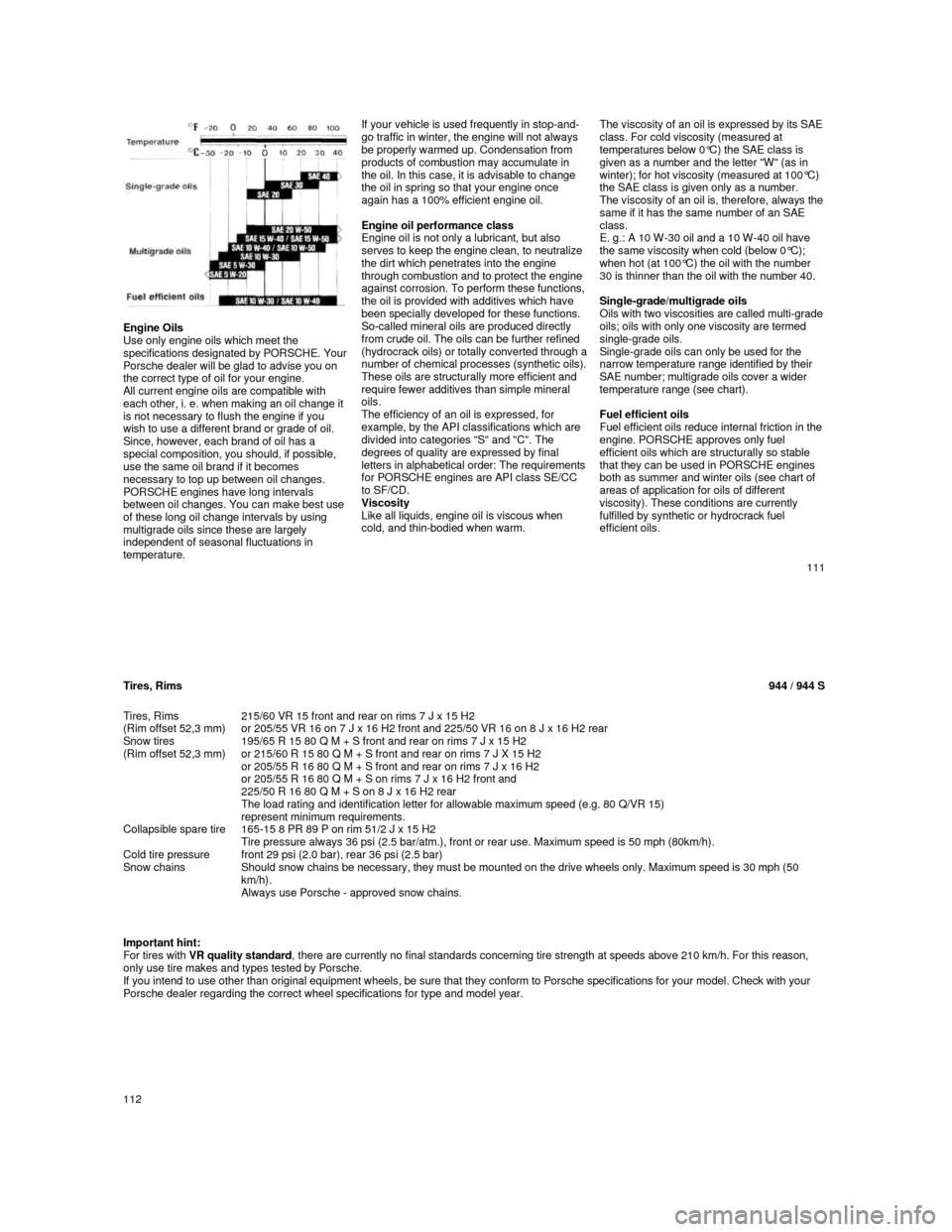
The viscosity of an oil is expressed by its SAE class. For cold viscosity (measured at
temperatures below 0°C) the SAE class is
given as a number and the letter "W" (as in
winter); for hot viscosity (measured at 100°C) the SAE class is given only as a number. The viscosity of an oil is, therefore, always the same if it has the same number of an SAE
class.
E. g.: A 10 W -30 oil and a 10 W-40 oil have
the same viscosity when cold (below 0°C);
when hot (at 100°C) the oil with the number 30 is thinner than the oil with the number 40.
Single-grade/multigrade oils
Oils with two viscosities are called multi-g
rade oils; oils with only one viscosity are termed
single-grade oils.
Single-grade oils can only be used for the
narrow temperature range identified by their
SAE number; multigrade oils cover a wider
temperature range (see chart).
Fuel efficient oils
Fuel efficient oils reduce internal friction in the
engine. PORSCHE approves only fuel
efficient oils which are structurally so stable
that they can be used in PORSCHE engines
both as summer and winter oils (see chart of
areas of application for oils of different
viscosity). These conditions are currently
fulfilled by synthetic or hydrocrack fuel
efficient oils.
111
Tires, Rims 944 / 944 S
Tires, Rims
(Rim offset 52,3 mm) 215/60 VR 15 front and rear on rims 7 J x 15 H2
or 205/55 VR 16 on 7 J x 16 H2 front and 225/50 VR
16 on 8 J x 16 H2 rear
Snow tires
(Rim offset 52,3 mm) 195/65 R 15 80 Q M + S front and rear on rims 7 J x
15 H2
or 215/60 R 15 80 Q M + S front and rear on rims 7 J X 15 H2
or 205/55 R 16 80 Q M + S front and rear on rims 7 J x 16 H2
or 205/55 R 16 80 Q M + S on rims 7 J x 16 H2 front and
225/50 R 16 80 Q M + S on 8 J x 16 H2 rear
The load rating and identification letter for allow able maximum speed (e.g. 80 Q/VR 15)
represent minimum requirements.
Collapsible spare tire 165-15 8 PR 89 P on rim 51/2 J x 15 H2
Tire pressure always 36 psi (2.5 bar/atm.), front o r rear use. Maximum speed is 50 mph (80km/h).
Cold tire pressure front 29 psi (2.0 bar), rear 36 psi (2.5 bar)
Snow chains Should snow chains be necessary, they m ust be mounted on the drive wheels only. Maximum speed is 30 mph (50
km/h).
Always use Porsche - approved snow chains.
Important hint:
For tires with VR quality standard , there are currently no final standards concerning tire strength at speeds above 210 km/h. For this r eason,
only use tire makes and types tested by Porsche.
If you intend to use other than original equipment wheels, be sure that they conform to Porsche specif ications for your model. Check with your
Porsche dealer regarding the correct wheel specific ations for type and model year.
112