1987 PORSCHE 944 fuel type
[x] Cancel search: fuel typePage 27 of 66
WARNING
Never carry additional fuel in portable containers in your car. Such containers,
full or partially empty, may leak, cause an
explosion, or result in fire in case of a
collision.
Porsche does not recommend the use of
fuel additives.
Do not use any fuel with octane ratings
lower than 91 RON or 87 CLC or AKI,
944S/944 Turbo 95 RON or 90 CLC or AKI.
Gasolines containing alcohol
Gasoline containing alcohol is available at gas
stations in some areas. The gas pump may not
be labeled to identify that alcohol is present in
the gasoline. If it is labeled, it may not identify
what amount and type(s) of alcohol
are used. We recommend you DO NOT use
fuels where the alcohol content cannot be
identified.
Gasolines containing methanol
DO NOT
use fuels containing methanol (methyl alcohol, wood alcohol). The use of fuel
containing this type of alcohol can result in
vehicle drivability and performance problems
and may damage critical parts of your vehicle's
fuel and emission control systems.
Gasolines containing ethanol
A mixture of unleaded gasoline and ethanol (ethyl alcohol, grain alcohol) is sold in some
areas. This mixture is sometimes called
"Gasohol".
You may use gasohol in your
Porsche, provided it contains no more than
10% ethanol, and the octane requirements for
your vehicle are met. However, we strongly
recommend to switch back to gasoline without
ethanol, if you experience any of the following
problems with your vehicle:
Deterioration of drivability and performance.
Substantially reduced fuel economy. Vapor lock and non-start problems, especially
at high altitude or at high temperatures.
Engine malfunction or stalling.
Continued use of gasohol under these
conditions may cause costly damage to the fuel system and the emission control system of your vehicle.
51
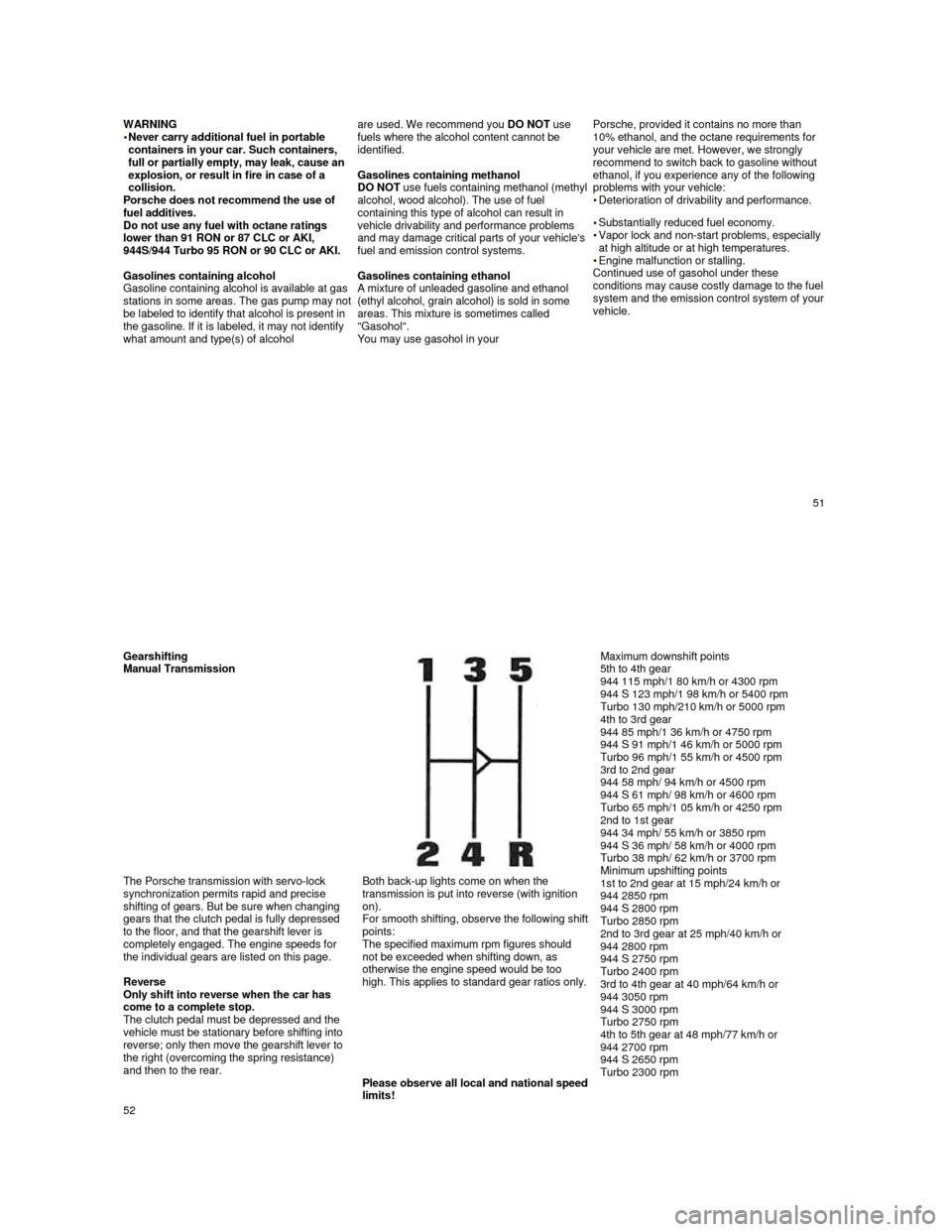
Gearshifting Manual Transmission
Maximum downshift points
5th to 4th gear
944 115 mph/1 80 km/h or 4300 rpm
944 S 123 mph/1 98 km/h or 5400 rpm
Turbo 130 mph/210 km/h or 5000 rpm
4th to 3rd gear
944 85 mph/1 36 km/h or 4750 rpm
944 S 91 mph/1 46 km/h or 5000 rpm
Turbo 96 mph/1 55 km/h or 4500 rpm
3rd to 2nd gear
944 58 mph/ 94 km/h or 4500 rpm
944 S 61 mph/ 98 km/h or 4600 rpm
Turbo 65 mph/1 05 km/h or 4250 rpm
2nd to 1st gear
944 34 mph/ 55 km/h or 3850 rpm
944 S 36 mph/ 58 km/h or 4000 rpm
Turbo 38 mph/ 62 km/h or 3700 rpm
Minimum upshifting points
1st to 2nd gear at 15 mph/24 km/h or
944 2850 rpm
944 S 2800 rpm
Turbo 2850 rpm
2nd to 3rd gear at 25 mph/40 km/h or
944 2800 rpm
944 S 2750 rpm
Turbo 2400 rpm
3rd to 4th gear at 40 mph/64 km/h or
944 3050 rpm
944 S 3000 rpm
Turbo 2750 rpm
4th to 5th gear at 48 mph/77 km/h or
944 2700 rpm
944 S 2650 rpm
Turbo 2300 rpm
The Porsche transmission with servo-lock
synchronization permits rapid and precise
shifting of gears. But be sure when changing
gears that the clutch pedal is fully depressed
to the floor, and that the gearshift lever is
completely engaged. The engine speeds for
the individual gears are listed on this page.
Reverse
Only shift into reverse when the car has
come to a complete stop.
The clutch pedal must be depressed and the
vehicle must be stationary before shifting into
reverse; only then move the gearshift lever to
the right (overcoming the spring resistance)
and then to the rear. Both back-up lights come on when the
transmission is put into reverse (with ignition
on).
For smooth shifting, observe the following shift points:
The specified maximum rpm figures should
not be exceeded when shifting down, as
otherwise the engine speed would be too
high. This applies to standard gear ratios only.
Please observe all local and national speed limits!
52
Page 43 of 66
may not always be due to improper wheel
alignment. It can be the result of individual
driving habits such as cornering at high
speeds. If the tire pressure is not checked and adjusted regularly, abnormal tire wear can
also occur.
Tire care
WARNING
Avoid damaging tires and wheel rims. If you must drive over a curb or other obstacle,
drive slowly and at an obtuse angle.
Frequently check tires for uneven wear and
damage.
Remove imbedded material. Replace worn or damaged tires immediately. Replace missing valve dust caps. Keep oil, fuel, brake fluid, etc. away from
tires.
Keep tires inflated correctly.
Tire replacement
In the interest of maximum safety and best
all-around car handling, always buy
replacement tires that have the same
specifications with regard to tire size,
design, load carrying capacity, tread
pattern, tread depth etc. This also applies
to Porsche recommended alternate
replacement tires. If you do not use a
Porsche recommended replacement tire,
make sure that you purchase your new
tires from a reputable
tire specially dealer and that the dealer complies with all manufacturers warnings
for those tires.
In case of tire damage where it is uncertain
whether there is a break in the ply with all its consequences or, tire damage caused by
thermal or mechanical overloading due to a
loss of pressure or any other prior damage,
we recommend that the tire be replaced for safety reasons.
If one faulty tire on an axle is replaced it
should be noted that the difference in tread
depth on one axle must not be more than
30%.
Tire specifications are imprinted on the
sidewall of the tires. If in doubt, check with
your Porsche dealer.
When replacing tubeless tires, always install
new valve stems. When replacing tires
requiring an inner tube, always install new
tubes.
New tires do not possess maximum
traction. They tend to be slippery. Break
new tires in by driving at moderate speed
for the first 60-120 miles or 100-200
kilometers.
Wheel balancing
A wheel should always be balanced after a tire repair. Even with regular use a wheel can
get out of balance, and should therefore be
balanced from time to time. Unbalanced
wheels may affect car handling and tire life.
When balancing light alloy wheels, use only
adhesive balancing weights supplied through
the Porsche parts service.
Wheels
If you intend to use other than original
equipment wheels, be sure that they conform
to Porsche specifications for your model.
Check with your Porsche dealer regarding the
correct wheel specifications for type and
model year.
Removing and storing tires
The driving direction should be clearly marked on all tires before removing them for storage,
to make sure they are mounted and run in the
same direction as before. Store tires in a cool
and dry place. Tires without rims upright!
Avoid contact with oil, grease or gasoline. When remounting, put tires with the most
tread depth at the front.
Snow tires
For a better grip on snow and ice use radial M + S tires or snow tires with studs. Check with
your local Motor Vehicle Bureau for possible
restrictions.
Radial ply M+S tires should be inflated with
the same cold tire inflation pressures required
for the regular radial ply tires. However, do not exceed the maximum tire inflation pressure
listed on the tire sidewall.
Snow tires should have the same load
capacity as original equipment tires and
should be mounted on all four wheels. Snow
tires with studs should be run at moderate
speeds when new in order to give the studs
time to settle.
83
WARNING
Tires with badly worn treads and studs are
very dangerous. Make sure they are replaced
immediately.
Do not drive a vehicle equipped with snow
tires at prolonged high speed. Snow tires do
not have the same degree of traction on dry,
wet or snow free roads as a normal tire. Furthermore, snow tires wear rapidly under
these conditions.
Snow tires do not fulfill their purpose if the
tread depth is less than 5/32 in. / 4 mm.
Comply with all state and local laws
governing snow tire and tread depth
requirements.
Snow chains Should snow chains be necessary, they
must be mounted on the drive wheels
only.
Check with local authorities for possible
restrictions.
Use only Porsche-approved snow chains with
fine pitch links, so that enough
space remains between the chains and the inside of the wheel arches.
Drive wheels must rotate freely with chains
mounted to prevent damage to body, axle or
brake components. Follow instructions issued
by the supplier of the chains. Remove chains
as soon as roads are free of ice and snow.
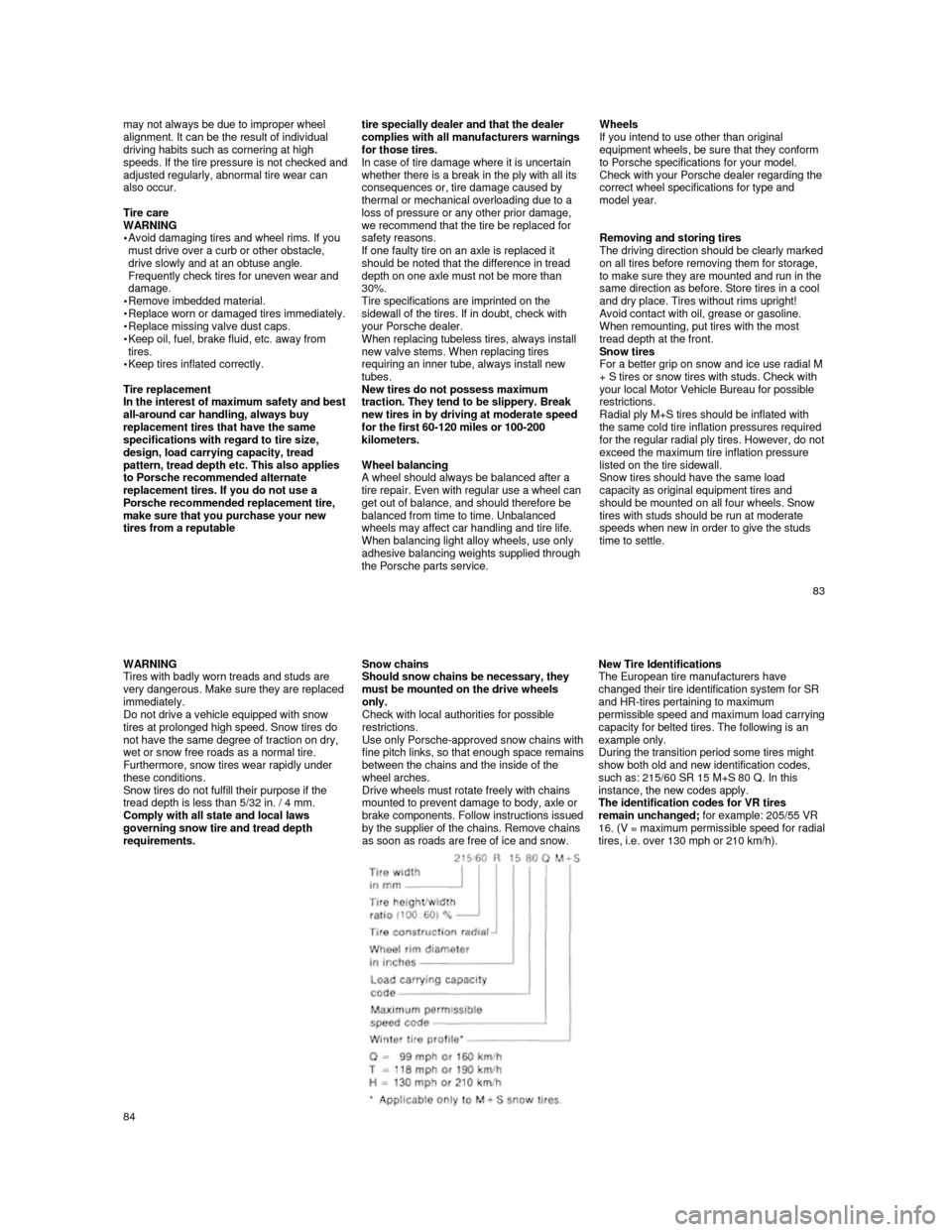
New Tire Identifications
The European tire manufacturers have
changed their tire identification system for SR
and HR-tires pertaining to maximum
permissible speed and maximum load carrying capacity for belted tires. The following is an
example only.
During the transition period some tires might
show both old and new identification codes,
such as: 215/60 SR 15 M+S 80 Q. In this
instance, the new codes apply.
The identification codes for VR tires
remain unchanged; for example: 205/55 VR
16. (V = maximum permissible speed for radial tires, i.e. over 130 mph or 210 km/h).
84
Page 57 of 66

Engine Oils
Use only engine oils which meet the
specifications designated by PORSCHE. Your Porsche dealer will be glad to advise you on
the correct type of oil for your engine.
All current engine oils are compatible with each other, i. e. when making an oil change it
is not necessary to flush the engine if you
wish to use a different brand or grade of oil. Since, however, each brand of oil has a
special composition, you should, if possible,
use the same oil brand if it becomes
necessary to top up between oil changes.
PORSCHE engines have long intervals
between oil changes. You can make best use
of these long oil change intervals by using
multigrade oils since these are largely
independent of seasonal fluctuations in
temperature.
If your vehicle is used frequently in stop-and-
go traffic in winter, the engine will not always
be properly warmed up. Condensation from
products of combustion may accumulate in
the oil. In this case, it is advisable to change
the oil in spring so that your engine once
again has a 100% efficient engine oil.
Engine oil performance class
Engine oil is not only a lubricant, but also
serves to keep the engine clean, to neutralize
the dirt which penetrates into the engine
through combustion and to protect the engine
against corrosion. To perform these functions, the oil is provided with additives which have
been specially developed for these functions.
So-called mineral oils are produced directly
from crude oil. The oils can be further refined
(hydrocrack oils) or totally converted through a number of chemical processes (synthetic oils). These oils are structurally more efficient and
require fewer additives than simple mineral
oils.
The efficiency of an oil is expressed, for
example, by the API classifications which are
divided into categories "S" and "C". The
degrees of quality are expressed by final
letters in alphabetical order: The requirements for PORSCHE engines are API class SE/CC
to SF/CD.
Viscosity
Like all liquids, engine oil is viscous when
cold, and thin-bodied when warm.
The viscosity of an oil is expressed by its SAE class. For cold viscosity (measured at
temperatures below 0°C) the SAE class is
given as a number and the letter "W" (as in
winter); for hot viscosity (measured at 100°C) the SAE class is given only as a number. The viscosity of an oil is, therefore, always the same if it has the same number of an SAE
class.
E. g.: A 10 W -30 oil and a 10 W-40 oil have
the same viscosity when cold (below 0°C);
when hot (at 100°C) the oil with the number 30 is thinner than the oil with the number 40.
Single-grade/multigrade oils
Oils with two viscosities are called multi-g
rade oils; oils with only one viscosity are termed
single-grade oils.
Single-grade oils can only be used for the
narrow temperature range identified by their
SAE number; multigrade oils cover a wider
temperature range (see chart).
Fuel efficient oils
Fuel efficient oils reduce internal friction in the
engine. PORSCHE approves only fuel
efficient oils which are structurally so stable
that they can be used in PORSCHE engines
both as summer and winter oils (see chart of
areas of application for oils of different
viscosity). These conditions are currently
fulfilled by synthetic or hydrocrack fuel
efficient oils.
111
Tires, Rims 944 / 944 S
Tires, Rims
(Rim offset 52,3 mm) 215/60 VR 15 front and rear on rims 7 J x 15 H2
or 205/55 VR 16 on 7 J x 16 H2 front and 225/50 VR
16 on 8 J x 16 H2 rear
Snow tires
(Rim offset 52,3 mm) 195/65 R 15 80 Q M + S front and rear on rims 7 J x
15 H2
or 215/60 R 15 80 Q M + S front and rear on rims 7 J X 15 H2
or 205/55 R 16 80 Q M + S front and rear on rims 7 J x 16 H2
or 205/55 R 16 80 Q M + S on rims 7 J x 16 H2 front and
225/50 R 16 80 Q M + S on 8 J x 16 H2 rear
The load rating and identification letter for allow able maximum speed (e.g. 80 Q/VR 15)
represent minimum requirements.
Collapsible spare tire 165-15 8 PR 89 P on rim 51/2 J x 15 H2
Tire pressure always 36 psi (2.5 bar/atm.), front o r rear use. Maximum speed is 50 mph (80km/h).
Cold tire pressure front 29 psi (2.0 bar), rear 36 psi (2.5 bar)
Snow chains Should snow chains be necessary, they m ust be mounted on the drive wheels only. Maximum speed is 30 mph (50
km/h).
Always use Porsche - approved snow chains.
Important hint:
For tires with VR quality standard , there are currently no final standards concerning tire strength at speeds above 210 km/h. For this r eason,
only use tire makes and types tested by Porsche.
If you intend to use other than original equipment wheels, be sure that they conform to Porsche specif ications for your model. Check with your
Porsche dealer regarding the correct wheel specific ations for type and model year.
112