1987 PORSCHE 944 fuel consumption
[x] Cancel search: fuel consumptionPage 3 of 66

INDEX
A
ABS Acceleration diagram Accelerator pedal Air Bag System Air - cleaner
- conditioner
- filter
Alternator warning light Antifreeze Antilock, Brake system Anti-theft alarm Ashtray Automatic- garage door
- speed control
- transmission
- transmission fluid B
Battery
Boost pressure gauge
Brake - booster
- fluid
- fluid warning light
- pads
- parking
- pedal
- system
- warning light
Break-in hints
Bulb replacing
Buzzer 28,39
118-129
55
20, 21, 38, 3980, 8144-4680,81 39
74,75,11028, 39
11
42, 98
25
29
53-55
78,110,128
90-9234
27
39,79,11039
27,37,47,79,80 26
26, 27
26,27,11537
47
93-98
10,18,24,30
C/D
CASIS
Capacities
Car care instructions
Casis
Catalytic Converter
Cautions
Central locking
Central warning light
Cigarette lighter
Cleaning
Clock
Clutch pedal
Collapsible spare tire
Control warning light system
Coolant Temperature Gauge
Cooling system
Corrosion prevention
Dashboard
Defogging/defrosting
Dimensions
Doors
Driving hints
E/F
Electrical system
Emergency- flasher
- starting
Emission Control System
Engine - cooling
- exhaust
- hood
- number
- oil checking & changing
- oil
-speed, max 35
110
61-66
35
50,10267
13
37
41
61-66 40
27
85
36-39 36
74-77
65-66
24
44-46 114
12,138-9, 48, 49
89-92
41
92
100-103 74-77
48
586
69-72
69,110,111,128
34,47,52,106-
108
Fan control switch knob
Fan, radiator
Filling capacities
Fog lights
Fuel - economy
- evaporation control
- gauge
- recommendation
- tank
Fuses and relays
G/H
Gas Station Information
Gasohol
Gasoline
Gear ratio diagram
Gearshift lever
Glove compartment
Hatchback
Headlights
Headlight- dimmer
- flasher
- switch
- washing system
Heater/ventilation controls
Hood - front
- rear
Horn
I/J
Ignition/steering lock
Instrument illumination
Instruments
Interior ligh 44
36, 74 110
30, 96, 97
49
103 37
50, 51
50,110
89,126
126-129 51
50,51
122-125 52-55
42
56
30,95,99 30
30
30
31,32,81,11044-4658
56,57
21,24
24
30
33-40
43, 98
4
Jack
- supports
K/L
Keys
Kickdown
Lane changer
Leather
License plate light
Light switch
Lights - ashtray
- fog
- interior
- license plate
- parking
- turn signal
Locks - doors, wheels
Loudspeakers
Lubricants
Luggage compartment
M/O
Manual transmission
- oil
Mirrors
Oil- change
- consumption
- filter changing
- pressure gauge
- pressure warning light
Octane rating
Oxygen Sensor
P/R
Paint code number 68
87, 88, 129
10-11,86 55
30
65
98
30
98
30, 96, 97
43, 9898
30, 37, 93, 94
30,93,94
10-13, 86 89
110,111 57
52,122-125 77,11022,43
71,72
47, 69
71, 72 38
38
50, 51,106-108 101,102
7
Parking- brake
- lights
Performance
Power assisted steering
Power train
Power windows
Prop-up roof
Radiator fan
Rear - hood
- view mirrors
- window defogger
- wiper
Recirculation Switch
Refrigerant
Relays
Rims
Roof racks
Roof, removable S
Safe driving hints
Safetybelts
Safety belt warning light
Safety compliance sticker
Seat heating System
Seats
Sekuriflex windshield
Shift indicator
Shift points
Side marker lights
Ski racks
Snow- chains
- tires
Spare tire, collapsible
Spark plugs
Specifications, engine
26, 3730,37,93,94116731091259, 6036, 7456,572241424446,11089,12664,112,11357,11459, 60
8-9
17-21,6518,3771514-1631, 63, 643552-559457,11483, 84,112,113
83,84, 111,113
85106-108106-109
Speedometer
Starting procedures
Sun visors
T/U
Tachometer
Technical data
Tirepressure
Tires
Tool kit
Trip odometer
Transmission oil
Trunk
Turn signal lights
Undercoating
Unleaded fuel
V/W
Vehicle identification
Ventilation
Voltmeter
Warning/indicator lights
Washer reservoir
Washing
Water temperature gauge
Weatherstrips
Weights
Wheel alignment
Wheel nuts, lockable
Wheels
Wheel changing
Windows
Windshield- washer reservoir
- wiper/washer lever 3324, 2543
34, 35105-12582,112,113,12947,82-87,112,113683377, 78,11056,5730, 37, 93, 9465, 66,10050, 51,106-108,110
6-744-463835-4081,11061-6636641141158647,64,82-87,11285-8812,63,6481,11031
5
Page 18 of 66
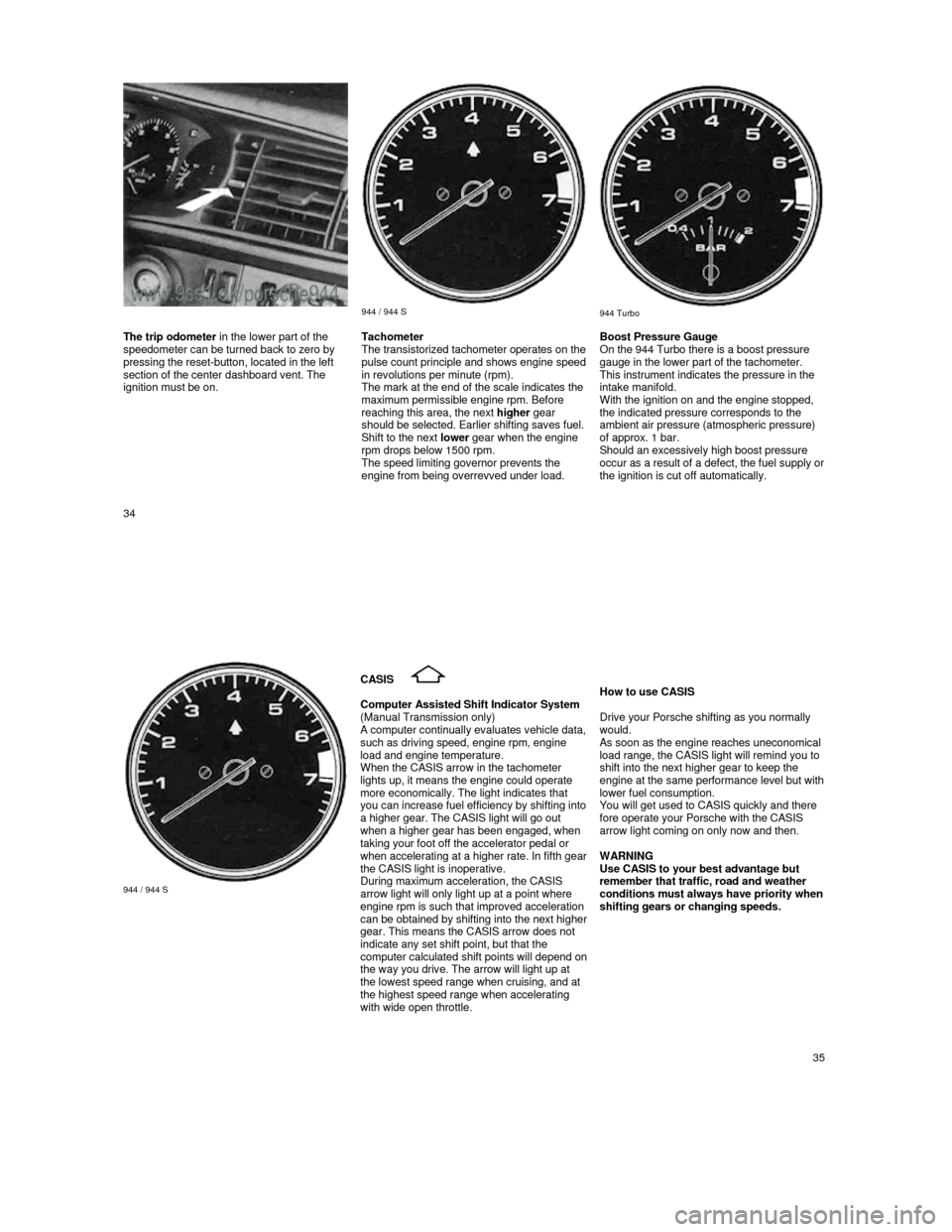
944 / 944 S
944 Turbo The trip odometer
in the lower part of the
speedometer can be turned back to zero by
pressing the reset-button, located in the left
section of the center dashboard vent. The
ignition must be on. Tachometer
The transistorized tachometer operates on the pulse count principle and shows engine speed in revolutions per minute (rpm).
The mark at the end of the scale indicates the
maximum permissible engine rpm. Before
reaching this area, the next higher gear
should be selected. Earlier shifting saves fuel.
Shift to the next lower gear when the engine
rpm drops below 1500 rpm.
The speed limiting governor prevents the
engine from being overrevved under load.
Boost Pressure Gauge
On the 944 Turbo there is a boost pressure
gauge in the lower part of the tachometer.
This instrument indicates the pressure in the
intake manifold.
With the ignition on and the engine stopped,
the indicated pressure corresponds to the
ambient air pressure (atmospheric pressure)
of approx. 1 bar.
Should an excessively high boost pressure
occur as a result of a defect, the fuel supply or the ignition is cut off automatically.
34
944 / 944 S
CASIS
Computer Assisted Shift Indicator System (Manual Transmission only) A computer continually evaluates vehicle data, such as driving speed, engine rpm, engine
load and engine temperature.
When the CASIS arrow in the tachometer
lights up, it means the engine could operate
more economically. The light indicates that
you can increase fuel efficiency by shifting into a higher gear. The CASIS light will go out when a higher gear has been engaged, when taking your foot off the accelerator pedal or when accelerating at a higher rate. In fifth gear the CASIS light is inoperative.
During maximum acceleration, the CASIS
arrow light will only light up at a point where
engine rpm is such that improved acceleration
can be obtained by shifting into the next higher gear. This means the CASIS arrow does not
indicate any set shift point, but that the
computer calculated shift points will depend on the way you drive. The arrow will light up at
the lowest speed range when cruising, and at
the highest speed range when accelerating
with wide open throttle.
How to use CASIS
Drive your Porsche shifting as you normally
would. As soon as the engine reaches uneconomical load range, the CASIS light will remind you to
shift into the next higher gear to keep the
engine at the same performance level but with lower fuel consumption.
You will get used to CASIS quickly and there
fore operate your Porsche with the CASIS
arrow light coming on only now and then.
WARNING
Use CASIS to your best advantage but
remember that traffic, road and weather
conditions must always have priority when shifting gears or changing speeds.
35
Page 25 of 66

Break-in Hints for the first 1.000 miles /
1.600 kilometers
There are no specific break-in rules for your
Porsche. However, by observing a few
precautions you can help extend the service
life and performance of your engine.
During the first 1.000 miles / 1.600 km, all
working components of the engine adjust to
each other to a certain degree. Therefore:
Avoid full throttle starts and abrupt stops. Change speeds frequently. Vary the throttle
load.
Do not exceed maximum engine speed of
5.000 rpm (revolutions per minute).
Do not run a cold engine at high rpm or in
Neutral.
Do not let the engine labor, especially when
driving uphill. Shift to the next proper gear in
time (use the most favorable rpm range).
There may be a slight stiffness in the steering, gearshifting or other controls during the break-
in period, which will gradually disappear.
Never lug the engine in high gear at low
speeds. This rule applies all the time, not
just during the break-in period.
Breaking in brake pads
Brake pads do not possess maximum braking
efficiency when the car is new. Therefore
more pedal force is necessary during the first
100 to 150 miles (150 to 250 km). This also
applies to replacement brake pads.
New tires
New tires do not possess maximum traction.
They tend to
be slippery. Break in new tires by driving at moderate speeds during the first 60
to 120 miles (100 to 200 km), and longer
braking distances must be anticipated.
Engine Oil Consumption
During the break-in period oil consumption
may be higher than normal.
As always, the rate of oil consumption depends on the quality and viscosity of oil, the speed at which the engine is operated, the climate, road conditions as well as the amount of dilution and oxidation of the lubricant.
Check engine oil level, add if necessary. Make it a habit to have engine oil checked with
every fuel filling.
47
Engine Exhaust WARNING
Engine exhaust is dangerous if inhaled.
Never start or let the engine run in a closed garage. Never sit in your car for
prolonged periods with the engine on and
the car not moving.
Although exhaust fumes from the engine have many components which you can smell, they also contain carbon monoxide, which is a colorless and odorless gas.
Carbon monoxide can be fatal if inhaled.
If you smell gas fumes in the vehicle, drive with the windows open but keep the
hatchback closed. Have the cause
immediately located and corrected.
Because of inherent hazards, we do not recommend transporting objects larger
than those fitting safely into the luggage
compartment. Keep the hatchback closed
while driving to prevent poisonous
exhaust gas from being drawn into the
vehicle.
Never carry additional fuel containers in your vehicle. Such containers, full or
partially empty, may leak, cause an
explosion, or result in fire in case of a
collision.
Operating Your Porsche in other Countries Government regulations in the United States
and Canada require that automobiles meet
specific emission regulations and safety
standards.
Therefore cars built for the U.S. and Canada
differ from vehicles sold in other countries.
If you plan to take your Porsche outside the
continental limits of the United States or
Canada, there is the possibility that
unleaded fuel may not be available;
unleaded fuel may have a considerably lower octane rating. Excessive engine knock and
serious damage to both engine and catalytic
converter could result;
service may be inadequate due to lack of
proper service facilities, tools or diagnostic
equipment;
replacement parts may not be available or
very difficult to get.
Porsche cannot be responsible for the
mechanical damage that could result
because of inadequate fuel, service or
parts availability.
If you bought your car abroad and want to
bring it back home, be sure to find out about
shipping and forwarding requirements, as well as current import and customs regulations.
48
Page 26 of 66
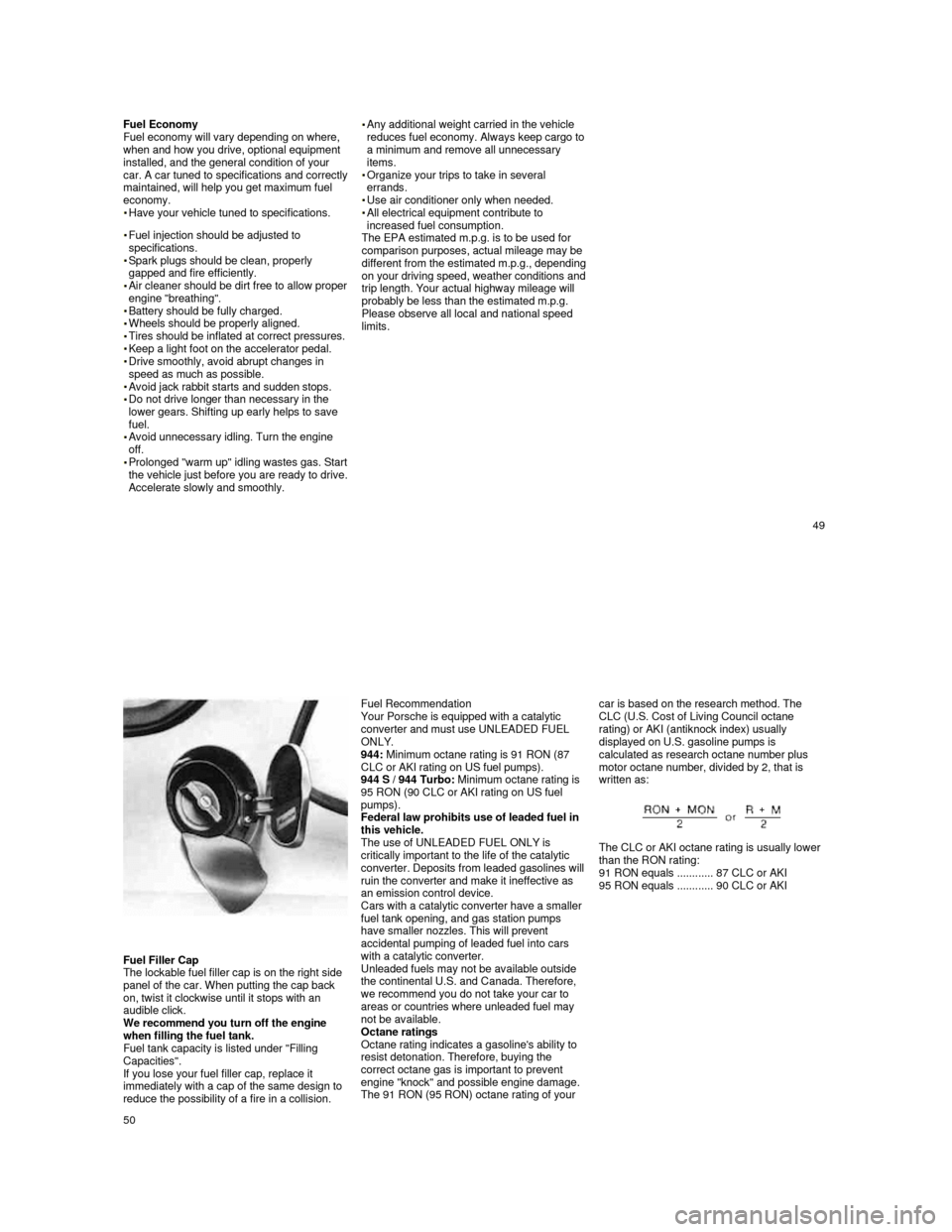
Fuel Economy
Fuel economy will vary depending on where,
when and how you drive, optional equipment installed, and the general condition of your
car. A car tuned to specifications and correctly maintained, will help you get maximum fuel
economy.
Have your vehicle tuned to specifications.
Fuel injection should be adjusted to
specifications.
Spark plugs should be clean, properly
gapped and fire efficiently.
Air cleaner should be dirt free to allow proper engine "breathing". Battery should be fully charged. Wheels should be properly aligned. Tires should be inflated at correct pressures. Keep a light foot on the accelerator pedal. Drive smoothly, avoid abrupt changes in
speed as much as possible.
Avoid jack rabbit starts and sudden stops. Do not drive longer than necessary in the
lower gears. Shifting up early helps to save
fuel.
Avoid unnecessary idling. Turn the engine
off.
Prolonged "warm up" idling wastes gas. Start the vehicle just before you are ready to drive. Accelerate slowly and smoothly.
Any additional weight carried in the vehicle reduces fuel economy. Always keep cargo to
a minimum and remove all unnecessary
items.
Organize your trips to take in several
errands.
Use air conditioner only when needed. All electrical equipment contribute to increased fuel consumption.
The EPA estimated m.p.g. is to be used for
comparison purposes, actual mileage may be
different from the estimated m.p.g., depending on your driving speed, weather conditions and trip length. Your actual highway mileage will
probably be less than the estimated m.p.g.
Please observe all local and national speed
limits.
49
Fuel Filler Cap
The lockable fuel filler cap is on the right side
panel of the car. When putting the cap back
on, twist it clockwise until it stops with an
audible click.
We recommend you turn off the engine
when filling the fuel tank.
Fuel tank capacity is listed under "Filling
Capacities".
If you lose your fuel filler cap, replace it
immediately with a cap of the same design to
reduce the possibility of a fire in a collision.
Fuel Recommendation
Your Porsche is equipped with a catalytic
converter and must use UNLEADED FUEL
ONLY.
944:
Minimum octane rating is 91 RON (87
CLC or AKI rating on US fuel pumps).
944 S / 944 Turbo: Minimum octane rating is
95 RON (90 CLC or AKI rating on US fuel
pumps).
Federal law prohibits use of leaded fuel in
this vehicle.
The use of UNLEADED FUEL ONLY is
critically important to the life of the catalytic
converter. Deposits from leaded gasolines will ruin the converter and make it ineffective as
an emission control device.
Cars with a catalytic converter have a smaller
fuel tank opening, and gas station pumps
have smaller nozzles. This will prevent
accidental pumping of leaded fuel into cars
with a catalytic converter.
Unleaded fuels may not be available outside
the continental U.S. and Canada. Therefore,
we recommend you do not take your car to areas or countries where unleaded fuel may
not be available.
Octane ratings
Octane rating indicates a gasoline's ability to
resist detonation. Therefore, buying the
correct octane gas is important to prevent
engine "knock" and possible engine damage.
The 91 RON (95 RON) octane rating of your
car is based on the research method. The CLC (U.S. Cost of Living Council octane
rating) or AKI (antiknock index) usually
displayed on U.S. gasoline pumps is
calculated as research octane number plus
motor octane number, divided by 2, that is
written as:
The CLC or AKI octane rating is usually lower
than the RON rating:
91 RON equals ............ 87 CLC or AKI
95 RON equals ............ 90 CLC or AKI
50
Page 29 of 66
Neutral
Shift to this position for standing with brakes
applied.
Never use Neutral for coasting downhill.
You may lose control over the car because of reduced braking and cause serious damage to the transmission when a driving range has to be selected. CAUTION: While driving with the automatic speed control set (at speeds above 25 mph or 40 km/h), do not bring shift lever into
the Neutral position as excessive engine
rpm and severe engine damage may result.
Maneuvering
When alternating between forward (D) and
reverse (R) (for instance, while maneuvering
the car into a tight parking space), only shift
into Reverse or Drive
when the car has come to a full stop and the engine is running at idle
speed.
Stuck in snow, mud or sand
When alternating between Drive and
Reverse in an effort to free the vehicle,
depress the accelerator pedal lightly while the
transmission is in gear, and release the
accelerator pedal while shifting. Do not race
the engine and avoid spinning the wheels.
Do not repeat "rocking" back and forth
with wheels spinning at high engine speed
and heavy throttle, as serious damage may be caused to the automatic transmission
and other critical parts.
If you cannot free the vehicle after a few
"rocking" attempts, call for help or a tow truck.
Accelerator Pedal
For good fuel economy we recommend
smooth and even acceleration. Very fast, racy
driving, alternating between full throttle and
hard braking, raises the fuel consumption
considerably. Also, tires and brake linings
wear faster. It is more economical to drive smoothly and at a fairly constant speed.
Accelerator "Kickdown"
When depressing the accelerator pedal you
will find resistance near the full throttle position. By applying greater pressure the
pedal can be pushed beyond this point to the
kick-down position. The transmission will now
shift automatically into the next lower gear to
give you maximum acceleration, and only shift up again after the engine has reached
maximum speed in that particular gear.
WARNING
Be careful when using the kickdown on
slippery roads. Rapid acceleration may
cause skidding.
Please observe the following when applying
the accelerator kickdown:
With the selector lever in D, you can apply the kickdown to make the transmission shift down into second gear when driving below 88 mph
or 140 km/h and down to first gear when
driving below 47 mph or 75 km/h.
With the selector lever in "2", you can apply
the kickdown to make the transmission shift
down into first gear when driving below 47
mph or 75 km/h.
As soon as you release the pedal from the kickdown position the next higher gear is
automatically engaged.
Please observe all local and national speed limits.
55
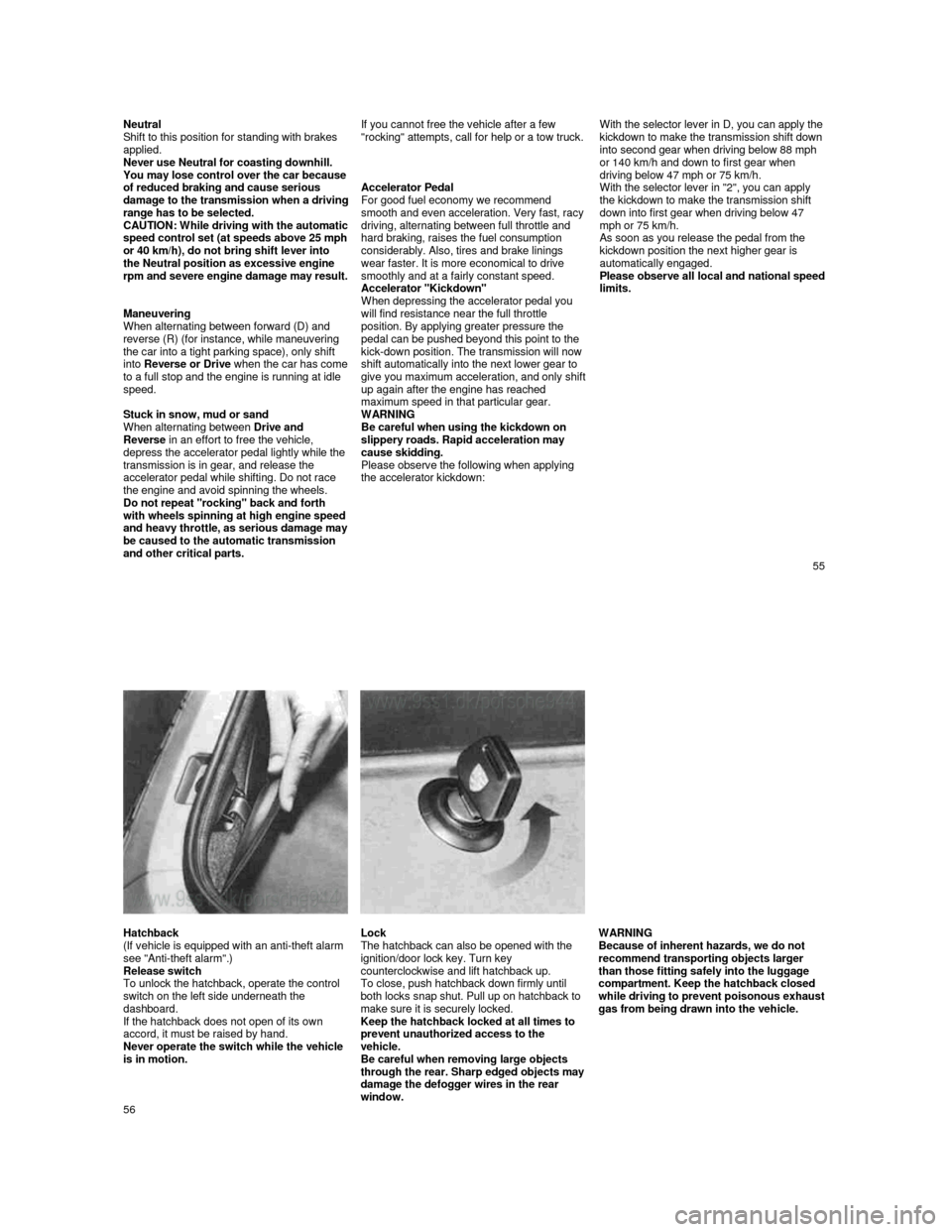
Hatchback
(If vehicle is equipped with an anti-theft alarm
see "Anti-theft alarm".)
Release switch
To unlock the hatchback, operate the control
switch on the left side underneath the
dashboard.
If the hatchback does not open of its own
accord, it must be raised by hand.
Never operate the switch while the vehicle
is in motion. Lock
The hatchback can also be opened with the
ignition/door lock key. Turn key
counterclockwise and lift hatchback up.
To close, push hatchback down firmly until
both locks snap shut. Pull up on hatchback to
make sure it is securely locked.
Keep the hatchback locked at all times to
prevent unauthorized access to the
vehicle.
Be careful when removing large objects
through th
e rear. Sharp edged objects may damage the defogger wires in the rear
window.
WARNING
Because of inherent hazards, we do not
recommend transporting objects larger
than those fitting safely into the luggage
compartment. Keep the hatchback closed
while dr
iving to prevent poisonous exhaust gas from being drawn into the vehicle.
56
Page 36 of 66
944
944 S
944 Turbo Engine Oil Level
Engine oil consumption
It is normal for your engine to consume oil.
The rate of oil consumption depends on the
quality and viscosity of oil, the speed at which
the engine is operated, the climate, road
conditions as well as the amount of dilution
and oxidation of the lubricant.
Because of these variables, no standard rate
of oil consumption can be established, but
drivers should expect an increased oil
consumption at high speeds and when the
engine is new.
The engine in your vehicle depends on oil to lubricate and cool all of its moving
parts. Therefore, the engine oil should be
checked regularly and kept at the required level.
Make it a habit to have the engine oil level checked with every fuel filling. Lack of sufficient engine oil may lead to severe engine damage. The oil pressure warning light is not an oil level indicator.
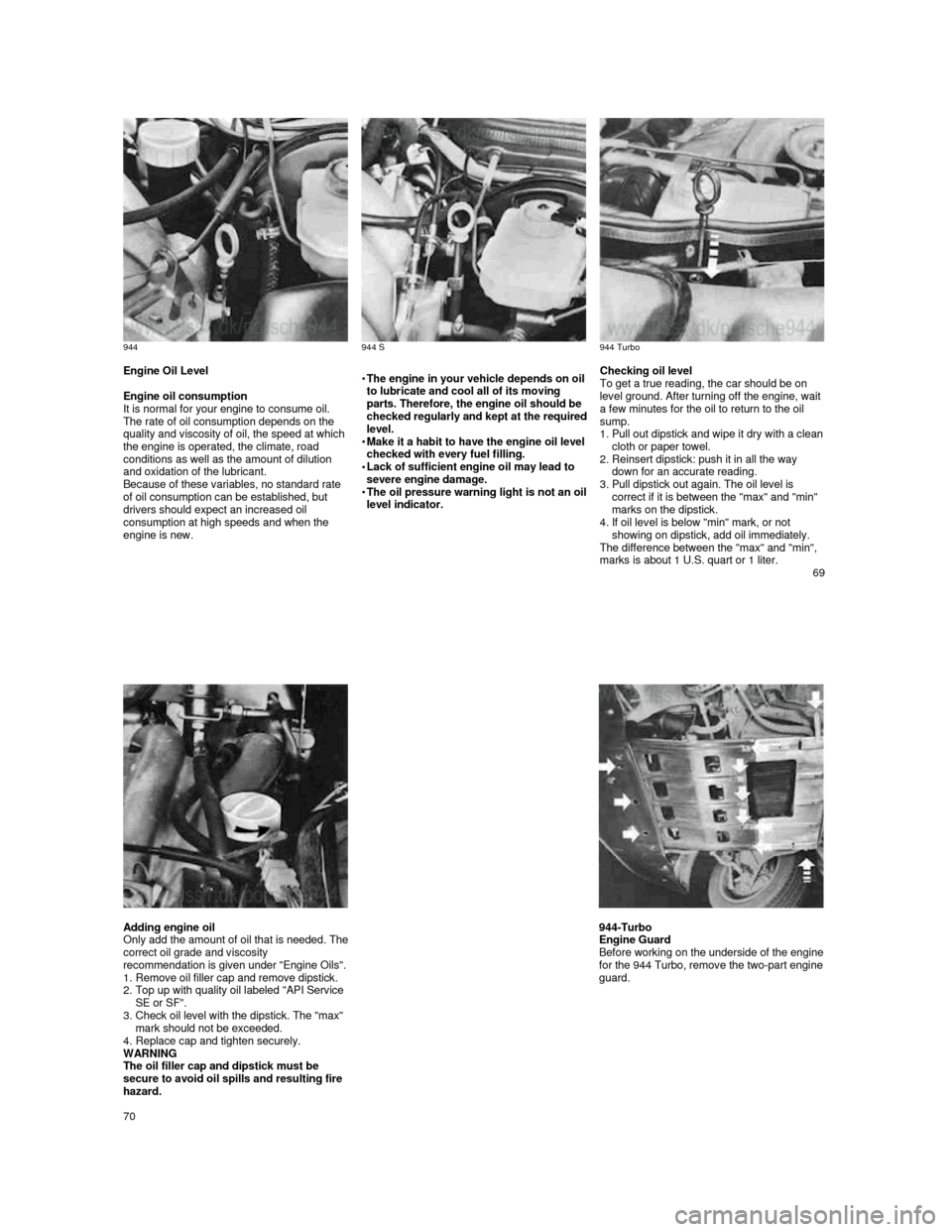
Checking oil level
To get a true reading, the car should be on
level ground. After turning off the engine, wait
a few minutes for the oil to return to the oil
sump.
1. Pull out dipstick and wip
e it dry with a clean cloth or paper towel.
2. Reinsert dipstick: push it in all the way
down for an accurate reading.
3.
Pull dipstick out again. The oil level is
correct if it is between the "max" and "min"
marks on the dipstick.
4.
If oil level is below "min" mark, or not
showing on dipstick, add oil immediately.
The difference between the "max" and "min",
marks is about 1 U.S. quart or 1 liter. 69
Adding engine oil Only add the amount of oil that is needed. The correct oil grade and viscosity
recommendation is given under "Engine Oils". 1. Remove oil filler cap and remove dipstick.
2. Top up with quality oil labeled "API Service
SE or SF".
3.
Check oil level with the dipstick. The "max"
mark should not be exceeded.
4.
Replace cap and tighten securely.
WARNING
The oil filler cap and dipstick must be
secure to avoid oil spills and resulting fire
hazard.
944-Turbo
Engine Guard
Before working on the underside of the engine for the 944 Turbo, remove the two-part engine guard.
70