Page 1424 of 1865
1 1 POWER BRAKE UNIT
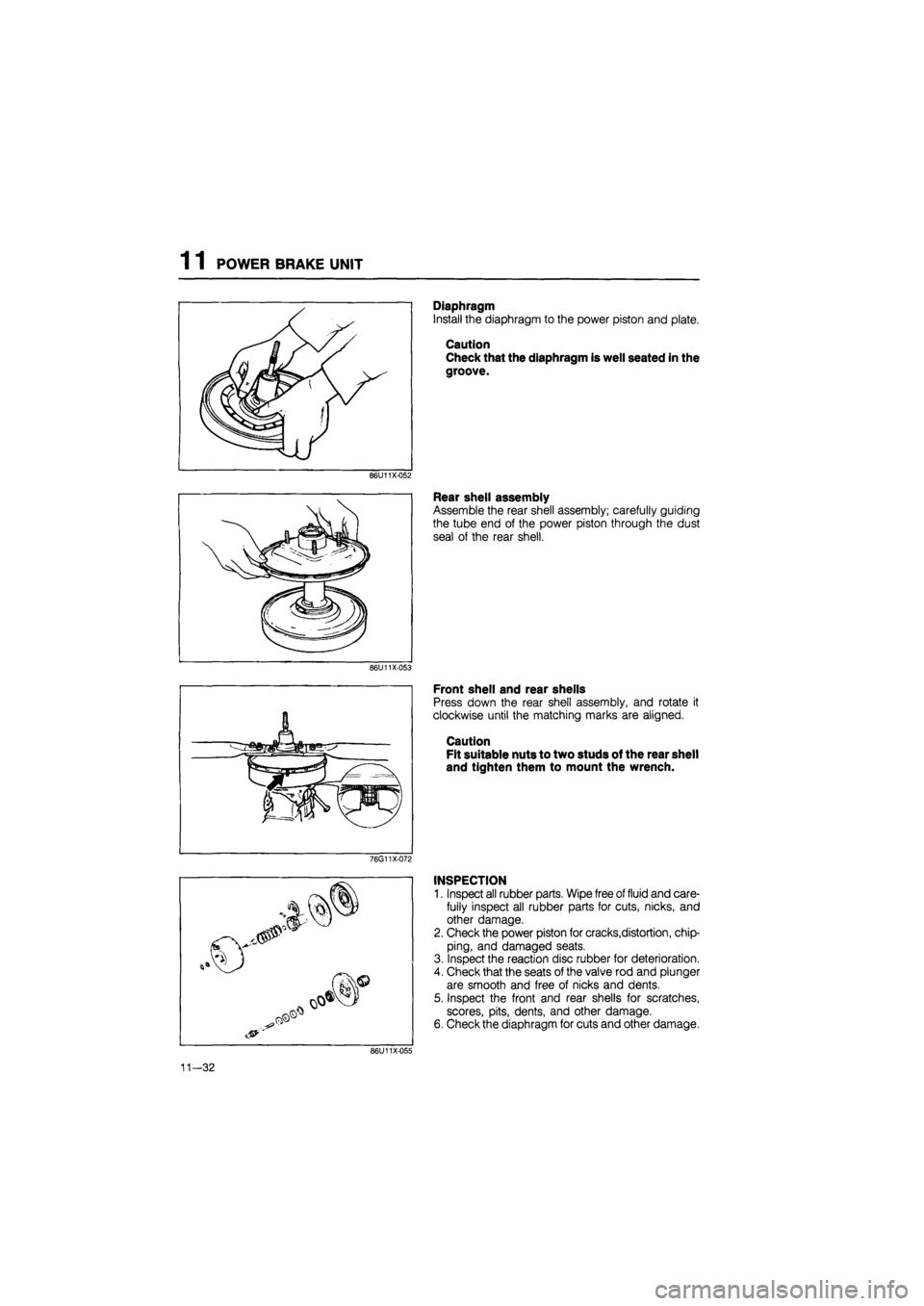
Diaphragm
Install the diaphragm to the power piston and plate.
Caution
Check that the diaphragm is well seated in the
groove.
86U11X-052
Rear shell assembly
Assemble the rear shell assembly; carefully guiding
the tube end of the power piston through the dust
seal of the rear shell.
86U11X-053
Front shell and rear shells
Press down the rear shell assembly, and rotate it
clockwise until the matching marks are aligned.
Caution
Fit suitable nuts to two studs of the rear shell
and tighten them to mount the wrench.
76G11X-072
INSPECTION
1. Inspect all rubber parts. Wipe free of fluid and care-
fully inspect all rubber parts for cuts, nicks, and
other damage.
2. Check the power piston for cracks,distortion, chip-
ping, and damaged seats.
3. Inspect the reaction disc rubber for deterioration.
4. Check that the seats of the valve rod and plunger
are smooth and free of nicks and dents.
5. Inspect the front and rear shells for scratches,
scores, pits, dents, and other damage.
6. Check the diaphragm for cuts and other damage.
11—32
Page 1430 of 1865
![MAZDA 626 1987 Workshop Manual
1
1
DUAL PROPORTIONING VALVE
B6U11X-060
DUAL PROPORTIONING VALVE
FUNCTION CHECK
1. Connect
two
pressure gauges [9,810
kPa (100
kg/cm2,1,422 psi)
]
to the brake pipes and adap-
tors
as](/manual-img/28/57059/w960_57059-1429.png "MAZDA 626 1987 Workshop Manual
1
1
DUAL PROPORTIONING VALVE
B6U11X-060
DUAL PROPORTIONING VALVE
FUNCTION CHECK
1. Connect
two
pressure gauges [9,810
kPa (100
kg/cm2,1,422 psi)
]
to the brake pipes and adap-
tors
as")
1
1
DUAL PROPORTIONING VALVE
B6U11X-060
DUAL PROPORTIONING VALVE
FUNCTION CHECK
1. Connect
two
pressure gauges [9,810
kPa (100
kg/cm2,1,422 psi)
]
to the brake pipes and adap-
tors
as
shown
in
the
figure.
Adaptor and flare
nut
tightening torque:
13—22 N m (1.3—2.2 m-kg, 9—16 ft-lb)
Note
Disconnect and connect the brake pipes with
the
SST
(49
0259 770B).
2. Bleed
air
from
the
brake system.
(Refer
to
page 11—9.)
76G11X-043
t 0}
^
£
»
Rear
brake
pressu
kPa
(kg/cm2,
p
>
DO
Rear
brake
pressu
kPa
(kg/cm2,
p
>
DO
TTi
A
B
Master cylinder pressure
kPa
(kg/cm2,
psi)
76G11X-044
Depress the brake pedal until the master cylinder
pressure equals A; then measure rear brake pres-
sure
A'.
Depress the brake pedal again; apply additional
pressure until
A
equals
B;
then measure pressure
B'.
If the measurements
are
not
within specification,
replace
the
valve assembly.
Install the brake pipes to the valve,
and
bleed
air
from
the
brake system.
Specification
Fluid pressure
kPa
(kg/cm2,
psi)
A A' B B'
Except General
LHD
and
RHD
1,962 (20,284)
1,962 ±
196
(20
± 2,
284
± 28)
6,867 (70,995)
3,434 ±
196
(35
± 2,
498
± 28)
General
LHD
and
RHD
2,943 (30,427)
2,943 ±
196
(30
± 2,
427
± 28)
6,867 (70,995) 4,120 ±
196
(42
± 2,
597
± 28)
11-38
Page 1432 of 1865
1 1 FRONT DISC BRAKE
76G11X-073
86U11X066
76G11X-074
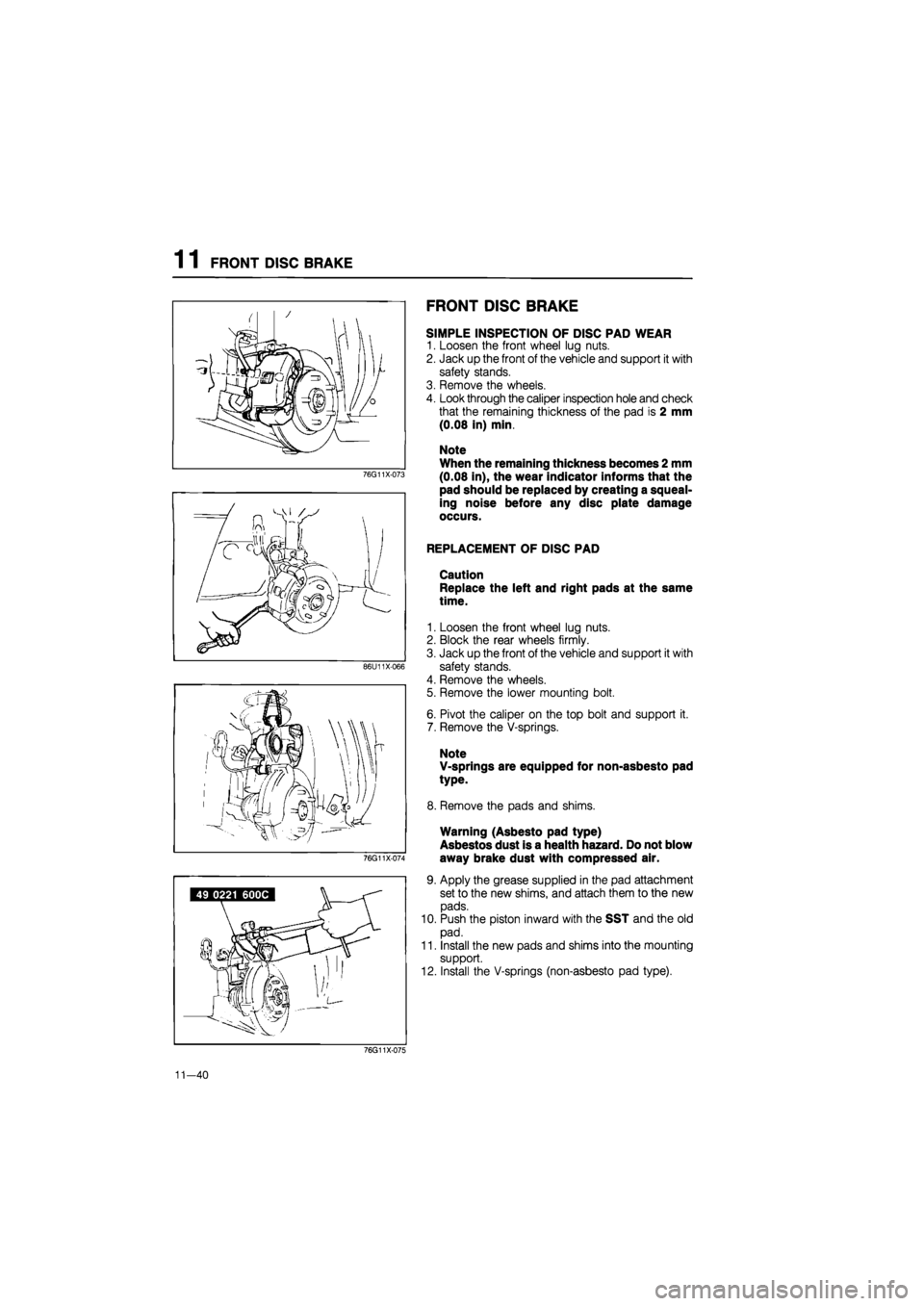
FRONT DISC BRAKE
SIMPLE INSPECTION OF DISC PAD WEAR
1. Loosen the front wheel lug nuts.
2. Jack up the front of the vehicle and support it with
safety stands.
3. Remove the wheels.
4. Look through the caliper inspection hole and check
that the remaining thickness of the pad is 2 mm
(0.08 in) min.
Note
When the remaining thickness becomes 2 mm
(0.08 in), the wear indicator informs that the
pad should be replaced by creating a squeal-
ing noise before any disc plate damage
occurs.
REPLACEMENT OF DISC PAD
Caution
Replace the left and right pads at the same
time.
1. Loosen the front wheel lug nuts.
2. Block the rear wheels firmly.
3. Jack up the front of the vehicle and support it with
safety stands.
4. Remove the wheels.
5. Remove the lower mounting bolt.
6. Pivot the caliper on the top bolt and support it.
7. Remove the V-springs.
Note
V-springs are equipped for non-asbesto pad
type.
8. Remove the pads and shims.
Warning (Asbesto pad type)
Asbestos dust is a health hazard. Do not blow
away brake dust with compressed air.
9. Apply the grease supplied in the pad attachment
set to the new shims, and attach them to the new
pads.
10. Push the piston inward with the SST and the old
pad.
11. Install the new pads and shims into the mounting
support.
12. Install the V-springs (non-asbesto pad type).
76G11X-075
11-40
Page 1439 of 1865
REAR DISC BRAKE 1 1
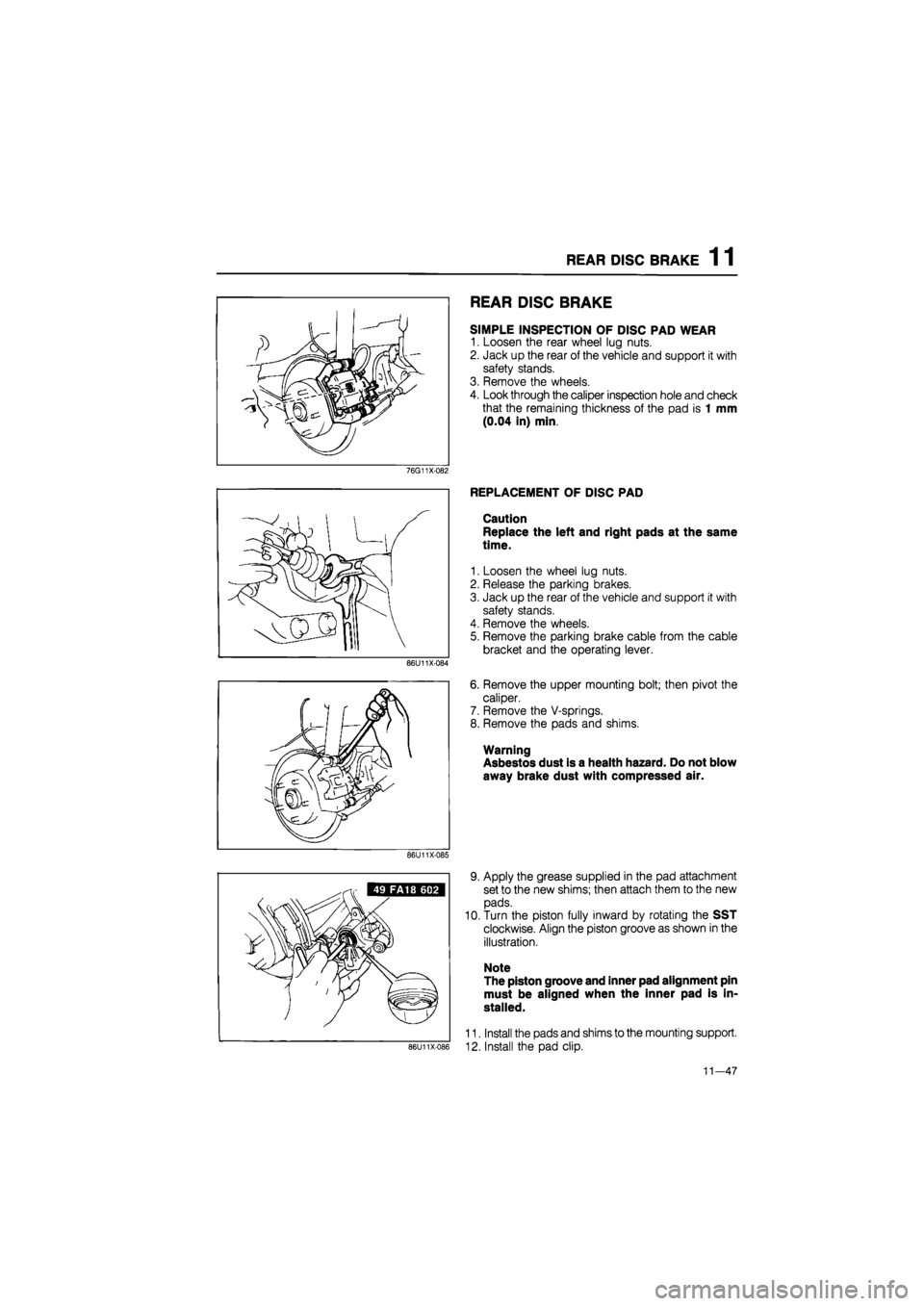
REAR DISC BRAKE
SIMPLE INSPECTION OF DISC PAD WEAR
1. Loosen the rear wheel lug nuts.
2. Jack up the rear of the vehicle and support it with
safety stands.
3. Remove the wheels.
4. Look through the caliper inspection hole and check
that the remaining thickness of the pad is 1 mm
(0.04 in) min.
76G11X-082
86U11X-084
REPLACEMENT OF DISC PAD
Caution
Replace the left and right pads at the same
time.
1. Loosen the wheel lug nuts.
2. Release the parking brakes.
3. Jack up the rear of the vehicle and support it with
safety stands.
4. Remove the wheels.
5. Remove the parking brake cable from the cable
bracket and the operating lever.
6. Remove the upper mounting bolt; then pivot the
caliper.
7. Remove the V-springs.
8. Remove the pads and shims.
Warning
Asbestos dust is a health hazard. Do not blow
away brake dust with compressed air.
86U11X-085
86U11X-086
9. Apply the grease supplied in the pad attachment
set to the new shims; then attach them to the new
pads.
10. Turn the piston fully inward by rotating the SST
clockwise. Align the piston groove as shown in the
illustration.
Note
The piston groove and inner pad alignment pin
must be aligned when the inner pad is in-
stalled.
11. Install the pads and shims to the mounting support.
12. Install the pad clip.
11—47
Page 1440 of 1865
1 1 REAR DISC BRAKE
86U11X-087
86U11X-088
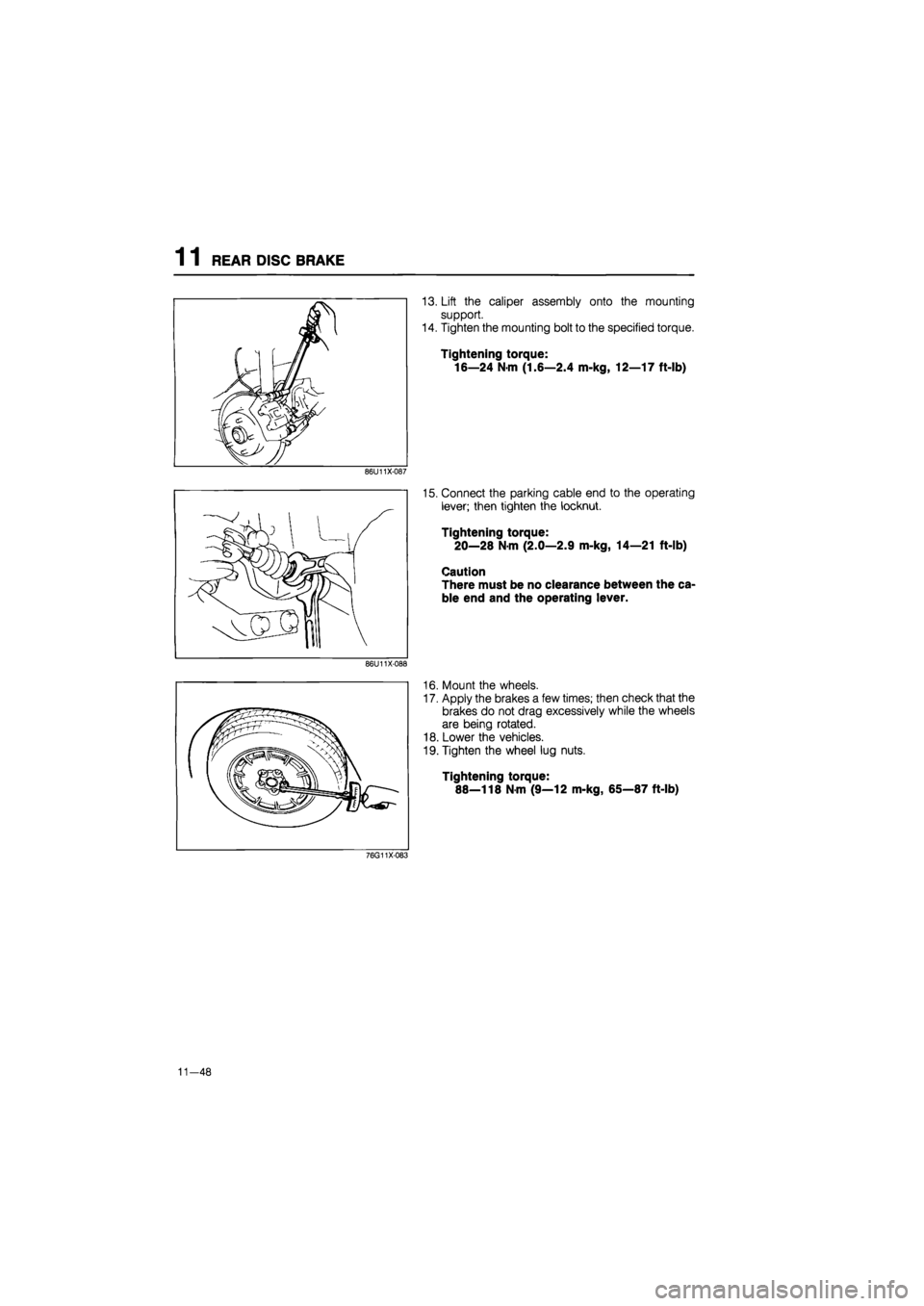
13. Lift the caliper assembly onto the mounting
support.
14. Tighten the mounting bolt to the specified torque.
Tightening torque:
16—24 Nm (1.6—2.4 m-kg, 12—17 ft-lb)
15. Connect the parking cable end to the operating
lever; then tighten the locknut.
Tightening torque:
20—28 N-m (2.0—2.9 m-kg, 14—21 ft-lb)
Caution
There must be no clearance between the ca-
ble end and the operating lever.
16. Mount the wheels.
17. Apply the brakes a few times; then check that the
brakes do not drag excessively while the wheels
are being rotated.
18. Lower the vehicles.
19. Tighten the wheel lug nuts.
Tightening torque:
88—118
N
m (9—12 m-kg, 65—87 ft-lb)
76G11X-083
11-48
Page 1441 of 1865
REAR DISC BRAKE 1 1
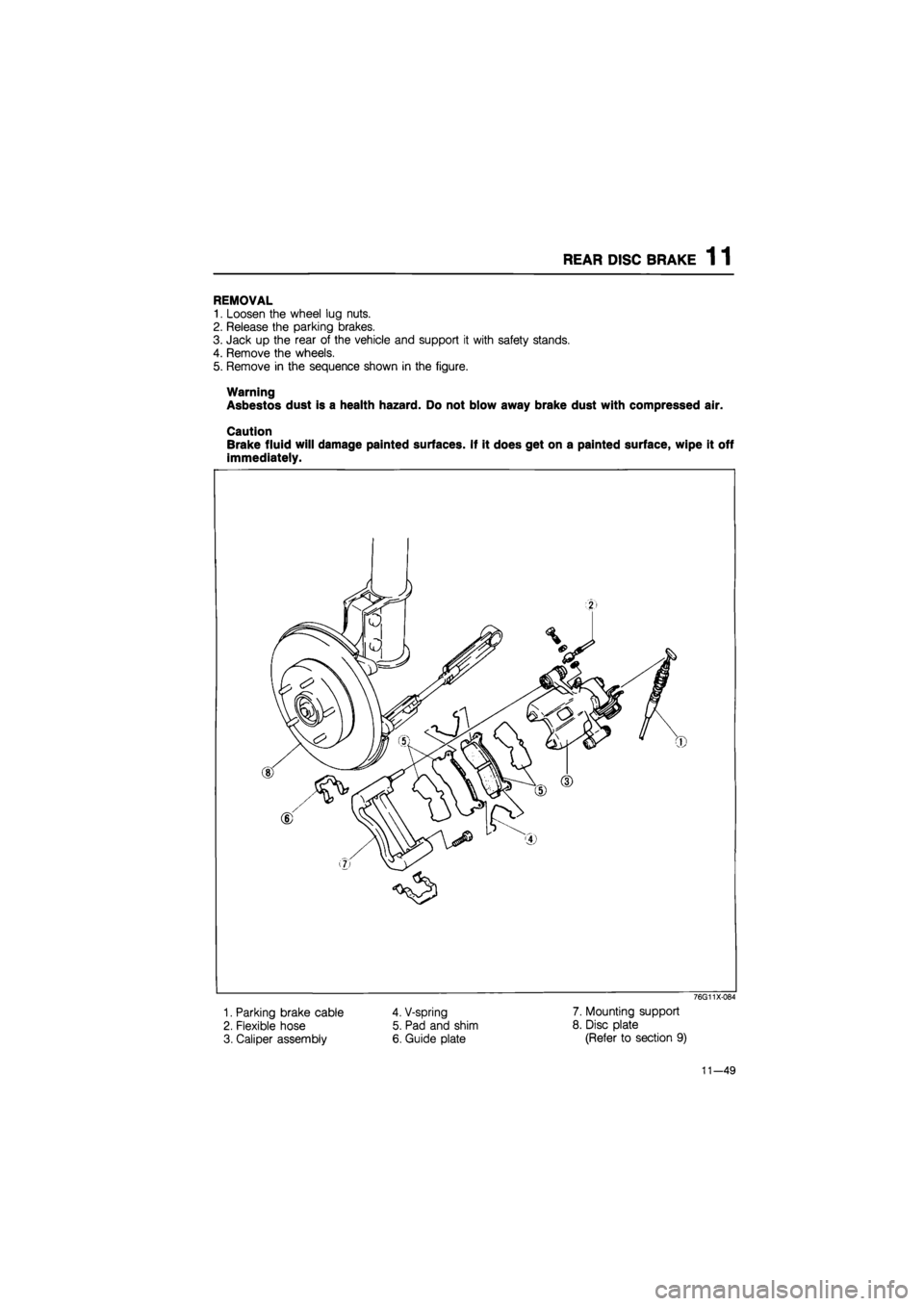
REMOVAL
1. Loosen the wheel lug nuts.
2. Release the parking brakes.
3. Jack up the rear of the vehicle and support it with safety stands.
4. Remove the wheels.
5. Remove in the sequence shown in the figure.
Warning Asbestos dust is a health hazard. Do not blow away brake dust with compressed air.
Caution
Brake fluid will damage painted surfaces. If it does get on a painted surface, wipe it off
immediately.
76G11X-084
1. Parking brake cable
2. Flexible hose
3. Caliper assembly
4. V-spring
5. Pad and shim
6. Guide plate
7. Mounting support
8. Disc plate
(Refer to section 9)
11—49
Page 1442 of 1865
1 1 REAR DISC BRAKE
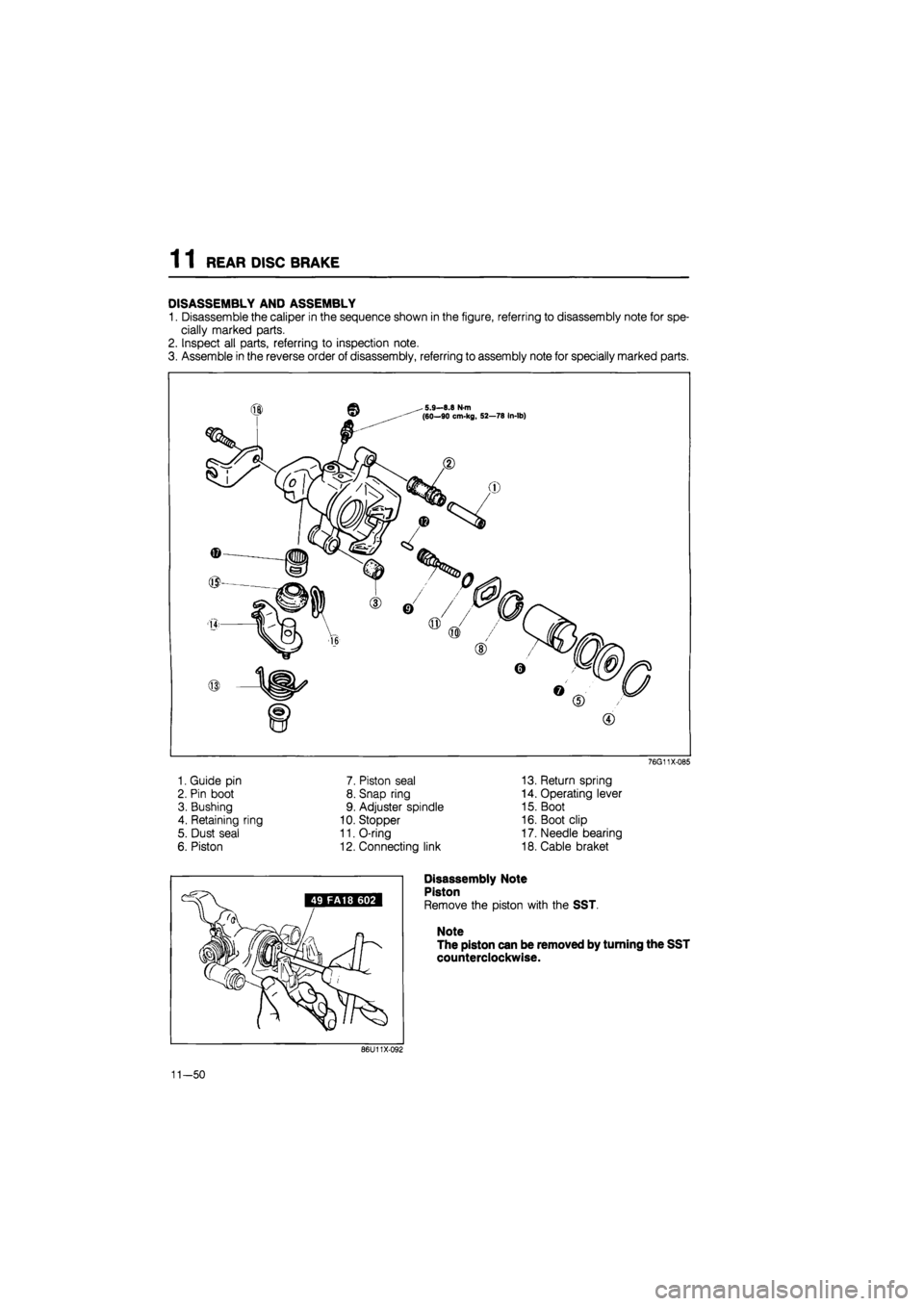
DISASSEMBLY AND ASSEMBLY
1. Disassemble the caliper in the sequence shown in the figure, referring to disassembly note for spe-
cially marked parts.
2. Inspect all parts, referring to inspection note.
3. Assemble in the reverse order of disassembly, referring to assembly note for specially marked parts.
76G11X-0B5
1. Guide pin
2. Pin boot
3. Bushing
4. Retaining ring
5. Dust seal
6. Piston
7. Piston seal
8. Snap ring
9. Adjuster spindle
10. Stopper
11. O-ring
12. Connecting link
13. Return spring
14. Operating lever
15. Boot
16. Boot clip
17. Needle bearing
18. Cable braket
Disassembly Note
Piston
Remove the piston with the SST.
Note
The piston can be removed by turning the SST
counterclockwise.
86U11X-092
11-50
Page 1443 of 1865
REAR DISC BRAKE 1 1
86U11X-093
86U11X-094
86U11X-095
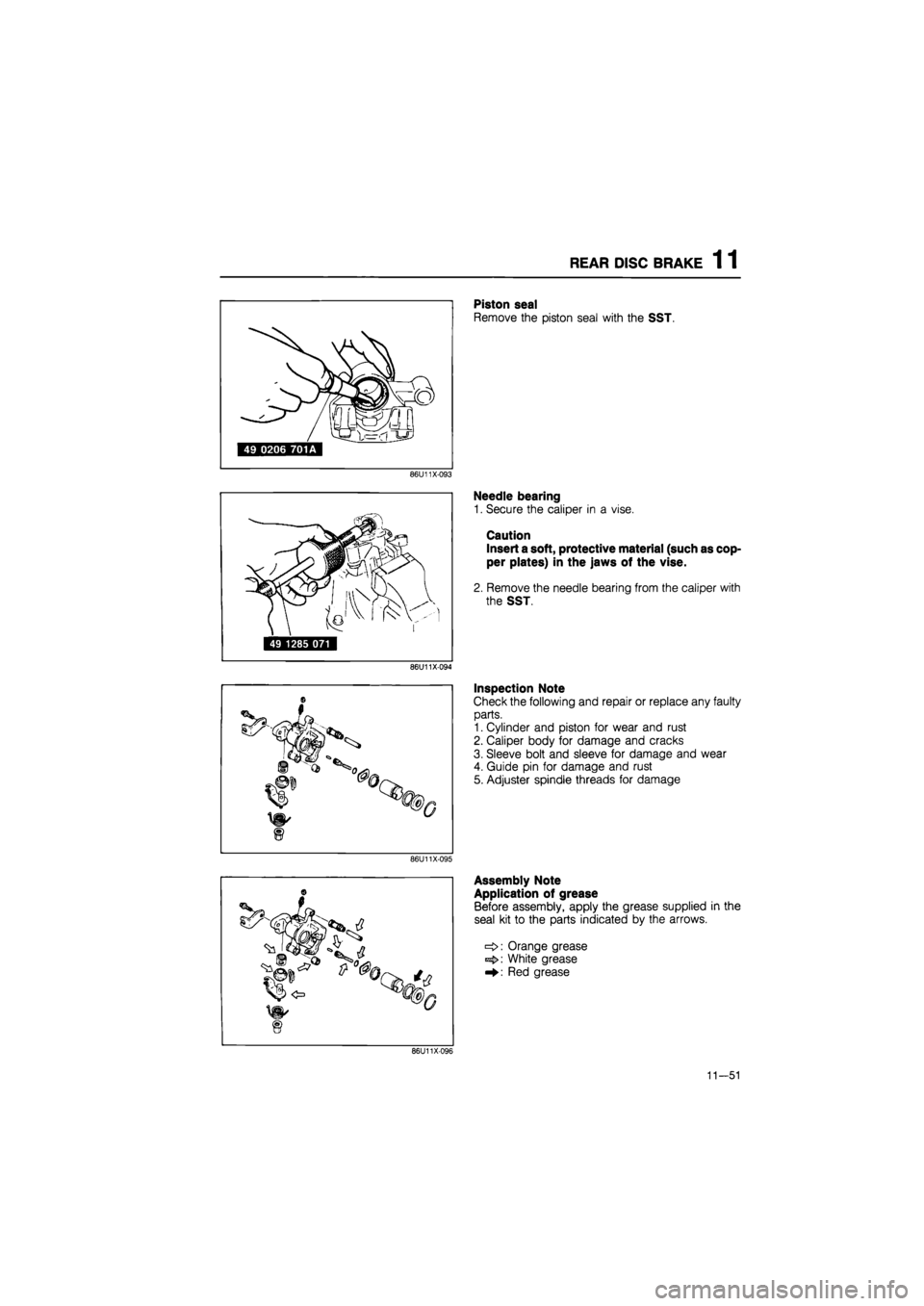
Piston seal
Remove the piston seal with the SST.
Needle bearing
1. Secure the caliper in a vise.
Caution
Insert a soft, protective material (such as cop-
per plates) in the jaws of the vise.
2. Remove the needle bearing from the caliper with
the SST.
Inspection Note
Check the following and repair or replace any faulty
parts.
1. Cylinder and piston for wear and rust
2. Caliper body for damage and cracks
3. Sleeve bolt and sleeve for damage and wear
4. Guide pin for damage and rust
5. Adjuster spindle threads for damage
Assembly Note
Application of grease
Before assembly, apply the grease supplied in the
seal kit to the parts indicated by the arrows.
Orange grease
White grease
Red grease
86U11X096
11-51