1987 MAZDA 626 cooling
[x] Cancel search: coolingPage 1788 of 1865
OUTLINE 16
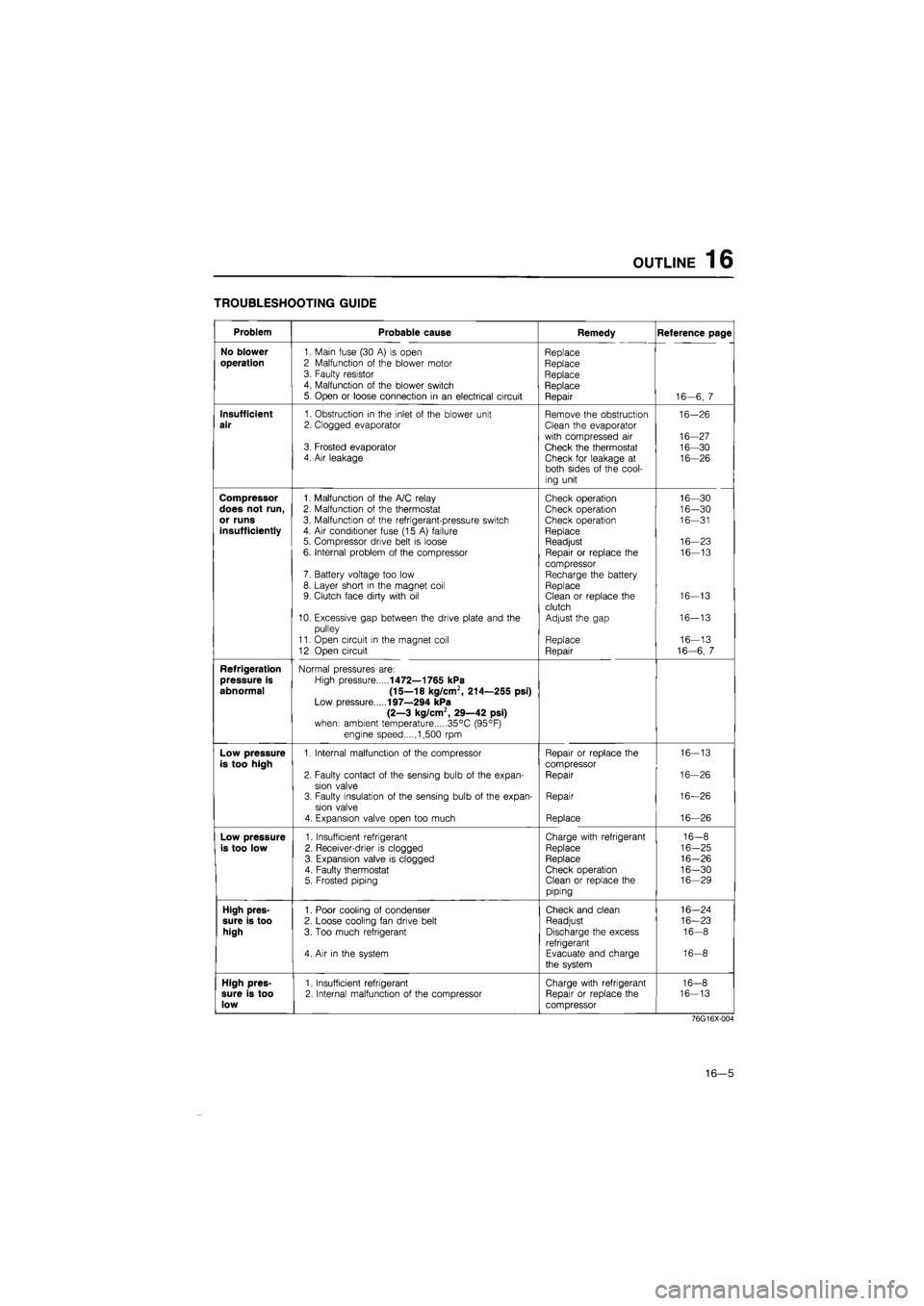
TROUBLESHOOTING GUIDE
Problem Probable cause Remedy Reference page
No blower
1. Main fuse (30
A) is
open Replace
operation
2 Malfunction
of
the blower motor Replace 3. Faulty resistor Replace 4. Malfunction
of
the blower switch Replace 5. Open
or
loose connection
in an
electrical circuit Repair 16—6,
7
Insufficient
1. Obstruction
in
the inlet
of
the blower unit Remove the obstruction 16-26
air
2. Clogged evaporator Clean the evaporator
with compressed
air
16-27 3. Frosted evaporator Check the thermostat 16-30 4. Air leakage Check for leakage
at
16-26 both sides
of
the cool-
ing unit
Compressor
1. Malfunction
of
the A/C relay Check operation 16—30
does not run,
2. Malfunction
of
the thermostat Check operation 16—30
or runs
3. Malfunction
of
the refrigerant-pressure switch Check operation 16—31
insufficiently
4.
Air
conditioner fuse (15
A)
failure Replace 5. Compressor drive belt
is
loose Readjust 16—23
6. Internal problem
of
the compressor Repair
or
replace
the
16—13
compressor 7. Battery voltage too low Recharge the battery 8. Layer short
in
the magnet coil Replace 9. Clutch face dirty with
oil
Clean
or
replace the 16-13
clutch 10. Excessive gap between the drive plate and
the
Adjust the gap 16-13
pulley
11. Open circuit
in
the magnet coil Replace 16—13
12 Open circuit Repair 16-6,
7
Refrigeration
Normal pressures are:
pressure is
High pressure
1472—1765 kPa
abnormal (15—18 kg/cm2, 214—255 psi)
Low pressure
197—294 kPa
(2—3 kg/cm2, 29—42 psi)
when: ambient temperature 35°C (95°F)
engine speed 1,500
rpm
Low pressure
1. Internal malfunction
of
the compressor Repair
or
replace the 16-13
is too high
compressor
2. Faulty contact
of
the sensing bulb
of
the expan-Repair 16-26
sion valve 3. Faulty insulation
of
the sensing bulb
of
the expan-Repair 16—26
sion valve
4. Expansion valve open too much Replace 16—26
Low pressure
1. Insufficient refrigerant Charge with refrigerant 16-8
is too low
2. Receiver-drier
is
clogged Replace 16-25
3. Expansion valve
is
clogged Replace 16-26
4. Faulty thermostat Check operation 16-30 5. Frosted piping Clean
or
replace the 16—29
piping
High pres-
1. Poor cooling
of
condenser Check and clean 16-24
sure is too
2. Loose cooling fan drive belt Readjust 16—23
high
3. Too much refrigerant Discharge the excess 16-8
refrigerant 4.
Air in
the system Evacuate and charge 16-8
the system
High pres-
1. Insufficient refrigerant Charge with refrigerant 16-8
sure is too
2. Internal malfunction
of
the compressor Repair
or
replace the 16-13
low
compressor
76G16X-004
16—5
Page 1791 of 1865
16 OUTLINE
Sight glass
REFRIGERATION SYSTEM
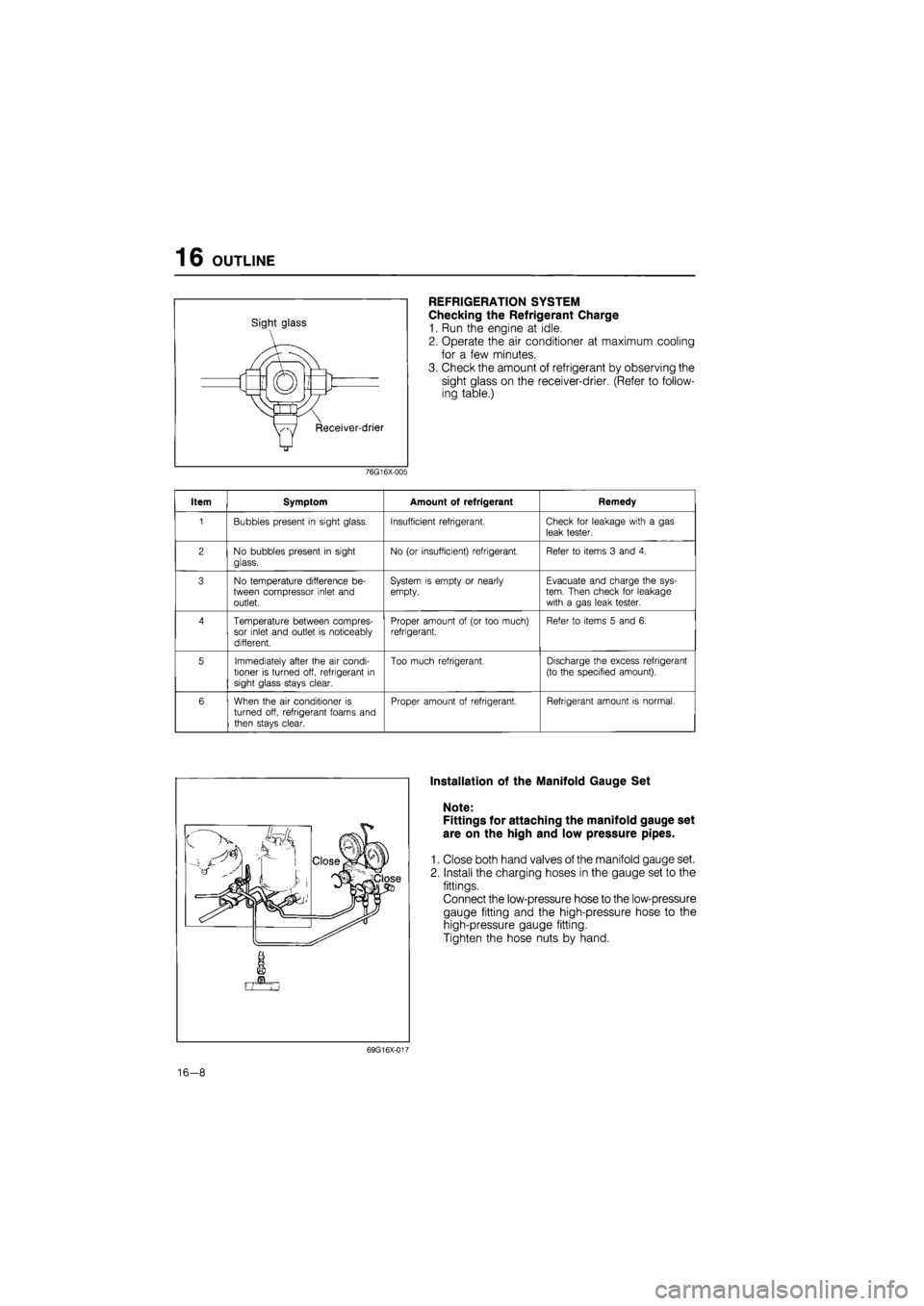
Checking the Refrigerant Charge
1. Run the engine at idle.
2. Operate the air conditioner at maximum cooling
for a few minutes.
3. Check the amount of refrigerant by observing the
sight glass on the receiver-drier. (Refer to follow-
ing table.)
76G16X-005
Item Symptom Amount of refrigerant Remedy
1 Bubbles present
in
sight glass. Insufficient refrigerant. Check
for
leakage with
a gas
leak tester.
2 No bubbles present
in
sight
glass.
No
(or
insufficient) refrigerant. Refer
to
items
3
and
4.
3 No temperature difference
be-
tween compressor inlet and outlet.
System
is
empty
or
nearly empty. Evacuate and charge the sys-tem. Then check
for
leakage with
a
gas leak tester.
4 Temperature between compres-sor inlet and outlet
is
noticeably different.
Proper amount
of (or
too much) refrigerant. Refer
to
items
5
and
6.
5 Immediately after the
air
condi-tioner
is
turned off, refrigerant
in
sight glass stays clear.
Too much refrigerant. Discharge the excess refrigerant
(to the specified amount).
6 When the
air
conditioner
is
turned off, refrigerant foams and
then stays clear.
Proper amount
of
refrigerant. Refrigerant amount
is
normal.
Installation of the Manifold Gauge Set
Note:
Fittings for attaching the manifold gauge set
are on the high and low pressure pipes.
1. Close both hand valves of the manifold gauge set.
2. Install the charging hoses in the gauge set to the
fittings.
Connect the low-pressure hose to the low-pressure
gauge fitting and the high-pressure hose to the
high-pressure gauge fitting.
Tighten the hose nuts by hand.
69G16X-017
16-8
Page 1795 of 1865
16 OUTLINE
Thermometer (Dry)
Thermometer
(Dry & Wet)
76G16X-633
69G16X-024
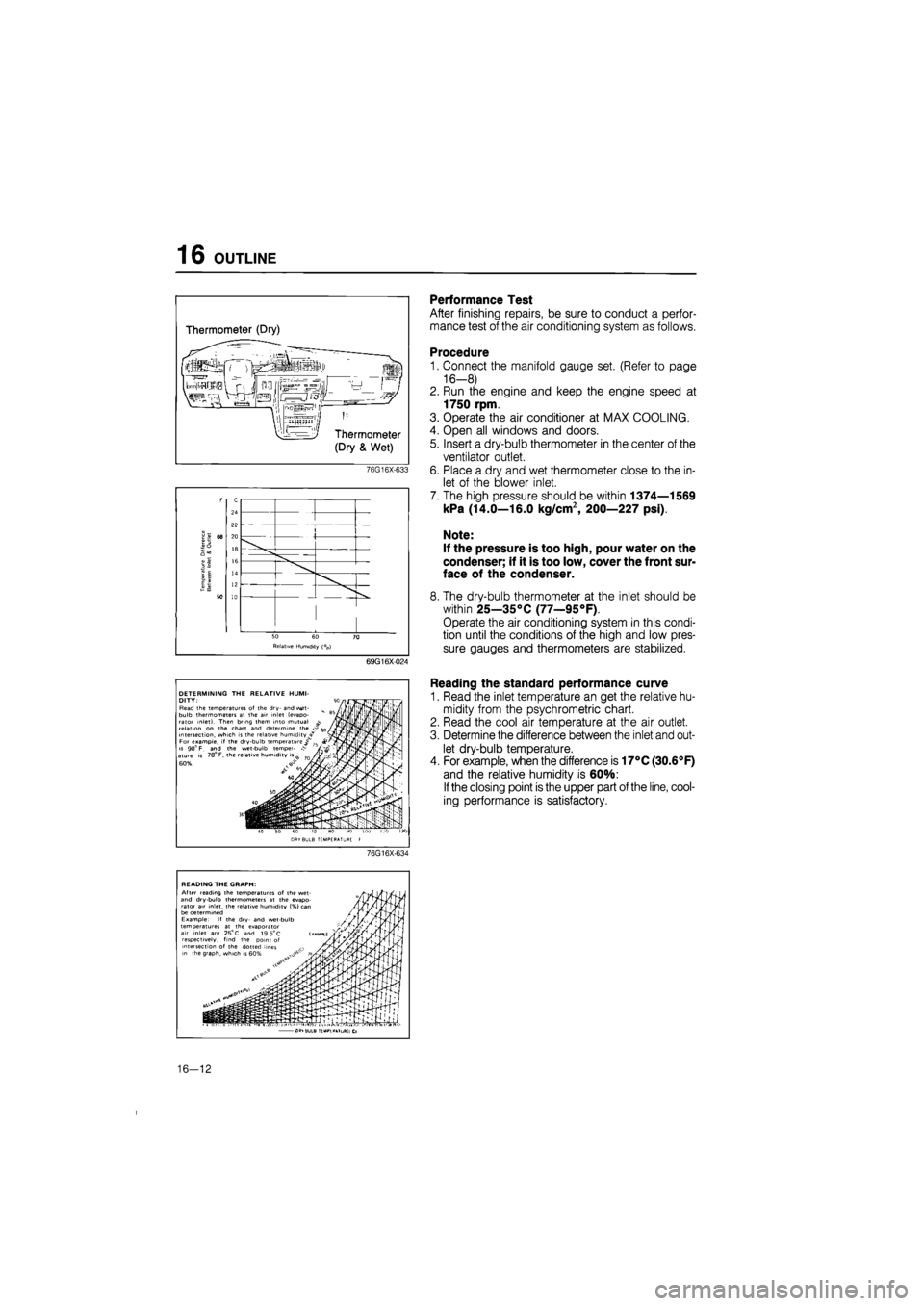
DETERMINING THE RELATIVE HUMI-DITY: Read the temperatures of the dry- and v^et-bulb thermometers at the air inlet (evapo-rator inlet). Then bring them into mutual relation on the chart and determine the intersection, which is the relative humidity^ For exampie, if the dry-bulb temperature^ is 90° F. and the wet-bulb temper- ^ ature is 78° F, the relative humidity is ^ 60%.
DRV BUL8 TEMPERATURE
Performance Test
After finishing repairs, be sure to conduct a perfor-
mance test of the air conditioning system as follows.
Procedure
1. Connect the manifold gauge set. (Refer to page
16-8)
2. Run the engine and keep the engine speed at
1750 rpm.
3. Operate the air conditioner at MAX COOLING.
4. Open all windows and doors.
5. Insert a dry-bulb thermometer in the center of the
ventilator outlet.
6. Place a dry and wet thermometer close to the in-
let of the blower inlet.
7. The high pressure should be within 1374—1569
kPa (14.0—16.0 kg/cm2, 200—227 psi).
Note:
If the pressure is too high, pour water on the
condenser; if it is too low, cover the front sur-
face of the condenser.
8. The dry-bulb thermometer at the inlet should be
within 25—35°C (77—95°F).
Operate the air conditioning system in this condi-
tion until the conditions of the high and low pres-
sure gauges and thermometers are stabilized.
Reading the standard performance curve
1. Read the inlet temperature an get the relative hu-
midity from the psychrometric chart.
2. Read the cool air temperature at the air outlet.
3. Determine the difference between the inlet and out-
let dry-bulb temperature.
4. For example, when the difference is 17°C (30.6°F)
and the relative humidity is 60%:
If
the closing point is the upper part of the line, cool-
ing performance is satisfactory.
76G16X-634
READING THE GRAPH: After reading the temperatures of the wet-and dry-bulb thermometers at the evapo-rator air inlet, the relative humidity (%} can be determined Example: If the dry- and wet-bulb temperatures at the evaporator air inlet are 25°
C
and 19 5°C respectively, find the point of intersection of the dotted lines in the graph, which is
• i
•.p-I--!1. fi -GL^TIULB ': "'.L .T.L CL
16—12
Page 1796 of 1865
COMPRESSOR 16
69G16X-026
M10X1.25^45
Low-pressure x pressure
hose hose Compressor
COMPRESSOR
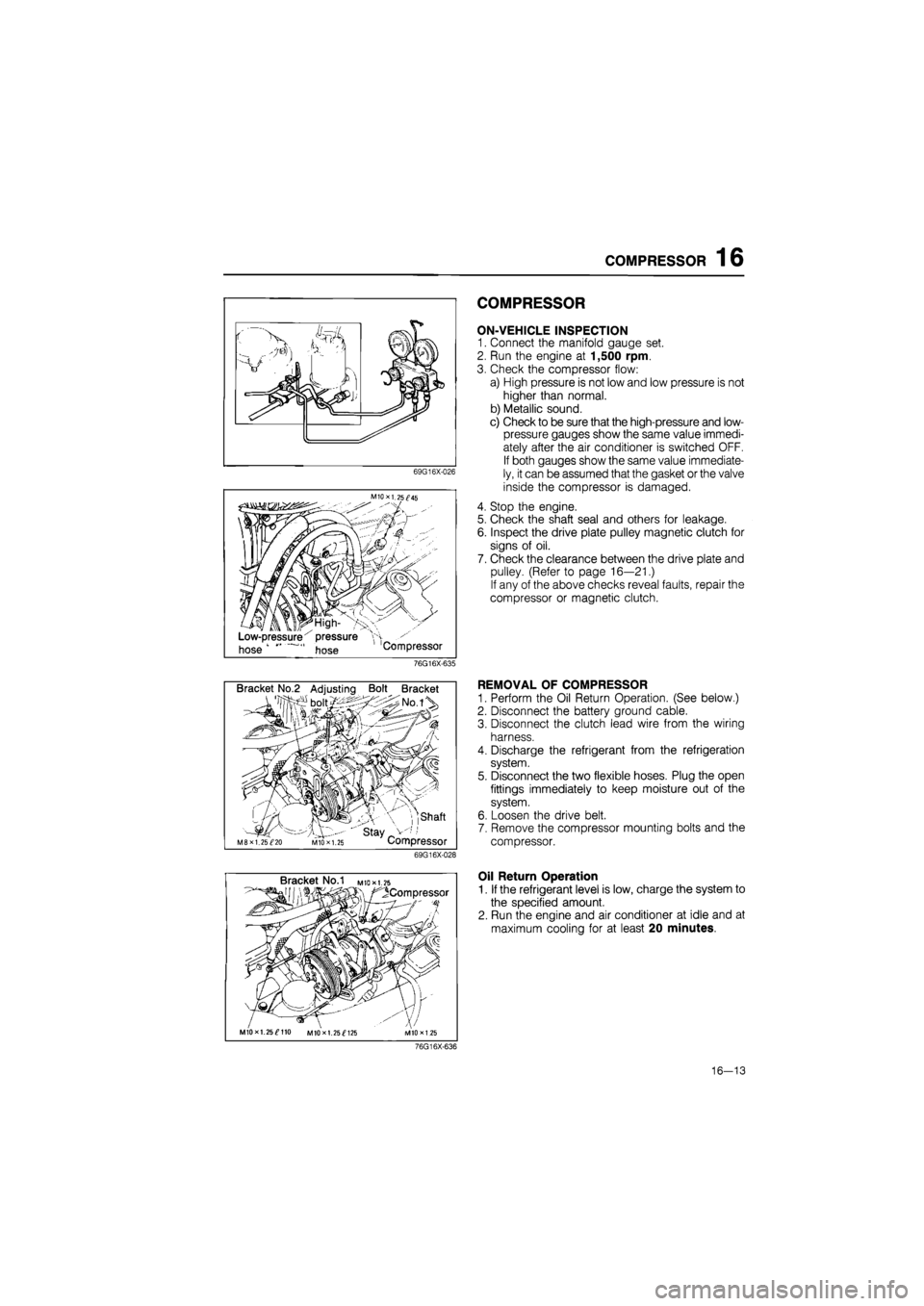
ON-VEHICLE INSPECTION
1. Connect the manifold gauge set.
2. Run the engine at 1,500 rpm.
3. Check the compressor flow:
a) High pressure is not low and low pressure is not
higher than normal.
b) Metallic sound.
c) Check to be sure that the high-pressure and low-
pressure gauges show the same value immedi-
ately after the air conditioner is switched OFF.
If both gauges show the same value immediate-
ly, it can be assumed that the gasket or the valve
inside the compressor is damaged.
4. Stop the engine.
5. Check the shaft seal and others for leakage.
6. Inspect the drive plate pulley magnetic clutch for
signs of oil.
7. Check the clearance between the drive plate and
pulley. (Refer to page 16—21.)
If any of the above checks reveal faults, repair the
compressor or magnetic clutch.
76G16X-635
Bracket No.2 Adjusting Bolt Bracket
, ,shaft
' stay _ M8XI. 25^20 MIO X 1.25 Compressor
69G16X-028
REMOVAL OF COMPRESSOR
1. Perform the Oil Return Operation. (See below.)
2. Disconnect the battery ground cable.
3. Disconnect the clutch lead wire from the wiring
harness.
4. Discharge the refrigerant from the refrigeration
system.
5. Disconnect the two flexible hoses. Plug the open
fittings immediately to keep moisture out of the
system.
6. Loosen the drive belt.
7. Remove the compressor mounting bolts and the
compressor.
Bracket No.1 M
to* 1.25
^Compressor
MIOxl. 25^110 MIOxl. 25^125
Oil Return Operation
1. If the refrigerant level is low, charge the system to
the specified amount.
2. Run the engine and air conditioner at idle and at
maximum cooling for at least 20 minutes.
76G16X-636
16—13
Page 1809 of 1865
16 COOLING UNIT
COOLING UNIT
ON-VEHICLE INSPECTION OF EXPANSION
VALVE
1. Connect the manifold gauge set to the gauge fit-
tings on the low- and high-pressure pipes.
2. Operate the engine at 1,500 rpm and the air con-
ditioner at MAX. COOLING.
3. Check the low and high pressures.
Normal pressures are:
Low: 197—294 kPa
(2—3 kg/cm2, 28—43 psi)
High: 1472—1765 kPa
(15—18 kg/cm2, 210—260 psi)
If pressure is not as specified, replace the expansion
valve.
76G16X-623
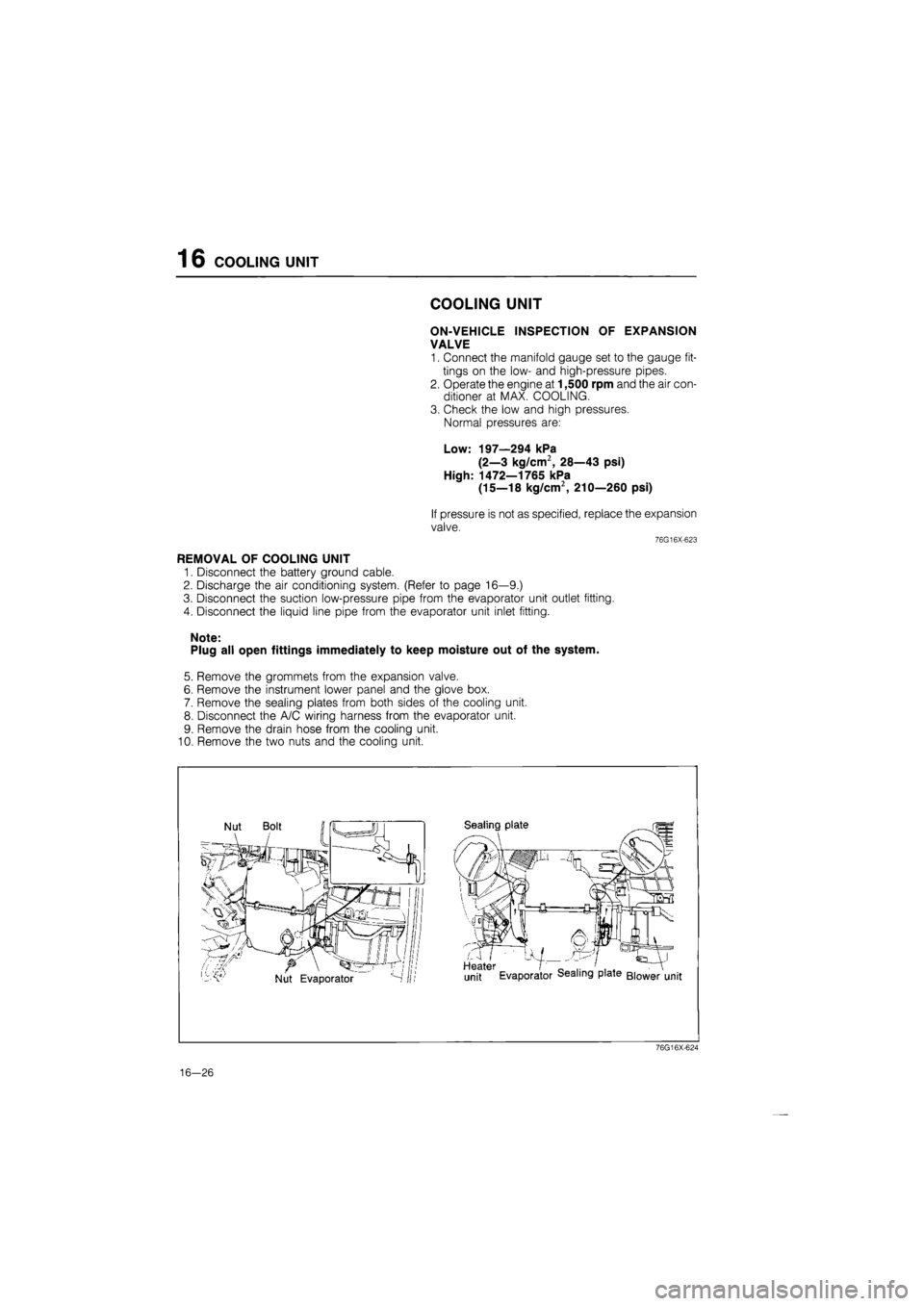
REMOVAL OF COOLING UNIT
1. Disconnect the battery ground cable.
2. Discharge the air conditioning system. (Refer to page 16—9.)
3. Disconnect the suction low-pressure pipe from the evaporator unit outlet fitting.
4. Disconnect the liquid line pipe from the evaporator unit inlet fitting.
Note:
Plug all open fittings immediately to keep moisture out of the system.
5. Remove the grommets from the expansion valve.
6. Remove the instrument lower panel and the glove box.
7. Remove the sealing plates from both sides of the cooling unit.
8. Disconnect the A/C wiring harness from the evaporator unit.
9. Remove the drain hose from the cooling unit.
10. Remove the two nuts and the cooling unit.
76G16X-624
16-26
Page 1810 of 1865
COOLING UNIT 1 6
Upper case Expansion valve / Thermostat
Lower case
76G16X-006
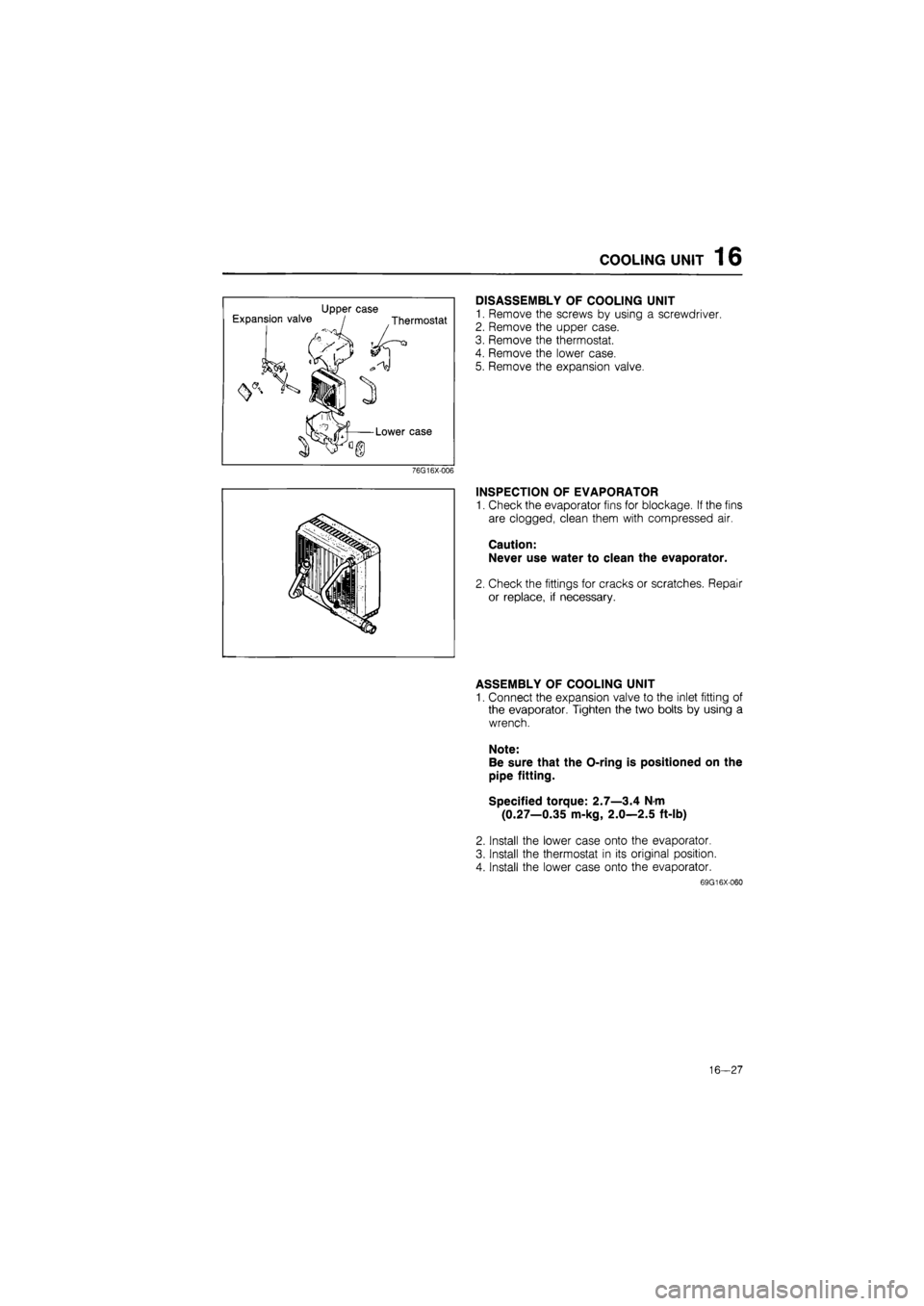
DISASSEMBLY OF COOLING UNIT
1. Remove the screws by using a screwdriver.
2. Remove the upper case.
3. Remove the thermostat.
4. Remove the lower case.
5. Remove the expansion valve.
INSPECTION OF EVAPORATOR
1. Check the evaporator fins for blockage. If the fins
are clogged, clean them with compressed air.
Caution:
Never use water to clean the evaporator.
2. Check the fittings for cracks or scratches. Repair
or replace, if necessary.
ASSEMBLY OF COOLING UNIT
1. Connect the expansion valve to the inlet fitting of
the evaporator. Tighten the two bolts by using a
wrench.
Note:
Be sure that the O-ring is positioned on the
pipe fitting.
Specified torque: 2.7—3.4 N-m
(0.27—0.35 m-kg, 2.0—2.5 ft-lb)
2. Install the lower case onto the evaporator.
3. Install the thermostat in its original position.
4. Install the lower case onto the evaporator.
69G16X-060
16—27
Page 1811 of 1865
1 6 COOLING UNIT
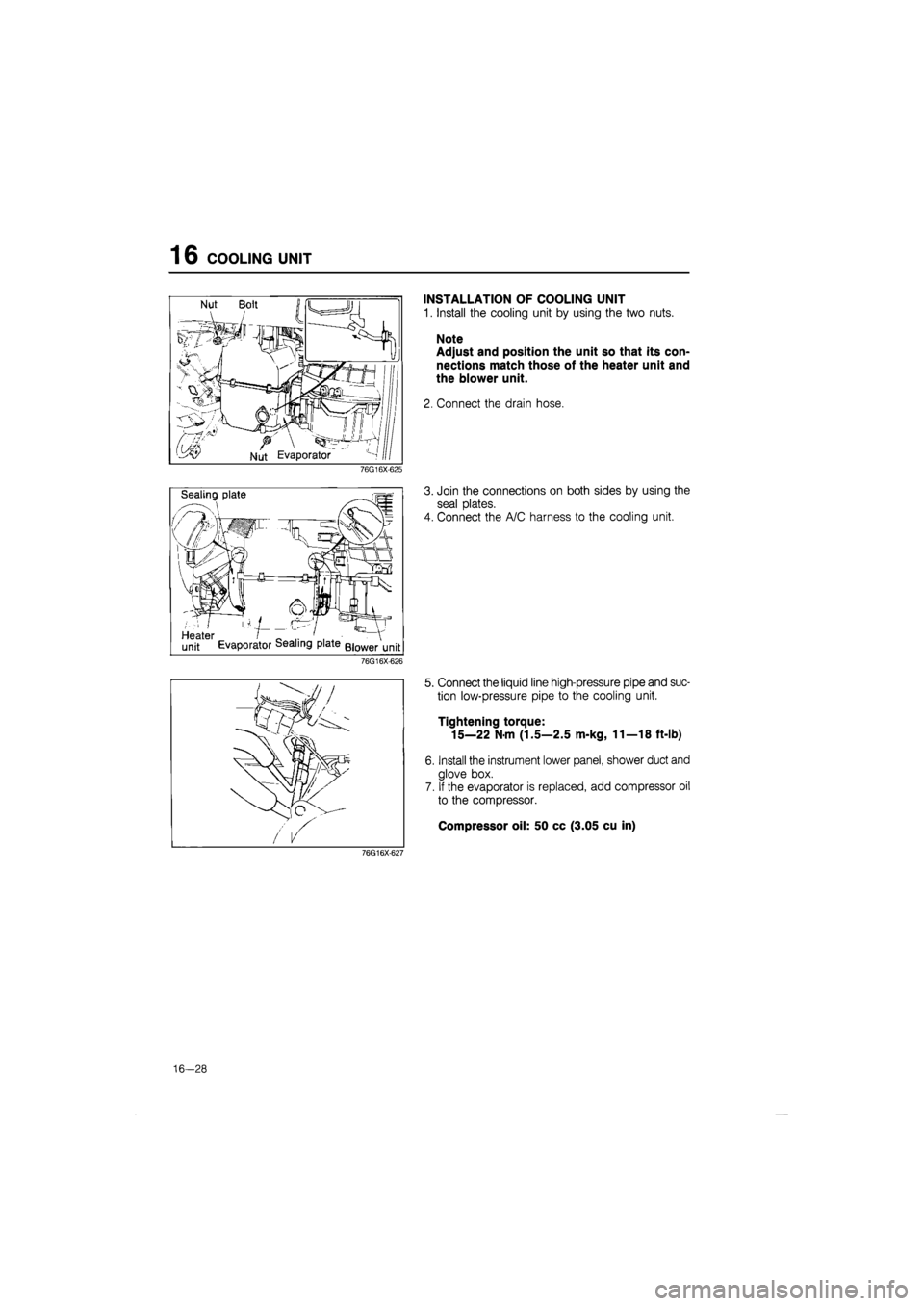
INSTALLATION OF COOLING UNIT
1. Install the cooling unit by using the two nuts.
Note
Adjust and position the unit so that its con-
nections match those of the heater unit and
the blower unit.
2. Connect the drain hose.
76G16X-625
Sealing plate
Heater I _ .. ' . . - V
unit Evaporator dealing plate Blower unit
3. Join the connections on both sides by using the
seal plates.
4. Connect the A/C harness to the cooling unit.
76G16X-626
76G16X-627
5. Connect the liquid line high-pressure pipe and suc-
tion low-pressure pipe to the cooling unit.
Tightening torque:
15—22 Nm (1.5—2.5 m-kg, 11—18 ft-lb)
6. Install the instrument lower panel, shower duct and
glove box.
7. If the evaporator is replaced, add compressor oil
to the compressor.
Compressor oil: 50 cc (3.05 cu in)
16-28
Page 1813 of 1865
1 6 A/C RELAY
A/C RELAY
REMOVAL OF RELAY
1. Disconnect the negative battery cable.
2. Disconnect the wire harness connector
3. Remove the relay from the seal plate.
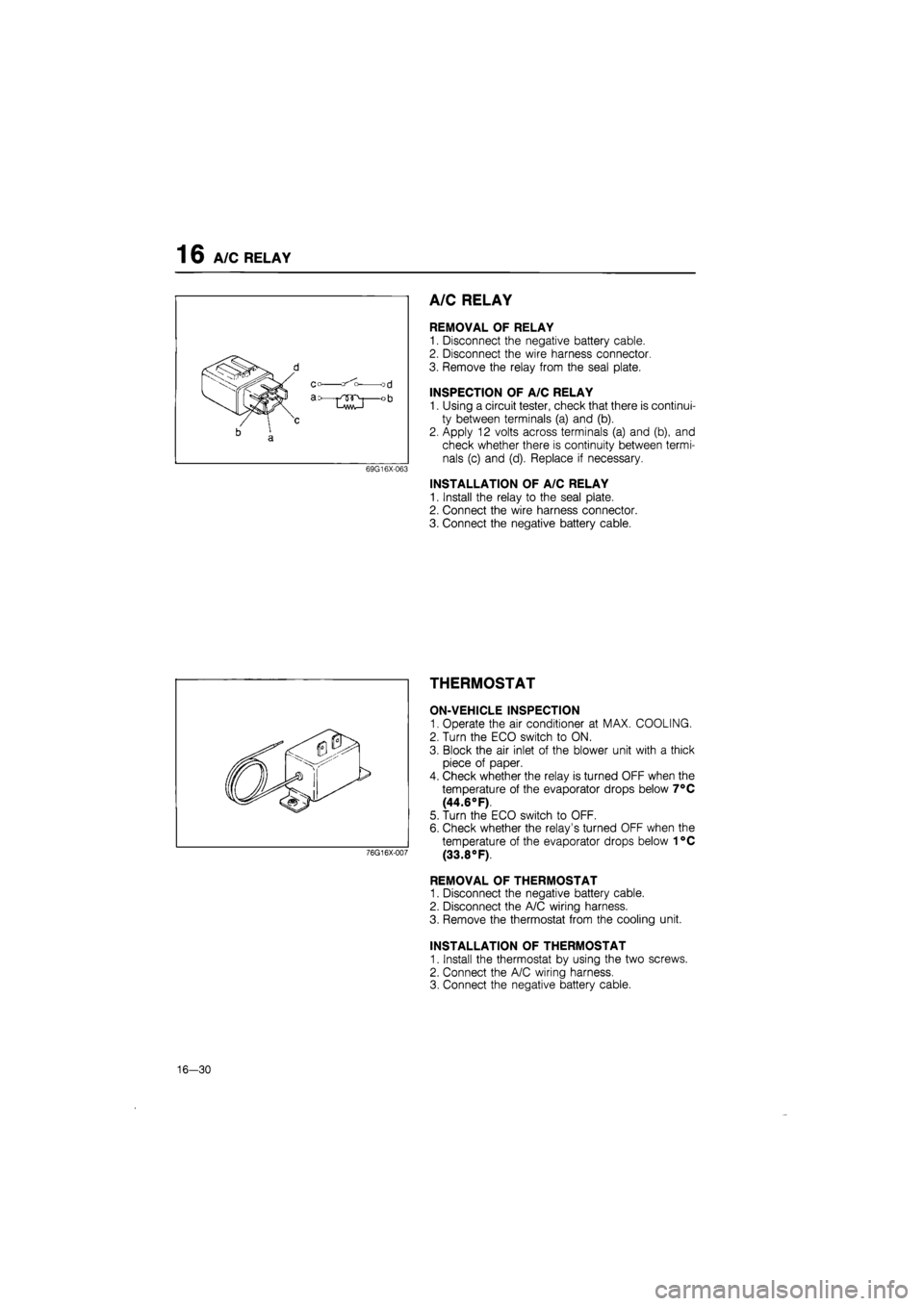
INSPECTION OF A/C RELAY
1. Using a circuit tester, check that there is continui-
ty between terminals (a) and (b).
2. Apply 12 volts across terminals (a) and (b), and
check whether there is continuity between termi-
nals (c) and (d). Replace if necessary.
INSTALLATION OF A/C RELAY
1. Install the relay to the seal plate.
2. Connect the wire harness connector.
3. Connect the negative battery cable.
THERMOSTAT
ON-VEHICLE INSPECTION
1. Operate the air conditioner at MAX. COOLING.
2. Turn the ECO switch to ON.
3. Block the air inlet of the blower unit with a thick
piece of paper.
4. Check whether the relay is turned OFF when the
temperature of the evaporator drops below 7°C
(44.6°F).
5. Turn the ECO switch to OFF.
6. Check whether the relay's turned OFF when the
temperature of the evaporator drops below 1°C
(33.8°F).
REMOVAL OF THERMOSTAT
1. Disconnect the negative battery cable.
2. Disconnect the A/C wiring harness.
3. Remove the thermostat from the cooling unit.
INSTALLATION OF THERMOSTAT
1. Install the thermostat by using the two screws.
2. Connect the A/C wiring harness.
3. Connect the negative battery cable.
76G16X-007
16-30