1982 CHEVROLET CAMARO belt
[x] Cancel search: beltPage 441 of 875

GM – CAMARO 1982-1992 – Repair Guide (Checked by WxMax) 441
2. Remove the fan, driv
e belts and water pump pul ley. Remove the valve
cover. Loosen the rocker arms and pivot them, then remove the
pushrods.
3. Remove the oil pump driveshaft and gear assembly. This is located
under a small plate secured by two bol ts near the oil filter. Remove the
spark plugs.
4. Mark the position of the distribut or rotor, housing, and engine block.
Remove the distributor.
5. Remove the valve lifters. They are located behind the pushrod cover.
6. Remove the timing gear cover.
7. Insert a screwdriver through the holes in the ti ming gear and remove the
2 camshaft thrust plate screws.
8. Pull the camshaft and gear assembly out through the front of the engine
block.
When removing the camshaft, be careful not to damage the camshaft bearings.
9. If the camshaft is to be removed from the timing gear, place the assembly in an arbor press and s eparate. CAUTION When removing the
timing gear from the camshaft, the thrust plate must be positioned so that
the woodruff key does not damage it.
To install: 10. To install the timing gear to the camshaft, press the assembly together
and measure the end clearance. T here should be 0.0015-0.0050 in.
(0.038-0.127mm) between the thrust plate and the camshaft.
If the clearance is less than 0.0015 in. (0 .038mm), replace the spacer ring; if
more than 0.0050 in. (0.127mm), replace the thrust ring.
11. Lubricate the camshaft, bearings, and lifters. Slide the camshaft
assembly into the engine and align the timing marks of the camshaft gear
and crankshaft gear.
12. Complete the installation by reversing the removal procedure.
V6 AND V8 ENGINES 1. Remove the engine from the vehicl e or remove all components from the
front of the engine (radi ator, grille, etc.).
2. Remove the timing gear cover and chain.
3. Mark the distributor rotor, housi ng and engine block, then remove the
distributor. Remove the fuel pump and fuel pump pushrod on carbureted
engines.
4. Remove the intake manifold and valve covers. Loosen the rocker arms
and pivot out of way. Remove the pushrods and valve lifters.
5. Remove the oil pump drive.
6. Slide the camshaft toward the front of the engine (be careful not to
damage the camshaft bearings).
Page 491 of 875

GM – CAMARO 1982-1992 – Repair Guide (Checked by WxMax) 491
The first step for any assembly job is
to have a clean area in which to work.
Next, thoroughly clean all of the parts and components that are to be
assembled. Finally, place all of the co mponents onto a suitable work space and,
if necessary, arrange the parts to their respective positions.
1. Lightly lubricate the valve stems and insert all of the valves into the
cylinder head. If possible, maintain their original locations.
2. If equipped, install any valve spring shims which were removed.
3. If equipped, install the new valve seal s, keeping the following in mind:
• If the valve seal presses over the guide, lightly lubricate the outer
guide surfaces.
• If the seal is an O-ring type, it is installed just after compressing
the spring but before the valve locks.
4. Place the valve spring and retainer over the stem.
5. Position the spring compressor tool and compress the spring.
6. Assemble the valv e locks to the stem.
7. Relieve the spring pressure slowly and insure that neither valve lock
becomes dislodged by the retainer.
8. Remove the spring compressor tool.
9. Repeat Steps 2 through 8 until all of the springs have been installed.
ENGINE BLOCK
GENERAL INFORMATION
A thorough overhaul or rebuild of an engine block would include replacing the
pistons, rings, bearings, timing belt/chai n assembly and oil pump. For OHV
engines also include a new camshaft and lifters. The block would then have the
cylinders bored and honed oversize (or if using removable cylinder sleeves,
new sleeves installed) and the cranksha ft would be cut undersize to provide
new wearing surfaces and per fect clearances. However, your particular engine
may not have everything worn out. What if only the piston rings have worn out
and the clearances on everything else are still within factory specifications?
Well, you could just replace the rings and put it back together, but this would be
a very rare example. Chances are, if one component in your engine is worn,
other components are sure to follow, and soon. At the very least, you should
always replace the rings, bearings and oil pump. This is what is commonly
called a "freshen up".
CYLINDER RIDGE REMOVAL
Because the top piston ring does not travel to the very top of the cylinder, a
ridge is built up between the end of the trav el and the top of the cylinder bore.
Pushing the piston and connecting rod assembly past the ridge can be difficult,
and damage to the piston ring lands could occur. If the ridge is not removed
before installing a new piston or not re moved at all, piston ring breakage and
piston damage may occur.
Page 562 of 875

GM – CAMARO 1982-1992 – Repair Guide (Checked by WxMax) 562
Air is injected into either the exhaust
port(s), the exhaust manifold(s) or the
catalytic converter by an engine driven ai r pump. The system is in operation at
all times and will bypass air only mom entarily during deceleration and at high
speeds. The bypass function is performed by the air control valve, while the
check valve protects the air pump by pr eventing any backflow of exhaust gases.
The AIR system helps r educe HC and CO content in the exhaust gases by
injecting air into the exhaust ports dur ing cold engine operation. This air
injection also helps the catalytic conv erter to reach the proper temperature
quicker during warmup. When the engine is warm (Closed Loop), the AIR
system injects air into the beds of a th ree-way converter to lower the HC and
the CO content in the exhaust.
The system utilizes the following components:
1. An engine driven AIR pump.
2. AIR Control valves (Air Control, Air Switching).
3. Air flow and control hoses.
4. Check valves.
5. A dual-bed, three-way catalytic converter.
6. A deceleration back-fire control valve - 2.8L engine only.
The belt driven, vane-type air pump is lo cated at the front of the engine and
supplies clean air to the AIR system fo r purposes already stated. When the
engine is cold, the Electronic Control Module (ECM) energizes an AIR control
solenoid. This allows air to flow to the AIR switching valve. The AIR switching
valve is then energized to direct air to the exhaust ports.
When the engine is warm, the ECM de-energ izes the AIR switching valve, thus
directing the air between the beds of the catalytic converter. This provides
additional oxygen for the ox idizing catalyst in the second bed to decrease HC
and CO, while at the same time keeping oxygen levels low in the first bed,
enabling the reducing catalyst to effect ively decrease the levels of NOx.
If the AIR control valve detects a r apid increase in manifold vacuum
(deceleration), certain operat ing modes (wide open throttle, etc.) or if the ECM
self-diagnostic system detects any problem in the system, air is diverted to the
air cleaner or directly into the atmosphere.
The primary purpose of the EC M's divert mode is to prevent backfiring. Throttle
closure at the beginning of deceleration will temporarily create air/fuel mixtures
which are too rich to burn completely . These mixtures become burnable when
they reach the exhaust if combined with the injection ai r. The next firing of the
engine will ignite this mixt ure causing an exhaust backf ire. Momentary diverting
of the injection air from the exhaust prevents this.
The AIR system check valves and hoses should be checked periodically for any
leaks, cracks or deterioration.
Page 565 of 875

GM – CAMARO 1982-1992 – Repair Guide (Checked by WxMax) 565
3. Reconnect the signal
hose and listen for air flow through the ventilation
tube into the anti-backfire valve. A speed drop should be noticed when
the hose is reconnected.
4. If these conditions are not found, check hoses for restrictions or leaks. If
hoses are OK, replace the anti-backfire valve.
AIR PUMP 1. Check the drive belt tension.
2. Increase the engine speed and observe an increase in air flow. If air flow
does not increase, replace the air pump.
CONTROL VALVE 1. Remove the hoses. Blow through t he valve (toward the cylinder head).
2. Then, suck through the valve (or blow through the other side). If air flows
in one direction, the valve is operative. If not, replace the control valve.
REMOVAL & INSTALLATION
AIR PUMP 1. Remove the AIR control valves and/or adapter at the pump.
2. Loosen the air pump adjustment bolt and remove the drive belt.
3. Unscrew the pump mounting bolts and then remove the pump pulley.
4. Unscrew the pump mounting bol ts and then remove the pump.
To install: 5. Position the pump into place and secure it with the mounting bolts.
6. Install the pump pulley.
7. Install the air pump drive belt and adjust pump belt with the pump
adjustment bolt.
8. Install the AIR contro l valves and/or adapter.
Page 812 of 875

GM – CAMARO 1982-1992 – Repair Guide (Checked by WxMax) 812
9. Connect one end of the other jumper
cable to the negative (-) terminal on
the booster battery and the final cable clamp to an engine bolt head,
alternator bracket or ot her solid, metallic point on the engine with the
dead battery. Try to pick a ground on the engine that is positioned away
from the battery in order to minimi ze the possibility of the 2 clamps
touching should one l oosen during the procedure. DO NOT connect this
clamp to the negative (-) term inal of the bad battery.
CAUTION - Be very careful to keep the jum per cables away from moving parts
(cooling fan, belts, etc.) on both engines.
10. Check to make sure that the c ables are routed away from any moving
parts, then start the d onor vehicle's engine. Run the engine at moderate
speed for several minutes to allow the dead battery a chance to receive
some initial charge.
11. With the donor vehicle's engine still r unning slightly above idle, try to start
the vehicle with the dead battery. Crank the engine for no more than 10 \
seconds at a time and let the starter cool for at least 20 seconds between
tries. If the vehicl e does not start in 3 tries, it is likely that something else
is also wrong or that the battery needs additional time to charge.
12. Once the vehicle is star ted, allow it to run at idle for a few seconds to
make sure that it is operating properly.
13. Turn ON the headlight s, heater blower and, if equipped, the rear
defroster of both vehicles in order to reduce the severity of voltage spikes
and subsequent risk of dam age to the vehicles' electrical systems when
the cables are disconnected. This st ep is especially important to any
vehicle equipped with computer control modules.
14. Carefully disconnect the cables in the reverse order of connection. Star\
t with the negative cable that is attached to the engine ground, then the
negative cable on the donor battery. Di sconnect the positive cable from
the donor battery and finally, disconnect the positive cable from the
formerly dead battery. Be careful when disconnecting the cables from the
positive terminals not to allow the alli gator clips to touch any metal on
either vehicle or a short and sparks will occur.
JACKING
Your vehicle was supplied with a jack for emergency road repairs. This jack is
fine for changing a flat tire or other s hort term procedures not requiring you to
go beneath the vehicle. If it is used in an emergency situation, carefully follow
the instructions provided eit her with the jack or in your owner's manual. Do not
attempt to use the jack on any portions of the vehicle other than specified by the
vehicle manufacturer. Always block the diagonally opposite wheel when using a
jack.
A more convenient way of jacking is the use of a garage or floor jack. You may
use the floor jack to raise the vehicle in the areas shown in the illustration .
Page 870 of 875
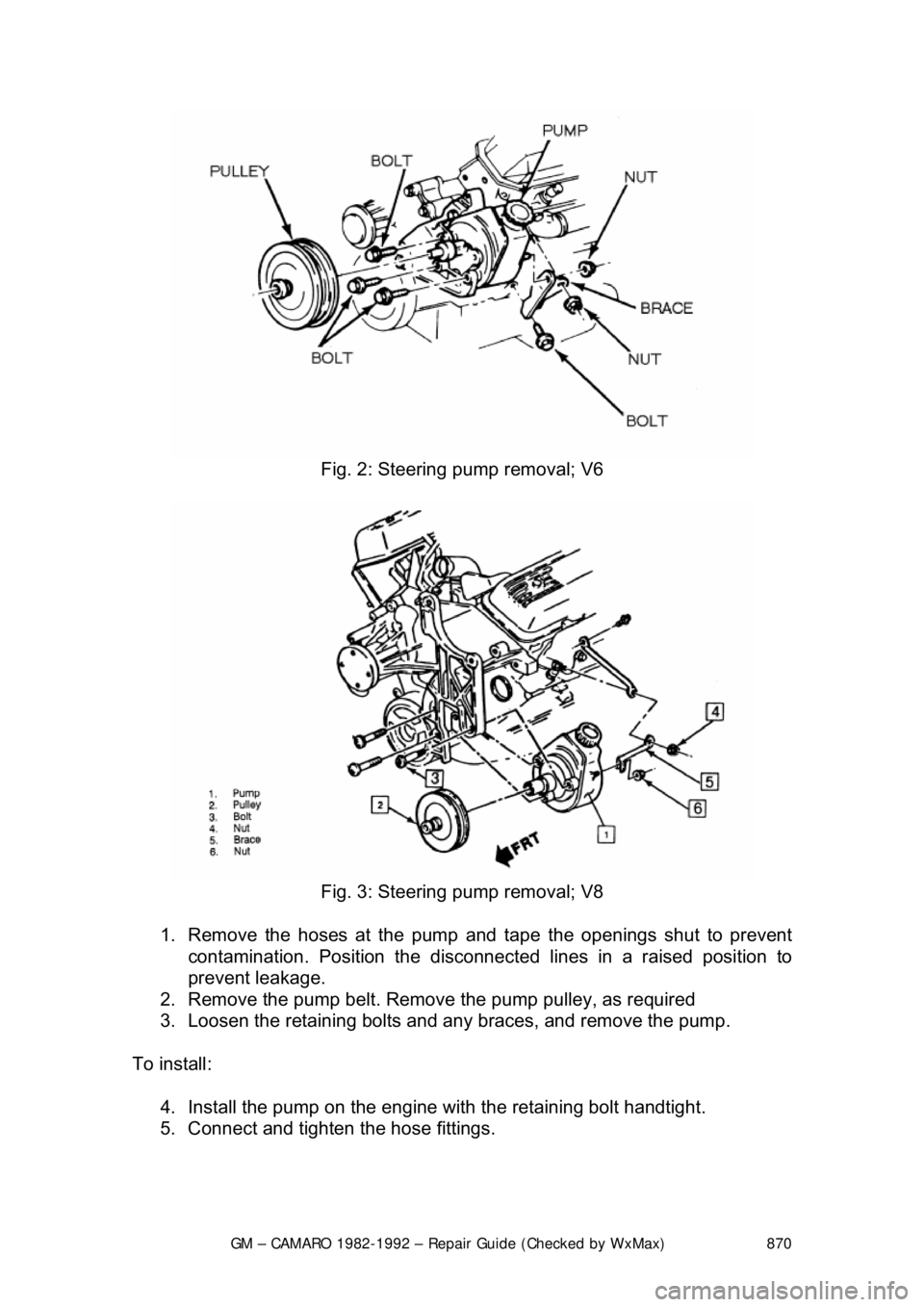
GM – CAMARO 1982-1992 – Repair Guide (Checked by WxMax) 870
Fig. 2: Steering pump removal; V6
Fig. 3: Steering pump removal; V8
1. Remove the hoses at the pump and tape the openings shut to prevent
contamination. Position the disconnec ted lines in a raised position to
prevent leakage.
2. Remove the pump belt. Remove the pump pulley, as required
3. Loosen the retaining bolts and any braces, and remove the pump.
To install: 4. Install the pump on the engine with the retaining bolt handtight.
5. Connect and tighten the hose fittings.
Page 871 of 875

GM – CAMARO 1982-1992 – Repair Guide (Checked by WxMax) 871
6. Refill the pump with fluid and
bleed by turning the pulley
counterclockwise (viewed from the front). Stop the bleeding when air
bubbles no longer appear.
7. Install the pump belt on the pulley and adjust the tension.
SYSTEM BLEEDING 1. Fill the reservoir with power steering fluid.
The use of automatic transmission flui d in the power steering system is NOT
recommended.
2. Allow the reservoir and fluid to sit undisturbed for a few minutes.
3. Start the engine, allow it to run for a mome nt, then turn it off.
4. Check the reservoir fluid level and add fluid if necessary.
5. Repeat the above steps until the fluid level stabilizes.
6. Raise the front of the vehicle so that the wheels are off of the ground.
7. Start the engine and increase t he engine speed to about 1500 rpm.
8. Turn the front wheels right to le ft (and back) several times, lightly
contacting the wheel stops at the ends of travel.
9. Check the reservoir fluid level. Add fluid as required.
10. Repeat step 8 until the fluid leve l in the reservoir stabilizes.
11. Lower the vehicle and repeat steps 8 and 9.