1982 CHEVROLET CAMARO ABS
[x] Cancel search: ABSPage 568 of 875
GM – CAMARO 1982-1992 – Repair Guide (Checked by WxMax) 568
6. Tag and disconnect any electrical
connections at the valve and then
remove the valve from the elbow.
To install: 7. Position the valve into the elbow.
8. Connect any electrical c onnections at the valve.
9. Install the bolts holding the elbow to the valve and bend the lock tabs.
10. Connect the air outlet hoses to the valve.
11. Connect the vacuum hose to the valve.
12. Install the air cleaner.
13. Connect the negative battery cable.
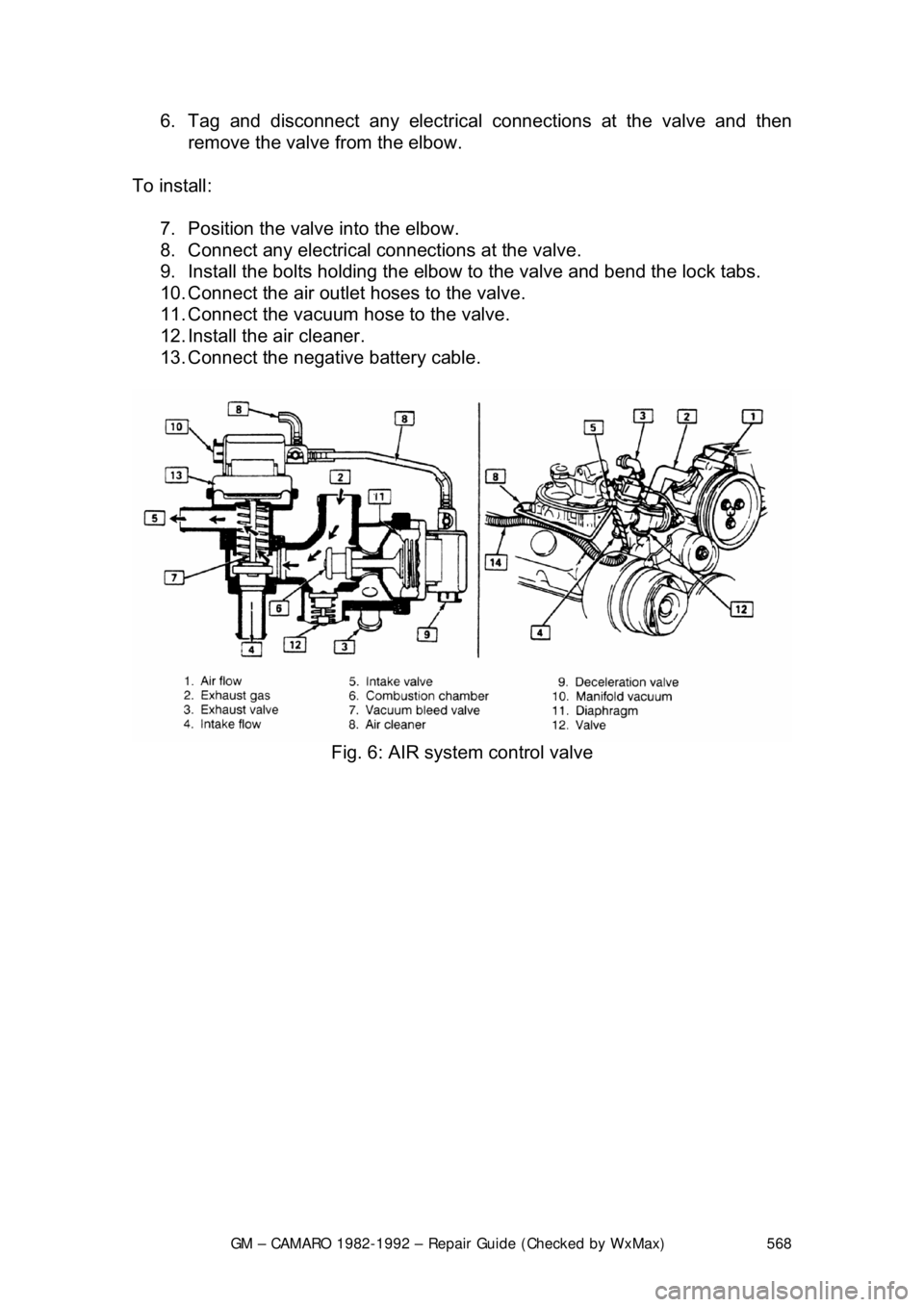
Fig. 6: AIR system control valve
Page 585 of 875

GM – CAMARO 1982-1992 – Repair Guide (Checked by WxMax) 585
MANIFOLD ABSOLUTE PRESSURE SENSOR
OPERATION
The MAP sensor measures the changes in
intake manifold pressure, which
result from engine load/ speed changes and converts this information to a
voltage output. The MAP sensor reading is the opposite of a vacuum gauge
reading: when manifold pressu re is high, MAP sensor value is high and vacuum
is low. A MAP sensor will produce a low output on engine coast-down with a
closed throttle while a wide open throttle will produce a high output. The high
output is produced because the pressure inside the manifold is the same as
outside the manifold, so 100 percent of t he outside air pressure is measured.
The MAP sensor is also used to meas ure barometric pressure under certain
conditions, which allows the ECM to autom atically adjust for different altitudes.
The MAP sensor changes the 5 volt signal supplied by the ECM, which reads
the change and uses the information to cont rol fuel delivery and ignition timing.
Fig. 1: MAP sensor
REMOVAL & INSTALLATION 1. Disconnect the negative battery cable.
2. Disconnect the vacuum connection.
3. Release the electrical wiring lo cking tab and disconnect the connector.
4. Remove the bolts or release the MAP sensor locking tabs and remove
the sensor.
To install: 5. Install the bolts or snap sensor onto the bracket.
Page 628 of 875

GM – CAMARO 1982-1992 – Repair Guide (Checked by WxMax) 628
SPARK PLUG HEAT RANGE
Spark plug heat range is
the ability of the plug to dissipate heat. The longer the
insulator (or the farther it extends in to the engine), the hotter the plug will
operate; the shorter the insulator (the cl oser the electrode is to the block's
cooling passages) the cooler it will operate. A plug that absorbs little heat and
remains too cool will quickly accumulate deposits of oil and carbon since it is
not hot enough to burn them off. This leads to plug fouling and consequently to
misfiring. A plug that absorbs too much heat will have no deposits but, due to
the excessive heat, the electrodes will burn away quickly and might possibly
lead to preignition or other ignition probl ems. Preignition takes place when plug
tips get so hot that they gl ow sufficiently to ignite the air/fuel mixture before the
actual spark occurs. This early igniti on will usually cause a pinging during low
speeds and heavy loads.
Fig. 3: Spark plug heat range
The general rule of thumb for choosing the correct heat range when picking a
spark plug is: if most of your driving is long distanc e, high speed travel, use a
colder plug; if most of your driving is stop and go, use a hotter plug. Original
equipment plugs are general ly a good compromise between the 2 styles and
most people never have the need to change their plugs from the factory-
recommended heat range.
REMOVAL & INSTALLATION
A set of spark plugs usually requi res replacement after about 20,000-30,000
miles (32,000-48,000 km), depending on y our style of driving. In normal
operation plug gap increases about 0.001 in. (0.025mm) for every 2500 miles
(4000 km). As the gap increases, the plug' s voltage requirement also increases.
It requires a greater voltage to jump t he wider gap and about two to three times
Page 630 of 875

GM – CAMARO 1982-1992 – Repair Guide (Checked by WxMax) 630
WARNING
- Do not use the spark plug socke t to thread the plugs. Always
carefully thread the plug by hand or us ing an old plug wire to prevent the
possibility of crossthreading and damaging the cylinder head bore.
8. Carefully tighten the spark plug. If the plug you are installing is equipped
with a crush washer, seat the plug, then tighten about
1/4 turn to crush
the washer. If you are installing a t apered seat plug, tighten the plug to
specifications provided by the vehicle or plug manufacturer.
9. Apply a small amount of silicone di electric compound to the end of the
spark plug lead or inside the spark pl ug boot to prevent sticking, then
install the boot to the spark plug and pus h until it clicks into place. The
click may be felt or hear d, then gently pull back on the boot to assure
proper contact.
INSPECTION & GAPPING
Check the plugs for deposits and wear. If they are not going to be replaced,
clean the plugs thoroughly. Remember t hat any kind of deposit will decrease
the efficiency of the plug. Plugs can be cleaned on a spark plug cleaning
machine, which can sometimes be found in service stations, or you can do an
acceptable job of cleaning with a stiff br ush. If the plugs are cleaned, the
electrodes must be filed flat. Use an igni tion points file, not an emery board or
the like, which will leave deposits. The electrodes must be filed perfectly flat
with sharp edges; rounded edges reduce the s park plug voltage by as much as
50%.
Check spark plug gap before installati on. The ground electrode (the L-shaped
one connected to the body of the plug) mu st be parallel to the center electrode
and the specified size wire gauge (please refer to the Tune-Up Specifications
chart for details) must pass between t he electrodes with a slight drag.
NEVER adjust the gap on a used platinum type spark plug .
Always check the gap on new plugs as they are not always set correctly a\
t the
factory. Do not use a flat feeler g auge when measuring the gap on a used plug,
because the reading may be inaccurate. A round-wire type gapping tool is the
best way to check the gap. The co rrect gauge should pass through the
electrode gap with a slight drag. If you're in doubt, try one size smaller and one
larger. The smaller gauge should go through easily, while the larger one\
shouldn't go through at all. Wire gapping tools usually have a bending tool
attached. Use that to adjust the side electrode until the proper distance is
obtained. Absolutely never attempt to bend the center electrode. Also, be
careful not to bend the side electrode too fa r or too often as it may weaken and
break off within the engine, requiring remova l of the cylinder head to retrieve it.
Page 698 of 875

GM – CAMARO 1982-1992 – Repair Guide (Checked by WxMax) 698
5. Disconnect and plug hose to canister purge port.
6. Disconnect and plug hose to idle load compensator.
7. Back out idle stop screw
on carburetor 3 turns.
8. Turn air conditioning OFF.
9. Block drive wheels, set parki ng brake, place transmission in P, start and
warm engine to normal operating temperature. Make certain choke is
OPEN .
10. With engine RUNNING place transmission in D and idle load
compensator fully extended (no vacuum applied). Using tool J-29607, or
equivalent, adjust plunger to obtain 650-750 rpm. Locknut on plunger
must be held with a wrench to prevent damage to guide tabs.
11. Measure distance from the locknut to tip of the plunger. This distance
must not exceed 1 in. (25mm). If it does check for low idle condition.
12. Reconnect vacuum hose to idle load compensator and observe idle
speed.
13. Idle speed should be between 425-475 rpm in D.
14. If idle speed is correct no further adjustment is necessary, proceed to the
next step. If idle speed is still incorrect continue as follows:
It may be necessary to remove the idle load compensator from the engine
unless a hex key wrench is m odified to clear obstructions.
a. Stop engine, remove rubber cap from the center outlet tube.
b. Using a 0.90 in. (23mm) hex wrench, insert through open center tube to
engage idle speed adjusting screw.
c. If idle speed was low, turn t he adjusting screw counterclockwise
approximately 1 turn for every 85 rpm low. If idle speed was high turn
screw 1 turn for every 85 rpm high.
15. Disconnect and plug vacuum hose to the idle load compensator.
16. Using a hand pump, apply vacuum to the idle load compensator until fully
retracted.
17. Adjust the idle stop screw on carburetor float bowl to obtain 450 rpm in
D .
18. Place transmission in P and stop engine.
19. Reconnect the idle load compensator.
20. Reconnect all vacuum hoses.
21. Install air cleaner and gasket. Remove wheel blocks.
Page 716 of 875

GM – CAMARO 1982-1992 – Repair Guide (Checked by WxMax) 716
INJECTOR REPLACEMENT
Use care in removing injectors to prev
ent damage to the electrical connector
pins on top of the injector, the fuel injector fuel filter and nozzle. The fuel injector
is serviced as a complete assembly on ly and should never be immersed in any
type of cleaner.
SINGLE INJECTOR UNITS 1. Relieve the fuel system pressure.
2. Remove the air cleaner.
3. Detach the injector connector by squeezing the two tabs together and
pulling straight up.
4. Remove the screws securing the fuel meter cover. Note the location of
any short screws for correct placement during reassembly.
CAUTION - DO NOT remove the four screws se curing the pressure regulator to
the fuel meter cover. The fuel pressure regulator includes a large spring under
heavy tension which could cause personal injury if released.
5. With the old fuel meter gasket in place to prevent damage to the casting,
use a prytool and fulcrum to pry the inje ctor carefully until it is free from
the fuel meter body.
6. Remove the injector.
7. Remove the large O-ring and steel back-up washer at the top of the
injector cavity in the fuel meter body.
8. Remove the small O-ring located at the bottom of the injector cavity.
To Install: 9. Lubricate the new, small O-ring with automatic transmission fluid; then,
push the new O-ring on the nozzle end of the injector up against the
injector fuel filter.
10. Install the steel backup washer in the recess of the fuel meter body.
Lubricate the new large O-ring with automatic transmission fluid, then
install the O-ring directly above t he backup washer, pressing the O-ring
down into the cavity recess. The O-ri ng is properly installed when it is
flush with the casting surface.
WARNING - Do not attempt to reverse this procedure and install the backup
washer and O-ring after the injector is located in the cavity. To do so will
prevent proper seating of the O-ring in th e cavity recess which could result in a
fuel leak and possible fire.
11. Install the injector by using a pushing/twisting mo tion to center the nozzle
O-ring in the bottom of the injector cavity and aligning the raised lug on
the injector base with the notch cast into the fuel meter body. Push down
on the injector making sure it is fully seated in the cavity. Injector
installation is correct when the lug is seated in the notch and the
electrical terminals are parallel to the throttle shaft.
Page 718 of 875
GM – CAMARO 1982-1992 – Repair Guide (Checked by WxMax) 718
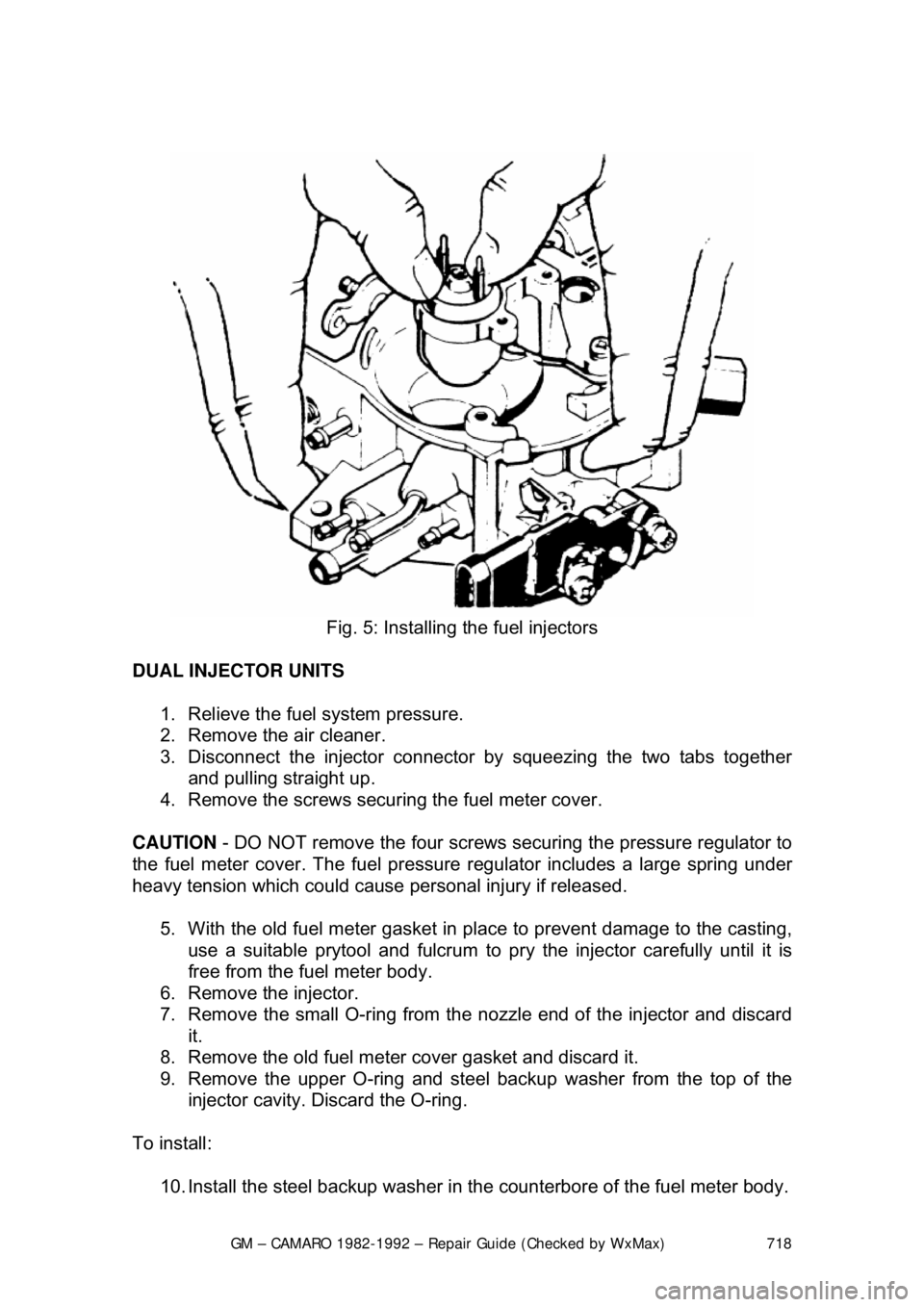
Fig. 5: Installing the fuel injectors
DUAL INJECTOR UNITS 1. Relieve the fuel system pressure.
2. Remove the air cleaner.
3. Disconnect the injector connector by squeezing the two tabs together and pulling straight up.
4. Remove the screws securi ng the fuel meter cover.
CAUTION - DO NOT remove the four screws securing the pressure regulator to
the fuel meter cover. The fuel pressure regulator includes a large spring under
heavy tension which could cause personal injury if released.
5. With the old fuel meter gasket in pl ace to prevent damage to the casting,
use a suitable prytool and fulcrum to pr y the injector carefully until it is
free from the fuel meter body.
6. Remove the injector.
7. Remove the small O-ring from the nozzle end of the injector and discard
it.
8. Remove the old fuel meter cover gasket and discard it.
9. Remove the upper O-ring and steel ba ckup washer from the top of the
injector cavity. Discard the O-ring.
To install: 10. Install the steel backup washer in t he counterbore of the fuel meter body.
Page 736 of 875

GM – CAMARO 1982-1992 – Repair Guide (Checked by WxMax) 736
The mass air flow systems measure the
mass of air that is drawn into the
engine cylinders, rather than just the vo lume. The sensor contains a hot-wire
sensing unit, which is made up of an electronic balanced bridge network.
Whenever current is suppli ed to the sensor, the bridge is energized and the
sensing hot-wire is heated. As the air enter s the mass air flow sensor, it passes
over and cools the hot wire. When the hot wire is cooled, it's resistance changes
and additional current is needed to k eep the bridge network balanced. This
increase in current is sent to the computer as a voltage signal and is used to
calculate the mass of the incoming air. The ECM uses this information to\
determine the duration of fuel injection pulse, ignition timing and EGR operation.
The speed density systems calculate the volume of air moving through the
intake. The ECM establishes the speed fact or through a signal from the ignition
module. The Manifold or Intake Air Temperature (MAT/IAT) and the Engine
Coolant Temperature (ECT) sensors work together to assure that proper
temperature information gets to the ECM wh ile the Manifold Absolute Pressure
(MAP) sensor monitors the changes in m anifold pressure which results from
changes in engine loading. These three se nsors contribute to the density factor.
Together, these inputs (engine speed, coolant temperature sensor, etc ...) are
the major determinants of the air/fuel mixture delivered by the fuel injection
system.
The following engines and fuel managem ent systems are covered in this
section:
• 1985-1989 2.8L MPFI - Mass Air Flow
• 1990-1992 3.1L MPFI - Speed Density
• 1985-1989 5.0L and 5.7L TPI - Mass Air Flow
• 1990-1992 5.0L and 5.7L TPI - Speed Density
Relieving Fuel System Pressure
1. Disconnect the negative battery cable to prevent fuel discharge if the key
is accidentally turned to the RUN position.
2. Loosen the fuel filler cap to reliev e the tank pressure and do not tighten
until service has been completed.
3. Connect J-34730-1 fuel pressure gauge or equivalent, to the fuel
pressure test valve. Wrap a shop towel around the fitting while
connecting the gauge to prevent spillage.
4. Place the end of the bleed hose into a suitable container and open the
valve to relieve the fuel system pressure.
ELECTRIC FUEL PUMP
REMOVAL & INSTALLATION
The fuel pump is part of t he fuel sender assembly located inside the fuel tank.