1982 CHEVROLET CAMARO lock
[x] Cancel search: lockPage 34 of 875

GM – CAMARO 1982-1992 – Repair Guide (Checked by WxMax) 34
REAR LIFTGATE PULL-DOWN UNIT
REMOVAL & INSTALLATION
Fig. 1: Pull-down lock unit
1. Open the rear hatch. Disconnec t the negative battery cable.
2. Remove the rear trim panel. Disconnec t the electrical connector and remove
the attaching screws.
3. Disconnect the unit lock cable co nnection from the lock cylinder.
4. Remove the unit.
5. Installation is the reverse of the re moval procedure. Torque the screws to 18
ft. lbs. (24 Nm).
ADJUSTMENT
Adjust the unit as necessary fo r proper lock striker engagement.
DOOR WINDOW
REMOVAL & INSTALLATION
1. Remove the door trim panel and the inner panel water deflector.
2. Raise the window to the half-up position.
3. Punch out the center pins of the gl ass to sash channel attaching rivets.
4. Remove the rear guide channel through the rear access hole.
5. Remove the up stop.
6. Using a
1/4 in. (6mm) drill bit, drill out the atta ching rivets on sash channel.
7. Raise the glass to remove from the sash channel and remove the glass from
the door.
Page 36 of 875

GM – CAMARO 1982-1992 – Repair Guide (Checked by WxMax) 36
2. Raise the window to half-
up position and hold in place by inserting a rubber
wedge door stops at the front and r ear of the window between window and
inner panel.
3. Remove the rear guide channel and inner panel cam channel.
4. Punch out the center pins of the r egulator rivets; then drill out the rivets
using a
1/4 in. (6mm) drill bit.
5. Move the regulator rear ward and disconnect wire harness from the motor (if
equipped). Disengage the roller on the re gulator lift arm from glass sash
channel.
6. Remove the regulator thr ough the rear access hole.
CAUTION - If electric motor removal from t he regulator is required, the sector
gear must be locked in positi on. The regulator lift arm is under tension from the
counterbalance spring and could cause personal injury if the sector gear is not
locked in position.
7. Drill a hole through the r egulator sector gear and backplate and install a bolt
and nut to lock the sector gear in position.
8. Using a
3/16 in. (5mm) drill bit, drill out the motor attaching rivets and remove
the motor from the regulator.
To install:
9. To install the motor to the regulator, use a rivet tool J-29022 or equivalent,
and install
3/16 in. (5mm) rivets or 3/16 in. (5mm) nuts and bolts. Remove bolt
and nut used to secure the sector gear in position.
10. Place the regulator th rough the rear access hole into the door inner panel. If
electric regulator is being installed, connect the wire connector to motor prior
to installing the regulat or to the inner panel.
11. Locate the lift arm roller in to the glass sash channel.
12. Using rivet tool J-29022 or equivalent, rivet the regulator to the inner panel
of the door using
1/4 in. (6mm) 1/2 in. (13mm) aluminum peel type rivets (part
No. 9436175 or equivalent). If rivet tool is not available, use the following nut
and bolt method:
a. Install U-clips on the regulator at the attaching locations. Be sure to
install the clips with clinch nuts on the outboard side of the regulator.
b. Locate the regulator in the door inner panel. If the electric regulator is
being installed, connect the wire connec tor to the regulator motor.
c. Locate the lift arm roller in the glass sash channel.
d. Align the regulator with clinch nuts to holes in the inner panel.
e. Attach the regulator (and mo tor) to the door inner panel with
1/4-20 x 1/2
in. screws (part No. 9 419723 or equivalent) into 1/4 in. (6mm) nuts with
integral washers. Tighten the screw to 90-125 inch lbs. (10-14 Nm)
torque.
13. Install the inner panel cam channel and rear guide channel.
14. Remove the rubber wedge door stops at the front and rear of the window
between window and inner panel.
15. Install the inner panel water deflector and the door trim panel.
Page 57 of 875
GM – CAMARO 1982-1992 – Repair Guide (Checked by WxMax) 57
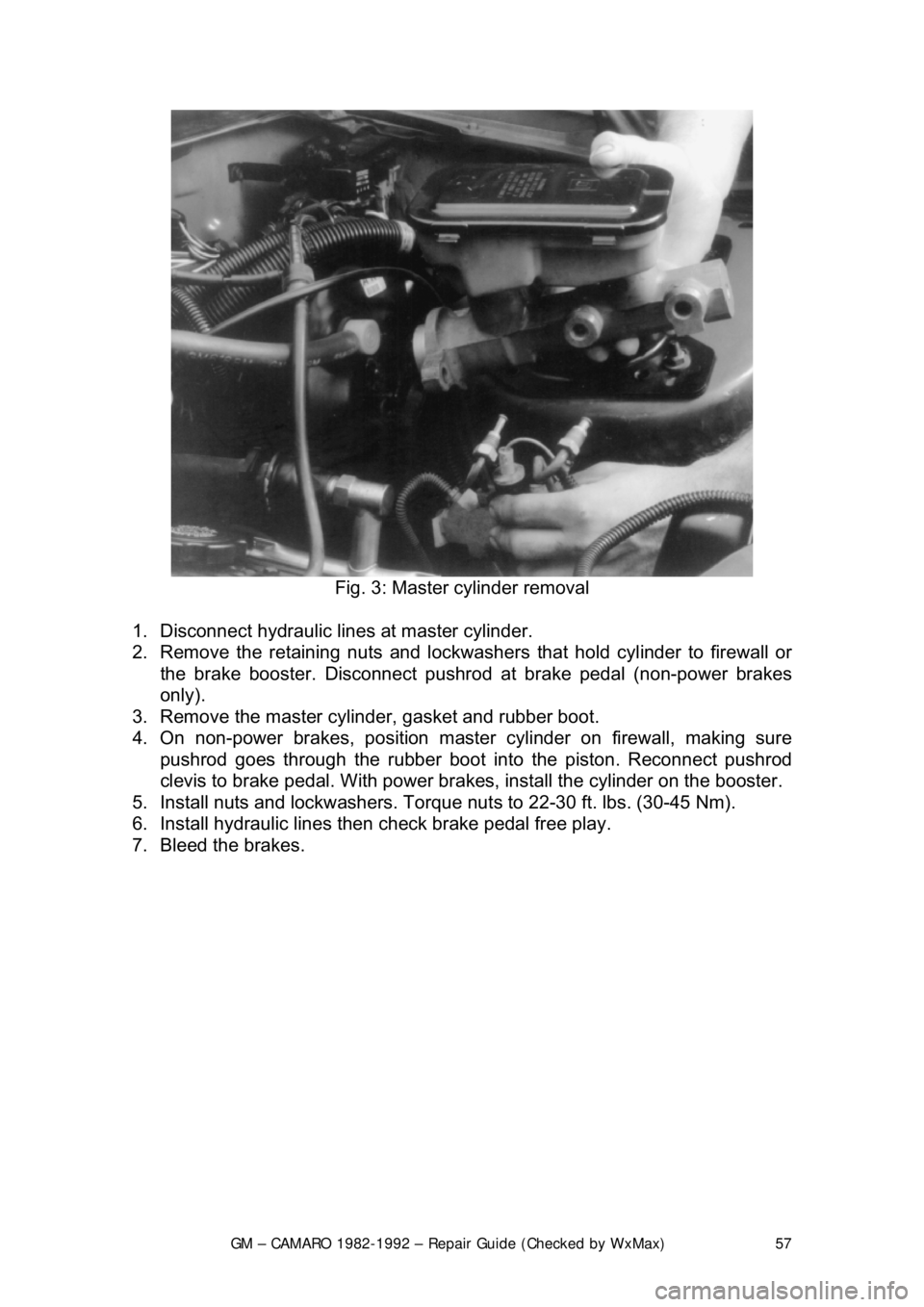
Fig. 3: Master cylinder removal
1. Disconnect hydraulic lines at master cylinder.
2. Remove the retaining nuts and lockwasher s that hold cylinder to firewall or
the brake booster. Disconnect pushrod at brake pedal (non-power brakes
only).
3. Remove the master cylinder, gasket and rubber boot.
4. On non-power brakes, position master cylinder on firewall, making sure pushrod goes through the rubber boot in to the piston. Reconnect pushrod
clevis to brake pedal. With power brakes, install the cylinder on the bo\
oster.
5. Install nuts and lockwashers. Torque nut s to 22-30 ft. lbs. (30-45 Nm).
6. Install hydraulic lines t hen check brake pedal free play.
7. Bleed the brakes.
Page 64 of 875

GM – CAMARO 1982-1992 – Repair Guide (Checked by WxMax) 64
This is a tedious, time-consuming job. You
can save yourself a lot of trouble by
buying a rebuilt master cylinder from y our dealer or parts supply house. The
small difference in price between a r ebuilding kit and a rebuilt part usually
makes it more economical, in terms of time and work, to buy the rebuilt part.
1. Remove the reservoir cover and diap hragm. Discard any brake fluid in the
reservoir.
2. Inspect the reservoir cover and diaphr agm for cuts, cracks, or deformation.
Replace any defective parts.
3. Depress the primary pist on and remove the lock ring.
4. Direct compressed air into the outle t at the blind end of the bore and plug
the other outlet to remove primary and secondary piston.
5. Remove the spring retainer and s eals from the secondary piston.
6. Clamp the master cylinder in a vise. Do not clamp it on the master cylinder
body. Use a pry bar to re move the reservoir.
7. Do not attempt to remove the quick take-up valve from the body. This valve
is not serviced separately.
8. Remove the reservoir grommets.
9. Inspect the master cylinder bore for corrosion. If corroded, replace the
master cylinder. Do not use any abrasive on the bore.
10. Reassemble, using new seals and gr ommets. Lubricate all parts with brake
fluid.
11. Install the reservoir grommets.
12. Install the reservoir.
13. Install the spring retainer and seals from the secondary piston.
14. Install primary and secondary piston.
15. Depress the primary pist on and install the lock ring.
16. Fill with brake fluid. Install the reservoir cover and diaphragm.
17. Bleed brake system.
Page 66 of 875

GM – CAMARO 1982-1992 – Repair Guide (Checked by WxMax) 66
4. Remove nuts and lockwashers that se
cure booster to firewall and remove
booster from engine compartment.
5. Install by reversing removal procedure. Make sure to check operation of stop
lights. Allow engine vacuum to build before applying brakes.
COMBINATION VALVE
REMOVAL & INSTALLATION
This valve is not repairable and only serviced as a complete assembly.
1. Disconnect the hydraulic lines from t he valve. Plug the lines to prevent fluid
loss and dirt contamination.
2. Disconnect the electrical connection.
3. Remove the valve.
To install:
4. Position the valve.
5. Connect the electrical connection.
6. Connect the hydraulic lines to the valve.
7. Bleed the brake system.
Page 82 of 875

GM – CAMARO 1982-1992 – Repair Guide (Checked by WxMax) 82
Avoid inhaling any dust from
any brake surface! When cleaning brake surfaces,
use a commercially available brake cleaning fluid.
1. Remove
2/3 of the brake fluid from the mast er cylinder. Raise the vehicle and
remove the wheel.
2. Place a C-clamp across the caliper, positioned on the brake pads. Tighten it
until the piston is forced into its bore.
3. Remove the C-clamp. Remove the bolt holding the brake hose to the caliper.
4. Remove the Allen head caliper mounting bolts. Inspect them for corrosion
and replace them if necessary. Remove the caliper.
To install:
5. Position the caliper with the brake pad installed and install Allen head caliper
mounting bolts. Mounting bo lt torque is 21-35 ft. lbs. (28-47 Nm.) for the
caliper.
6. Install the bolt holding the brake hos e to the caliper and tighten to 18-30 ft.
lbs. (24-40 Nm.).
7. Fill the master cylinder with brake fluid.
8. Install the wheels and lower the vehicle.
CAUTION - Before moving the vehicle, pump the brakes several times to seat
the brake pad against the rotor
OVERHAUL
Some vehicles may be equipped dual piston calipers. The procedure to
overhaul the caliper is e ssentially the same with t he exception of multiple
pistons, O-rings and dust boots.
1. Remove the caliper from the ve hicle and place on a clean workbench.
CAUTION - NEVER place your finger s in front of the pistons in an attempt to
catch or protect the pistons when applying compressed air. This could result in
personal injury!
Depending upon the vehicle, there are two different ways to remove the piston
from the caliper. Refer to the brake pad replacement procedure to make sure
you have the correct procedure for your vehicle.
2. The first method is as follows: a. Stuff a shop towel or a block of wood into the caliper to catch the piston.
b. Remove the caliper piston using co mpressed air applied into the caliper
inlet hole. Inspect the piston for scor ing, nicks, corrosion and/or worn or
damaged chrome plating. The piston mu st be replaced if any of these
conditions are found.
Page 97 of 875
GM – CAMARO 1982-1992 – Repair Guide (Checked by WxMax) 97
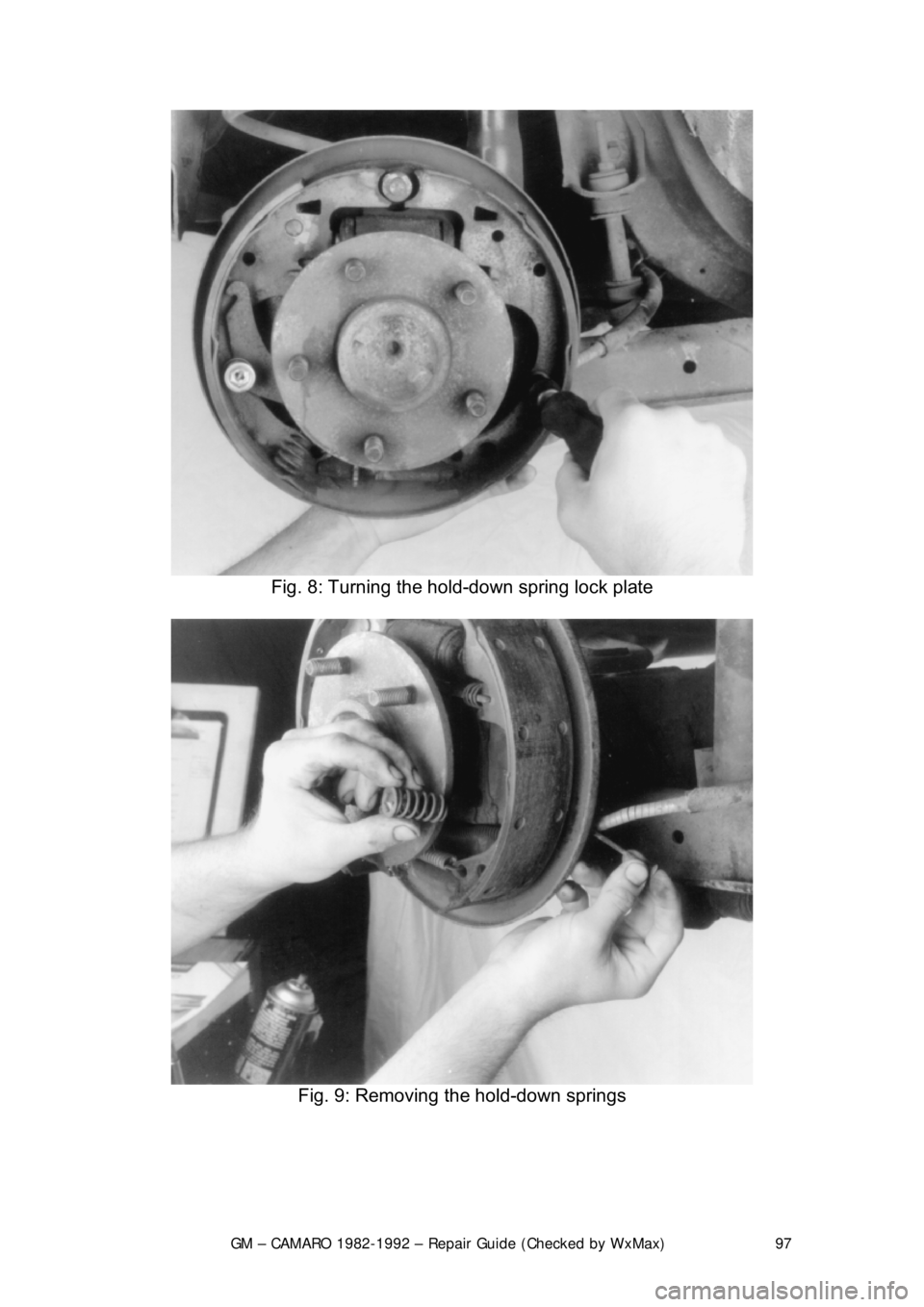
Fig. 8: Turning the hold-down spring lock plate
Fig. 9: Removing the hold-down springs
Page 102 of 875

GM – CAMARO 1982-1992 – Repair Guide (Checked by WxMax) 102
CAUTION
- Brake shoes may contain asbest os, which has been determined to
be a cancer causing agent. Never clean the brake surfaces with compressed
air! Avoid inhaling any dust from any brake surface! When cleaning brake
surfaces, use a commercially available brake cleaning fluid.
1. Raise and support the car. Remove t he wheel. Remove the brake shoes by
following the Brake Shoe R eplacement procedure.
2. Remove dirt from ar ound the wheel cylinder inle t and pilot. Disconnect the
inlet tube.
3. Using 2 awls,
1/8 in. (3mm) in diameter, or J29839, remove the wheel
cylinder retainer. Insert the awls in to the access slots between the wheel
cylinder pilot and retainer. Simultaneous ly, bend both tabs away from each
other. Remove the wheel cylinder.
To install:
4. Place wheel cylinder into position and place a block of wood between it and
the axle flange. Install a new retainer over the end of the wheel cylinder.
Using a 1
1/8 in. 12-point socket with an extensi on, drive the new retainer into
position.
5. Connect the inlet tube and torque 120-280 inch lbs. (13.6-20 Nm). Complete
installation by reversing the remova l procedure. Bleed the brakes.
OVERHAUL
Wheel cylinder overhaul kits may be available, but often at little or no savings
over a reconditioned wheel cylinder. It often makes sense with these
components to substitute a new or re conditioned part instead of attempting an
overhaul.
If no replacement is availabl e, or you would prefer to overhaul your wheel
cylinders, the following procedure may be used. When rebuilding and installing
wheel cylinders, avoid getting any cont aminants into the system. Always use
clean, new, high quality brake fluid. If di rty or improper fluid has been used, it
will be necessary to drain the entire syst em, flush the system with proper brake
fluid, replace all rubber components , then refill and bleed the system.
1. Remove the wheel cylinder from the vehicle and place on a clean
workbench.
2. First remove and discard the old r ubber boots, then withdraw the pistons.
Piston cylinders are equipped with seals and a spring assembly, all located
behind the pistons in the cylinder bore.