1982 CHEVROLET CAMARO brake rotor
[x] Cancel search: brake rotorPage 118 of 875

GM – CAMARO 1982-1992 – Repair Guide (Checked by WxMax) 118
9. Remove the caliper lever pivot pin s
eal, sprag clip, spring and lever. Discard
the clip.
10. Inspect the caliper lever for worn spots, replace as necessary.
11. Remove the 2 guide pins from the mounting bracket.
12. Clean all parts not included in the r ebuild kit in denatured alcohol. Use only
dry filtered compressed air to dry parts . Replace the caliper housing if badly
scored or corroded.
To install:
13. Lubricate the new piston s eal with clean brake fluid. Place the seal into the
caliper groove, making sure t he seal is not twisted.
14. Install the piston. Lubricate seal s and piston with brake fluid prior to
reinstallation.
15. Assemble the pushrod, 2 new boots and new retainers to the actuating
collar.
16. Lightly coat the actuat ing collar with the lubricant provided in the rebuild kit.
Do not use any other type of lubricant.
17. Install the clamp retainers firmly agains t the actuating collar. Bend the tabs
on the retainer to hold the assembly together.
18. Install the preload spring into the boot retainers.
19. Install the clamp rod to the actuati ng collar and boot. Lubricate the clamp rod
with the lubricant supplied in the kit.
20. Slide the clamp rod th rough the holes in the boot and actuating collar. The
boot must be against the reacti on plate on the clamp rod.
21. Lubricate and install t he new compliance bushing with the lubricant supplied
in the kit.
22. Install the clamp rod with assembled parts into the connecting hole in the
caliper piston.
23. Install a new bleeder valve.
24. Install the pivot pin and new nut into the housing, if removed.
25. Install the caliper pivot pin seal, parking brake lever, new sprag clip and
spring, in that order. The teeth of the sprag clip mu st face away from the
lever.
26. Install the 2 collar return springs to the retainer. The retainer must enter the
return springs at the end of the second coil.
27. Install the adjuster screw into the cali per housing until the actuating collar is
parallel to the piston bore face of the caliper housing.
28. Lubricate and then install the guide pi ns and boots. Install the pads and
caliper assembly.
29. Bleed the brake system.
BRAKE DISC (ROTOR)
REMOVAL & INSTALLATION
CAUTION - Brake pads contain asbestos, which has been determined to be a
cancer causing agent. Never clean the brake surfaces with compressed air!
Avoid inhaling any dust from any brake surface! When cleaning brake surfaces,
use a commercially available brake cleaning fluid.
Page 119 of 875

GM – CAMARO 1982-1992 – Repair Guide (Checked by WxMax) 119
1. Raise and support the car. Remove the wheel.
2. Remove the caliper by referring to
the Rear Caliper Removal procedure. Pull
the brake disc from the axle.
3. To install, place the rotor ont o the spindle and install caliper.
4. Install the wheel and lower the car.
INSPECTION
1. Raise and support the car. Remove the wheel. Replace wheel nuts to hold rotor in place.
2. Check the rotor surface for wear, sco ring, grooves or rust pitting. Rotor
damage can be corrected by refacing, cons ult your local garage or machine
shop. If the damage exceeds the minimu m thickness, which is stamped on
the rotor, replace the rotor.
3. Using a dial indicator, check the ro tor parallelism at several points around
the circumference. The difference must not vary more than 0.0005 in.
(0.013mm). Make all measur ements at the same distance in from the edge
of the rotor.
4. Using the same dial indicator, meas ure the rotor runout. The runout should
not exceed 0.004 in. (0.10mm).
5. If any of these conditions are not me t, reface or replace the rotor.
PARKING BRAKES
CABLES
REMOVAL & INSTALLATION
FRONT CABLE
Fig. 1: Lever and front cable
1. Raise the car and support it with jackstands.
Page 122 of 875
GM – CAMARO 1982-1992 – Repair Guide (Checked by WxMax) 122
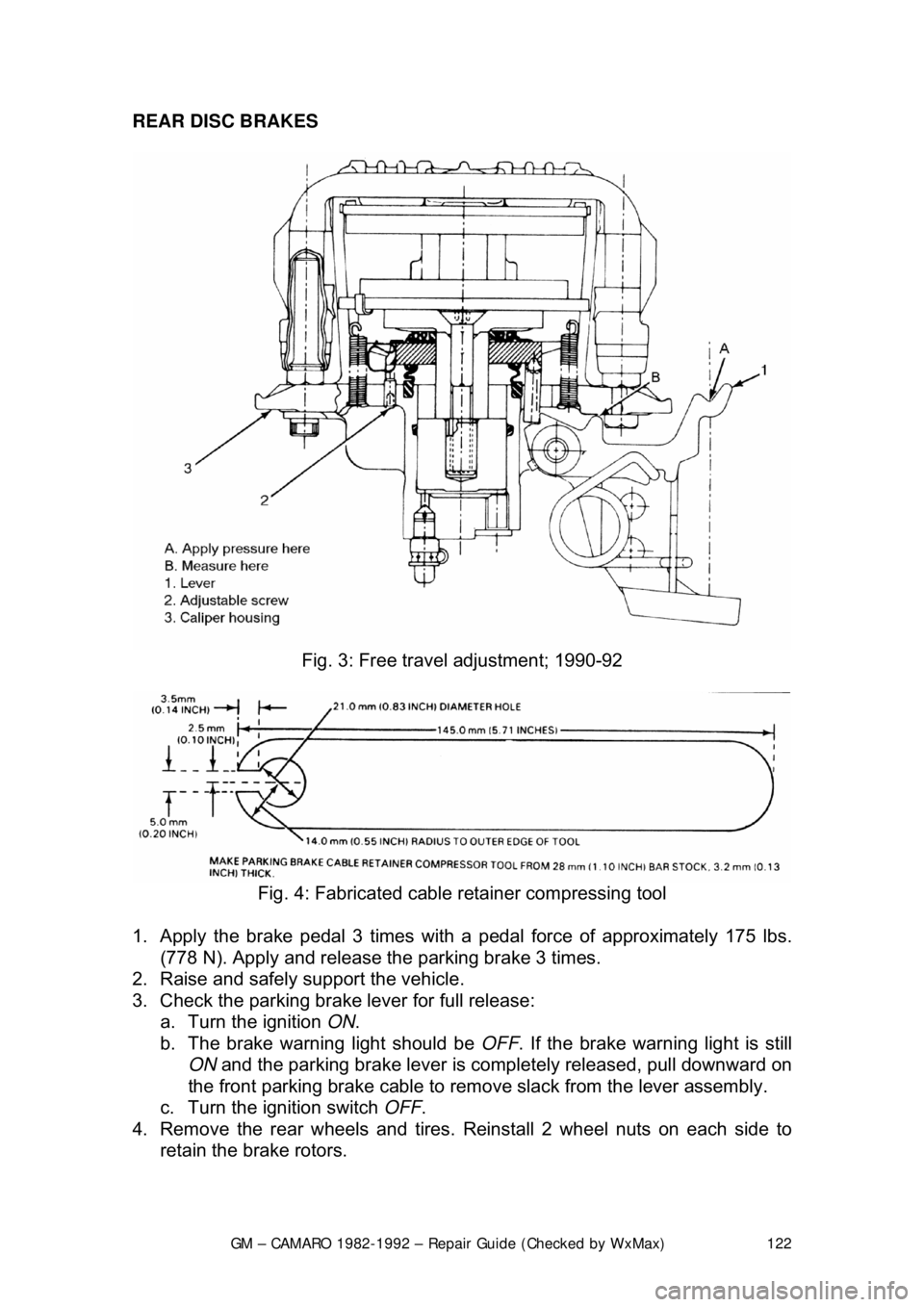
REAR DISC BRAKES
Fig. 3: Free trav el adjustment; 1990-92
Fig. 4: Fabricated cable retainer compressing tool
1. Apply the brake pedal 3 times with a pedal force of approximately 175 lbs.
(778 N). Apply and release t he parking brake 3 times.
2. Raise and safely support the vehicle.
3. Check the parking brake lever for full release: a. Turn the ignition ON.
b. The brake warning light should be OFF. If the brake warning light is still
ON and the parking brake lever is comple tely released, pull downward on
the front parking brake cable to remove slack from the lever assembly.
c. Turn the ignition switch OFF.
4. Remove the rear wheels and tires. Reinstall 2 wheel nuts on each side to
retain the brake rotors.
Page 123 of 875

GM – CAMARO 1982-1992 – Repair Guide (Checked by WxMax) 123
5. Pull the parking lever 4 clicks. T
he parking brake levers on both calipers
should be against the lever stops on the caliper housings. If the levers are
not against the stops, check for binding in the rear cables and/or loosen the
cables at the equalizer nut until both left and right levers are against their
stops.
6. Adjust the equalizer adjusting nut unt il the parking brake levers on both
calipers just begin to mo ve off their stops.
7. Back off the adjuster nut until the le vers move back, barely touching their
stops.
8. Operate the parking brak e lever several times to check adjustment. After
cable adjustment, the parking brake le ver should travel no more than 14
ratchet clicks. The rear wheels shoul d not turn forward when the parking
brake lever is applied 8-16 ratchet clicks.
9. Release the parking brake lever. Both rear whee ls must turn freely in both
directions. The parking brake levers on both calipers should be resting on
their stops.
10. Remove the wheel nuts retaining t he rotors. Install the wheel and tire
assemblies.
11. Lower the vehicle.
PARKING BRAKE FREE-TRAVEL
ADJUSTMENT
1989-92 MODELS
REAR DISC BRAKES
Disc brake pads must be new or parallel to within 0.006 in. (0.15mm). Parking
brake adjustment is not valid wit h heavily tapered pads and may cause
caliper/parking brake binding. Replace tapered brak e pads. Parking brake free-
travel should only be made if the caliper has been taken apart. This adjustment
will not correct a condition where the caliper levers will not return to their stops.
1. Have an assistant apply a light brake pedal load, enough to stop the rotor
from turning by hand. This takes up all clearances and ensures that
components are correctly aligned.
2. Apply light pressure to the caliper lever.
3. Measure the free-travel between t he caliper lever and the caliper housing.
The free-travel must be 0.0024-0.028 in. (0.6-0.7mm).
4. If the free-travel is incorrect, do the following: a. Remove the adjuster screw.
b. Clean the thread adhesive re sidue from the threads.
c. Coat the threads with adhesive.
d. Screw in the adjuster screw far enough to obtain 0.024-0.028 in. (0.6-
0.7mm) free-travel between the caliper lever and the caliper housing.
5. Have an assistant release the brak e pedal, then apply the brake pedal firmly
3 times. Recheck the free-travel and adjust as necessary.
Page 334 of 875
GM – CAMARO 1982-1992 – Repair Guide (Checked by WxMax) 334
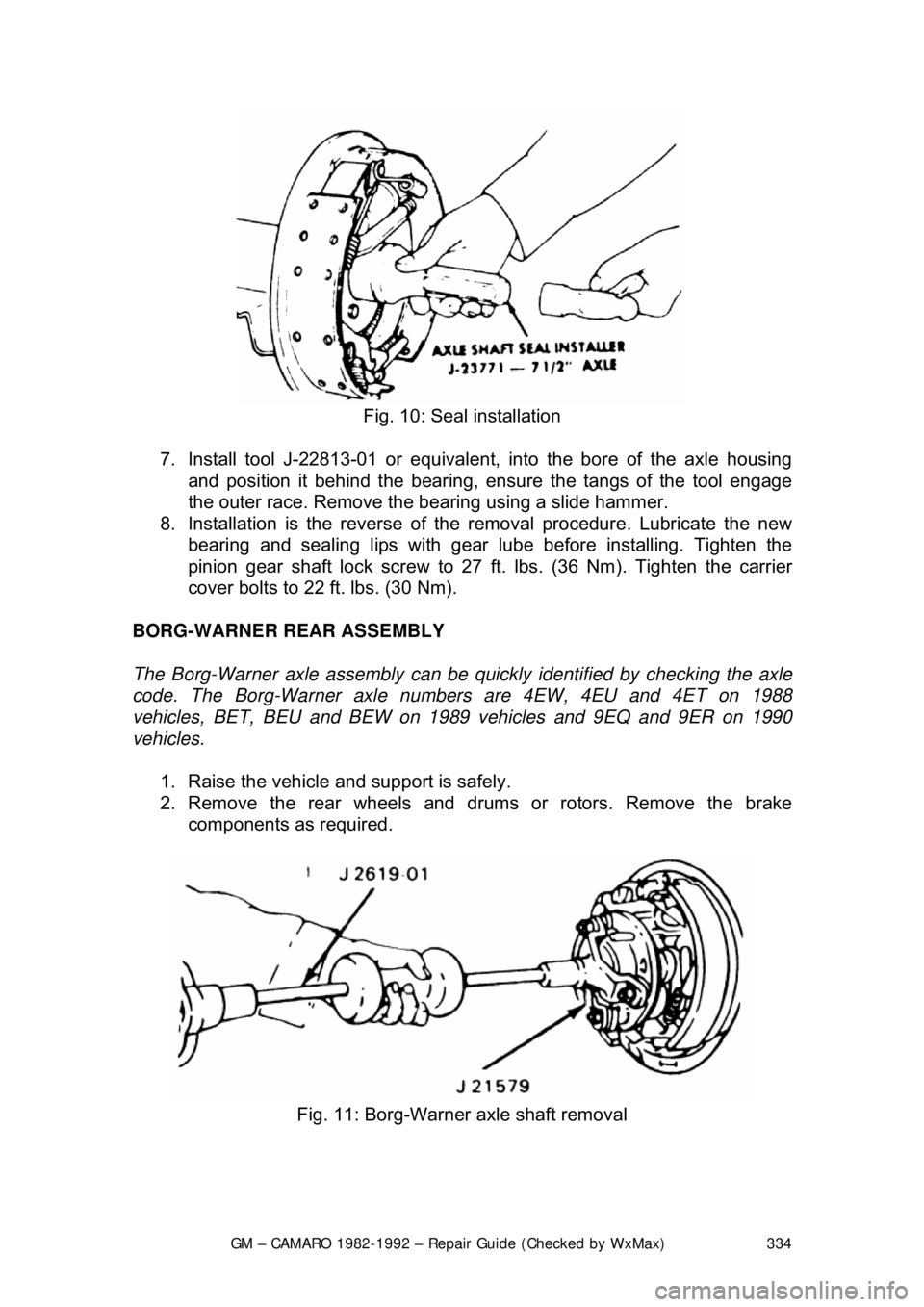
Fig. 10: Seal installation
7. Install tool J-22813-01 or equivalent, into the bore of the axle housing
and position it behind t he bearing, ensure the tangs of the tool engage
the outer race. Remove the bearing using a slide hammer.
8. Installation is the reverse of the removal procedure. Lubricate the new
bearing and sealing lips wi th gear lube before installing. Tighten the
pinion gear shaft lock screw to 27 ft. lbs. (36 Nm). Tighten the carrier
cover bolts to 22 ft. lbs. (30 Nm).
BORG-WARNER REAR ASSEMBLY
The Borg-Warner axle assembly can be quickly identified by checking the axle
code. The Borg-Warner axle num bers are 4EW, 4EU and 4ET on 1988
vehicles, BET, BEU and BEW on 1989 vehicles and 9EQ and 9ER on 1990
vehicles.
1. Raise the vehicle and support is safely.
2. Remove the rear wheels and drums or rotors. Remove the brake components as required.
Fig. 11: Borg-Warner axle shaft removal
Page 386 of 875

GM – CAMARO 1982-1992 – Repair Guide (Checked by WxMax) 386
FUEL INJECTION
1. Remove the air cleaner.
2. Drain the radiator.
3. Disconnect: a. Battery cables at the battery.
b. Upper radiator and heater hoses at the manifold.
c. Crankcase ventilation hoses as required.
d. Fuel line at the carburetor.
e. Accelerator linkage.
f. Vacuum hose at the distributor, if equipped.
g. Power brake hose at the car buretor base or manifold, if
applicable.
h. Temperature sending switch wires.
4. Remove the distributor cap and scribe the rotor position relative to the
distributor body, and engine.
5. Remove the distributor.
6. If applicable, remove the alternator upper bracket. As required, remove
the air cleaner bracket, and accelerator bellcrank.
7. Remove the manifold-to-head attachi ng bolts, then remove the manifold
and carburetor as an assembly.
8. Mark and disconnect all emission re lated items (e.g.: wiring, vacuum
hoses, etc.) which are connected to manifold mounted items.
9. If the manifold is to be replaced , transfer the carburetor (and mounting
studs), water outlet and thermostat (use a new gasket) heater hose
adapter, EGR valve (use new gasket) and, if applicable, TVS switch(s)
and the choke coil.
To install: 10. Before installing the manifold, thoroughly clean the gasket and sealing
surfaces of the cylinder heads and manifold.
11. Install the manifold end seals, folding the tabs if applicable, and the
manifold/head gaskets, using a s ealing compound around the water
passages.
Make sure that the new manifold gaskets match the old ones EXACTLY.
12. When installing the manifold, care should be taken not to dislocate the
end seals. It is helpful to use a pilo t in the distributor opening. Tighten the
manifold bolts to 30 ft. lbs. (40 Nm) for 5.0L or 20-25 ft. lbs. (27-34 Nm)
for 2.8L in the sequence illustrated.
13. Install the distributor with the rotor in its original location as indicated by
the scribe line. If the engi ne has been disturbed, refer to the previous
Distributor Removal and Installation procedure.
14. If applicable, install the alter nator upper bracket and adjust the belt
tension.
15. Connect all disconnected components at their original locations.
16. Fill the cooling system, start the engine, check for leaks and adjust the
ignition timing and carburetor idle speed and mixture.
Page 817 of 875

GM – CAMARO 1982-1992 – Repair Guide (Checked by WxMax) 817
SUSPENSION & STEERING
SUSPENSION AND STEERING WHEELS
REMOVAL & INSTALLATION
• Park the vehicle on a level surface.
• Remove the jack, tire iron and, if nec essary, the spare tire from their
storage compartments.
• Check the owner's manual or refer to General Information & Maintenance
of this repair guide for the jacking poi nts on your vehicle. Then, place the
jack in the proper position.
• If equipped with lug nut trim caps, remo ve them by either unscrewing or
pulling them off the lug nuts, as appr opriate. Consult the owner's manual,
if necessary.
• If equipped with a wheel cover or hub c ap, insert the tapered end of the
tire iron in the groove and pry off the cover.
1. Apply the parking brake and block the diagonally opposite wheel with a
wheel chock or two.
Wheel chocks may be purchased at your lo cal auto parts store, or a block of
wood cut into wedges may be used. If possi ble, keep one or two of the chocks
in your tire storage compartment, in case any of the tires has to be removed on
the side of the road.
2. If equipped with an automatic transmi ssion, place the selector lever in P
or Park; with a manual transmission, place the shifter in Reverse.
3. With the tires still on the ground, use the tire iron/wrench to break the lug
nuts loose.
If a nut is stuck, never use heat to loosen it or damage to the wheel and
bearings may occur. If the nuts are seized, one or two heavy hammer blows
directly on the end of the bol t usually loosens the rust. Be careful, as continued
pounding will likely damage the brake drum or rotor.
3. Using the jack, raise the vehicle unt il the tire is clear of the ground.
Support the vehicle safely using jackstands.
4. Remove the lug nuts, then remove the tire and wheel assembly.
To install:
5. Make sure the wheel and hub mating su rfaces, as well as the wheel lug
studs, are clean and free of all foreign material. Always remove rust from
the wheel mounting surfac e and the brake rotor or drum. Failure to do so
may cause the lug nuts to loosen in service.
6. Install the tire and wheel asse mbly and hand-tighten the lug nuts.
7. Using the tire wrench, tighten all the lug nuts, in a crisscross pattern, until
they are snug.
8. Raise the vehicle and withdraw the jackstand, then lower the vehicle.
Page 818 of 875
GM – CAMARO 1982-1992 – Repair Guide (Checked by WxMax) 818
•
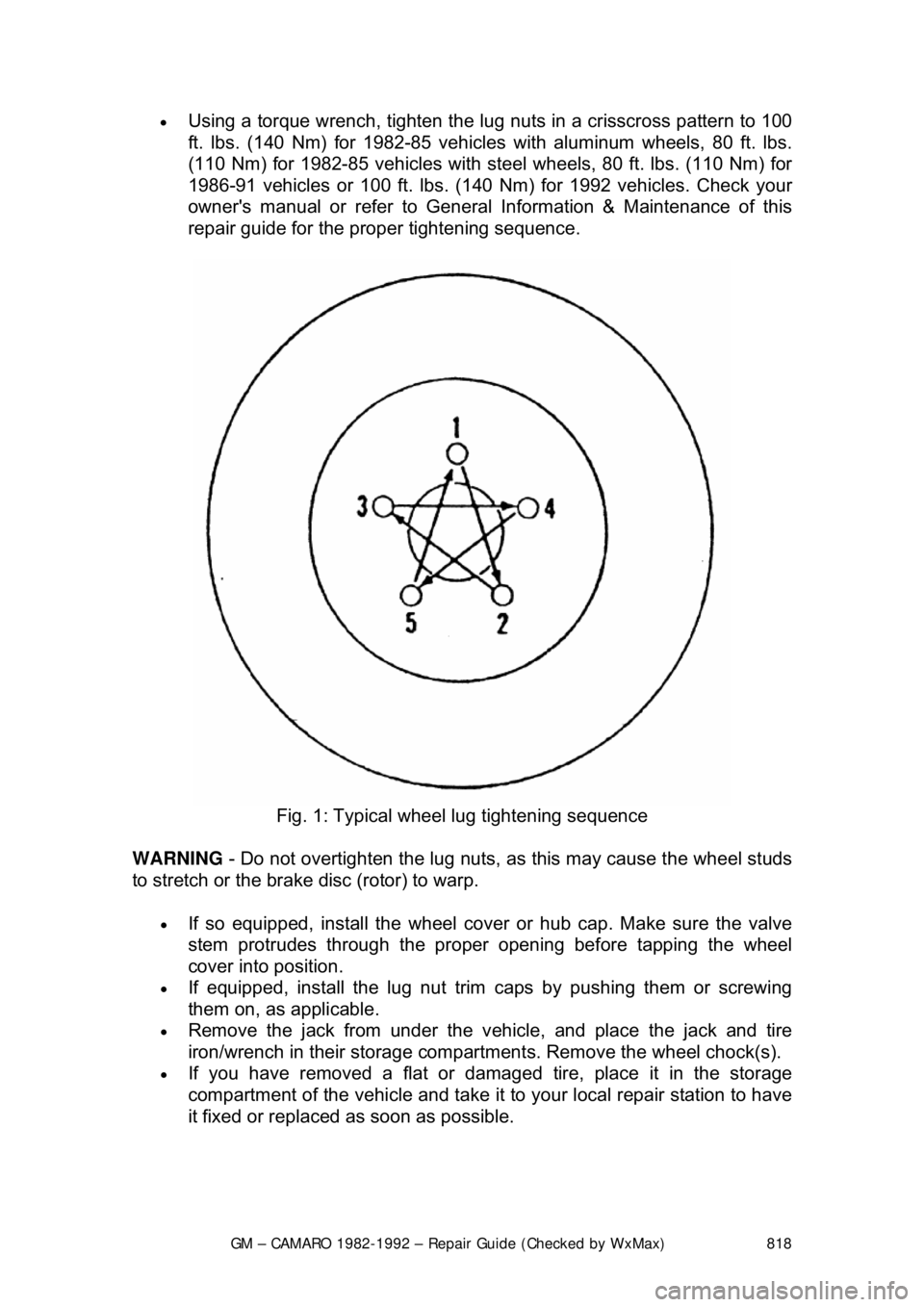
Using a torque wrench, tighten the lug nuts in a crisscross pattern to 100
ft. lbs. (140 Nm) for 1982-85 vehicles with aluminum wheels, 80 ft. lbs.
(110 Nm) for 1982-85 vehicles with st eel wheels, 80 ft. lbs. (110 Nm) for
1986-91 vehicles or 100 ft. lbs. (140 Nm) for 1992 vehicles. Check your
owner's manual or refer to General Information & Maintenance of this
repair guide for the proper tightening sequence.
Fig. 1: Typical wheel lug tightening sequence
WARNING - Do not overtighten the lug nuts, as this may cause the wheel studs
to stretch or the brake disc (rotor) to warp.
• If so equipped, install the wheel cover or hub cap. Make sure the valve
stem protrudes throu gh the proper opening bef ore tapping the wheel
cover into position.
• If equipped, install the lug nut trim caps by pushing them or screwing
them on, as applicable.
• Remove the jack from under the v ehicle, and place the jack and tire
iron/wrench in their storage compartment s. Remove the wheel chock(s).
• If you have removed a flat or damaged tire, place it in the storage
compartment of the vehicle and take it to your local repair station to have
it fixed or replaced as soon as possible.