1969 FORD MUSTANG section 18
[x] Cancel search: section 18Page 195 of 413
04-01-08
General Axle Service
04 01-08
Too/-T57L-4067-A
E 1595-A
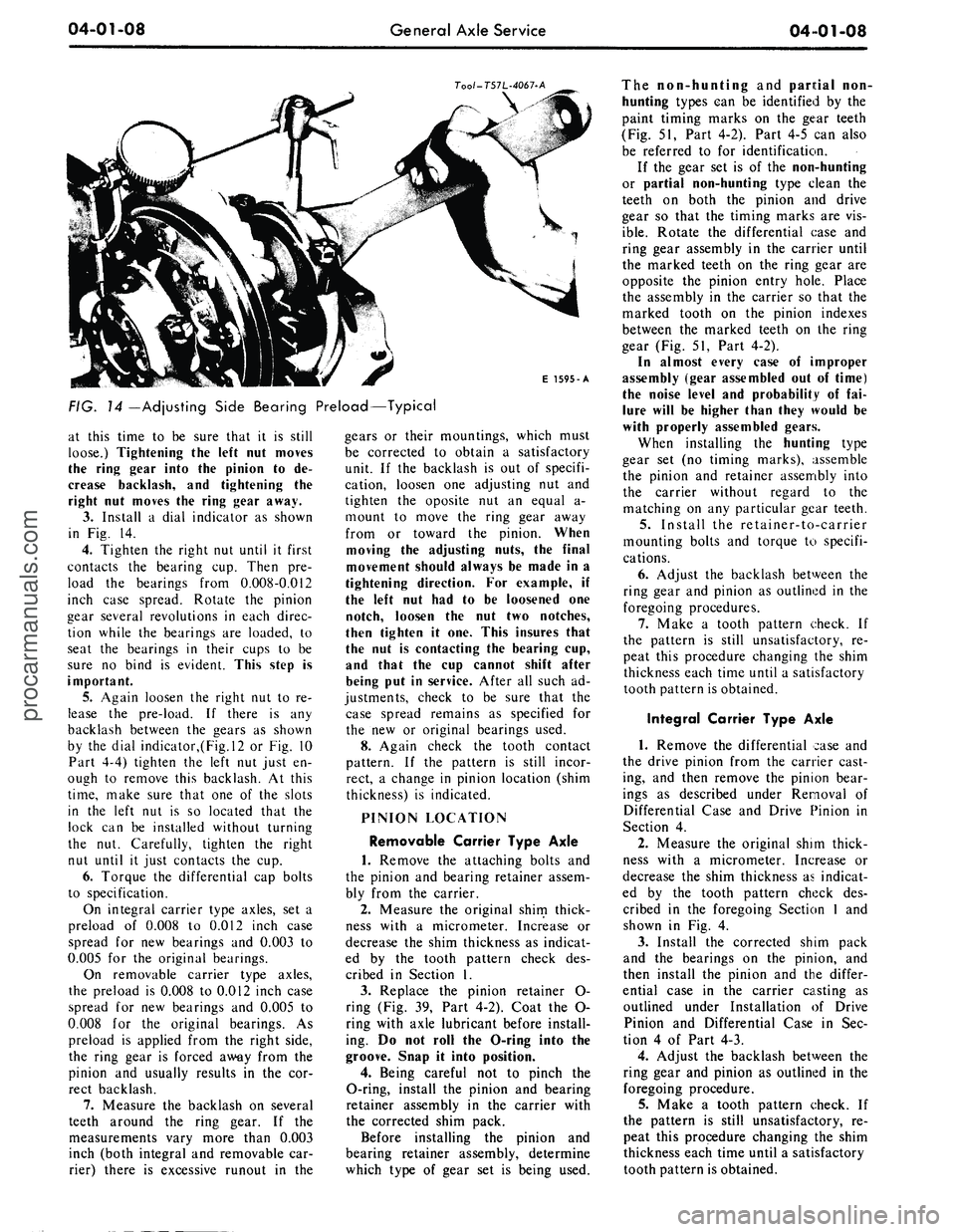
FIG.
14
—Adjusting Side Bearing Preload—Typical
at this time to be sure that it is still
loose.) Tightening the left nut moves
the ring gear into the pinion to de-
crease backlash, and tightening the
right nut moves the ring gear away.
3.
Install a dial indicator as shown
in Fig. 14.
4.
Tighten the right nut until it first
contacts the bearing cup. Then pre-
load the bearings from 0.008-0.012
inch case spread. Rotate the pinion
gear several revolutions in each direc-
tion while the bearings are loaded, to
seat the bearings in their cups to be
sure no bind is evident. This step is
important.
5. Again loosen the right nut to re-
lease the pre-load. If there is any
backlash between the gears as shown
by the dial indicator,(Fig.l2 or Fig. 10
Part 4-4) tighten the left nut just en-
ough to remove this backlash. At this
time,
make sure that one of the slots
in the left nut is so located that the
lock can be installed without turning
the nut. Carefully, tighten the right
nut until it just contacts the cup.
6. Torque the differential cap bolts
to specification.
On integral carrier type axles, set a
preload of 0.008 to 0.012 inch case
spread for new bearings and 0.003 to
0.005 for the original bearings.
On removable carrier type axles,
the preload is 0.008 to 0.012 inch case
spread for new bearings and 0.005 to
0.008 for the original bearings. As
preload is applied from the right side,
the ring gear is forced away from the
pinion and usually results in the cor-
rect backlash.
7.
Measure the backlash on several
teeth around the ring gear. If the
measurements vary more than 0.003
inch (both integral and removable car-
rier) there is excessive runout in the
gears or their mountings, which must
be corrected to obtain a satisfactory
unit. If the backlash is out of specifi-
cation, loosen one adjusting nut and
tighten the oposite nut an equal a-
mount to move the ring gear away
from or toward the pinion. When
moving the adjusting nuts, the final
movement should always be made in a
tightening direction. For example, if
the left nut had to be loosened one
notch, loosen the nut two notches,
then tighten it one. This insures that
the nut is contacting the bearing cup,
and that the cup cannot shift after
being put in service. After all such ad-
justments, check to be sure that the
case spread remains as specified for
the new or original bearings used.
8. Again check the tooth contact
pattern. If the pattern is still incor-
rect, a change in pinion location (shim
thickness) is indicated.
PINION LOCATION
Removable Carrier Type Axle
1.
Remove the attaching bolts and
the pinion and bearing retainer assem-
bly from the carrier.
2.
Measure the original shim thick-
ness with a micrometer. Increase or
decrease the shim thickness as indicat-
ed by the tooth pattern check des-
cribed in Section 1.
3.
Replace the pinion retainer O-
ring (Fig. 39, Part 4-2). Coat the O-
ring with axle lubricant before install-
ing. Do not roll the O-ring into the
groove. Snap it into position.
4.
Being careful not to pinch the
O-ring, install the pinion and bearing
retainer assembly in the carrier with
the corrected shim pack.
Before installing the pinion and
bearing retainer assembly, determine
which type of gear set is being used.
The non-hunting and pantial non-
hunting types can be identified by the
paint timing marks on the gear teeth
(Fig. 51, Part 4-2). Part 4-5 can also
be referred to for identification.
If the gear set is of the non-hunting
or partial non-hunting type clean the
teeth on both the pinion and drive
gear so that the timing marks are vis-
ible.
Rotate the differential case and
ring gear assembly in the carrier until
the marked teeth on the ring gear are
opposite the pinion entry hole. Place
the assembly in the carrier so that the
marked tooth on the pinion indexes
between the marked teeth on the ring
gear (Fig. 51, Part 4-2).
In almost every case of improper
assembly (gear assembled out of time)
the noise level and probability of fai-
lure will be higher than they would be
with properly assembled gears.
When installing the hunting type
gear set (no timing marks), assemble
the pinion and retainer assembly into
the carrier without regard to the
matching on any particular gear teeth.
5.
Install the retainer-to-carrier
mounting bolts and torque to specifi-
cations.
6. Adjust the backlash between the
ring gear and pinion as outlined in the
foregoing procedures.
7.
Make a tooth pattern check. If
the pattern is still unsatisfactory, re-
peat this procedure changing the shim
thickness each time until a satisfactory
tooth pattern is obtained.
Integral Carrier Type Axle
1.
Remove the differential case and
the drive pinion from the carrier cast-
ing, and then remove the pinion bear-
ings as described under Removal of
Differential Case and Drive Pinion in
Section 4.
2.
Measure the original shim thick-
ness with a micrometer. Increase or
decrease the shim thickness as indicat-
ed by the tooth pattern check des-
cribed in the foregoing Section 1 and
shown in Fig. 4.
3.
Install the corrected shim pack
and the bearings on the pinion, and
then install the pinion and the differ-
ential case in the carrier casting as
outlined under Installation of Drive
Pinion and Differential Case in Sec-
tion 4 of Part 4-3.
4.
Adjust the backlash between the
ring gear and pinion as outlined in the
foregoing procedure.
5.
Make a tooth pattern check. If
the pattern is still unsatisfactory, re-
peat this procedure changing the shim
thickness each time until a satisfactory
tooth pattern is obtained.procarmanuals.com
Page 196 of 413
04-01-09
General Axle Service
04-01-09
CLEANING AND INSPECTION
INSPECTION BEFORE
DISASSEMBLY OF CARRIER
(ALL AXLES)
The differential case or carrier
should be inspected before any parts
are removed from it. These inspec-
tions can help to find the cause of the
trouble and to determine the correc-
tions needed.
Mount the carrier in the holding
fixture shown in Fig. 15. Wipe the lu-
bricant from the internal working
parts,
and visually inspect the parts
for wear or damage.
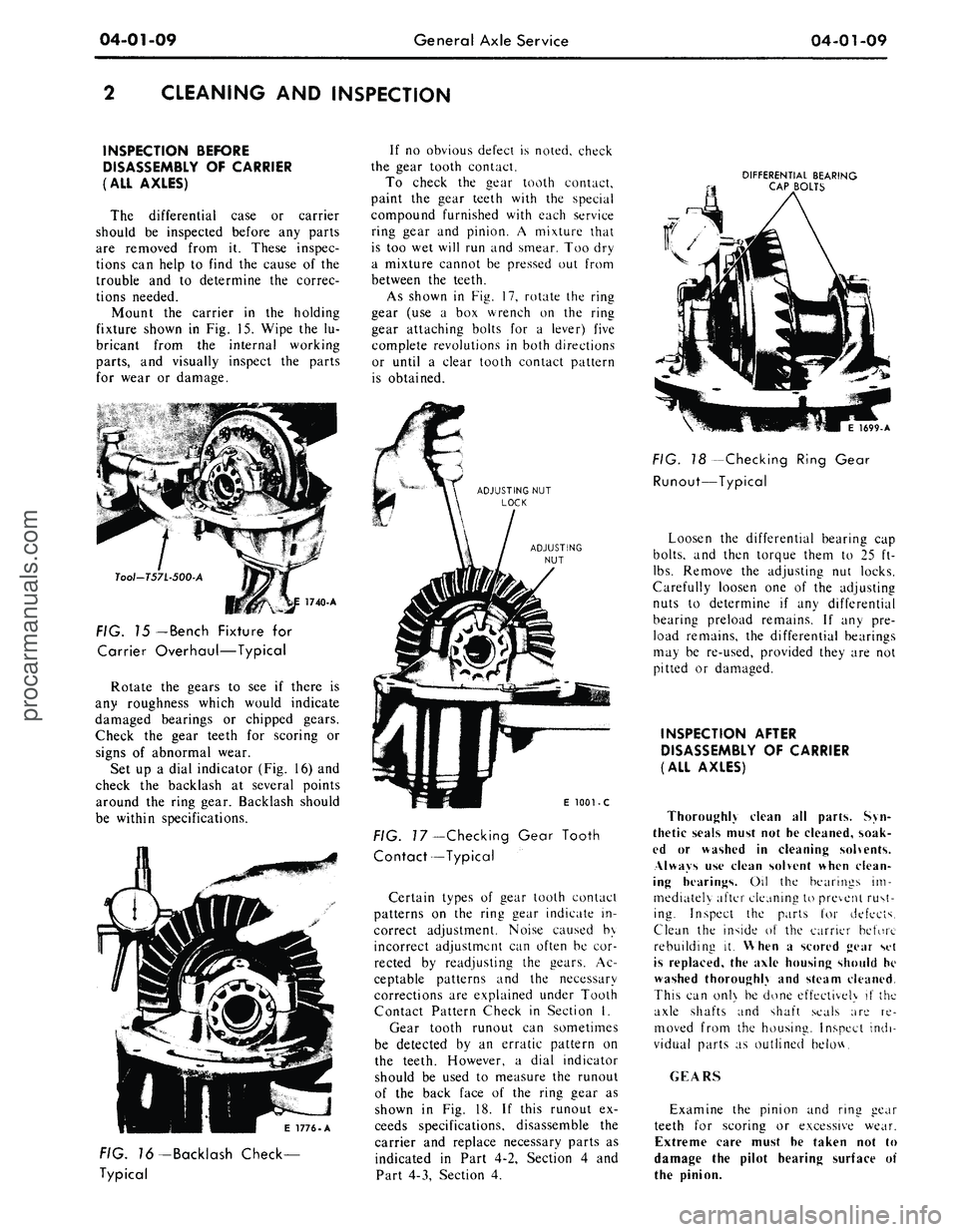
Tool-T57L-500-A
FIG. 15
— Bench
Fixture for
Carrier Overhaul—Typical
Rotate the gears to see if there is
any roughness which would indicate
damaged bearings or chipped gears.
Check the gear teeth for scoring or
signs of abnormal wear.
Set up a dial indicator (Fig. 16) and
check the backlash at several points
around the ring gear. Backlash should
be within specifications.
If no obvious defect is noted, check
the gear tooth contact.
To check the gear tooth contact,
paint the gear teeth with the special
compound furnished with each service
ring gear and pinion. A mixture that
is too wet will run and smear. Too dry
a mixture cannot be pressed out from
between the teeth.
As shown in Fig. 17, rotate the ring
gear (use a box wrench on the ring
gear attaching bolts for a lever) five
complete revolutions in both directions
or until a clear tooth contact pattern
is obtained.
DIFFERENTIAL BEARING
CAP BOLTS
E 1776-A
FIG. 76-Backlash Check-
Typical
E
1001 - C
FIG.
7
7—Checking Gear Tooth
Contact—Typical
Certain types of gear tooth contact
patterns on the ring gear indicate in-
correct adjustment. Noise caused by
incorrect adjustment can often be cor-
rected by readjusting the gears. Ac-
ceptable patterns and the necessary
corrections are explained under Tooth
Contact Pattern Check in Section I.
Gear tooth runout can sometimes
be detected by an erratic pattern on
the teeth. However, a dial indicator
should be used to measure the runout
of the back face of the ring gear as
shown in Fig. 18. If this runout ex-
ceeds specifications, disassemble the
carrier and replace necessary parts as
indicated in Part 4-2, Section 4 and
Part 4-3, Section 4.
1699-A
FIG. 18 -Checking Ring Gear
Runout—Typical
Loosen the differential bearing cap
bolts,
and then torque them to 25 ft-
lbs.
Remove the adjusting nut locks.
Carefully loosen one of the adjusting
nuts to determine if any differential
bearing preload remains. If any pre-
load remains, the differential bearings
may be re-used, provided they are not
pitted or damaged.
INSPECTION AFTER
DISASSEMBLY OF CARRIER
(ALL AXLES)
Thoroughly clean all parts. Syn-
thetic seals must not he cleaned, soak-
ed or washed in cleaning solvents.
Always use clean solvent when clean-
ing hearings. Oil the bearings im-
mediately after cleaning to prevent rust-
ing. Inspect the parts for defects.
Clean the inside of the carrier before
rebuilding it. When a scored gear set
is replaced, the axle housing should he
washed thoroughly and steam cleaned.
This can onl\ be done effectively if the
axle shafts and shaft seals are re-
moved from the housing. Inspect indi-
vidual parts as outlined below.
GEARS
Examine the pinion and ring gear
teeth for scoring or excessive wear.
Extreme care must he taken not to
damage the pilot hearing surface of
the pinion.procarmanuals.com
Page 208 of 413
04-02-11
Rear Axle — Removable Carrier Type
04-02-11
If the axle housing is new, install a
new vent. The hose attaching portion
must face toward the front of the ve-
hicle.
2.
If leather-type wheel bearing ser-
vice seals are to be installed, soak the
new rear wheel bearing oil seals in
SAE 10 oil for 1/2 hour before instal-
lation. Wipe a small amount of an oil
resistant sealer on the outer edge of
each seal before it is installed. Do not
put any of the sealer on the sealing
lip.
Install the oil seals in the ends of
the axle housing with one of the tools
shown in Fig. 10 and 12.
3.
Position the replacement axle
housing under the vehicle, and raise
the axle with a hoist or floor jack.
Connect the suspension lower arms to
their mounting brackets on the axle
housing with pivot bolts and nuts. Do
not tighten the bolts and nuts at this
point.
4.
Position the suspension upper
arm in its mounting bracket on the
axle housing, and install the adjusting
bolt, eccentric washers, lock washer
and nut. Leave the bolt and nut loose
at this point.
5.
Position the brake lines to the
axle housing, and secure with the re-
taining clips.
6. Install the brake backing plates
on the axle housing flanges.
7.
Connect the track bar to the
mounting stud, install the washer and
attaching nut, and torque to specifica-
tions.
8. Position the rear coil springs and
insulators in the pockets provided.
9. Connect the lower studs of the
two rear shock absorbers to the
mounting brackets on the axle hous-
ing. Install the attaching nuts, and
torque to specifications.
10.
Connect the vent tube to the
vent on the housing. If axle housing is
new, install a new vent.
11.
Clean the mating surfaces of
the axle housing and differential car-
rier. Position the carrier on the
mounting studs on the housing using a
new gasket between carrier and hous-
ing. Install the copper washers and the
carrier-to-housing attaching nuts, and
torque to specifications.
12.
Make sure that both the front
and rear pivot bolts of the upper and
the two lower arms are loose, and
then raise the axle assembly to con-
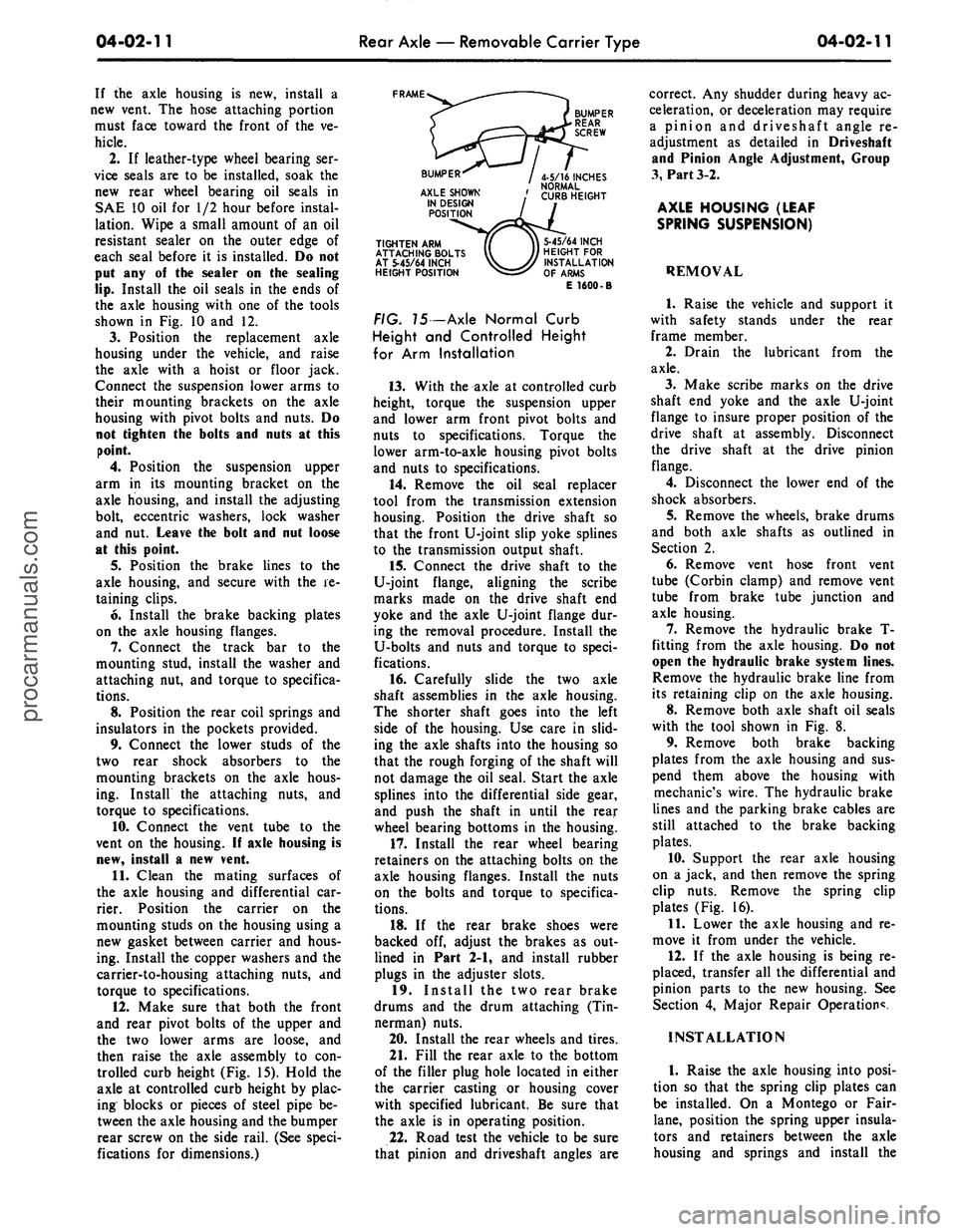
trolled curb height (Fig. 15). Hold the
axle at controlled curb height by plac-
ing blocks or pieces of steel pipe be-
tween the axle housing and the bumper
rear screw on the side rail. (See speci-
fications for dimensions.)
FRAME
TIGHTEN ARM
ATTACHING BOLTS
AT 5-45/64 INCH
HEIGHT POSITION
5-45/64 INCH
HEIGHT FOR
INSTALLATION
OF ARMS
E 1600-B
FIG. 75 -Axle Normal Curb
Height and Controlled Height
for Arm Installation
13.
With the axle at controlled curb
height, torque the suspension upper
and lower arm front pivot bolts and
nuts to specifications. Torque the
lower arm-to-axle housing pivot bolts
and nuts to specifications.
14.
Remove the oil seal replacer
tool from the transmission extension
housing. Position the drive shaft so
that the front U-joint slip yoke splines
to the transmission output shaft.
15.
Connect the drive shaft to the
U-joint flange, aligning the scribe
marks made on the drive shaft end
yoke and the axle U-joint flange dur-
ing the removal procedure. Install the
U-bolts and nuts and torque to speci-
fications.
16.
Carefully slide the two axle
shaft assemblies in the axle housing.
The shorter shaft goes into the left
side of the housing. Use care in slid-
ing the axle shafts into the housing so
that the rough forging of the shaft will
not damage the oil seal. Start the axle
splines into the differential side gear,
and push the shaft in until the rear
wheel bearing bottoms in the housing.
17.
Install the rear wheel bearing
retainers on the attaching bolts on the
axle housing flanges. Install the nuts
on the bolts and torque to specifica-
tions.
18.
If the rear brake shoes were
backed off, adjust the brakes as out-
lined in Part 2-1, and install rubber
plugs in the adjuster slots.
19.
Install the two rear brake
drums and the drum attaching (Tin-
nerman) nuts.
20.
Install the rear wheels and tires.
21.
Fill the rear axle to the bottom
of the filler plug hole located in either
the carrier casting or housing cover
with specified lubricant. Be sure that
the axle is in operating position.
22.
Road test the vehicle to be sure
that pinion and driveshaft angles are
correct. Any shudder during heavy ac-
celeration, or deceleration may require
a pinion and driveshaft angle re-
adjustment as detailed in Driveshaft
and Pinion Angle Adjustment, Group
3,
Part 3-2.
AXLE HOUSING (LEAF
SPRING SUSPENSION)
REMOVAL
1.
Raise the vehicle and support it
with safety stands under the rear
frame member.
2.
Drain the lubricant from the
axle.
3.
Make scribe marks on the drive
shaft end yoke and the axle U-joint
flange to insure proper position of the
drive shaft at assembly. Disconnect
the drive shaft at the drive pinion
flange.
4.
Disconnect the lower end of the
shock absorbers.
5.
Remove the wheels, brake drums
and both axle shafts as outlined in
Section 2.
6. Remove vent hose front vent
tube (Corbin clamp) and remove vent
tube from brake tube junction and
axle housing.
7.
Remove the hydraulic brake T-
fitting from the axle housing. Do not
open the hydraulic brake system lines.
Remove the hydraulic brake line from
its retaining clip on the axle housing.
8. Remove both axle shaft oil seals
with the tool shown in Fig. 8.
9. Remove both brake backing
plates from the axle housing and sus-
pend them above the housing with
mechanic's wire. The hydraulic brake
lines and the parking brake cables are
still attached to the brake backing
plates.
10.
Support the rear axle housing
on a jack, and then remove the spring
clip nuts. Remove the spring clip
plates (Fig. 16).
11.
Lower the axle housing and re-
move it from under the vehicle.
12.
If the axle housing is being re-
placed, transfer all the differential and
pinion parts to the new housing. See
Section 4, Major Repair Operation*.
INSTALLATION
1.
Raise the axle housing into posi-
tion so that the spring clip plates can
be installed. On a Montego or Fair-
lane,
position the spring upper insula-
tors and retainers between the axle
housing and springs and install theprocarmanuals.com
Page 213 of 413
04-02-16
Rear Axle — Removable Carrier Type
04-02-16
Tool~T53L-200-A
Tool-T57L-4625-A
or 4625-K
E 1725-A
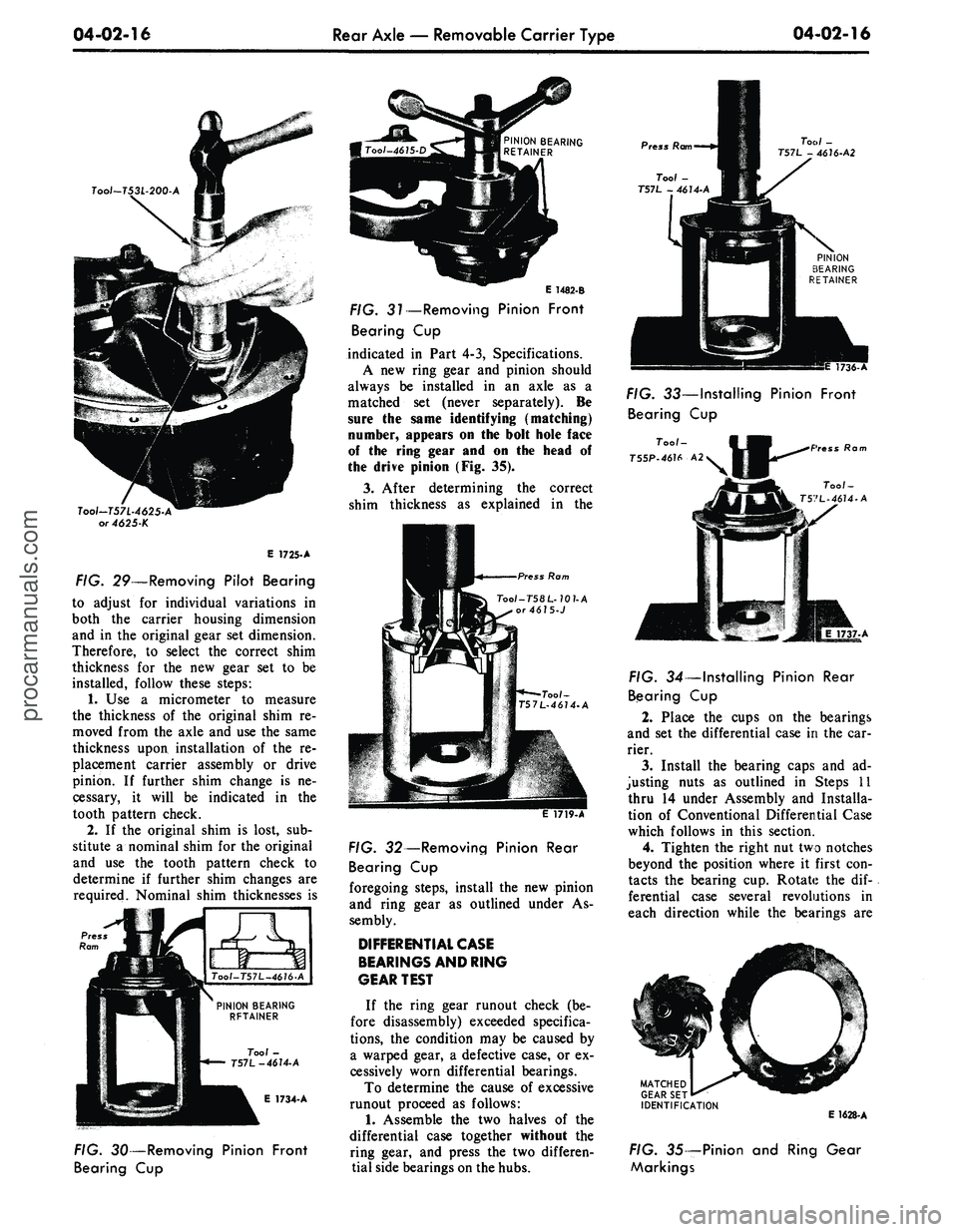
FIG. 29—Removing Pilot Bearing
to adjust for individual variations in
both the carrier housing dimension
and in the original gear set dimension.
Therefore, to select the correct shim
thickness for the new gear set to be
installed, follow these steps:
1.
Use a micrometer to measure
the thickness of the original shim re-
moved from the axle and use the same
thickness upon installation of the re-
placement carrier assembly or drive
pinion. If further shim change is ne-
cessary, it will be indicated in the
tooth pattern check.
2.
If the original shim is lost, sub-
stitute a nominal shim for the original
and use the tooth pattern check to
determine if further shim changes are
required. Nominal shim thicknesses is
E 1734-A
PINION BEARING
RETAINER
E 1482-B
FIG. 31—Removing Pinion Front
Bearing Cup
indicated in Part 4-3, Specifications.
A new ring gear and pinion should
always be installed in an axle as a
matched set (never separately). Be
sure the same identifying (matching)
number, appears on the bolt hole face
of the ring gear and on the head of
the drive pinion (Fig. 35).
3.
After determining the correct
shim thickness as explained in the
ss
Rom
Too/-T58L-70?-A
or4675-J
FIG. 30—Removing Pinion Front
Bearing Cup
FIG. 32—Removing Pinion Rear
Bearing Cup
foregoing steps, install the new pinion
and ring gear as outlined under As-
sembly.
DIFFERENTIAL
CASE
BEARINGS
AND
RING
GEAR
TEST
If the ring gear runout check (be-
fore disassembly) exceeded specifica-
tions,
the condition may be caused by
a warped gear, a defective case, or ex-
cessively worn differential bearings.
To determine the cause of excessive
runout proceed as follows:
1.
Assemble the two halves of the
differential case together without the
ring gear, and press the two differen-
tial side bearings on the hubs.
Press Ram
Tool -
T57L - 4614-A
Tool -
T57L - 4676-A2
1736-/
FIG. 33—Installing Pinion Front
Bearing Cup
too;-
IB .
T55P-46U
A2V •H"^^
\
Press Ram
Tool-
T57L-46U-A
FIG. 34—Installing Pinion Rear
Bearing Cup
2.
Place the cups on the bearings
and set the differential case in the car-
rier.
3.
Install the bearing caps and ad-
justing nuts as outlined in Steps 11
thru 14 under Assembly and Installa-
tion of Conventional Differential Case
which follows in this section.
4.
Tighten the right nut two notches
beyond the position where it first con-
tacts the bearing cup. Rotate the dif-
ferential case several revolutions in
each direction while the bearings are
MATCHED
GEAR SET
IDENTIFICATION
E 1628-A
FIG. 35— Pinion and Ring Gear
Markingsprocarmanuals.com
Page 217 of 413
04-02-20
Rear Axle — Removable Carrier Type
0402-20
THRUST WASHER
E1175-B
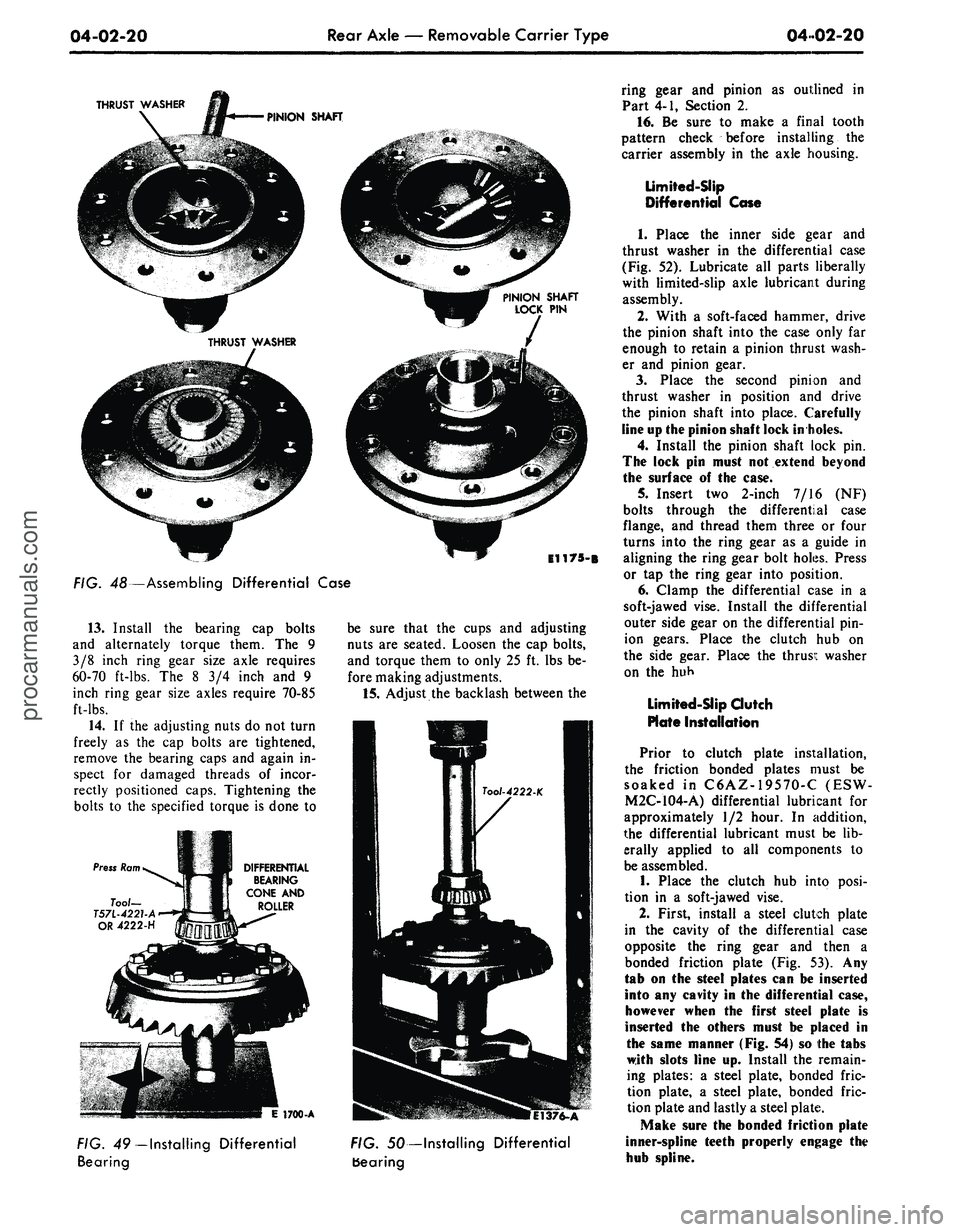
FIG. 48—Assembling Differential Case
13.
Install the bearing cap bolts
and alternately torque them. The 9
3/8 inch ring gear size axle requires
60-70 ft-lbs. The 8 3/4 inch and 9
inch ring gear size axles require 70-85
ft-lbs.
14.
If the adjusting nuts do not turn
freely as the cap bolts are tightened,
remove the bearing caps and again in-
spect for damaged threads of incor-
rectly positioned caps. Tightening the
bolts to the specified torque is done to
be sure that the cups and adjusting
nuts are seated. Loosen the cap bolts,
and torque them to only 25 ft. lbs be-
fore making adjustments.
15.
Adjust the backlash between the
DIFFERENTIAL
BEARING
CONE AND
ROLLER
E 1700-A
FIG. 49—
Installing
Differential
Bearing
1376-A
FIG. 50—Installing Differential
bearing
ring gear and pinion as outlined in
Part 4-1, Section 2.
16.
Be sure to make a final tooth
pattern check before installing the
carrier assembly in the axle housing.
Limited-Slip
Differential Case
1.
Place the inner side gear and
thrust washer in the differential case
(Fig. 52). Lubricate all parts liberally
with limited-slip axle lubricant during
assembly.
2.
With a soft-faced hammer, drive
the pinion shaft into the case only far
enough to retain a pinion thrust wash-
er and pinion gear.
3.
Place the second pinion and
thrust washer in position and drive
the pinion shaft into place. Carefully
line up the pinion shaft lock in holes.
4.
Install the pinion shaft lock pin.
The lock pin must not extend beyond
the surface of the case.
5. Insert two 2-inch 7/16 (NF)
bolts through the differential case
flange, and thread them three or four
turns into the ring gear as a guide in
aligning the ring gear bolt holes. Press
or tap the ring gear into position.
6. Clamp the differential case in a
soft-jawed vise. Install the differential
outer side gear on the differential pin-
ion gears. Place the clutch hub on
the side gear. Place the thrusi: washer
on the huh
Limited-Slip dutch
Plate Installation
Prior to clutch plate installation,
the friction bonded plates must be
soaked in C6AZ-19570-C (ESW-
M2C-104-A) differential lubricant for
approximately 1/2 hour. In addition,
the differential lubricant must be lib-
erally applied to all components to
be assembled.
1.
Place the clutch hub into posi-
tion in a soft-jawed vise.
2.
First, install a steel clutch plate
in the cavity of the differential case
opposite the ring gear and then a
bonded friction plate (Fig. 53). Any
tab on the steel plates can be inserted
into any cavity in the differential case,
however when the first steel plate is
inserted the others must be placed in
the same manner (Fig. 54) so the tabs
with slots line up. Install the remain-
ing plates: a steel plate, bonded fric-
tion plate, a steel plate, bonded fric-
tion plate and lastly a steel plate.
Make sure the bonded friction plate
inner-spline teeth properly engage the
hub spline.procarmanuals.com
Page 226 of 413
04-03-06
Rear Axles — Integral Carrier Type
04-03-06
9. Install a new integral nut and
ivasher on the pinion shaft. (Apply a
small amount of lubricant on the
washer side of the nut.)
10.
Hold the flange with the tool
shown in Fig. 9 while the nut is being
tightened.
11.
Tighten the pinion shaft nut,
rotating the pinion occasionally to in-
sure proper bearing seating, (Fig. 6)
and take frequent preload readings
until the preload is at the original rec-
orded reading established in step 3.
12.
After original preload has been
reached, tighten the pinion nut slowly,
until an additional preload of 6 to 12
in-lbs has been added.
The preload should not exceed the
amount shown above, or bearing fail-
ure may result.
Under no circumstances should the
pinion nut be backed off to lessen pre-
load. If this is done, a new pinion
bearing spacer must be installed. (In
addition, the U-joint flange must
never be hammered on, or pneumatic-
-tools used.)
13.
Remove the oil seal replacer
tool from the transmission extension
housing. Install the front end of the
drive shaft on the transmission output
shaft.
14.
Connect the rear end of the
drive shaft to the axle U-joint flange,
aligning the scribe marks made on the
drive shaft end yoke and the axle U-
joint flange (Fig. 14).
15.
Check the lubricant level. Make
sure the axle is in running position.
Add whatever amount of specified lu-
bricant is required to reach the lower
edge of the filler plug hole, located in
the carrier casting or housing cover.
REMOVAL AND INSTALLATION
REAR AXLE HOUSING
REMOVAL
1.
Raise the vehicle and support it
with safety stands under the rear
frame member.
2.
Drain the lubricant from the
axle.
3.
Make scribe marks on the drive
shaft end yoke and the axle U-joint
flange to insure proper position of the
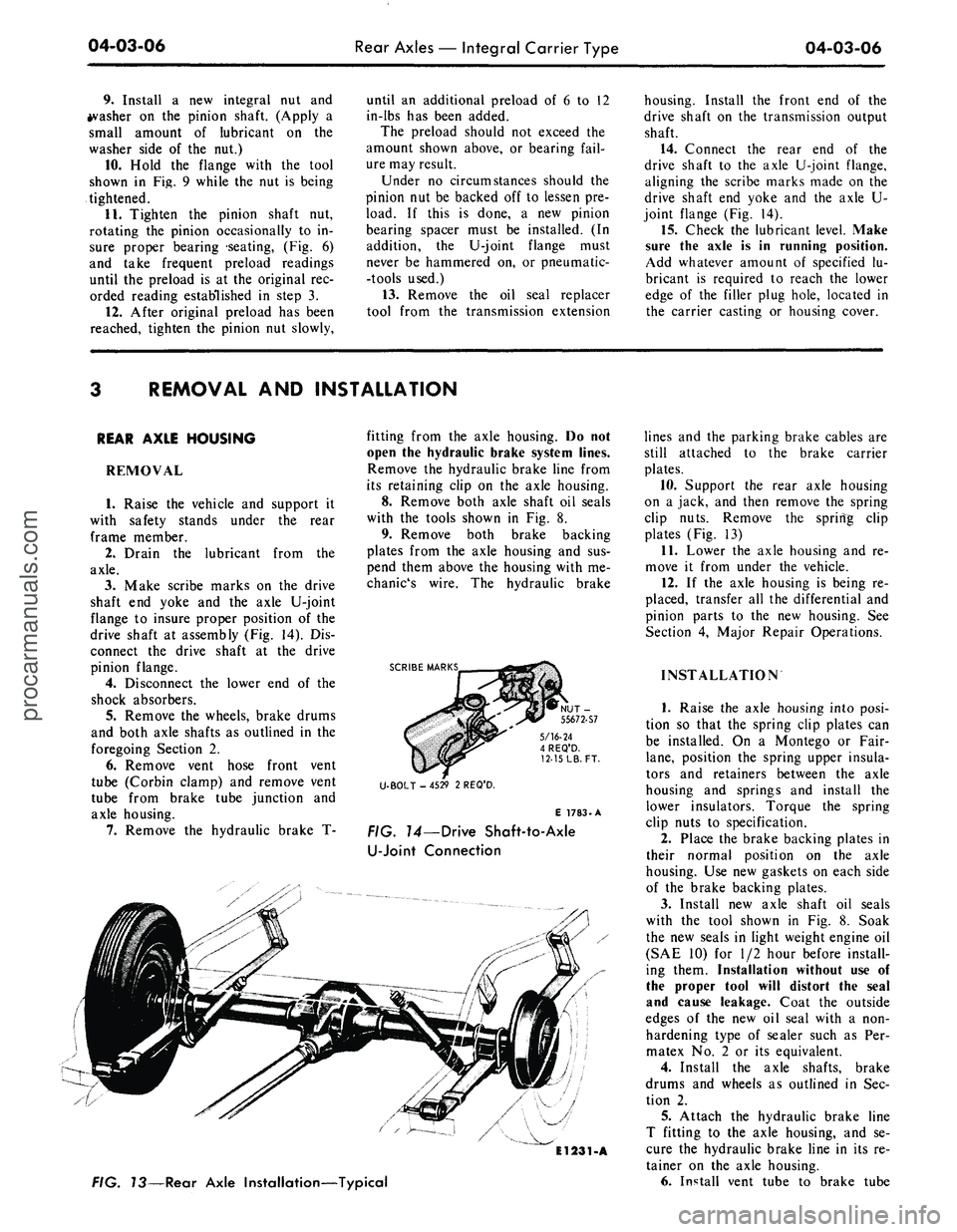
drive shaft at assembly (Fig. 14). Dis-
connect the drive shaft at the drive
pinion flange.
4.
Disconnect the lower end of the
shock absorbers.
5.
Remove the wheels, brake drums
and both axle shafts as outlined in the
foregoing Section 2.
6. Remove vent hose front vent
tube (Corbin clamp) and remove vent
tube from brake tube junction and
axle housing.
7.
Remove the hydraulic brake T-
fitting from the axle housing. Do not
open the hydraulic brake system lines.
Remove the hydraulic brake line from
its retaining clip on the axle housing.
8. Remove both axle shaft oil seals
with the tools shown in Fig. 8.
9. Remove both brake backing
plates from the axle housing and sus-
pend them above the housing with me-
chanic's wire. The hydraulic brake
SCRIBE MARKS
5/16-24
4 REQ'D.
12-15
LB.
FT.
U-BOLT - 4529 2 REQ'D.
E 1783-A
FIG. 14—Drive Shaft-to-Axle
U-Joint
Connection
El231-A
FIG. 73—Rear Axle Installation—Typical
lines and the parking brake cables are
still attached to the brake carrier
plates.
10.
Support the rear axle housing
on a jack, and then remove the spring
clip nuts. Remove the spring clip
plates (Fig. 13)
11.
Lower the axle housing and re-
move it from under the vehicle.
12.
If the axle housing is being re-
placed, transfer all the differential and
pinion parts to the new housing. See
Section 4, Major Repair Operations.
INSTALLATION
1.
Raise the axle housing into posi-
tion so that the spring clip plates can
be installed. On a Montego or Fair-
lane,
position the spring upper insula-
tors and retainers between the axle
housing and springs and install the
lower insulators. Torque the spring
clip nuts to specification.
2.
Place the brake backing plates in
their normal position on the axle
housing. Use new gaskets on each side
of the brake backing plates.
3.
Install new axle shaft oil seals
with the tool shown in Fig. 8. Soak
the new seals in light weight engine oil
(SAE 10) for 1/2 hour before install-
ing them. Installation without use of
the proper tool will distort the seal
and cause leakage. Coat the outside
edges of the new oil seal with a non-
hardening type of sealer such as Per-
matex No. 2 or its equivalent.
4.
Install the axle shafts, brake
drums and wheels as outlined in Sec-
tion 2.
5.
Attach the hydraulic brake line
T fitting to the axle housing, and se-
cure the hydraulic brake line in its re-
tainer on the axle housing.
6. Install vent tube to brake tubeprocarmanuals.com
Page 227 of 413
04-03-07
Rear Axles — Integral Carrier Type
04-03-07
junction and install vent hose to vent
tube.
7.
Raise the axle housing and con-
nect the shock absorbers.
8. Connect the rear end of the drive
shaft to the axle U-joint flange, align-
ing the scribe marks made on the
drive shaft end yoke and the axle U-
joint flange (Fig. 14).
9. Fill the axle with the proper
grade and amount of lubricant.
10.
Road test the vehicle.
MAJOR REPAIR OPERATIONS
DISASSEMBLY
All service operations on the differ-
ential case assembly and the drive pin-
ion assembly can be performed with
the housing in the vehicle.
REMOVAL OF
DIFFERENTIAL
CASE AND DRIVE PINION
1.
Raise the vehicle and support it
on the underbody, so that the rear
axle drops down as far as the springs
and shock absorbers permit.
2.
Remove the cover from the car-
rier casting rear face, and drain the
lubricant.
3.
Perform the Inspection Before
Disassembly of Carrier in Part 4-1,
Section 3.
4.
Remove both rear wheels.
5.
Remove the brake drums.
6. Working through the hole pro-
vided in the axle shaft flange, remove
the nuts that attach the wheel bearing
retainers to the axle housing.
7.
Pull the axle shafts with the tool
shown in Fig. 2. Care must be exer-
cised to prevent damage to the oil
seals.
Install a nut on one of the brake
backing plate attaching bolts to hold
the plate to the axle housing after the
shaft has been removed. Remove both
seals with the tool shown in Fig. 8.
8. Make scribe marks on the drive
shaft end yoke and the axle U-joint
flange to insure proper position of the
drive shaft at assembly (Fig. 14). Dis-
connect the drive shaft from the axle
U-joint flange. Be careful to avoid
dropping the loose universal joint
bearing cups. Hold the cups on the
spider with tape. Mark the cups so
that they will be in their original posi-
tion in relation to the flange when
they are assembled. Remove the drive
shaft from the transmission extension
housing. Install an oil seal replacer
tool in the transmission extension
housing to prevent transmission leak-
age.
Refer to the transmission group
for the appropriate tool.
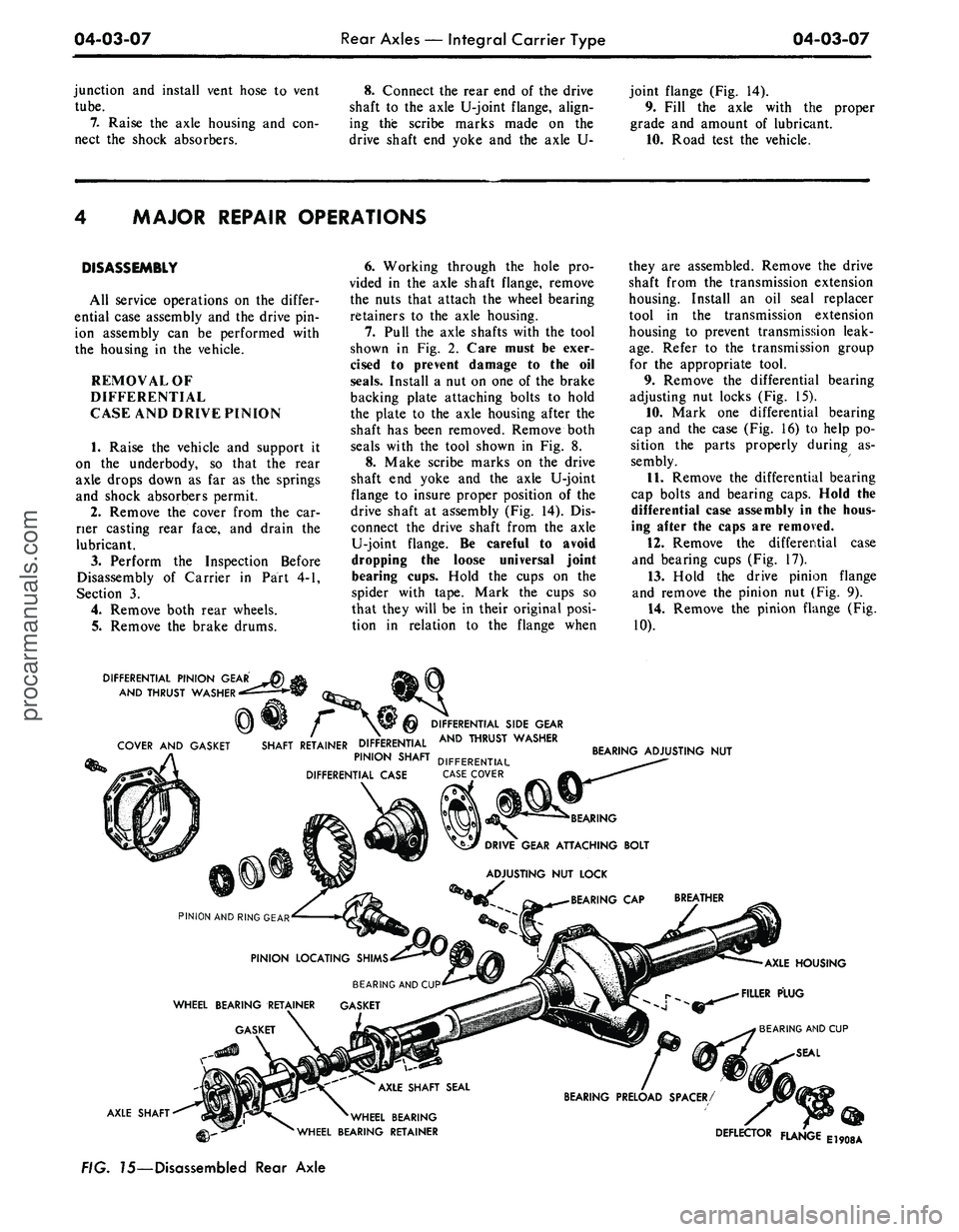
9. Remove the differential bearing
adjusting nut locks (Fig. 15).
10.
Mark one differential bearing
cap and the case (Fig. 16) to help po-
sition the parts properly during as-
sembly.
11.
Remove the differential bearing
cap bolts and bearing caps. Hold the
differential case assembly in the hous-
ing after the caps are removed.
12.
Remove the differential case
and bearing cups (Fig. 17).
13.
Hold the drive pinion flange
and remove the pinion nut (Fig. 9).
14.
Remove the pinion flange (Fig.
10).
DIFFERENTIAL PINION GEAR
AND THRUST WASHER
COVER AND GASKET
DIFFERENTIAL SIDE GEAR
AND THRUST WASHER
SHAFT RETAINER DIFFERENTIAL
PINION SHAFT DIFFERENT|AL
DIFFERENTIAL CASE CASE COVER
BEARING ADJUSTING NUT
PINION AND RING GEAR
AXLE SHAFT
BEARING
DRIVE GEAR ATTACHING BOLT
ADJUSTING NUT LOCK
BEARING CAP
PINION LOCATING SHIMS
BEARING AND CUP
WHEEL BEARING RETAINER
GASKET
BEARING AND CUP
SEAL
AXLE SHAFT SEAL
BEARING PRELOAD SPACER/
AXLE HOUSING
FILLER PLUG
'WHEEL BEARING
WHEEL BEARING RETAINER
DEFLECTOR FLANGE
E1908A
FIG. 75—Disassembled Rear Axleprocarmanuals.com
Page 228 of 413

04-03-08
Rear Axles — Integral Carrier Type
04-03-08
15.
With
a
soft-faced hammer,
drive
the
pinion
out of the
front bear-
ing cone
and
remove
it
through
the
rear
of the
carrier casting.
16.
Drive against
the
pinion front
bearing cone
and
drive
the
pinion
flange seal
and the
bearing cone
out
of
the
front
of the
carrier casting.
17.
To
remove
and
install
the pin-
ion rear bearing cone
use the
tools
in
Fig.
18 and 19.
18.
Measure
the
shim which
is
found under
the
bearing cone with
a
MARKINGS
E1909A
FIG. 16—Typical Differential
Bearing Cap Marking
E1910A
FIG. 77—Differential Case
Removal or Installation
1368-A
micrometer. Record
the
thickness
of
the shim.
DISASSEMBLY
OF
DIFFERENTIAL CASE
1.
If the
differential bearings
are to
be removed,
use the
tools shown
in
Fig.
20.
Press
Ram
REAR BEARING
CONE
AND
ROLLER
Fiber
Block
E1911A
FIG. 79—Installing Pinion Rear
Bearing Cone
Tool-
4221-AL
FIG. 18—Removing Pinion Rear
Bearing Cone
DIFFERENTIAL
BEARING
E1912A
FIG. 20—Differential Bearing
Removal
2.
Remove
the
bolts that attach
the
ring gear
to the
differential case. Press
the ring gear from
the
case
or tap it
off with
a
soft-faced hammer.
3.
With
a
drift, drive
out the
differ-
ential pinion shaft lock
pin (Fig. 21).
4.
Drive
out the
pinion shaft with
a
brass drift. Remove
the
gears
and
thrust washers.
PARTS REPAIR
OR
REPLACEMENT
Clean
and
inspect
all the
parts
as
outlined
in
Part 4-1, Section
3.
Before
assembling
the
carrier, repair
or re-
place
all
parts
as
indicated
by the in-
spection.
The principal replacement opera-
tions
are
covered
in the
following
pro-
cedures.
All
other repair
or
replace-
ment operations
are
performed during
Cleaning
and
Inspection Part
4-1,
Section
3, or
during
the
Assembly
in
this section.
PINION BEARING CUPS
Do
not
remove
the
pinion bearing
cups from
the
carrier casting unless
the cups
are
worn
or
damaged.
If
the
pinion bearing cups
are to be
replaced, drive them
out of the
carrier
E1913A
FIG. 21—Differential Pinion
Shaft Lock Pin Removalprocarmanuals.com