1969 FORD MUSTANG torque
[x] Cancel search: torquePage 246 of 413

04-05-05
Specifications
04-05-05
SPECIAL TOOLS
FORD MERCURY, METEOR (Continued)
Ford Tool No.
T57L-4221-A1 or
Tool-4222-K
TOOL 6565-AB
TOOL 6565
TOOLS 4201-C
andD
TOOL-T57L-
4067-A
TOOL-T50T-100-A
T00L-T66L-
12132-B
CJ-6625 (Snap-
On)
Foniisr
NO.
4222-H
6565-AB
6565
4201-C
4067-B
—
—
—
Description
Differential Bearing Installer
Adapter
Dial Indicator
Differential Backlash and Runout
Gauge with Universal Bracket, Dial
Indicator and Bracket
Differential Bearing Adjuster Wrench
Impact Hammer-Long
Adapter
Puller
Ford Tool No.
TOOL-T60K-
7697-B
T00L-T65F-
1177-A
T00L-T65L-
4851-A
TOOL-OTC-951
T00L-T67P-
4616-A
TOOL-T53T-
4621-C
Fomor No.
—
—
—
—
—
Description
Transmission Extension Housing
Bushing Repiacer
Rear Wheel Bearing Oil Seal Repiacer
Flange (Universal Joint) Axle End
Remover
Universal Puller
Pinion Bearing Cups Repiacer
Pinion Bearing Cone Repiacer
COUGAR, FAIRLANE, FALCON,
Ford Tool No.
T50T-100-A
T58L-101-A
T62L-201-A
T56L-400-A
T57L-500-A
T00L-1175-AB
T50T-100-Aand
TOOL-1175-AB
T60K-1177-B
T60K-1225-Aor
T00L-1225-C
TOOL-1225-B
T00L-T54-P-
3044-A
T00L-T57L-
4067-A
T57L-4067-Aor
T60K-4067-A
TOOL-4201-C
andD
T65K-4204A or
T59L-4204-A
T00L-4221-AL
T57L-4221-A
T00L-4222-H
T66L-4235-A
Former No.
B-160
-
4851-A
-
1175-AB
1175-AE
1177-B
4067-B
4221 or
4211-A
4201-C
4067-E
4221-AL
4222-K
4222
MONTEGO, MUSTANG
Description
Impact Hammer
Puller Attachment
Handle Adapter
Puller
Bench Mounted Holding Fixture
Grease Seal Remover (Head Only)
Seal Remover
Rear Wheel Bearing Oil Seal
Axle Shaft Bearing Remover and Repiacer
Axle Shaft Searing Remover
Axle Shaft Bearing Repiacer
Front Suspension Upper and Lower Arm
Overhaul Tool Kit
Differential Bearing Adjuster Nut
Wrench
Limited-Slip Differential Check
Differential Backlash and Runout Gauge
With Universal Bracket, Dial Indicator
and Bracket
Differential Bearing Adjuster Nut
Wrench
Differential Bearing Cone Remover
Pilot (Use with T00L-4221C or
T00L-4851-A)
Differential Bearing Cone Repiacer
Differential Bearing Cone Repiacer
Rear Axle Shaft Assembly Remover
Adapter
Ford Tool No.
T57L-4614-A
T00L-4615-J
T60K-4616-A
T57L-4616-A
T57L-4616-A2
T55P-4616-A2
T00L-4621-K
T62F-4621A
T62F-4625-A
T55P-4676-A
T62F4676A
T53T-4851A
T57L-4851-A
T00L-4858-E
T65K-4204-A
T59L-4204-A
T00L-6565-AB
TOOL-6565
Former No.
4614
4615-J
4615-HF
4625-HR
4615-
E
andP
4615-
E
andF
-
4621-K
4625-AC
land 2
4676-G
4676-
H
4851-A
4858-D
4851-K
4858-
E
—
44211 and
44211-A
6565-AB
6565
Description
Drive Pinion and Drive Pinion Retainer
Assembly Support
Drive Pinion Front Bearing Cup Remover
Pinion Bearing Cup Repiacer
Pinion Front Bearing Cup Remover
Pinion Front Bearing Cup Repiacer
Pinion Rear Bearing Cup Repiacer
Drive Pinion Rear Bearing Cone Remover
Pinion Bearing Cone Repiacer
Drive Pinion Pilot Bearing Remover
and Repiacer
Drive Pinion Oil Seal Repiacer
Drive Pinion Oil Seal Repiacer
Flange (Universal Joint) Axle End
Remover
Universal Joint Flange Holder
Companion Flange and Pinion Bearing
Repiacer
Limited-Slip Differential Torque Check
Adapter
Locking Differential Torque Check
Adapter
Dial Indicator
T68P-4946-A - Traction-Lok Shim Template Toolprocarmanuals.com
Page 248 of 413

05-01-01
05-01-01
Clutch
GROUP
5
PART
5-1
PAGE
Drive Shaft 05-01-01
PART
5-2
General Clutch Service 05-02-01
PART
5-3
Clutch
PART
5-4
Specifications
PAGE
05-03-01
05-04-01
PART
5-1
Drive Shaft
COMPONENT INDEX
DESCRIPTION
DRIVE SHAFT ANGLE CHECK
DRIVE SHAFT BALANCE CHECK
DRIVE SHAFT BALANCING
(Single Universal Joint)
DRIVE SHAFT DISASSEMBLY
AND
OVERHAUL
Single Universal Joint — Ford Design
Double Cardan Joint — Dana Design
Double Cardan Joint — Saginaw Design
DRIVE SHAFT REMOVAL
AND
INSTALLATION
DRIVE SHAFT RUNOUT CHECK
MODEL APPLICATION
All
Models
01-01
01-01
01-01
01-02
01-01
Ford
01-04
01-04
N/A
N/A
Mercury
01-04
01-04
N/A
N/A
Meteor
01-04
01-04
N/A
N/A
Cougar
01-04
01-04
N/A
N/A
Fairlane
01-04
01-04
N/A
N/A
Falcon
01-04
01-04
N/A
N/A
Montego
01-04
01-04
N/A
N/A
Mustang
01-04
01-04
N/A
N/A
Lincoln-
Continental
N/A
N/A
01-04
N/A
Thunderbird
N/A
N/A
N/A
01-05
Continental-
Mark
III
N/A
N/A
N/A
01-05
A page number indicates that the item
is for the
vehicle listed
at the
head
of
the column.
N/A indicates that
the
item
is not
applicable
to the
vehicle listed.
DRIVE SHAFT TESTS
DRIVE LINE BALANCE CHECK
If detailed parts
of the
drive shaft
are replaced
and
shaft vibration
is en-
countered after installation, disconnect
the shaft
at the
slip yoke. Rotate
the
slip yoke
180
degrees; then, reconnect
the shaft
to the
slip yoke.
If the
vibra-
tion persists, disconnect
the
shaft
at
the rear axle companion flange.
Ro-
tate
the
companion flange
180
degrees
and reconnect
the
shaft
to the
flange.
DRIVE LINE ANGLE CHECK
Vibration
or
"shudder" which
is no-
ticeable either
on
fast acceleration
or
when coasting, using
the
engine
for a
brake,
may be
caused
by the
rear axle
housing being loose
on the
rear
springs
or by
improper pinion angle.
Refer
to
Group
3,
Part
2 for
pinion
angle checking procedures.
If the
rear
axle U-bolts (Fairlane, Montego,
Mustang, Cougar, Falcon models
only)
are
loose, torque
the
nuts
to
specification.
DRIVE SHAFT RUNOUT CHECK
Using
a
dial indicator, check
the
runout
at
each
end and in the
middle
of
the
driveshaft.
The
rear check
should
be
made
on the
small tube
sec-
tion
of the
shaft between
the
balance
weights
and the
yoke welds. Drive-
shaft runout should
not
exceed 0.035
inch
at any one
point.
DESCRIPTION
The drive shaft
is the
means
of
transferring power from
the
engine,
through
the
transmission,
to the dif-
ferential
in the
rear axle,
and
then
to
the rear wheels.
The
drive shaft incor-
porates
two
universal joints
and a
slip
yoke
(Fig. 1) or two
double cardan
universal joints,
one at
each
end of the
shaft (Figs.
2 and 3).
Each double
procarmanuals.com
Page 251 of 413

05-01-04
Drive Shaft
05-01-04
tralizing.
If a
vibration exists,
the
drive shaft should
be
disconnected
from
the
axle, rotated 180 degrees
and
reinstalled.
3.
Install
the
U-blots
and
nuts that
attach
the
U-joint
to the
drive pinion
flange. Torque
the
U-bolt nuts
to
specification.
On
vehicles equipped
with
a
double cardan joint, install
the
rear joint-to-drive pinion flange
at-
taching bolts. Torque
the
bolts
to spe-
cification.
YOKE
C1773-A
FIG. 5—Output Shaft Spline Seal
—
Continental Mark
III
and Thunderbird
IN-VEHICLE REPAIR
USE SUPPORT STAND
AS
A
STEADY REST
E 1685-A
FIG. 6—Marking Driveshaft
CHALK MARK
CLAMPS 18d*FR0M CHALK MARK
*« >
E 1686-A
FIG. 7—Installing Whittek Clamps
E
1687-
A
. 8—Rotating Whittek Clamps
DRIVESHAFT BALANCING
(SINGLE UNIVERSAL JOINT)
If rotating
the
driveshaft
180 de-
grees does
not
eliminate vibration,
the
driveshaft
may be
balanced using
the
following procedure:
1.
Place
the
vehicle
on a
twin post
hoist
so
that
the
rear
of the
vehicle
is
supported
on the
rear axle housing
with
the
wheels free
to
rotate.
2.
With
the
driveshaft rotating
at a
speedometer speed
of
40-50
mph,
carefully bring
a
crayon
or
colored
pencil
up
until
it
just barely contacts
the rearward
end of
driveshaft
(Fig.
6).
The
mark made
by the
crayon
or
pencil will indicate
the
heavy side
of
the shaft. Care should
be
exercised
when working near
the
balance
weights
to
prevent injury
to the
hands.
3.
Install
two
Whittek type hose
clamps
on the
driveshaft
so
that
the
heads
are
located
180
degrees from
the crayon marking
(Fig. 7).
Tighten
the clamps.
4.
Run the
vehicle
up to
65-70
mph
speedometer speed.
If no
vibration
is
felt, lower
the
vehicle
and
road test.
If
unbalance still exists rotate
the
clamp
heads approximately
45
degrees away
from each other
and
test
for
vibration
(Fig.
8).
5.
Continue
to
rotate
the
clamp
heads apart
in
smaller amounts until
vibration
is
eliminated.
To
prevent
overheating,
do not run the
vehicle
on
the
hoist
for an
extended period.
6. Road test
the
vehicle.procarmanuals.com
Page 257 of 413
05-02-03
General Clutch Service
05-02-03
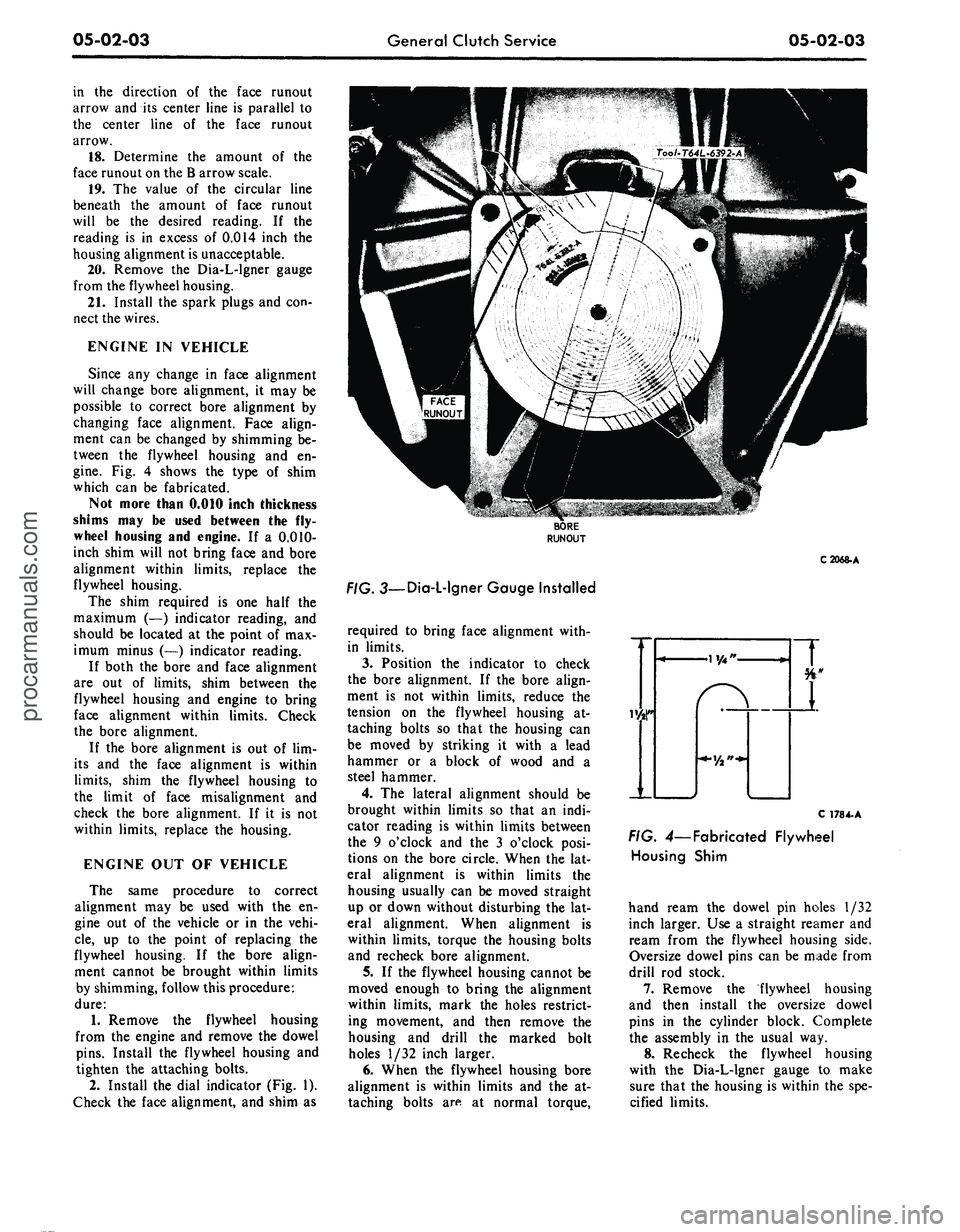
in the direction of the face runout
arrow and its center line is parallel to
the center line of the face runout
arrow.
18.
Determine the amount of the
face runout on the B arrow scale.
19.
The value of the circular line
beneath the amount of face runout
will be the desired reading. If the
reading is in excess of 0.014 inch the
housing alignment is unacceptable.
20.
Remove the Dia-L-lgner gauge
from the flywheel housing.
21.
Install the spark plugs and con-
nect the wires.
ENGINE IN VEHICLE
Since any change in face alignment
will change bore alignment, it may be
possible to correct bore alignment by
changing face alignment. Face align-
ment can be changed by shimming be-
tween the flywheel housing and en-
gine.
Fig. 4 shows the type of shim
which can be fabricated.
Not more than 0.010 inch thickness
shims may be used between the fly-
wheel housing and engine. If a 0.010-
inch shim will not bring face and bore
alignment within limits, replace the
flywheel housing.
The shim required is one half the
maximum (—) indicator reading, and
should be located at the point of max-
imum minus (—) indicator reading.
If both the bore and face alignment
are out of limits, shim between the
flywheel housing and engine to bring
face alignment within limits. Check
the bore alignment.
If the bore alignment is out of lim-
its and the face alignment is within
limits,
shim the flywheel housing to
the limit of face misalignment and
check the bore alignment. If it is not
within limits, replace the housing.
ENGINE OUT OF VEHICLE
The same procedure to correct
alignment may be used with the en-
gine out of the vehicle or in the vehi-
cle,
up to the point of replacing the
flywheel housing. If the bore align-
ment cannot be brought within limits
by shimming, follow this procedure:
dure:
1.
Remove the flywheel housing
from the engine and remove the dowel
pins.
Install the flywheel housing and
tighten the attaching bolts.
2.
Install the dial indicator (Fig. 1).
Check the face alignment, and shim as
C2068-A
. 3—Dia-L-lgner Gauge Installed
required to bring face alignment with-
in limits.
3.
Position the indicator to check
the bore alignment. If the bore align-
ment is not within limits, reduce the
tension on the flywheel housing at-
taching bolts so that the housing can
be moved by striking it with a lead
hammer or a block of wood and a
steel hammer.
4.
The lateral alignment should be
brought within limits so that an indi-
cator reading is within limits between
the 9 o'clock and the 3 o'clock posi-
tions on the bore circle. When the lat-
eral alignment is within limits the
housing usually can be moved straight
up or down without disturbing the lat-
eral alignment. When alignment is
within limits, torque the housing bolts
and recheck bore alignment.
5.
If the flywheel housing cannot be
moved enough to bring the alignment
within limits, mark the holes restrict-
ing movement, and then remove the
housing and drill the marked bolt
holes 1/32 inch larger.
6. When the flywheel housing bore
alignment is within limits and the at-
taching bolts are at normal torque,
C 178 4-A
FIG. 4— Fabricated Flywheel
Housing Shim
hand ream the dowel pin holes 1/32
inch larger. Use a straight reamer and
ream from the flywheel housing side.
Oversize dowel pins can be made from
drill rod stock.
7.
Remove the flywheel housing
and then install the oversize dowel
pins in the cylinder block. Complete
the assembly in the usual way.
8. Recheck the flywheel housing
with the Dia-L-lgner gauge to make
sure that the housing is within the spe-
cified limits.procarmanuals.com
Page 261 of 413

05-03-03
Clutch
05-03-03
CLUTCH PEDAL
ADJUSTMENTS
Adjust
the
clutch pedal free travel
whenever
the
clutch does
not
disen-
gage properly,
or
when
new
clutch
parts
are
installed. Improper adjust-
ment
of the
clutch pedal
is one of the
most frequent causes
of
clutch failure
and
can be a
contributing factor
in
some transmission failures.
FREE TRAVEL
1.
Disconnect
the
clutch return
spring from
the
release lever.
2.
Loosen
the
release lever
rod
locknut
and
adjusting
nut
(Figs.
1, 2
and
3).
3.
Move
the
clutch release lever
rearward until
the
release bearing
lightly contacts
the
clutch pressure
plate release fingers.
4.
Adjust
the rod
length until
the
rod seats
in the
release lever pocket.
5.
Insert
the
specified feeler gauge
between
the
adjusting
nut and the
swivel sleeve. Then tighten
the
adjust-
ing
nut
against
the
gauge finger tight.
6. Tighten
the
locknut against
the
adjusting
nut,
being careful
not to di-
sturb
the
adjustment. Torque
the
lock-
nut
to
specification
and
remove
the
feeler gauge.
7.
Install
the
clutch return spring.
8. Check
the
free travel
at the
pedal
for conformance
to
specification.
Re-
adjust
if
necessary.
9.
As a
final check, measure
the
pedal free travel with
the
transmission
in neutral
and the
engine running
at
about 3000
rpm. If the
pedal free
travel
at
this speed
is not a
minimum
of
1/2
inch, readjust
the
clutch pedal
free travel. Otherwise,
the
release
fin-
gers
may
contact
the
release bearing
continuously, resulting
in
premature
bearing
and
clutch failure. Free travel
must
be
exactly
to
specification.
CLUTCH ASSIST
SPRING REPLACEMENT
(FAIRLANE, FALCON,
MONTEGO)
1.
Remove
the
cotter
pin
from
the
clutch
rod at the
clutch pedal lever
as-
sembly inside
the
passenger compart-
ment.
2.
Grasp
the
clutch pedal lever
firmly
to
prevent slipping
and
remove
the clutch
rod
from
the
lever. Allow
the clutch pedal lever
to
rest
on the
floor panel.
3.
Remove
the
forward bolt secur-
ing
the
assist spring bracket
to the
brake pedal bracket
and
loosen
the
rear bolt
two or
three turns.
Do not
remove
the
rear bolt.
4.
Grasp
the
assist spring bracket
with pliers
and
rotate upward until
the
spring
can be
separated from
the
bracket.
BRAKE PEDAL
BRACKET
CLUTCH ASSIST SPRING
BRACKET
-
7535
CLUTCH PEDAL
7519
5.
Position
the
assist spring
in the
clutch pedal spring bracket
and the
assist spring bracket. Rotate
the
spring bracket downward until
the
forward bolt holes
in the
assist spring
bracket line
up
with
the
holes
in the
brake pedal bracket
(Fig. 4).
6. Install
the
forward bolt retaining
the assist spring bracket
to the
brake
pedal bracket
and
torque
the
forward
and rear bolts
to
specification.
7.
Install
the
clutch
rod to the
clutch pedal lever
and
insert
the
cotter
pin.
CLUTCH PEDAL, PEDAL
ASSIST SPRING AND/OR
BUSHING REMOVAL
AND INSTALLATION
FORD, MERCURY,
METEOR
1.
Remove
the pin
that secures
the
clutch pedal-to-equalizer
rod to the
clutch pedal.
2.
Grasp
the
clutch pecal lever
firmly
to
prevent slipping
and
remove
the clutch
rod
from
the
lever. Allow
the clutch pedal lever
to
rest
on the
floor.
3.
Loosen
the
lower bolt securing
the assist spring bracket
to the
pedal
support bracket
two or
three turns.
Then, remove
the
upper bolt from
the
bracket.
Do not
remove
the
lower
bolt.
4.
Grasp
the
assist spring bracket
with pliers
and
rotate
it
counterclock-
wise until
the
spring
is
free
(Fig 5).
5.
Remove
the
retaining ring from
the
end of the
clutch pedal shaft. Then
remove
the
shaft, bushings
and
clutch
pedal from
the
support.
6. Remove
the
bushings from
the
pedal shaft
and
pedal support
and
transfer
the
rubber pedal
pad.
7.
After lubricating
the
pedal shaft
ASSIST SPRING
LOWER BOLT
ASSIST SPRING BRACKET-
UPPER
BOL"
C 1769-B
FIG. 4—Clutch Pedal Assembly
—
Fairlane, Montego, Falcon
C2058-A
;. 5—Removing Clutch Assist
Spring
—
Ford,
Mercury and Meteorprocarmanuals.com
Page 262 of 413
05-03-04
Clutch
05-03-04
bushings, position the clutch pedal and
bushings in the pedal support.
8. Install the retaining ring on the
clutch pedal shaft.
9. Position the assist spring in the
pedal support bracket and the assist
spring bracket. Rotate the assist
spring bracket clockwise until the
upper bolt holes line up and install the
bolt. Torque both the upper and lower
bolts to specification.
10.
Check the clutch pedal free
travel and adjust as required.
MUSTANG, COUGAR
1.
Disconnect the battery ground
cable.
2.
Remove the steering column.
Refer to Group 3 of this manual for
the procedure.
3.
Remove the two capscrews re-
taining the master cylinder or booster
to the dash panel. Then remove the
two capscrews retaining the pedal sup-
port bracket to the dash panel.
4.
Working inside the vehicle, dis-
connect the clutch pedal-to-equalizer
rod at the clutch pedal by removing
the retainer and bushing.
5.
Secure the clutch pedal against
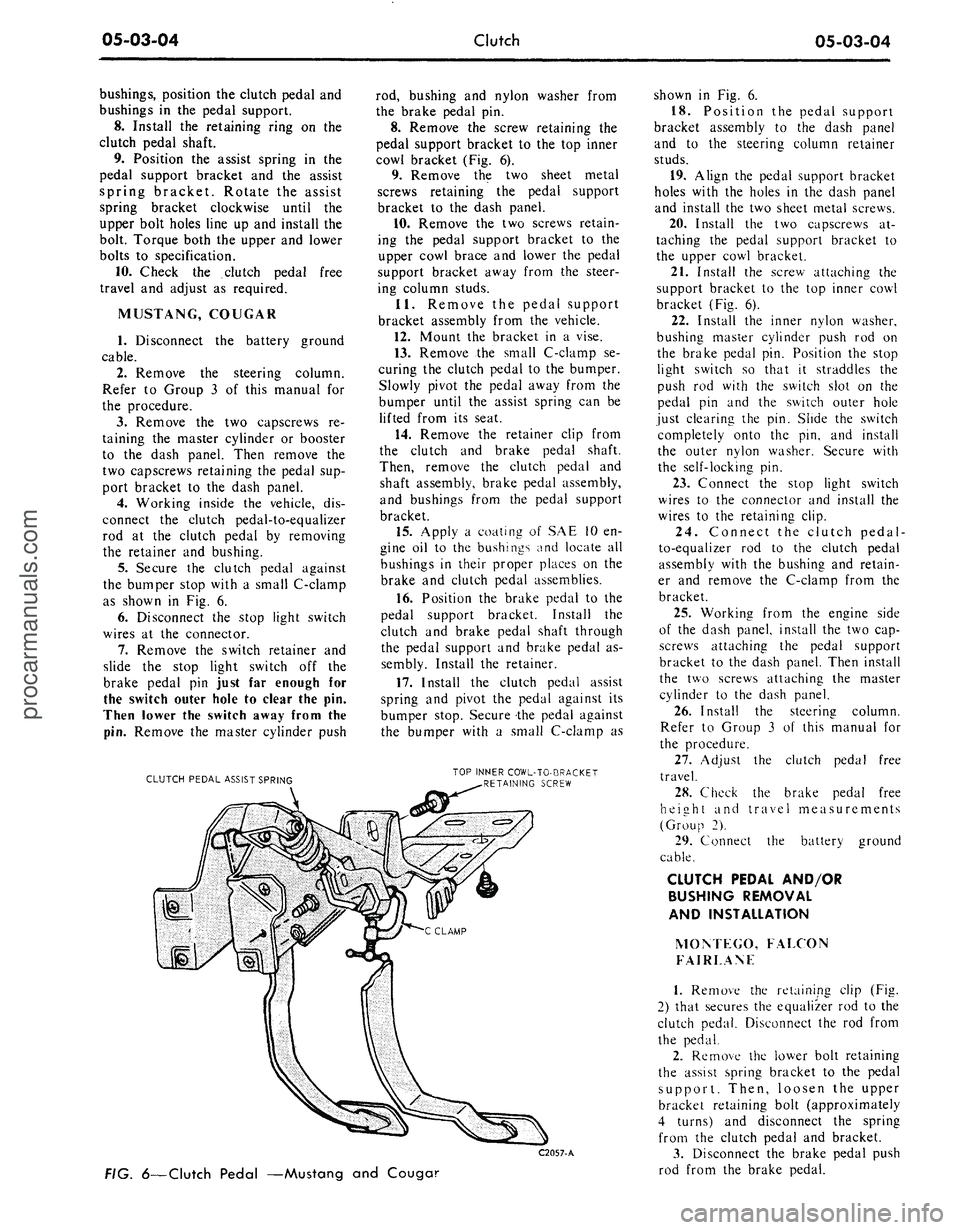
the bumper stop with a small C-clamp
as shown in Fig. 6.
6. Disconnect the stop light switch
wires at the connector.
7.
Remove the switch retainer and
slide the stop light switch off the
brake pedal pin just far enough for
the switch outer hole to clear the pin.
Then lower the switch away from the
pin.
Remove the master cylinder push
CLUTCH PEDAL ASSIST SPRING
rod, bushing and nylon washer from
the brake pedal pin.
8. Remove the screw retaining the
pedal support bracket to the top inner
cowl bracket (Fig. 6).
9. Remove the two sheet metal
screws retaining the pedal support
bracket to the dash panel.
10.
Remove the two screws retain-
ing the pedal support bracket to the
upper cowl brace and lower the pedal
support bracket away from the steer-
ing column studs.
11.
Remove the pedal support
bracket assembly from the vehicle.
12.
Mount the bracket in a vise.
13.
Remove the small C-clamp se-
curing the clutch pedal to the bumper.
Slowly pivot the pedal away from the
bumper until the assist spring can be
lifted from its seat.
14.
Remove the retainer clip from
the clutch and brake pedal shaft.
Then, remove the clutch pedal and
shaft assembly, brake pedal assembly,
and bushings from the pedal support
bracket.
15.
Apply a coating of SAE 10 en-
gine oil to the bushings and locate all
bushings in their proper places on the
brake and clutch pedal assemblies.
16.
Position the brake pedal to the
pedal support bracket. Install the
clutch and brake pedal shaft through
the pedal support and brake pedal as-
sembly. Install the retainer.
17.
Install the clutch pedal assist
spring and pivot the pedal against its
bumper stop. Secure the pedal against
the bumper with a small C-clamp as
TOP INNER COWL-TO-BRACKET
RETAINING SCREW
C2057-A
FIG.
6—Clutch
Pedal —Mustang and Couga?
shown in Fig. 6.
18.
Position the pedal support
bracket assembly to the dash panel
and to the steering column retainer
studs.
19.
Align the pedal support bracket
holes with the holes in the dash panel
and install the two sheet metal screws.
20.
Install the two capscrews at-
taching the pedal support bracket to
the upper cowl bracket.
21.
Install the screw attaching the
support bracket to the top inner cowl
bracket (Fig. 6).
22.
Install the inner nylon washer,
bushing master cylinder push rod on
the brake pedal pin. Position the stop
light switch so that it straddles the
push rod with the switch slot on the
pedal pin and the switch outer hole
just clearing the pin. Slide the switch
completely onto the pin, and install
the outer nylon washer. Secure with
the self-locking pin.
23.
Connect the stop light switch
wires to the connector and install the
wires to the retaining clip.
24.
Connect the clutch pedal-
to-equalizer rod to the clutch pedal
assembly with the bushing and retain-
er and remove the C-clamp from the
bracket.
25.
Working from the engine side
of the dash panel, install the two cap-
screws attaching the pedal support
bracket to the dash panel. Then install
the two screws attaching the master
cylinder to the dash panel.
26.
Install the steering column.
Refer to Group 3 of this manual for
the procedure.
27.
Adjust the clutch pedal free
travel.
28.
Check the brake pedal free
height and travel measurements
(Group 2).
29.
Connect the battery ground
cable.
CLUTCH PEDAL AND/OR
BUSHING REMOVAL
AND INSTALLATION
MOM EGO, FALCON
FAIRLANF
1.
Remove the retaining clip (Fig.
2) that secures the equalizer rod to the
clutch pedal. Disconnect the rod from
the pedal.
2.
Remove the lower bolt retaining
the assist spring bracket to the pedal
support. Then, loosen the upper
bracket retaining bolt (approximately
4 turns) and disconnect the spring
from the clutch pedal and bracket.
3.
Disconnect the brake pedal push
rod from the brake pedal.procarmanuals.com
Page 263 of 413

05-03-05
Clutch
05-03-05
4.
Remove the bolt that secures the
left air vent control cable bracket to
the instrument panel. Position the
control cable to one side.
5.
Remove the retaining clip and
flat washer from the clutch pedal
shaft. Then, remove the shaft, bush-
ing, clutch pedal and brake pedal
from the support.
6. Remove the bushings from the
pedal shaft, and transfer the pedal
pad.
7.
Lubricate the clutch pedal shaft
bushings and position them on the
shaft. Then, position the brake pedal
and clutch pedal in the pedal support.
8. Install the flat washer and re-
taining clip on the pedal shaft.
9. Position the assist spring to the
pedal and bracket. Pry the bracket
forward and install the lower bolt.
Torque the bolts to specifications.
10.
Position the master cylinder
push rod, bushing, and washers on the
brake pedal and secure with a retain-
ing clip.
11.
Connect the equalizer rod to
the clutch pedal and secure it in place
with a retaining clip.
12.
Position the air vent control
cable bracket to the instrument panel
and secure with the attaching bolt.
13.
Adjust the clutch pedal free
travel.
EQUALIZER BAR AND/OR
BUSHING REMOVAL AND
INSTALLATION
FORD, MERCURY
AND METEOR
1.
Raise the vehicle and disconnect
the clutch pedal-to-equalizer rod at
the equalizer bar (Fig. 1).
2.
Disconnect the return spring and
retaining spring at the release lever.
Separate the release lever rod from
the release lever.
3.
Remove the equalizer bar frame
bracket from the frame.
4.
Remove the equalizer bar from
the pivot on the flywheel housing.
5.
Remove the wire clip to replace
the outer bushing and the snap ring
from the inner pivot stud to replace
the inner bushing.
6. Position the flat washer, felt
washer and bushing on the inner and
outer pivots. Secure these parts with
the snap ring.
7.
Position the equalizer bar on the
inner pivot and bolt the equalizer bar
frame bracket to the frame. Torque
the attaching bolts to specification.
8. Install the clutch release rod, re-
turn spring and retaining spring.
9. Connect the clutch pedal rod to
the equalizer bar.
10.
Adjust the clutch pedal free
travel.
MUSTANG, COUGAR,
MONTEGO, FALCON,
FAIRLANE (EXCEPT
MONTEGO AND FAIRLANE
WITH 390 V-8)
1.
Disconnect the clutch pedal
equalizer rod at the equalizer bar
(Figs.
2 and 3).
2.
Raise the vehicle and disconnect
the release lever, return spring at the
lever.
3.
Remove the equalizer bar outer
bracket and bushing assembly.
4.
Remove the release rod from the
equalizer bar, and then remove the
equalizer bar. Remove the bushing
and washers from the inner mounting
stud.
5.
Position the equalizer bar, wash-
ers,
inner bushing, and retainer on the
inner stud.
6. After positioning the outer bush-
ing, install the outer bracket (with the
equalizer bar in place).
7.
Connect the release rod and the
release lever return spring.
8. Lower the vehicle. Connect the
clutch pedal equalizer rod to the
equalizer baY and secure with the re-
taining pin.
9. Adjust the clutch pedal free trav-
el as required.
MONTEGO AND
FAIRLANE—390 V-8
1.
Disconnect the clutch pedal
equalizer rod at the equalizer bar (Fig.
2).
2.
Raise the vehicle and disconnect
the return spring at the release lever.
Disconnect the release lever rod from
the equalizer lever.
3.
Remove the equalizer bar center
bolt.
4.
Separate the equalizer bar and
remove both sections from the vehicle.
5.
Remove the bolts retaining the
equalizer bar inner bracket to the fly-
wheel housing and remove the bracket
and bushing assembly.
6. Remove the equalizer bar outer
bracket and bushing assembly.
7.
Remove the snap ring, bushing,
and felt washer from each bracket as-
sembly.
8. Position a felt washer, and bush-
ing on each bracket assembly and se-
cure with the snap ring.
9. Install the outer bracket and
bushing assembly to the frame (Fig.
2).
Torque the bracket attaching bolts
to specifications.
10.
Position the outer section of the
equalizer bar on the outer bracket
pivot.
11.
Connect the two sections of the
equalizer bar. Insert the inner bracket
pivot into the equalizer bar and install
the assembly to the flywheel housing.
Torque the attaching bolts to specifi-
cations.
12.
Install the equalizer bar center
bolt and torque to specifications.
Make sure that both ends of the
equalizer bar are against the felt
washers.
13.
Connect the release rod and the
release lever return spring.
14.
Adjust the clutch pedal free
travel.
15.
Lower the vehicle. Connect the
clutch pedal equalizer rod to the
equalizer bar and secure with the re-
taining clip.
16.
Check the free travel at the
pedal for conformance to specifica-
tions.
Readjust if necessary.
REMOVAL AND INSTALLATION
CLUTCH REMOVAL
1.
Raise the vehicle on a hoist.
2.
Disconnect the drive shaft from
the rear U-joint flange. Then, slide the
drive shaft off the transmission output
shaft. Insert the appropriate tool over
the output shaft and into the extension
housing oil seal.
3.
Disconnect the speedometer
cable from the extension housing.
4.
Disconnect the gear shift rods
from the transmission. If the vehicle is
equipped with a four-speed transmis-
sion, remove the bolts that secure the
four-speed transmission, disconnect
the front brake cable from the cross-
member and remove the crossmem-
member from the vehicle.
5.
Remove the bolts that attach the
transmission to the flywheel housing.
6. Move the transmission rearward
until the input shaft clears the fly-
wheel housing, then remove it from
the vehicle.
7.
Disconnect the clutch release
lever retaining spring from the release
lever.procarmanuals.com
Page 264 of 413

05-03-06
Clutch
05-03-06
8. Remove the starter cable then
remove the starter motor from the fly-
wheel housing.
9. Remove the bolts that secure the
engine rear plate to the front lower
part of the flywheel housing.
10.
Remove the flywheel housing
lower cover (390 CID housing only).
11.
Remove the bolts that attach
the housing to the cylinder block.
12.
Move the housing back just far
enough to clear the pressure plate,
then move it to the right to free the
pivot from the clutch equalizer bar. Be
careful not to disturb the linkage and
assist spring.
13.
Loosen the six pressure plate
cover attaching bolts evenly to release
the spring tension. If the same pres-
sure plate and cover is to be installed
after the clutch is overhauled, mark
the cover and flywheel so that the
pressure plate can be installed in the
same position.
14.
Remove the pressure plate and
the clutch disc from the flywheel.
CLUTCH INSTALLATION
1.
Install the clutch release lever if
it was removed.
2.
Place the clutch disc, and pres-
sure plate assembly in position on the
flywheel. Start the cover attaching
bolts to hold the pieces in place, but
do not tighten them. Avoid touching
the clutch disc facing, dropping the
parts or contaminating them with oil
or grease as clutch chatter may result.
3.
Align the clutch disc with the
tool shown in Fig. 7, and alternately
tighten the bolts a few turns at a time
until they are all tight. Then torque
the six pressure plate cover attaching
bolts to specification before removing
the tool.
4.
Apply a light film of grease
(C3VY-19586-A) to the outside diam-
eter of the transmission front bearing
retainer. Apply a light film of grease
(C3VY-19586-A) to both sides of the
release lever fork where it contacts the
release bearing bore spring clips.
Apply a light film of grease to the re-
lease bearing surface that contacts the
pressure plate release fingers. Fill the
grease groove of the release bearing
hub with lithium base grease (C3VY-
19586-A). Clean all excess grease
from inside the bore of bearing hub.
Excess grease will be forced onto the
spline by the transmission input shaft
bearing retainer and will contaminate
the clutch disc. Also, place the release
bearing and hub on the release lever.
5.
Make certain that the flywheel
housing and the cylinder block mount-
ing surfaces are clean. Position the
felt washer on the pivot in the fly-
wheel housing. Slip the pivot into the
clutch equalizer shaft being careful
not to disturb the linkage and at the
same time position the housing on the
dowels in the cylinder block. Install
and torque the attaching bolts to spec-
ification.
6. Install the starting motor and
connect the cable.
7.
The mounting surfaces of the
transmission and the flywheel housing
must be free of dirt, paint, and burrs.
Install two guide pins in the flywheel
housing lower mounting bolt holes.
Move the transmission forward on the
guide pins until it is tightly positioned
against the flywheel housing.
8. Install the two upper mounting
bolts.
Then, remove the guide pins
and install the two lower mounting
bolts.
Torque all the bolts to specifica-
tion.
9. Raise the rear of the engine and
install the crossmember. Install and
torque the crossmember attaching
bolts to specifications, then lower the
engine.
10.
Install the extension housing-
to-engine rear support attaching bolts.
Torque the bolts to specification.
11.
Remove the transmission jack
and connect the parking brake cable.
12.
If the vehicle is equipped with a
four-speed transmission, connect the
gear shift linkage control bracket to
the extension housing.
13.
Connect the gear shift rods to
the transmission. Adjust the shift link-
age as required.
14.
Connect the release lever retain-
ing spring. Install the flywheel housing
cover (390 CID housing only).
15.
Remove the tool from the
transmission output shaft and install
the drive shaft.
16.
Check the clutch pedal free
travel.
CLUTCH ARBOR CLUTCH DISC
PRESSURE PLATE
C 1788-A
FIG. 7—Installing Clutch Disc —
Typicalprocarmanuals.com