1969 FORD MUSTANG wheel
[x] Cancel search: wheelPage 194 of 413

04-01-07
General Axle Service
04-01-07
Tool-4201-
C
Tool-6565 USED WITH BRACKET
FROM Too/^*207-C
FLANGE
E1743-A
procedure under Backlash and Differ-
ential Bearing Preload Adjustments.
If the tooth pattern indicates a change
in shim thickness, follow the proce-
dure under Pinion Location.
REMOVABLE CARRIER
TYPE AXLE
The shim location for the removable
carrier type axle is between the pinion
retainer and the carrier (Fig. 13).
When adjusting this type carrier re-
ducing shim thickness will move the
pinion toward the ring gear; increas-
ing shim thickness will move the pi-
nion away from the ring gear (Fig.
13).
FIG. 11—Checking Companion Flange Lateral Runout—
Thunderbird and Continental Mark III
INTEGRAL CARRIER
TYPE AXLE
8. If the runout is still excessive, re-
place the companion flange and check
the runout. If necessary, rotate the
new flange on the pinion shaft until an
acceptable runout is obtained.
If excessive runout is still evident
after replacement of the companion
flange, it will be necessary to replace
the ring and pinion gear, and repeat
the above checks until runout is within
specifications.
9. Install the driveshaft assembly
(Group 5).
PINION LOCATION
ADJUSTMENT
BACKLASH
ADJUSTMENT,
LEFT
ADJUSTING
NUT
E1476-A
FIG. 12—Pinion and Ring Gear
Tooth Contact Adjustment
—
Integral Carrier Type Axles
PINION AND RING GEAR
TOOTH CONTACT
ADJUSTMENT
Two separate adjustments affect pin-
ion and ring gear tooth contact.
They are pinion location and backlash
(Figs.
12 and 13).
Individual differences in matching
the differential housing and the gear
set require the use of shims to locate
the pinion for correct contact with the
ring gear.
When adjusting either type axle,
shim thickness should be increased or
reduced only as indicated by the tooth
pattern check described in the fore-
going Section 1.
If the tooth pattern check indicates
a change in backlash only, follow the
PINION
LOCATION
ADJUSTMENT
SHIMS
LEFT
ADJUSTING
NUT
RIGHT
ADJUSTING
BACKLASH NUT
ADJUSTMENT El 409-A
FIG. 13—Pinion and Ring Gear
Tooth Contact Adjustment—
Removable Carrier Axles
The shim location for the integral
carrier type axle, is between the pi-
nion gear and the pinion rear bearing
cone (Fig. 12). When adjusting this
type axle, increasing shim thickness
moves the pinion toward the ring
gear; reducing shim thickness moves
the pinion away from the ring gear
(Fig. 12).
BACKLASH AND DIFFERENTIAL
BEARING PRELOAD
ADJUSTMENTS (ALL AXLES)
On a Light-Duty (WER) Axle, it is
necessary to remove the rear axle
shafts prior to performing the adjust-
ment procedures. Refer to Rear Axle
Shaft Wheel Bearing and Oil Seal Re-
placement—Light-Duty (WER), Axle,
Part 4-4, Section 2.
To secure a more uniform control
of differential side bearing preload in
service repairs, a dial indicator set-up
such as shown in Fig. 12 is used.
In both types of axle (Fig. 11 and
12),
the ring gear is moved away from
or toward the pinion as described in
the following procedure.
1.
Remove the adjusting nut locks,
loosen the differential bearing cap
bolts,
then torque the bolts to 15 ft-lbs
on integral carrier type axle; 20 ft-lbs
on removable carrier type axles before
making adjustments.
2.
The left adjusting nut is on the
ring gear side of the carrier. The right
nut is on the pinion side. Loosen the
right nut until it is away from the cup.
Tighten the left nut until the ring gear
is just forced into the pinion with
0.000 backlash then rotate the pinion
several revolutions to be sure no bind-
ing is evident. (Recheck the right nutprocarmanuals.com
Page 199 of 413

04-02-02
Rear Axle — Removable Carrier Type
04-02-02
COMPONENT INDEX
PINION SPACER (Solid)
Determining Spacer Size
Removal and Installation
REAR WHEEL BEARINGS AND SEALS
Cleaning and Inspection
Removal and Installation
TRACTION-LOK DIFFERENTIAL
Cleaning and Inspection
Description
Disassembly and Overhaul
Removal and Installation
U-JOINT FLANGE
Cleaning and Inspection
Removal and Installation
MODEL APPLICATION
All
Models
02-18
02-18
01-10
02-04
01-10
02-07
Ford
N/A
N/A
N/A
N/A
Mercury
N/A
N/A
N/A
N/A
Meteor
N/A
N/A
N/A
JN/A
Cougar
01-10
02-03
02-22
02-13
Fairlane
01-10
02-03
02-22
02-13
Falcon
01-10
02-03
02-22
02-13
Montego
01-10
02-03
02-22
02-13
Mustang
01-10
02-03
02-22
02-13
Lincoln-
Continental
N/A
02-03
N/A
N/A
Thunderbird
N/A
N/A
N/A
N/A
Continental-
Mark
III
N/A
N/A
N/A
N/A
A page number indicates that the item is for the vehicle listed at the head of the column.
N/A indicates that the item is not applicable to the vehicle listed.
1 DESCRIPTION
CONVENTIONAL AXLE
The rear axle is of the banjo-
housing, hypoid gear type using an 8
3/4, 9 or 9 3/8 inch ring gear, in
which the centerline of the pinion is
mounted below the centerline of the
ring gear (Fig. 1).
The pinion gear and the pinion
bearings are assembled in a pinion re-
tainer, which is bolted to the carrier.
The pinion is straddle mounted; that
LEFT AXLE SHAFT
4235
DRIVE PINION
4209
TAPERED ROLLER
BEARINGS 4621
SEAL - 4676
FIG.
1
—
Rear
Axle Assembly—Integral Pinion Gear and Shaft—8-3/4, 9, or 9-3/8 Inch Ring Gear—Typical
procarmanuals.com
Page 200 of 413

04-02-03
Rear Axle — Removable Carrier Type
04-02-03
is,
it is supported by bearings both in
front of and to the rear of the pinion
gear. Two opposed tapered roller
bearings support the pinion shaft in
front of the pinion gear with a col-
lapsible spacer for 8-3/4 inch or 9
inch ring gear, and a solid spacer used
with the 9 3/8 inch ring gear. A
straight roller (pilot) bearing supports
the pinion shaft at the rear of the pi-
nion gear. Pinion and ring gear tooth
contact is adjusted by adding or re-
moving shims from between the pinion
retainer and the carrier housing.
The differential assembly is mount-
ed on two opposed tapered roller
bearings, which are retained in the
carrier by removable caps. The entire
carrier assembly is bolted to the axle
housing.
Ball bearing assemblies (rear wheel
bearings) are pressed onto the outer
ends of the axle shafts and set in the
outer ends of the axle housing. These
bearings support the semi-floating
axle shafts at the outer ends. The
inner ends of the shafts spline to the
differential side gears. Bearing retain-
er plates hold the shafts in the hous-
ing. The left and right axle shafts are
not interchangeable, the left shaft
being shorter than the right.
CASE
COVER
BELLEVILLE
SPRING
CLUTC
HUB
STEEL
PLATES
BONDED
PLATES
E1741-A
FIG. 2—Limited-Slip Differential
LIMITED-SUP DIFFERENTIAL
The axle assembly, except for the
differential case and its internal com-
ponents, is identical to the convention-
al axle.
A constant-friction locking differen-
tial,
which employs clutch plates to
control differential action, is available
as optional equipment (Fig. 2).
Four steel clutch plates are locked
into the differential cover. Three
bronze, bonded clutch plates are
splined to a clutch hub which, in turn,
is splined to the left axle shaft. A
Belleville spring washer maintains a
constant pressure between the steel
and bonded clutch plates so that the
clutch is always engaged.
TRACTION-LOK
DIFFERENTIAL
The Traction-Lok (torque sensitive)
locking differential (Fig. 3) employs a
multiple disc clutch to control differ-
ential action. Shim(s), which control
side gear mounting distance, four
steel, four friction and one composite
plate (steel on one side and friction
material on the other) stacked on a
clutch hub, and four ear guides are
housed in the differential cover. Lo-
cated in the differential case between
the side gears is a one-piece pre-load
plate and block (four-pinion) and four
calibrated pre-load springs, which
apply an initial force to the clutch
pack. Additional clutch capacity is
derived from the side gear thrust
loads.
The four friction plates are
splined to the clutch hub which in turn
is splined to the left axle shaft, and
the eared steel plates are dogged to
the case; thus, the clutch is always en-
gaged.
PINION SHAFT
4211
PINION SHAFT
RETAINING PINS
359475-S
DIFFERENTIAL
CASE-4204
CASE-TO-COVER
RETAINING SCREWS
50025-S2
SIDE GEAR
THRUST WASHER
4228
CENTER BLOCK
(SHORT PINION PINION
SHAFT SEAT) SHAFT
4420 44207
7
PINION GEAR
THRUST WASHER
4230
PINION GEARS
4215
PINION GEAR
THRUST WASHER
4230
PINION SHAFT
44207
SHIM(S)
(AS REQ'D.)
4A324
DIFFERENTIAL
CASE COVER
4204
PINION GEAR
THRUST WASHER
4230
PRE-LOAD SPRING
PINION GEAR PLATE-4A326
THRUST WASHER
4230
CLUTCH PLATE
EAR GUIDES
(4)
4A323
E 1896-A
FIG. 3—Traction-Lok Differentialprocarmanuals.com
Page 201 of 413
04-02-04
Rear Axle — Removable Carrier Type
04-02-04
IN-VEHICLE ADJUSTMENTS AND REPAIRS
REAR AXLE SHAFT, WHEEL
BEARING AND OIL SEAL
REPLACEMENT
The rear axle shafts, wheel bear-
ings,
and oil seal can be replaced
without removing the differential as-
sembly from the axle housing.
REMOVAL OF
AXLE SHAFT
Synthetic wheel bearing seals are
used in production only. Removal and
insertion of rear axle shafts must be
performed with caution. The entire
length of the shaft (including spline)
up to the seal journal must pass
through the seal without cutting of the
seal element during axle removal or
installation will result in early seal fai-
lure.
Leather seals only will be used as
service replacement for synthetic
wheel bearing seals.
1.
Remove the wheel cover, wheel
and tire from the brake drum.
2.
Remove the nuts that secure the
brake drum to the axle shaft flange,
then remove the drum from flange.
3.
Working through the hole pro-
vided in each axle shaft flange, re-
move the nuts that secure the wheel
bearing retainer plate. Then pull the
axle shaft assembly out of the axle
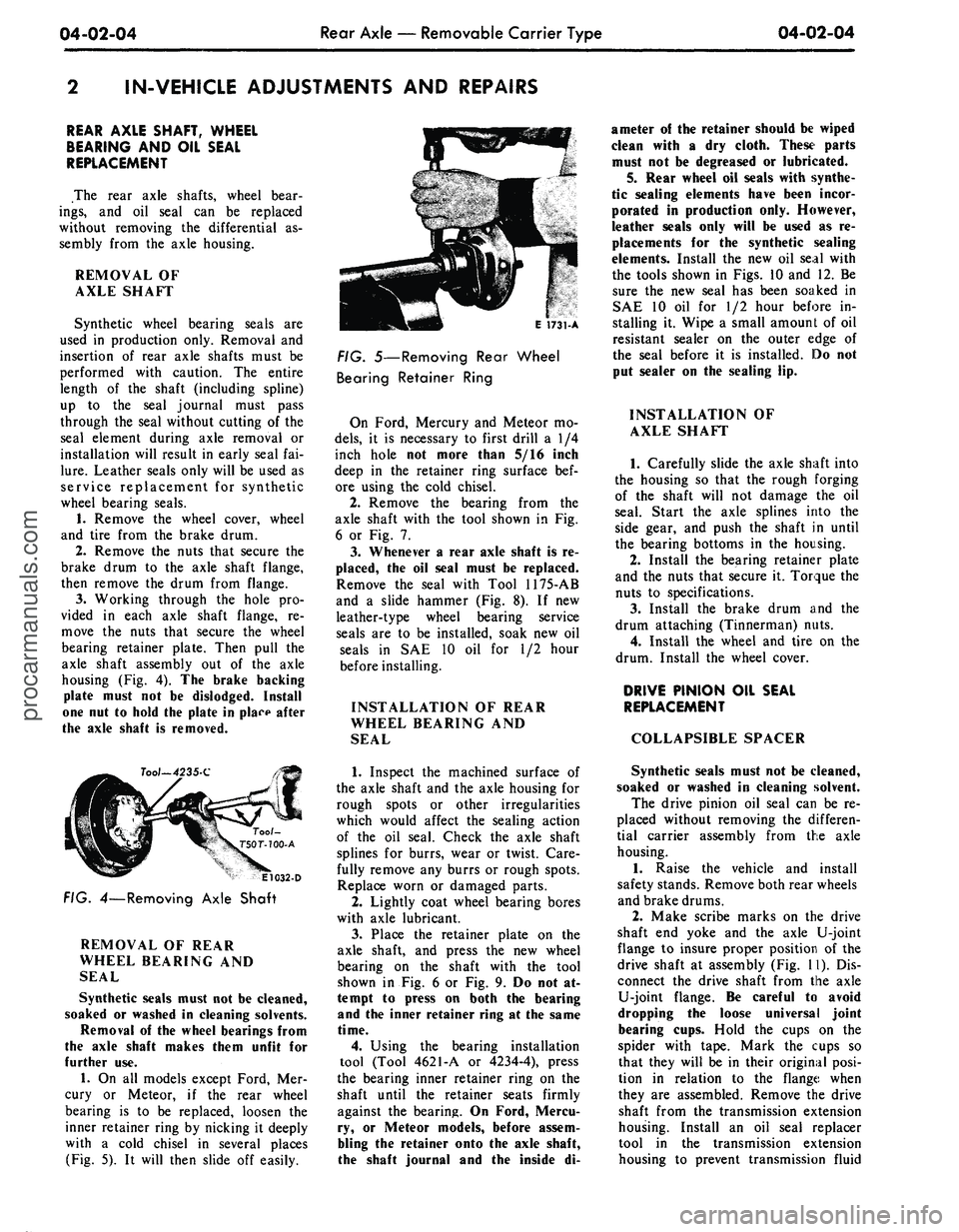
housing (Fig. 4). The brake backing
plate must not be dislodged. Install
one nut to hold the plate in place after
the axle shaft is removed.
Too/-4235-C
E1032-D
FIG. 4—Removing Axle Shaft
REMOVAL OF REAR
WHEEL BEARING AND
SEAL
Synthetic seals must not be cleaned,
soaked or washed in cleaning solvents.
Removal of the wheel bearings from
the axle shaft makes them unfit for
further use.
1.
On all models except Ford, Mer-
cury or Meteor, if the rear wheel
bearing is to be replaced, loosen the
inner retainer ring by nicking it deeply
with a cold chisel in several places
(Fig. 5). It will then slide off easily.
E 1731-A
FIG. 5—Removing Rear Wheel
Bearing Retainer Ring
On Ford, Mercury and Meteor mo-
dels,
it is necessary to first drill a 1/4
inch hole not more than 5/16 inch
deep in the retainer ring surface bef-
ore using the cold chisel.
2.
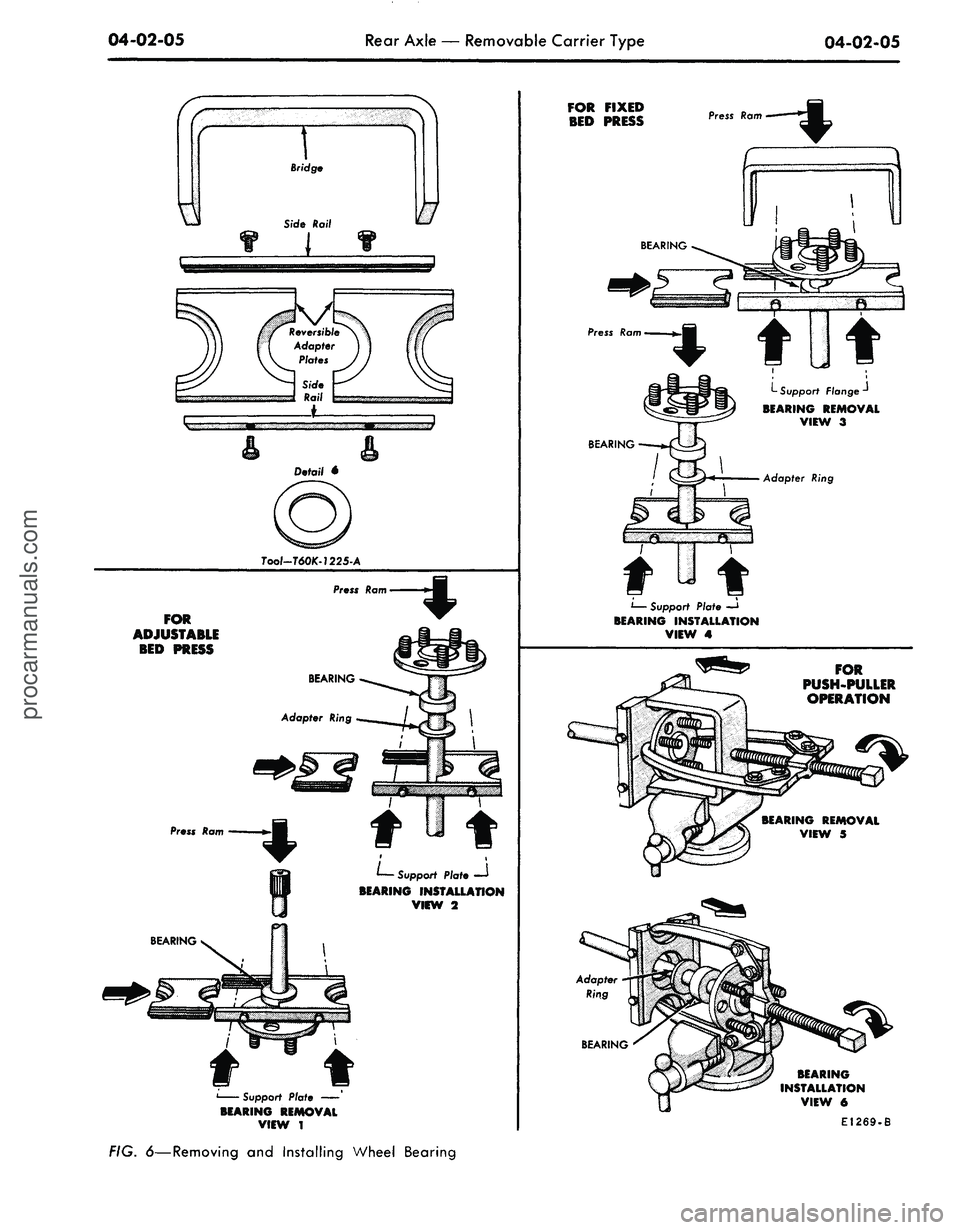
Remove the bearing from the
axle shaft with the tool shown in Fig.
6 or Fig. 7.
3.
Whenever a rear axle shaft is re-
placed, the oil seal must be replaced.
Remove the seal with Tool 1175-AB
and a slide hammer (Fig. 8). If new
leather-type wheel bearing service
seals are to be installed, soak new oil
seals in SAE 10 oil for 1/2 hour
before installing.
INSTALLATION OF REAR
WHEEL BEARING AND
SEAL
1.
Inspect the machined surface of
the axle shaft and the axle housing for
rough spots or other irregularities
which would affect the sealing action
of the oil seal. Check the axle shaft
splines for burrs, wear or twist. Care-
fully remove any burrs or rough spots.
Replace worn or damaged parts.
2.
Lightly coat wheel bearing bores
with axle lubricant.
3.
Place the retainer plate on the
axle shaft, and press the new wheel
bearing on the shaft with the tool
shown in Fig. 6 or Fig. 9. Do not at-
tempt to press on both the bearing
and the inner retainer ring at the same
time.
4.
Using the bearing installation
tool (Tool 4621-A or 4234-4), press
the bearing inner retainer ring on the
shaft until the retainer seats firmly
against the bearing. On Ford, Mercu-
ry, or Meteor models, before assem-
bling the retainer onto the axle shaft,
the shaft journal and the inside di-
ameter of the retainer should be wiped
clean with a dry cloth. These parts
must not be degreased or lubricated.
5. Rear wheel oil seals with synthe-
tic sealing elements have been incor-
porated in production only. However,
leather seals only will be used as re-
placements for the synthetic sealing
elements. Install the new oil seal with
the tools shown in Figs. 10 and 12. Be
sure the new seal has been soaked in
SAE 10 oil for 1/2 hour before in-
stalling it. Wipe a small amount of oil
resistant sealer on the outer edge of
the seal before it is installed. Do not
put sealer on the sealing lip.
INSTALLATION OF
AXLE SHAFT
1.
Carefully slide the axle shaft into
the housing so that the rough forging
of the shaft will not damage the oil
seal. Start the axle splines into the
side gear, and push the shaft in until
the bearing bottoms in the housing.
2.
Install the bearing retainer plate
and the nuts that secure it. Torque the
nuts to specifications.
3.
Install the brake drum and the
drum attaching (Tinnerman) nuts.
4.
Install the wheel and tire on the
drum. Install the wheel cover.
DRIVE PINION OIL SEAL
REPLACEMENT
COLLAPSIBLE SPACER
Synthetic seals must not be cleaned,
soaked or washed in cleaning solvent.
The drive pinion oil seal can be re-
placed without removing the differen-
tial carrier assembly from the axle
housing.
1.
Raise the vehicle and install
safety stands. Remove both rear wheels
and brake drums.
2.
Make scribe marks on the drive
shaft end yoke and the axle U-joint
flange to insure proper position of the
drive shaft at assembly (Fig. 11). Dis-
connect the drive shaft from the axle
U-joint flange. Be careful to avoid
dropping the loose universal joint
bearing cups. Hold the cups on the
spider with tape. Mark the cups so
that they will be in their original posi-
tion in relation to the flange when
they are assembled. Remove the drive
shaft from the transmission extension
housing. Install an oil seal replacer
tool in the transmission extension
housing to prevent transmission fluidprocarmanuals.com
Page 202 of 413
04-02-05
Rear Axle
—
Removable Carrier Type
04-02-05
Bridge
Side Rail
_J f.
Detail 4
Tool-T60K-1225-A
Press
Ram
FOR
ADJUSTABLE
BED PRESS
Press
Ram
BEARING
'—
Support
Plat*
—*
BEARING INSTALLATION
VIEW
2
1
Support Plate
BEARING REMOVAL
VIEW
1
FOR FIXED
BED PRESS
Press
Ram
Press
Ram
BEARING
LSupport Flange^
BEARING REMOVAL
VIEW
3
Adapter Ring
1—
Support Plate
—»
BEARING INSTALLATION
VIEW
4
FOR
PUSH-PULLER
OPERATION
BEARING REMOVAL
VIEW
5
BEARING
BEARING
INSTALLATION
VIEW
6
E1269-B
FIG.
6—Removing
and
Installing Wheel Bearingprocarmanuals.com
Page 203 of 413
04-02-06
Rear Axle — Removable Carrier Type
04-02-06
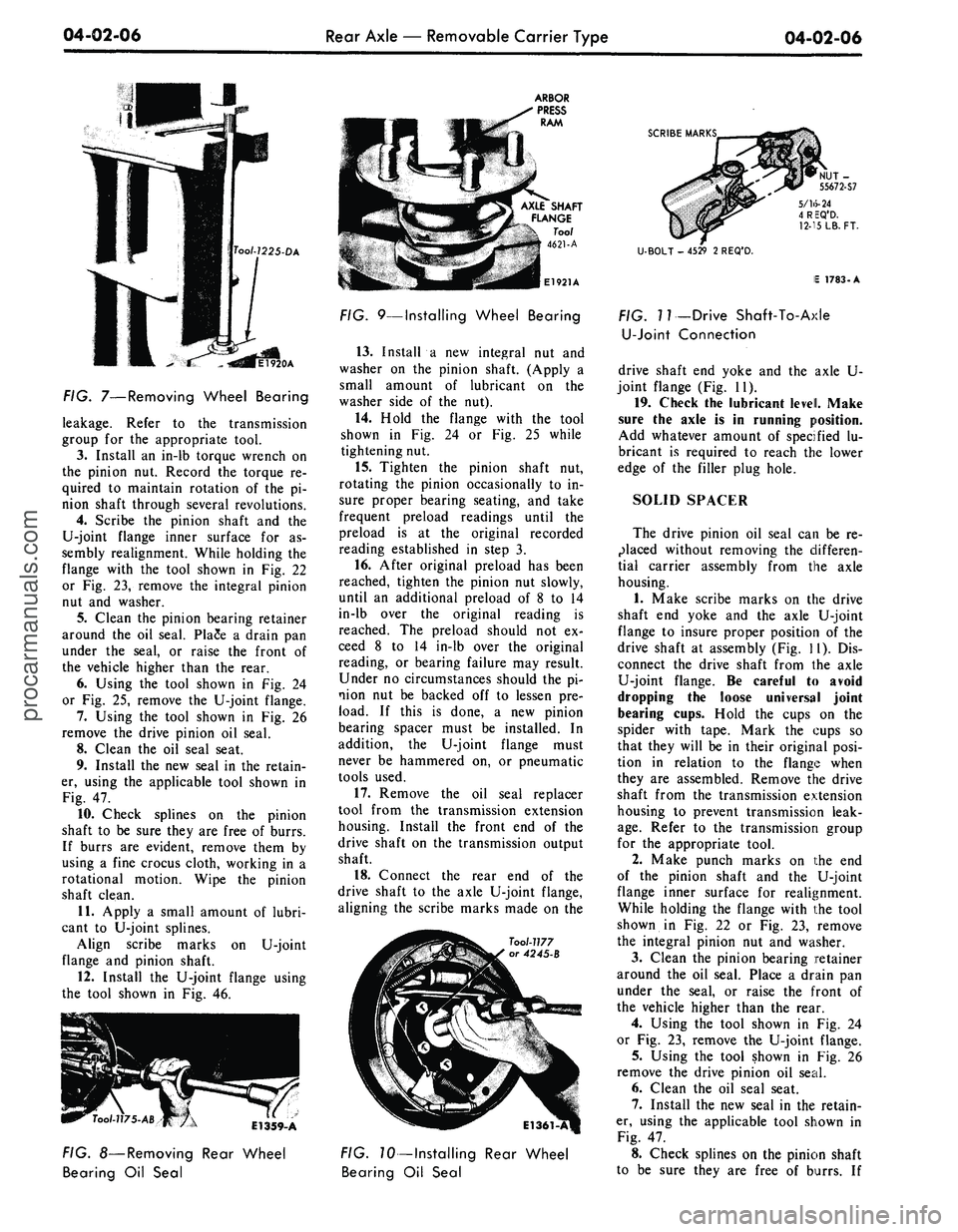
FIG. 7—Removing Wheel Bearing
leakage. Refer to the transmission
group for the appropriate tool.
3.
Install an in-lb torque wrench on
the pinion nut. Record the torque re-
quired to maintain rotation of the pi-
nion shaft through several revolutions.
4.
Scribe the pinion shaft and the
U-joint flange inner surface for as-
sembly realignment. While holding the
flange with the tool shown in Fig. 22
or Fig. 23, remove the integral pinion
nut and washer.
5.
Clean the pinion bearing retainer
around the oil seal. PlaSe a drain pan
under the seal, or raise the front of
the vehicle higher than the rear.
6. Using the tool shown in Fig. 24
or Fig. 25, remove the U-joint flange.
7.
Using the tool shown in Fig. 26
remove the drive pinion oil seal.
8. Clean the oil seal seat.
9. Install the new seal in the retain-
er, using the applicable tool shown in
Fig. 47.
10.
Check splines on the pinion
shaft to be sure they are free of burrs.
If burrs are evident, remove them by
using a fine crocus cloth, working in a
rotational motion. Wipe the pinion
shaft clean.
11.
Apply a small amount of lubri-
cant to U-joint splines.
Align scribe marks on U-joint
flange and pinion shaft.
12.
Install the U-joint flange using
the tool shown in Fig. 46.
SCRIBE MARKS
AXLE SHAFT
FLANGE
Tool
4621-A
E1921A
FIG. 9—Installing Wheel Bearing
13.
Install a new integral nut and
washer on the pinion shaft. (Apply a
small amount of lubricant on the
washer side of the nut).
14.
Hold the flange with the tool
shown in Fig. 24 or Fig. 25 while
tightening nut.
15.
Tighten the pinion shaft nut,
rotating the pinion occasionally to in-
sure proper bearing seating, and take
frequent preload readings until the
preload is at the original recorded
reading established in step 3.
16.
After original preload has been
reached, tighten the pinion nut slowly,
until an additional preload of 8 to 14
in-lb over the original reading is
reached. The preload should not ex-
ceed 8 to 14 in-lb over the original
reading, or bearing failure may result.
Under no circumstances should the pi-
nion nut be backed off to lessen pre-
load. If this is done, a new pinion
bearing spacer must be installed. In
addition, the U-joint flange must
never be hammered on, or pneumatic
tools used.
17.
Remove the oil seal replacer
tool from the transmission extension
housing. Install the front end of the
drive shaft on the transmission output
shaft.
18.
Connect the rear end of the
drive shaft to the axle U-joint flange,
aligning the scribe marks made on the
Tool-1177
or 4245-B
E1359-A
U-BOLT-4529 2 REQ'D.
5/l<>-24
4 REQ'D.
12-15
LB.
FT.
IE 1783-A
FIG. 8—
Removing
Rear Wheel
Bearing Oil Seal
FIG. 70—Installing Rear Wheel
Bearing Oil Seal
FIG. 11
— Drive
Shaft-To-Axle
U-Joint Connection
drive shaft end yoke and the axle U-
joint flange (Fig. 11).
19.
Check the lubricant level Make
sure the axle is in running position.
Add whatever amount of specified lu-
bricant is required to reach the lower
edge of the filler plug hole.
SOLID SPACER
The drive pinion oil seal can be re-
placed without removing the differen-
tial carrier assembly from the axle
housing.
1.
Make scribe marks on the drive
shaft end yoke and the axle U-joint
flange to insure proper position of the
drive shaft at assembly (Fig. 11). Dis-
connect the drive shaft from the axle
U-joint flange. Be careful to avoid
dropping the loose universal joint
bearing cups. Hold the cups on the
spider with tape. Mark the cups so
that they will be in their original posi-
tion in relation to the flange when
they are assembled. Remove the drive
shaft from the transmission extension
housing to prevent transmission leak-
age.
Refer to the transmission group
for the appropriate tool.
2.
Make punch marks on the end
of the pinion shaft and the U-joint
flange inner surface for realignment.
While holding the flange with the tool
shown in Fig. 22 or Fig. 23, remove
the integral pinion nut and washer.
3.
Clean the pinion bearing retainer
around the oil seal. Place a drain pan
under the seal, or raise the front of
the vehicle higher than the rear.
4.
Using the tool shown in Fig. 24
or Fig. 23, remove the U-joint flange.
5.
Using the tool shown in Fig. 26
remove the drive pinion oil seal.
6. Clean the oil seal seat.
7.
Install the new seal in the retain-
er, using the applicable tool shown in
Fig. 47.
8. Check splines on the pinion shaft
to be sure they are free of burrs. Ifprocarmanuals.com
Page 204 of 413

04-02-07
Rear Axle — Removable Carrier Type
04-02-07
burrs are evident, remove them with a
fine crocus cloth, working in a rota-
tional motion, then wipe clean. Apply
a small quantity of lubricant to U-
joint splines.
9. Install the U-joint flange using
the tool shown in Fig. 46.
10.
Install a new integral attaching
nut and washer on the pinion shaft.
11.
Tighten the pinion attaching
nut, rotating the pinion several times
to seat the bearing, then torque the pin-
ion nut to 180-200 ft-lbs. Hold the
flange with the tool shown in Fig. 22
or Fig. 23 while the nut is being tight-
ened.
12.
Remove the oil seal replacer
tool from the transmission extension
housing. Install the front end of the
drive shaft on the transmission output
shaft.
13.
Connect the rear end of the
drive shaft to the axle U-joint flange,
aligning the scribe marks made on the
drive shaft end yoke and the axle U-
joint flange.
14.
Check the lubricant level, and
add whatever amount of specified lu-
bricant is necessary to reach the lower
edge of the filler plug hole. Make sure
the axle is in running position when
the level is checked
ORIGINAL U-JOINT FLANGE
(IN VEHICLE REPLACEMENT)
Use procedure as outlined under
Drive Pinion Oil Seal Replacement.
Synthetic seals must not be cleaned,
soaked or washed in cleaning solvent.
INSTALLATION OF A NEW
UNIVERSAL JOINT FLANGE
COLLAPSIBLE SPACER
1.
Raise the vehicle and install
safety stands. Remove both rear wheels
and brake drums.
2.
Disconnect the drive shaft from
the axle U-joint flange. Be careful to
avoid dropping the loose universal
joint bearing cups. Hold the cups on
the spider with tape. Mark the cups so
that they will be in their original posi-
tion in relation to the flange when
they are assembled. Remove the drive
shaft from the transmission extension
housing. Install an oil seal replacer
tool in the transmission extension
housing to prevent transmission fluid
leakage. Refer to the transmission
group for the appropriate tool.
3.
Install an in-lb torque wrench on
the pinion nut. Record the torque re-
quired to maintain rotation of the pin-
ion shaft through several revolutions.
4.
While holding the flange with the
tool shown in Fig. 23 or Fig. 24, re-
move the integral pinion nut and
washer.
5.
Clean the pinion bearing retainer
around the oil seal. Place a drain pan
under the seal, or raise the front of
the vehicle higher than the rear. Syn-
thetic seals must not be cleaned,
soaked or washed in cleaning solvent.
6. Using the tool shown in Fig. 23
or Fig. 24, remove the U-joint flange.
7.
Check splines on the pinion shaft
to be sure they are free of burrs. If
burrs are evident, remove them by
using a fine crocus cloth, working in a
rotational motion, then wipe clean.
Apply a small amount of lubricant
to U-joint splines.
8. Install the U-joint flange using
the tool shown in Fig. 46.
9. Install a new integral nut and
washer on the pinion shaft. (Apply a
small amount of lubricant on the
washer side of the nut.)
10.
Hold the flange with the tool
shown in Fig. 23 or Fig. 24 while the
nut is being tightened.
11.
Tighten the pinion shaft nut,
rotating the pinion occasionally to in-
sure proper bearing seating, and take
frequent preload readings until the
preload is at the original recorded
reading established in step 3.
12.
After original preload has been
reached, tighten the pinion nut slowly,
until an additional preload of 8 to 14
in-lb over the original reading is
reached. (The preload should not ex-
ceed 8 to 14 in-lb over the original
reading, or bearing failure may result.
Under no circumstances should the
pinion nut be backed off to lessen pre-
load. If this is done, a new pinion
bearing spacer must be installed. In
addition, the U-joint flange must
never be hammered on, or power tools
used.
13.
Remove the oil seal replacer
tool from the transmission extension
housing. Install the front end of the
drive shaft on the transmission output
shaft.
14.
Connect the rear end of the
drive shaft to the axle U-joint flange,
aligning the scribe marks made on the
drive shaft end yoke and the axle U-
joint flange.
15.
Check the lubricant level. Make
sure the axle is in running position.
Add whatever amount of specified lu-
bricant is required to reach the lower
edge of the filler plug hole.
SOLID SPACER
1.
Disconnect the drive shaft from
the axle U-joint flange. Be careful to
avoid dropping the loose universal
joint bearing cups. Hold the cups on
the spider with tape. Mark the cups so
that they will be in their original posi-
tion in relation to the flange when
they are assembled. Remove the drive
shaft from the transmission extension
housing. Install an oil seal replacer
tool in the transmission extension
housing to prevent transmission leak-
age.
Refer to the transmission group
for the appropriate tool.
2.
While holding the flange with the
tool shown in Fig. 23 or Fig. 24, re-
move the integral pinion nut and
washer.
3.
Clean the pinion bearing retainer
around the oil seal. Place a drain pan
under the seal, or raise the front of
the vehicle higher than the rear.
4.
Using the tool shown in Fig. 23
or Fig. 24, remove the U-joint flange.
5.
Check splines on the pinion shaft
to be sure they are free of burrs. If
burrs are evident, remove them by
using a fine crocus cloth, working in a
rotational motion, then wipe clean.
Apply a small amount of lubricant to
U-joint splines.
6. Install the U-joint flange using
the tool shown in Fig. 46.
7.
Install integral attaching nut and
washer on the pinion shaft.
8. Tighten the pinion attaching nut,
rotating the pinion several times to
seat the bearing, then torque the pin-
ion attaching nut to 180-220 ft-lbs.
Hold the flange with the tool shown in
Fig. 23 or Fig. 24 while the nut is
being tightened.
9. Remove the oil seal replacer tool
from the transmission extension hous-
ing. Install the front end of the drive
shaft on the transmission output shaft.
10.
Connect the rear end of the
drive shaft to the axle U-joint flange.
11.
Check the lubricant level, and
add whatever amount of specified lu-
bricant is necessary to reach the lower
edge of the filler plug hole. Make sure
the axle is in running position when
the level is checked.
DRIVE SHAFT PINION ANGLE
ADJUSTMENT
Refer to Group 3, Part 3-2 for this
procedure.procarmanuals.com
Page 205 of 413
04-02-08
Rear Axle — Removable Carrier Type
04-02-08
REMOVAL AND INSTALLATION
CARRIER ASSEMBLY
REMOVAL
1.
Raise the vehicle on a hoist and
remove the two rear wheels and tires.
2.
Remove the two brake drums (3
Tinnerman nuts at each drum) from
the axle shaft flange studs. If diffi-
culty is experienced in removing the
drums, remove the brake adjuster
knockout slug or rubber plug (if so
equipped) and back off the brake
shoes.
3.
Working through the hole pro-
vided in each axle shaft flange, re-
move the nuts that secure the rear
wheel bearing retainer plate. Pull each
axle shaft assembly out of the axle
housing using axle shaft remover,
Tool 4235-C. (Fig. 4). Care must be
exercised to prevent damage to the
production-type synthetic oil seal, if so
equipped. Any roughing or cutting of
the seal element during removal or in-
stallation can result in early seal fail-
ure.
Install a nut on one of the brake
backing plate attaching bolts to hold
the plate to the axle housing after the
shaft has been removed. Whenever a
rear axle shaft is replaced, the wheel
bearing oil seals must be replaced.
Remove the seals with tool 1175AB.
4.
Make scribe marks on the drive
shaft end yoke and the axle U-joint
flange to insure proper position at as-
sembly. Disconnect the drive shaft at
the rear axle U-joint. Hold the cups
on the spider with tape. Mark the
cups so that they will be in their orig-
inal position relative to the flange
when they are assembled. Remove the
drive shaft from the transmission ex-
tension housing. Install an oil seal re-
placer tool in the housing to prevent
transmission leakage. Refer to the
transmission group for the appropriate
tool.
5.
Clean area around carrier to
housing surfaced with a wire brush and
wipe clean, to prevent dirt entry into
the housing. Place a drain pan under
the carrier and housing, remove the
carrier attaching nuts, and drain the
axle.
Remove the carrier assembly
from the axle housing.
INSTALLATION
Synthetic production-type wheel
bearing seals must not be cleaned,
soaked or washed in cleaning solvent.
1.
Clean the axle housing and
shafts using kerosene and swabs. To
avoid contamination of the grease in
the sealed ball bearings, do not allow
any quantity of solvent directly on the
wheel bearings. Clean the mating sur-
faces of the axle housing and carrier.
2.
Position the differential carrier
on the studs in the axle housing using
a new gasket between carrier and
housing. Install the carrier-to-housing
attaching nuts, and torque them to
specifications.
3.
Remove the oil seal replacer tool
from the transmission extension hous-
ing. Position the drive shaft so that
the front U-joint slip yoke splines to
the transmission output shaft.
4.
Connect the drive shaft to the
axle U-joint flange, aligning the scribe
marks made on the drive shaft end
yoke and the axle U-joint flange dur-
ing the removal procedure. Install the
U-bolts and nuts and torque to speci-
fications.
5.
If the synthetic, production-type
wheel bearing seals were replaced with
service-type leather seals, soak the
new rear wheel bearing oil seals in
SAE 10 oil for 1/2 hour before instal-
lation. Wipe a small amount of an oil
resistant sealer on the outer edge of
each seal before it is installed. Do not
put any of the sealer on the sealing
lip.
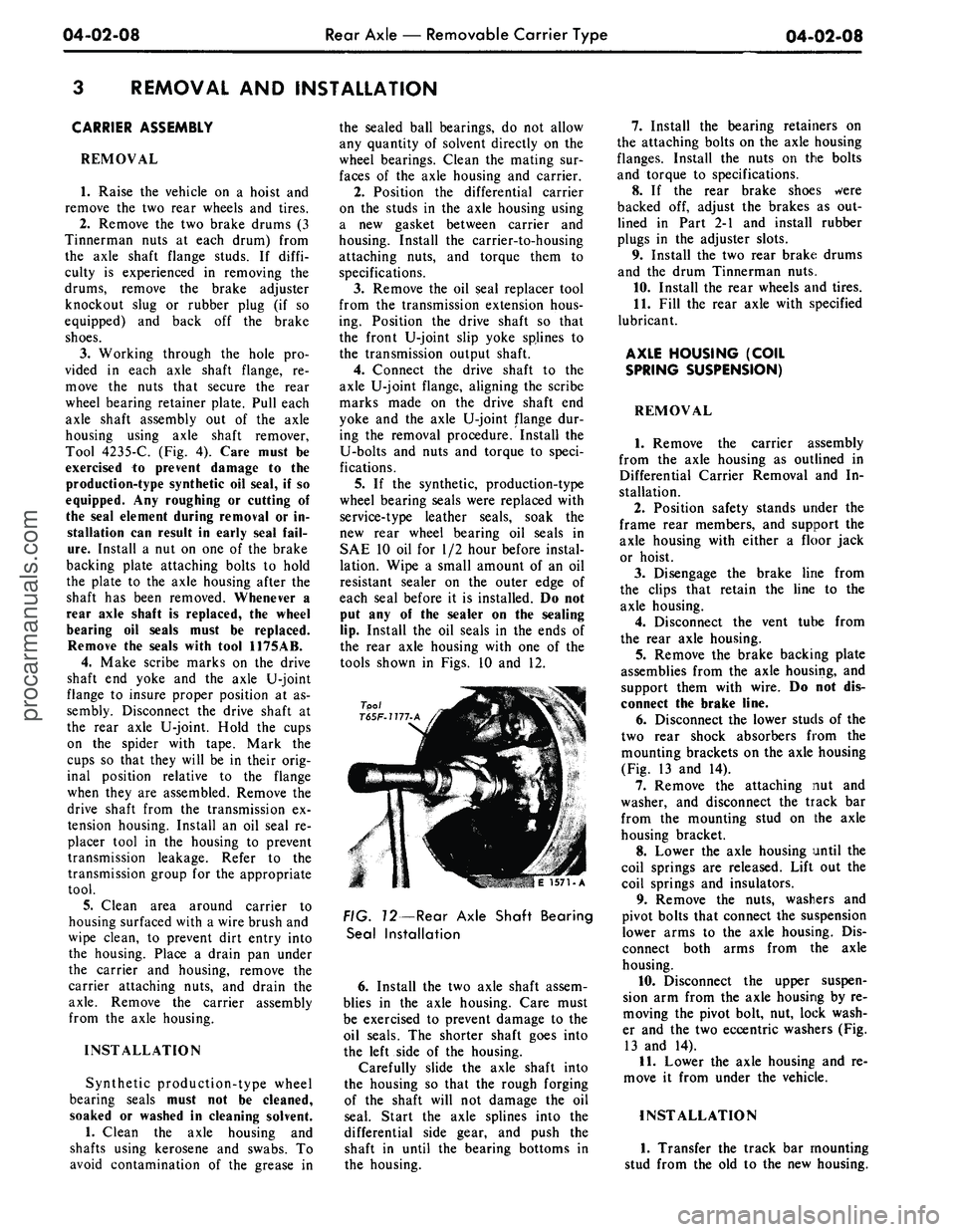
Install the oil seals in the ends of
the rear axle housing with one of the
tools shown in Figs. 10 and 12.
Tool
T65F-1177.A
E 1571-A
FIG. 12—Rear Axle Shaft Bearing
Seal Installation
6. Install the two axle shaft assem-
blies in the axle housing. Care must
be exercised to prevent damage to the
oil seals. The shorter shaft goes into
the left side of the housing.
Carefully slide the axle shaft into
the housing so that the rough forging
of the shaft will not damage the oil
seal. Start the axle splines into the
differential side gear, and push the
shaft in until the bearing bottoms in
the housing.
7.
Install the bearing retainers on
the attaching bolts on the axle housing
flanges. Install the nuts on the bolts
and torque to specifications.
8. If the rear brake shoes were
backed off, adjust the brakes as out-
lined in Part 2-1 and install rubber
plugs in the adjuster slots.
9. Install the two rear brake drums
and the drum Tinnerman nuts.
10.
Install the rear wheels and tires.
11.
Fill the rear axle with specified
lubricant.
AXLE HOUSING (COIL
SPRING SUSPENSION)
REMOVAL
1.
Remove the carrier assembly
from the axle housing as outlined in
Differential Carrier Removal and In-
stallation.
2.
Position safety stands under the
frame rear members, and support the
axle housing with either a floor jack
or hoist.
3.
Disengage the brake line from
the clips that retain the line to the
axle housing.
4.
Disconnect the vent tube from
the rear axle housing.
5.
Remove the brake backing plate
assemblies from the axle housing, and
support them with wire. Do not dis-
connect the brake line.
6. Disconnect the lower studs of the
two rear shock absorbers from the
mounting brackets on the axle housing
(Fig. 13 and 14).
7.
Remove the attaching nut and
washer, and disconnect the track bar
from the mounting stud on the axle
housing bracket.
8. Lower the axle housing until the
coil springs are released. Lift out the
coil springs and insulators.
9. Remove the nuts, washers and
pivot bolts that connect the suspension
lower arms to the axle housing. Dis-
connect both arms from the axle
housing.
10.
Disconnect the upper suspen-
sion arm from the axle housing by re-
moving the pivot bolt, nut, lock wash-
er and the two eccentric washers (Fig.
13 and 14).
11.
Lower the axle housing and re-
move it from under the vehicle.
INSTALLATION
1.
Transfer the track bar mounting
stud from the old to the new housing.procarmanuals.com