1967 CHEVROLET CAMARO tow
[x] Cancel search: towPage 288 of 659

ENGINE 6-23
ENGINE MOUNTS
Engine mounts (fig. 21L) are the non-adjustable type
and seldom require service. Broken or deteriorated
mounts should be replaced immediately, because of the
added strain placed on other mounts and drive line
components.
Front Mount Replacement
Chevrolet,
Chevelle, and Comoro
1.
Remove nut, washer, spacer then engine mount
through-bolt.
2.
Raise engine to release weight from mount.
3.
Remove mount, stop bracket and frame bracket as-
sembly from crossmember, then remove stop
bracket and mount from frame bracket.
4.
Install stop bracket and new mount on frame bracket,
then install assembly on crossmember.
5.
Lower engine, install through-bolt and tighten all
mount bolts to specified torques.
Chevy II
, 1. Remove nut, washer and engine mount through-bolt.
2.
Raise engine to release weight from mount.
3.
Remove bracket-to-mount bolt, then remove mount.
4.
Install new mount on bracket.
5.
Lower engine, install through-bolt and tighten all
mount bolts to specified torques.
Rear Mount Replacement
Chevrolet
1.
Remove crossmember-to-mount bolts.
2.
Raise transmission to release weight from mount.
3.
Remove mount-to-trans mission bolts, then remove
mount and spacer.
4.
Install spacer and new mount on transmission.
5.
While lowering transmission, align and start cross-
member-to-mount bolts.
6. tower transmission and tighten all mounting bolts
to specified torques.
Chevelle and Camaro
1.
Remove crossmember-to-mount bolts.
2.
Raise transmission to release weight from mount.
3.
Remove mount-to-transmission bolts, then remove
mount.
4.
Install new mount on transmission.
5.
While lowering transmission align and start cross-
member-to-mount bolts.
6. Lower transmission and tighten all mounting bolts to
specified torques.
Chevy II
1.
Remove crossmember-to-mount bolts.
2.
Raise transmission to release weight from mount.
3.
Remove mount-to-transmission bolts, then remove
mount.
4.
Install new mount on transmission.
5.
While lowering transmission align and start cross-
member-to-mount bolts.
6. Lower transmission and tighten all mounting bolts
to specified torques.
FRONT
CHEVROLET
REAR
REAR
L4 FRONT
CHEVY II
L6 FRONT
L6 REAR
FRONT
CAMARO
REAR
Fig.
21L- Engine Mounts
CHEVROLET CHASSIS SERVICE MANUAL
Page 297 of 659

ENGINE 6-32
Fig.
1GV - Removing Oil Seal (Lower Half)
bearing cap, aligning slot on top end of extension
shaft with drive tang on lower end of distributor
drive shaft.
2.
Install pump to rear bearing cap bolt and torque to
specifications.
NOTE:
Installed position of oil pump, screen
is with bottom edge parallel to oil pan rails.
3.
Install oil pan as outlined.
OIL SEAL (REAR MAIN)
Replacement
The rear main bearing oil seal can be replaced (both
halves) without removal of the crankshaft.
Fig.
12V - Removing Torstonal Damper
NOTE:
Always replace the upper and lower
seal as a unit.. Install with the lip facing toward
the front of the engine.
With the oil pan and oil pump removed, remove the
rear main bearing cap.
Remove oil seal from the groove by prying from the
bottom with a small screw driver (fig. 10V).
Lubricate the lip of a new seal with engine oil. Keep
oil off the parting line surface as this is treated with
glue. Insert seal in cap and roll it into place with
finger and thumb, using light pressure so seal tangs
at parting line do not cut bead on back of seal.
To remove the upper half of the seal, use a small
hammer to tap a brass pin punch on one end of seal
until it protrudes far enough to be removed with
pliers (fig. 11V).
NOTE:
Always wipe crankshaft surface clean
before installing a new seal.
1.
2.
3.
5.
Fig.
1IV - Removing Oil Seal (Upper Half)
Lubricate the lip of a new seal with engine oil. Keep
oil off the parting line surface as this is treated with
glue. Gradually push with a. hammer handle, while
turning crankshaft, until seal is rolled into place.
(Similar to installing a main bearing.) Be careful
that seal tangs at parting line do not cut bead on back
of seal.
6. Install the rear main bearing cap (with new seal) and
torque to specifications.
TORSIONAL DAMPER
Removal
1.
Remove fan belt, fan and pulley as outlined in Sec-
tion 6K.
2.
Remove the radiator and shroud as outlined in Sec-
tion 13.
NOTE:
If additional operations such as cam-
shaft removal are not being performed, the radi-
ator will not have to be removed
.on
Chevrolets
and Corvettes equipped with 396 and 427 cu. in.
engines.
. 3. On Corvettes equipped with 427 cu. in. engines, re-
move engine front mount through-bolts and raise
front of engine enough for torsional damper to clear
frame crossmember.
CHEVROLET CHASSIS SERVICE MANUAL
Page 299 of 659

ENGINE 6-34
Fig.
15V - Centering Tool in Cover (396 and 427)
396 and 427
cu.
in.
Engine
1.
Make certain that cover mounting face and cylinder
block front face are clean and flat.
2.
Coat the oil seal with engine oil and install Aligning
Tool J-22102 in oil seal (fig. 15V) then using a new
cover gasket coated with gasket sealer, install cover
and gasket on cylinder block.
3.
Install cover screws and torque bolts to specifica-
tions,
then remove Aligning Tool J-22102.
4.
Install water pump as outlined in Section 6K.
5. Install torsional damper as outlined.
6. Install oil pan as outlined.
Fig.
17V - Installing Oil Seal (Cover Removed)
396 and 427
OIL SEAL (FRONT COVER)
Replacement
With Cover
Removal
1.
With cover removed, pry old seal out of cover from
the front with a large screw driver.
2.
Install new seal so that open end of the seal is toward
the inside of cover and drive it into position with
Tool J-995 on 283, 327 and 350 cu. in. engines
(fig. 16V) or Tool J-22102 on 396 and 427 cu. in.
engines (fig. 17V).
CAUTION: Support cover at sealing area to
avoid distorting cover.
Without Cover
Removal
1.
With torsional damper removed, pry old seal out of
cover from the front with a large screw driver, being
careful not to damage the surface on the crankshaft.
2.
Install new seal so that open end of seal is toward the
inside of cover and drive it into position with Tool
J-8340 on 283, 327 and 350 cu. in. engines (fig. 18V)
or Tool J-22102 on 396 and 427 cu. in. engines
(fig. 19V),
Fig.
16V - Installing Oil Seal (Cover Removed)
283,
327 and 350
Fig.
18V- Installing Oil Sea! (Cover Installed)
283,
327 and 350
CHEVROLET CHASSIS SERVICE MANUAL
Page 317 of 659

ENGINE FUEL 6M-9
4.
Wash body with cleaning solvent and wip dry.
5. Wash filter element by sloshing up and down in
cleaning solvent.
6. Dry filter unit with an air hose or let stand until
dry.
7. Fill body of cleaner to full mark with SAE 50 engine
oil. If expected temperatures are to be consistently
below freezing, use SAE 20 engine oil.
8. Assemble filter and cover assembly to body of
cleaner.
9. Install cleaner, making sure it fits tight and is set
down securely. \
OIL
WETTED
PAPER
ELEMENT
Replacement
1.
Remove wing nut, washer and cover.
2.
Remove paper element and discard.
3.
Remove bottom section of air cleaner and gasket
on air horn of carburetor. Discard air horn gasket.
4.
Clean bottom section of air cleaner and cover pieces
thoroughly, to remove dust and grime.
NOTE:
Check bottom section of air cleaner
seal for tears or cracks.
5. Install a new gasket on carburetor air horn and set
bottom section of air cleaner on carburetor.
6. Install new paper element on bottom section of air
cleaner with either end up.
NOTE:
Plastisol seal is the same material on
both ends.
7. Install cover, washer and wing nut.
Testing (Fig. 5A)
Tool J-7825, is designed to check paper element air
cleaners to determine whether the element has ma-
terially decreased in efficiency arid should be replaced
or has only slightly increased air restriction and is
suitable for further service. In combination with a
tachometer, this instrument will quickly and accurately
determine the air cleaner element condition.
VENT HOLE
TOWARD DASH
NOTE:
t Before testing, inspect for holes or
breaks in the element, as these defects re-
quire immediate replacement. If no holes or
breaks exist, proceed as follows:
1.
Remove all hoses and plug all openings except air
cleaner inlet.
2.
Install air cleaner, using Tool J-7825 in place of the
wing nut. Screw Tool J-7825 onto the stud until it
seals tightly against the air cleaner cover. Rotate
the entire tool so that the scale can be read from
the left side of the car. Be sure the vent hole is
toward the dash.
3.
Connect a tachometer and place it so that it may be
read simultaneously with Tool J-7825.
4.
Zero oil level in the inner tube by pulling inner tube
upward until the rubber seal is above the vent hole,
then raise or lower as' required until the inner tube
oil level is exactly to the "0" mark.
5. Start engine. If engine is cold, allow to run for 2 to
3 minutes. The automatic choke must be fully open.
6. Accelerate the engine slowly until the inner tube oil
level of Tool J-7825 just reaches the 1/4 mark.
Allow engine speed to stabilize and note tachometer
(rpm) reading. Decelerate engine.
7. If the tachometer reading is at or below the follow-
ing, the oil wetted paper air cleaner element is re-
stricted beyond the allowable limit and should be
replaced. If testing indicates that the element
restriction is satisfactory at 12,000 miles, the ele-
ment need not be replaced but should be retested
every 6,000 miles thereafter until replaced.
Engine
Displacement
283 cu.
in.
327 cu.
in.
350 cu. in.
396 cu.
in.
427 cu.
in.
Horsepower
195
210
275
300
325
350
295
325
350
385
390
425
Minimum
Allowable
RPM
2300
2100
210Q
2600
2600
1550
1950
1850
1850
2140
Fig.
5A—Testing Air Cleaner
8. Remove tachometer and Tool J-7825 from vehicle
and push down inner tube until seal is below vent
hole to prevent oil loss.
Tool J-7825
FiHing
Tool
Tool J-7825 is shipped dry and must be filled with the
red gauge oil (specific gravity .826) provided.
Pull the knurled inner tube completely out of the gauge
and add oil to the reservoir until the oil level is between
CHEVROLET CHASSIS SERVICE /MANUAL
Page 323 of 659
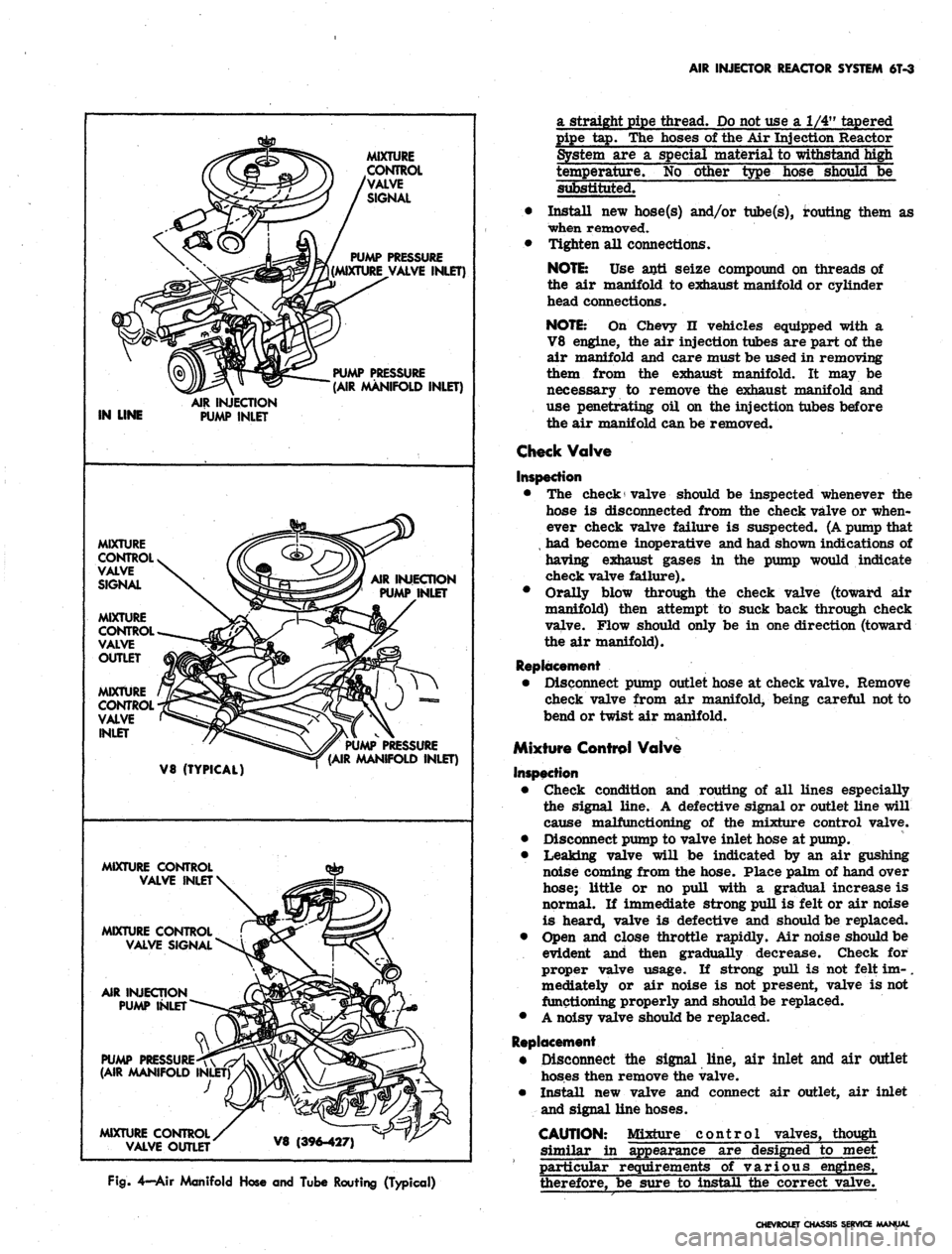
AIR INJECTOR REACTOR SYSTEM
6T-3
MIXTURE
CONTROL
VALVE
SIGNAL
PUMP PRESSURE
(MIXTURE VALVE INLET)
PUMP PRESSURE
(AIR MANIFOLD INLET)
IN LINE
AIR INJECTION
PUMP INLET
MIXTURE
CONTROL
VALVE
SIGNAL
MIXTURE
CONTROL
VALVE
OUTLET
MIXTURE
CONTROL
VALVE
INLET
AIR INJECTION
PUMP INLET
V8 (TYPICAL)
PUMP PRESSURE
(AIR MANIFOLD INLET)
MIXTURE CONTROL
VALVE INLET
MIXTURE CONTROL
VALVE SIGNAL
AIR INJECTION
PUMP INLET
PUMP PRESSURE^
(AIR MANIFOLD
J
MIXTURE CONTROL
VALVE OUTLET
V8 (396-427)
Fig.
4—Air Manifold Hose and Tube Routing (Typical)
a straight pipe thread.
Do
not use
a 1/4"
tapered
pipe
tap. The
hoses
of
the
Air
Injection Reactor
System
are a
special material
to
withstand high
temperature.
No
other type hose should
be
substituted.
• Install
new
hose(s) and/or tube(s), routing them
as
when removed.
• Tighten
all
connections.
NOTE:
Use
anti seize compound
on
threads
of
the
air
manifold
to
exhaust manifold
or
cylinder
head connections.
NOTE:
On
Chevy
n
vehicles equipped with
a
V8 engine,
the air
injection tubes
are
part
of the
air manifold
and
care must
be
used
in
removing
them from
the
exhaust manifold.
It may be
necessary
to
remove
the
exhaust manifold
and
use penetrating
oil on the
injection tubes before
the
air
manifold can
be
removed.
Check Valve
Inspection
•
The
check valve should
be
inspected whenever
the
hose
is
disconnected from
the
check valve
or
when-
ever check valve failure
is
suspected. (A pump that
,
had
become inoperative and had shown indications
of
having exhaust gases
in the
pump would indicate
check valve failure)..
• Orally blow through
the
check valve (toward
air
manifold) then attempt
to
suck back through check
valve. Flow should only
be in one
direction (toward
the
air
manifold).
Replacement
• Disconnect pump outlet hose
at
check valve. Remove
check valve from
air
manifold, being careful not
to
bend
or
twist
air
manifold.
Mixture Control Valve
Inspection
• Check condition
and
routing
of all
lines especially
the signal line.
A
defective signal
or
outlet line will
cause malfunctioning
of the
mixture control valve.
• Disconnect pump
to
valve inlet hose
at
pump.
• Leaking valve will
be
indicated
by an air
gushing
noise coming from
the
hose. Place palm
of
hand over
hose; little
or no
pull with
a
gradual increase
is
normal.
If
immediate strong pull
is
felt
or air
noise
is heard, valve
is
defective
and
should
be
replaced.
• Open
and
close throttle rapidly.
Air
noise should
be
evident
and
then gradually decrease. Check
for
proper valve usage.
If
strong pull
is not
felt
im-.
mediately
or air
noise
is not
present, valve
is not
functioning properly and should be replaced.
•
A
noisy valve should be replaced.
Replacement
• Disconnect
the
signal line,
air
inlet
and air
outlet
hoses then remove
the
valve.
• Install
new
valve
and
connect
air
outlet,
air
inlet
and signal line hoses.
CAUTION: Mixture control valves, though
similar
in
appearance
are
designed
to
meet
particular requirements
of
various engines,
therefore,
be
sure
to
install
the
correct valve.
CHEVROLET CHASSIS SERVICE MANUAL
Page 335 of 659
ENGINE-ELECTRICAL 6Y-10
circuit. Make absolutely certain all connections in
the circuit are secure.
5.
Do not short across or ground any of the terminals
on the generator or regulator.
6. Do not attempt to polarize the generator.
7.
Do not disconnect lead at generator without first dis-
connecting battery ground cable.
Trouble in the A.C. charging system will usually be
indicated by one or more of the following conditions:
1.
Faulty indicator lamp or ammeter operation.
2.
An undercharged battery (usually evidenced by slow
cranking speeds).
3.
An overcharged battery (usually evidenced by exces-
sive battery water usage).
4.
Excessive generator noise or vibration.
Described below are a series of on-the-vehicle quick
checks which are designed to assist the service tech-
nician in locating troubles within the various components
of the engine electrical system. Additional checks, ad-
justments and overhaul procedures of these components
are also described in the "Charging Systems—Service
Operations Section" and should be referred to as
necessary.
STATIC CHECKS
Before making any electrical checks, perform the fol-
lowing static checks:
1.
Check for loose fan belt.
2.
Check for defective battery. (Refer to Battery).
3.
Inspect all connections, including the slip-on con-
nectors at the regulator and Delcotron.
NOTE: Do not short field to ground to check if
generator is charging since this will seriously
damage the charging system.
SYSTEM CONDITION TEST
This test is used .to indicate the overall condition of the
charging system (both good and defective) and to isolate
the malfunctioning unit if the system is defective.
NOTE: On Corvette models difficulty may be
encountered -when attempting to make the re-
quired test connections at the voltage regulator.
It is advisable to remove the regulator from its
mounting location to perform the necessary con-
nections at the regulator for the following tests
but make sure unit is grounded.
1.
With ignition off, perform the prescribed Static
Checks outlined in this section. Then set hand brake
and shift transmission
into
neutral.
2.
Connect a voltmeter from junction block relay to
ground at regulator base.
CAUTION: Be sure meter clip does not touch a
resistor or terminal extension under regulator,
3.
Connect a tachometer on engine.
4.
Models equipped with Indicator Lamp: Turn ignition
switch on "ON" position and check indicator lamp.
If lamp fails to glow, perform appropriate tests and
corrections (Indicator Lamp Circuit Tests) before
continuing.
Models equipped with Ammeter: Turn ignition
switch to "ACC" with an accessory on and check
ammeter. If ammeter fails to read discharge, check
ammeter circuit before continuing.
5.
Models equipped with Indicator Lamp: If lamp glows,
start the engine and run' it at 1500 rpm or above.
Check indicator lamp. If lamp fails to go out, per-
form appropriate test and corrections (Indicator
Lamp Circuit Test) before continuing.
Models equipped with Ammeter: If ammeter reads
discharge, start the engine and observe ammeter. If
meter fails to move toward charge (from original
position), perform appropriate test and corrections
(Field Circuit Tests) before continuing.
NOTE: At this point a field circuit has been
established and any other problem will lie in
generator or regulator.
6. Turn on high-beam headlights and heater blower
motor to high speed, run engine at or above 1500
rpm (for a few minutes, if necessary) and read the
voltage on meter.
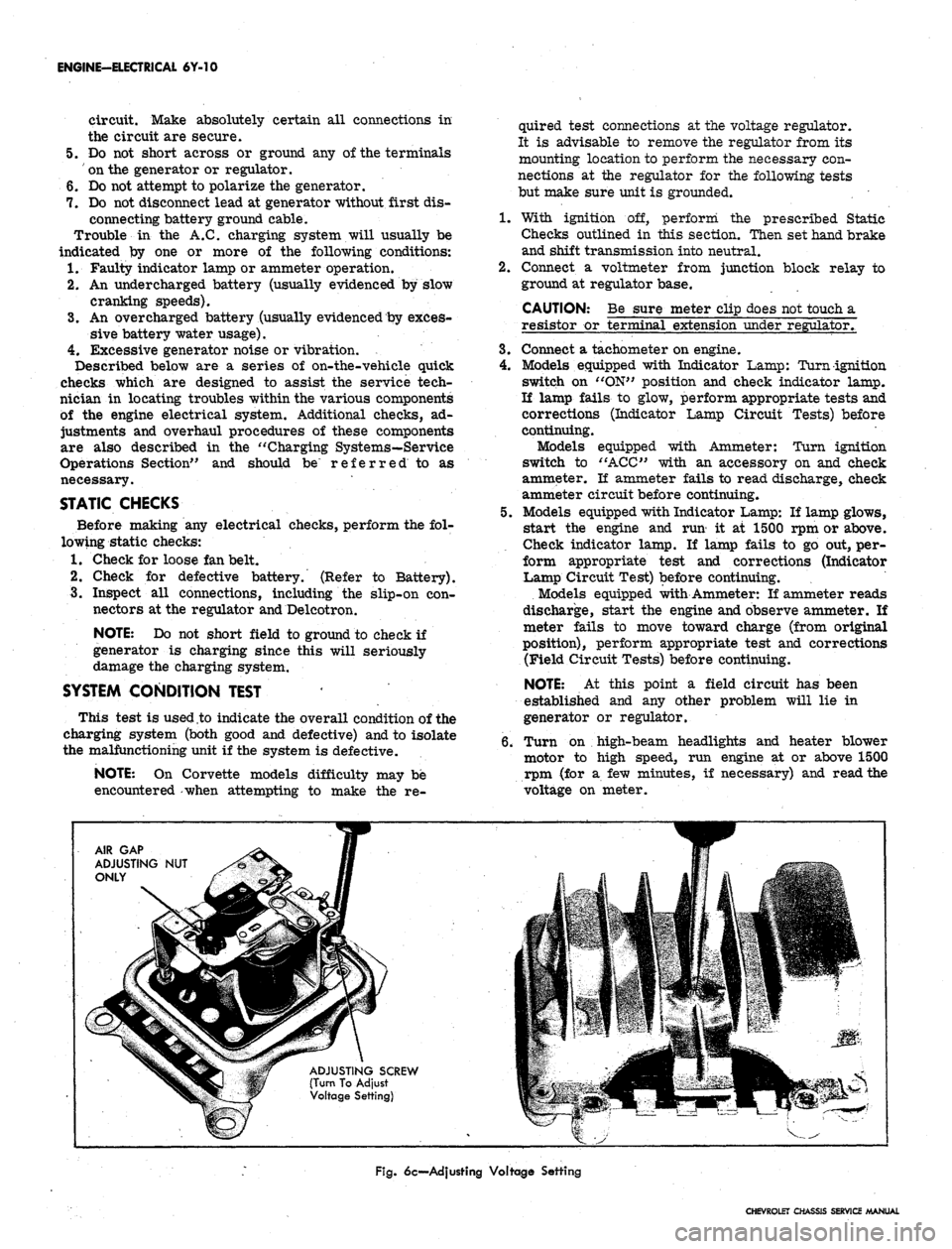
AIR GAP
ADJUSTING NUT
ONLY
ADJUSTING SCREW
(Turn To Adjust
Voltage Setting)
Fig.
6c—Adjusting Voltage Setting
CHEVROLET CHASSIS SERVICE MANUAL
Page 344 of 659

MAINTENANCE AND ADJUSTMENTS
ENGINE-ELECTRICAL 6Y-19
PERIODIC MAINTENANCE
BREAKER POINT SYSTEM
The distributor breaker points and spark plugs are the
only ignition system components that require periodic
service. The remainder of the ignition system requires
only periodic inspection to check operation of the units,
tightness of the electrical connections, and condition of
the wiring. When checking the coil, test with a reputable
tester.
Breaker type distributors are equipped with cam lubri-
cator and should have the wick replaced at the same time
contact point set is replaced. It is not necessary to
lubricate the breaker cam when using a cam lubricator.
Do not attempt to lubricate the wick - Replace when
necessary. When installing a new wick, adjust its posi-
tion so the end of the wick just touches the lobe of the
breaker cam.
Distributor shaft lubrication is accomplished by a
reservoir of lube around the mainshaft in the distributor
body.
BREAKERLESS SYSTEM
Since there are no moving parts in the ignition pulse
amplifier unit mounted forward of the radiator bulkhead,
and the distributor shaft and bushings have permanent
type lubrication, no periodic maintenance is therefore
required for the breakerless ignition system. The dis-
tributor lower bushing is lubricated by engine oil through
a splash hole in the distributor housing, and a housing
cavity next to the upper bushing contains a supply of
lubricant which will last between overhaul periods. At
time of overhaul, the upper bushing may be lubricated
by removing the plastic seal and then adding SAE 20 oil
to the packing in the cavity. A new plastic seal will be
required since the old one will be damaged during
removal.
Tachometer readings for test purposes can be made on
the primary circuit of the breakerless ignition system in
the same manner as on the conventional ignition system,
however before attempting to connect a test tachometer
into the primary circuit check with your instrument
supplier to insure that satisfactory readings can be
obtained and the breakerless system will not be damaged
by the tachometer that is to be used,
IGNITION COIL CHECK (BREAKERLESS)
The ignition coil primary can be checked for an open
PULSE
AMPLIFIER
IGN. SWITCH WIRE
"("IGN" TERMINAL)
-E3 IJU
12
WHITE-
-20 BLACKf' • 12 WHITE-
Fig.
3i—
Breakerless Ignition System
condition by connecting an ohmmeter across the two
primary terminals with the battery disconnected. Pri-
mary resistance at 75
°F.
should be between .35 and .55
ohm. An infinite reading indicates the primary is open.
For the engine to run but miss at times, the primary
open may be of the intermittent type.
The coil secondary can be checked for an open by con-
necting an ohmmeter from the high tension center tower
to either primary terminal. To obtain a reliable reading,
a scale on the ohmmeter having the 20,000 ohm value
within, or nearly within, the middle third of the scale
should be used. Secondary resistance at 75°F. should be
between
8,000
and 12,500 ohms. If the reading is infinite,
the coil secondary winding is open.
A number of different types of coil testers are avail-
able from various test equipment manufacturers. When
using these testers, follow the procedure recommended
by the tester manufacturer.
tester will properly
NOTE:
Make sure the
check this special coil.
SPARK PLUGS
Should be removed, inspected cleaned and regapped at
tune-up. Defective plugs should be replaced, see Servic-
ing of Units Off the Vehicle.
SERVICE OPERATIONS
DISTRIBUTOR CONTACT POINTS
CLEANING
Dirty contact points should be dressed with a few
strokes of a clean, fine-cut contact file. The file should
not be used for other metals and should not be allowed to
become greasy or dirty. Never use emery cloth to clean
contact points. Contact surfaces, after considerable use,
may not appear bright and smooth, but this is not neces-
sarily an indication that they are not functioning satis-
factorily. Do not attempt to remove all roughness nor
dress the point surfaces down smooth; merely remove
scale or dirt.
Badly burned or pitted contact points should be re-
placed and the cause of trouble determined so it can be
eliminated. High resistance or loose connections in the
condenser circuit, oil or foreign materials on the contact
surfaces, improper point adjustment or high voltages may
CHEVROLET CHASSIS SERVICE MANUAL
Page 348 of 659

ENGINE-ELECTRICAL 6Y-23
condenser leak or to a defective connection. This
will cause burned points and ignition failure upon
initial starts and at high speeds.
4.
Capacity - Capacity is determined by the area of
the metallic elements and the insulating and im-
pregnating materials.
For a complete check of the condenser, use a tester
which will check for all of the above conditions. Follow
the instructions given by the manufacturer of the
test equipment. Condenser capacity should be
.18-:
23
microfarads.
REPLACEMENT
Four and Six Cylinder Engine Distributor (Fig. 4i)
1.
Release distributor cap hold-down screws, remove
cap and place it out of the work area.
2.
Remove rotor.
3.
Disconnect condenser lead wire from contact point
quick-disconnect terminal.
4.
Remove condenser attaching screw, lift.condenser
from breaker plate and wipe breaker plate clean.
5. Install new condenser using reverse of procedure
outlined above.
Eight Cylinder Engine Distributor
1.
Remove distributor cap.
2.
Loosen condenser lead attaching screw (fig. 6i) and
lift out condenser lead clip.
3.
Remove screw holding condenser bracket to breaker
plate and slide condenser from bracket.
4.
To replace condenser reverse the above procedure.
NOTE:
Make sure that new condenser lead is
installed in proper position (fig. 6i).
DISTRIBUTOR
(BREAKER POINT TYPE)
REMOVAL
1.
On radio equipped Corvettes, remove ignition shield
from over distributor and coil. One bolt is accessible
from top of shield, the other two are at rear of
shield, facing firewall.
2.
Release the distributor cap hold-down screws, re-
move the cap and place it clear of the work area.
NOTE:
If necessary, remove secondary leads
from the distributor cap after first marking the
cap tower for the lead to No. 1 cylinder. This
will aid in the reinstallation of leads in the cap.
3.
Disconnect the distributor primary lead from the coil
terminal.
4.
Scribe a realignment mark on the distributor bowl
and engine in line with the rotor segment.
5. Disconnect vacuum line to distributor and tachometer
drive cable (Corvette). Remove the distributor hold-
down bolt and elamp and remove the distributor from
the engine. Note position of vacuum advance mecha-
nism relative to the engine.
CAUTION: Avoid rotating the engine with the
distributor removed as the ignition timing will
be upset.
Rg.
121-L-6 Distributor-Exploded View
1.
Breaker Plate Attaching
Screws
2.
Condenser Attaching
Screws
3. Condenser
4.
Breaker Plate Assembly
4a.
Cam Lubricator
5. Vacuum Control Assembly
6. Vacuum Control
Attaching Screws
7. Housing
8. Cap
9. Rotor
DISASSEMBLY
10.
Contact Point
Attaching Screw
11.
Contact Point Assembly
12.
Weight Cover
Attaching Screws
13.
Weight Cover
14.
Weight Springs
15.
Advance Weights
16. Cam Assembly
17.
Main Shaft Assembly
18.
Roll Pin
19.
Drive Gear
It is advisable to place the distributor in a distributor
testing machine or synchroscope prior to disassembly.
CHEVROLET CU
SERVICE MANUAL